
Hey all. Continuing in my series on time travel in science fiction, I am addressing some of the most poignant and memorable examples of the concept in film. Working in chronological order, and avoiding any examples of movies based directly on books (and their sequels), I have compiled a list of what I consider the top 12. Hope you enjoy, and remember that suggestions are welcome. No sense in limiting myself to one list, after all!
Time Bandits:
 A cult-hit which is also a fond memory from my childhood! The story tells the tale of an imaginative child (Kevin) who loves history but lives a boring, materialistic life, who one night is whisked away by time travelers and taken on an incredible journey. All the while, we, the audience are left wondering if this just another flight of fancy, or if his reality is beginning to mirror his imagination.
The adventure begins when a group of dwarves pour out of Kevin’s wall and reveal that it is a time portal, and that the dwarves have stolen a precious map. They escape through the portal when an evil visage – the Supreme Being – appears behind them demanding the return of the map. After landing in the era of the Napoleonic Wars, Kevin learns that Randall and his friends were once employed by the Supreme Being to repair holes in the spacetime fabric, but instead realized the potential to use the map to steal valuable riches.
With the map and Kevin’s help, they visit several locations in spacetime, meeting historical figures and stealing valuable objects while Kevin documents their adventures with his Polaroid camera. Meanwhile, an sorceress named Evil is monitoring them and hopes to steal the map for himself. After several time jumps, Evil manipulates the group by luring them to his realm and the Fortress of Ultimate Darkness, where they are led to believe that “The Most Fabulous Object in the World” awaits them.
Evil takes the map and locks the group into a cage over an apparent bottomless pit while the group plans their escape. Evil quickly thwarts them, but then turns into stone and explodes. From the remains, an elderly man emerges, revealed as the true form of the Supreme Being. He orders the dwarfs to collect Evil’s remains, recovers the map, and allows the dwarves to rejoin him. The Supreme Being disappears with the dwarfs, leaving Kevin stranded behind with one last smoking piece of Evil’s remains.
Kevin then awakens in his bedroom and finds that it’s filled with smoke. Firefighters break down the door and rescue him, claiming that his parents’ new microwave caused the fire. As Kevin recovers, he discovers that he still has the photos from his adventure. As his parents look at a strange piece of rock in the microwave, Kevin tries to warn them off that it is a piece of concentrated evil and they should not touch it; nevertheless, both do, and suddenly explode and disappear…
The Terminator:
 Here we have a classic example of science fiction and time travel, where parties from the future travel back in time with the intent of altering the future, only to beget it. Naturally, the two parties involved are warring factions, humans on the one hand and intelligent machines on the other. For both sides, victory in the past means victory in the future, and its a zero sum game!
Arnold Schwarzenegger plays the leading role as the Terminator, a race of cyborg that is specifically designed to hunt and kill humans. His target in the past is the woman (Sarah Conner) who will give birth to the man that will lead humanity to victory over the Terminators and their AI (Skynet) in the future. Naturally, the resistance sends back their own guardian, a soldier named Kyle Reese, to protect her.
In the course of fighting each other, they end up creating the very future that sent them back. Kyle Reese and Sarah Conner make love, which leads to Sarah becoming pregnant with John. The destruction of the Terminator machine produces the wreckage which, when recovered, becomes the basis for Skynet’s eventual creation. A temporal paradox is thus created, and Sarah is left with a heavy burden! On the one hand, she must raise the future leader of humanity, all the while being the one person who knows the future and all the horrors it will hold.
Back to the Future:
 The classic comedy about the accidental time traveler, altering the past – and thereby the future – and all the hijinks that ensue. In this story, we get a teen-age apprentice (Marty) and his genius friend (Doc), who one night creates history when he invents the world’s first time machine. Shortly thereafter, said genius is killed by a group of terrorists, and the teen-ager accidentally escapes into the past and must get home.
Michael J Fox plays the role of Marty McFly, who by sheer happenstance is transported back to 1955, on the very date that the Doc first conceived of the device that makes time travel possible – the Flux Capacitor. Once in the past, he seeks out the Doc and the two begin to plot how to send him home.
However, there’s a snag. Due to Marty’s inadvertent tampering with the past, he has altered the flow of future events. By saving his father from a car accident, he ends up preventing him and his mother from meeting. What’s worse, by taking his place, he becomes the object of her affection.
Marty knows that if his parents do not meet and fall in love, he will never exist. So in addition to getting”Back to the Future”, he must ensure that that future – and he himself – still exists. Some close shaves result, but in the end, he is able to get his future father to step up, to take on the bully and win his mother’s love. He in turn is able to get the time machine into the right place at the right time to intercept a bolt of lighting which triggers the Flux Capacitor. Back in the future, he sees that things have changed, but in good ways. All seems well, until the Doc tells him they’ve got more time traveling to do!
Star Trek IV: The Voyage Home:
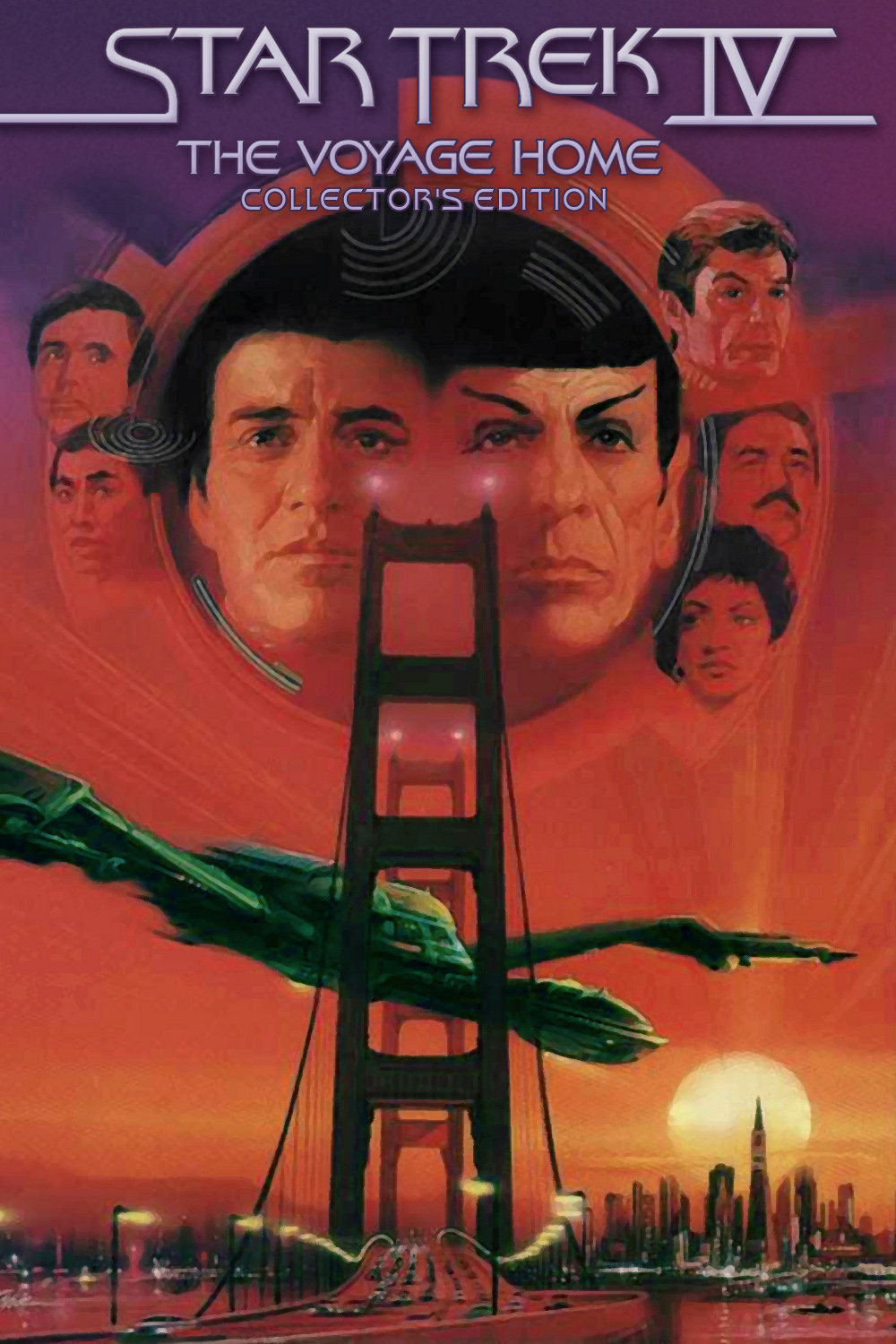 Though time travel is a familiar theme in the Star Trek universe, Star Trek IV was the first example of it occurring in film. And for many fans of the franchise, the aspect of traveling back in time to the 20th century is what makes this movie the best in the series. For others, not so much… But regardless of individual opinions, the message of this movie was clear. Time travel is ultimately necessitated, not to alter the past, but to save the future
At the beginning of the film, an alien probe reaches Federation space, leaving a trail of neutralized ships in its wake. When it reaches Earth, it has a similarly damaging effect, neutralizing all power sources and vaporizing the oceans. The probe is in search of something, but all attempts to communicate fail. On their way back from Vulcan, the crew of the Enterprise are told to avoid Earth at all costs.
After some research, they realize that the probe is specifically looking to communicate with Humpback whales, a species which has been extinct since the 21st century. Kirk orders the crew to prepare for time warp, which involves sling-shotting around a star at maximum warp, thus picking up a boost of speed which will break the time barrier. They succeed, and find themselves in orbit of an Earth that doesn’t look that different.
Once in the 20th century, they begin searching for Humpback whales while doing their best not to alter the past. These attempts are somewhat frustrated when they are forced to look for a contemporary source of fuel for their depleted engines, and Chekhov is mortally injured while attempting to evade capture. In the end, they make a daring rescue and make it back to the present and the whales are able to save Earth, bringing with them a 20th century whale biologist who will oversee the repopulation of the species.
Flight of the Navigator:
 I remember this one fondly from my youth. Released in 1986, the story revolves around an average 12 year old who finds himself “chosen” by powers far greater than himself to play a role far beyond his maturity level. A typical coming-of-age story, as provided by Disney, but involving space aliens and the laws of Relativity. Funky!
The story opens in 1978 when a boy named David (Joey Cramer), while camping, falls into a ravine and loses consciousness. When he awakens, he wanders home and finds that the year is now 1986. Shortly thereafter, an alien spacecraft crashes into some power lines and is taken into custody by NASA, but is impenetrable to their investigations. Meanwhile, David is examined by doctors who discover that he has accurate star charts in his mind, a detail which comes to the attention of lead researcher. Dr. Faraday (Howard Hesseman) at NASA.
After convincing him to come to NASA to let them research him, they discover that the star charts he holds lead to an alien planet called Phaelon. Time dilation also accounts for the fact that he has not aged, and they decide to keep him on lockdown. David then begins to hear a telepathic voice coming from the ship. With the help of an intern named Carolyn (played by a young Sarah Jessica Parker), he escapes from his room and enters the ship.
Once inside, he is told by the AI – whom he names Max (voiced by Paul Reubens) – that it’s mission is to travel to alien worlds, pick up organisms for study, then return them to their homeworld. In the course of studying David, he experimented by storing star charts in his mind since the average human only uses 10 percent of their brain capacity. Unfortunately, after dropping David off, he crashed the ship into some power lines before attempting to leave and lost all his navigation info.
He now needs to retrieve the info from David’s brain so he can return all the alien specimens to their own worlds. Together, they escape from the facility and begin flying around the world and into high orbit. Meanwhile, the NASA men put his family under house arrest. Upon seeing all this, David concludes that he doesn’t belong in 1986 and asks Max to return him to his own time, regardless of the risks. He does, and David returns to his family, happy to be home.
One of the main reasons this movie sticks out in my mind was because of the way it merged family-friendly material with genuine scientific ideas. All in all, it was impressive for a Disney flick, and even provided some hard sci-fi elements, such as time-dilation, artificial intelligence, and polymorphic materials. Seriously, a seamless ship that can morph its shape and is impenetrable, pretty advanced for ol’ Walt!
Army of Darkness:
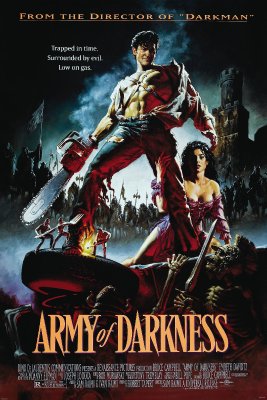 Here is the cult hit that exemplified low-budget ham comedy! In this film, we have an unwitting time-traveler who is transported back in time to the Dark Ages where he is called upon to play the role of a hero. Initially resistant, he eventually takes to the role and ends up saving the day, and finding his way home.
The story picks up from its predecessor, Evil Dead 2, where a man named Ash (Bruce Campbell) is transported back in time through a wormhole after battling living dead forces in his own time. Equipped with a shotgun, a chainsaw, and some badass one-liners, he finds himself in deep past where warring kingdoms are threatened by the forces of the undead.
He is quickly informed that the Book of the Death (the Necronomicon) is responsible for all of their fates. His initial attempts to help them are frustrated when he botches the ritual for sending the book back into the abyss, and his newfound love interest is captured by the enemy.
However, in the end, he and his newfound allies come together to defeat the Army of Darkness in a pitch battle, and he conducts the ritual one last time to send the book into hell, and bring him back to his own time. Of course, one of the demons follows him, and he’s forced to get into it in the present! A gunfight ensues, the demon dies, and the women swoon. Ash is the king, man!
Freejack:
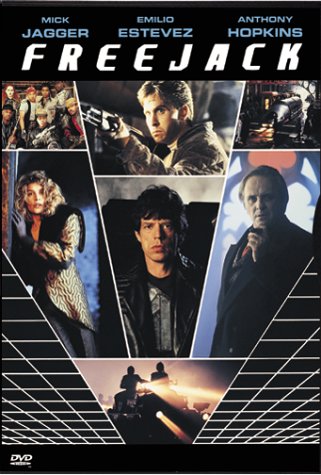 An early nineties take on the concept of time travel and a semi-dystopian future where clinical immortality is possible through the concept of “bonejacking”. Though negatively reviewed, the movie did capture a lot of Gibsonian, cyberpunk themes and had a more than a few braincells dedicated to it. In short, the time travel in this film involves capturing people from the past seconds before they die and bringing them into the future. Once there, they become vessels for the consciousness of those who pay to bring them forward. Those who escape are known as “freejacks”, property of the wealthy who must be retrieved.
Enter into this Alex Furlong (Emilio Estevez) who is brought forward by a wealthy industrialist Ian McCandless (played by Anthony Hopkins). He was supposed to have died in 1991 during a race-car driving stint, but now finds himself in 2009. The US of the future has become the picture of cyberpunk dystopia, where the rich rule and the poor are numerous and live by whatever means they can.Much of this is due to the “trade wars” which the US apparently lost to emergent Asian interests, who now run much of America’s economy.
He escapes to find his wife, Julie (Rene Russo), who is apparently in the employ of the man who paid to bring him back. He is eventually captured, but is saved thanks to the intervention of one of the chief execs who wants the boss to die. Essentially, if the boss doesn’t transfer his consciousness within a specific window, it will be lost for all time. However, a double-cross ensues, the boss’ chief enforcer Victor (played by Mick Jagger) shoots the chief exec, as it appears the transfer is complete and his boss is still alive and in control of the company.
It is revealed afterwards that the process failed, that Alex is still himself, and that Victor knew. He would rather work for Alex, a man he has come to respect, than the asshole who planned to usurp his old boss. He lets Alex and Julie go, who now have control of the company and continue to maintain the pretense that Alex is now McCandless. All in all, not a bad movie, though it was perhaps miscast and kind of cheesy!
Timecop:
 In the near future, the Time Enforcement Commission is created once it is realized that time travel is possible. Known as Timecops, they are responsible for policing the past and ensuring the protection of the space-time continuum. One of their chief cops, Max Walker (Van Damme), is a man with a haunted past, as his wife was murdered years before by unknown assailants.
After conducting an arrest, he is made aware of a conspiracy to alter the future. At the head of it is Senator Aaron McComb (Ron Silver), head of the TEC, who is looking to change the past so that he will be president in the present. It is he who sent thugs back in time to kill Walker, due to the fact that he is getting wise to his schemes in the present. Apparently, he was the target, the fact that he survived and his wife was killed was entirely incidental.
Having learned all this, Walker makes an unauthorized jump into the past and meets his wife. After explaining to her what is going on, he urges her to keep his past self with her on the night of the attack while he deals with the thugs sent to kill them. A confrontation ensues in which Walker confronts McComb and kills him by merging his past self with his future self. This violates the law of the same matter of occupying the same space, and both die. He returns to a future (his present) in which his wife is alive and things are starkly different due to the death of McComb and all his schemes.
In essence, the story is all about the dangers of human avarice and the desire to control the future. On the one hand, it had its own a share of grey matter, but suffers from inconsistencies in that it tries to be an action flick and a respectable sci-fi piece at the same time. The brains comes from the fact that it actually incorporates ideas such as the “Ripple Effect” – i.e. unintended results of tampering – but this is watered down for the sake of getting to the action. Too bad too, because it remains a good and time-honored premise.
12 Monkeys:
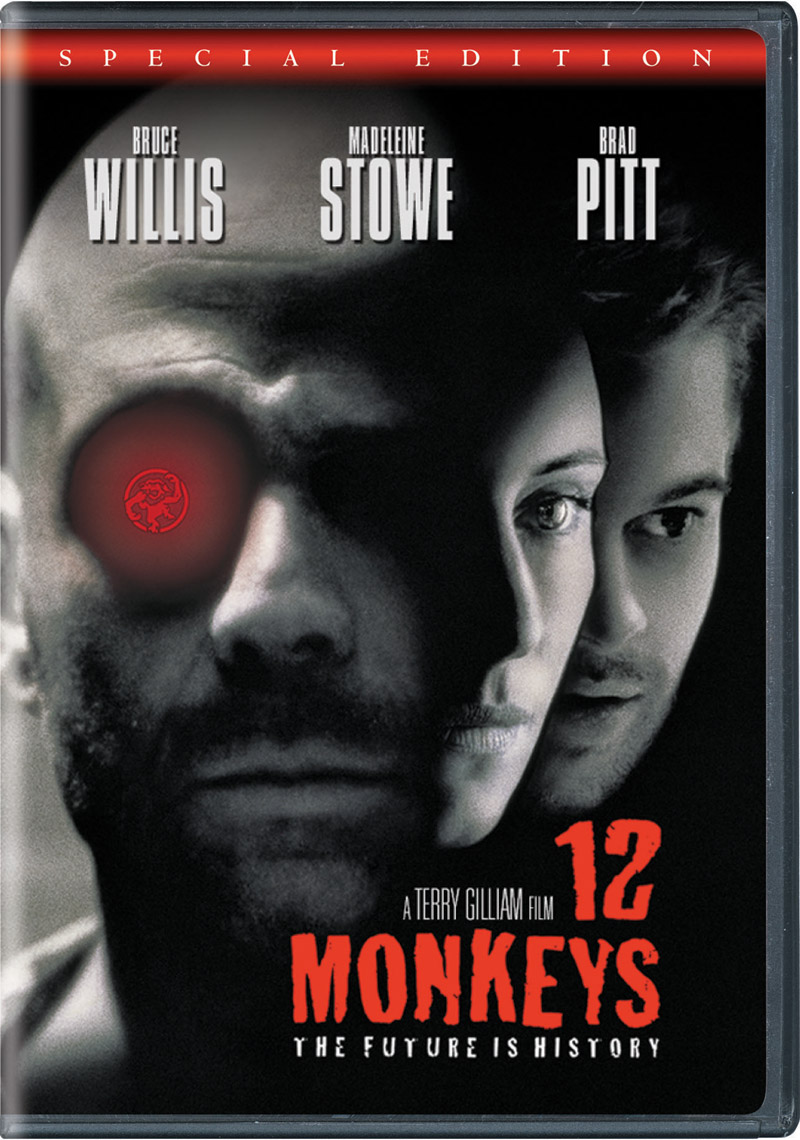 Post-apocalyptic sci-fi meets psychological thriller, with plenty of bat-shit crazy material thrown in for good measure! Based on a classic premise of time travel being used to prevent a cataclysmic event, the story is a satire on the dangers of human avarice, control, and how easily chaos can result. And of course, there is a temporal paradox angle, where the actions of the time traveler end up fulfilling the very future they were trying to prevent.
The main character is a convicted felon named James Cole (Bruce Willis) who lives in a grim desolate future where human beings live underground. This is due to a virus released in 1996-97, apparently by a terrorist group known as the Army of the 12 Monkeys. To earn a pardon, Cole agrees to go into the past to collect information on the virus that caused the pandemic. His ultimate goal is to procure a sample and bring it to the future so a cure can be made. Unfortunately, the technology is imprecise, and Cole is sent off course many times.
In his first trip, he lands in 1990 and is committed by Dr. Kathryn Railly (Madeleine Stowe). While in the institution, he meets another mental patient named Jeffrey Goines (Brad Pitt) a fanatical animal activist. He tries in vain to contact the future by calling a number the scientists are monitoring, but can’t get through. He then is transported to the future where he hears the garbled message, and is told that Goines is a suspected member of the the Army of the 12 Monkeys. Goines Labs, which his father owns, is apparently the producer of the virus, and Jeffrey is believed to be the one who spread it.
His next trip sends him to 1996, as planned. Once there, he kidnaps Dr. Railly and goes off in search of Goines. Throughout all this, Cole is troubled with recurring dreams involving a chase and a shooting in an airport. When he finds Goines, he learns that he is the founder of 12 Monkeys but denies any knowledge of the virus. Cole vanishes again and Railly begins to wonder if Cole is telling the truth when she finds a photograph from World War I in which Cole appears. Cole, on the other hand, begins to doubt his own sanity, but both he and Railly settle the question when she leaves a voice mail on the number he provided, creating the message the scientists played for him prior to his second mission.
They both now realize that the coming plague is real and that the Army of the Twelve Monkeys is a red herring. Believing they can’t stop it, they plan to fly off together to enjoy what time they have left. At the airport, Cole leaves a last message telling the scientists they are on the wrong track and that he will not return. He is soon confronted an acquaintance from his own time who gives him a gun and instructs him to complete his mission. At the same time, Railly spots the true culprit behind the virus: an assistant at the Goines virology lab named Dr. Peters who is about to embark on a tour of several cities around the world, which matches the sequence of viral outbreaks.
Cole attempts to shoot the man but is fatally shot himself while trying to get through security. As Cole dies in Railly’s arms, she makes eye contact with a small boy – the young James Cole witnessing his own death, which is what he keeps reliving in his dreams. Dr. Peters, aboard the plane with the plague, sits down next to one of the lead scientists in the future and comments about how the world is coming to an end.
Ultimately, this movie was effective because it combined aspects of a post-apocalyptic sci-fi movie with a psychological thriller. By employing an anti-hero like Cole, a convicted criminal as an anti-hero who’s sanity is in doubt, the audience is presented with the same kind of mind-bending questions the main characters are. At every turn, the reality of their situation remains in doubt, and given the situation, they would prefer insanity to the notion that the apocalypse they are trying to prevent is real. Naturally, this fatalistic story ends on a note of self-fulfillment, where prophecy comes true and the everything they’ve done to fight it proves fruitless.
The Primer:
 This low budget 2004 film by master-writer Shane Carruth is perhaps one of the smartest explorations of sci-fi to ever be presented in film. In addition to its experimental structure and deep, philosophical nature, it employs an unapologetic, complex technical dialogue. After collecting the Grand Jury Prize at the 2004 Sundance Film Festival, it has gone on to earn a cult following.
The story opens when a team of engineers create a machine that reduces the weight of objects, but has the unexpected side effect of causing time travel. After building a man-sized prototype, Abe and Aaron decide to cut their two other friends out of the discovery and begin using the device to make trades on the market. However, when a potential financial backer finds and uses the box, which leaves him comatose, Abe concludes that its too dangerous.
He uses a “failsafe box” – his own machine which he built in secret – to travel back in time and warn his past self not to make the box. However, he soon finds out that Aaron has already beaten him to the punch and used his own machine to go back in time and ensure that the time machine will be built. What’s more, he ensures that his past self will be able to build the machine all by himself, thus cutting Abe out of involvement down the line.
Abe eventually convinces Aaron to leave and not attempt to tamper with their past selves again. However, the movie ends with Aaron speaking on the phone to an unspecified person, relaying the information about the box to them. We then see a past version of Aaron working on a building-sized version of the box, indicating that he has ensured his past self will have control over time travel and continue to tamper with it.
The movie is considered inaccessible for obvious reasons. For one, its technical lingo is deliberately complicated and esoteric, and the confusing portrayal of time travel and multiple selves that comes from repeated iterations can make a person go cross-eyed! But just about everyone agrees, its smart, inspired, and was made on a shoestring budget by a very committed soul.
Mr. Nobody:
 Here we have a very interesting story that addresses the concepts of time travel, post-mortality, and the theory of multiple universes. It also embraces the familiar themes of choice and free will, exploring the different consequences that come of them, and tops it all off with a pseudo-spiritual psychological twist. Like many other films listed here, audiences are left in a state of wonder about what they are seeing and whether or not it is real or imagined.
The story opens in 2092 with the introduction of Nemo Nobody (Jared Let0), a 118 year old man who is the last mortal on Earth. Nearing death, people want to hear about his life and experiences, which he begins to relate with the help of a psychiatrist and journalist. However, when the prodded, he begins to spit out contradictory stories that occur in a non-linear narrative which revolve around three points in his life – age nine, when his parents get divorced; at age fifteen, when he fell in love; and at age thirty-four, living his adulthood.
At nine, his parents get divorced, prompting to choose whom he’s going to live with. As a result of this, different scenarios happen which affect his future. With his mother, he finds that there are two choices involving a young love of his named Anna, but neither work out in the long run. In one, he misses his chance while young and reconnects with her later, only to find her unavailable. In the second, they fall in love and enjoy many years together but are sadly separated. They make plans to meet up when older, but he her loses her number and subsequently any chance at finding her again.
With his father, who becomes an invalid that he must care for, all the while writing a fantasy novel about life on Mars, things take a similar course. Here, events revolve around another series of love interests, and he is called upon to make decisions which will effect the outcome of his life. In one, he is rejected by the woman he loves and is rendered paralyzed after he drives off in frustration and crashes. In another, they get married and she dies in an accident, and Nemo dies in space after spreading her ashes on Mars. In yet another, their marriage is destroyed due to his love’s affliction with borderline personality disorder. In the next, he takes random chances and ends up getting murdered as a result of mistaken identity. And in the final one, he wakes up in a strange world where he finds a tape of himself, as an old man, telling him that he does not exist.
After all this, Mr. Nobody tells the journalist and shrink that they both don’t exist, that they are in the mind of Nemo as a boy when he is being forced to choose between two futures. Back at the railway station as a nine year old, Nemo creates a third and totally unexpected choice for himself by abandoning both parents and running away from the tracks, escaping his dilemma and moving towards an unknown future. He then finds himself as the adult Nemo sleeping on a bench by the lighthouse and waiting for Anna to return. When she arrives, the two embrace and are ecstatic over their reunion.
The movie then cuts to the precise moment where Mr. Nobody dies of old age and the expansion of the universe comes to a halt and time reverses itself. The imaginary 118 year-old man then cackles triumphantly as he springs back into awareness with the realization that his younger self has finally found his one true love and life and conquered causality.
Like I said, can’t tell if it’s real or fake, for in the end, any or all of the timelines being mentioned here could be in the mind of one of Nemo’s selves. However, in presenting this non-linear and highly subjective narrative, the movie provides a fitting commentary on the nature of time and choice. With every decision we make, a million potential outcomes are brought to life and die out in the blink of an eye. If one were to truly examine the course of their life’s events and seek to understand the outcomes, they surely would go mad! But ultimately, the movie ends on a very happy note, showing that free will is what is important and the means out of an endless stream of fatalism and predestination.
Safety Not Guaranteed:
 Here is a movie that is not only unique, it’s also based on a true story. In addition, it was just released this past June and earned the Waldo Salt Screenwriting Award at the 2012 Sundance Film Festival. Inspired by an actual classified ad that appeared in a 1997 issue of Backwoods Home Magazine, the movie tells the story of a man who is seeking a companion for time travel, saying that he has done it only once before and, naturally, “safety not guaranteed”.
The story opens with a disillusioned college graduate named Darius Britt (Aubrey Plaza) who takes a job at a Seattle magazine where her father works. After finding the article, he asks Darius to help track down the man and earn his trust. She eventually locates the man, Kenneth Calloway (Mark Duplass), and tells him she wants to be his time traveling companion. Kenneth, despite being paranoid that he is being watched by secret agents, puts his trust in Darius and the two begin to conduct training exercises for the mission.
Eventually, Kenneth tells her that his mission is to go back to 2001 and prevent the death of his old girlfriend who was killed when someone drove a car into her house. In time, Darius begins to develop feelings for him and tells him that her motives involve saving her mother who died when she was young. However, she soon finds that his ex-girlfriend is still alive and that it was Kenneth who drove into her house with her in the car. Having begun to suspect that Kenneth may not be insane, this revelation leads her to question his sanity once again.
Afterwards, Darius is questioned by two government agents who have been following Kenneth since they think he might be spy, apparently due to his communications with government scientists. This throws her into further disarray, and she returns to Kenneth’s house to confront him about Belinda. However, Kenneth claims that if she is alive then his time traveling must have worked. Her father then arrives to warns Kenneth that the government agents are on his property. Kenneth panics and runs, Darius follows him, and finds him on a boat with his time machine.
After telling him that she’s sorry but what she shared was real, Kenneth tells Darius that the mission has changed. He now intends to go back with the intention of saving her mother. As her father and the government agents close in, Kenneth activates his time machine and the boat disappears. In the end, things end on a happy note, with every indication being given that the time machine works and Kenneth was telling the truth all along.
Naturally, this movie has earned a great deal of accolades and rave reviews, and for obvious reasons. In the end, it presents viewers with a scenario where a person may very well be insane, but clearly has a good heart and understandable intentions. Throughout the movie, we are thrown curve balls that make us question whether or not this is real or the product of a delusional mind, made all the more poignant because Plaza’s character seems to be genuinely falling for him. In the end, we are thrown a bone with the happy resolution, with everything leading up to that point making it all the more suspenseful and engrossing.
Summary:
And that’s time travel in film! Hope you all enjoyed it, because I sure as hell enjoyed taking the trip down memory lane. Now if you’ll excuse me, I’m feeling nostalgic and want to catch up on some old hits. I imagine some of you have some movie watching you want to do now too 😉















 Stories by Williams