Lobby Congress to Illegalize the use of Surveillance Drones

X-47BCall me concerned, but some recent news items have made more than a few people frightened that unmanned drones could be peaking in their windows and watching them as they go to work very soon. The first came back in September when US Congress passed the Modernization and Reform Act of 2012 which, among other things, required the Federal Aviation Administration (FAA) to accelerate drone flights in U.S. airspace.

A number of US law enforcement agencies have also adopted the use of drones for the sake of police work. Amongst them are the Miami-Dade Police Department, the Texas Department of Public Safety, and the Alameda Sheriff’s Department is likely to follow. The Seattle Police Department also maintained a small fleet as well, but grounded them due to public outcry and concerns over privacy.

As it stands, the Obama Administration has already adopted legislation that prevents drones from being armed and would demand that law enforcement agencies register drones, adopt privacy polices, and only use them in criminal matters for which warrants would be required.

https://petitions.whitehouse.gov/petition/make-illegal-use-unmanned-aerial-vehicles-sake-surveillance-within-us/Fqq2C9Wb

NASA Engine Will Take Us To The Moon (And Beyond)

NASA_Moon1For almost a year now, NASA has been discussing plans which will eventually culminate in a return to the Moon. Initially, such plans were kept under wraps just in case NASA found itself in a budget environment that did not favor renewed space exploration. But since the 2012 election, and the re-election of President Obama, NASA publicly announced its plans, confident that the budget voted on in 2010 (which included lucrative funding for them) would continue.

And now, NASA has been unveiling the tools that will take us there and beyond in the coming years. Far from simply shooting for the Moon for the first time in decades, NASA’s plans also include manned missions to Mars, and exploratory missions which will take it out to Jupiter and the outer Solar System. And since they are thinking big, its clear some budget-friendly and powerful tools will be needed for the job.

jx-2rocketAbove, we have the latest. It’s called the JX-2, a liquid-fuel cryogenic rocket engine is the modernized version of the J-2, the engine that NASA used in the late-’60s and early-’70s to thrust humans beyond low Earth orbit. With the conclusion of the Apollo program, these babies fell into disuse. But with the upgrades made to these new versions, NASA hopes to send people back to the Moon, and a few places beyond.

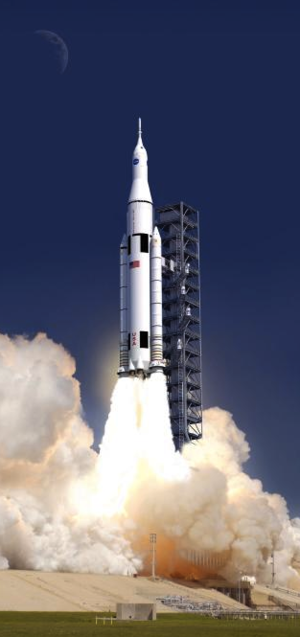
Of course, there are other noted improvements in NASA’s arsenal that will also come into play. For starters, the J-2 was part of the general assembly of the Saturn V rocket, the mainstay of the space agency’s fleet at the time. In the years to come, NASA will be deploying its new Space Launch System (SLS) and the Orion Multi-Purpose Crew Vehicle (MPCV).

NASA_marsThe SLS is NASA’s next-generation rocket, a larger, souped-up version of the Saturn V’s that took the Apollo teams into space and men like Neil Armstrong to the Moon. According to NASA spokesmen, the SLS rocket will “incorporate technological investments” and “proven hardware” from previous space exploration programs.” Essentially, this means that projects which have been shelved and retired have been updated and incorporated to create a rocket that can do the job of sending men into deep space again.

The Orion MPCV, on the other hand, is the module that will sit atop the SLS, carrying its crew compliment and delivering them to their destination once the rocket has put them into space and disassembled itself. Announced back in September of 2011, the SLS and MPCV constitute the largest and most powerful space rocket system ever built by a space agency.

No date has been given as to when the SLS and MPCV will be sent into space, courtesy of the new JX-2 rocket engine. But NASA claims there will be a launch sometime next year. As for the Moon, well, we’re waiting on that too, but it’s clear that with Mars slated for 2030, a manned mission to the Moon is sure to happen before this decade is out.

In the meantime, check out the infographic on the new rocket system below, and keep your eyes on the skies! We’re going back, and this time, we mean to stay!

nasa-spaceship-mpcv-orion-capsule-comparison-apollo-shuttle-infographic-110525b-02

Sources: IO9.com, (2), Space.com

U.N. Launches Drone Investigation

Predator_drone_2In a move which will surely strike some as predictable and others overdue, the U.N. announced that it would begin an investigation into the legality of the US’s drone program. For years now, unmanned aerial vehicles have been the mainstay of the United States anti-terrorism efforts overseas, sparking controversy and leading to demands for more oversight and transparency. And as of this past Thursday, it will be the subject of a major international investigation.

Led by special rapporteur on counterterrorism and human rights Ben Emmerson, the investigation is expected to focus on the legal justification for America’s expansive drone program, which has largely remained secretive and unexamined. What’s more, Emmerson and his team are expected to examine exactly how much collateral damage and civilian deaths the use of drones has caused, which is a major point for those opposed to their use.

In a statement released from Emmerson’s office, he outlines the parameters of the issue and the investigation to be mounted as follows:

“The exponential rise in the use of drone technology in a variety of military and non-military contexts represents a real challenge to the framework of established international law. It is therefore imperative that appropriate legal and operational structures are urgently put in place to regulate its use in a manner that complies with the requirements of international law, including international human rights law, international humanitarian law (or the law of war as it used to be called), and international refugee law.”

Other groups were quick to chime in on the decision to launch an investigation, not the least of which were Americans themselves. For example, Dennis Blair, the former director of national intelligence under President Barack Obama and the current chairman of the Council on Foreign Relations, has urged the administration to make more of its drone policies public. “There’s been far too little debate [about the tactics of drone use] said Blair. “The United States is a democracy, we want our people to know how we use military force and that we use it in ways the United States is proud of.”

The American Civil Liberties Union, which has been waging a years-long effort to compel the Obama administration to release its internal legal considerations, also welcomed the U.N. investigation, and urged the U.S. to participate in it. Hina Shamsi, the director of the Union’s National Security Project, released a statement encompassing the ACLU’s position:

“Virtually no other country agrees with the U.S.’s claimed authority to secretly declare people enemies of the state and kill them and civilian bystanders far from any recognized battlefield. To date, there has been an abysmal lack of transparency and no accountability for the U.S. government’s ever-expanding targeted killing program.”

Naturally, the US is not the only nation under scrutiny in this investigation. And neither is the issue of civilian deaths the only focus. The use of drones has increased exponentially in recent years, thanks in no small part to extensive development of UAV technology in a number of countries. And with countries like China and Iran following suit, drone use is only expected to grow and expand. By Investigating the legality and implications of their use now, the potential exists to establish a framework before they become widespread.

Source: Huffingtonpost.com


NASA Considers Catching Asteroids

CometNASA is apparently considering playing a little catch and release with some giant rocks. Basically, they want to capture an asteroid and deposit in orbit around the Moon by the early 2020s. The announcement of this new plan was made earlier this month, and left many wondering if this has anything to do with the Obama administration’s long term plans for establishing an outpost on the dark side of the moon or sending a manned mission to a near-Earth asteroid.

This makes sense, since if NASA were to place an asteroid in orbit around the Moon, a crewed space craft could practice engaging with it without needing to move beyond the range of a rescue mission. What’s more, such a body would come in handy as a potential stopover base for spaceships looking to refuel and resupply before setting off on deeper space missions – particularly to Mars.

NASA_moonWhat’s more, capturing a near Earth asteroid and bringing it in orbit of the Moon is a safer, cheaper way to perform manned landings on object in the asteroid belt. The nearest proposed target is a space rock named 1999 AO10, an asteroid which is roughly a year’s trip away. Traveling to this body would expose astronauts to long-term radiation since they would be beyond Earth’s protective magnetic field, and would also take them beyond the reach of any possible rescue.

Researchers with the Keck Institute for Space Studies in California have confirmed that NASA is mulling over the plan to build a robotic spacecraft for just such a purpose. They also confirmed that the project would take six to ten years and would involve the launching of a slow-moving spacecraft propelled by solar-heated ions on an Atlas V rocket. After locating and studying the target asteroid, the robot would catch it in a bag measuring about 10 by 15 meters and bring it back towards the moon.

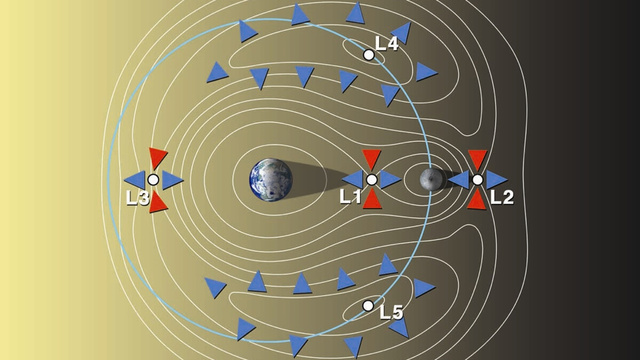
Altogether, the mission would take 6 to 10 years, and cost about 2.6 billion. If successful, it may cut costs when it comes time to place a base in orbit at Lagrange Point 2 – on the dark side of the moon – or when missions to Mars start heating up by 2030. Yes, at this point, I’m thinking the people at NASA are thanking their lucky stars (no pun!) that Obama was reelected back in November. Always good to have powerful friends, especially when they can sign multi-billion dollar checks!

Source: Wired.com, newscientist.com

NASA’s Next-Gen Spacesuit

NASA_suitIt’s like something Buzz Lightyear would be seen in, minus the death ray laser. It’s called the Z-1 spacesuit, a prototype that NASA hopes to incorporate into their equipment lineup by 2015. Not only does this new design offer a wide range of advantages compared with the space agency’s previous suit – the Extravehicular Mobility Unit (EMU) spacesuit – it also represents the first major overhaul in spacesuit technology since 1998.

For example, it boasts a rear-entry hatch which lets an astronaut put on the suit from the back, as opposed to putting on the top, bottom and helmet separately. This hatch also coincides with a feature known as the suit port, which allows the suit to be attached to the outside of a vehicle (such as a rover), thus allowing the astronaut to simply enter the suit from inside the vehicle. This is a big step from the current space suits which must be stored and put on internally.

I don't see a resemblance, do you?
I don’t see a resemblance, do you?

On top of that, the Z-1 excels in the areas of mobility and visibility. The former arises from the fact that the suit comes as a single piece rather than being made up of multiple segments. The larger, bubble dome helmet is what ensures that the astronauts has a better field of view. And finally, NASA plans to address the issue of life support through the portable PLSS 2.0 which condenses all life support systems into one package and does not need external components.

The PLSS 2.0 design also incorporates a massive bonus in the form of the Spacesuit Water Membrane Evaporator temperature regulator, which would actually make it possible for future astronauts to comfortably walk on extraterrestrial planets. According to NASA’s PLSS engineer Carly Watts, the PLSS 2.0 “can be used in a Martian environment. It can be frozen without damaging the unit, and it’s not particularly sensitive to contamination.” Good news for the astronauts heading to Mars in 2030, assuming the budget environment remains friendly after President Obama is no longer in power.

Check out this video of NASA Public Affairs Officer Brandi Dean talking with Cristina Anchondo, Z1 spacesuit test director, about the Z1 spacesuit at the Johnson Space Center.


Source: news.cnet.com

Drone Wars!

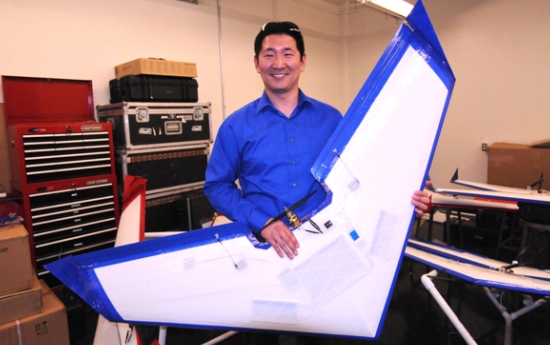
X-47BThat’s the crux of Timothy Chung’s research, an assistant professor in the Systems Engineering department at the Naval Postgraduate School in Monterey, California. For the most part, he and the Advanced Robotics Systems Engineering Lab (ARSENL) have been working on a way to construct a series of low-cost, lightweight autonomous flying vehicles known as Aerial Battle Bots that will give the US and the western allies an advantage should a full-scale conflict involving UAV’s happen.

The aspect of cost is especially important, seeing as how drones cost on the order of several million dollars apiece. By supplementing reconnaissance and hunter-killers with dogfighting drones, the army and navy of the future will have a lost cost-option for keeping their big-budget fliers safe. What’s more, it’s extremely important that the drones work in tandem, since it’s highly likely other nations will be developing similar swarms of drones in the future too.

Chung_droneWith the help of a DARPA research grant, Chung and his associates have completed a small fleet of about a dozen drones. Each is a essentially a commodity radio-controlled flying machine, called Unicorn, that has been retrofitted with an onboard computer and other gear in order to take their places in the larger group. He hopes that by this August, he and his team will be able to get the vehicles flying and be able to start experimenting with getting them working together, as well as facing off!

In other news, questions relating to drone dogfights and the issue of autonomous drones were raised once again at the White House. Back around Thanksgiving, the mounting concerns from the human rights community led Deputy Defense Secretary Ashton Carter to sign a series of instructions that were designed to ensure that human oversight would always be a factor where drone strikes and UAV’s were concerned.

john-brennanThese concerns have since mounted with the recent announcement that John Brennan, the White House’s counter-terrorism adviser and the man known as the “Drone Godfather”, was nominated to become the next head of the CIA. For years now, he has been the man in charge of the US antiterrorism efforts in Central Asia, many of which have involved the controversial use of Predator and Reaper strikes.

These concerns were voiced in a recent letter from Sen. Ron Wyden (D-Ore), a member of the Senate intelligence committee. In it, he asked Brennan pointedly when and under what conditions the president would be able to target American citizens using drones:

“How much evidence does the President need to determine that a particular American can be lawfully killed? Does the President have to provide individual Americans with the opportunity to surrender before killing them?”

Naturally, the questions were quite specific when it came to the authorization of lethal force and when such authorization would be given to target people within the US’s borders. But there were also many questions that highlighted concerns over how this same process of authorization has taken place in other countries, and how little oversight has taken place.

(U.S. Air Force photo/Staff Sgt. Brian Ferguson)(Released)In short, Wyden used the occasion to express “surprise and dismay” that the intelligence agencies haven’t provided the Senate intelligence committee with a complete list of countries in which they’ve killed people in the war on terrorism, a move which he says “reflects poorly on the Obama administration’s commitment to cooperation with congressional oversight.” And given the mounting criticism at home that using killer drones against unspecified targets in Afghanistan and Pakistan has earned, not to mention the blowback happening overseas, he is not alone in thinking this.

Like it or not, it’s a new age where “umanning” the front lines is having an effect, albeit not the desired one. At one time, the predominant thinking in military and intelligence communities was that using automated aerial, land and sea vehicles, war could be fought cleanly, effectively, and without the loss of life – at least on OUR side. However, this thinking is coming under increasing scrutiny as it comes closer and closer to realization. And at the center of it all, the philosophical and existential questions are numerous and impossible to ignore.

For starters, war is and always will be a human endeavor. Just because you are not risking the lives of your own people doesn’t mean the fight is any more sanitary or bloodless. Second, even though none of your own citizens will be mourning the death of their loved ones doesn’t mean there won’t be mounting civilian opposition as conflicts go on. In a global community, people are able to witness and empathize with the plight of others. And finally, the increased use of machinery, be it autonomous or remote controlled, will inevitably lead to fears of what will happen if that same technology would ever be turned against its own people. No weapon is so safe and no government so trustworthy that people won’t fear the possibility of it being turned on them as well.

Source: news.cnet.com, wired.com

News From The Red Planet!

mars_lifeIt’s been quite the busy month for NASA and the Curiosity Rover Team. In addition to the hectic research schedule and the excitement over all the potential finds, there’s also been a lot of planning as to what future mission will be like. Already, NASA announced that they plan to send another rover (InSight) to Mars in 2016, this one for the purpose of conducting interior planet studies. But given the success of Curiosity thus far, NASA announced recently that the multi-year, robotic rover program will continue, and will include an additional launch in 2020.

Apparently, this has much to do with the reelection of Barack Obama, whose commitment to space exploration also means that NASA can go ahead with its plans to create an outpost on the Moon. According to NASA Administrator Charles Bolden, this and the planned 2020 launch will ensure that “America remains the world leader in the exploration of the Red Planet, while taking another significant step toward sending humans there in the 2030s.”

The planned mission portfolio includes the Curiosity and Opportunity rovers, two NASA spacecraft and contributions to one European spacecraft currently orbiting Mars, the 2013 launch of the Mars Atmosphere and Volatile EvolutioN (MAVEN) orbiter to study the Martian upper atmosphere, the Interior Exploration using Seismic Investigations, Geodesy and Heat Transport (InSight) mission, and participation in the European Space Agency’s 2016 and 2018 ExoMars missions.

That alone is pretty exciting  news. But in and around these grand announcements, the Mars Science Labs also released some information a week ago concerning the Martian soil samples which were thought to contain organics. Though the samples did prove to be “earthshaking” as was hoped, they did present some rather interesting findings which are now being released.

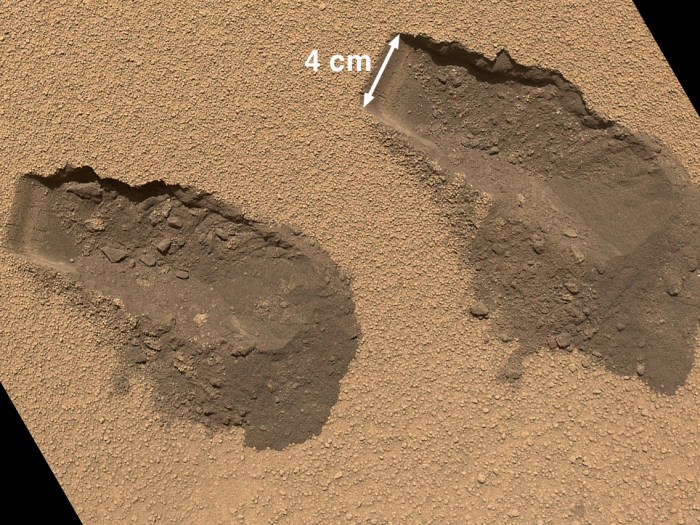
curiosity_samplesApparently, the samples taken with the “Rocknest” inside the Gale Crater showed signs of water, sulfur and chlorine-containing substances, among other ingredients, that were delivered by Curiosity’s arm to the analytical laboratory inside the rover. Lamentably, this does not confirm the existence of organic compounds, as the team hoped. But the find does confirm what Curiosity team and NASA scientists have been postulating for some time – which includes the existence of water on Mars and the existence of complex chemical compounds.

Also, it’s important to note that this kind of soil surveying was not possible with any previous rovers or exploratory missions in space. Curiosity is the first Mars rover that is able to scoop soil into analytical instruments and conducts tests in the way it has, so really, any findings should be considered a windfall. Detection of the substances during this early phase of the mission also demonstrated the ability of the rover laboratory to analyze diverse soil and rock samples, which will continue over the course of the next two years.

And as the team was sure to mention in a Tweet made shortly after the “earthshaking” discovery did not materialize, there’s still plenty of time to find all that they are looking for. Curiosity’s mission is far from over, and she will hardly be the last surveyor – man-made or manned – that will be roving the landscape of the Red Planet.

Source: NASA Jet Propulsion Laboratory