
 Olympic athletes competing for the gold at the 2014 Sochi Winter Games can expect something truly out of this world if they win. According to media reports, the Russian government is planning on using pieces of the Chelyabinsk meteor that broke up over the remote community in the Urals during February of this year.
Scarcely anyone could forget that incident, where a 17 meter (55 foot) meteor entered the Earth’s atmosphere and caused an airburst that damaged buildings, caused 1600 injuries and frightened every living thing in the region. As astronomers collecting fragments and calculating the orbit of the fireball, the incident directed attention towards the need to monitor space rocks that could threaten the Earth.
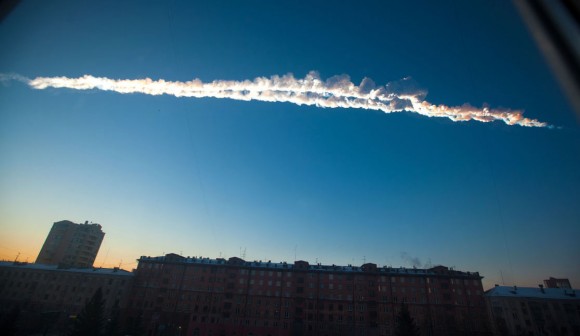 And it now seems that the Russian government wants to turn that frightening and eye-opening incident into something positive and celebratory. Alexei Betekhtin, the Minister of Culture of the Chelyabinsk Region, had this to say on the subject:
We will hand out our medals to all the athletes who will win gold on that day, because both the meteorite strike and the Olympic Games are the global events.
Using the shards collected by the various scientific expeditions who’s job it was to recover and study the meteor, they have fashioned seven sets of gold medals. The reported sports that will receive these medals include:
- Women’s 1,000 meter and men’s 1,500 meter short track
- Men’s skeleton
- Women’s cross-country skiing relay
- Men’s K-125 ski jump
- Men’s 1,500 meter speed skating
- Women’s super giant slalom
Each one will feature a small chunk of the meteor contained within the gold frame. And it goes without saying that this is an historic first. To date, no single Olympic games has ever sought to include stellar material in any of their medals. Perhaps this is a sign of the times, where global and interstellar events come together so publicly.
 No telling as to whether or not this decision was at all influenced by the negative publicity Russia has been getting for its anti-gay legislation in the lead up to the Olympics. Between people being jailed for joining gay advocacy groups and the government’s refusal to prosecute hate crimes committed against homosexuals, there are those who are arguing for a boycott of the Russian Olympics.
But controversy is hardly a new thing when it comes to the Olympics, especially where the human rights records of host nations are involved. For those old enough to remember, the US boycotted the Moscow Olympics in 1980 to protest the Soviet invasion of Afghanistan. Four years later, the Soviets retaliated in kind by boycotting the Olympics being held in Los Angeles.
And of course, one has to remember that Beijing hosted the Summer Games back in 2008, and if human rights were ever a reason to boycott the games, this would have been a prime opportunity to stand on principle. Personally, I think the Russian government needs to get its head out of its ass and join the post-Medieval era, but I suppose political pressure will have to come from sources other than the Olympic committee.
Source: universetoday.com, en.rian.ru

 Stories by Williams