Looking Forward: Science Stories to Watch for in 2014

BrightFutureThe year of 2013 was a rather big one in terms of technological developments, be they in the field of biomedicine, space exploration, computing, particle physics, or robotics technology. Now that the New Year is in full swing, there are plenty of predictions as to what the next twelve months will bring. As they say, nothing ever occurs in a vacuum, and each new step in the long chain known as “progress” is built upon those that came before.

And with so many innovations and breakthroughs behind us, it will be exciting to see what lies ahead of us for the year of 2014. The following is a list containing many such predictions, listed in alphabetical order:

Beginning of Human Trials for Cancer Drug:
A big story that went largely unreported in 2013 came out of the Stanford School of Medicine, where researchers announced a promising strategy in developing a vaccine to combat cancer. Such a goal has been dreamed about for years, using the immune system’s killer T-cells to attack cancerous cells. The only roadblock to this strategy has been that cancer cells use a molecule known as CD47 to send a signal that fools T-cells, making them think that the cancer cells are benign.

pink-ribbonHowever, researchers at Stanford have demonstrated that the introduction of an “Anti-CD47 antibody” can intercept this signal, allowing T-cells and macrophages to identify and kill cancer cells. Stanford researchers plan to start human trials of this potential new cancer therapy in 2014, with the hope that it would be commercially available in a few years time. A great hope with this new macrophage therapy is that it will, in a sense, create a personalized vaccination against a patient’s particular form of cancer.

Combined with HIV vaccinations that have been shown not only to block the acquisition of the virus, but even kill it, 2014 may prove to be the year that the ongoing war against two of the deadliest diseases in the world finally began to be won.

Close Call for Mars:
A comet discovery back in 2013 created a brief stir when researchers noted that the comet in question – C/2013 A1 Siding Springs – would make a very close passage of the planet Mars on October 19th, 2014. Some even suspected it might impact the surface, creating all kinds of havoc for the world’s small fleet or orbiting satellites and ground-based rovers.

Mars_A1_Latest_2014Though refinements from subsequent observations have effectively ruled that out, the comet will still pass by Mars at a close 41,300 kilometers, just outside the orbit of its outer moon of Deimos. Ground-based observers will get to watch the magnitude comet close in on Mars through October, as will the orbiters and rovers on and above the Martian surface.

Deployment of the First Solid-State Laser:
The US Navy has been working diligently to create the next-generation of weapons and deploy them to the front lines. In addition to sub-hunting robots and autonomous aerial drones, they have also been working towards the creation of some serious ship-based firepower. This has included electrically-powered artillery guns (aka. rail guns); and just as impressively, laser guns!

Navy_LAWS_laser_demonstrator_610x406Sometime in 2014, the US Navy expects to see the USS Ponce, with its single solid-state laser weapon, to be deployed to the Persian Gulf as part of an “at-sea demonstration”. Although they have been tight-lipped on the capabilities of this particular directed-energy weapon,they have indicated that its intended purpose is as a countermeasure against threats – including aerial drones and fast-moving small boats.

Discovery of Dark Matter:
For years, scientists have suspected that they are closing in on the discovery of Dark Matter. Since it was proposed in the 1930s, finding this strange mass – that makes up the bulk of the universe alongside “Dark Energy” – has been a top priority for astrophysicists. And 2014 may just be the year that the Large Underground Xenon experiment (LUX), located near the town of Lead in South Dakota, finally detects it.

LUXLocated deep underground to prevent interference from cosmic rays, the LUX experiment monitors Weakly Interacting Massive Particles (WIMPs) as they interact with 370 kilograms of super-cooled liquid Xenon. LUX is due to start another 300 day test run in 2014, and the experiment will add another piece to the puzzle posed by dark matter to modern cosmology. If all goes well, conclusive proof as to the existence of this invisible, mysterious mass may finally be found!

ESA’s Rosetta Makes First Comet Landing:
This year, after over a decade of planning, the European Space Agency’s Rosetta robotic spacecraft will rendezvous with Comet 67P/Churyumov-Gerasimenko. This will begin on January 20th, when the ESA will hail the R0setta and “awaken” its systems from their slumber. By August, the two will meet, in what promises to be the cosmic encounter of the year. After examining the comet in detail, Rosetta will then dispatch its Philae lander, equipped complete with harpoons and ice screws to make the first ever landing on a comet.

Rosetta_and_Philae_at_comet_node_full_imageFirst Flight of Falcon Heavy:
2014 will be a busy year for SpaceX, and is expected to be conducting more satellite deployments for customers and resupply missions to the International Space Station in the coming year. They’ll also be moving ahead with tests of their crew-rated version of the Dragon capsule in 2014. But one of the most interesting missions to watch for is the demo flight of the Falcon 9 Heavy, which is slated to launch out of Vandenberg Air Force Base by the end of 2014.

This historic flight will mark the beginning in a new era of commercial space exploration and private space travel. It will also see Elon Musk’s (founder and CEO of Space X, Tesla Motors and PayPal) dream of affordable space missions coming one step closer to fruition. As for what this will make possible, well… the list is endless.

spaceX-falcon9Everything from Space Elevators and O’Neil space habitats to asteroid mining, missions to the Moon, Mars and beyond. And 2014 may prove to be the year that it all begins in earnest!

First Flight of the Orion:
In September of this coming year, NASA is planning on making the first launch of its new Orion Multi-Purpose Crew Vehicle. This will be a momentous event since it constitutes the first step in replacing NASA’s capability to launch crews into space. Ever since the cancellation of their Space Shuttle Program in 2011, NASA has been dependent on other space agencies (most notably the Russian Federal Space Agency) to launch its personnel, satellites and supplies into space.

orion_arrays1The test flight, which will be known as Exploration Flight Test 1 (EFT-1), will be a  short uncrewed flight that tests the capsule during reentry after two orbits. In the long run, this test will determine if the first lunar orbital mission using an Orion MPCV can occur by the end of the decade. For as we all know, NASA has some BIG PLANS for the Moon, most of which revolve around creating a settlement there.

Gaia Begins Mapping the Milky Way:
Launched on from the Kourou Space Center in French Guiana on December 19thof last year, the European Space Agency’s Gaia space observatory will begin its historic astrometry mission this year. Relying on an advanced array of instruments to conduct spectrophotometric measurements, Gaia will provide detailed physical properties of each star observed, characterising their luminosity, effective temperature, gravity and elemental composition.

Gaia_galaxyThis will effectively create the most accurate map yet constructed of our Milky Way Galaxy, but it is also anticipated that many exciting new discoveries will occur due to spin-offs from this mission. This will include the discovery of new exoplanets, asteroids, comets and much more. Soon, the mysteries of deep space won’t seem so mysterious any more. But don’t expect it to get any less tantalizing!

International Climate Summit in New York:
While it still remains a hotly contested partisan issue, the scientific consensus is clear: Climate Change is real and is getting worse. In addition to environmental organizations and agencies, non-partisan entities, from insurance companies to the U.S. Navy, are busy preparing for rising sea levels and other changes. In September 2014, the United Nations will hold another a Climate Summit to discuss what can be one.

United-Nations_HQThis time around, the delegates from hundreds of nations will converge on the UN Headquarters in New York City. This comes one year before the UN is looking to conclude its Framework Convention on Climate Change, and the New York summit will likely herald more calls to action. Though it’ll be worth watching and generate plenty of news stories, expect many of the biggest climate offenders worldwide to ignore calls for action.

MAVEN and MOM reach Mars:
2014 will be a red-letter year for those studying the Red Planet, mainly because it will be during this year that two operations are slated to begin. These included the Indian Space Agency’s Mars Orbiter Mission (MOM, aka. Mangalyaan-1) and NASA’ Mars Atmosphere and Volatile EvolutioN (MAVEN) mission, which are due to arrive just two days apart – on September 24th and 22nd respectively.

mars_lifeBoth orbiters will be tasked with studying Mars’ atmosphere and determining what atmospheric conditions looked like billions of years ago, and what happened to turn the atmosphere into the thin, depleted layer it is today. Combined with the Curiosity and Opportunity rovers, ESA’s Mars Express,  NASA’s Odyssey spacecraft and the Mars Reconnaissance Orbiter, they will help to unlock the secrets of the Red Planet.

Unmanned Aircraft Testing:
A lot of the action for the year ahead is in the area of unmanned aircraft, building on the accomplishments in recent years on the drone front. For instance, the US Navy is expected to continue running trials with the X-47B, the unmanned technology demonstrator aircraft that is expected to become the template for autonomous aerial vehicles down the road.

X-47BThroughout 2013, the Navy conducted several tests with the X-47B, as part of its ongoing UCLASS (Unmanned Carrier Launched Airborne Surveillance and Strike) aircraft program. Specifically, they demonstrated that the X-47B was capable of making carrier-based take offs and landings. By mid 2014, it is expected that they will have made more key advances, even though the program is likely to take another decade before it is fully realizable.

Virgin Galactic Takes Off:
And last, but not least, 2014 is the year that space tourism is expected to take off (no pun intended!). After many years of research, development and testing, Virgin Galactic’s SpaceShipTwo may finally make its inaugural flights, flying out of the Mohave Spaceport and bringing tourists on an exciting (and expensive) ride into the upper atmosphere.

spaceshiptwo-2nd-flight-2In late 2013, SpaceShipTwo and passed a key milestone test flight when its powered rocket engine was test fired for an extended period of time and it achieved speeds and altitudes in excess of anything it had achieved before. Having conducted several successful glide and feathered-wing test flights already, Virgin Galactic is confident that the craft has what it takes to ferry passengers into low-orbit and bring them home safely.

On its inaugural flights, SpaceShipTwo will carry two pilots and six passengers, with seats going for $250,000 a pop. If all goes well, 2014 will be remembered as the year that low-orbit space tourism officially began!

Yes, 2014 promises to be an exciting year. And I look forward to chronicling and documenting it as much as possible from this humble little blog. I hope you will all join me on the journey!

Sources: Universetoday, (2), med.standford.edu, news.cnet, listosaur, sci.esa.int

The Future of Transport: High-Speed MagLev’s

hyperloopThis past summer, Elon Musk once again impressed the world with his futuristic design for a high-speed transit tube that could take passengers from Los Angeles and San Francisco in just 30 minutes. It’s known as the Hyperloop, a “fifth form” of transportation that would utilize linear electric motors, solar panels, and air cushions to achieve speeds of up to 1290 kilometers per hour (800 mph).

Unfortunately, Musk also indicated that with his current, busy schedule, it would be many years before a working demonstration could be produced. What’s more, he was unclear on what role, if any, he would play in its creation. The project was unveiled as an open-source venture, and he called upon business investors to take up the role of making it happen.

hyperloop1However, some investors have come forward to do just that. Gathering around the entrepreneurial collaboration platform known as JumpStartFund, these enthusiasts have come together to create a corporation that will see Musk’s concept through to development. This is no small task, seeing as how the price-tag (according to Musk) would be between 6 and 10 billion dollars.

JumpStartFund launched on August 22, and aims to give entrepreneurs a network through which to both seek funding and support as well as crowdsource the idea and collaborate with others to refine it. The Hyperloop concept, put up on the site by the JumpStart team, became the platform’s flagship project within its first week of launch.

hyperloop2Dirk Ahlborn, CEO and co-founder of JumpStartFund, said in an interview back in September:

We want to be the ones that actually make things happen. So of course we need to create a corporation. Whoever decides to dedicate more time to this than just logging onto the platform deserves to be part of this company.

Because Ahlborn and his co-founders have connections with SpaceX, they were able to talk over the idea with the company’s president, Gwynne Shotwell, and get the green light to feature it on the platform. Joining them are engineers Marco Villa and Patricia Galloway, who worked for SpaceX and the US National Science Board respectively and even held directorial and vice chair positions.

hyperloop3JumpStartFund is also accepting applications from members of the site to work full-time on the Hyperloop project in exchange for equity in the company. Ahlborn has also indicated that even naming the company will be a crowdsourced effort:

We want to find a way to give everyone the ability to be a part of this project. The whole concept is always going to be on the platform. Everything is going to be very transparent, and we intend to reserve a percent of future revenues for people that work with us on the platform.

And the Hyperloop is hardly alone when it comes to the future of mass transit. On the opposite side of the US, along the Northeast Corridor, The Northeast Maglev (TNEM) company is looking to create a superconducting magnetic railway that could take passengers from New York to Washington D.C. in 60 minutes, and from Baltimore to D.C. is just 15.

scmaglev-rendering-marylandAt present, this American company – which is backed by a Japanese government bank – is testing a maglev route in Japan that runs from Nagoya to Tokyo in Japan and is planned to be completed by 2027. In the US, their efforts are aimed at replacing the nation’s aging transit infrastructure, which is unable to cope with modern demand.

As Northeast Maglev CEO and chairman Wayne Rogers said in a recent interview with Co.Exist:

What’s happening is we’re operating on 1940s and 1950s infrastructure and drowning in congestion. This isn’t pie-in-the-sky technology. This is something that you could fly to Tokyo, sit on a train, and actually ride a train that goes 311 miles per hour.

Much like the Hyperloop, the train would run on a bed of air, levitated by a series of electromagnetic coils located on the track. While similar magnetic levitation projects along the corridor have been considered in the past, they repeatedly failed due to curves that would slow down the transit process, and passengers projections were consistently too low.

scmaglev-rendering-new-jersey-high-trafficThe current maglev project plans on using tunnels to bypass the curves, and train ridership is at an all-time high. However, the realization of the project will still require significant funds. As Rogers himself projects, the first leg of the route – from D.C. to Baltimore – will cost some $10 billion. As such, the company imagines it will require some additional federal support.

The company does have some high-profile support working in its favor, though. Its advisory board includes two former transportation secretaries, former majority leader Tom Daschle, Under Armour CEO Kevin Plank, former Northwest Airlines CEO Doug Steenland, and George Pataki, Christine Todd Whitman, and Ed Rendell – the former governors of New York, New Jersey, and Pennsylvania.

scmaglev-rendering-washington-stationAnd ultimately, Rogers and his company are hopeful, citing recent changes and the enthusiasm garnered by the Hyperloop project:

[T]he concept is different, the sponsorship is different, the routing is different, and the technology is different. I think one of the things [the Hyperloop] has done – without commenting on the feasibility of the Hyperloop or not – is it’s brought people’s attention to the problem and brings America back to the things it’s good at, which is thinking big things and implementing cutting-edge technologies on terrific projects.

Who knows? In a few decades times, we could be looking at a world where high-speed maglev trains crisscross every continent, carrying people between all major cities faster than jet planes, and at a fraction of the cost. Meanwhile, intercontinental transit could be taking the form of aerospace travel, jets that fly into the lower atmosphere at hypersonic speeds. It’s important to dream big!

And in the meantime, enjoy this promotional video from The Northeast Maglev company:


Sources: news.cnet.com, fastcoexist.com

News From Space: XS-1 Reusable Spacecraft

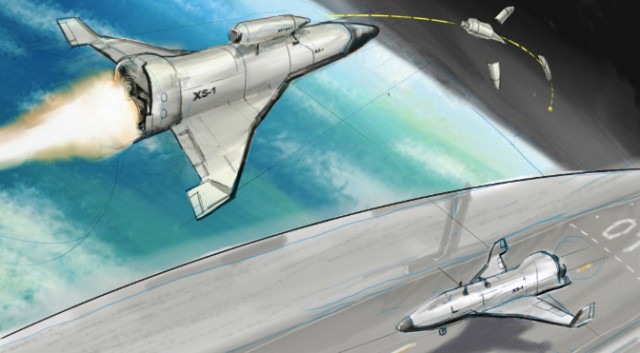
sx-1_spaceplaneWhen it comes to the future of space exploration, the ongoing challenge has been to find a way to bring down the costs associated with getting things into orbit. In recent years, a number of solutions have been presented, many of which have been proposed by private companies like SpaceX and Reaction Engines. Not to be outdone, the US government has its own proposal, known as the XS-1.

Developed by DARPA, the XS-1 is the latest in a string of designs for a reusable spacecraft that would be capable of taking off and landing from an airfield. But unlike its predecessors, this craft would be a two-stage craft that has no pilot and is controlled much like a drone. By combining these two innovations, DARPA foresees an age where a “one day turnaround,” or daily launches into space, would be possible.

skylon-orbit-reaction-enginesBasically, the XS-1 will work as a two-stage flyer, beginning as a regular high-altitude drone meant to fly as high as possible and reach hypersonic speed. Once this has been achieved, the payload will separate along with an expendable launch system with a small tank of rocket fuel which will then be automatically delivered to its final destination. The plane, meanwhile, will automatically return to base and begin prep for the next day’s mission.

In addition to being cheaper than rockets and space shuttles, an XS-1 space plane would also be much faster than NASA’s now-retired STS shuttles. Much like Reaction Engines Skylon concept, the ship is designed for hypersonic speeds, in this case up to Mach 10. While this might sound incredibly ambitious, NASA has already managed to achieve a top speed of Mach 9.8 with their X-43A experimental craft back in 2004 (albeit only for ten seconds).

x-43a The XS-1′s payload capacity should be around 2300 kilograms (5000 pounds) per mission, and DARPA estimates that a single launch would cost under $5 million. Currently, it costs about $20,000 to place a single kilo (2.2lbs) into geostationary orbit (GSO), and about half that for low-Earth orbit (LEO). So while DARPA’s requirements are certainly stringent, they would cut costs by a factor of ten and is within the realm of possibility.

As it stands, all ideas being forth are centered around reinventing the rocket to make launches cheaper. When it comes to long-term solutions, grander concepts like the space elevator, the slingatron, or space penetrators may become the norm. Regardless, many of the world’s greatest intellectual collectives have set their sights on finding a more affordable path into space. These advanced launch jets are just the first step of many.

Sources: extremetech.com, news.cnet.com

News From Space: 3-D Printed Spacecraft

3D_spaceprinting13D-Printing has led to many breakthroughs in the manufacturing industry in recent years. From its humble beginnings assembling models out of ABS plastic, the technology has been growing by leaps and bounds, with everything from construction and food printing to bioprinting becoming available. And as it happens, another major application is being developed by a private company that wants to bring the technology into orbit.

It’s called SpiderFab, a system of technologies that incorporates 3-D printing and robotic assembly to create  “on-orbit” structures and spaceship components (such as apertures, solar arrays, and shrouds). Developed by tech firm Tethers Unlimited, Inc. (TUI), the project is now in its second phase and recently landed a $500,000 development contract from NASA.

spiderfabOne of the greatest challenges of space exploration is the fact that all the technology must first be manufactured on Earth and then shuttled into orbit aboard a rocket or a shroud. The heavier the cargo, the larger the rocket needs to be. Hence, any major undertaking is likely to have a massive price tag attached to it. But by relocating the manufacturing process to a place on-site, aka. in orbit, the entire process will be much cheaper.

Towards this end, the SpiderFab, incorporates two major innovations in terms of transportation and manufacture. The first makes it possible to pack and launch raw materials, like spools of printable polymer, in a cost-effective way using smaller rockets. The second uses patented robotic fabrication systems that will process that material and aggregate it into structural arrangements.

3D_spaceprintingDr. Rob Hoyt, CEO of TUI, had this to say of his company’s brainchild in a recent interview with Co.Design:

SpiderFab is certainly an unconventional approach to creating space systems, and it will enable significant improvements for a wide range of missions.

The unorthodox system is also a solution to the problem that Hoyt began working on two decades ago when he first began working with NASA. While there, he experimented with on-orbit fabrication as a concept, but was limited due to the fact that there were no means available to make it reality. However, once 3-D printing became mainstream, he seized the opportunity presented. As he explains:

I didn’t strike on anything dramatically better than [previous investigations] until about six years ago, when additive manufacturing was really starting to take off. I realized that those techniques could be evolved to enable some dramatic improvements in what we can build in space.

spiderfab3At present, TUI is working on several different models of what the SpiderFab will eventually look like. The first of these is known as the Trusselator, one of many building blocks that will form the factory responsible for producing spacecraft components. The Trusselator is designed to print high-performance truss elements, while another, the Spinneret, will use 3-D printing-like techniques to connect and fuse together clusters of trusses.

Hoyt says that the TUI team will be further testing these processes in the next couple of months, first in the lab and then in a thermal-vacuum chamber. He hopes, however, that they will be able to conduct an on-orbit demonstration of SpiderFab a few years down the line. And with any luck, and more funding, NASA and other agencies may just convert their production process over to orbital 3-D printing facilities.

Alongside concepts like the SpaceX Grasshopper reusable rocket and reusable space craft, 3-D space printing is yet another revolutionary idea that is likely to bring the astronomical (no pun!) costs of space exploration down considerably. With affordability will come growth; and with growth, greater exploration will follow…

Star-Trek-universe

Sources: fastcodesign.com, tethers.com

News from Space: Curiosity Finds Water!

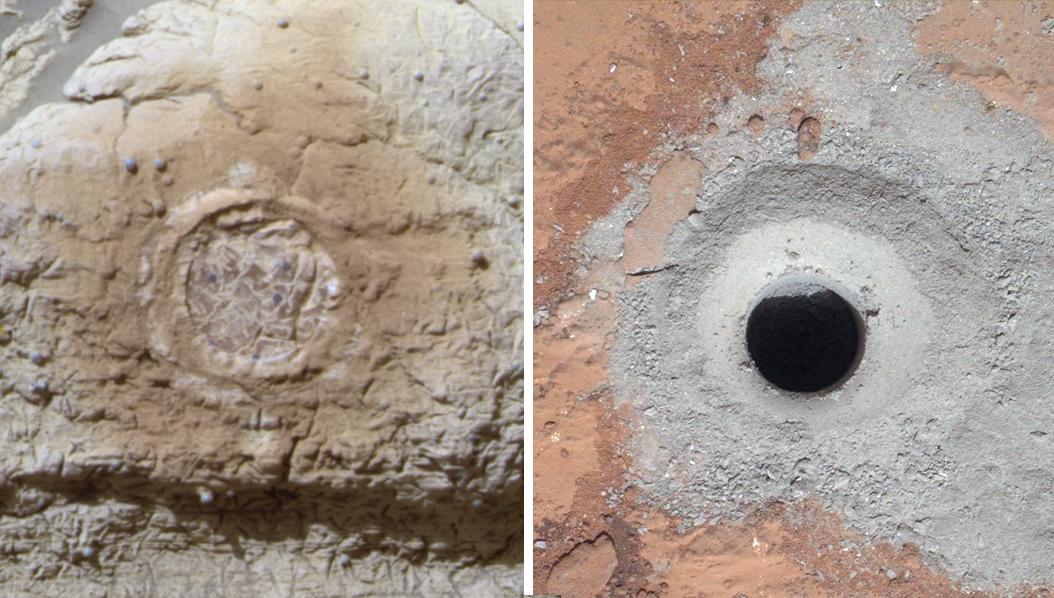
curiosity_drillsGood news (and bad) from the Red Planet! According to NASA, an examination of the fine-grained soil particles extracted by Curiosity, scientists have concluded that roughly 2 percent of Martian surface soil is made up of water. Though they did not find any traces of organic particles, this latest find confirms that water not only used to exist on the surface of the planet, but can still be found within.

These results bode well for future manned missions to Mars, wherein astronauts could mine the soil for water and study it to advance their understanding of Mars’ history. The findings, which were published today in the journal Science are part of a five-paper segment that began back in August of 2012 and is dedicated to Curiosity’s ongoing mission.

curiosity_drilling2Laurie Leshin, dean of the School Science at Rensselaer Polytechnic Institute and lead author of the paper, said in a NASA press release:

One of the most exciting results from this very first solid sample ingested by Curiosity is the high percentage of water in the soil.

These tests were conducted using the rover’s Sample Analysis at Mars (SAM), a collection of instruments that includes a gas chromatograph, a mass spectrometer, and a tunable laser spectrometer. The first soil samples were collected back in February when the rover used its drill tool for the first time and created a series of holes that were a little over 6 centimeters (2.5 inches) deep and collected the fine dust that resulted.

SAM_NASAOnce placed into the SAM assembly, the samples were heated to 835 degrees Celsius (1,535 degrees Fahrenheit). The gases that were released – which included significant portions of carbon dioxide, oxygen, and sulfur compounds – were then analyzed. The Mars Science Laboratory (MSL) also noticed that quantities of gaseous carbonite were found, which would suggests the presence of water in the Martian soil.

These positive findings were quite welcome, especially in light of the disheartening news last week that Curiosity has yet to crack the methane mystery. Back in 2003, scientists observed methane plumes coming from the planet, a strong indicator of microbial life, which sent scientific and professional interest in finding life on the red planet soaring.

Since that time, no traces of methane have been found, and it was hoped that Curiosity would finally locate it. However, the lack of methane thus far indicates that the rover has little chance of finding existing microbial life on the planet. But the existence of water in such great quantities in the surface soil brings scientists one step closer to piecing together the planet’s past potential for harboring life.

Curiosity_drillingsPaul Mahaffy, a lead investigator for SAM at NASA’s Goddard Space Flight Center, had this to say:

This work not only demonstrates that SAM is working beautifully on Mars, but also shows how SAM fits into Curiosity’s powerful and comprehensive suite of scientific instruments… By combining analyses of water and other volatiles from SAM with mineralogical, chemical, and geological data from Curiosity’s other instruments, we have the most comprehensive information ever obtained on Martian surface fines. These data greatly advance our understanding surface processes and the action of water on Mars.

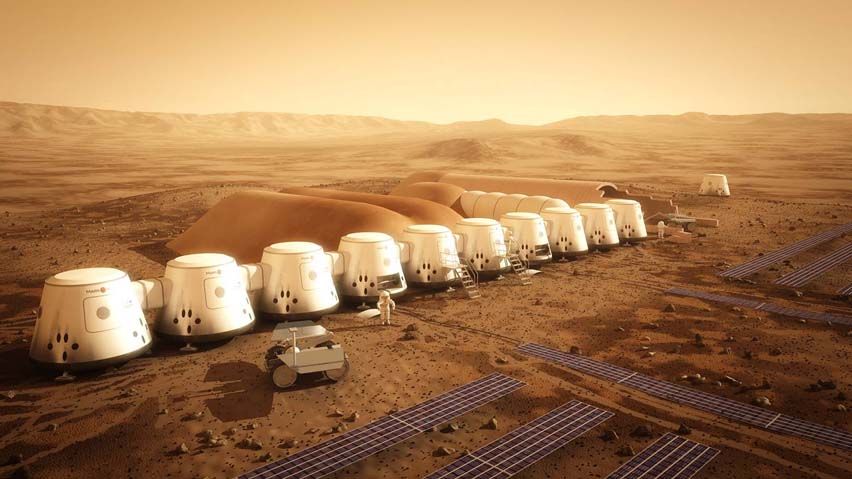
Given the renewed interest of late in manned missions to Mars – from nonprofit organizations like Mars One, privatized transportation companies like SpaceX, and the unofficial plans to mount a manned mission to Mars by 2030 by NASA – these findings are reassuring. In addition to providing fuel for hydrogen fuel cells for a return craft, subsurface water will be a boon for settlers and terraformers down the road.

mars-one-brian-versteegLeshin confirmed a cubic foot of soil, as opposed to the tiny sample Curiosity analyzed, could yield nearly 2 pints of condensation when heated. So volunteers who are planning on signing up with Mars One, pack your buckets and stoves and be prepared to do a lot of condensing! And perhaps we can expect “moisture farms” to become the norm on a colonized Mars of the future.

Source: news.cnet.com

News From Space: The Antares Rocket Launch!

antares_launch1Commercial space flight got a shot in the arm just two days ago thanks to the flawless launch of the privately developed Antares rocket from the NASA Wallops Flight Facility in Virginia. On board was the first of many Cygnus craft, a commercial unmanned cargo resupply vehicle that is now making its way to the ISS in orbit. It was a day of firsts, and signaled the beginning of a new space race.

For starters, it was the first time the launchpad in Virginia was used, not to mention the maiden flight of a Cygnus craft. But perhaps most importantly, it was the first time in a long time that supplies and equipment were bound for the International Space Station from American soil. Since its cancellation in 2011, NASA’s space program has been forced to rely on the Russians and an aging fleet of Soyuz rockets to send astronauts and supplies into orbit.

spaceX_elonmuskAnd, as already noted, it was a big day for commercial space flight, since both the Antares and the Cygnus were produced by the Orbital Sciences Corporation. For some time now, SpaceX has been leading the charge to develop rockets and spacecraft for private commercial use. Now, with NASA awarding OSC contracts to restore America’s ability to mount resupply missions, it seems they might have some competition.

The “picture perfect” blastoff took place at 10:58 a.m. EDT on the morning  of Sept. 18 from Virginia and was witnessed by a large crowd of spectators. The launch was reported as being incredibly beautiful as the rockets two stage engines spewed intensely bright flames and send out reverberations that wowed the people watching and woke people who were still asleep in the nearby community of Chincoteague.

antares_deploymentAnother historic first that bears mentioning is the fact that this latest mission happens to be the heaviest cargo load ever delivered to the ISS by a commercial vehicle. And by awarding contracts for such missions to private companies, NASA hopes to be able to free more of its budget up for long-term missions. These include exploration beyond low earth orbit, getting people back to the Moon and beyond to deep space destinations including Asteroids and Mars.

NASA Administrator Charles Bolden spoke glowingly of the launch in a statement and praised OSC for their role in making it happen:

Today marks a milestone in our new era of exploration as we expand the capability for making cargo launches to the International Space Station from American shores.  Orbital’s extraordinary efforts are helping us fulfill the promise of American innovation to maintain our nation’s leadership in space.

According to ongoing mission updates, the Cygnus spacecraft successfully unfurled its solar panels starting 1.5 minutes after separation from the second stage, which took place about 10 minutes after launch. Currently, Cygnus is traveling at 28,000 km/h (17,500 mph) and will rendezvous with the space station on Sunday, Sept. 22.

antares_launch2Once there, the cargo vessel will deliver about 590 kilograms (1,300 pounds) of cargo, including food, clothing, water, science experiments, spare parts and gear to the Expedition 37 crew. The flight, known as Orb-D1 is a demonstration mission to prove that Cygnus can conduct a complex series of maneuvers in space safely bringing it to the vicinity of the ISS.

And once the mission is complete and the supplies delivered, we can expect to be hearing about more missions like this one! Between SpaceX’s Dragon module, the Cygnus, and both companies ongoing rocket tests, space will is likely to become the new frontier where private enterprises carry out their endless dance of competition.

And of course, there are some cool videos of the launch to behold. So behold!

Time-lapse video of Antares deployment:


Antares launch:


Sources:
universetoday.com, (2)

News From Space… ShipTwo!

spaceshiptwo-2nd-flightVirgin Galactic’s founder Sir Richard Branson has been working tirelessly for over a decade now in the hopes of realizing the dream of privatized space travel. And earlier this month, his company once again made history with the second rocket-powered supersonic test flight of its SpaceShipTwo craft. And in the process, it broke its previous records for speed and altitude, bringing it that much closer to its first commercial flight.

The flight test took place last Thursday at 8:00 am PDT, when the SS2 took off slung beneath the WhiteKnightTwo (WK2) carrier aircraft from Virgin Galactic’s Mojave Air and Space Port in California. The SS2 was then released from the carrier at 14,000 meters (46,000 ft) and the rocket motor burned for 20 seconds, pushing the spacecraft to an altitude of 21,000 meters (69,000 ft) and a maximum speed of Mach 1.43 (1,752 km/h, 1,088 mph).

spaceshiptwo-2nd-flight-6According to the company, the tourism spacecraft went through its full technical mission profile in a single flight for the first time, including the deployment of its “feathering” re-entry mechanism at high altitude. This took place after engine shutdown and involved rotating the tail section to vertical, which slows the ship down and allows the shuttle to glide back home. The craft then landed in a controlled, unpowered glide at Mojave at 9:25 AM.

This flight builds on the success of the first rocket-powered supersonic flight that took place on April 29. Designed out of carbon composite, the space craft is powered by a hybrid rocket motor that uses solid rocket fuel and nitrous oxide as an oxidizer. Once test flights are complete, it will begin carrying six passengers on suborbital flights and will also have the option of deploying research equipment such as micro-satellites into Low-Earth Orbit (LEO).

spaceshiptwo-2nd-flight-1Naturally, the CEO and founder, Sir Richard Branson, chose to mark the occasion with some choice words:

We couldn’t be more delighted to have another major supersonic milestone under our belts as we move toward a 2014 start of commercial service. It was particularly thrilling to see for the first time today the whole elegant system in action during a single flight, including the remarkable feathering re-entry system. It was this safety feature more than anything else that originally persuaded us that the overall design of the system was uniquely fit for purpose. Everything we have seen today just confirms that view.

Next year, if all goes well, Virgin Galactic will be conducting its first commercial flights, ferrying passengers into low orbit where they will experience several minutes of weightlessness before gliding back to Earth. In this, they are joined by such groups as KLM, Golden Spike and SpaceX in attempting to create the first set of commercial space flights which will one day bring people to and from orbit, and possible even the Moon.

spaceshiptwo-2nd-flight-2And of course, Virgin Galactic was sure to capture the test flight on tape using a tail camera. It captures the engine burn, and then the near-vertical acceleration, as the craft puts planet Earth in its rear view and heads for atmo! Quite cool! Check it out:


Source: gizmag.com

News from SpaceX: More Tests and the Coming Launch

spaceX_elonmuskElon Musk just can’t get enough of the spotlight lately! But that’s the price you pay for being a billionaire, innovator, genius-type person! And barely a week after announcing his idea for the Hyperloop high-speed train, it now seems that SpaceX is once again making the news, thanks to its latest test of the Grasshopper reusable rocket system as well as their planned launch of the Falcon Heavy rocket.

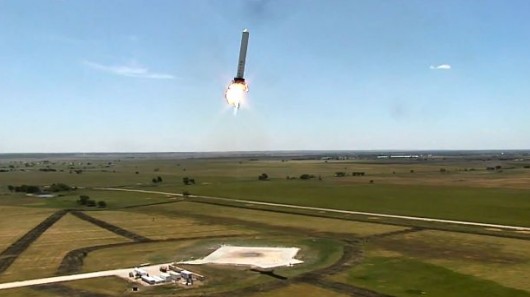
For those unfamiliar with the Grasshopper, this is a proposed reusable rocket system that Musk and SpaceX created with the hopes of bringing the costs associated with space launches down considerably. Since September 2012, the rocket has been put through successive tests, reaching higher and higher altitudes and safely making it back to the ground.

grasshopper_lateraldivertIn this latest test, the rocket successfully performed a “lateral divert test”. In all previous tests, the rocket lifted off vertically from a launch pad and then used its Merlin-1D engine to ease itself back down to the pad. However, in actual launch situations, the rocket wont simply be traveling up and down. When it comes time to land, a considerable amount of lateral steering will be necessary to line it back up with the launch site.

This is what the test, which took place on Tuesday, August 13th, amounted to. It began with the Grasshopper reaching its previously-achieved altitude of 250 meters, but then continued with the rocket moving an additional 100 m (328 ft) to one side. It was subsequently still able to land safely back at the center of the launch pad, compensating for its lateral diversion.

According to SpaceX: “The test demonstrated the vehicle’s ability to perform more aggressive steering maneuvers than have been attempted in previous flights.” What’s more, it places the company that much closer to the realization of a truly reusable rocket system, something which will drastically cut costs for future space missions.

And of course, they were sure to catch the entire test on video:


But equally important for this rising company that seeks to privatize space travel was the announcement that they have are moving ahead with plans to launch their Falcon Heavy rocket system by late 2013 or early 2014. At present, the Falcon is the most power rocket system in the world, overshadowed only by the now retired – but soon to be reserviced – Saturn V booster that put the Apollo astronauts into space and on the Moon.

spaceX-falcon9As Musk himself said of the rocket:

Falcon Heavy will carry more payload to orbit or escape velocity than any vehicle in history, apart from the Saturn V moon rocket, which was decommissioned after the Apollo program. This opens a new world of capability for both government and commercial space missions.

Fully loaded, the Falcon Heavy will be able to carry payloads of 53 metric tons (117,000 pounds or 53,070 kg) into orbit, and is made up of two engine stages. The first stage consists of a Falcon 9 rocket, with a nine-engine cores, followed by two additional nine-engine cores attached to either side. In addition, the Merlin engines have been upgraded to handle the additional weight, and are being tested at SpaceX’s facility in McGregor, Texas.

flacon-heavy-3At liftoff the 69.2m (227 ft) long Falcon Heavy will generate 3.8 million pounds of thrust, which is equivalent to the thrust of fifteen Boeing 747’s taking off at the same time. SpaceX claims that this gives the Falcon Heavy more than twice the performance of the next most powerful vehicle – the Delta IV Heavy operated by the Boeing-Lockheed Martin joint venture United Launch Alliance.

SpaceX also says that with more than twice the payload of the Delta IV but at one third the cost, the Falcon Heavy sets a new world record in terms of economy at approximately US$1,000 per pound to orbit. This is in keeping with Musk’s promise to bring the associated costs of space travel and exploration down, hopefully one day to his goal of $500 per pound.


spaceX_solararrayWith the ability to carry satellites or interplanetary spacecraft to orbit, SpaceX is offering the Falcon Heavy on the commercial market for US$80–$125 million, which compares to the $435 million per launch the U.S. Air Force has budgeted for four launches in 2012. So in effect, Musk’s company is offering a money-saving alternative to both the public and private sector.

For those fascinated by the long-term potential of space travel, this is certainly exciting news. By cutting the costs of placing satellites, supplies and people in orbit, many things are being made feasible that were previously impossible. This includes conducting more research in orbit, the ability to create space-based solar arrays (a very cool solution to our current power problems and the limitations of Earth-based solar power) and perhaps even begin work on a Moon settlement.

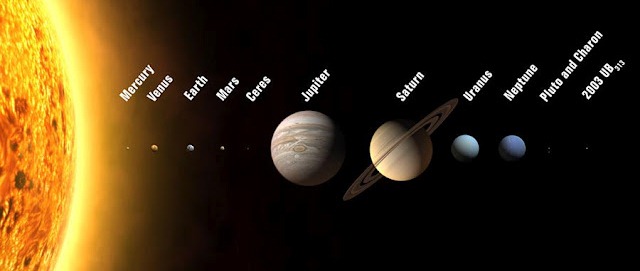
solar_system1Beyond that, there are the growing possibilities of commercial space travel, space tourism, and even setting our sights father afield with manned missions to the Moon, prospecting missions to the asteroid belt, and surveying probes to Jupiter’s Moons and to the very edge of the Solar System. Possibly even beyond…

Exciting times we live in, when the impossible is slowly becoming possible!

Sources: gizmag.com, (2), spacex.com


The Future of Transit: Elon Musk’s Hyperloop

hyperloopThe high-speed transit tube. It’s been a staple of science fiction for many years. Remember the tubes cars in Logan’s Run, the elevators in the Jetsons, or the tubes that shoot people around New New York in Futurama? Much like flying cars, they are a feature of a futuristic society that people have been waiting on. And thanks to Elon Musk, it might finally be coming true.

Yes, the same man that brought us the Tesla electric car, PayPal, and SpaceX is now working on a design for a high-speed transit system that works the same way as the pneumatic tube. In a series of statements and documents released yesterday, the billionaire entrepreneur unveiled his concept for a tube that could whisk passengers between Los Angeles and San Francisco in just 30 minutes – half the time it takes an airplane.

hyperloop1In the newly released documents, Musk outlined the basic design, which would consist of a low-pressure steel tube that houses capsules which move back and forth. The aluminum capsules (or pods) would have skis on the bottom containing holes that pump out air, creating an air cushion. They would be propelled forward with magnets found on the skis as well as an electromagnetic pulse generated by a series of electric motors.

Linear electric motors placed at each destination would slow the pods down by absorbing their kinetic energy. That energy would then be put back into battery packs and used to accelerate the next pods, or stored for future use. Solar panels on top of the tubes would also provide energy. The pods, which have room for 28 people each, could leave every 30 seconds – transporting up to 7.4 million people on each route (SF to LA or vice versa).

hyperloop2At 1290 kilometers per hour (800 mph) the above ground Hyperloop system would be dramatically faster than a bullet train or even an airplane. Alongside boats, planes, trains and automobiles, Musk claims that the train would constitute a “fifth form” of transportation. And of course, safety would be paramount, with each pod being spaced apart by 8 km (5 miles), and the system would have an emergency brake.

The system would also be designed to deal with seismic shifts, which are common in California. In order to mitigate earthquake risk, the system would be built on pylons (the tube wouldn’t be rigidly fixed at any point). Adjustable lateral and vertical dampers would be placed inside the pylons to “absorb the small length changes between pylons due to thermal changes, as well as long form subtle height changes.”

hyperloop3What’s more, Musk was sure to play up the comfort value of the ride:

Once you’re traveling the speed you wouldn’t notice the speed at all. It would be really smooth, like you’re riding on a cushion of air. Maximum G-force of about half a G, comparable to what you might feel in an airplane but far less than what you would feel in a rollercoaster. Really quiet.

Musk estimates that price tag per ride would be $20 per person, making the Hyperloop more reasonably priced than train, plane, or automobile. The whole project would cost an estimated $6 billion if it contained “people-only pods,” but would be priced at $10 billion if it had pods for both people and cars.

As it stands, its not entirely clear when the Hyperloop would be up and running. What’s more, its unclear what tole Musk would play in its creation. Since he is currently occupied with developing things like a nationwide Supercharger network for Tesla and launching satellites with SpaceX, he thinks it could be three to four years before a demo could be finished. As for a full system that would run from LA to San Francisco, that could take between seven to ten.

hyperloop4In any event, the concept is open-source, and Musk is calling on inventors, engineers and investors to get involved. Given that it is a rather elegant solution to the problem of transit, such an idea is not likely to remain idle for too long. Originally inspired by the sad state of $70 billion California’s high-speed rail initiative, the Hyperloop could easily prove to be another transportation initiative that is never completed. At the same time, it might prove to be a “leapfrog maneuver”, bypassing lightrail completely and ushering in something better.

It might sound like a fantasy, but Musk has a reputation for making the impossible a reality. What’s more, engineers from both Tesla and SpaceX have been working on the concept for close to a year and some are now dedicated to it full-time. And given that nations like China, India, Russia and the EU are in need of expanded transit systems, don’t be surprised if we see something similar emerging overseas.

And be sure to enjoy this video of the concept, courtesy of Elon Musk and CBC news:


Sources: cbc.ca, fastcoexist.com

Google CEO Wants Land Set Aside for Experimentation

future-city-1Back in May, Google co-founder and CEO Larry Page hosted a rare Q&A session with the attendees of the Google I/O keynote speech. During this time, he gave some rather unfiltered and unabashed answers to some serious questions, one of which was how he and others should focus on reducing negativity and focusing on changing the world.

Page responded by saying that “the pace of change is increasing” and that “we haven’t adapted systems to deal with that.” He was also sure to point out that “not all change is good” and said that we need to build “mechanisms to allow experimentation.” Towards that end, he claimed that an area of the world should be set aside for unregulated scientific experimentation. His exact words were:

There are many exciting things you could do that are illegal or not allowed by regulation. And that’s good, we don’t want to change the world. But maybe we can set aside a part of the world… some safe places where we can try things and not have to deploy to the entire world.

So basically he’s looking for a large chunk of real-estate to conduct beta tests in it. What could possibly go wrong?

detroit_experimentOne rather creative suggestion comes from Roy Klabin of PolicyMic, who suggest that an aging and dilapidated Detroit might be just the locale Page and his associates are looking for. This past week, the city declared bankruptcy, and began offering to sell city assets and eradicate retirement funds to meet its $18 billion debt obligations.

What’s more, he suggests that SpaceX founder Elon Musk, who’s always after innovation, should team up with Google. Between the two giants, there’s more than enough investment capital to pull Detroit out of debt and work to rehabilitate the city’s economy. Hell, with a little work, the city could be transformed back into the industrial hub it once was.

And due to a mass exodus of industry and working people from the city, there is no shortage of space. Already the city is considering converting segments of former urban sprawl into farming and agricultural land. But looking farther afield, Klabin sees no reason why these space couldn’t be made available for advanced construction projects involving arcologies and other sustainable-living structures.

dragonfly-vertical-farm-for-a-future-new-york-1Not a bad idea, really. With cities like Boston, New York, Las Vegas, New Orleans, Moscow, Chendu, Tokyo and Masdar City all proposing or even working towards the creation of arcologies, there’s no reason why the former Industrial Heartland – now known as the “Rust Belt” – shouldn’t be getting in on the action.

Naturally, there are some who would express fear over the idea, not to mention Page’s blunt choice of words. But Page did stress the need for positive change, not aimless experimentation. And future generations will need housing and food, and to be able to provide these things in a way that doesn’t burden their environment the way urban sprawl does. Might as well get a jump on things!

And thanks to what some are calling the “New Industrial Revolution” – a trend that embraces nanofabrication, self-assembling DNA structures, cybernetics, and 3D printing – opportunities exist to rebuild our global economy in a way that is cleaner, more efficient and more sustainable. Anyone with space to offer and an open mind can get in on the ground floor. The only question is, what are they willing to give up?

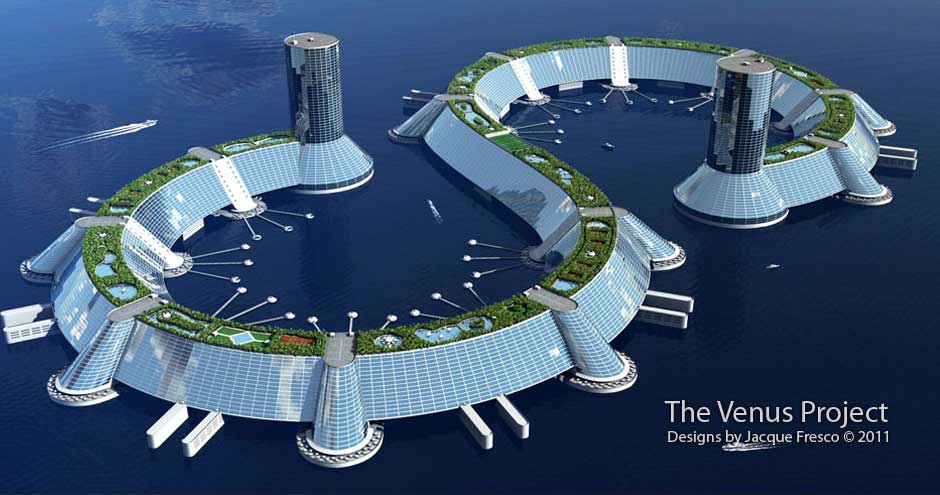
venus_projectThere’s also a precedent here for what is being proposed. The famous American architect and designer Jacque Fresco has been advocating something similar for decades. Believing that society needs to reshape the way it lives, works, and produces, he created the Venus Project – a series of designs for a future living space that would incorporate new technologies, smarter materials and building methods, and alternative forms of energy.

And then there’s the kind of work being proposed by designer Mitchell Joachim and Terreform ONE (Open Network Ecology). And amongst their many proposed design concepts is one where cities use vertical towers filled with energy-creating algae (pictured below) to generate power. But even more ambitious is their plan to “urbaneer” Brooklyn’s Navy Yard by turning natural ecological tissues into viable buildings.

future-city2This concept also calls to mind Arconsanti, the brainchild of architect Paolo Solari, who invented the concept of arcology. His proposed future city began construction back in the 1970 in central Arizona, but remains incomplete. Designed to incorporate such things as 3D architecture, vertical farming, and clean, renewable energy, this unfinished city still stands as the blueprint for Solari’s vision of a future where architecture and ecology could be combined.

What’s more, this kind of innovation and development will come in mighty handy when it comes to time to build colonies on the Moon and Mars. Already, numerous Earth cities and settlements are being considered as possible blueprints for extra-Terran settlement – places like Las Vegas, Dubai, Arviat, Black Rock City and the Pueblos and pre-Columbian New Mexico.

Black Rock City - home to "Burning Man" - shown in a Martian crater
Black Rock City – home to “Burning Man” – shown in a Martian crater

These are all prime examples of cities built to withstand dry, inhospitable environments. As such, sustainability and resource management play a major role in each of their designs. But given the pace at which technology is advancing and the opportunities it presents for high-tech living that is also environmentally friendly, some test models will need to be made.

And building them would also provide an opportunity to test out some of the latest proposed construction methods, one that do away with the brutally inefficient building process and replace it with things like drones, constructive bacteria, additive manufacturing, and advanced computer modelling. At some point, a large-scale project to see how these methods work together will be in order.

Let’s just hope Page’s ideas for a beta-testing settlement doesn’t turn into a modern day Laputa!

And be sure to check out this video from the Venus Project, where Jacque Fresco explains his inspirations and ideas for a future settlement:


Sources:
1.
Elon Musk and Google Should Purchase and Transform a Bankrupt Detroit (http://www.policymic.com/)
2. Larry Page wants to ‘set aside a part of the world’ for unregulated experimentation (theverge.com)

3. Six Earth Cities That Will Provide Blueprints for Martian Settlements (io9.com)
4. The Venus Project (thevenusproject.org)
5. Arcosanti Website (arcosanti.org)
6. Terreform ONE website (terreform.org)