Episode 105 – Megastructures (Part II) – is now live!

Episode 105 – Megastructures (Part II) – is now live!

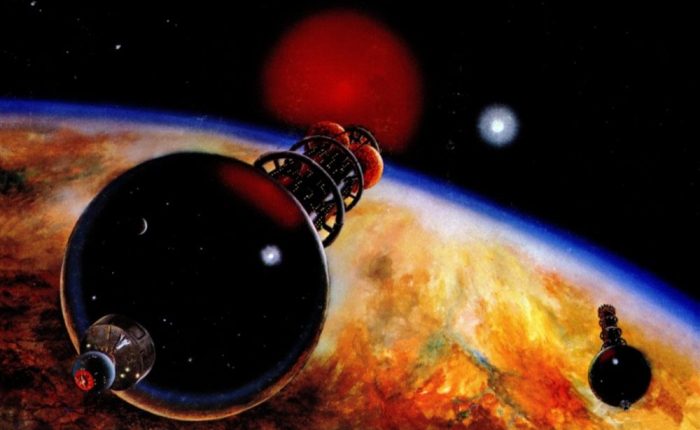
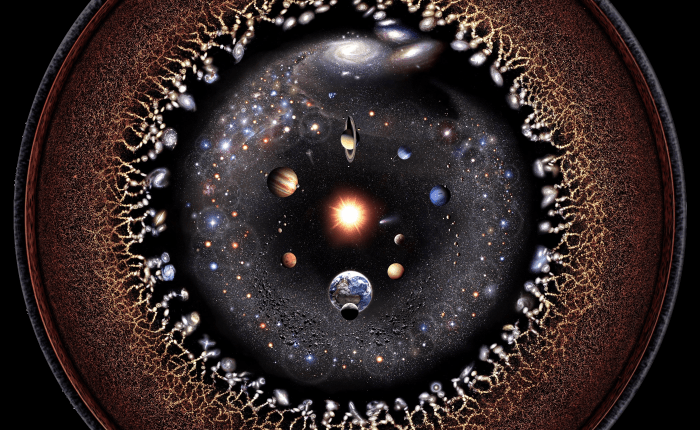
This week’s episode is the second installment in my series about megastructures. In the previous installment, we took a look at the Dyson Sphere, the concept that started it all, as well as variations like the Niven Ring and Matrioshka Brain. As promised, this episode examines some of the more exotic concepts for Dyson structures that could allow an advanced species to harness the power of its star. This includes the Alderson Disk and the Shkadov Thruster (pictured above and below).

Neil Blevins
Neil Blevins

These are all examples of megastructures that a Type II civilization (on the Kardashev Scale) could conceivably create. In part III, I hope to delve into proposed concepts that a Type I+ civilization could create someday (and that includes humanity). Some examples include a Space Elevator, an O’Neill Cylinder, a Stanford Torus, a Clarke Band, and more. As always, I will be referencing the artwork of Neil Blevins (and others) to illustrate what these fascinating concepts could look like. Follow the links below to learn more.
Where to Listen:

Episode 55 – “The Firstborn Hypothesis” – is now Live!

Episode 55 – “The Firstborn Hypothesis” – is now Live!

This week, I decided it was time to get back into the Fermi Paradox! This time, I addressed the Firstborn Hypothesis, the notion that humanity may be the first advanced civilization to emerge in our Galaxy. Much like the Brief Window Hypothesis, I’m not sure it’s an official proposal. In fact, I’m pretty sure I assigned a name to a general idea that has been raised many times over the years and is considered one of the more obvious resolutions.

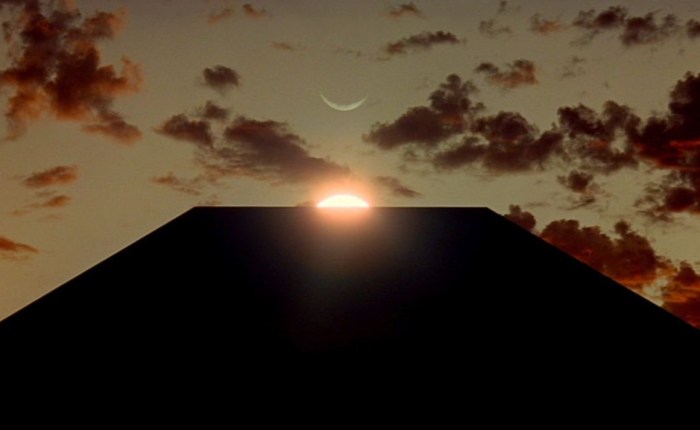
The name itself was inspired by Arthur C. Clarke’s 2001: A Space Odyssey. In this series, “Firstborn” is the name of the advanced species that was the first civilization to emerge in our galaxy. These were the aliens that created the monoliths and tampered with human evolution in the distant past, and are contemplating whether they made a mistake (and need to correct it) in the present. If true, then humanity has a pretty massive responsibility before it! Tune in to hear more:

Where to Listen:

Episode 53 – The Drake Equation – is now Live!

Episode 53 – The Drake Equation – is now Live!

For this week’s episode, I addressed one of the most important and well-known theories in the Search for Extraterrestrial Intelligence (SETI). It’s known as the Drake Equation, a thought experiment proposed by famed astronomer and SETI researcher Dr. Frank Drake. Drake presented this equation during the first SETI meeting in 1961, held at the Green Bank Observatory in West Virginia and attended by some of the most influential scientists of the day (including Carl Sagan). As Drake later said about his famous equation:

“As I planned the meeting, I realized a few day[s] ahead of time we needed an agenda. And so I wrote down all the things you needed to know to predict how hard it’s going to be to detect extraterrestrial life. And looking at them it became pretty evident that if you multiplied all these together, you got a number, N, which is the number of detectable civilizations in our galaxy.”

The equation basically states that the number of intelligent species we can communicate within our galaxy (N) can be determined by multiplying the average rate of star formation in our galaxy (R*) by the number of stars that have planetary systems (fp), the number of planets that are habitable (ne), the fraction of habitable planets where life will emerge (fl), the fraction of those where intelligent life will emerge (fi), the fraction of those that will develop transmission technologies that are detectable from space (fc), and the average longevity of civilizations (L).

To this day, the equation remains foundational to SETI and is comparable only to the Fermi Paradox and the Kardashev Scale. Dr. Frank Drake passed away on September 2nd, 2022, at the age of 92. He is one of many luminaries to pass on in recent years, like Stephen Hawking (2018) and Freeman Dyson (2020), and he will be missed!

Where to Listen:

Episode 52 – Going Interstellar: Generation Ships! – is now Live!

Episode 52 – Going Interstellar: Generation Ships! – is now Live!

This week’s episode focuses on a time-honored proposal for interstellar travel. Known as a Generation Ship (or Interstellar Ark, Arkship, etc.), the concept envisions a massive starship that can accommodate multiple generations of crews as they travel to nearby stars. The basic philosophy is that if you can’t go fast enough to get there within a single lifetime, then pack for the long haul! But of course, there are lots of considerations that need to be addressed in advance.

A lot can happen on a multi-generational interstellar voyage, which is why Generation Ships are a wonderful setting for science fiction stories! These include Robert A. Heinlein’s Orphans of the Sky, Poul Anderson’s Tau Zero, Arthur C. Clarke’s Rendezvous with Rama, Ursula K. LeGuin’s Paradises Lost, Kim Stanley’s Robinson’s Aurora, and something I’m currently working on (titled Traverse). Check out the episode below…

Where to Listen:

Episode 51 – The Relativity Revolution: The Life and Times of Albert Einstein – Part II – is now live!

Episode 51 – The Relativity Revolution: The Life and Times of Albert Einstein – Part II – is now live!

In Part I, we looked at the early life and education of Einstein and the steps that would eventually lead him to his groundbreaking theory of Relativity. In this second installment, we examine the implications of his theories, his later contributions to the sciences, and the years he spent in exile due to the rise of Nazi Germany. And, of course, there’s his enduring legacy, which includes theories like Dark Matter, Dark Energy, and the most predominantly accepted cosmological model that is still in use to this day.

Here’s where you can check it out…

Where to Listen:

Episode 49 – “Where is Everybody?” Our Interstellar Future with Prof. Avi Loeb – is now live!

Episode 49 – “Where is Everybody?” Our Interstellar Future with Prof. Avi Loeb – is now live!

This week I sat down with Israeli-American theoretical physicist Professor Avi Loeb, the Frank B. Baird Jr. Professor of Science at Harvard University, the longest-serving Chair of the Department of Astronomy, the founder of Harvard’s Black Hole Initiative (BHI), and director of the Institute for Theory and Computation (ITC) at the Harvard-Smithsonian Center for Astrophysics. He is also the founder of the Galileo Project, a public project dedicated to the investigation of Unidentified Aerial Phenomena (UAP), and the Chairman of the Advisory Committee of Breakthrough Starshot.

A few years ago, Prof. Loeb became the focus of international attention when he suggested that the interstellar object ‘Oumuamua might be an extraterrestrial probe. With the release of the “UFO File” in 2021 by the Office of the Director of National Intelligence (ODNI), Loeb and many of his colleagues launched Project Galileo to assist with the transition where UAP studies are now the subject of open scientific research rather than a clandestine affair overseen by government agencies. We touched on all these topics during our conversation. Check it out below!

Where to Listen:

Episode 48 – “Where Are All the Aliens? The Dark Forest Hypothesis” – is now Live!

Episode 48 – “Where Are All the Aliens? The Dark Forest Hypothesis” – is now Live!

This week’s episode was dedicated to another proposed resolution to the Fermi Paradox. This one was inspired by the novel of the same name, The Dark Forest, written by Chinese science fiction author Liu Cixin. The book is the second installment in the Memories of Earth’s Past trilogy, which started with The Three-Body Problem. The concept is explained thusly:

“The universe is a dark forest. Every civilization is an armed hunter stalking through the trees like a ghost, gently pushing aside branches that block the path and trying to tread without sound. Even breathing is done with care. The hunter has to be careful, because everywhere in the forest are stealthy hunters like him. If he finds other life — another hunter, an angel or a demon, a delicate infant or a tottering old man, a fairy or a demigod — there’s only one thing he can do: open fire and eliminate them. In this forest, hell is other people. An eternal threat that any life that exposes its own existence will be swiftly wiped out. This is the picture of cosmic civilization. It’s the explanation for the Fermi Paradox.

I got an especially nice surprise while prepping this episode. While looking for possible links to include, I came across a link to the University of Edinburgh. On Halloween night in 2021, Dr. Anna Lisa Varri delivered a lecture at the Higgs Center for Theoretical Physics about the Dark Forest Hypothesis. Guess who she listed as her first source? ME! Or rather, the article I wrote for Universe Today about six months prior! How cool is that? Check it out below…

Where to Listen:

The Best Astronomy Podcasts for 2023

The Best Astronomy Podcasts for 2023

I have to this, this was a complete surprise and I didn’t even realize anyone was keeping track. And yet, my friend and colleague James Maynard brought this bit of news to my attention. The list comes from PlayPodcast.net, a site that that offers free listening for hundreds of podcasts and (apparently) ranks them according to various categories. For this list, they ranked the best astronomy podcasts this year.

Guess who made the list?

I’m not sure if this represents their own assessment or based on reviews, but I’ll take it. Also, note that The Cosmic Companion is the podcast of my buddy James. I invite you to check it out seeing as how he has some very cool stories, is a NASA alumni, and interviews some very interesting people (scientists, researchers, astronauts, etc.).

Episode 37 of Stories from Space – “Where Are All the Aliens? The Planetarium Hypothesis” – is Now Live!

Episode 37 of Stories from Space – “Where Are All the Aliens? The Planetarium Hypothesis” – is Now Live!

This week, I got into another favorite proposed resolution to the Fermi Paradox. In 2001, famed scientist and SF author Stephen Baxter wrote a paper titled “The Planetarium Hypothesis – A Resolution of the Fermi Paradox.” Addressing Fermi’s question, Baxter suggested that the reason humanity hasn’t heard from advanced civilizations is that the Universe (as we know it) is a simulation.

To put it another way, what we see when we look up at the night sky is a giant virtual reality “planetarium” built by an advanced species to give the illusion of an empty Universe. The purpose of this could be to keep humanity contained, possibly for its own good or that of other species (i.e., intelligent life is dangerous), or to keep less-advanced species from developing too quickly and becoming a threat.

Like the Berserker Hypothesis, the idea is science fiction gold but admittedly unlikely (phew!) Another problem is that the hypothesis is untestable. While Baxter and other scientists suggested ways this theory could be tested (based on the principles of quantum mechanics and thermodynamics), critics have pointed out that the laws of physics themselves could be part of the simulation.

Personally, I think that the laws of physics and the fact that they make space exploration so challenging is the most compelling evidence for the hypothesis. What better way is there to control the growth of a species than to set the physics model to “extra hard”? If I were an advanced civilization looking to keep a species in the dark, this is precisely what I’d do! Check it out below:

Where to Listen:

Stories from Space is now Live!

Stories from Space is now Live!

It’s officially Launch Day! My podcast series, Stories from Space, just released its first episode. The topic, “We’re Going Back to the Moon!” talks about Artemis and related programs that will send astronauts back to the lunar surface with the long-term goal of establishing a sustained human presence on the Moon. Mostly, the episode addresses the question: why did it take us over fifty years to go back?

Answering a question like that takes about half an hour (or the length of a podcast episode). You can check it out at the Stories from Space homepage (https://www.itspmagazine.com/stories-from-space), or just click on the play button below. The episode is also available for streaming on Spotify and Apple