
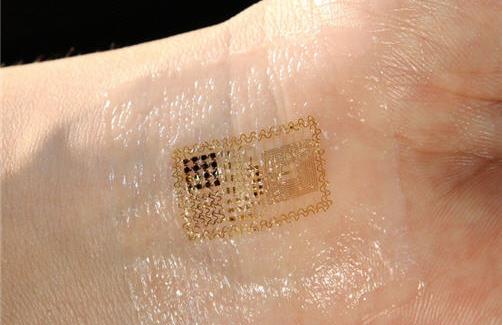
 One of the newest and greatest developments in medical technology of late has been the creation of electronics that can stretch and flex. Increasingly, scientists are developing flexible electronics like video displays and solar panels that could make their way into clothing or even bodies. But of course, some challenges remain, specifically in how to power these devices.
Thus far, researchers have been able to develop batteries that are thin and bendable, flexibility has proven more of a challenge. In addition, no stretchable batteries have thus far offered rechargeability with high the kind of storage capacity that one might expect from the lithium-ion technology now powering many smartphones, tablets, laptops and other mobile devices.
 However, that may be changing thanks to two research scientists – Yonggang Huang from Northwestern University and John A. Rogers University of Illinois. Together, they have unveiled a rechargeable lithium-ion battery that can be stretched, twisted and bended, and is still capable of powering electronics. What’s more, the power and voltage of this battery are similar to a conventional lithium-ion battery and can be used anywhere, including the inside of the human body.
Whereas previous batteries of its type had a hard time stretching up to 100 percent of their original size, this new design is capable of stretching up to 300 percent. Huang and Rogers have indicated that this will make it ideal for powering implantable electronics that are designed for monitoring brain waves or heart activity. What’s more, it can be recharged wirelessly and has been tested up to 20 cycles of recharging with little loss in capacity.
 For their stretchable electronic circuits, the two developed an array of tiny circuit elements connected by metal wire “pop-up bridges.” Typically, this approach works for circuits but not for a stretchable battery, where components must be packed tightly to produce a powerful enough current. Huang’s design solution is to use metal wire interconnects that are long, wavy lines, filling the small space between battery components.
In a paper published on Feb. 26, 2013 in the online journal Nature Communications, Huang described the process of creating their new design:
“We start with a lot of battery components side by side in a very small space, and we connect them with tightly packed, long wavy lines. These wires provide the flexibility. When we stretch the battery, the wavy interconnecting lines unfurl, much like yarn unspooling. And we can stretch the device a great deal and still have a working battery.”
No telling when the first stretchable electronic implant will be available for commercial use, but now that we have the battery issue worked out, its only a matter of time before hospitals and patient care services are placing them in patients to monitor their health and vitals. Combined with the latest in personal computing and wireless technology, I also imagine everyone will be able to keep a database of their health which they will share with their doctor’s office.
And be sure to check out the video of the new battery in action:
Source: neurogadget.com


 Stories by Williams