
 And I’m back with the sixth and final installment in the 2014 Williams’ Family Eurotrip! And luckily, this one should prove to be the shortest, since our adventures during these last few days really don’t require any historical background. In reality, our last five days in Paris were spent seeing sight after sight, walking the city, drinking up the local culture and relaxing. So there’s plenty to describe and share, but most of it speaks for itself!
Monday, April 21st – Friday, April 25th – Paris and Nanaimo:

As so often happens on a trip, Monday was a day set aside for doing laundry and making sure our wardrobe lasted to the end. So, after breakfast at the hotel, we ventured down to the laundromat and figured out how to work the archaic machines. My mother seemed to remember, as this was the exact same laundromat she had used when she came to France with my sister in 1990 (did I mention they stayed at the same hotel too?) Anyhoo, Carla and I decided we would go for a run while our clothes washed and dried. This took us from our hotel down to the Seine, where we then headed south along the water to get the bridge that would take us to the Bastille Square. This was something we did not get to see the day before on our bus tour, so we decided now would be a good opportunity.
Very quickly, we noticed that the air quality was different than what we were used to. Living in small town BC, our outdoor runs are always characterized by meadow air intermixed with ocean breezes. But Paris, with its many million vehicles and mass transit system, can be forgiven for not being so pure. But of course, the sights were much more plentiful. Along the Seine, between the Pont de la Tournelle and the Pont de Sully, we saw the Statues en Plein Air art exhibit that runs along the south side. I have to admit, I didn’t examine the artwork much, but what I did see seemed very “moderne”.
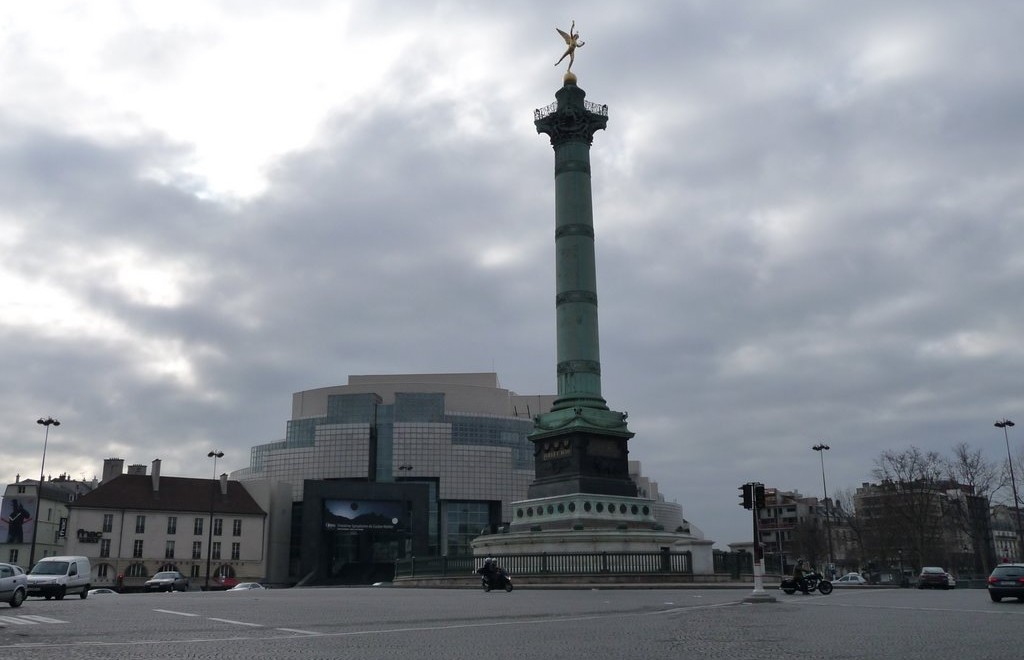
After crossing the Pont de Sully, we ran up Boulevard Henry IV and reached the Place de la Bastille. The July Monument stood in the center of a roundabout, which we ran around to get a good look of! At the base, the inscription of July 1830 appears in gold, commemorating the July Revolution – otherwise known as the Second French Revolution. The square is jam packed with stores, cafes, cobblestone walk ways, and straddles three separate arrondissements (districts), with half a dozen other landmarks located nearby.
After rounding the Square and running back the way we came, and saw something a little odd. On the Seine, right next to the Pont de Sully, a group of police divers were out in a zodiac, their truck parked on the walkway next to the water. The divers pulled what looked like a body out of the water, and once they got it aboard, one of them began doing chest compressions. I chose to interpret this as an training exercise where the rescue divers were pulling a mannequin out of the water and practicing CPR. But Carla remains convinced that they were pulling a jumper out of the water and trying to resuscitate him. We’re still divided on this…

Anyway, we arrived back at the laundromat a little while later and helped my folks escort our clothing home. It was nice to be able to get a second round out of our gear, we changed and showered, and walked to the Ile de la Cite. It was our hope to see Notre Dame’s interior; unfortunately, the lineup was prohibitively long! But it was Easter Monday, so that didn’t come as a huge surprise. So we decided we’d try again on the morrow and decided to carry on to our next destination.
Luckily enough, we were able to snap plenty of picks of the Cathedral, the Square of Jean XXIII, and the awesome statute of Charlemagne that sits out in front. For those who don’t know, he was the Carolingian (aka. Frankish) king who reigned during the late 8th and early 9th century, became Emperor of a western Europe and even led campaigns against the Moors in Spain. Naturally, I had to get a picture of him for our album. But I asked Carla to also take one of me standing in front of the statute because I really liked the look of his beard, and hoped people might see some similarities.

And so we decided to carry on to the Louvre. But first, we needed some lunch. This we found at a restaurant sitting next to the Palais de Justice nearby, which was temporarily closed to the public for renovations. After some sandwiches and coffee, we proceeded to check out the Marche aux Fleurs (Flower Market) next to us, which was jam packed with animals – including some livestock – and carried on. After crossing another bridge, we landed on the east side of town and walked up the Quai de la Megisserie.
As it turned out, was also packed with animals! And by that I mean, pet stores. I’m not sure how many hours we spent visiting each and every one of these, but it was a few. But I guess that’s what happens when you take cat owners and animals lovers away from their pets! After shaking off the guilt of not being able to take every puppy and kitten home with us, we continued on our way to the Louvre, which was just a few more blocks away.

Entering the museum was a bit of a task. First, we had to walk through the former Palace grounds, which is jam packed with vendors – people selling miniature Eiffel Towers and even one guy roasting chestnuts! – and then into the main grounds where the glass pyramid (as shown above) sits. Here, the lineups and crowds were to be found, and lots of signs out telling us to keep an eye on our handbags (thieves and purse cutters like to work there!)
But surprisingly, the wait time was only a half hour or so, and the lineup not as unbelievably long as we suspected. And before we knew it, we were inside and going down the escalator to the entrance foyer. To be fair, everyone in the family had been to the Louvre before, save me. So I was naturally quite impressed when we got inside and looked around. Many escalators ran from the ground to this area, and there were literally hundreds of people crowded in there. And from this spot, multiple staircases lead up to the adjoining floors where all the exhibits that cover the entirety of human civilization are kept.

We grabbed out tickets, some maps, and looked for our way out. After perusing the layout and debating what we’d like to see first, we decided to head over to the ancient world exhibits. We started with the Ancient Near East, which was filled with examples of ancient Mesopotamian sculptures, stone work, mosaics, and statues. As we walked through the many connected rooms, we were treated to pieces of the region’s later history, dating back as far as 7000 BCE and spanning the civilizations of Ancient Sumeria, Babylon, Iran and the Levant.
Now I’m not exaggerating in the slightest when I say that everything we saw was pretty damn kickass and impressive! But of particular interest, at least to me, were the Stele’s and tablets that contained ancient Sumerian and Babylonian script. And when I finally found the Stele showing the Code of Hammurabi and the tablets with the sections of the code written on it, I was sure to snap some pictures of them! This, and other examples of ancient writings, are amongst the most important historical objects in existence, and it was kind of mind-blowing being in their presence for the first time.

As you can see from the photo above, the front end of the Stele (which is sometimes referred to as a “fingernail” because of its shape) shows Hammurabi sitting on his throne where he is dispensing the law to what appears to be a Babylonian subject. Beneath that, the code is listed in its entity, setting out various rules of jurisprudence, religion, trade, slavery, the duties of workers, the distribution of food, and the punishment for infractions. Click on the pictures to get a better look.
We then doubled-back and went through the Greek antiquities, where my wife asked that we snap a photo of Aphrodite (aka. Venus de Milo) since this was the one major exhibit she missed on her previous trip. Like most of the main exhibits in the museum, get a close look at this one proved tricky. But I somehow managed to get a few shots using her iPod Touch camera, and some of them weren’t too blurry. Check it out below:

After working our way through the 18th-19th century French Sculptures wing, we doubled back to the Pharaonic Egyptian wing to see the statue of Ramses II. This area also proved to be pretty crowded! And it was here, amidst several sphinx statues, Egyptian columns, and some tall walls designed to look like massive sandstone brickwork, that we got a look at the famous Pharaoh who is chronicled by Egyptian, Biblical, and Greek sources, and who was caricatured by English Romantic poet Percy Bysshe Shelley in his poem “Ozymandias”.
And yet, I have to say, this statue was not that impressive. Seating in the corner next to many others and flanked by columns and big walls, he seemed like merely a part of the larger exhibit and not the focal point, as the map would seemed to suggest. But this came as no huge surprise, considering that his significance – while great in terms of Egyptian history – is a bit uncertain as far as Biblical and western sources are concerned. To this day, there is no actual proof that this is the man Noah said “let my people go” to, or that the Egyptian captivity actually happened. But what can you do?

After this, we began making the long trek to the 1st floor so we could see the piece de resistance, the Mona Lisa! Given the size of the palace and the layout, this was no easy task, and we had to weave our way about while someone stood in the front with the map open, calling out directions and making sure we all stayed together in the midst of the crowds. But we succeeded, and found ourselves just one room over from the Mona Lisa.
However, I insisted we pause for second to witness some of the 19th century French Paintings, which this room was dedicated to. Mainly because it was here that the painting of The consecration of Emperor Napoleon I was to be found (seen above). As a historian, this painting was of great interest to me and the events it captured were nothing if not extremely relevant. So after getting a good shot of the rather massive painting, we proceeded into the densely-packed Mona Lisa exhibit.

As expected, it was very difficult to get a clear shot of this historic portrait, and the one seen below was about the best we could manage. So thick was the crowd that the only way to get a photo was to hold your camera up high and snap one from a few meters away. The painting was also significantly smaller than I expected, and was kept behind protective wall of glass. But after a few quick pics, we decided we’d done all we could and decided to call it a day! Our feet and knees were hurting, and we were all pretty tired.
After returning to the hotel, we decided to have a low key dinner consisting of food that was bought at a patisserie shop on the way back. Between some baked quiches, sandwiches, delectable deserts, and a few bottles of Leffe Brune, we were all sated and didn’t even need to go out for dinner that night. However, I was determined to check out some of the bars down the street, and the wife and I concluded the evening with a few pints at some of the local pubs.

This included the Mayflower, which was about a block away from us and had some wonderful Belgian beers that I know and love on tap. But being an English-themed pub, they served them in pint glasses! This is pretty impressive when you consider that Belgian ales – most of which are centuries-old operations run by Abbeys and Monasteries – range from 6-10% alcohol and accordingly come in 330 ml bottles or are served in chalice glasses. As such, a full pint (568 ml or 20 oz) of this kind of beer is likely to pack a serious wallop!
After a few of these, we proceeded to the next stop down the street, a place known as Teddy’s, where I drank a bit more. I was determined to try all of the taps I did not recognize and could not easily find back home. After we did this, we headed back to the hotel for some hard sleep. Unfortunately, we had a freak accident in our room which made the next few days a little bit difficult. Basically, I was reading from my iPad in bed, and when my wife – who was laying next to me – turned to look up at it, the corner of it got her in the eye. To make matters worse, I freaked out and dropped it, making a bad situation even worse!

We lay up in bed for awhile while she tried to nurse her throbbing eye. After finally getting to sleep, she woke up the next day with a terrible headache and throbbing eye pain. And that is how Carla got a black eye in Paris! As a result of it, we cancelled out plans with my folks for the day and took it easy. After a late morning and breakfast, we walked around the Latin Quarter, bought lunch from a local market, and walked down to the Pantheon, which was also just a few blocks away from the hotel. Situated next to the Law School of the Universite de Paris and the Lycee Henry IV, the place was packed with students eating lunch, and the smell of weed was in the air!
Originally built as a church dedicated to St. Genevieve, the Pantheon has changed quite a bit over the centuries and now functions as a secular mausoleum containing the remains of several distinguished French citizens – among them such greats as Voltaire, Jean-Jacques Rousseau, Victor Hugo, Emile Zola, Louis Braille, and Marie Curie. We never did get inside, but we enjoyed the lovely walk, and even managed to squeeze in a quick visit to a British-themed local pub called the Bombardier. Then, it was back to the hotel, dinner with my folks at the Petit Gaston (for the second time), and to promptly to bed. Because on Wednesday, we had another big day!
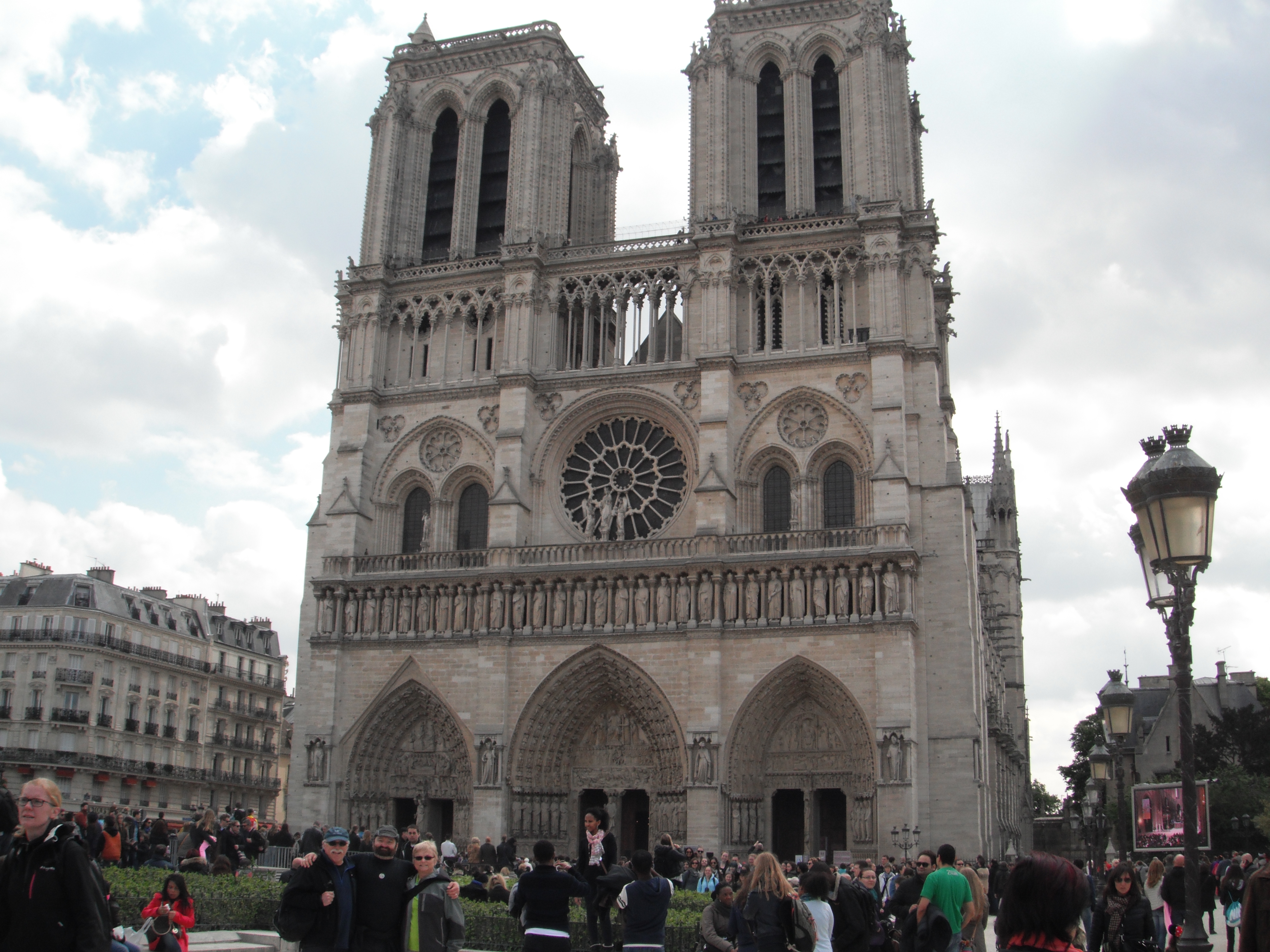
It consisted of us visiting the place we saw on the bus tour on foot, or at least as we possible could in a single day. We had hoped to do much of this on Tuesday, but Carla’s eye injury – which I will forever carry a terrible shame for! – put a hold on that. But feeling so much better, we decided to give it a go and proceeded first to the Notre Dame Cathedral. Since it was no longer Easter Weekend, we figured we stood a better chance of getting in. And lo and behold, we did! Despite the long line ups, the crowd proceeded inside at a rapid pace and we found ourselves stepping into this ancient cathedral before long.
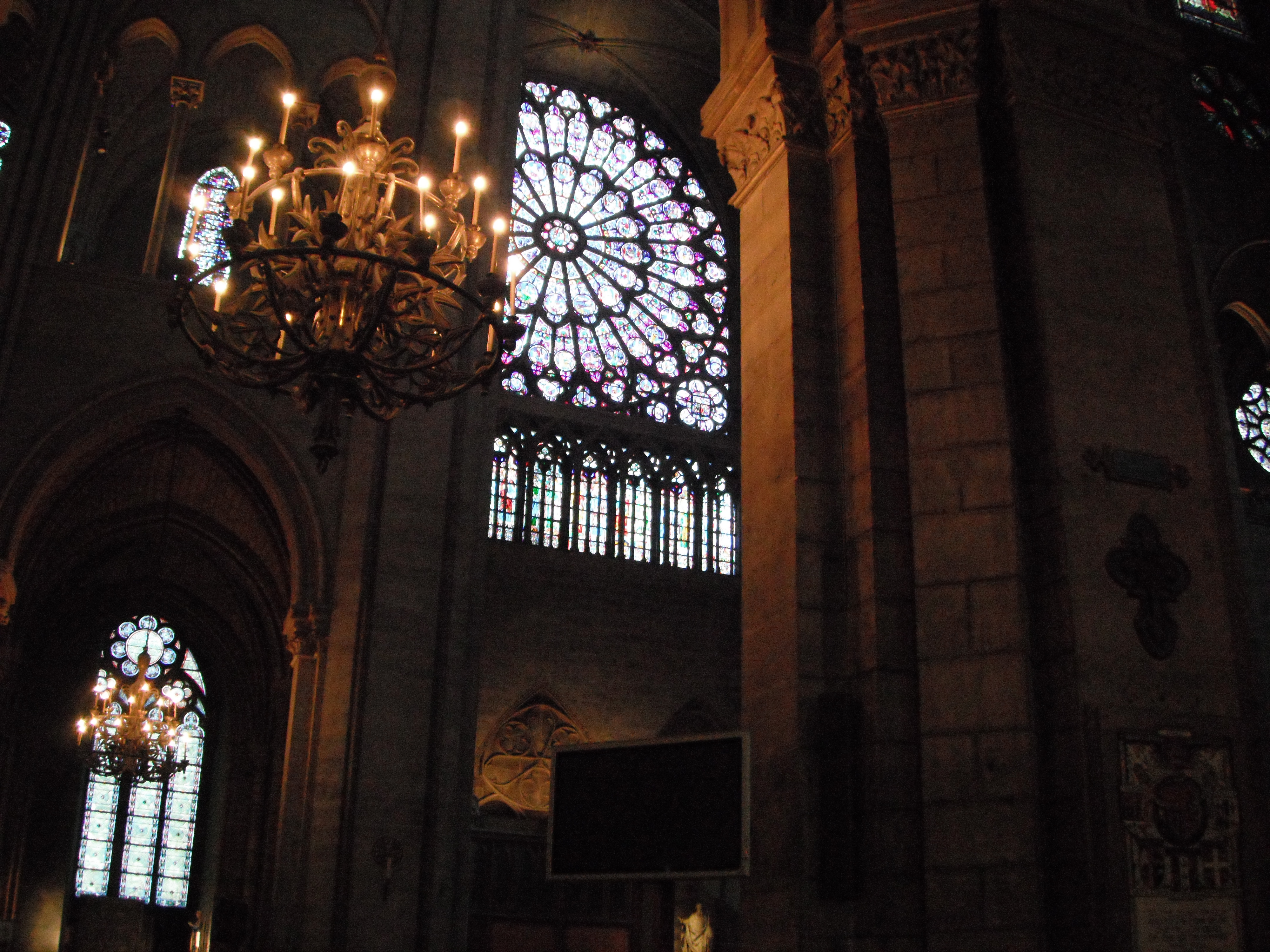
Once inside, we were treated to the musty smell, the sounds of chanting, light streaming in from countless stain glass windows, and plenty of amazing art and architecture. As usual, my father explained all features and told us exactly how it differed from the Cathedrals at Chartres and Bayeux. Not surprisingly, this one was the largest we visited to date, and I was sure to get one of the commemorative gold coins from the machine near the entrance. This upped my collection of these tourist keepsakes to four, with coins from the Juno Beach Museum, the Caen Memorial Museum, the Bayeux Tapestry Museum, and the Notre Dame Cathedral.
And then, it was off to the Tour Eiffel, which we hoped to be able to ascend and catch sight of the city from on high. However, when we arrived, the lineups proved to be absolutely terrible, and one of the stairwells that connects to the first landing was closed. However, we did catch some lovely break dancers putting on a show at the foot of the tower. We also got to see several soldiers wandering with their FAMAS assault rifles hanging over their shoulders. Similar to what we saw at Charles de Gaulle, this is apparently what passes for normal in Paris. For this humble Canuck, this was a little frightening and but also freaking cool!
So we meandered around the tower for awhile, checked out the Field of Mars located nearby, and walked the entire length of it and rubbed shoulders with some interesting people along the way. We also snapped about half a dozen pics of the Tower itself, including the WIlliams’ family portrait shown below. Once we reached the far end of the field, we rounded the Academie Militaire and proceeded on foot to our next destination – the UNESCO Headquarters. As a heritage register officer, Carla was keen on seeing this place.

This took some time, and we once again stopped at a roadside restaurant to get some lunch. And I got to say, the building itself was pretty un-ostentatious compared to some of what we’d already seen. But our visit just happened to coincide with a series of displays for International Book and Copyright Day. Trust me, this is actually a lot more fun than it sounds! As we walked down the hallway, we passed dozens of exhibits celebrating different books, styles of writing, animation, and the like. Carla and I sat down at one of the Calligraphy boots, which taught Georgian style writing, and began to learn.
This included the proper way to apply ink to a traditional calligraphy pen and write letters and symbols in the Georgian style. This part was definitely fun, and Carla and I did pretty well for ourselves! She’s a quick study, and calligraphy is kind of my thing. The instructor noted this, and told Carla “Il est fort” (he’s strong) with a degree of wonder and pride in his voice. I didn’t tell him that I’ve actually been doing it for year, even though my preferred style is Black Letter Gothic and I have no formal training.
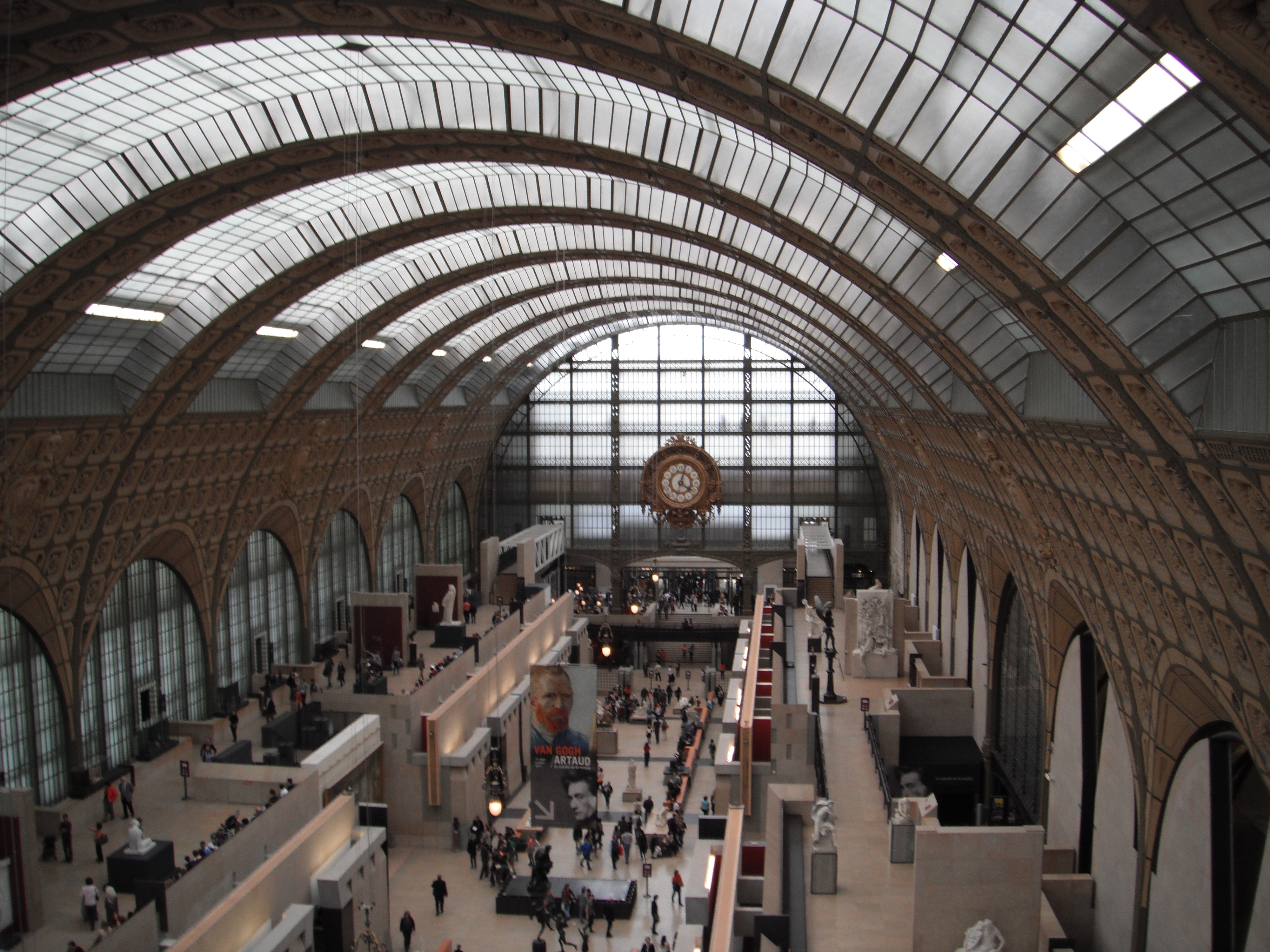
And then, for our last stop, we went back along the Seine and stopped in at the Musée d’Orsay. Another line, another long wait, and we were inside, surrounded by Paris’ premier museum of sculpture and art. Carla and my mother sure enjoyed this part. Unfortunately, I had had too much sun that day and my feet were too tired for me to really getting into the spirit of things. Still, it was impressive to see so many impressionist paintings, sculptures, and in one place. Van Gogh was unfortunately not available, since his work was part of a special exhibit. Still, we spent some serious time in the converted train station, and took some rather magnificent pics before finally calling it a day.
We walked back to the hotel along Boulevard St. Germaine, the Seine-adjacent strip that is packed with stores, restaurants, and greenery. We stopped by the 2 Magots (pronounced maj-oats), a restaurant frequented by Hemmingway in his day. Across the street, we also caught a glimpse of the apartment where existentialist philosopher Jean Paul Sartre and philosopher and renowned feminist writer Simone de Beauvoir lived. It really is amazing sometimes how little you have to do in Paris to experience some serious history.
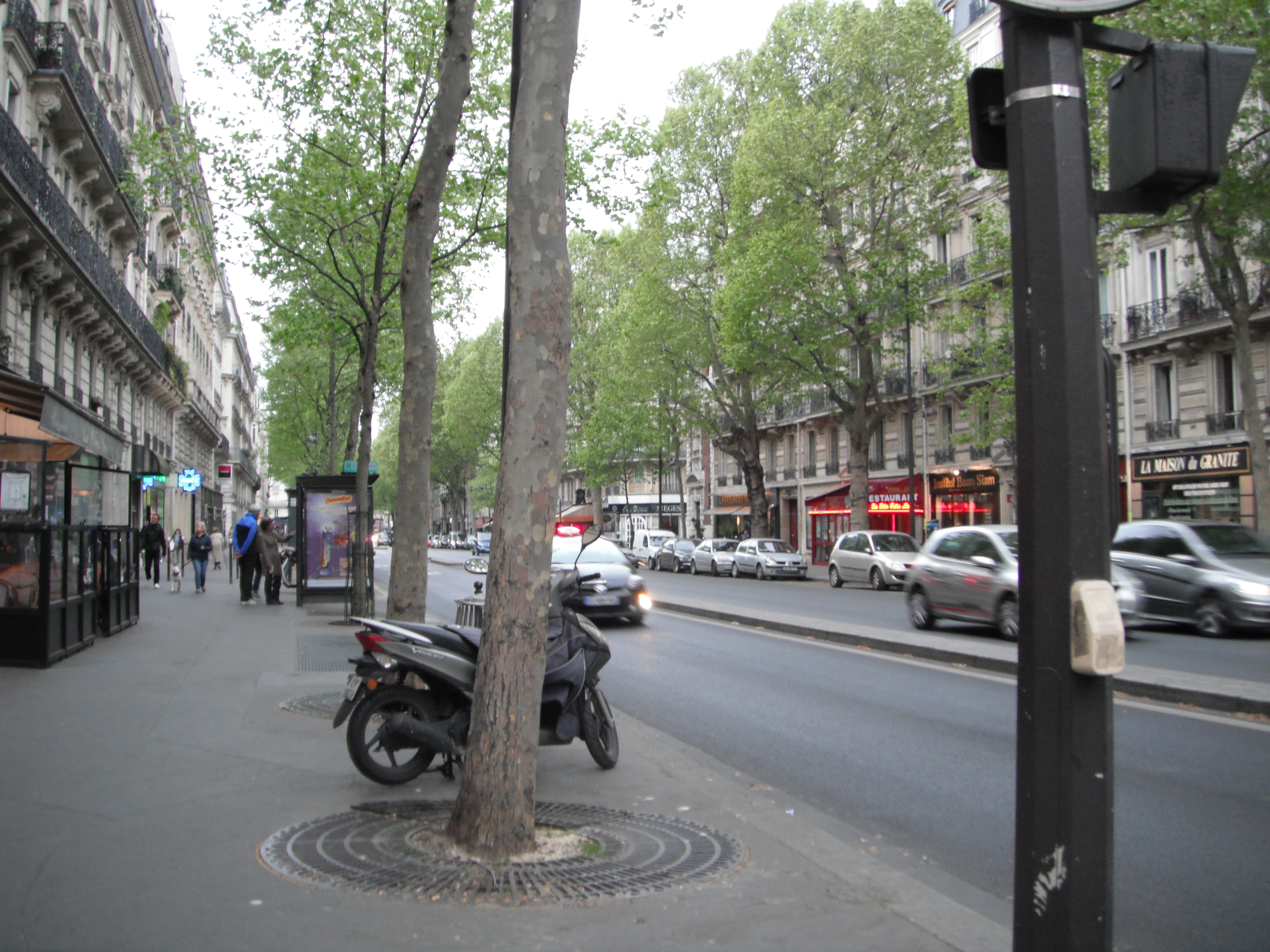
After another sleep, we prepared for our penultimate day Paris. This would consist of us taking in some final sights and sounds and then checking in at one of the airport hotels for the night. For my choice, I asked that we go to the Musee du Moyenne-Ages, the museum of Medieval History on Rive Droite (northern side) of the Seine, which was on the way towards the destination my mother and wife so wanted to see – Les Galleries Lafayette (the freakishly big department store near the Opera Nationale de Paris).
I have to say though that the former was a bit of a letdown. Having expected a large museum similar to the ones we had been seeing all throughout Europe, one containing tons of artifacts and displays recreating the period in question, what we got was basically a collection of medieval statues, architecture and sculpture. Only one room, at the tail end of the museum, contained any arms, armor, or artifacts that weren’t structural in nature (seen below). While this was still very interesting, I could not help but feel disappointed.

Where were all the swords, armor, livery, and seige engines? Where were the maps that showed the Battle of Hastings, Agincourt, the Crusades and the seige of Constantinople? Where were the recreated manuscripts of Aristotle and other classic texts that were being preserved by monasteries? Where were the displays of what everyday life was like for men, women and children of all walks of life? This is a museum dedicated to one of the most brutal, interesting, and pivotal periods in European history, last roughly 1000 years (5th to 15th century) and encompassing the fall of the Roman Empire to the “discovery” of the New World and the beginning of the Renaissance. Why it was jam-packed with the same stuff found at the Musee D’Orsay or the Louvre?
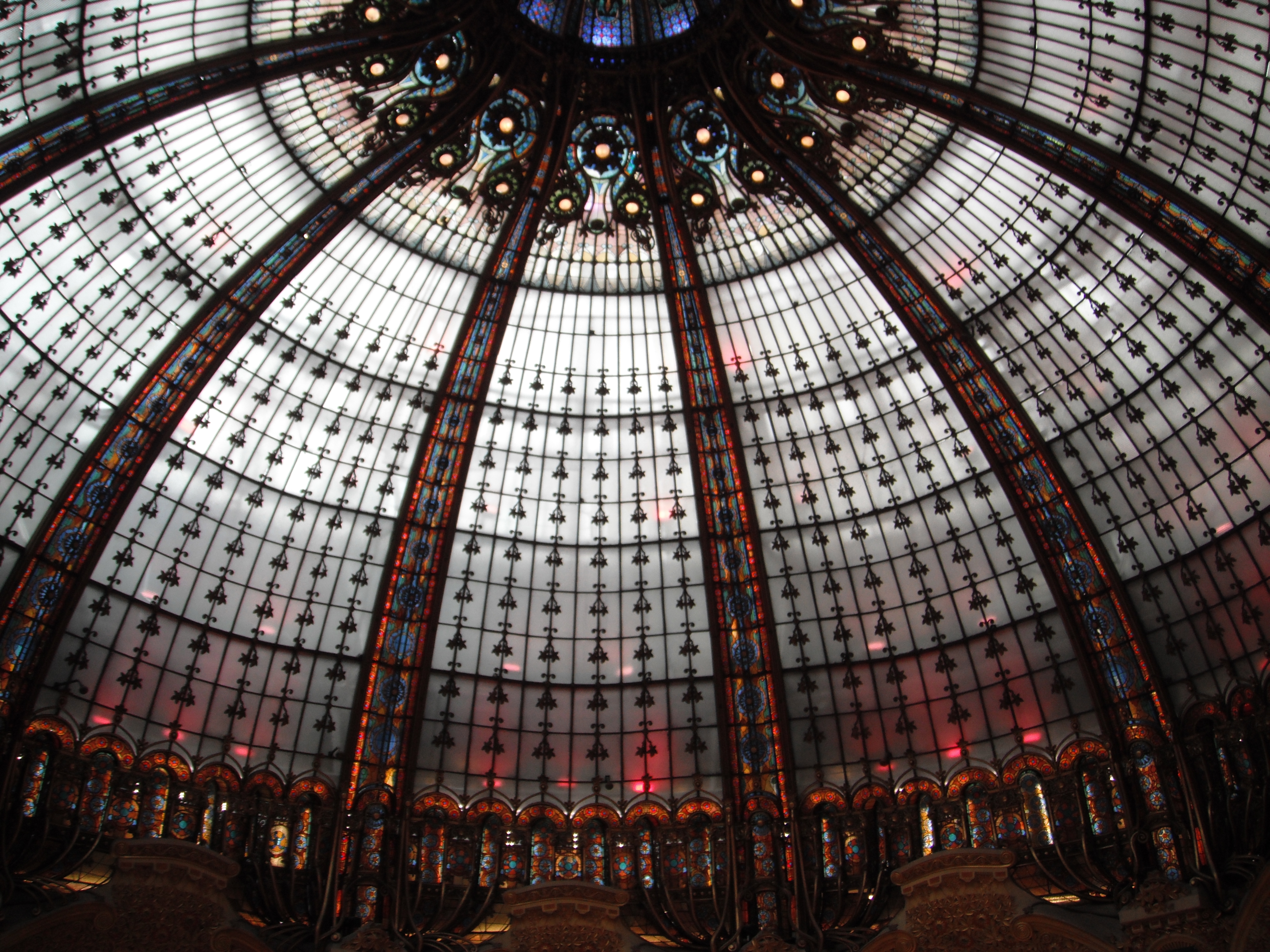
Ah well, you get the point. After leaving here, we pressed on to the 9th arrondisement and the Galeries Lafayette. This massive department store that encompasses several floors of a domed building, and is jam-packed with clothing outlets, cafes, shoe stores, and just about every other kind of apparel store imaginable. My mother and wife were quite happy wandering around and checking things out, while my father and I were just generally bored, tired, and grumbling. But we did our best, since this last visit in Paris was all about the women getting to explore a major landmark.
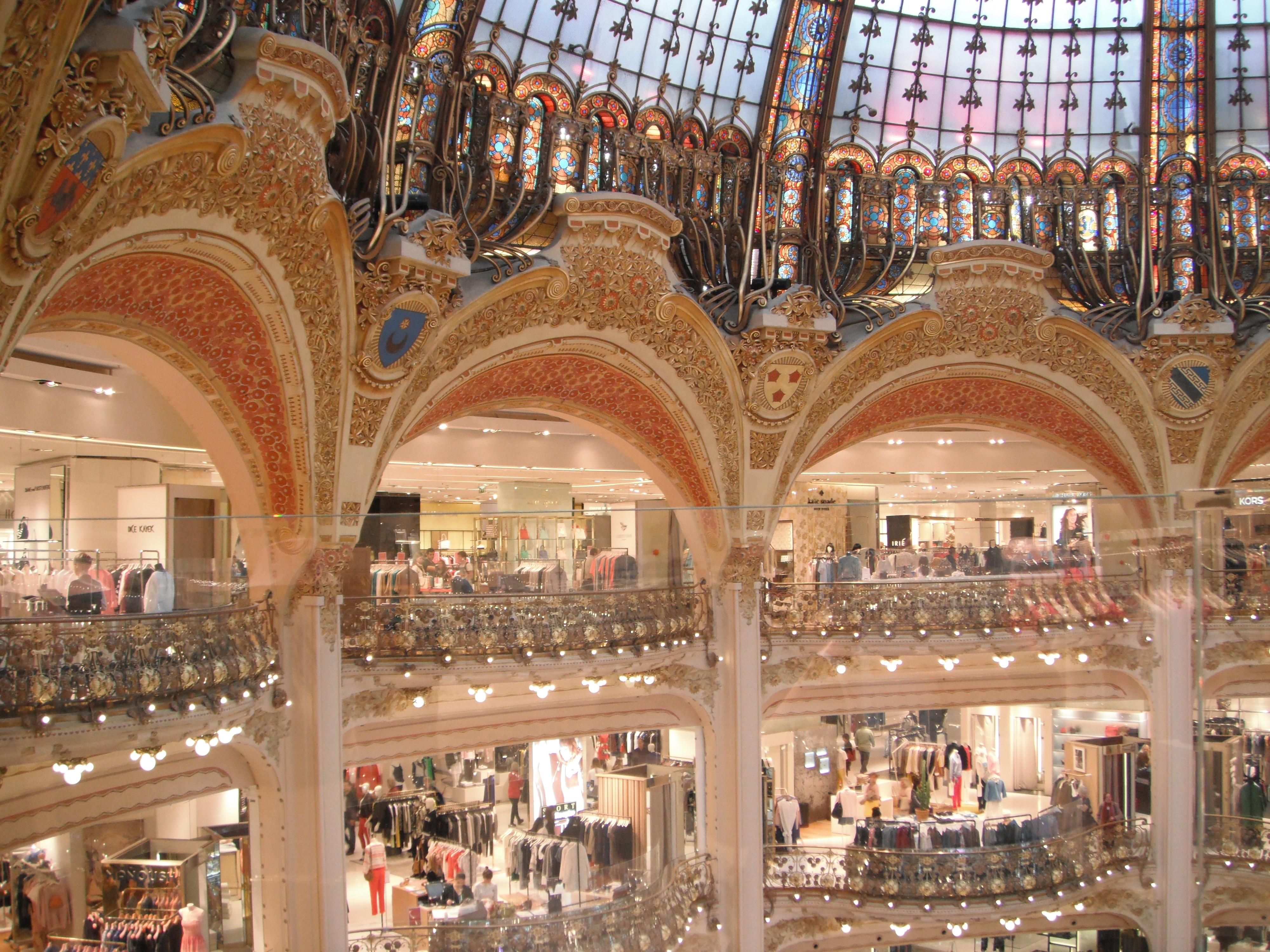
Still, I can’t emphasize enough how much I hate shopping, at least when I’m not buying anything. But therein lies the problem, I guess. I believe shopping is about buying things and leaving. My wife believes its about trying things on, looking for deals, and endlessly perusing what’s available. When this is happening, I quickly run out of patience and enthusiasm, my feet get sore, my head begins to ache, and I desperately want to go “do something”. Yeah, I’m not good company on these sorts of things.
Still, as you can see from the pics (above and below), the place was very opulent and I would not deny that it was something we needed to see before we left. And then, it was a trip on Le Metro to the airport, where we were serenaded by a gentlemen and his accordion. I tell ya, these are the kind of things you really need to see while in Paris. The entire time he played, and he was pretty damn good too, it was like I could hear the soundtrack to an old Parisian movie, or any movie set in Paris that is trying to go for that romantic feel.
Once we reached Charles de Gaulle, again, we hopped the shuttle bus that took us to our hotel a few klicks away. Naturally, the international airport has several major chains set up a short ride away and shuttles countless people too and from the place on a daily basis. We checked in, ate at the hotel restaurant, and went to bed early. This was essential given that we had an early morning, and 20 hours of flight time and layovers to look forward to!
This time around, it was easier since we the eventual jet lag kind of worked in our favor. No overnights and by the time we landed, it would be late at night so we could get swiftly to sleep. And while the layovers SUUUUUCKED – three hours in Toronto and Vancouver respectively – the flights were easy enough to get through. Fourteen hours of flying time doesn’t seem so bad when you got plenty of movies and cable Tv shows to watch. And I managed to catch a few I’ve been meaning to see, like Anchorman 2, Pacific Rim, Catching Fire.
And when it ended, we found ourselves in Nanaimo and ready to hit the hay! A long and sound sleep, and we had breakfast with my parents, discussed our trip, and lamented how we would miss getting up every morning, having breakfast together, and then going out to see historic sites. But we all agreed, we were ready to get home and we missed out cats! So after packing up and saying goodbye for the last time, we hit the island highway and drove off in separate directions.
And I have to say, readjusting to life here at home has been quite difficult. After you see so much of history commemorated, honored, preserved and remembered, with battles that shook the world, wars that changed the course of history, and monuments, artifacts, buildings and entire cities that have stood for thousands of years, domestic life can seem pretty damn humdrum. Lucky for us, we have our photo collections, our keepsakes, our memories and our stories. And sharing them like this with the outside world has been a fun way for me to remember it all.
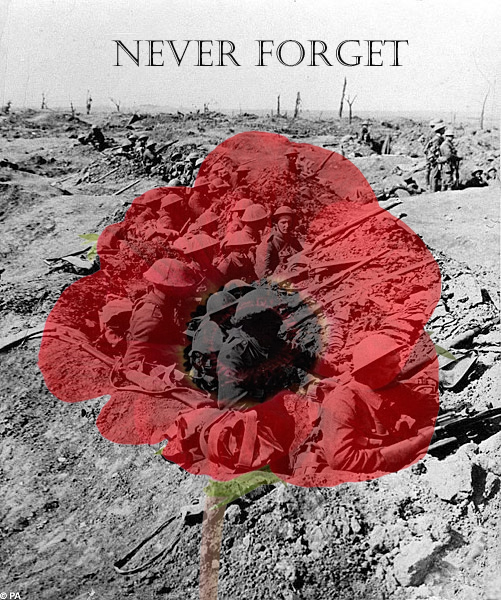
So thanks for reading and I hope that someday in the not-too-distant future, I get to share something equally engrossing and awesome with you all! Carla and I of course have our plans, and we’ve already been talking to my folks about our next trip together, where it will take us, and how we’re going to do it all up right this time! So expect to hear more at some point, and as always, I would like to remind people how important it is to remember all that has happened in the past century to make this world a safer and better place.
I guess there’s no way to end this other than to close with the very sentiments that started it all…

 Stories by Williams