
 Back in May, Google co-founder and CEO Larry Page hosted a rare Q&A session with the attendees of the Google I/O keynote speech. During this time, he gave some rather unfiltered and unabashed answers to some serious questions, one of which was how he and others should focus on reducing negativity and focusing on changing the world.
Page responded by saying that “the pace of change is increasing” and that “we haven’t adapted systems to deal with that.” He was also sure to point out that “not all change is good” and said that we need to build “mechanisms to allow experimentation.” Towards that end, he claimed that an area of the world should be set aside for unregulated scientific experimentation. His exact words were:
There are many exciting things you could do that are illegal or not allowed by regulation. And that’s good, we don’t want to change the world. But maybe we can set aside a part of the world… some safe places where we can try things and not have to deploy to the entire world.
So basically he’s looking for a large chunk of real-estate to conduct beta tests in it. What could possibly go wrong?
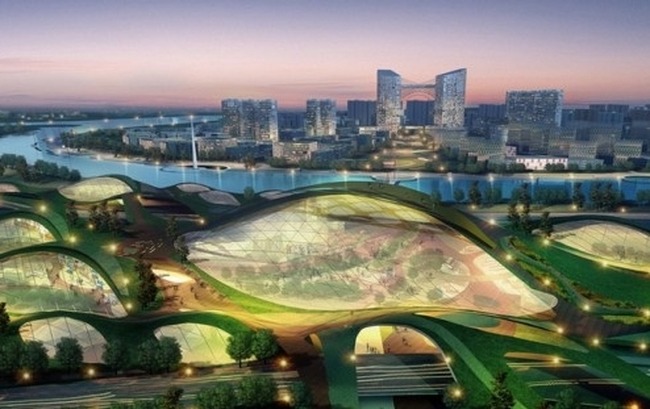 One rather creative suggestion comes from Roy Klabin of PolicyMic, who suggest that an aging and dilapidated Detroit might be just the locale Page and his associates are looking for. This past week, the city declared bankruptcy, and began offering to sell city assets and eradicate retirement funds to meet its $18 billion debt obligations.
What’s more, he suggests that SpaceX founder Elon Musk, who’s always after innovation, should team up with Google. Between the two giants, there’s more than enough investment capital to pull Detroit out of debt and work to rehabilitate the city’s economy. Hell, with a little work, the city could be transformed back into the industrial hub it once was.
And due to a mass exodus of industry and working people from the city, there is no shortage of space. Already the city is considering converting segments of former urban sprawl into farming and agricultural land. But looking farther afield, Klabin sees no reason why these space couldn’t be made available for advanced construction projects involving arcologies and other sustainable-living structures.
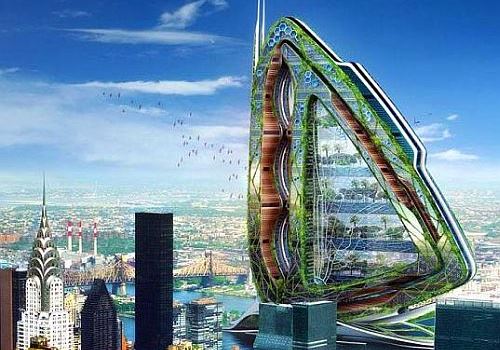 Not a bad idea, really. With cities like Boston, New York, Las Vegas, New Orleans, Moscow, Chendu, Tokyo and Masdar City all proposing or even working towards the creation of arcologies, there’s no reason why the former Industrial Heartland – now known as the “Rust Belt” – shouldn’t be getting in on the action.
Naturally, there are some who would express fear over the idea, not to mention Page’s blunt choice of words. But Page did stress the need for positive change, not aimless experimentation. And future generations will need housing and food, and to be able to provide these things in a way that doesn’t burden their environment the way urban sprawl does. Might as well get a jump on things!
And thanks to what some are calling the “New Industrial Revolution” – a trend that embraces nanofabrication, self-assembling DNA structures, cybernetics, and 3D printing – opportunities exist to rebuild our global economy in a way that is cleaner, more efficient and more sustainable. Anyone with space to offer and an open mind can get in on the ground floor. The only question is, what are they willing to give up?
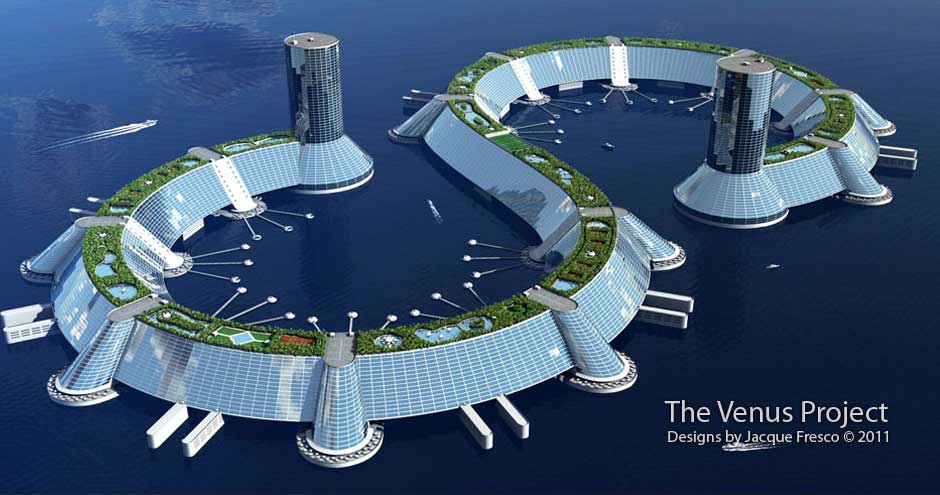 There’s also a precedent here for what is being proposed. The famous American architect and designer Jacque Fresco has been advocating something similar for decades. Believing that society needs to reshape the way it lives, works, and produces, he created the Venus Project – a series of designs for a future living space that would incorporate new technologies, smarter materials and building methods, and alternative forms of energy.
And then there’s the kind of work being proposed by designer Mitchell Joachim and Terreform ONE (Open Network Ecology). And amongst their many proposed design concepts is one where cities use vertical towers filled with energy-creating algae (pictured below) to generate power. But even more ambitious is their plan to “urbaneer” Brooklyn’s Navy Yard by turning natural ecological tissues into viable buildings.
 This concept also calls to mind Arconsanti, the brainchild of architect Paolo Solari, who invented the concept of arcology. His proposed future city began construction back in the 1970 in central Arizona, but remains incomplete. Designed to incorporate such things as 3D architecture, vertical farming, and clean, renewable energy, this unfinished city still stands as the blueprint for Solari’s vision of a future where architecture and ecology could be combined.
What’s more, this kind of innovation and development will come in mighty handy when it comes to time to build colonies on the Moon and Mars. Already, numerous Earth cities and settlements are being considered as possible blueprints for extra-Terran settlement – places like Las Vegas, Dubai, Arviat, Black Rock City and the Pueblos and pre-Columbian New Mexico.

These are all prime examples of cities built to withstand dry, inhospitable environments. As such, sustainability and resource management play a major role in each of their designs. But given the pace at which technology is advancing and the opportunities it presents for high-tech living that is also environmentally friendly, some test models will need to be made.
And building them would also provide an opportunity to test out some of the latest proposed construction methods, one that do away with the brutally inefficient building process and replace it with things like drones, constructive bacteria, additive manufacturing, and advanced computer modelling. At some point, a large-scale project to see how these methods work together will be in order.
Let’s just hope Page’s ideas for a beta-testing settlement doesn’t turn into a modern day Laputa!
And be sure to check out this video from the Venus Project, where Jacque Fresco explains his inspirations and ideas for a future settlement:
Sources:
1. Elon Musk and Google Should Purchase and Transform a Bankrupt Detroit (http://www.policymic.com/)
2. Larry Page wants to ‘set aside a part of the world’ for unregulated experimentation (theverge.com)
3. Six Earth Cities That Will Provide Blueprints for Martian Settlements (io9.com)
4. The Venus Project (thevenusproject.org)
5. Arcosanti Website (arcosanti.org)
6. Terreform ONE website (terreform.org)




 Stories by Williams