
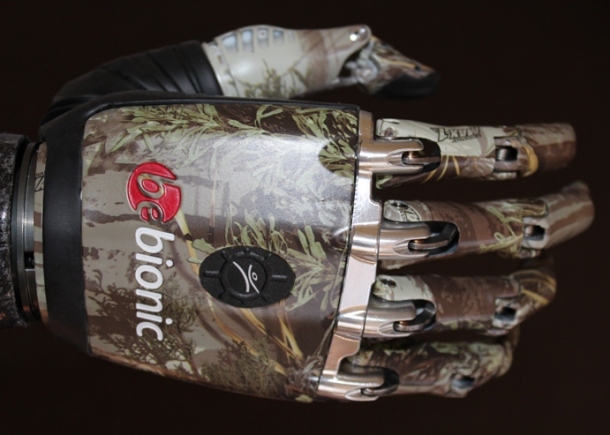
 Behold, the latest in bionic technology! The bebionic 3 model prosthetic hand, by the RSL Steeper company! Encased in an aluminum chassis, boasting improved electronics, a redesigned thumb, and new motors that increase the power grip, this hand was first unveiled at the American Orthotic Prosthetic Association (AOPA) Conference in Boston this past September. Since that time, amputees have been obtaining the hand and incorporating it into their daily lives. And the results are quite encouraging!
In addition to being able to do delicate work, like handle eggs and fine china without breaking them, the hand is also capable of performing a power grip that is capable of generating 31.5 pounds of force. That’s quite the Kung Fu grip, just in case you were wondering. And in “hook” mode, the hand is able to bear a load of 99 pounds. So, though it doesn’t have quite the same dexterity or free range of motion as an organic hand, the bebionic is capable of performing all the basic tasks, and is pretty powerful to boot!
Much like the bionic leg which was popularized by Zak Vawter’s historic climb last weekend, the bebionic works by reading the nerve impulses from the wearer’s arm skin. These are amplified by the arm’s electronics and translated into one of 14 possible grip configurations. These different grips are uploaded to the hands internal memory and users are able to cycle through them to determine which grip they want for which purpose. For instance, a mouse-clicking action makes the thumb grip a mouse, while the index finger clicks the left button. The “precision open grip” can be used to grab small objects and the “tripod grip” can be used to write with a pen.
Currently, and depending on its configuration, the hand costs clinical centers between $25,000 and $35,000. In time, and as it becomes available for public purchase, the price is likely to come down somewhat. Still, such a revolutionary device will not come cheap for many years to come. It also comes available in a range of colors and designs, including snow and jungle camouflage and tiger stripes, as well as realistic silicone skin coverings. See the video below for some examples.
Combined with other advances in the field of bionics and prosthetic devices, the bionic hand presents some new and very exciting possibilities. For one, technologies like ReWalk and other exoskeletons are making it possible for paraplegics to walk again, while sophisticated wheelchairs like the wheelchairbot are making stairs and obstacles passable. Coupled with bionic limbs that are giving full ambulatory motion back to amputees, we could be looking at a future where robotic enhancements can restore any and all ability to accident victims, combat veterans and people born with physical deformities.
In addition, the most audacious developments, such as bionic enhancements or robot chairs that read brain waves directly, giving full motion to quadriplegics and the ability to communicate fully to people with degenerative conditions is still yet to come! Once such technologies are readily available and commercially viable, we might even be seeing the emergence of a cybernetics industry, where people can receive enhancements that not only restore abilities, but greatly enhance them. Artificial limbs the enhance strenght and speed, artificial eyes that enhance vision and provide projected images and augmented reality displays, and even silicate implants that enhance brain function and make people smarter.
Homo Superior people… I just got goosebumps!
And while we’re waiting on all that to happen, check out this promo video for the latest bebionic model:
And here’s a video of the bebionic going through a battery grip pattern tests:
 Stories by Williams