Classic sci-fi books, reviews, and the best of from a dedicated fan and author!
Author: storiesbywilliams
Matt Williams is a professional writer, science fiction author, and science communicator who currently writes for Universe Today, Interesting Engineering, Stardom Space, and Stellar Amenities. He is also the Director of Media Communications for Mars City Design and a member of Enterprise in Space and Explore Mars. His novels, The Formist Series, are available at Amazon.com and through Castrum Press. He lives with his wife and family on Vancouver Island in beautiful British Columbia.
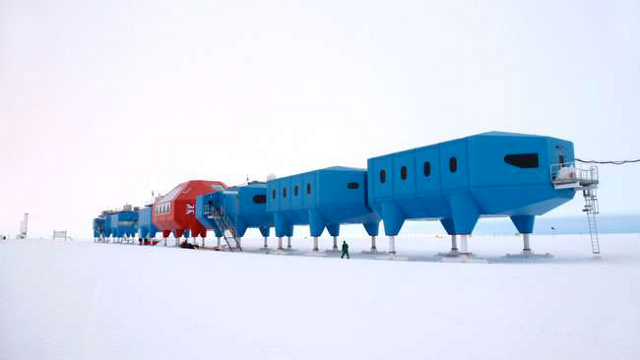
For years, Antarctic research stations have been plagued by environmental conditions that go far beyond the extreme cold. For one, there’s the problem of moving ice, which recedes towards the ocean at a rate of about 0.4 kilometers a year. On top of that, literally, there is the ice and snow accumulation, which threatens to bury any building placed on the continent. Because of this, research stations have a top life expectancy of about ten years in Antarctica. But that may be about to change…
Meet the Halley VI Antarctic research station, a mobile structure which began operations this past February. The brainchild of Hugh Broughton Architects, and established by the British Antarctic Survey (BAS), the station features extendable legs on giant skis. Comprised of eight interconnected modules, the station rests atop a series of retractable hydraulic legs which enable the structure to clear the rising ground each year. And when the station needs to be moved, a bulldozer can simply tow it to a new location.
Cutaway of an individual module
The base can also accommodate 50 research scientists in its segmented hull. Living accommodations and laboratories, clad in blue glass-reinforced plastic, are positioned on either side of a larger unit clad in red, which serves as a social nexus. This space is especially crucial to the well-being of the station, since its crew will live in it year-round and have to endure the permanent darkness, -60 degree temperatures, and 125-kilomer (100 mph) winds the continent is known for.
Home comforts include a hydroponic salad garden and a climbing wall within a double-height central space lined with Lebanese cedar, selected for its scent. The architect also worked with a color psychologist to identify “refreshing and stimulating” shades, and developed a bedside lamp with a daylight bulb to simulate sunrise.
Said architect Hugh Broughton of the creation of Halley VI:
It has been a fascinating project because it combines microscopic examples of many different building types – an operating theater, air traffic control, a power plant – rolled into 20,000 square feet.
And since this project has led to similar appeals being made by other national research groups – which include scientists from Spain, India and Korea – this could be merely the first of many such stations standing near the South Pole. Almost makes the idea of being there for a year conducting research sound fun, doesn’t it?
It seems we’re in for a bit of a two-fer today. Its become a habit of mine to post trailers for upcoming movies on Mondays now. However, it just so happens that while I was doing my due diligence for one, I came across a second must-see teaser which I had to pass on. This one is for the third season of Game of Thrones, which premiers in less than one week!
And I think you’ll agree, this one is definitely the biggest and baddest. Whereas the first gave us nothing but some voice over and a simple graphic (like the one featured above), and the second gave us a brief glimpse with a little eye candy, this one has gone the full nine yards and covered all the major bases.
In addition to all the intrigue and plots taking place in Kings Landing, we are given some quick glimpses of the ongoing War of Five Kings, Danearys’ efforts to obtain an army in Slavers Bay, John Snow’s time amongst the Wildlings and their efforts to bring down the Wall, Brienne and Jaime in the Riverlands, Stannis’ ongoing attempts to fulfill an ancient prophecy, and even Bran’s journey to the far North.
And fittingly, they gave the voice over for the whole thing to Stannis, who performs the “We do not choose our destiny speech”. Though he is referring to himself in this speech and the role he thinks he will play, it pretty much sums up what everyone in the series is going through at this point. Beyond all the warring, intrigue and personal ambitions, it is fast becoming clear that there is a greater plot at work. But for those of you who haven’t read the many tomes that make up this series, I guess you’ll just have to wait to see what it is!
Six more days, people! If you’re not going to be at home, be sure to set your TiVos and DVR’s! And then be sure to swing by because yours truly will of course be doing a review 😉
You can tell a studio is serious about a movie when the trailer releases are many and not too far between. That seemed to be the case with Prometheus, the movie that couldn’t stop dropping hints before it even aired. And it’s definitely the case with the latest installment in the Abrams relaunch of Star Trek, entitled Star Trek: Into Darkness. And so for my third MTM, I’ve decided to post the third trailer for this upcoming movie.
This time around, there’s plenty of action to behold, plus some genuine hints as to what the bad guy is doing and what his deal truly is. Thanks to the previous two trailers, we already knew that Benedict Cumberbatch would be playing the lead villain and that this movie follows the rule of Act II being the darker story. We also knew that this time around, Kirk’s mettle will be tested as he’s forced to go beyond his usual combination of daring and bravado.
And with this latest teaser, some hints are given as to what exactly is motivating the villain and how Kirk and crew will be forced to deal with him. Apparently, it involves a massive terror attack against the Federation which cripples it by taking out its leadership. And what’s more, I believe that Cumberbatch, who’s character is rumored to be named Khan and who sound a lot like the original, will be stepping into the role once occupied by Ricardo Montelban. Fingers crossed at any rate, because that would be cool!
And of course, it’s an exciting watch. So enjoy it and join me in waiting eagerly for the May 17th theatrical release!
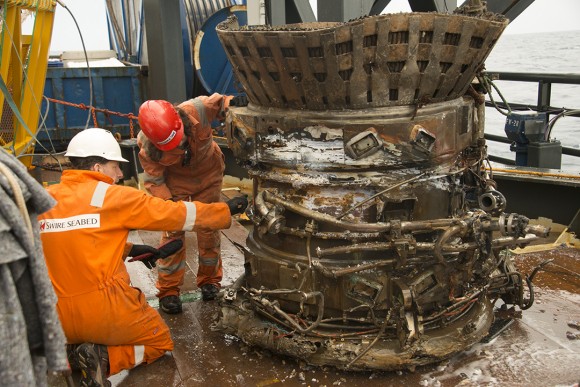
This past week, history was made when Jeff Bezos (founder of Amazon.com) and his privately funded company, Bezos Expeditions, announced that they had successfully retrieved pieces of the very engines that had once launched Apollo astronauts to the moon. Using remotely operated vehicles and a series of slings, the crew members recovered enough parts to reconstruct the majority of two F-1 rocket boosters.
Bezos Expeditions announced last year that using state-of-the-art deep sea sonar, that they had discovered the remains off the coast of Cape Canaveral off the coast of Florida. And this past Thursday, and with NASA’s help, Bezos located the fragments at a depth of almost 4.8 kilometers (3 miles) and began hauling them to the surface. Bezos claims they belonged to the historic Apollo 11 spaceflight, but further study and restoration will be needed before their identity can be confirmed.
Regardless, this is an exciting find, and the nature of the rocket boosters confirms that they were at least part of the Apollo program. Between 1968 and 1972, ten missions were conducted that flew out of the Kennedy Space Center, each one using the Saturn V rocket, that used five F-1 engines to boost them into orbit. Once the rockets had spent their fuel, they were detached and fell into the sea.
That means that approximately sixty five F-1 engines reside in the ocean off the coast of Florida. No telling which of those these ones could be, but it is hoped that serial numbers will be retrieved from the engines that can connect them to a specific Apollo mission. But regardless, this is an exciting find, and could not have come at a better time since NASA is looking to embark on a renewed era of exploration.
All told, Bezos and his team spent three weeks at sea, working almost 5 kilometers below the surface. During this time, Bezos claims that his team found so much:
We’ve seen an underwater wonderland – an incredible sculpture garden of twisted F-1 engines that tells the story of a fiery and violent end, one that serves testament to the Apollo program. We photographed many beautiful objects in situ and have now recovered many prime pieces. Each piece we bring on deck conjures for me the thousands of engineers who worked together back then to do what for all time had been thought surely impossible.
Naturally, NASA was pretty impressed with the find as well. After the find was announced, NASA Administrator Charlie Bolden made the following statement on behalf of the Agency:
This is a historic find and I congratulate the team for its determination and perseverance in the recovery of these important artifacts of our first efforts to send humans beyond Earth orbit. We look forward to the restoration of these engines by the Bezos team and applaud Jeff’s desire to make these historic artifacts available for public display.
Needless to say, this is an exciting find, regardless of whether or not these rockets were the same ones that sent Neil Armstrong, Buzz Aldrin and Michael Collins to the Moon. Naturally, I hope it is. I can think of no greater tribute to Armstrong’s memory so soon after his passing. I can imagine him looking down on this from the stars, where he now resides, with a big old smile!
And be sure to check out this video taken by the Bezos Expedition of the undersea find:
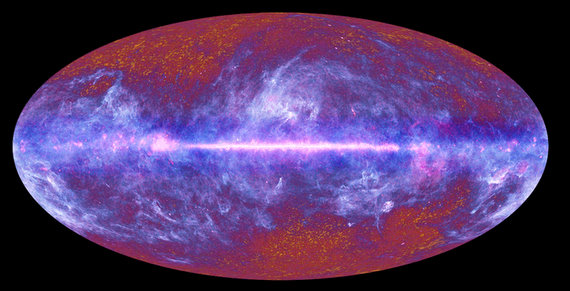
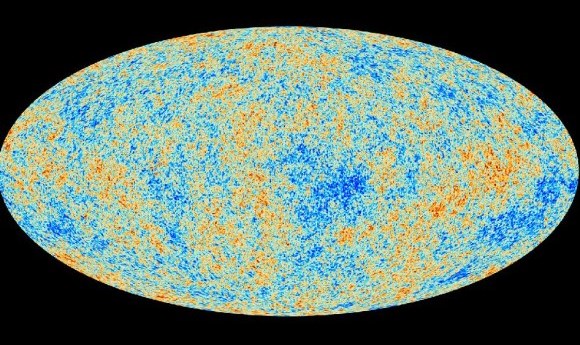
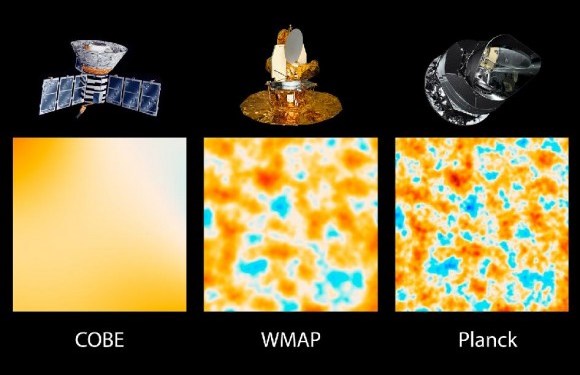
After 15 months of observing deep space, scientists with the European Space Agency Planck mission have generated a massive heat map of the entire universe.The “heat map”, as its called, looks at the oldest light in the universe and then uses the data to extrapolate the universe’s age, the amount of matter held within, and the rate of its expansion. And as usual, what they’ve found was simultaneously reassuring and startling.
When we look at the universe through a thermal imaging system, what we see is a mottled light show caused by cosmic background radiation. This radiation is essentially the afterglow of the Universe’s birth, and is generally seen to be smooth and uniform. This new map, however, provides a glimpse of the tiny temperature fluctuations that were imprinted on the sky when the Universe was just 370,000 years old.
Since it takes light so long to travel from one end of the universe to the other, scientists can tell – using red shift and other methods – how old the light is, and hence get a glimpse at what the universe looked like when the light was first emitted. For example, if a galaxy several billion light years away appears to be dwarfish and misshapen by our standards, it’s an indication that this is what galaxies looked like several billion years ago, when they were in the process of formation.
Hence, like archaeologists sifting through sand to find fossil records of what happened in the past, scientists believe this map reveals a sort of fossil imprint left by the state of the universe just 10 nano-nano-nano-nano seconds after the Big Bang. The splotches in the Planck map represent the seeds from which the stars and galaxies formed. As is heat-map tradition, the reds and oranges signify warmer temperatures of the universe, while light and dark blues signify cooler temperatures.
The cooler temperatures came about because those were spots where matter was once concentrated, but with the help of gravity, collapsed to form galaxies and stars. Using the map, astronomers discovered that there is more matter clogging up the universe than we previously thought, at around 31.7%, while there’s less dark energy floating around, at around 68.3%. This shift in matter to energy ratio also indicates that the universe is expanding slower than previously though, which requires an update on its estimated age.
All told, the universe is now believed to be a healthy 13.82 billion years old. That wrinkles my brain! And also of interest is the fact that this would appear to confirm the Big Bang Theory. Though widely considered to be scientific canon, there are those who dispute this creation model of the universe and argue more complex ideas, such as the “Steady State Theory” (otherwise known as the “Theory of Continuous Creation”).
In this scenario, the majority of matter in the universe was not created in a single event, but gradually by several smaller ones. What’s more, the universe will not inevitable contract back in on itself, leading to a “Big Crunch”, but will instead continue to expand until all the stars have either died out or become black holes. As Krzysztof Gorski, a member of the Planck team with JPL, put it:
This is a treasury of scientific data. We are very excited with the results. We find an early universe that is considerably less rigged and more random than other, more complex models. We think they’ll be facing a dead-end.
Martin White, a Planck project scientist with the University of California, Berkeley and the Lawrence Berkeley National Laboratory, explained further. According to White, the map shows how matter scattered throughout the universe with its associated gravity subtly bends and absorbs light, “making it wiggle to and fro.” As he went on to say:
The Planck map shows the impact of all matter back to the edge of the Universe. It’s not just a pretty picture. Our theories on how matter forms and how the Universe formed match spectacularly to this new data.
The Planck space probe, which launched in 2009 from the Guiana Space Center in French Guiana, is a European Space Agency mission with significant contribution from NASA. The two-ton spacecraft gathers the ancient glow of the Universe’s beginning from a vantage more than a million and a half kilometers from Earth. This is not the first map produced by Planck; in 2010, it created an all-sky radiation map which scientists, using supercomputers, removed all interfering background light from to get a clear view at the deep background of the stars.
However, this is the first time any satellite has been able to picture the background radiation of the universe with such high resolution. The variation in light captured by Planck’s instruments was less than 1/100 millionth of a degree, requiring the most sensitive equipment and the contrast. So whereas cosmic radiation has appeared uniform or with only slight variations in the past, scientists are now able to see even the slightest changes, which is intrinsic to their work.
So in summary, we have learned that the universe is a little older than previously expected, and that it most certainly was created in a single, chaotic event known as the Big Bang. Far from dispelling the greater mysteries, confirming these theories is really just the tip of the iceberg. There’s still the grandiose mystery of how all the fundamental laws such as gravity, nuclear forces and electromagnetism work together.
Ah, and let’s not forget the question of what transpires beneath the veil of an even horizon (aka. a Black Hole), and whether or not there is such a thing as a gateway in space and time. Finally, there’s the age old question of whether or not intelligent life exists somewhere out there, or life of any kind. But given the infinite number of stars, planets and possibilities that the universe provides, it almost surely does!
And I suppose there’s also that persistent nagging question we all wonder when we look up at the stars. Will we ever be able to get out there and take a closer look? I for one like to think so, and that it’s just a matter of time!
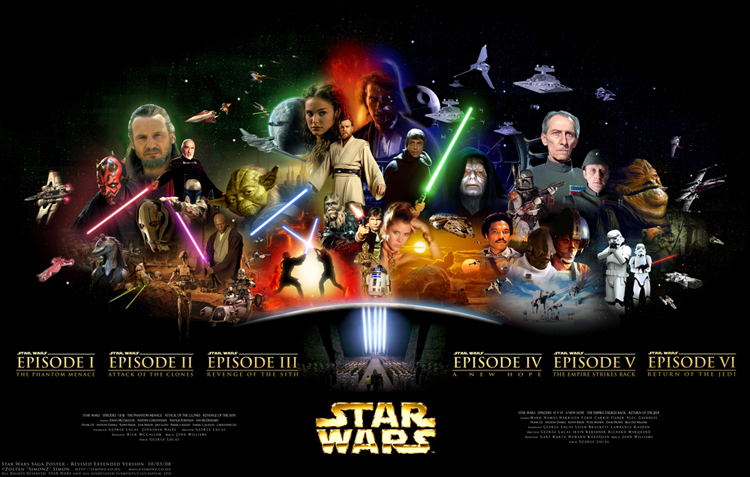
Don’t worry, that’s not the tagline for (yet) another Gangnam Style parody. It’s actually a concept for a March Madness style betting game involving Star Wars characters. Known as “This Is Madness!”, named after a favorite quote by C3P0, and designed to look like a bracket-style tournament between all of Lucasfilm’s classic characters… and the ones from the prequels too.
The tournament kicked off this past Monday, March 19th, and will continue until a winner is picked. The point of it all? To determine who is the biggest, baddest and most beloved fan favorite Star Wars character of all time! Daily matchups will take place, for which fans will get to vote by simply going to Starwars.com.
Each bracket will be for a different class of character (Jedis, Sith, Bounty Hunters, etc) until a final matchup between the light side and the dark. The winner will be announced on April 9th, and will presumably have bragging rights until Star Wars is no longer relevant… whenever that will be!
And of course, there’s a promotional video with the Dark Lord of the Sith explaining the rules of the tournament and encouraging us to vote Vader! Personally, I don’t much care who wins, so long as it isn’t that annoyingly racist caricature who’s name means container. Get it? That bloody bastard better not win anything, or I’m moving to Argentina!
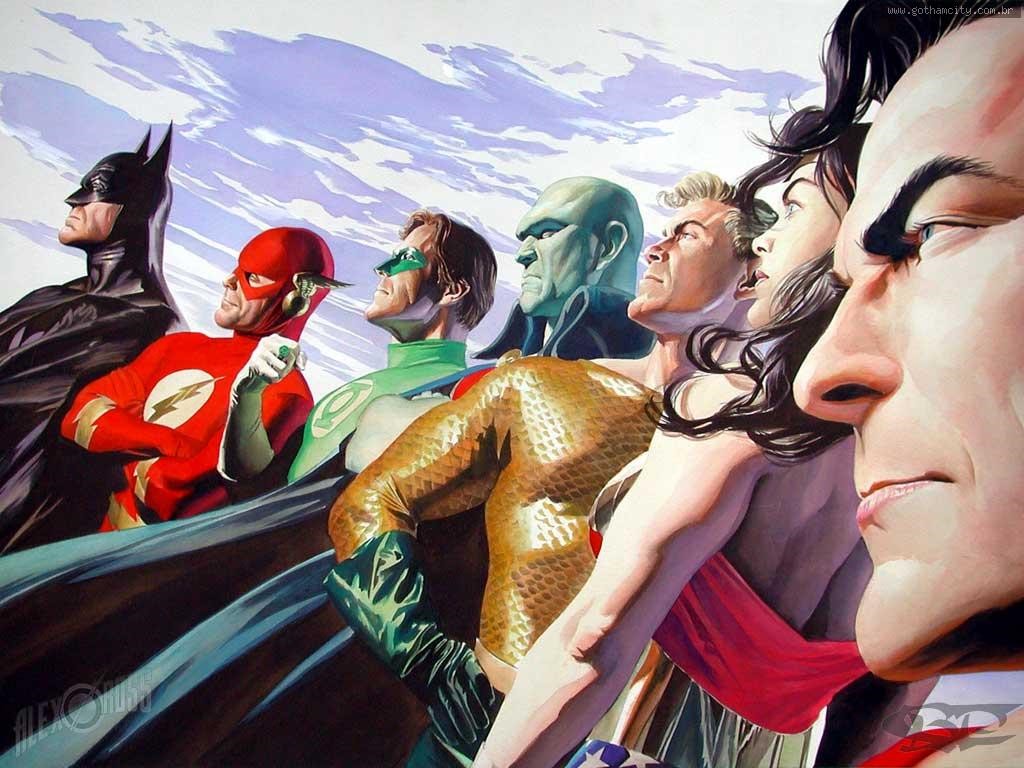
Good afternoon Revengers! We go now to the field where our league of crime-fighting superheroes is taking to the field to locate and destroy a very dangerous artifact. As I’m sure you’re all aware by now, our mission to investigate the Tyrene Code turned up some very interesting information. Following the clues left behind by the famed artist and superhero, we have found our way to a government facility where the source of his powers appears to have been kept.
Our infiltrators managed to get within spitting distance of the facility and take down its sentries, but things may be taking an unexpected turn. As such, I, your humble Captain, have ordered our second team – the strike force made up of Veiled Tsunami, Dark Angel, Freedom Fighter and myself – into the fray. The security is tight closer to the facility and we’ll need all our initial assets committed to take them out in time.
We go now to the location to see what’s happening. I hope everyone brought there A game because there’s no way we’re pulling this off with anything less…
* * *
The door slammed shut and Smackdown raised his rifle. His hands were like a frantic, noisy mess, everything he did rushed and producing loud, angry clacks.
“Are you sure about this, Captain?”
His fingers were like a blur, one hand slapping a magazine in the bottom on the gun while the other slid the front end open to place a grenade inside. He looked up with mild annoyance to reply.
“Look, you people were the one who said you didn’t trust my source. Now you wanna second guess my being paranoid? C’mon, we’re going in?”
Freedom raised her hand in mock surrender, though her fingers began to tighten on her sword. She used her best diplomatic tone too, just to let him know she wasn’t prepared to use it on him yet.
“No one is second-guessing you, Captain. This just seems sudden.”
“She’s right,” said Tsunami, crouching by the front end of the vehicle. “I get the feeling you know something we don’t. Or you’re just not telling us.”
Smackdown looked angrily at her next. Her eyes were invisible behind her darkened glasses and her face stony, but her tone spoke volumes. He looked to Panacea who was standing quietly next to her. Even she didn’t appear to be offering him the benefit of the doubt right now. Even her with her usually gentle demeanor.
Great, he thought. Surrounded by women, any one of whom could probably kick my ass, and I got to go and try to assert dominance over them!
“Look, I don’t know anything at this point,” he said coolly. “But I get the feeling we made it here too easily, and we’re finding our way to their front door like someone left’s it open. Feels wrong, that’s all I’m saying.”
Freedom looked to Tsunami. She wished she knew what had happened during his supposed meeting with that “Source” of his. Ever since that ended, he had been in a mood. She Tsunami was in the know, but not her. And the only other person she could ask was waiting behind, part of their team of last resort.
“So what’s our plan?” asked Panacea.
Smackdown took a deep breath and looked to their resident Goddess. Somehow, seeing her always did much to lift people’s moods. She suspected that was why he made it a habit of keeping her around. Calmer now, a plan began to form on his head and trickled out of his mouth.
“I want you two ladies,” he indicated Tsunami and Freedom, “to do a quick fly over. Get their attention and then swoop in, see if they’re stupid enough to start shooting. I’m thinking that will give Atrum and Pax enough time to teleport inside. Once they’re in, we start hitting the guards with everything we got. Depending on what the situation is inside, I think it’s fair to say the confusion will mess them up and make them that much easier to beat.”
“Captain?” Panacea said, an eyebrow raised inquisitively. “How are you to get in there? You planning on taking the car again?”
Smackdown smiled wryly. Yes, of everyone in their team, he was the only one not particularly gifted with the ability of flight. And he was the last person who needed to be reminded of that.
“I’m glad you asked,” he said, equally wryly. “You get to carry me, Panacea. We go in the second the ladies make their second pass and our boys with the means of teleporting pop up inside. And if we catch any flack, I fully expect you to heal me. That okay with you?”
Freedom cleared her throat and shuffled her feet. No one had ever seen her scowl or frown before, but Freedom suspected this was the closest she could manage. As the one to ask him about his apparent limitations, she had clearly volunteered – or grabbed the short straw, as it were.
“Sure thing, Captain. Whenever you’re ready.”
“Ladies, first,” Smackdown replied and looked in their direction. “Freedom, good to go?”
“Always, Captain,” she replied. Smackdown nodded and turned his attention to Tsunami.
“How about you, Hawa? You feel ready for this?”
Hawa stood up and looked to be scowling behind her eyewear. Though it was hard to tell with her. Her face always seemed to be poised on the edge of a frown, ready to spit flame at a moment’s notice.
“Why wouldn’t I be?” she asked.
“No reason,” said Smackdown, quickly. “It’s just that we may be on the verge of finding the artifact your father was working on. I know you must have some feelings about that.”
“None I care to share,” she said coolly. Smackdown eventually nodded and left it at that. Tsunami never really did like to talk about such things. He had thought that at this juncture, there might be something, but apparently there wasn’t.
“Alright then. You and Freedom are up. Give em a good show, cuz when you come back around, I expect those guards to emptying their clips at you.”
That elicited a smile. “They won’t see me coming, Captain…”
“But they’ll know we were here when it’s all over,”added Freedom, her shimmering sword now reflected in Tsunami’s glasses. Side by side, they looked like something out of a childhood dream, or a villain’s worst nightmare.
For a moment, Panacea and Smackdown simply stared at the pair and felt a strange chill. Panacea was not the type to deal in cryptic talk and reasoning, but the Captain was clearly drawing some grim encouragement from it. As dark as any of his people could be, at least he knew they could be counted on to deliver.
What’s more, he knew that they were right. By the end of the day, the poor bastards manning the fence lines would be very sorry they ever got stuck with guarding this particular facility. When the dust settled, anyone still conscious would be looking for a new line of work and hoping it had comprehensive medical coverage.
He almost felt sorry for them…
* * *
Styka’s haunches were beginning to cramp and her lower back was screaming out for relief. Not far away, she heard Erotica grunting quietly to herself, no doubt nursing the same aches from all the crouching and waiting. The grass continued to brush by their faces as they kept them poked just high enough to see the fence line before them. And in the distance, they could hear one of the men guarding it barking through a radio.
“Alpha team, report in, please… Alpha team, what’s your status, over? Alpha team!”
“We can’t just sit here…” Erotica whispered to her. Styka kept her eyes fixed on the nearest man and the weapon he had hanging in front of him. She wondered just how quickly he could get to it before she smashed the helmet he wore in with her boot. He would be an easy enough takedown, but there were plenty more within shooting distance who would see it.
And at this distance, any sudden movements would surely be noticed. She surmised that her and Erotica could take two, maybe even four down between them before they started firing wildly. Then, anything could happen…
“I’m waiting, but I’m getting nothing,” she said, reaching out again and again. Atrum wasn’t answering, nor Pax, and her attempts to reach farther were met with the same absence. It was like trying to make a call, only to find the lines were dead.
[Atrum, Pax, where are you? What’s the Captain saying to you?]
Nothing. No one reaching out with instructions, no indication or new orders. And they were hip deep in enemy agents with automatic weapons. Moving in any direction seem ill advised.
“Forget this, I’m going in,” said Erotica. Moving from a hunched stance to a crouch, she prepared to leap forth like a spring-loaded predator. Styka eyed the man she had in her sights and called out to her as loud as she dared.
“Casey, no…”
[Styka] the familiar voice in her head sounded. [Duck and cover!]
She had no time to send a reply before a crack from overhead sent her reaching to her ears.Next to her, Erotica went from crouched and ready to practically hugging the ground. The thunderous roar from overhead seemed to have the same effect on everyone in the area, sending everyone down in a desperate search for cover.
“What the hell -?” she cried out. Over the sound of ringing in her ears, she could just barely make out the faint wisps of something cutting through the air overhead. Her dizzied eyes turned skyward and picked up the faint trails of two streams dancing back and forth through the clouds.
And then another sound, this one coming from within… [Styka? Can you hear me?]
“What the-?” she said aloud, before switching to her inner voice. [Atrum? Is that you?]
[Yes, Styka. Sorry about the short notice. Are you ready?]
[Ready for what?]
[For this!]
Again, there was no time to formulate a reply. All at once, the air changed around her, expanding outwards with a pop to admit a presence that hadn’t been there a second before. Just as quickly she felt hands closing around her. She got a glimpse of the face just in time to scold him.
“Pax? What’s going on?”
“We’re going in!” he yelled. He looked to his right, gave a thumbs up. Styka followed the direction of his site and saw Atrum negotiating an embrace with Erotica. Unlike her and Pax, they seemed to be having an easier time of it though.
“Ready?” he said, quite pointlessly.
“Fine. What’s one more shock?” she said, and took his hand. He grabbed hold of her shoulder with his other hand and closed his eyes. Styka did the same, knowing the experience she was about to go through was anything but comfortable.
Another pop, and then they were gone…
* * *
Stay tuned for the exciting conclusion to the latest Revenger mission! Despite all that’s happened so far, I promise you that things are just getting started…
Good morning people! Today, I will be participating in the NBTBH, thanks to my good friend and fellow author Melanie Edmonds who was nice enough to invite me to participate. As some of you may know, Mel and I are members of the Writer’s Worth group, an indie writer organization that is dedicated to the betterment and promotion of new and aspiring authors.
In addition, she’s one of the people taking part in the Yuva anthology and one of its chief contributors. Look for her story Swan Song in the collection just as soon as it’s available. And you also click the following link to learn more about her work: http://writer.apocalypseblog.com
So, what is this blog hop thing all about? Well basically, its a thing where I and my fellow authors, in their respective blogs, offer people a sneak peak at our works-in-progress by answering ten questions about it. We’ve also included some behind-the-scenes information about how and why we write what we write: the characters, inspirations, plotting and other choices we make. I hope you enjoy it!
Please feel free to comment and share your thoughts and questions. Here is my Next Big Thing!
1. What is the working title of your book?
Well, there are a few. But in this case, I’d have to go with Whiskey Delta, my first attempt at zombie apocalypse literature.
2. Where did the idea come from for the book?
Actually, interesting story, it came from two place. I began working on an idea for a near-future story about a militarized border between the US and Mexico, as part of a Climate Change-fueled dystopian scenario. But at some point, with all the talk of fencelines, borders, military units, and blockades, I became convinced it would be cooler with zombies. And an idea was born!
3. What genre does your book come under?
Tricky, but I’d say horror since zombie lit tends to end up in this category. Post-apocalyptic would be an equally appropriate category too, since the greatest theme of the work is how disaster of such proportions turns people against each other and forces us to put survival ahead of all else.
4. Which actors would you choose to play your characters in a movie rendition?
I’d say Adam Beach or Lou Diamond Phillips as Sergeant Dezba, Stark Sands as Lieutenant Braun, either Anne Hathaway or Jennifer Lawrence as Corporal Saunders, and
5. What is the one-sentence synopsis of your book?
In the sun-baked lands of New Mexico, the Rattlesnakes live by a singular philosophy: “Leave none undead!”
6. Is your book self-published, published by an independent publisher, or represented by an agency?
Self-published, like all my works thus far. However, that may change with time and a little promotion. We shall see!
7. How long did it take you to write the first draft of your manuscript?
Roughly six months. But then again, once you got a working idea, zombie lit pretty much writes itself!
8. What other books would you compare this story to within your genre?
I would have to say World War Z, since the focus is on the zombie apocalypse, though more concerned with the aftermath than the way it happened. And of course, the graphic novel of The Walking Dead and 28 Days Later, which were big inspirations for me.
9. Who or what inspired you to write this book?
Watching Generation Kill was a big boost, as it gave me a really good feel for the kinds of antics, military lingo and problems faced by today’s grunts. Studying up on various zombie franchises, from 28 Days Later and Shaun of the Dead, to Dawn of the Dead and The Walking Dead, were also a big push. My own passion for military history also played a role, as it helped me to understand things like grand strategies, unit tactics, and the way wars are planned and carried out. And of course, playing lots of Modern Warfare also helped to get me in the shoot-em-up, blow-em-up, action-packed mood to write all the action scenes.
10. What else about your book might pique the reader’s interest?
Plenty of speculation as to how a zombie virus (the Ambulus Mortus strain, in my story) would work, where it would come from, and the effects it would have on the infected. I explore a good deal of the long-term effects in my story, and the race to find a vaccine and/or a cure is central to the ongoing series which I have planned.
Who’s next on the NEXT BIG THING BLOG HOP?
So glad you asked! Below you will find authors who will be joining me by blog, next Wednesday. Do be sure to bookmark and add them to your calendars for updates on Works in Progress and New Releases! Happy writing and reading!
Rami Ungar: Without a doubt, he’s my first nominee. He has several irons in the fire, some of which I have had the honor of reading, and I know he’s hard at work and would like the chance to share about his process.
Khaalidah Mohammed-Ali: My second-in-command over at Yuva and an indie writer in her own right with An Unproductive Woman. I know she too deserves to share her writing and anything I can do to bring it to a wider audience, I will.
Goran Zidar: Another major contributor to Yuva and an indie writer of renown. I’ve been reading his material for some time and very much enjoy his techno-savy, grit, and realism. I know for a fact he’s got works in the works, so I say let’s hear about em!
Back in January, National Geographic Magazine celebrated its 125th anniversary. In honor of this occasion, they released a special issue which commemorated the past 125 years of human exploration and looked ahead at what the future might hold. As I sat in the doctor’s office, waiting on a prescription for antibiotics to combat my awful cold, I found myself terribly inspired by the article.
So naturally, once I got home, I looked up the article and its source material and got to work. The issue of exploration, especially the future thereof, is not something I can ever pass up! So for the next few minutes (or hours, depending on how much you like to nurse a read), I present you with some possible scenarios about the coming age of deep space exploration.
Suffice it to say, National Geographic’s appraisal of the future of space travel was informative and hit on all the right subjects for me. When one considers the sheer distances involved, not to mention the amount of time, energy, and resources it would take to allow people to get there, the question of reaching into the next great frontier poses a great deal of questions and challenges.
Already, NASA, Earth’s various space agencies and even private companies have several ideas in the works or returning to the Moon, going to Mars, and to the Asteroid Belt. These include the SLS (Space Launch System), the re-purposed and upgraded version of the Saturn V rocket which took the Apollo astronauts to the Moon. Years from now, it may even be taking crews to Mars, which is slated for 2030.
And when it comes to settling the Moon, Mars, and turning the Asteroid Belt into our primary source of mineral extraction and manufacturing, these same agencies, and a number of private corporations are all invested in getting it done. SpaceX is busy testing its reusable-launch rocket, known as the Grasshopper, in the hopes of making space flight more affordable. And NASA and the ESA are perfecting a process known as “sintering” to turn Moon regolith into bases and asteroids into manufactured goods.
Meanwhile, Virgin Galactic, Reaction Engines and Golden Spike are planning to make commercial trips into space and to the Moon possible within a few years time. And with companies like Deep Space Industries and Google-backed Planetary Resources prospeting asteroids and planning expeditions, it’s only a matter of time before everything from Earth to the Jovian is being explored and claimed for our human use.
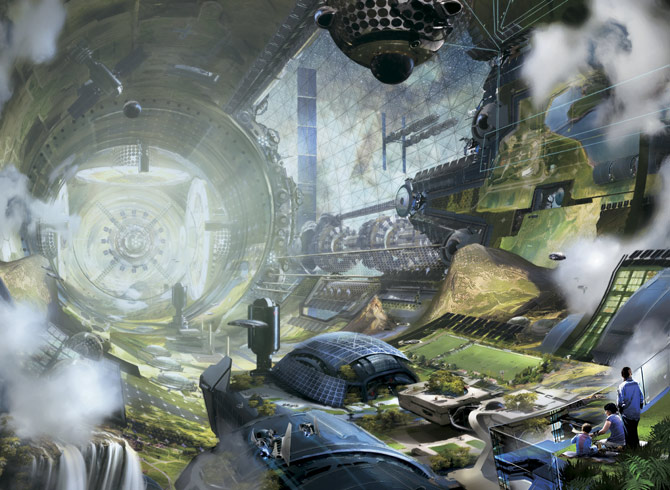
Space Colony by Stephan Martiniere
But when it comes to deep-space exploration, the stuff that would take us to the outer reaches of the Solar System and beyond, that’s where things get tricky and pretty speculative. Ideas have been on the table for some time, since the last great Space Race forced scientists to consider the long-term and come up with proposed ways of closing the gap between Earth and the stars. But to this day, they remain a scholarly footnote, conceptual and not yet realizable.
But as we embark of a renewed era of space exploration, where the stuff of science fiction is quickly becoming the stuff of science fact, these old ideas are being dusted off, paired up with newer concepts, and seriously considered. While they might not be feasible at the moment, who know what tomorrow holds? From the issues of propulsion, to housing, to cost and time expenditures, the human race is once again taking a serious look at extra-Solar exploration.
And here are some of the top contenders for the “Final Frontier”:
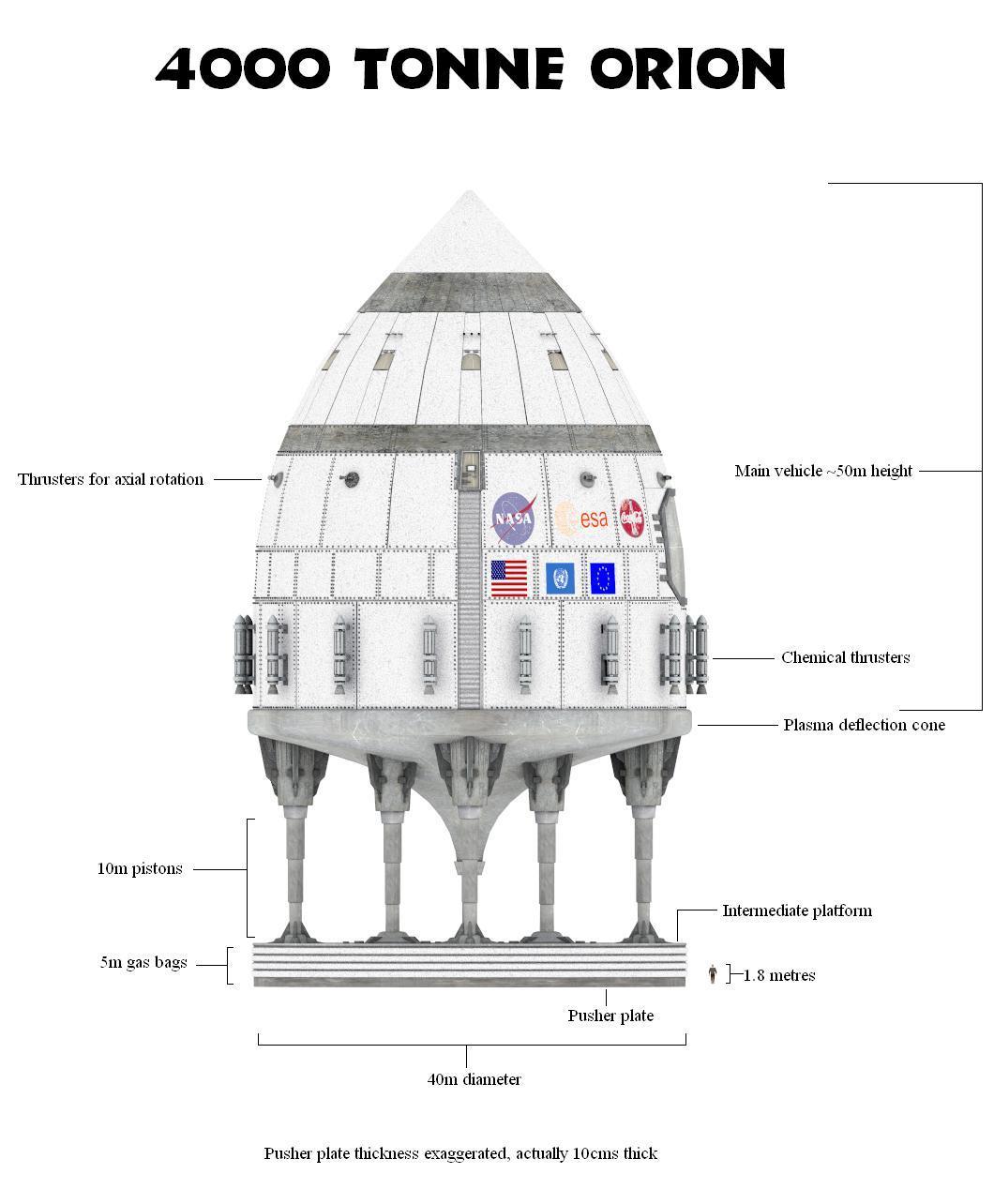
Nuclear Propulsion: The concept of using nuclear bombs (no joke) to propel a spacecraft was first proposed in 1946 by Stanislaw Ulam, a Polish-American mathematician who participated in the Manhattan Project. Preliminary calculations were then made by F. Reines and Ulam in 1947, and the actual project – known as Project Orion was initiated in 1958 and led by Ted Taylor at General Atomics and physicist Freeman Dyson from the Institute for Advanced Study in Princeton.
In short, the Orion design involves a large spacecraft with a high supply of thermonuclear warheads achieving propulsion by releasing a bomb behind it and then riding the detonation wave with the help of a rear-mounted pad called a “pusher”. After each blast, the explosive force is absorbed by this pusher pad, which then translates the thrust into forward momentum.
Though hardly elegant by modern standards, the proposed design offered a way of delivering the explosive (literally!) force necessary to propel a rocket over extreme distances, and solved the issue of how to utilize that force without containing it within the rocket itself. However, the drawbacks of this design are numerous and noticeable.
F0r starters, the ship itself is rather staggering in size, weighing in anywhere from 2000 to 8,000,000 tonnes, and the propulsion design releases a dangerous amount of radiation, and not just for the crew! If we are to rely on ships that utilize nuclear bombs to achieve thrust, we better find a course that will take them away from any inhabited or habitable areas. What’s more, the cost of producing a behemoth of this size (even the modest 2000 tonne version) is also staggering.
Antimatter Engine: Most science fiction authors who write about deep space exploration (at least those who want to be taken seriously) rely on anti-matter to power ships in their stories. This is no accident, since antimatter is the most potent fuel known to humanity right now. While tons of chemical fuel would be needed to propel a human mission to Mars, just tens of milligrams of antimatter, if properly harnessed, would be able to supply the requisite energy.
Fission and fusion reactions convert just a fraction of 1 percent of their mass into energy. But by combine matter with antimatter, its mirror twin, a reaction of 100 percent efficiency is achieved. For years, physicists at the CERN Laboratory in Geneva have been creating tiny quantities of antimatter by smashing subatomic particles together at near-light speeds. Given time and considerable investment, it is entirely possible this could be turned into a form of advanced propulsion.
In an antimatter rocket, a dose of antihydrogen would be mixed with an equal amount of hydrogen in a combustion chamber. The mutual annihilation of a half pound of each, for instance, would unleash more energy than a 10-megaton hydrogen bomb, along with a shower of subatomic particles called pions and muons. These particles, confined within a magnetic nozzle similar to the type necessary for a fission rocket, would fly out the back at one-third the speed of light.
However, there are natural drawback to this design as well. While a top speed of 33% the speed of light per rocket is very impressive, there’s the question of how much fuel will be needed. For example, while it would be nice to be able to reach Alpha Centauri – a mere 4.5 light years away – in 13.5 years instead of the 130 it would take using a nuclear rocket, the amount of antimatter needed would be immense.
No means exist to produce antimatter in such quantities right now, and the cost of building the kind of rocket required would be equally immense. Considerable refinements would therefore be needed and a sharp drop in the cost associated with building such a vessel before any of its kind could be deployed.
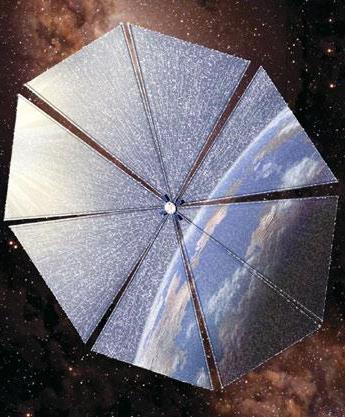
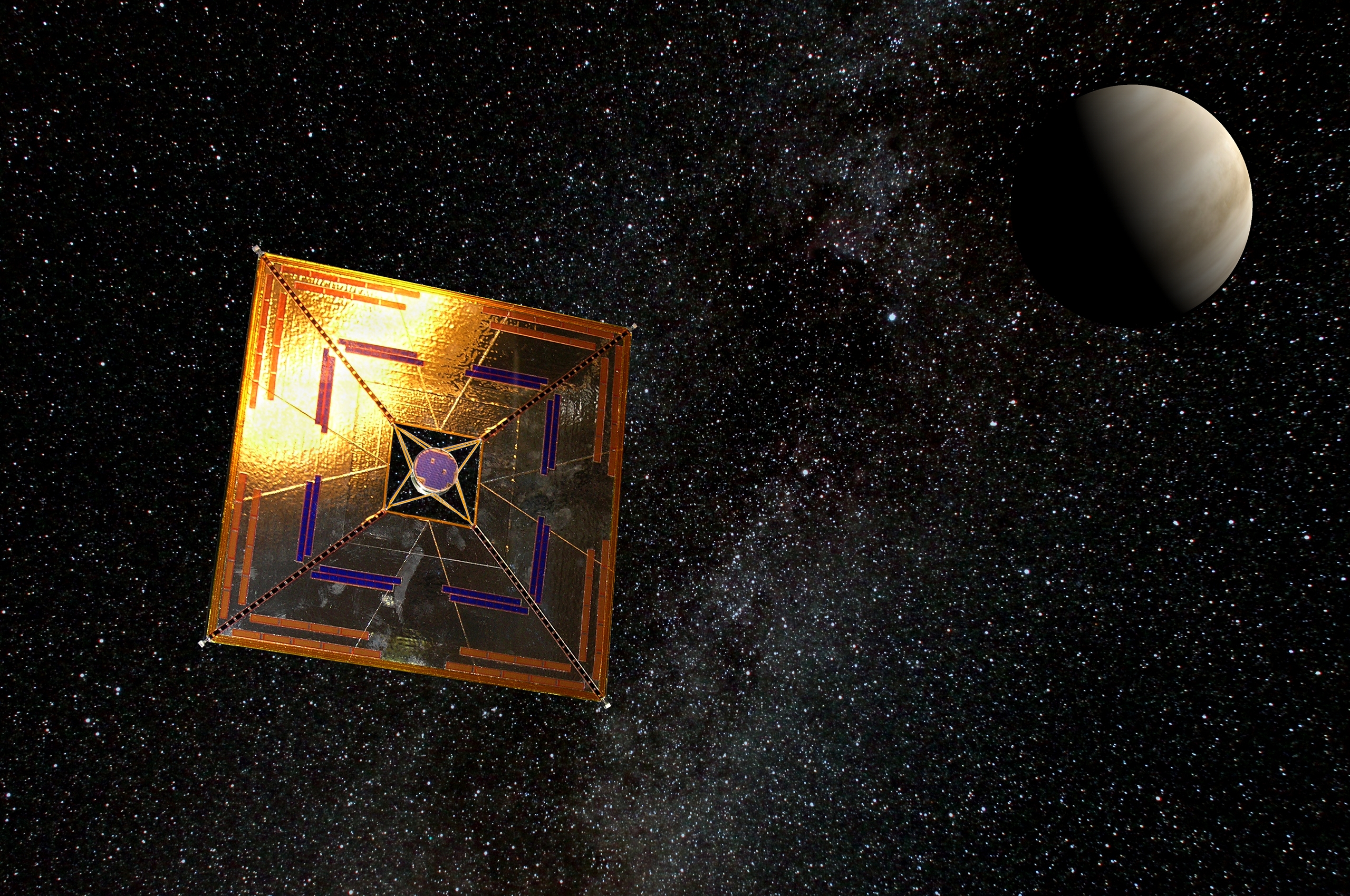
Laser Sail: Thinking beyond rockets and engines, there are some concepts which would allow a spaceship to go into deep space without the need for fuel at all. In 1948, Robert Forward put forward a twist on the ancient technique of sailing, capturing wind in a fabric sail, to propose a new form of space travel. Much like how our world is permeated by wind currents, space is filled with cosmic radiation – largely in the form of photons and energy associated with stars – that push a cosmic sail in the same way.
This was followed up again in the 1970’s, when Forward again proposed his beam-powered propulsion schemes using either lasers or masers (micro-wave lasers) to push giant sails to a significant fraction of the speed of light. When photons in the laser beam strike the sail, they would transfer their momentum and push the sail onward. The spaceship would then steadily builds up speed while the laser that propels it stays put in our solar system.
Much the same process would be used to slow the sail down as it neared its destination. This would be done by having the outer portion of the sail detach, which would then refocus and reflect the lasers back onto a smaller, inner sail. This would provide braking thrust to slow the ship down as it reached the target star system, eventually bringing it to a slow enough speed that it could achieve orbit around one of its planets.
Once more, there are challenges, foremost of which is cost. While the solar sail itself, which could be built around a central, crew-carrying vessel, would be fuel free, there’s the little matter of the lasers needed to propel it. Not only would these need to operate for years continuously at gigawatt strength, the cost of building such a monster would be astronomical, no pun intended!
A solution proposed by Forward was to use a series of enormous solar panel arrays on or near the planet Mercury. However, this just replaced one financial burden with another, as the mirror or fresnel lens would have to be planet-sized in scope in order for the Sun to keep the lasers focused on the sail. What’s more, this would require that a giant braking sail would have to be mounted on the ship as well, and it would have to very precisely focus the deceleration beam.
So while solar sails do present a highly feasible means of sending people to Mars or the Inner Solar System, it is not the best concept for interstellar space travel. While it accomplishes certain cost-saving measures with its ability to reach high speeds without fuel, these are more than recouped thanks to the power demands and apparatus needed to be it moving.
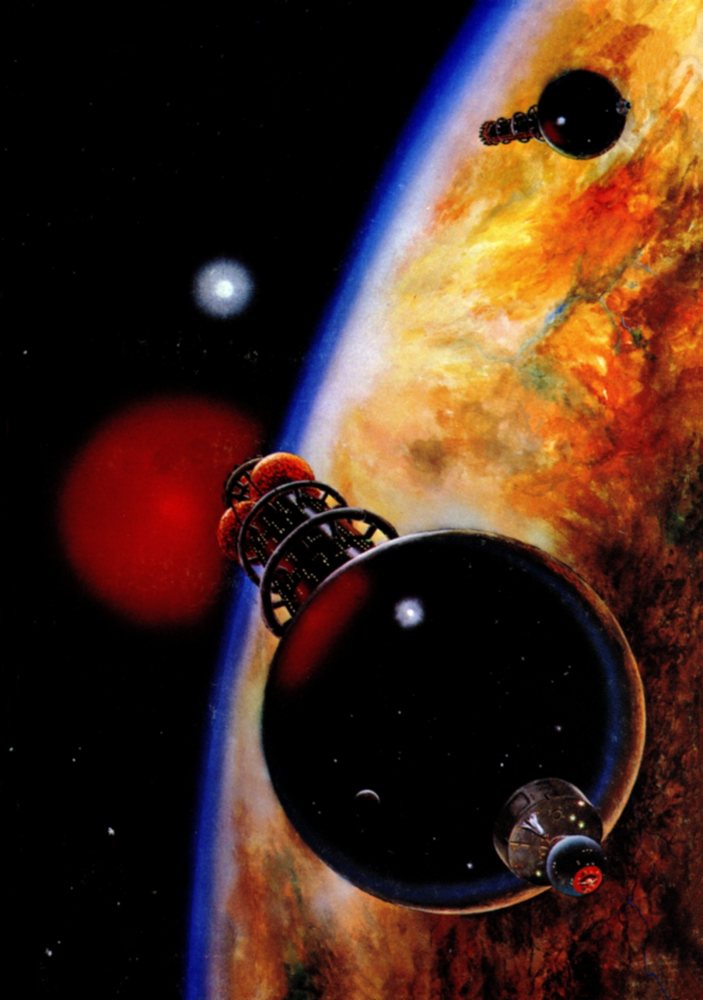
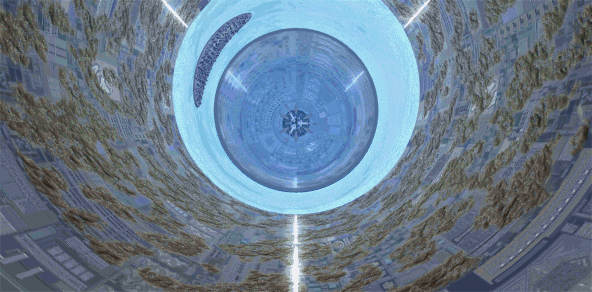
Generation/Cryo-Ship: Here we have a concept which has been explored extensively in fiction. Known as an Interstellar Ark, an O’Neill Cylinder, a Bernal Sphere, or a Stanford Torus, the basic philosophy is to create a ship that would be self-contained world, which would travel the cosmos at a slow pace and keep the crew housed, fed, or sustained until they finally reached their destination. And one of the main reasons that this concept appears so much in science fiction literature is that many of the writers who made use of it were themselves scientists.
The first known written examples include Robert H. Goddard “The Last Migration” in 1918, where he describes an “interstellar ark” containing cryogenic ally frozen people that set out for another star system after the sun died. Konstantin E. Tsiolkovsky later wrote of “Noah’s Ark” in his essay “The Future of Earth and Mankind” in 1928. Here, the crews were kept in wakeful conditions until they reached their destination thousands of years later.
By the latter half of the 20th century, with authors like Robert A. Heinlein’s Orphans of the Sky, Arthur C. Clarke’s Rendezvous with Rama and Ursula K. Le Guin’s Paradises Lost, the concept began to be explored as a distant possibility for interstellar space travel. And in 1964, Dr. Robert Enzmann proposed a concept for an interstellar spacecraft known as the Enzmann Starship that included detailed notes on how it would be constructed.
Enzmann’s concept would be powered by deuterium engines similar to what was called for with the Orion Spacecraft, the ship would measure some 600 meters (2000 feet) long and would support an initial crew of 200 people with room for expansion. An entirely serious proposal, with a detailed assessment of how it would be constructed, the Enzmann concept began appearing in a number of science fiction and fact magazines by the 1970’s.
Despite the fact that this sort of ship frees its makers from the burden of coming up with a sufficiently fast or fuel-efficient engine design, it comes with its own share of problems. First and foremost, there’s the cost of building such a behemoth. Slow-boat or no, the financial and resource burden of building a mobile space ship is beyond most countries annual GDP. Only through sheer desperation and global cooperation could anyone conceive of building such a thing.
Second, there’s the issue of the crew’s needs, which would require self-sustaining systems to ensure food, water, energy, and sanitation over a very long haul. This would almost certainly require that the crew remain aware of all its technical needs and continue to maintain it, generation after generation. And given that the people aboard the ship would be stuck in a comparatively confined space for so long, there’s the extreme likelihood of breakdown and degenerating conditions aboard.
Third, there’s the fact that the radiation environment of deep space is very different from that on the Earth’s surface or in low earth orbit. The presence of high-energy cosmic rays would pose all kinds of health risks to a crew traveling through deep space, so the effects and preventative measures would be difficult to anticipate. And last, there’s the possibility that while the slow boat is taking centuries to get through space, another, better means of space travel will be invented.
Faster-Than-Light (FTL) Travel: Last, we have the most popular concept to come out of science fiction, but which has received very little support from scientific community. Whether it was the warp drive, the hyperdrive, the jump drive, or the subspace drive, science fiction has sought to exploit the holes in our knowledge of the universe and its physical laws in order to speculate that one day, it might be possible to bridge the vast distances between star systems.
However, there are numerous science based challenges to this notion that make an FTL enthusiast want to give up before they even get started. For one, there’s Einstein’s Theory of General Relativity, which establishes the speed of light (c) as the uppermost speed at which anything can travel. For subatomic particles like photons, which have no mass and do not experience time, the speed of light is a given. But for stable matter, which has mass and is effected by time, the speed of light is a physical impossibility.
For one, the amount of energy needed to accelerate an object to such speeds is unfathomable, and the effects of time dilation – time slowing down as the speed of light approaches – would be unforeseeable. What’s more, achieving the speed of light would most likely result in our stable matter (i.e. our ships and bodies) to fly apart and become pure energy. In essence, we’d die!
Naturally, there have been those who have tried to use the basis of Special Relativity, which allows for the existence of wormholes, to postulate that it would be possible to instantaneously move from one point in the universe to another. These theories for “folding space”, or “jumping” through space time, suffer from the same problem. Not only are they purely speculative, but they raise all kinds of questions about temporal mechanics and causality. If these wormholes are portals, why just portals in space and not time?
And then there’s the concept of a quantum singularity, which is often featured in talk of FTL. The belief here is that an artificial singularity could be generated, thus opening a corridor in space-time which could then be traversed. The main problem here is that such an idea is likely suicide. A quantum singularity, aka. a black hole, is a point in space where the laws of nature break down and become indistinguishable from each other – hence the term singularity.
Also, they are created by a gravitational force so strong that it tears a hole in space time, and that resulting hole absorbs all things, including light itself, into its maw. It is therefore impossible to know what resides on the other side of one, and astronomers routinely observe black holes (most notably Sagittarius A at the center of our galaxy) swallow entire planets and belch out X-rays, evidence of their destruction. How anyone could think these were a means of safe space travel is beyond me! But then again, they are a plot device, not a serious idea…
But before you go thinking that I’m dismissing FTL in it’s entirety, there is one possibility which has the scientific community buzzing and even looking into it. It’s known as the Alcubierre Drive, a concept which was proposed by physicist Miguel Alcubierre in his 1994 paper: “The Warp Drive: Hyper-Fast Travel Within General Relativity.”
The equations and theory behind his concept postulate that since space-time can be contracted and expanded, empty space behind a starship could be made to expand rapidly, pushing the craft in a forward direction. Passengers would perceive it as movement despite the complete lack of acceleration, and vast distances (i.e. light years) could be passed in a matter of days and weeks instead of decades. What’s more, this “warp drive” would allow for FTL while at the same time remaining consistent with Einstein’s theory of Relativity.
In October 2011, physicist Harold White attempted to rework the equations while in Florida where he was helping to kick off NASA and DARPA’s joint 100 Year Starship project. While putting together his presentation on warp, he began toying with Alcubierre’s field equations and came to the conclusion that something truly workable was there. In October of 2012, he announced that he and his NASA team would be working towards its realization.
But while White himself claims its feasible, and has the support of NASA behind him, the mechanics behind it all are still theoretical, and White himself admits that the energy required to pull off this kind of “warping” of space time is beyond our means at the current time. Clearly, more time and development are needed before anything of this nature can be realized. Fingers crossed, the field equations hold, because that will mean it is at least theoretically possible!
Summary: In case it hasn’t been made manifestly obvious by now, there’s no simple solution. In fact, just about all possibilities currently under scrutiny suffer from the exact same problem: the means just don’t exist yet to make them happen. But even if we can’t reach for the stars, that shouldn’t deter us from reaching for objects that are significantly closer to our reach. In the many decades it will take us to reach the Moon, Mars, the Asteroid Belt, and Jupiter’s Moons, we are likely to revisit this problem many times over.
And I’m sure that in course of creating off-world colonies, reducing the burden on planet Earth, developing solar power and other alternative fuels, and basically working towards this thing known as the Technological Singularity, we’re likely to find that we are capable of far more than we ever thought before. After all, what is money, resources, or energy requirements when you can harness quantum energy, mine asteroids, and turn AIs and augmented minds onto the problems of solving field equations?
Yeah, take it from me, the odds are pretty much even that we will be making it to the stars in the not-too-distant future, one way or another. As far as probabilities go, there’s virtually no chance that we will be confined to this rock forever. Either we will branch out to colonize new planets and new star systems, or go extinct before we ever get the chance. I for one find that encouraging… and deeply disturbing!

 For years, Antarctic research stations have been plagued by environmental conditions that go far beyond the extreme cold. For one, there’s the problem of moving ice, which recedes towards the ocean at a rate of about 0.4 kilometers a year. On top of that, literally, there is the ice and snow accumulation, which threatens to bury any building placed on the continent. Because of this, research stations have a top life expectancy of about ten years in Antarctica. But that may be about to change…
















 Stories by Williams
