
 If there’s one thing that’s become an annoying cliche in commercial science fiction movies, and even some novels, it’s the idea of a super-advanced alien race that come to Earth, proceeds to kick ass, but then gets beaten by a ragtag bunch of superheroes by the most implausible means. You know what I’m talking about, the big evil monsters from another planet who seem to have armies, navies and nuclear arsenals beat, but then succumb to germs, basic hacking, and inferior weaponry.
Having grown up with a lot of bad science fiction, I could name a few titles from my childhood which, looking back, kind of insulted my intelligence. But as I’ve gotten older, the list has grown and expanded. And I really thought it was time I did a list that presents all of the bad stories, movies and television arcs that I’ve witnessed over the years, the ones that extra-terrestrial would definitely get a kick out of if ever they saw them. Hopefully, they wouldn’t conclude we humans actually think like this, and hence would be that much easier to conquer!
And here they are, in order of awfulness. The list of incompetent alien invaders!
1. Battlefield Earth:
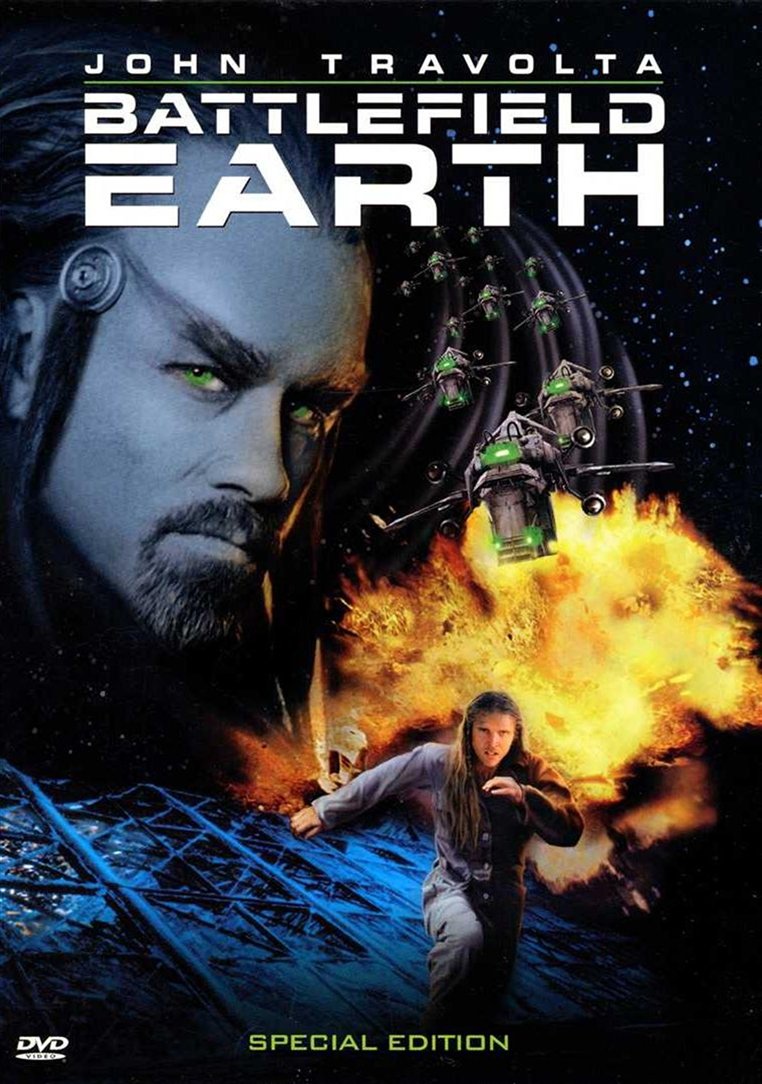 I start with this movie for obvious reasons. As far as logic and plot development were concerned, this movie could not have been more insulting to aliens! Not only was their own ineptitude galactic in proportions, but it flew in the face of everything we were told during the first half of the movie (or quarter of the book). Yes, L. Ron Hubbard (the inventor of Scientology) isn’t exactly known for being the most rational of human beings, but even he was out to lunch on this one!
For starters, it is established early on that the Psychlos – an alien civilization of clawed Rastafarians – have conquered Earth by the year 3000. But in the course of the story, we learn through the main character that it was extremely easy for them to do it. Using their superior technology, Earth’s armies, navies and air forces fell to the invasion after a mere 9 minutes! That’s quite the ass-whooping!
And yet, a group of tribal kinsmen are able to not only defeat the occupying Psychlos, but destroy their entire homeworld in the course of an uprising. How, you might ask? Well, as it turns out, Terl, the governor of Earth – played by director and Hubbard acolyte John Travolta – facilitated it all by giving Johnny Goodboy Tyler (the protagonist of the story) all the lucrative info on their race so he could become a foreman for a private gold mining operation, but in turn used it to train a resistance.
In the course of so doing, Tyler was able to trick Terl into accepting gold from Fort Knox, where he used 1000-year old simulators to train his ragtag misfits in how to use equally old Harriers, missiles, and even a nuke, which they then teleportedto the Psychlo home planet in the midst of their rebellion. Oh yeah, did I forget to mention that the Psychlos atmosphere ignites when it comes into contact with radiation? Yeah, that’s kind of important, because it resulted in the full-scale destruction of their home world!
Ignoring for a fact that the physics of this makes absolutely no sense, Hubbard’s tale basically asserts that by relying on the same technology that couldn’t last ten minutes against a bunch of alien invaders in the first place, a bunch of hill people did what ever army on Earth could not and killed off a far more advanced species. How did these Psychlos conquer Earth in the first place? They are not only breathe air that’s the equivalent of dry tinder of gasoline, they’re dumber than dirt!
2. Independence Day:
 Here we have another instance where audiences were presented with an alien menace that appeared unassailable in the first act of the movie, but then proved to be total pushovers. As the first Roland Emmerich disaster flick to grace the silver screen in America, this movie made a ton of money and set the arc for Emmerich’s career. Fun and silly, it sucked as far as realism and suspension of disbelief were concerned. For me, what endures about this movie is how fun it is to make fun of!
Basically, the aliens come to Earth in a massive mothership that begins deploying smaller motherships across the globe. Using our own satellites to sync up, they begin a countdown to Armageddon and start blowing up every major city on the planet. The only person who seems to notice the countdown ahead if time is a lone cable repair man, and not the NSA, CIA, MI6 or any other covert spy agency on the planet!
All counter-attacks fail, as it seems the alien ships have shields – these big green walls that protect them from our missiles. Nukes are even useless against them. All hope seems lost until, contained within Area 51, this same cable man comes up with an idea… He’s going to download a virus to the alien mothership using his Macbook and set off a nuke inside it. With the help of a fighter pilot who seems oddly and suddenly qualified to fly a captured alien ship, they fly into space, make it aboard the mothership, and begin their hack job.
And while the alien’s shields are down, what remains of Earth’s air forces mount a counter-attack that goes off quite well. It seems that without their shields, the alien fighters are a bunch of total wimps! And the smaller motherships, all you got to do is find a alcoholic, traumatized crop duster to fly a plane up their main gun shaft and the whole thing will blow up! Oh, and the hacker team, they make it out before the nuke goes off and somehow crashland without dying. Hurray for xenocide!
So basically, our species was on the verge of being exterminated, only to be saved by a cable man, a NASA reject, and a drunken crop duster with PTSD. Brent Spiner was right, it WAS just a matter of getting around their technology! And how easy was that? Yeah, they got interstellar spaceships, laser beams and shields, but the bastards can’t even erect a firewall to stop a single hacker? And speaking of those laser beams, turns out all you got to do is stick your finger in the barrel and the whole ship will blow up!
3. Battle: Los Angeles
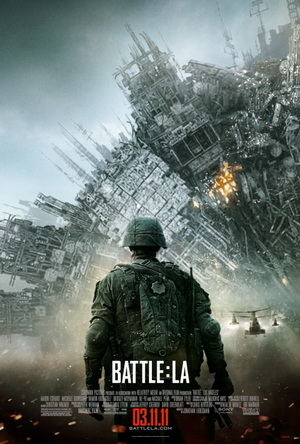 Here we have another instance where aliens attack, manage to do untold amounts of damage, but then seem to succumb when a small band of heroes come together and put their minds to the task of beating them. And in this case, the aliens didn’t even really have an Achilles heel. They just seemed to become beatable once the Marines figured out their physiology, technology and basic tactics, which was surprisingly easy…
It’s almost summer in LA, and a grizzled veteran who’s traumatized over the recent loss of his platoon is about to quit the service. But of course, hostile aliens land off the coast and throw a wrench in his retirement plans! And instead, he is deployed to the city to defend against the first wave of the assault, and is quickly trapped with what remains of his platoon behind the enemy’s lines.
There, they begin to figure out the enemy. This consists of first performing a recreational autopsy on one to find out how to kill it. Turns out all you have to do is shoot them “to the right of the heart”. So, in the chest then? No wonder all the other soldiers couldn’t kill them! They were aiming for the groin! Fleeing with some civilians in tow, they also systematically discover all their other weaknesses…
This includes the fact that the alien airdrones are drawn to their radio transmissions and that all their drones are controlled by some central command module. After realizing they are on their own because the Air Force aint coming, they divert to find the module and then destroy it. All the alien drones are deactivated, the Marines are rescued, and a counter-attack is now underway to clear the last of them. But of course, the Marines refuse to sit this one out and selflessly volunteer to go back in…
So the lesson here is, when entire armies fail and fall back, its a small group of heroes that will save the day. Not bad, but how is it a bunch of grunts in the field are able to figure out how an enemy arsenal works while the higher ups basically have their thumbs up their asses the whole time? Funny how that always seems to be the case!
And sure, I get that the leader of these heroes would be a scarred man seeking redemption, but are we to believe that a man who lost his entire platoon to insurgents would have no trouble leading a handful of people to victory over a far more advanced alien species? Something just doesn’t add up here…
4. Signs:
 I remember the days when M. Night Shyamalan was considered a big deal, and not some dude past his prime who made a string of critically-panned movies. Yes, in addition to being hellbent on starring in his own films and using material that seemed marginal (comic book heroes, monsters, aliens and ghosts), he also seemed to have a real hard on for stories that were full of holes!
And this movie was no exception, adding to an already rich tradition of scary aliens who don’t seem to have a clue when it comes to conquering planet Earth. The story starts out clear enough, with “signs” of an impending invasion by alien beings. And of course, the heroes here are a single family made up of people strangely qualified to defeat them – a priest who’s lost his faith after losing his wife, a psychic daughter, an asthmatic son, and former baseball player who swings at everything.
When the aliens show up, it turns out his dying wife’s words were a prophecy on how to beat back in the invasion. First, hit them in the head with a bat, they hate that! Then, rely on your sons asthma to prevent him from inhaling their toxic vapors. And finally, realize your daughter’s desire to keep glasses of water around the house are a defensive mechanism, since water is toxic to them.
Really? So these things can travel light years to our planet for the sake of terrorizing and killing us, but are vulnerable to a blows in the head from a blunt object and a liquid that covers 70% of our planet and permeates the air. What kind of invaders are these? Are these the same ones who were defeated in the Simpsons by a “board with a nail?”
Also, did they not notice ahead of time that the most basic element, next to the air itself, was fatal to them? What is it with alien invaders not doing their due diligence? How is it that we here on Earth are able to notice lakes of sulfuric acid on Venus, despite having never landed there, but aliens can’t notice the equivalent on a planet they are actively invading? Kang, Kodos… get off our planet!
5. Battleship:
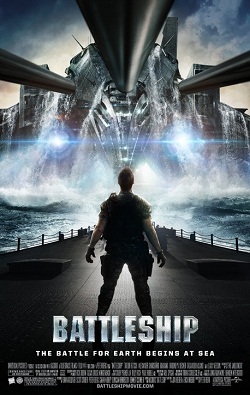 Next up, we have the movie that dared to ask the age old question: “what do you get if you cross Transformers with Independence Day?” The answer being, the same old story of unlikely heroes beating an alien menace, but with a twist! This one is set at sea. And if that wasn’t enough, it also stars Rihanna, who proved once again that there are some singers who should stick to what they’re good at and avoid crossing over!
And much like in Battle: LA, we once again have aliens landing in the sea and wreaking havoc on nearby city – this time in Honolulu. After trapping and destroying the US and Japanese naval ships in the vicinity, the alien ships take control of the communications array on the nearby island of Oahu. A single vessel, captained by a LT after his brother (the Captain) is killed, manages to survive and continues the fight…
This includes the US naval ship taking out two of the alien ships and capturing an alien to learn that they are vulnerable to sunlight. On land, a veteran and quadruple amputee in recovery also figures out what the aliens are doing with the array. Apparently, they are using it to summon more of their ships to Earth. So on land and at sea, we have unlikely heroes who begin unraveling the aliens’ plans.
Using the aliens rather pedestrian weakness to their advantage, the US naval ships manage to blind the last of the smaller alien ships with sunlight and destroy it. However, it too is sunk, but they manages to survive and gets back to base to commandeer the USS Missouri, the last remaining US Battleship in existence. Bringing her out of retirement, they use her big guns to take out the alien ships shields, allowing the Air Force to finish her off.
Following this, the Lieutenant is promoted and given a ship of his own to command. Him and Rihanna also arrange to get married. Hurray! Planet Earth is saved and everybody’s getting laid! And once again, it seems that if you’re a reluctant hero, or you’ve got vengeance on your mind, you can beat the odds and overcome a vastly superior alien foe. Never mind that a small fleet was useless against this enemy, or that your vessel is dangerously out of date even by Earth standards!
6. The Borg (Star Trek: TNG):
 Here we have a truly chilling and frightening alien menace that started out as a credible threat, but quickly degenerated into a nuisance that was eventually beaten through some unlikely twists! I can still remember when the Borg were first presented in the second and third season of TNG, just how tough and scary they seemed! How they went from this from the clumsy, easily-fooled menace led by a “Queen” towards the end is a mystery…
As Guinan said during their introductory episode, the Borg are a collective “made up of organic and artificial life which has been developing for thousands of centuries.” In addition to being virtually indestructible and entirely collectivized, they are hellbent on assimilating all known lifeforms and technology they come across. This makes them an inevitable threat, one which Q believes they are unprepared to face.
 Hence, he arranges for a little face-to-face between them and the Enterprise, and it doesn’t go too well. In addition to finding that their weapons are virtually ineffective against a Borg ship, they also learn that these ships are capable of healing from battle damage, are faster and far more coordinated than their own; and most importantly, that they are crewed by a relentless enemy. They narrowly survive, and only because of Q’s intervention.
Their second confrontation happens shortly thereafter, when a Borg Cube is dispatched to Federation space to begin assimilating them. After an initial encounter with the vessel, Picard is captured and assimilated. The crew learns that he is now part of the Borg and that his knowledge has been absorbed. As the Borg vessel begins advancing on Earth, the Federation loses 39 ships in an attempt to stop it.
 In the end, they manage to stop it by recapturing the Captain, tapping into the Borg neural net, and commanding them to go to sleep. The Borg ship self-destructs, realizing their collective has been intruded and they are vulnerable. It is for this reason, and this reason alone, that humanity survives its first engagement with the Borg and lives to fight another day. Scary stuff, and doesn’t bode too well for the future!
Immediately thereafter, the Borg ceases to become a serious threat. Not appearing again until the end of Season 5, at which point Roddenberry had died, the Enterprise discovers a single stranded Borg and rescue him, plotting to return him to the collective carrying a virus. However, they soon realize the lone Borg, who’ve they’ve humanized by naming him “Hugh”, is no longer a Borg per se, and cannot commit to the plan. Instead, they learn that Hugh’s individuality have spread throughout the collective, causing chaos.
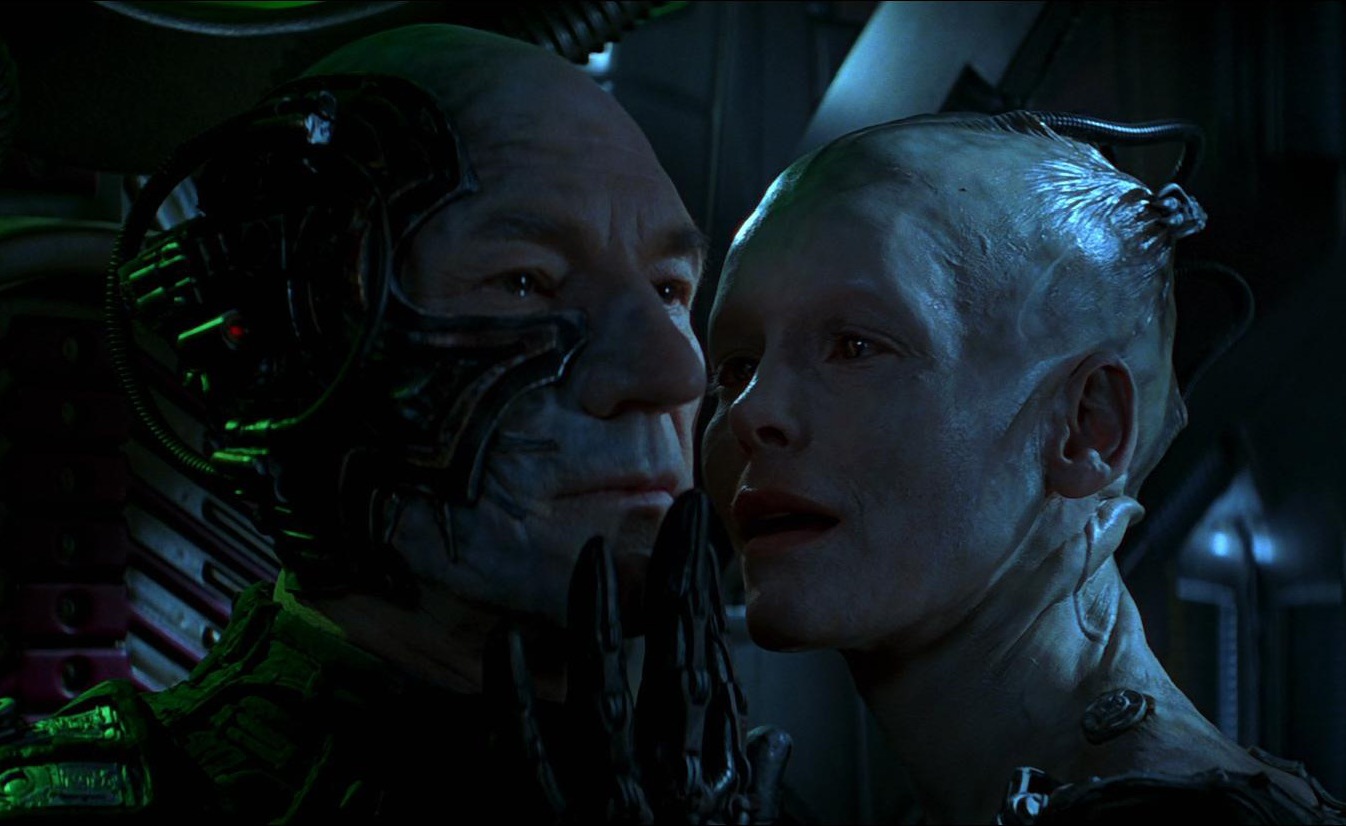 Thereafter, the Borg made no real appearance in the series until the spinoff series Voyager, where they make numerous appearances before being vanquished. First, they are shown to be fighting a losing war against beings from a parallel dimension where space is fluid and technology is organic in nature. The Voyager crew assists the collective against this common threat, and gains 7 of 9 as a crewmember.
In subsequent episodes and seasons, Voyager wages a one-ship war with the collective as they flee back to Federation space. They manage to outwit the Borg Queen (weren’t they supposed to be a collective?) time after time, stealing a trans warp coil from her, saving a group of resistance fighters from the collective’s grasp, and coordinating their efforts with a future Janeway to not only make it home, but crash the entire collective with a virus.
From invincible enemy that spoke with one voice, to a bunch of dumb drones led by a megalomaniacal queen that made deals and was easily tricked, the Borg was a truly awesome concept that degenerated into a sort “Evil the Cat” that became all-too-human. Ironic, and quite disappointing really. Much like many elements of the show, this was one of Roddenberry’s babies that seemed to suffer in his successor’s hands.
7. The Day of the Triffids:
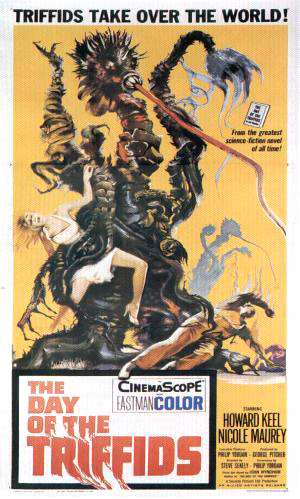 Although based on a novel that ended quite differently, the film adaptation of this novel has gone down in history as a case of aliens that seemed so menacing, but proved to be very dumb. Written by John Wyndham, the author that brought us The Chrysalids, the story considers the possibility of an alien invasion that doesn’t involve tripods, motherships or little green men armed with ray guns.
No, in the end, Windham’s invasion was much more subtle, patient, and far more effective. It begins when the triffids, a race of seemingly intelligent, aggressive plants that begin popping up all over the world. Initially thought to be the result of bioengineering within the USSR (a possible commentary on Lysenkoism), the venomous plants are soon revealed to be the first wave in an alien invasion.
After being blinded by contact with one of the plants, the main character awakens in the hospital to find it deserted. He begins to walk through the streets of London, apparently surrounded by other blind people. He soon comes upon a group of people who still have their sight and are planning on establishing a colony to repopulate the human race.
In time, it is made clear that the triffids are causing the environment to change, effectively terraforming Earth to become more like the alien environment they are used to. They continue to advance and eventually surround the small home the main characters make for themselves. But at the same time, the main characters learns that a colony has been formed on the Isle of Wight, which is removed from the infestation, where people are attempting to continue the fight.
In creating this story, Wydnham acknowledged a great debt to H.G. Wells’ War of the Worlds; though in this novel, the aliens are not foiled. However, in the film adaptation of the novel, the triffids are eventually foiled by a very likely source: salt water! Yes, it seems that an invasive species chose to attack a planet where the majority of the surface is covered by something entirely poisonous to them.
Little wonder then why Shyamalan chose water as his aliens’ weakness. He was ripping off a classic movie! Too bad it was an unfaithful adaptation of the original novel. He could have avoided making one of several bad movies!
8. The War of the Worlds:
 We come to it at last, the original story that inspired an entire slew of classic alien invasion tales. Written in 1895-97, H.G. Wells’ The War of the Worlds not only introduced the world to the concept of a “Martian invasion”, it set the tone for all subsequent generations of paranoia and fear regarding extra-terrestrial life. This was not an intended consequences of his work, mind you, just a side-effect of what was arguably a brilliant novel.
Told from a first-person point of view, the story follows a philosophically-inclined author who witnesses the invasion firsthand. It all begins shortly after an observatory notes the appearance of several “explosions’ on the surface of Mars. Shortly thereafter, the narrator is one of many people to notice the arrival of a meteor which turns out to be a large cylinder. When the cylinder opens, disgorging tripods that begin incinerating everything with heat rays.
 More cylinders begin falling all over Southern England, laying waste to military units and communities. After meeting up with an artilleryman, the narrator finds out that he has become cut off from his wife, and reroutes to try and find her. People begin to evacuate London, and British forces are able to bring down some of the tripods, but eventually, all organized resistance ceases.
In their wake, the Martian begin to unleash a species known as Red Weed, a native martian plant that begins altering the Earth’s ecology. Of the narrator’s companions, a curate and the artilleryman, the former comes to see the invasion as a herald of the Apocalypse, while the latter begins to advocate that humanity rebuild civilization underground. He eventually leaves both behind and returns to London, where he finds the aliens dead due to infectious disease.
At once brilliant and original, Wells story has undergone extensive scrutiny over the years. It’s plot and thematic makeup have led many critics to wonder what its central message was, whether it was meant as a sort of cautionary tale, an historical allusion, or an indictment on British colonial policy. As part of the larger trend of invasion literature, there were also many who thought that the aliens represented an actual enemy (i.e. Germany), and the point was merely to stoke fears about the possibility of an actual world war.
Summary:
In the end, it seems pretty obvious that when it comes to alien invasion stories and movies, everyone is picking at the crumbs from Wells’ table. As one of the first stories involving war between humanity and extra-terrestrials, it was also the first to introduce the world to the concept of a seemingly unassailable alien menace that was brought down because of an Achilles heel.
And without fail, it now seems like just about every purveyor of science fiction has followed in his footsteps. Whether it’s Verhoeven’s disaster porn, classic B-movie adaptations, new generations of speculative sci-fi novels, or mainstream TV shows, the concept of a fearsome, super-advanced species that initially has the edge on humanity, only to be foiled by superior… whatever, is destined to be all the rage!
And much like Wells War, one can’t help but wonder about the psychology and deeper sociological implications of that. Do such ideas remain popular with us as part an enduring xenophobic tendency, or are they part of some deeper destructive impulse, where we just love to see civilization as we know reduced to ashes? In some respects, you might say this a healthy sublimation of that desire, where we allow others to do what we secretly desire, right before we pay them back in full!
I’m thinking this is getting a little too intellectual given the subject matter I started with. This was supposed to about clueless aliens and how these stories and film parody them. Once again, I sincerely hope that if there are aliens out there who are able to listen in on our radio, television and movie transmissions, that they take all of this entertainment with a massive grain of salt.
I think I speak for all of humanity when I say we don’t need no invasions anytime soon! Come back after we’ve developed our own death rays!
















 Stories by Williams