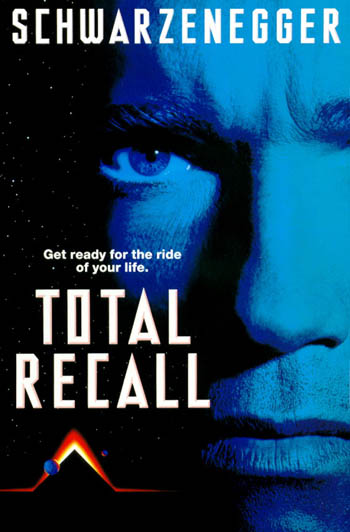
 Remake season continues for me, this week with the 2012 remake of the 1990 original movie Total Recall. Back when it came out, I was seriously questioning what the hell was going on in Hollywood, as this was just another remake in a summer that was packed full of them. But as the saying goes, “put up or shut up” – i.e. if I’m going to complain about the tide of remade movies, I might as well know what I’m talking about.
And much like last time, I figure that a review of this movie should start by paying a little lipservice to the original (which this remake did in spades!)
Total Recall 1990:
 The film is set in the not-so-distant future, where a man named Douglas Quaid is haunted by dreams of Mars and a mysterious woman and seeks an escape from his humdrum life as a metal worker. He learns of a memory-implant service named Rekall which he believes might be the solution, since they can provide a simulated adventure that he has always wanted – to go to Mars and live a life of adventure.
He then goes to Rekall and selects a package that includes a simulation where he is a special agent on a top-secret mission. However, things go terribly wrong when he begins acting out his secret agent character before the company has even had a chance to implant it. They sedate him and put him in a car, hoping to wash their hands of the incident. But when he wakes up, his friends and wife try to kill him, claiming he is not who he says he is.
 He is given a briefcase by a former associate which contains a recording, in which he is telling himself that he’s really a man named Carl Hauser, and that the governor of Mars (Cohaagen) erased his memory because of a secret he carries. Quaid/Hauser then goes to Mars, retracing the path his old self has given him, and finds his way to Melina and the resistance. She then takes him to Kuato, leader of the resistance, to unlock his memories.
They help him recover the secret he’s been carrying – which involves the discovery of an alien artifact under the surface of Mars – but the base is then found and overrun. He and Melina are taken prisoner, and he learns that Hauser was never a double-agent, but a mole working with Cohaagen all along to lead them to the resistance. They strap him and Melina into chairs and try to force Hauser to recover his old self.
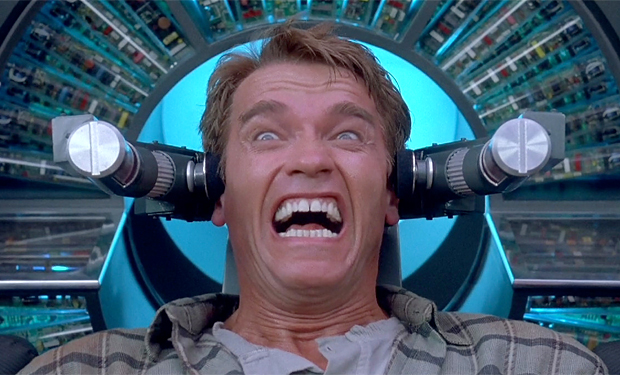 However, Quaid and Melina escape and enter the alien artifact. Cohaagen tries to stop them, claiming its a doomsday device that will destroy the planet, but Quaid manages to activate it before the three of them are sucked out onto the surface. The reactor turns out to be an atmospheric generator that turns Mars’ icy core into breathable air, which then pours out onto the surface, saving Melina and Quaid and making the planet livable.
Quaid kisses Melina, still not sure if what he has experienced is real or a dream.
Total Recall 2012:
 At the end of the 21st century, the world has been devastated by chemical warfare, rendering all but two regions unihabitable. Whereas the wealthy live in the northern hemisphere – in the United Federation of Britain (UFB) – and in the Colony (former Australia). Tensions between the two are high due to the latter demanding independence, and a series of terrorist bombings attributed to a man named Matthias.
Enter into this Douglas Quaid, a factory worker who makes the transit between the Colony and the UFB every day on a massive subterranean lift called “The Fall”. At night, he dreams of fleeing for his life with a woman, and then being taken captive. He attributes these dreams to feeling trapped in his dead end life, and then hears of the memory-implant service known as Rekall.
 Against his friend Harry’s recommendation, he goes to Rekall and requests a memory in which he is a intelligence service agent. The chief technician reveals that any duplication will cause problems, and then stops the process when he learns that Quaid really is a secret agent. Federal agents then break in and shoot everyone and try to take Quaid prisoner. However, he kills his captors and escapes.
Coming home to his wife Lori, he tells her of what happened and she tries to kill him as well. After escaping again, a pursuit begins, and Lori is told by UFB Chancellor Cohaagen to bring Quaid in alive. Meanwhile, Quaid is told by a former coworker to find the “key”, and a hidden message in the call leads him to a safety deposit box containing fake IDs, a holographic disguise, and a recording in which he explains what is happening.
 Apparently, Quaid is actually a man named Hauser who worked for UFB intelligence. He was given the task of infiltrating the Colony’s resistance until he met Melina, who convinced him to change sides. He is instructed to go to the UFB and find it, but upon arrival, he is found out and forced to flee again. He is then rescued by the woman he keeps seeing in his dreams and escape Lori for the second time.
Together, they make it away and Quaid takes them to his old apartment to hide. Here, he finds the “key”, which is a recorded message on his piano that tells him that Cohaagen has been behind the bombings, and that he is planning an invasion of the Colony with an army of synthetics so he can level it and rebuild it as a new living space for the UFB. Luckily, Hauser discovered a kill code for the synthetics, which he must get to Matthias to stop the invasion.
 As they attempt to leave his apartment, they are interrupted by Harry, who claims Quaid is still at Rekall and that he is an implant there to help him wake up to reality. Quaid chooses to shoot him and save Melina, and they are once again pursued by Lori and once again escape. They travel via the Fall to the Colony, where they meet with Matthias to hand over the memory that contains the kill code.
Unfortunately, the memory proves to be a recording of Cohaagen telling them they’ve been had. He then shows up with Lori and several security forces, kill Matthias, and take Melina away. Hauser is told he was given a false code to lead them to the resistance, and that a backup of his memories that predate his betrayal will be restored. Hauser realizes his old colleague is with them, has left his restrain undone, and escapes.
 A fight takes place aboard the Fall, and Hauser and Melina plant a series of bombs on the rails. The Fall arrives and the synthetics begin to deploy, and Hauser begins fighting it out with Cohaagen and his forces. Hauser and Melina defeat Cohaagen and then detonate the bombs, which causes the Fall to begin falling backwards towards the center of the Earth where it explodes.
Hauser loses consciousness and wakes up with Melina inside a medical vehicle. He realizes it is actually Lori wearing his holographic disguise and they fight again, and he finally kills her. He and Melina are reunited, and they stand together and hear how the Colony is now expecting full independence. He sees a Rekall signs and has a moment of doubt, but ignores it and kisses Melina.
Summary:
Once again, I am forced to give this one to the original. Whereas the remake had some signs of quality, which included decent enough performances from Farrel, Biel, Beckinsale, and Cranston. But unfortunately, some decent sets, a whole of lot of chase scenes and big budget special effects were not enough to save this movie from a relatively weak plot and a whole lot, too much CGI, and a whole lot of borrowing.
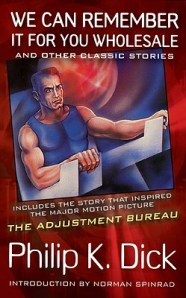 First of all, why did they do away with the whole Mars plot? The story which both the original and the remake are based on – “We Can Remember It For You Wholesale” by Philip K Dick – centered on Mars, though it did not take place there. Including it in the plot seems like a no-brainer. But for some reason, the writers of the remake wanted a story focused on Earth and the dangers of chemical warfare and rezoning.
Second, the story did away with a crucial element this time, which was the good old fashioned mind-fuck of the original. In that version, not only did we not know for certain whether or not Quaid/Hauser was dreaming the whole thing, we truly thought he was a good guy up until they showed otherwise. The plot involving replacing his memories was a ruse by Cohaagen in order to get Hauser past Kuato’s psychic detection.
 In other words, in order to infiltrate the resistance, he had to believe he was an actual traitor. Thus began the convoluted process of making the resistance think he was genuine by erasing his memory and dumping him on Earth, then leading him to retrace his path and find his way to Kuato. Though the information he had about the Martian artifact was real, it was just the bait they dangled in front of the resistance’s nose to get them to give up their location.
Which brings me to item two in the weak plot front. The fact that Quaid/Hauser was actually a good guy in this version made me respect the plot way less. It was cool finding out the hero was a villain, and then seeing him chose to remain with his implanted identity rather than allow himself to be turned back into his old self. It was a big reveal, added a solid twist to the plot, and even raised an existential question or two.
 And then there was the key moment where Quaid/Hauser has to decide what is real. In both versions, this takes the form of someone telling him he’s still dreaming and has to do something he won’t like in order to wake up. In the original, it involved Quaid being handed a pill which the man from Rekall says is a symbol of his desire to wake up, but could just as easily be a sedative. He realizes the man is a fake by the way he’s sweating and shoots him.
In the remake, it takes the form of him being confronted by his friend Harry who tells him he’s dreaming and to shoot Melina, a figment of his imagination. He chooses to shoot his friend Harry and accept that what he is experiencing is real because Jessica Biel begins to cry. But isn’t that be exactly what a fantasy woman would do in that situation? Seemed like quite the gambit there.
 Also, the “secret” that Hauser had stumbled upon in this version was really quite lame. In the original, it involved an alien artifact, which is oodles more interesting than than Cohaagen planning to rezone Australia for more living space. Sure, the idea was laden with scientific inaccuracies – melting an ice core doesn’t instantly terraform a planet! – the ridiculousness of it could always be circumvented by arguing that it really was all a dream.
Last, but not least, there were the many parts of this remake that were obvious shout outs or references to the original. First, you had the three-breasted hooker, who was well cast and easy on the eyes. You also had key lines like – “If I’m not me, then who the hell am I?” “How would I know? I just work here.” And of course, the redheaded woman at the customs line. But these seemed a bit too many and obvious to be a simple wink and a nod.
 Also, Bill Knighy had barely any screen time at all, and only really comes on to paraphrase what Kuato said in the original film. And the bad guys? No comparison! While Kate Beckinsale was believable enough as a villainess, Brian Cranston simply did not hold a candle to the original’s Ronny Cox and Michael Ironside. Those two were perfectly cast as the evil, somewhat over-the-top bad guys, the perfect counter to Arnie’s over-the-top good guy.
But getting past that, there’s the matter of what the movie kinda-sorta did right. The settings were all quite artistic, with the world in the Colony being gritty, crowded, dirty looking, and consisting of a great deal of cultural influences. By contrast, the UFB looked cleaner, brighter, and the design seemed singular by comparison. And the emphasis of shortages of space was summed up nicely by the massive, overlapping layers of structures.
 And the “synthetics” were artfully done and kind of cool looking. As were the flying cars, the aerial traffic lanes, and the three-dimensional elevator pods that crisscrossed the sky. And “The Fall” was a pretty neat idea, especially with the whole “gravity reversal thing”. But in just about all cases, these things have been done before. The sets are reminiscent of Blade Runner, with it’s gritty, crowded streets, signs in Asian characters, and the synthetic humans wandering around.
The robots also looked like a cross between Storm Troopers and the machines from I, Robot, and the flying cars called to mind another Philip K Dick adaptation, namely Minority Report. What can be said about a movie who’s set designs and concept art are quite impressive, but which borrow heavily from several other franchises? It’s like this movie is subtly mocking itself for a lack of originality – which makes sense since it’s a remake.
 And with all the special effects, things looked entirely too fake. People today might find the Kuato puppet and the molded plastic suits of the mutants to be outdated, but those showed a lot of heart versus the extensive use of CGI in this one. In fact, seeing movies like these make me long for the days of old-style effects where costumes, real actors and real sets were built rather than generating everything digitally. George Lucas, I’m looking at you as I say this!
I’d say its blatantly obvious at this point, but this one definitely goes to the original. And much like the Robocop remake, it begs the question: why redo a movie when the original got it right? Sure, the 1990 version of Total Recall wasn’t perfect. It had a lot of cheesy elements and some massive scientific inaccuracies, but it managed to both entertain and impress with the way it played with perceptions, twisted things around and kept people guessing until the end.
In this remake, there really is no mystery, the plot is simplified, the most important element (i.e. Mars) is dropped, some of the best elements are missing, and it borrowed too heavily from multiple sources – not the least of which was the original. So really, why was it even made? In this season of remake review, I find myself asking that question quite a lot! Not a good way to start…
Okay, onto new things. Which may, at this point, include The Teenage Mutant Ninja Turtles relaunch. No promises though 🙂

 Climate Change means more than just on average hotter temperatures year round. There are also numerous consequences for sea levels, glaciers, weather patterns, weather stability, crop growth, fisheries, wildlife, forest fires, disease, parasites, rivers and fresh water tables. Explaining it can be a challenge, which is why visual tools like tables, maps and charts are so very useful.
 The first is known as 1001 Blistering Future Summers, a tool produced by the Princeton-based research and journalist organization Climate Central. This interactive map illustrates much hotter summers will become by the end of the century if nothing is done to stem global warming. Users simply type in the name of their hometown and the map compares current temperatures in their town to how high they will be and finds the geographic equivalent.
 As you can imagine, changes like these will have drastic effects that go far beyond scorching summers and inflated AC bills. Furthermore, when one considers the changes in a global context, and they will be disproportionately felt, they become even more disconcerting. And that is where the series of maps, collectively known as the “human dynamics of climate change”, come into play.
 Then the maps get into specific issues, based on climate forecasts for 2100 that assume that nothing will be done to stop global warming. You can see, for example, how higher temperatures could increase demand for irrigation water; how parts of the world could see increases and decreases in water run-off into rivers; how different areas are set for more flooding; and how the warmest days in Europe, parts of Asia, and North America are projected to be 6°C warmer.
 The overall impression is one of flux, with changing temperatures also resulting in vast changes to systems that human beings heavily rely on. This is the most frightening aspect of Climate Change, since it will mean that governments around the world will be forced to cooperate extensively to adapt to changes and make do with less. And in most cases, the odds of this aren’t good.
 The Yangtze, China’s greatest river, similarly originates in territory that the country considers unstable – i.e. the Tibetan Plateau. Should water from this river prove scarcer in the future, control and repression surrounding its source is likely to increase. And when one considers that the Arab Spring was in large part motivated by food price spikes in 2010 – itself the result of Climate Change – the potential for incendiary action becomes increasingly clear.
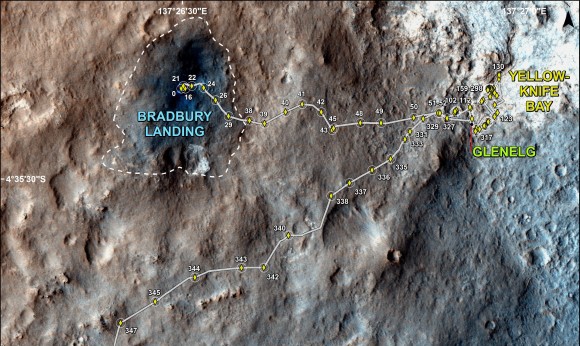
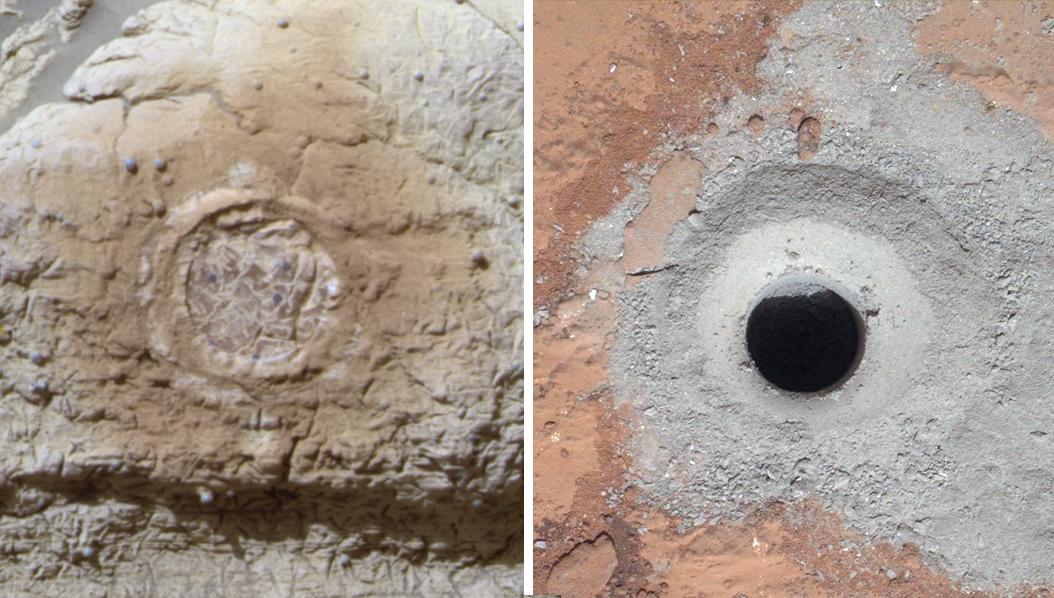

 The sedimentary layers in the lower slopes of Mount Sharp are the principal reason why the science team specifically chose Gale Crater as the primary landing site. Using high resolution spectral observations collected by NASA’s powerful Mars Reconnaissance Orbiter (MRO), they were able to determine the presence of deposits of clay-bearing minerals. or phyllosilicates, a key sign that organic molecules could exist on the planet.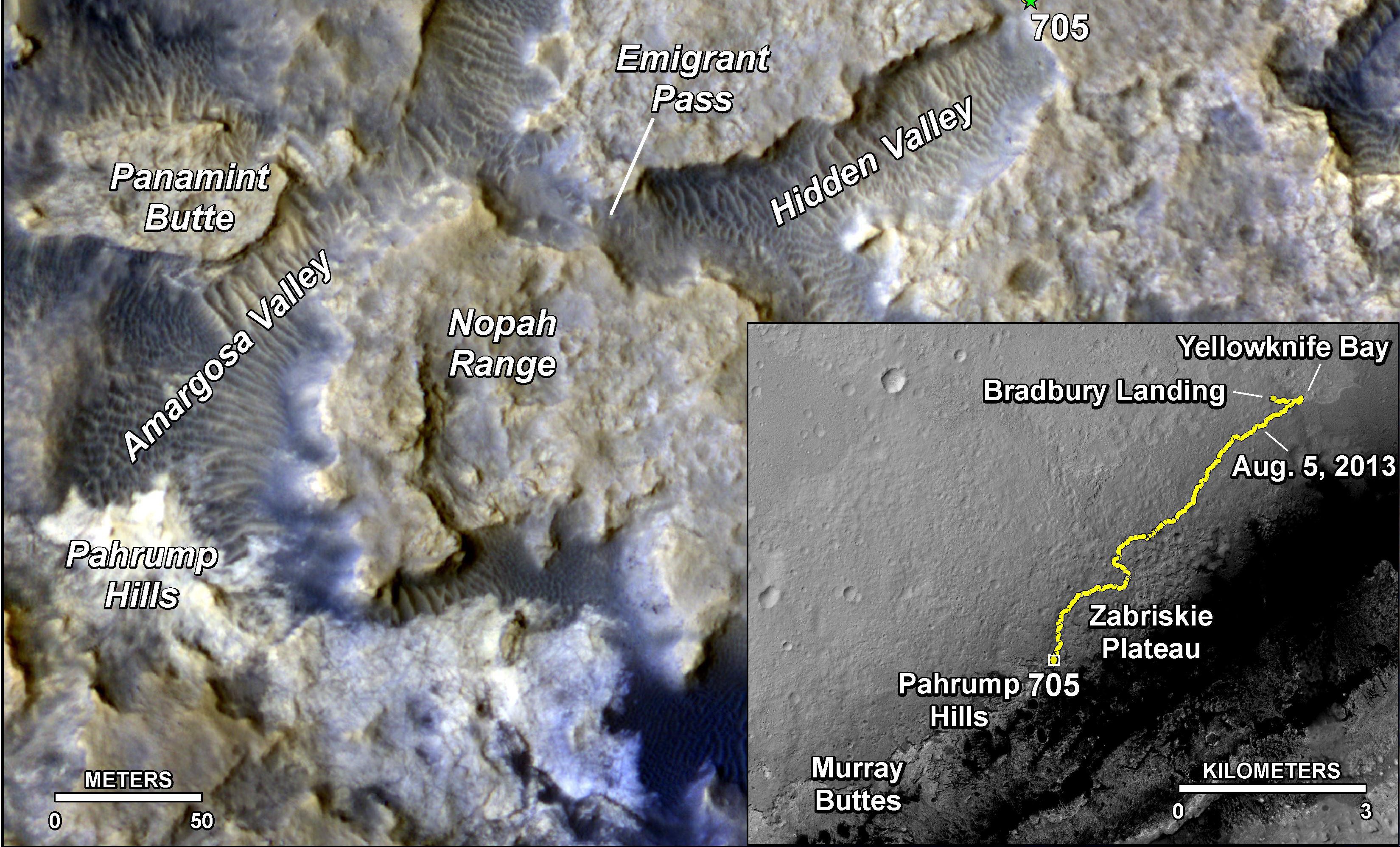

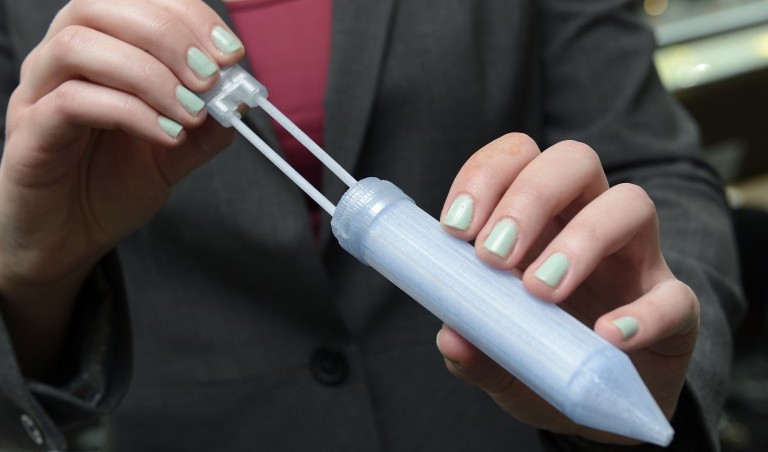

 As Sydney Rooney, the student team leader of the John Hopkins research team, said in an interview with Gizmag:
 Here is one of the latest from Screen Junkies’ “Honest Trailers”. And the funny thing is, it really makes me want to see it! But of course, it wouldn’t be HT if they didn’t mock a little bit, and the plot holes they identified are pretty well true. Much like with Iron Man 3, this movie begs the question “Where the hell are the rest of the Avengers?” Come to think of it, why do you even need other superheroes when some are already nigh-invulnerable?







 As the US Investigations Services said on their website:










 Stories by Williams