Worlds of the Firefly Universe

It’s been forever since I did a post about the various planets that make up a sci-fi universe. And I got to admit, this is one I’ve been holding out on simply because the sheer volume of info made it seem just the slightest bit intimidating. I am, of course, referring to The Verse, also known as, the Firefly/Serenity universe.

As fans of the show are no doubt aware, The Verse is a pretty happening place! As the teacher described it in the opening section of the Serenity movie, the system is made up of “dozens of planets and hundreds of moons”, all of which had been terraformed over the course of generations to ensure that they were habitable.

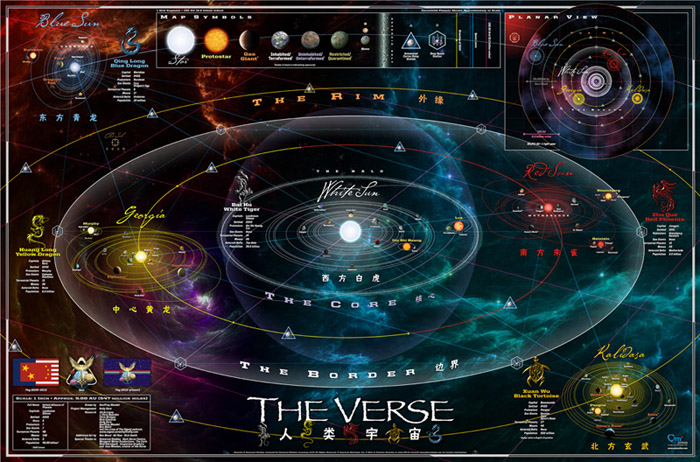
But I was surprised to learn more recently was that this system was also made up of multiple stars. Yes, 34 Tauri, aka. The White Sun, aka. Bai Hu (“White Tiger” in Chinese), contains not only hundreds of worlds, but also is also made up of five stars and seven brown dwarf protostars. Many of these have their own planetary systems, and their position relative to the central White Sun is indicative of their overall position in the systems social and political makeup.

The Verse

To break it down succinctly, the verse consists of hundreds of terraformed planets and moons which orbit three stars and two brown dwarves. The White Sun, aka. Bai Hu/White Tiger, is home to the “Central Planets” that make up the Alliance. Farther out lie the planets that orbit the Red Sun (Zhu Que or “Red Phoenix”) and Georgia (Huang Long, “Yellow Dragon”), which are known as the “Border Planets”.
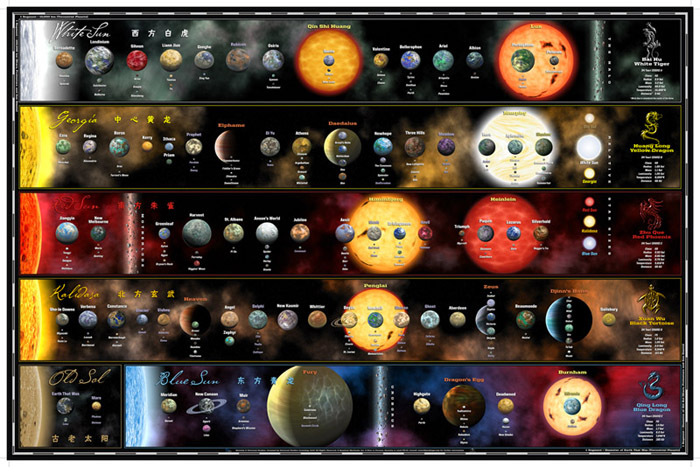
Next are Kalidasa, also known as Xuan Wu (Black Tortoise) and the Blue Sun (Qing Long or “Blue Dragon”). The worlds orbiting these last two stars comprise “The Rim”. Within all of these planets, the seven brown dwarf/protostars also share orbits and host some of the mini-systems planets as well.

The Central Planets:
The worlds that orbit the White Sun have the distinction of being the first that were colonized and constitute the core of the Alliance, its many institutions and centers of power. They are also the most advanced, developed, and Earth-like of all the planets in the system.

The White Sun:
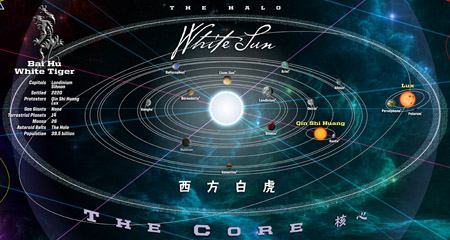
Also known as Bai Hu (or “White Tiger”), the White Sun is core of The Verse and the principal star in The White Sun system. It is orbited by fourteen planets and the two brown dwarves Qin Shi Huang and Lux, which are themselves home to three of the system’s planets.

Londonimium: The second planet orbiting the White Sun. Along with its sister planet Sihnon, Londoninium was one of the first planets colonized after the exodus from Earth-That-Was and being the most Earth-like of the systems planets, was the easiest to settle. Most of the settlers here came from Europe and the Americas and the predominant western culture took hold here quickly. The planet also orbited by the two moons, Balkherne and Colchester.

In addition to being the home of the Alliance Parliament, Londinium also boasts the Museum of History and the Museum of Art, the finest museums of Earth-That-Was, colonial artifacts, and the largest collections of Western-style art in the system.  On top of all that, the Alliance has many of it’s most important military assets here, which includes the Ministry of Intelligence and the headquarters of the elite SAS (Special Alliance Support) forces.

Sihonn: The third planet orbiting the White Sun and the second of the system’s major planets. Inhabited primarily by colonists from China, the planet is renowned for being highly sophisticated and place of advanced technology. Viewed from space, the planet has a deep red color and the surface is renowned for its natural beauty and cultural diversity. The planet is also the training grounds for many Registered Companions, hence why Inara Serra calls the planet home. The capital city is said to be, according to Inara, “like an ocean of light.” The planet is orbited by three moons, Airen, Xiansheng, and Xiaojie

Ariel: The eleventh planet orbiting the White Sun, Ariel is a central planet and one of the most valued members of the Alliance. As the home to the major medical center (named Saint Lucy’s), it is here where the majority of medical advances and technology are produced. It is also because of its reputation that it is the home of the lucrative black market trade in artificially grown organs. During the episode “Ariel”, the crew pulled its greatest heist on this planet while Simon Tam used the facilities to examine his sister. The moons Ariopolis, Shiva, and Poseidon all orbit this world.

Bellerophon: The tenth planet orbiting the White Sun, this planet is largely an ocean planet and an enclave for the wealthy. The majority of the inhabitants live in estates suspended above the ocean and where supplies are shipped in from off world and garbage carried away by automated ships. Each of these estates are something akin to a self-contained city, with lavish living, spacious facilities, and state of the art security.

Liann Jiun: The fourth planet orbiting the White Sun.

Bernadette: The first planet of the White Sun, this world was one of the first to be settled alongside Londoninium and Sihonn. Like all central Alliance worlds, this planet is renowned for being technologically advanced and boasts all the amenities for its population. As the staging point for all citizens looking to settle on the Border Planets and Rim, As a result, the official resettlement bureau, the Alliance Colony and Settlement Authority was based in the city of New Tombstone. At the same time, however, an underground slave trade also grew up on the planet that kidnapped new arrivals and sold them to clients both in the core and out on the rim. The moons Nautilus and Spinrad also orbit this planet.

Persephone: One of the outermost White Sun planets that also orbits the protostar Lux, Persephone is a world riddled with contradiction. While it is an advanced Alliance planet with plenty of wealthy residents, its proximity to the Border Worlds also means that it contains many large slums and underworld elements. For example, the Eavesdown Docks are located here, which Badger, a criminal boss who frequently employs Mal and his crew, call home. It was also here that the Firefly crew found Shepherd Book and the Tams in the first episode.

The Border Planets:
Made up of Georgia and the Red Sun, the Border Planets regions is where the Independents made their stand against the Alliance’s attempts at Unification. Many of the worlds, particularly in the Georgia System, still bear the scars of that war. Shadow, for instance, was rendered uninhabitable due to extensive bombing, and Hera is the location of the Serenity Valley, where the war was effectively lost by Independent forces.

Georgia:
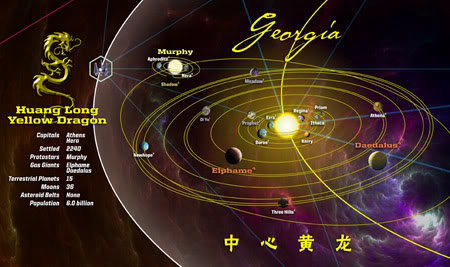
Also known as Huang Long (or Yellow Dragon), Georgia is the principal star of the Georgia system, the largest system orbiting the White Sun. It is home to sixteen planets and the brown dwarf/protostar Murphy, which is itself home to three more planets.

Ezra: The first planet in the Georgia system, Ezra is a desert world that marks the very border between the Central and Border Planets. It is here that Niska’s Skyplex, home to one of the most brutal crime lords in The Verse, is located.

Boros: The third planet of the Georgia system which is orbited by the moon of Ares. Between the planet and its moon, the Alliance maintains a strong military presence in the form of a base and a shipyard.

Kerry: Named after county Kerry in Ireland, this is the fourth planet of the Georgia system.

Athens: The Ninth planet of the Georgia system, Athens, despite its name, lies at the very edge of the Border Worlds and is hence a relatively uncivilized place. It has four moons, including Whitefall which is the fourth and most distant. This moon has the dubious honor of being home to Patience, the matriarchal outlaw who has done business with the Firefly crew and was even said to have shot Mal on one occasion. Whitefall was featured in the episode “Serenity” where Mal and crew were looking to offload a crate of Alliance supplies.

Regina: The second planet of the Georgia system, Regina is known mainly for its mining operations and as the birthplace of the degenerative disease known as “Bowden’s Malady”. This disease has apparently infected everyone on the planet, and requires regular medical treatment to keep from progressing. This planet was featured in the episode “The Train Job”.

Hera: The fourteenth planet orbiting Georgia and one of three planets orbiting the protostar Murphy, Hera occupies a strategic position as the core of the Border Worlds. Due to its Earth-like climate, where terraforming was not necessary as it was with many other Border Planets, Hera became an agricultural colony and breadbasket for most of the system. It is also the location of Serenity Valley, the site of a major battle during the Unification War, where Mal and the Independents made a concerted stand against superior Alliance forces, and were devastated in the end. It is this battle which is considered the final battle of the war, in that it signaled the inevitable defeat of the Independents.

Shadow: An agricultural planet orbiting the protostar Murphy, along with Hera and Aphrodite, Shadow itself is the sixteenth and final planet that orbits the star Georgia. Shadow is where Mal Reynolds was raised on his mother’s ranch, until the Alliance rendered it uninhabitable during the Unification War. As  one of the three leading planets for the Independent’s side, it was heavily bombed by Alliance forces during the initial phase of the invasion. Mal is quoted as saying of it: “No one lives there. No one can.”

Red Sun:
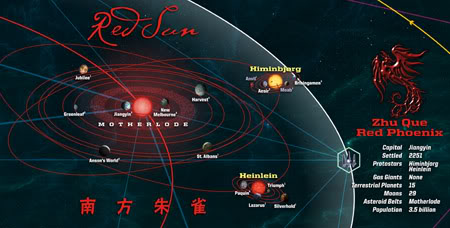
Also known as Zhu Que (Red Phoenix), the Red Sun is the coldest of all the suns in the ‘Verse. It is the principal star of the Red Sun system and shares an orbit with Georgia around the White Sun. Like Georgia, it is home to sixteen planets and two dwarf suns, Heinlein and Himinbjurg.

Greenleaf: The third planet orbiting the Red Sun, Greenleaf is so named because of its large tropical belt, massive jungles and rainforests. Thanks to the presence of so many tropical plants, the planet boasts several major pharmaceutical facilities which use the native flora as a source life-saving drugs that cannot easily be synthesized in a laboratory. In addition, drug smugglers and criminal operations also exist, giving rise to one of the largest black market rings in the system. Because of this, the Alliance maintains a strong presence in orbit and planet side, restricting the flow of ships in the hopes of clamping down on the drug trade. It is also orbited by the moon of Dyton, which Badger himself may have lived on at one time since he called “the old homestead”.

Harvest: The fourth planet of the Red Sun system, this world is also orbited by two moons – the more notable of which is Higgins’ Moon, the home of the “mudder’ operations (an indentured servant operation where mud is transported off world to manufacture ceramics). This moon is also the location of Jaynestown, a settlement which revered Jayne as a saint after he accidentally dumped a haul of money onto the mudder’s village. These events were detailed in the episode entitled “Jaynestown”.

Jiangyin: The first planet of the Red Sun, this border world is home to several agricultural and ranching operations, and is also marked by the strange divide between the townspeople and the “hill people”. These latter folk live in communities located in the highlands where life is difficult and giving rise to superstitious, simple folk who compensate for their lack of skilled tradespeople by periodically kidnapping townspeople or off-world visitors. Two such individuals were Simon and River Tam in the episode “Safe”.

Triumph: The ninth planet of the Red Sun which also orbits the brown dwarf Heinlein, named in honor of sci-fi author Robert A. Heinlein, along with the worlds of Paquin, Lazarus, and Silverhold. Poor and backward by most standards, this world is quite primitive and largely controlled by Elder Gomman. It was also here that the Serenity crew picked up Saffron as part of a marriage contract in the episode “Our Mrs. Reynolds”.

The Rim:
The planets that make up the outermost region of the White Sun are noted for their lawlessness, criminal activity, and the presence of Reavers. As such, it is the most dangerous place in the system, and yet the only place where people seeking refuge from the Alliance can call home.

Kalidasa:
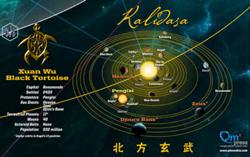
Also known as Xuan Wu (or Black Tortoise), Kaldisa is the principal star of the Kalidasa system and the starting point of the Rim Worlds. It is home to nineteen planets and the brown dwarf Penglai.

Angel/Zephyr: An astrological anamoly, these two planets orbit one another while simultaneously orbiting the star of Kalidasa.

Aberdeen: The thirteenth planet orbiting the star Kalidasa. Named after Aberdeen, Scotland.

Beylix: A border planet orbiting Penglai, a protostar that orbits Kalidasa, and the eleventh body in the Kalidasa system. It has three moons, and appears to have a permanent cloud cover and dense ice rings. Mal’s war buddy Monty was caught by the Alliance here which was mentioned in the episode “Trash”.

Beaumonde: The fifteenth planet in orbit of Kalidasa, Beaumonde is a heavily industrialized world and the manufacturing hub of the system. Because of its massive output of goods, pollution is a major problem and the planet is covered in a perpetual haze, necessitating the constant use of weather satellites to process the worse of it.  This planet was featured in the movie Serenity, where the crew land after pulling their heist on Lilac in order to do business with the crime brothers Fanty and Mingo. It was also here that they discovered River’s programming after a subliminal message triggered her.

Salisbury: The seventeenth and outermost planet of the Kalidas system.

Blue Sun:
Also known as Qing Long (the Blue Dragon), this is the principle tar of the Blue Sun system and contains eight planets and the protostar Burnham.

Muir: The third planet orbiting the Blue Sun, and the planet where Badger was apparently born and raised.

Highgate: The fifth planet orbiting the Blue Sun which has one moon, Perth.

Deadwood: Seventh planet orbiting the Blue Sun and which is orbited by the moon of Haven. It is this world that Shepherd retired to to start a ministry amongst a small colony of settlers. It is also where he died when Alliance forces, loyal to “The Operative” attacked the settlement.

Miranda: The outermost planet in the Blue Sun and White Star system, Miranda was long thought to be a dead world until events in Serenity indicated otherwise. As the farthest planet from the center of the system and uninhabited, it was here that the Alliance created an experimental colony where a quarter-million settlers were treated to a drug known as “Pax”. Designed to suppress violence instincts, the drug had the side-effect of causing the vast majority of the residents to lose all motivation and simply lay down and die. Of those who survived, the drug had the opposite effect, leading to extreme violence and cannibalistic behavior. This explained the existence of the Reavers and why they were to be found at the very edge of the system. The discovery of this planet and its secrets were central to the plot of the movie Serenity.

Summary:
Wow! See what I mean by “happening”? It’s no wonder I took so long to do this post, there’s so much info to sift through! Clearly, Joss Whedon and his writers really went to town when it came to setting and background in this story. And it only drives home just how tragic it is that this show was cancelled before it even finished running it’s first season. There was so much there to work with, so much more to flesh out, detail, and weave into the ongoing storyline. Why oh why did those lame-ass Fox executives cancel this show? I can only hope they’ve since been fired and flogged, and not necessarily in that order!
Off to See the Dark Knight!

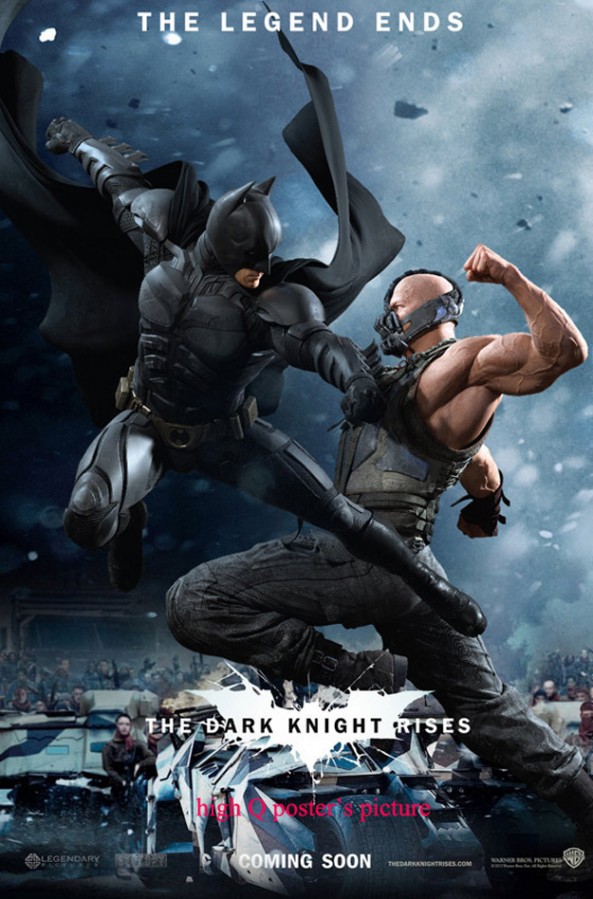
This weekend, after a painstaking week of waiting, I will finally be going to see The Dark Knight Rises! Oh, the anticipation! It’s like Christmas Eve, when all you can do is await the passage of time and pray morning comes, at which point you’ll tear into those presents hoping to find what you’ve been asking for!

In case you can’t tell, I’m looking forward to this. Maybe not as much as a kid does to Christmas Morning, but you get the idea. For Batman fans and total geeks, of which I am both, this is an occasion that has been many years in the making. Ever since the Dark Knight and the death of Heath Ledger, we’ve all been taking to the internet to dig up whatever news we can about what the next movie would be about, who would star in it, and whether or not it could possibly rival the second.

So far, the buzz is that this movie actually does live up to the Dark Knight, and some I’ve even heard whisper that it’s better. Now this is not a totally sacrilegious claim to make. Granted, no one wants to think they are spitting on Heath Ledger’s grave by implying that his performance could ever be topped. But it’s not so farfetched to think that the various elements of this movie might have actually come together better than the last one is it?

Well, that’s something I intend to find out. But first, let me tell what I was expecting long before the teaser trailers started coming out and they made it clear who the new villain was and what the bare bones of the story would be.

Predictions and Source Material:
Months after The Dark Knight debuted and Ledger’s death was announced, every geek and armchair critic took to the forums to speculate about what Nolan and his crew would be doing with the third installment in the franchise. Rumors began to abound that The Riddler would be the next villain, and some even claimed that Johny Depp would be playing him.

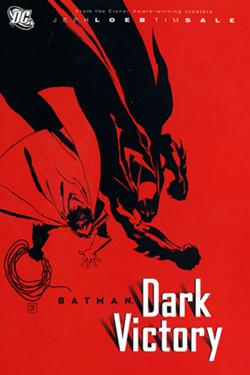
Others I spoke to looked to the original graphic novels and believed that the comic series Dark Victory would be a significant source of the next movie’s material. Having recently read that collection, I became convinced of this as well. Events occurring in this volume took place after the transformation of Harvey Dent into Two-Face and cataloged his descent into madness and his war with the mob. Granted, they did kill Harvey Dent off in the movie, myself and other fans of the comic felt that with Ledger’s death and the fact that Dent’s death got such a quick treatment, that they could bring Dent back and pair him with another villain.

Alas, Nolan put all these rumors to rest when he announced that the Riddler would NOT be the villain in the new movie. Bane, a somewhat obscure character from the animated series, would be filling that role. Catwoman would also be on scene as a sort of lesser villain turned ally, and the plot would harken back to the first movie with Batman’s involvement with Ra’s al Ghul and the League of Shadows.

And that’s when new rumors began, with fans of The Dark Returns coming out of the woodwork to announce that this movie was using that comic series as source material. Again, this includes me, and I can honestly say from all that I’ve heard about the plot that it mirrors Frank Miller’s conclusion to the Batman franchise quite well. You have Batman returning after a long hiatus to save Gotham from a new evil which threatens to consume it, Batman being branded a villain by the authorities and Gothamites alike, and a showdown where the Dark Knight fights it out with his rival in the streets in a big, climactic showdown!

And I for one wouldn’t be too surprised if this movie is better than the last. Like it or not, that movie did have undeniable weaknesses that aren’t talked about too much. In the wake of Ledger’s tragic death, it seemed that most people were willing to overlook these and focus instead on all that was right about the movie, namely Heath’s portrayal of the Joker! But even that couldn’t mask some of the flaws which hinted at rushed production or cut corners. These were mentioned, but didn’t seem to taint the overall legacy of the movie. Which is good, but I feel like mentioning them now before I see the next one.

Dark Knight Confused:
Remember that funny video by “The Key of Awesome”? If not, look it up, I’ll wait. It made some very valid points about the movie and what didn’t quite make sense about it. And there were a few others which I feel like adding now. For starters, the entire third act of the movie, everything which happened after Rachel was killed and Harvey Dent mutilated, was rushed. There wasn’t a single break int he action sequences to let the audience catch their breath and this opened a lot of holes.

For example, how did The Joker know that Harvey Dent wouldn’t splatter his brains all over the hospital room wall? Did he really trust in his own abilities of persuasion that much? Can’t be, since he handed him a loaded gun and told him to “embrace a little anarchy”. And he later said that this was all part of his plan, that unleashing a scarred Dent was his “ace up his sleeve” to ensure that Gothamites lost hope. But didn’t he say he didn’t do planning? And when you consider that it all came down to a coin toss, it kind of seems random and unplanned.

Second, when did he have time to rig up those boats AND conduct that big hospital kidnapping operation? I could see him pulling off one of these, the kidnapping while simultaneously releasing Harvey Dent and telling him to go create some chaos, but not both! And while we’re on the topic of the boats, why was the commissioner trucking all those convicts from Arkham back into the city? He said that since a lot of the Joker’s men came from Arkham, that it was likely some of them were involved in his plot… Okay, so why not just put some extra guards on the island to watch the inmates then? Removing ALL OF THEM and putting them on a boat that would be passing through a city in the grips of chaos seems really stupid. Talk about a prime opportunity to escape!

And how did Batman know that the people on these boats wouldn’t betray each other and blow one another up? In fact, it seemed like the self-righteous citizen was all set to do it. I liked the fact that the criminal didn’t, that made a good point about how the condemned of society really can be more noble and brave than the so-called law abiding. But in the case of the civilized man, the only reason he didn’t push the button was because he suffered a spontaneous attack of conscience.

Oh, and having this happen at the same time as the hostage taking, where the Joker was using patients as human shields and had them dressed as his men to confuse the police, really took away from the latter. That whole sequence was terribly rushed, like the boat scene, and the audience was left just struggling to keep up and waiting on the final fight between the Joker and Batman. And let’s not forget, we got Dent’s quest for revenge happening at the same time, which meant three things were going on at the same time. As a result, I think audiences were all just waiting for things to end so they could catch their breaths and take stock of what they saw.

When it comes right down to it, it felt like they were trying to end the movie on a victorious note, where the Joker went down for his crimes and some kind of resolution was given regarding the whole heroes taking responsibility and making the kinds of sacrifices that had to be made. I remember some people saying the movie felt like it ended naturally with the Joker escaping amidst the bombs. But I’m guessing Nolan and crew figured the story needed a happier ending. But then it also felt like they were trying to cram in every idea they had. Really, this whole problem could have been solved with a few scripting changes.

One, have the Joker hand Harvey an unloaded gun. That would have removed the whole chaos element from that scene and show that the Joker, despite his love of anarchy, really is capable of seeing the bigger picture and planning things out. He doesn’t let Harvey kill him, but does let him go in the hopes that his chaos will prove a distraction from all his hostage taking. That way, when he’s captured, he can say “Harvey’s out there and looking for payback! You may have caught me, but I still get the last laugh. HAHAHAHA!” Ingenious!

Second, nix the boat scene! What purpose did that really serve except as another good idea which they crammed in because they didn’t want to waste it? But they already had the hostage situation AND Harvey Dent looking for revenge against the people who betrayed him. Either go with the boats and Dent’s thread or the hostage taking and Dent’s thread. You can’t do all three and still expect audiences to follow! Still, at this point, audiences had already decided they loved the movie based on acts I and II alone, so the third act really didn’t matter that much.

Well that’s it. Looking forward to tomorrow and hoping like hell this movie is just as awesome as the last, but doesn’t have the same third act problems as it did. Also hoping that it does contain all the aforementioned Dark Knight Returns influences that I and other geeks claim it shared. That comic was awesome, and seeing its better elements adapted to screen would seem like a real validation!

Expect a review. A BIG ONE!

Stop-Motion Dark Knight Video

Check this out! It turns out a group of filmmakers – named Derek Kowk and Henri Wong – have created a stop-motion animated short of the Dark Knight and the Joker’s crew doing battle. They’ve named it Batman: Dark Knightfall. The production involved several Batman collector’s toys from the new movies and must have taken days or even weeks to compile. And the production value was pretty awesome, check it out!

Via: Cartoon Brew

The Hobbit will be a Trilogy

Some recent news has come in over the wire concerning the upcoming Tolkien adaptation. After much anticipation and a few snippets released from the studio as teaser trailers, Peter Jackson has announced that the upcoming Hobbit movie will in fact be a trilogy. Hints to that effect were dropped at the recent San Diego Comic Con, and now Peter Jackson has gone ahead and confirmed it.

Previously, he had indicated that two films would be needed to adapt this classic story to the big screen, but now it appears that the big time movie director/producer is going to need one more to make it all happen. Citing plot necessity and fan response, Jackson claimed that much of the added footage has to do with origin stories, background and character development for various characters in the story.

After meditating on the decision to go with a third movie or stick to the original plan for two, Jackson contended that, were they not to add in a third film, much about Bilbo, Gandalf, the Dwarves of Erebor, the Necromancer, and the climactic Battle of Dol Guldur would go untold. this corresponds to rumors that Jackson has been adding in a great deal of material to the story, relying on the LOTR appendices and background info which comes from that book.

Personally, I’m not sure what to make of this. Granted, it does kind of sound like an attempt to prolong the project and make more money, and Jackson is no stranger to padding movies with unnecessary flashbacks and cheesy cutaways to scenes with Arwen crying. But if Jackson has proven anything at this point, its just how dedicated he is to Tolkien’s creation and how much he wants to bring it all to life. So frankly, I see no reason to doubt him when he says he wants to tell the story and needs more screen time in order to do it.

In the meantime, check out the trailer of the upcoming movie!

2001: A Space Odyssey Trailer Relaunch

The fun folks over at Film School Rejects have just released a clever video which deals with the classic movie 2001: A Space Odyssey and how the trailers would look if the movie were relaunched today. As a big fan of 2001, I couldn’t help but enjoy the presentation and think that it was bang on with its not-so-subtle commentary on how things have changed over the years.

I can remember watching this movie when I was a child. Being too young to appreciate its nuances and complex plot, the only thing I remember was that many scenes had no sound. It was explained to me that this is because there is no sound in space. Suddenly Star Wars didn’t make any sense to me! But being too big a fan of that space opera, I chose to compartmentalize this knowledge and strategically ignore it whenever fun space simulators and sci-fi movies came out that broke this rule.

Years later, I would see the movie again as a young adult, when I was old enough to appreciate it. I did so in the hopes that I would understand it and why the movie has remained such an enduring classic. Of course I could see why, but I also didn’t fail to notice the many extended, and I mean really extended, scenes where space ships and space stations danced around in carefully choreographed display set to classical music. Beautiful, inspiring, but they sure could test your patience.

My mother noticed this too and wondered if anyone could get away with such things in today’s world. As a child of the sixties, she had seen this movie when it first came out and witnessed the stark changes that had taken place in cinema ever since. I recall observing that unlike today’s movies 2001 was shot in a time when “people still had attention spans”. She thought that was funny and reminds me of this from time to time, you know how parents are 😉 In any case, that’s what came to mind when I saw this trailer the other day.

Editing to ensure maximum effect in a minimum amount of time, and taking advantage of all the latest flashy editing techniques, FSR reminds us that at one time, people were willing to hear a presentation out. That is to say, they were willing to wait longer for a point to be made and didn’t demand explosions, cut scenes and loud music every few seconds just to stay interested. Take that Michael Bay!

New Skyfall Trailer!

Perhaps to follow up on Daniel Craig and the Queen’s big Olympic performance, Columbia Pictures has decided to release yet another trailer for the upcoming Bond movie Skyfall. But unlike the one that premiered after Craig and Queen Elizabeth II’s show, this one is way bigger and badder! Guess they thought the last one was underwhelming considering all it was competing with in London. I sure as hell thought so! And here it is, check it out!

The Future is Here: Robotaxis and Podcars!

2010 Zagato 2getthere Podcar

Fans of Total Recall may recall the Johnnycab, a robot taxi service that helped Arny get to where he was going and flee his armed assailants. Well, as it turns out, personal automated podcars (aka. robotaxis) are not a thing of the future anymore. Yes, as it turns out, Masdar City in the United Arab Emirates has a taxi service that consists of a small fleet of autonomous taxis which run entirely on electricity.

Invented by a European company named “2GetThere”, the service accommodates somewhere in the vicinity of 25,000 people per month. As part of the growing project to create a self-sustaining city that runs on clean, renewable energy, these rails are consistent with the city’s ethos and are expected to pave the way for clean mass transit. Best of all, the 2GetThere models don’t have weird-looking animatronic robot busts sitting in the front seat to creep you out and provide needless comic relief!

But of course, the UAE is not the only place where robotaxis can be found, nor is 2GetThere the only company investing in this revolutionary technology. In San Jose, the so-called “Capital of Silicon Valley”, similar efforts are being made to create clean, sustainable transportation. In this case, it takes the form of the Personal Rapid Transit System; or as it is more widely known, Podcars.

The system involves a series of on-call, point to point transit cars which move about on main lines and intermediate stations to find the quickest route to a destination. Under normal conditions, this means of transit has been shown to be faster than other forms of mass transit or automobile. The “matrix”, or looped layout structure of the network, allows for high-volume and is also expected to lessen the burden on conventional transit systems.

Granted, both networks are in their infancy, but both the science and the planning behind them is sound and expected to take off in the near future. Much like mag lev and light rail train systems, they are part of a growing Eco-friendly attitude towards city planning and mass transportation which is anticipated to become the mainstay of urban development and renewal in the 21st century.

And of course, Google and other companies are also hard at work trying to bring us other designs and concepts. Amongst them are true self-driving cars, the kinds that may very well involve robot drivers. But in all likelihood, these will take the form of truly “smart” cars – i.e. the kind that can guide themselves, pick optimal routes, and avoid accidents and traffic congestion. Sad to think that the days of driving might actually be coming to an end. But hey, at least we might save the planet in the process!

Terraforming in Pop Culture

Welcome back to the wonderful world (pun!) of Terraforming. In my last post on the subject, I came to see that it emerged in fiction in the early 20th century as part of our growing awareness of the universe and humanity’s place within it. As western civilization grew and came to encompass the entire world through exploration, conquest and colonization, human scientists simultaneously discovered that our universe was much larger than previously thought, and began to postulate that life could exist on other planets.

In short, while our world grew smaller, the universe grew much, much larger. With no more nooks  or corners left to explore and conquer, we began to set our sights to the heavens for the next frontier. It’s such a fertile topic, but I shan’t get into it here. If I start waxing philosophical on all the thought that goes into exploring new worlds, we’ll be here forever.

Onto to the subject for today, which is terraforming in popular culture! As you can guess, there are quite a few instances of this taking place, and for good reason. Wherever science fiction and exoplanets have shown up in pop-culture, the concept terraforming was sure to follow. In some cases, this constituted a mere mention, but in others, detailed descriptions were given. Here is a list of just a few examples that I could find:

Aliens:
Central to the plot of Aliens was the fact that LV-426, the planet where the Nostromo and its crew encountered the Xenomorph in the first movie, had become a settler colony. As the executive at Weyland Yutani told Ripley, it was what they referred to as a “Shake and Bake Colony”, where terraformers were sent on ahead to run the atmospheric processors and make the planet suitable for human use. This was all in keeping with WY’s motto of “Building Better Worlds”. Pshaw!

Shortly after they arrive on LV-426, Ripley and the compliment of Colonial Marines determined that the colonists had been moved into the atmospheric processor, specifically to its lower levels where the air was hot and humid. Apparently, these conditions were favorable to the Xenomorph hatchlings, which began to use the colonists as hosts to breed”Chestbusters”.

After their disastrous confrontation in the hive, the atmospheric processor suffered a rupture to its coolant systems, which meant that the entire thing would go thermonuclear in just a few hours. After being all but eradicated in their first encounter with the Xenomorph and losing their only transport back to the ship, this served to add further urgency to the plot. And in the end, it was the destruction of the atmospheric processor which ensured that the Xenomorph colony was destroyed and all traces of them (with the exception of the Queen) wiped out.

Cowboy Bebop:
Set in the not-too-distant future, this anime from from the late nineties was set in a universe where humanity lived throughout the Solar System. This was made possible due to the discovery of hyperspace gates; however, due to the explosion of one near the Moon, Earth found itself being bombarded by meteorites which devastated large sections of the planet. As a result, much of the human race had to relocate to the Inner Planets, the Asteroid Belt, and the moons of Jupiter.

Many episodes of the show take place on the planets of Venus, Mars, Ganymede, Io, Callisto, and Titan, where terraforming has rendered them partially of fully habitable. Though the concept is treated as a sort of given, some degree of explanation is given as to how it took place and the varying degrees of success that resulted. In the case of Mars and Venus, the terraforming was so successful that Mars became the new hub of human civilization and Venus a major population center.

With this background firmly in place, the series plot arc – which involves a motley group of bounty hunters patrolling the system Space Western style – is then able to unfold. Though the show last only 26 episodes, it did achieve a cult following and a level of influence, similar to Joss Wedon’s Firefly (another Space Western that died prematurely).

Firefly:
Speak of the devil, or in this case, a show that made good use of the concept of terraforming. Intrinsic to the plot of this show, so much so that they opened every episode by referring to it, is the fact that in this future, the human race was forced to relocate to a new star system after Earth had been “used up”. Arriving at the “White Star”, they found dozens of planets and hundreds of moons around the system’s central sun and its many dwarf suns. These planets were then terraformed, a process which took generations, and began populated them soon after.

Another fact which is central to the story is the fact that while the central worlds were terraformed successfully and boasted large, advanced populations, the outer planets were poorly terraformed, leading to dry, desolate worlds that became havens for crime and backwards populations. Though life was show to be difficult in these colonies, they were also the only places where people can still enjoy a life free of the repressive Alliance regime.

But more importantly, this back story gave Joss Whedon an excuse for the look and feel of his acclaimed Space Western! It also played perfectly into the show’s historical narrative, where the expanding Alliance represented the closing of the American frontier and the death of a way of life. For not only were the First Nations and their culture being sacrificed in the name of “Manifest Destiny”, a great deal of the American Dream of an open frontier was as well.

Red Planet:
Set in 2056 AD, the plot of this film centers around ongoing terraforming efforts on Mars. Faced with the dual problems of overpopulation and pollution, NASA and other space agencies begin sending automated probes to Mars that contain atmosphere-producing algae. These probes have been seeding Mars for twenty years as the first stage in a terraforming effort that will make the planet suitable for human settlement. When the oxygen production is inexplicably reduced, a crew is sent to investigate so that the  terraforming efforts can be put back on track.

When the mission arrives, and endures numerous disasters,they eventually discover that the introduction of Earth algae has stirred up the native Martian life. This consists of nematodes that have come to the surface to feed on the algae, emitting oxygen in return. This, they realize, has changed the parameters of the original project, but leaving it otherwise intact.

Star Trek II and III:
What is generally hailed by fans as the best movie of the franchise (Wrath of Khan) opens up with a rather unusual take on terraforming. In fact, the plot of both the second and third movie revolve around a project known as Genesis, a means of instantaneously transforming a planet from a lifeless husk into a habitable M-class planet.

In Wrath of Khan, things begin when the starship Reliant, while searching for a lifeless planet in the Ceti Alpha system, is taken over by Khan Noonien Soong and his band of genetically-modified people. Having learned of their mission, Khan becomes obsessed with finding the Genesis device so that he can restore the desolate landscape of Ceti Alpha V, presumably with the intention of resurrecting his dead wife.

In the end, Kirk and the Enterprise disable his ship inside a nebula, prompting Khan to set the Genesis device to self-destruct in the hopes of taking Kirk with him. With their warp drive non-functional, the Enterprise could not escape, prompting Spock to sacrifice himself in order to bring the engines back online. Though he dies from radiation poisoning, the ENterprise escapes as the Genesis device detonates, which has the effect of turning the nebula itself into an M-Class planet.

At the very end of the movie, Spock’s body is placed inside a torpedo casing and fired into orbit around Genesis. After landing on the surface, the “Genesis wave” heals Spock’s body and he is reborn. This, as all fans of the franchise know, was the basis for the third movie where Kirk and the Enterprise come back to Genesis to retrieve him. In the course of doing so, the Genesis plant is examined in more detail and the effects of the project. Ultimately, though the device was capable of creating life out of lifeless, it proved unstable and resulted in the total collapse of the planet created.

Total Recall:
The film adaptation of Philip K Dick’s “We can Remember it for You Wholesale” differed from the source material in many key ways. For example, in addition to the central theme of memory and the dividing line between real and artificial, there was also an extensive backstory involving Mars. Ultimately, the character of Quad (played by Arnold Schwarzenegger) learns that he is drawn to Mars because that is where he is from, and his false identity implanted because of something he witnessed there.

In the end, it is revealed that this secret has to do with an ancient alien device that lies at the heart of the planet, a device which has the power to terraform Mars into a habitable world. Apparently, this involved some super-heated coils that, when activated, would plunge into the planet’s watery core, evaporating them and filling Mars’ atmosphere with water vapor. When Quad activated the device, it had the effect of creating breathable atmosphere within a matter of minutes.

Not the most realistic depiction of terraforming, but it did have it’s upsides. For one, it took advantage of contemporary scientific theories that stated that Mars might have underground sources of water and ice. Second, it incorporated speculation of how these could be used to eventually create oxygen-creating plants on the surface and hence, an atmosphere. Last, it worked into the plot in that the villain, Coohagen, knew that if Mars had a natural atmosphere, it would destroy the basis of his power (controlling the air supply).

Shatner’s “Get A Life” Explores Star Trek Fandom

In 1986, William Shatner hosted Saturday Night Live and performed the sketch where he told a convention of Trekkers to “Get a life!” A hilarious moment in television history, or an instance of carefully scripted sincerity? Who knows? Either way, anyone who has not checked seen the sketch should do so immediately. I’ll wait, don’t worry…

Wasn’t that hilarious?

Anyway, it just so happens that Shatner is back at it, trying to find out what it is that defines Trekkies and contributes to the phenomena known as Star Trek fandom. Appropriately, he has named this movie “Get A Life” in honor of the satirical remarks he made on SNL. Again, this may or may not be sincere advice. The point is, even after decades of being the big name is Star Trek, he still wonders why the hell grown men and some grown women have spent their entire lives dedicated to this franchise.

Following in the same vein as Trekkies, this documentary goes beyond taking a look at Star Trek conventions and fandom over the years and  delves into the deeper questions of what makes Star Trek so enduringly popular. Much like Star Wars, it’s a science fiction franchise that has become inextricably embedded in our collective consciousness, to the point that even Captain Kirk himself is astounded and left wondering what the hell is going on…

Snippets from the documentary suggest that it was Roddenberry’s optimism that won fans over. His positive view of a future where all our current ills are solved and the worst didn’t happen is certainly one of the a selling points of the franchise. With so many dystopian and misanthropic visions permeating the pop culture sphere, people enjoy hearing a more positive appraisal of humanity and its prospects.

More echoes of Star Wars there, another franchise which captured fans imagination with its upbeat message and tempo. One has to wonder if the timing of these two franchises wasn’t just the slightest coincidental…

Anyhoo, here is the documentary’s official trailer. Enjoy!

New “Man of Steel” Trailer!

Behold! In the wake of this years’ Comic Con, it seems that trailer fever has struck. I, being a geek and hence unimmune to such strains of fever, am making it a point to post the updates. Here’s the most recent trailer from the upcoming Superman relaunch “Man of Steel”, which was first announced at Comic Con during preview night.

In this updated preview, we get a glimpse of the new Clark Kent (Henry Cavill), his father (played by Kevin Costner), and a scene of him with his Superman cape breaking the sound barrier. And of course its all done to a sort of “set the scene” narrative which establishes the coming of age nature of the movie, much like the “with great power comes great responsibility” speech Peter Parker’s uncle gave him in Spiderman.

Aside from that, this preview is pretty damn spares. Clearly, the studio is taking the eye drop approach, releasing tiny little clips to tease and taunt the audience into demanding more. By comparison, Robocop – another relaunch which first previewed at Comic Con – appears to be taking the Prometheus approach: doing mock ads and context pieces in order to establish background. Personally, I like the latter approach better. It promises that there will be debt to the franchise and more than just a bildungsroman about a central hero.