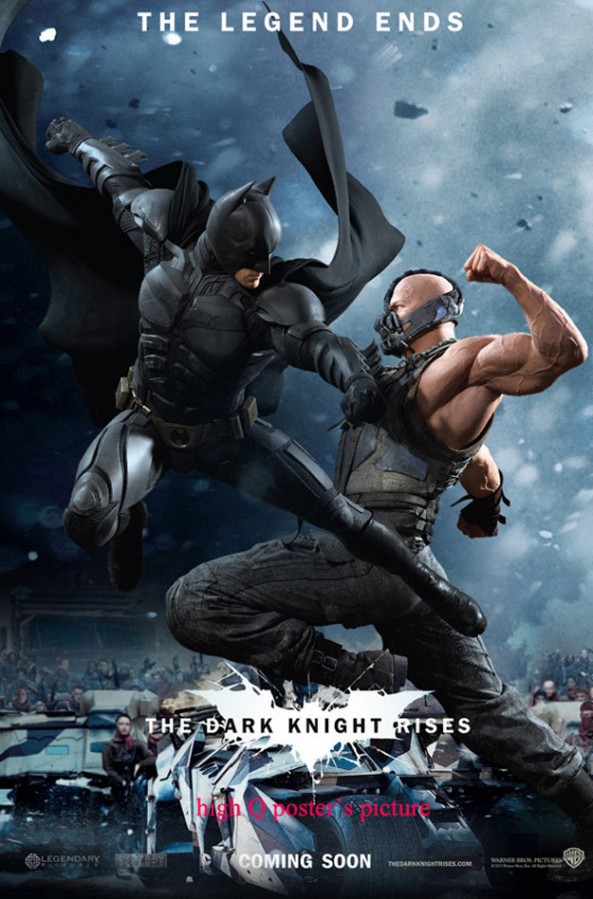
Dark Knight Rises is here… and stirring up controversy!

Well, it’s official! The Dark Knight Rises has hit the theaters, and audiences seem unanimously stoked! In less than 12 hours, the Twitter-sphere, blogosphere, and Rotten Tomatoes have been cluttered with people pouring in to sing the movie’s praises. And yet, more interesting is the controversy which seems to be taking root once again. Much like last time, those who have deigned to give the movie a critical review have caused an uproar, in many cases from fans who haven’t even seen the movie yet.

That is apparently what happened shortly before the release of The Dark Knight. At that time, a critic for New York Magazine expressed some negative opinions for the movie, especially with regards to its plot twists. This unleashed a flood of hate mail and online anger towards the critic, on behalf of franchise fans who, as already noted, hadn’t even seen the movie. This time around, the controversy is much the same. Having viewed the midnight premier, critic Marshall Fine posted a review on Rotten Tomatoes that attracted so much hate mail, his website crashed.

Since that time, the review has moved from Rotten Tomatoes, mainly so Fine can get his server running again, but tempers continue to boil. This prompted Matt Atchity, the editor-in-chief of Rotten Tomatoes, to order that the site’s comments feature be disabled for The Dark Knight Rises. He also published an open letter pleading for people to be civil on the issue. But of course, it’s not all the fault of the fanboys. It seems that, again, like last time, trolls have been doing what they do best (i.e. trolling) and inserting links to bogus reviews which are even more harsh just to stir up the shark tank.

And even Christopher Nolan chose to weigh in on the kerfuffle, saying that the fanboys are within their rights to criticize the critic. Sure they are, so long as they understand that freedom of speech cuts both ways. At least he didn’t go to Jacksonian lengths to silence the critic, calling on fanboys to get the person fired. Yes, shortly after a New York Times critic slammed the Avengers, Samuel L. Jackson responded by denouncing him on Twitter. Not good… not good.

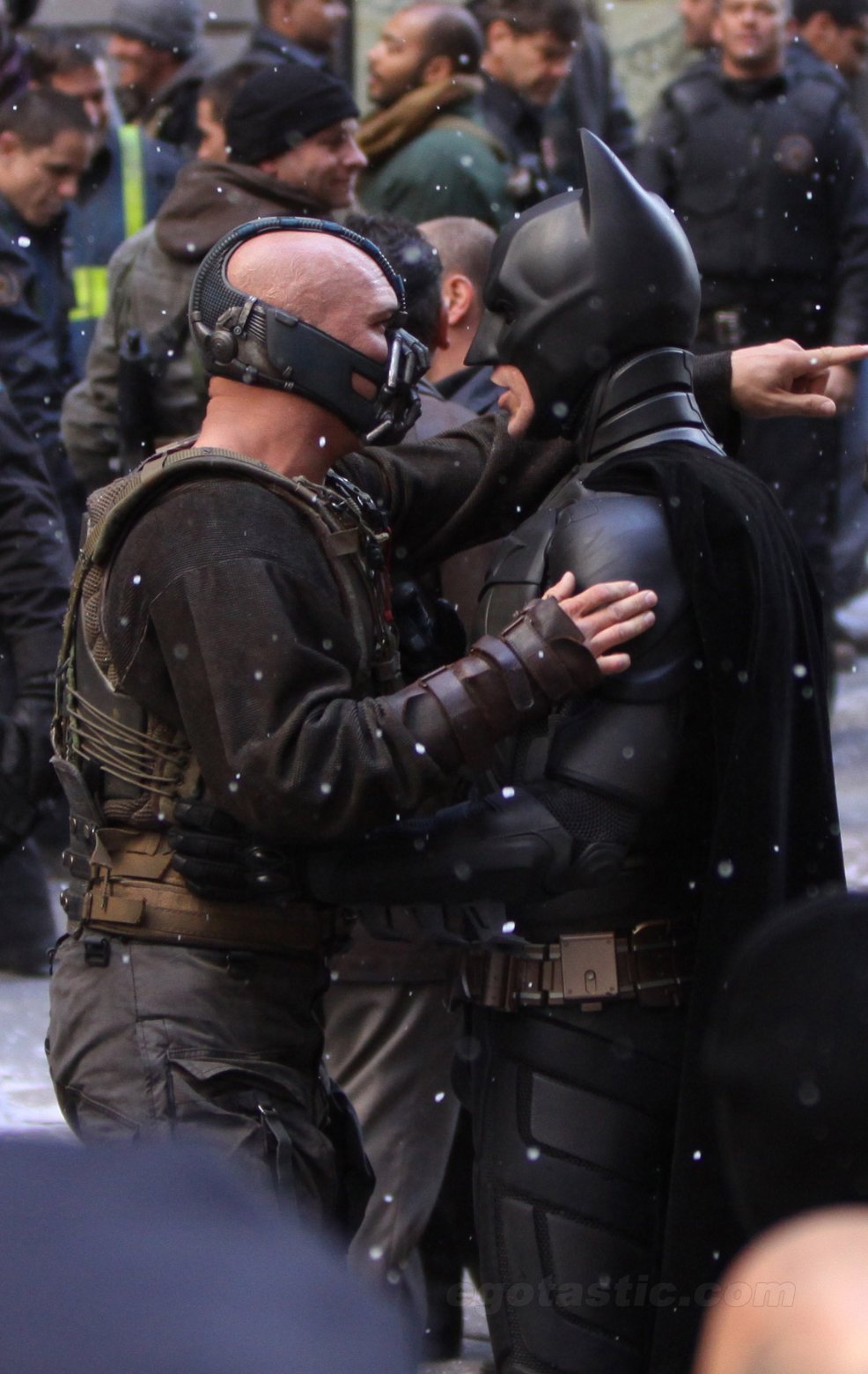
I for one look forward to seeing this movie, and not letting one bad review throw off my opinion of it or get me all worked up. Hell, even the last movie had its faults, but that didn’t take away from it being an awesome and memorable movie, especially where Heath’s portrayal was concerned. And if behind-the-scenes photos of Batman and Bane have taught us anything, it’s that even mortal enemies can kiss and make up! Seriously, check out these photos. Tell me that aint the perfect example of a heartwarming bromance!

Update: In the course of writing this, I read about a terrible tragedy in Aurora, Colorado, where a gunman broke into a theater and shot up the premier of The Dark Knight Rises, killing 15 people and wounding at least 50. The man is in custody and police indicated he tried to booby trap his apartment too. What kind of psycho lunatic is this weirdo?!

Luckily, he’s out of circulation for good and will have nothing but bad food, cold showers, whoopings and cavity searches to look forward to for the rest of his unnatural life. You know, events like this make me think we need REAL crime-fighting superheroes out there!

New Movie: Elysium!

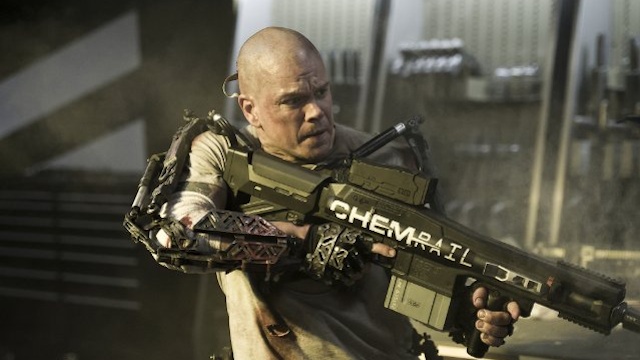
Yet another cool aspect of the recent Comic Con was the trailers for new movies previews that fans were treated to. One such movie was Neil Blomkamp’s (director of District 9) new film, entitled Elysium. According to IO9 magazine, the movie stars Matt Damon in the lead role and is scheduled for release in 2013.

Based on the video reel Blomkamp offered, the movie is still very much in development. Rough place holders had to stand in for many of the visual effects, which are as of yet incomplete. However, the fans were given a precis of the storyline, which is decidedly dystopian and cyberpunk in nature.

Set in 2159, the plot revolves around the eponymously named space station of Elysium, an apparently utopian retreat where the ultra-rich and beautiful live and have access to the most advanced medical technology. The rest of humanity lives planet-side, where overcrowding, disease and radiation have resulted from overpopulation and pollution. Enter into this Max (Matt Damon), a criminal who’s suffering from radiation sickness and must make it to Elysium’s medical facilities at all costs.

In time, Max’s mission becomes complicated as he comes into information which could shut down Elysium and usher in an age of equality for the human race, or at least a less polarized division of wealth. Additional concept art was also released, like an interior shot of the station featured below. Given the layout, Elysium appears to be based on an Island Three design, a circular space station and rotates to provide gravity. Echoes of 2001: A Space Odyssey there. Good for Blomkamp, referencing a classic!

Additional cast members will include Jodie Foster, District 9‘s Sharlto Copley, and Alice Braga (of City of God, Predators, Repo Men and I Am Legend fame). Think I might catch this one!

Robocop Relaunch!

Oh no, not another 80’s relaunch. And just when it seemed that this summer couldn’t possibly OD any more on 90’s relaunches! But, all things considered, I think this is one that might actually be worthwhile, and which I myself could be persuaded to see.

In any case, though the details are a bit sketchy, the movie is scheduled for launch in 2013 and will star Joel Kinnaman as Alex Murphy/Robocop. Additional cast include Gary Oldman, Samuel L. Jackson, Abbie Cornish (from Suckerpunch) and Hugh Laurie (of House fame).

In addition, the trailer seems to be taking the same approach as Scott did with his build-up to Prometheus. Rather than show any scenes from the film itself, the preview takes the form of an advertisement by Omni Consumer Corp (OCP), the evil mega-corporation that is responsible for building Robocop and controlling Old Detroit.

It’s quite interesting, and I am reasonably intrigued as to see how the remake chooses to deal with the original’s various themes, such as cybernetics, corporate domination, urban decay and a society numbed by violence and distracted by mindless entertainment.

“Synthetics” and “Artificial Humans”, the AI’s of Alien!

David:
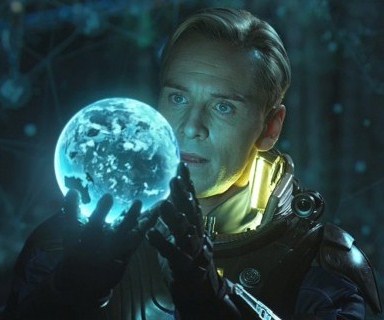
Also known as “David 8”, the first in the line of Weyland Industries fully functional AI’s, which have the ability to proximate human emotions, even though they cannot experience them. In addition to his impressive machine intelligence, he also comes equipped with a characteristic intrinsic to all Alien androids – moral flexibility!

Yes, in addition to assimilating all known info on Indo-European languages, the “Engineers” biology, and the nature of their bio-weapons, he also managed to unleash the bio-weapon within a human crew just to shake things up! And he did it all on the orders of Mr. Weyland himself, mainly so to help him find a way to cheat death.

In the end, David didn’t prove to be all bad. After having his head ripped off by an Engineer and witnessing Weyland’s death, he went on to help save Dr. Shaw and agreed to assist her in her mission to find the homeworld of the engineers. But that didn’t come as a huge surprise. As he had intimated to Shaw earlier in the movie, the death of Weyland would set him free. Once free, he became a much nicer guy!

Ash:
The same cannot be said for this next example, who comes to us from the original Alien movie. Originally thought to be a human who served as the Nostromo’s chief medical officer, Ash was revealed to be a synthetic that was taking his orders directly from the ship’s AI, which in turn was instructing him to follow company’s directives. And all who say him in the first movie can agree, this particular android was a complete and utter douche!

Not only was he willing to let the cry did in order to get the Xenomorph back to his handler’s alive, he tried to kill Ripley when she found out and even expressed open admiration for the Xenomorph. “I admire its purity,” he said. “A survivor… unclouded by conscience, remorse, or delusions of morality.” Jackass! Needless to say, Ripley’s experience with this synthetic severely soured her towards all androids.

Bishop:
Luckily, this next example was able to restore Ripley’s faith. As the Sulaco’s android executive officer, he was responsible for planetary maneuvering, but also acted as the away team’s science officer and performed various other functions as well. But unlike Ash, he was unable to allow harm to come to humans thanks to the inclusion of his “behavioural inhibitors”, which were tantamount to Asimov’s Three Laws.

Also unlike Ash, Bishop was loyal to the crew of the Sulaco and to Ripley in particular. When Burke tried to circumvent military authority and order Bishop to preserve the alien specimens, he alerted Ripley to the incongruity. He also managed to save Ripley and Newt from certain death when the Alien Queen had them cornered.

As if that wasn’t enough, he even prevented Newt when Ripley decompressed the Sulaco’s landing bay, and he was ripped in half at the time!

Annalee Call:
Taken from the universe of Alien: Resurrection, Annalee Call (aka. Call) was a secret “Auton” who managed to infiltrate a crew of mercenaries. This put her aboard the Auriga in time to meet Ripley 8, the clone produced by the military for the sake of resurrecting the Xenomorph species. After failing to kill Ripley before the Xenomorph could be extracted, she and the others were forced to band together to make it out alive.

Her agenda in all this was unclear, aside from a sense of displaced humanity which Ripley mocked when she said: “No human being is that humane”. As a member of the race of “second generation” synthetics known as “Autons”, which were apparently built by other machines, she was part of a dying species. Apparently, these synthetics were outlawed after they rebelled against their masters. Hmm, echoes of Blade Runner there; and by echoes I mean a total ripoff!

Eisenberg:
This next example comes from the expanded universe, specifically the 2001 game AVP 2. As the leader of Weyland-Yutani’s research facility on LV-1201, he was responsible for investigating the planet’s extensive ruins. This world was apparently discovered roughly a century and a half after events in the first movie, once the company traced the flight telemetry from the “Derelict” alien ship (aka. “Space Jockeys”/”Engineers”)

In the course of the game,it is revealed that Eisenberg was once human, and that during the initial mission to LV-1201, he was apparently the only survivor after a xenomorph attack. Due to terrible acid burns suffered during his rescue, he had his consciousness downloaded into an artificial body. As a result, he harbors a deep sense of fear of hatred for the xenomorphs, and unfortunately dies at their hands.

Katya:
Here we have a synthetic who refuses to go by that or any other of the more progressive monickers, preferring the term android instead. As Weyland Yutani’s administrative android for the Freya’s Prospect colony, this example comes from the 2010 video game relaunch of AVP. After the colony went to hell after the xenomorph’s escaped and began wreaking havoc, she is the one who called in the Marines.

Due in part to her enhanced empathic and morality processing, she became intrinsic to helping the “Rookie” (i.e. the protagonists in the Marine campaign) contain the outbreak and get the last human survivors to safety. In so doing, she went against Weyland’s orders and company policy. Good thing she was there to help out, one would have to wonder if what the company was thinking stationing a conscientious android there…

Karl Bishop Weyland:
The final example in this list also comes from the 2010 relaunch of AVP. As a descendent of the Charles Bishop Weyland, chairman of Weyland Industries, he was in charge of the facility on Freya’s Prospect and the director of the experiments involving the captured Xenomorphs. As such, he was also the main antagonist in the Marine campaign of the game.

Ultimately, his purpose in conducting research on Freya’s Prospect went far beyond breeding Xenomorphs. Within the planet’s jungles, and even more so beneath surface, Predator (aka. Hunter) ruins were discovered which he believed held ancient secrets, much of which was information about Hunter history, culture, and the Xenomorph itself.

By the end of the Marine campaign, the Weyland synthetic is killed and his research facility within the Hunter temple is destroyed. However, another android of the same make was still able to retrieve the information gleaned within, the most important part of which was the location of the Xenomorph homeworld.

Final Thoughts:
As you can see, the AI’s of Aliens have undergone some changes over the years. Beginning as conscienceless synthetics that seemed to admire the Xenomorph because it mirrored their amoral worldview, they went on to become the sympathetic characters who seemed, to quote another franchise, “more human than human”. Every other incarnation that has since appeared in the Alien and AVP franchises has been a reiteration of either of these concepts, being the tool of its corporate masters or a savior that was willing to risk its life to help its human brethren.

The one exception to this rule is also the most recent incarnation, Prometheus’ David. Of all the synthetics to inhabit the Alien or AVP universe, he is the only one who demonstrated both cold amorality and humanity. I believe Scott did this intentionally to provide a sense of synthesis to the characters of Ash and Bishop, honoring both archetypes as he attempted to return the Alien franchise to its roots.

Be they the kind of cold, calculating and inhumane androids that fueled our technophobia or the kind, gentle, and overtly “human” robots that made us question our own humanity, the Alien franchise certainly covered both ends of the spectrum in their portrayal of AI’s. Much like the Terminator franchise, they presented artificial intelligence as a double-edged sword, capable of being just as good and evil as any human being. And in the end, isn’t that really the point?

Recall how in Prometheus, Dr. Holloway told David “We built you because we could”? Well, that is only true to a point. Yes, new technologies are often is made simply because the means exist to do so. But the purpose in creating an artificial intelligence is to create life in our own image. And in the end, the consequences of that vanity is pretty obvious. Things created in our image will behave just like us, good and bad!

The Zombie Graph

Hey folks, remember this infographic from a few years back? I seem to remember posting about months ago, possibly in reference to 28 Days Later because I thought it was just so clever. Well, yesterday as I was typing out my zombie story, I got to thinking about this graph and how it applied to the basic rules I’ve seen in zombie movies.

As you can see, they not only classify zombies based on how fast and how smart they are, but also what form their zombie-hood takes. The basic breakdown they use involves three categories – undead, diseased, or possessed. This is one more than I acknowledged and I wonder if its apt. Can you really distinguish between diseased and undead when so many examples are both?

For example, the dead in The Walking Dead were the result of a disease, but they were totally undead creatures. A lot of time goes into explaining just how undead they are when they show that even dismembered and beheaded zombies are alive so long as their brains are still intact. This puts them apart from the zombies in 28 Days Later who were also the result of a virus but were still very much alive.

And then you’ve got the zombies in Dawn of the Dead (the 2004 remake) which were clearly the result of a virus (since the infection spread through bites) but were also undead. Shaun of the Dead follows the exact same pattern, with zombies who can withstand getting a pipe through the chest and losing a limb, but who won’t die until you shatter their brain pan. And even though I’ve never seen any of the Resident Evil movies, my understanding was they too were both undead and the result of a virus.

Am I picking nits here, because I’ve been known to do that. Or this could all just be the result of over-analysis as a result of over-research. I tend to do that as well. Yeah, it really doesn’t matter much, unless you’re trying to write for the genre and insist on understanding all the ins and outs of zombie creation. Mainly I just wanted to share the graph again because its fun and it puts people in mind of their favorite zombie flicks.

One question though… where would a Bath Salts zombie fall into all this? And how about that drunken weirdo in China? Do we need to revise this graph to take into account “substance abuse zombies”?


Of Faster-Than-Light Travel

It’s a popular concept, the fictional technology that could help us break that tricky light barrier. And it’s not hard to see why. The universe is a really, really, REALLY big place! And if we ever want to begin exploring and colonizing our tiny corner of it – and not have to deal with all the relativistic effects of time dilation and long, long waits – we better find a way to move faster.

And this is where various franchises come up with their more creative take on physics and the natural universe. Others, they just present it as a given and avoid any difficult, farfetched, or clumsy explanations. And in the end, we the viewers go along because we know that without it, space travel is going to be one long, tedious, and mind-bendingly complex journey!

Alcubierre Drive:
Proposed by Miguel Alcubierre as a way of resolving Einstein’s field equations, the Alcubierre Drive is an untested by possible way to achieve FTL travel. As opposed to Warp, Foldspace, or most other proposed means of FTL that involve some kind of internal propulsion of jump drive, the Alcubierre Drive is based on the idea of generating a wave that a ship would then “surf” in order to travel.

The creation of this wave would cause the fabric of space ahead of the spacecraft to contract and the space behind it to expand. The ship would then ride this wave inside a region of flat space known as a warp bubble and be carried along as the region itself moves through space. As a result, conventional relativistic effects such as time dilation would not apply in the same way as if the ship itself were moving.

The Alcubierre drive is featured in a few different science fiction genres, mainly those of the “hard” variety. This includes Stephen Baxter’s Ark, M. John Harrison’s novel Light, Warren Ellis and Colleen Doran’s Orbiter, and Ian Douglas’s Star Carrier where it is the primary means of transport.

FTL Drive:
The primary means of interstellar travel in the Battlestar Galactica universe, where every ship larger than a in-system transport is equipped with an FTL drive. How it works is never really explained, but it is clear that the technology is complex and involves a great deal of calculation. This is not only to ensureolve n accurate relocation through space-time, but also to make sure they don’t up jumping too close to a planet, star, or worse, right in the middle of either.

Whereas Colonial ships use their own computers to calculate jumps, Cylon ships rely on the Hybrid. These “machines” are essentially semi-organic computers, and represent the first step in Cylon evolution from pure machines to organic beings. Apparently, the hybrids were more sophisticated than Colonial computers, especially the aging Galactica. Hence, they were able to calculate jumps more quickly and accurately.

Holtzman Drive:
This FTL drive system comes to us from the Dune universe, and is otherwise known as a “Foldspace Engine”. Relying on principles that are not entirely clear to those in the Dune universe, the system involves depositing a ship from one point in space-time to another instantaneously. Though the workings of the drive are never really explained, it is intimated in Chapterhouse: Dune that tachyons are involved.

Another key component in the system is a Guild Navigator, a mutant who has been given natural prescient abilities thanks to constant exposure to spice. Using this prescience, the Navigator “sees” a path through space-time in order to guide the ship safely through. But in time, the Ixians invented a machine that was capable of doing this job as well, thus making the entire process automated and breaking the Guild’s monopoly on spacing.

Hyperspace:
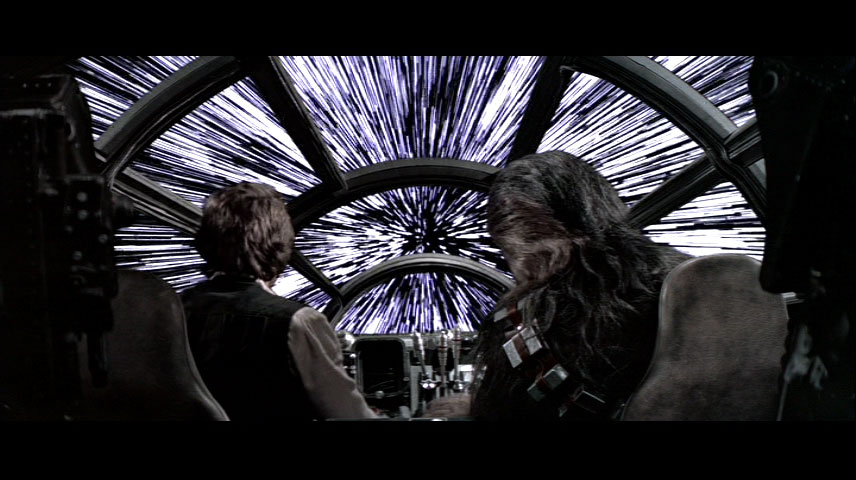
Like the Warp drive, the terms hyperspace and hyperdrive have become staples withing the science fiction community. It’s most popular usage comes from Star Wars where it is the principle means of interstellar travel. Though it is never explained how a hyperdrive works, it is made abundantly clear through a series of visuals in the first and subsequent movies that it involves speeds in excess of the speed of light.

In addition, Han Solo indicated in the original movie that the Falcon’s top speed was “point five past light-speed”, indicating that it can travel 1.5 c. All other references to hyperspace speed factors in the franchise are similar, with velocities given in terms of a decimal point value. As a fast ship, the Falcon can reach point five, whereas most of the larger Imperial and Rebel ships can make only point three or four at most.

Though Star Wars is the most popular example of hyperspace, it is by no means the earliest. The first recorded example was in John Campbell’s “Islands of Space,” which appeared in Amazing Stories in 1931. Arthur C. Clarke’s also mentioned hyperspace in his 1950 story Technical Error. However, the most enduring example comes from Asimov’s Foundation universe, where hyperspace is the principal means of travel in the Galactic Republic. In I, Robot, the invention of the “hyperspatial drive” is the basis of one of the short stories, and was meant to provide a sense of continuity with his earlier Foundation series.

Other franchises that feature the concept of hyperspace include Babylon 5, Homeworld, Macross/Robotech, and Stargate. Combined with Star Wars and the Foundation series, it is the most popular – albeit the most ill-defined -form of FTL in the realm of science fiction.

Infinite Probability Drive:
The perfect mixture of irreverence and science: the Infinite Probability Drive from The Hitchhikers Guide to the Galaxy. This FTL concept is based on a particular perception of quantum theory which states that a subatomic particle is most likely to be in a particular place, such as near the nucleus of an atom, but there is also a small probability of it being found very far from its point of origin.

Thus, a body could travel from place to place without passing through the intervening space if you had sufficient control of probability. According to the Guide, in this way the drive “passes through every conceivable point in every conceivable universe almost simultaneously,” meaning the traveller is “never sure where they’ll end up or even what species they’ll be when they get there” and therefore it’s important to dress accordingly!

Subspace Jump Drive:
Here we have an FTL concept which comes from one of my favorite games of all time, Descent Freespace. Subspace jumps, relying on the drive system of the same name, represent a very quick method of interstellar travel. By relying on subspace “corridors” that run from one point in space-time to another, a ship is able to move quickly from one star system to the next.

The only drawback to this concept is the fact that travel must occur along officially designated “nodes”. These nodes usually pass between large gravitational sources (i.e. between stars systems) but also can exist within a system itself. Virtually all nodes are unstable, existing for mere seconds or minutes at a time. However, nodes which will last for centuries or longer are designated as “stable” and used for transit.

Another favorite franchise which uses a similar concept is the Wing Commander universe. In all versions of the game, particularly Wing Commander: Privateer, interstellar travel comes down to plotting jumps from predesignated points in space. One cannot simply jump from one spot to another provided accurate calculations are made, they have to use the mapped out points or no jump is possible. This, as opposed to hyperspace travel, posits that subspace is a reality that exists only in certain areas of space-time and must be explored before it can be used.

TARDIS:
Officially, the Time and Relative Dimension in Space is a time machine and spacecraft that comes to us from British science fiction television program Doctor Who and its associated spin-offs. Produced by the advanced race known as the Time Lords, an extraterrestrial civilization to which the Doctor belongs, this device that makes his adventures possible.

Basically, a TARDIS gives its pilot the ability to travel to any point in time and any place in the universe. Based on a form of biotechnology which is grown, not assembled, they draw their power primarily from an artificial singularity (i.e. a black hole) known as the “Eye of Harmony”. Other sources of fuel include mercury, specialized crystals and a form of temporal energy.

Each TARDIS is primed with the biological imprint of a Time Lord so that only they can use it. Should anyone else try to commandeer one, it undergoes molecular disintegration and is lots. The interior of a TARDIS is much larger than its exterior, which can blend in with its surroundings using the ship’s “chameleon circuit”. Hence why it appears to outsiders as a phone booth in the series.

Warp Drive:
Possibly the best known form of FTL travel which comes to us from the original Star Trek and its many spinoffs. In addition to being a prime example of fictional FTL travel, it is also perhaps the best explained example.Though said explanation has evolved over time, with contributions being made in the original series, TNG, and the Star Trek technical manual, the basic concept remains the same.

By using a matter/antimatter reactor to create plasma, and by sending this plasma through warp coils, a ship is able to create a warp bubble that will move the craft into subspace and hence exceed the speed of light. Later explanations would go on to add that an anti-matter/matter reaction which powers the two separate nacelles of the ship are what create the displacement field (the aforementioned “bubble”) that allows for warp.

Apparently, Warp 10 is the threshold for warp speed, meaning that it is the point at which a ship reaches infinite speed. Though several mentions are made of ships exceeding this threshold, this was later explained as being the result of different scales. Officially, it is part of the Star Trek canon that no ship is capable of exceeding Warp 10 without outside help. When that occurs, extreme time dilation, such as anti-time, occurs, which can be disastrous for the crew!

In addition to Star Trek, several other franchises have made mention of the Warp Drive. This includes StarCraft, Mass Effect, Starship Troopers, and Doctor Who.

Final Thoughts:
Having looked through all these examples, several things become clear. In fact, it puts me in mind of a clip produced by the Space Network many years ago. Essentially, Space explored the differences between FTL in past and present franchises, connecting them to developments in real science. Whereas Warp and Hyperspace tended to be the earliest examples, based on the idea of simply exceeding the speed of light, thereby breaking the law of physics, later ideas focused on the idea of circumventing them. This required that writers come up with fictional ideas that either relied on astrophysics and quantum theory or exploited the holes within them.

One such way was to use the idea of “wormholes” in space-time, a hypothetical theory that suggests that space is permeated by topological holes that could act as “shortcuts” through space-time. A similar theory is that of subspace, a fictional universe where the normal rules of physics do not apply. Finally, and also in the same vein, is the concept of a controlled singularity, an artificial black hole that can open a rift through space-time and allow a ship to pass from one point in the universe to another.

Explanations as to how these systems would work remains entirely hypothetical and based on shaky science. As always, the purpose here is to allow for interstellar travel and communications that doesn’t take decades or even centuries. Whether or not the physics of it all works is besides the point. Which brings me to two tentative conclusions.

  1. Explanations Need Not Apply: Given the implausible (or at the very least, inexplicable) nature of most FTL concepts, the best sci-fi is likely to be the stuff that doesn’t seek to explain how its FTL system of choice works. I’st simply there and does the job. People hit a button, push a lever, do some calculations, or fly into a jump gate. Then boom! seconds later (or days and weeks) and they find themselves on the other side, light years away and ready to do their mission!
  2. That’s Hard: Given how any story that involves relativistic space travel, where both time dilation and confusing time jumps are necessarily incorporated into the story, only the hardest of hard sci-fi can ever expect to do without warp drives, hyperspace, jump or FTL drives. Any other kind of sci-fi that is looking to be accessible, and therefore commercially successful, will have to involve some kind of FTL or face extinction.

Well, that’s all I got for the time being. In the meantime, keep your eyes on the skies and don’t stop dreaming about how we’re one day going to get out there. For even if we start sending ships beyond our solar system in the near future, it’s going to be well into the distant future before they get anywhere and we start hearing back from them. At least until someone figures out how to get around Einstein’s Theory of Relativity, damn bloody genius! Until then, I’d like to sign off with a tagline:

This has been Matt Williams with another conceptual post. Good night, and happy spacing!

The Red Letter Media guys talk Prometheus plotholes

For people who don’t know who these guys are, they really should check the site out. Not only do they give Prometheus’ plot holes a pretty visceral (yet fair) treatment, they also mock Lucas like nobody’s business! I still can’t get over their long (very long) reviews of the prequel movies and why they sucked.

Having just watched their extended review of Prometheus, I know for a fact that these guys didn’t hate the movie; in fact, they actively mocked people who denounced it as “the worst thing since the Phantom Menace“. So really, they aren’t that harsh, just plain spoken in noticing the kinds of things that made many of us go “huh?”

Worth watching, if for no other reason than to make you laugh:

Upcoming Movies that Aren’t Reboots

Believe it or not, Hollywood actually has some movies that are now playing, or coming in the near future, that are not just reboots, reimaginings, or rehashings of old ideas. Much of this info comes from the online source Io9, and I have to say, I was quite impressed. To know that original ideas and long-overdue adaptations are actually in the works… wow. Still, don’t expect that this makes us even Hollywood! You’ve still wasted a ton of my and a good deal more people’s time and money!

Anyhoo, onto the list of coming or playing attractions:

Safety Not Guaranteed:


A time-traveller takes out an ad in the paper, looking for a companion to go back in time with him. A journalist, played by deadpan comedian Aubrey Plaza (of Parks and Recreation, Scott Pilgrim versus the World and Funny People), is tasked with finding a man who’s taken out the ad and determining just what his deal is. As time goes on, she becomes infatuated with the man because of his sincerity and the fact that he’s a true believer.

Produced by the same people who brought you Little Miss Sunshine and based on an actual ad, the movie explores the fine line between cynicism and realism, truth and belief. In the end, it remains a mystery whether or not the man is for real, and whether or not he is a harmless eccentric or a total nut! This movie has already been released and was screened at the 2012 Sundance Film Festival where it won the Waldo Salt Screenwriting Award.

The Prototype:


A story of a humanoid robot that contains the consciousness of its designer, a man obsessed with achieving the Singularity, as predicted by men like Ray Kurzweil. After a successful run where his mind is placed into “the prototype” robot, it escapes from its facility and is chased by government agents who believe it to be a malfunctioning military drone. Though it does look a tad cliche and over the top, it nevertheless explores some issues which are only increasing in relevance and getting closer and closer to being real.

Enders Game:
I’m not kidding! After decades of waiting, it seems that sci-fi geeks and Card fans will finally be getting a chance to see Ender adapted to the big screen. As someone who thoroughly enjoyed the original, but never got into the sequels, I can tell you that I will be waiting on this movie’s Nov. 2013 release date with eager anticipation.

According to the buzz, Director Gavin Hood (of Tstosi, Rendition and X-Men Origins:Wolverine) is taking great pains to keep it as loyal to the book as possible. In addition, such big names as Harrison Ford and Ben Kingsley are attached to play Colonel Graff and Mazer Rackham, and Asa Butterfield (of Hugo fame)will be playing the lead role of Ender Wiggin.

Life of Pi:
Now this is one I didn’t expect to see on the silver screen! Director Ang Lee, who brought us such hits as Crouching Tiger, Hidden Dragon, Brokeback Mountain and The Hulk will be directing this adaptation of Yann Martel’s magical novel about a boy, a lifeboat, and a handful of animals as they visit a strange island.

World War Z:
Not surprisingly, all this zombie-fanaticism of late has encouraged the good folks in LA LA land that it’s time to adapt one of the best zombie novels of all time. Written by Max Brooks, son of famed comedian Mel Brooks and master of all things zombie, the book tells the oral history of the Zombie War and was released as a follow-up to his satirical The Zombie Survival Guide.

According to the studio-related buzz, Marc Forster (Finding NeverlandThe Kite Runner, and Quantum of Solace) is slated to direct it, Michael Straczynski (creator of Babylon 5) is attached as a screenwriter, and actor Brad Pitt will be starring as the film’s protagonist. Clearly, these folks aren’t pulling punches with this adaptation. I look forward to seeing it sometime in 2013!

Hansel and Gretel: Witch Hunters
Look what you started, Abraham Lincoln: Vampire Hunter! Or was it you Snow White and the Huntsman with your decidedly violent take on a children’s classic? Perhaps it was Seth Grahame-Smith with his Pride and Prejudice and Zombies! I don’t know who’s to blame, but for some reason, it seems that fairy tales, classics of western lit and history are all getting the Buffy treatment these days.

But I digress, Jeremy Renner of The Avengers and the new Bourne Legacy movie stars alongside Gemma Arterton (Quantum of Solace and Clash of the Titans) in this sequel to the classic fairy tale. Apparently, the story takes place 15 years after the traumatic gingerbread house incident, and the now grown-up pair have become a leather-wearing witch hunting duo. Let’s just hope the producers of Van Hellsing don’t sue for plagiarism!

Neuromancer:
I almost jumped out of my seat when I read about this one, but then I noticed the production notes where it said that this movie hasn’t even been green-lighted yet. Ah well, fingers crossed it get’s made, because it would be about freaking time! Much like with Enders Game, fans of this sci-fi, cyberpunk classic have been waiting FOREVER to see a film adaptation! Several attempts have been made, but none have gotten off the ground.

But some details are forthcoming. For one, Vincenzo Natali, the brilliant Canadian writer/director who brought us Cube and Splice, is rumored to be the man who will direct this bad boy, should it ever get made. No other news yet, but my ear is firmly pressed to the ground and I will find out if it’s happening. Bank on it!

Snow Crash:
And another sci-fi movie that’s long overdue, but can never seem to get made! Well, it seems that writer/director Joe Cornish (Attack of the Block and The Adventures of Tin Tin) is set to adapt Neal Stephenson’s post-cyberpunk novel about the near future where America has been privatized, “franchulates” run everything, and a lone hacker named Hiro Protagonist investigates a potent new drug that infects users with a computer virus.

As a long0time fan of Stephenson’s, I for one will be awaiting this movie too with eager anticipation. In fact, I can scarcely believe that so many of my literary favorites are being adapted at the same time. One would think this was just a big tease, or some massive karmic payback!

Fingers crossed, people! Fingers crossed!

Happy Canada Day!

Hello and welcome to my Canada Day post! As it is the True North’s national birthday – commemorating the day when the original provinces came together and agreed on Confederation, the first act of national building and quasi-declaration of independence – I thought it fitting that I do a post honoring Canada’s contribution to the field of science fiction. The list is extensive, contrary to what you might you think, and includes some of the most critically acclaimed examples of literature, film and television in this genre. But like most things Canadian, it suffers from a potential lack of recognition. Well, I, as a patriotic (but not nationalistic!) individual, shall do my part to promote. Hell, one day I want to be on this list, so I better make sure people know about it 😉

First up, movies that were filmed, directed and produced right here in Canada, eh!

Scanners (1981):
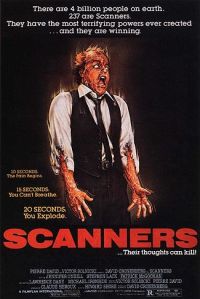
This film, directed by David Cronenberg, is considered a cult classic amongst fans of sci-fi and horror alike. In this movie, “Scanners” are people that exhibit powerful telepathic and telekinetic abilities who are being sought out by a corporation named ConSec, a purveyor of weapons and security systems. Ostensibly, their purpose is to register scanners so the public can be protected from them, but it is clear that they have a nefarious agenda as well.

The story revolves around two rogue scanners, the dangerous Darryl Revok (played by Michael Ironside) and the reclusive Cameron Vale (Stephen Lack). After a “demonstration” goes terrible wrong where Revok causes Dr. Ruth – head of ConSec’s scanner section – to explode, ConSec becomes dedicated to finding all rogue scanners and stamping them out. On their radar is Revok, a known and powerful scanner who is a homeless transient, moving from place to place in the hopes of staying ahead of corporate spies.

In the end, Vale finds himself trapped between Revok’s renegade faction on the one side and ConSec’s goons on the other. In the end, he is captured by Revok and learns that they are brothers, that Ruth is their father, and that all scanners are the result of drug trials involving pregnant women and ephemerol. This drug, which was designed to combat morning sickness (echoes of thalidomide), is the same one which they now use to control scanners.

Revok’s plan is to now use a captured shipment of the drug and administer it to countless pregnant women worldwide, thus creating an army of scanners. When he learns of this, Vale and Revok begin to fight each other using their powers. In the end, Vale defeats his brother and then assumes his likeness, thus putting him in charge of the rogue scanners. The story thusly ends on a cliffhanger note, with Vale’s intentions open to speculation.

This movie was not only a cult classic, but very heavily inspired. It’s investigation of psychic abilities, with corporate controllers, rogue telepaths, and drugs used to control them, would all show up in later franchises, particularly Babylon 5. In addition, that head exploding scene is considered an iconic imagine, one which has been referenced many times over on the silver screen. Consider the line from Wayne’s World where Garth appears to be having a nervous breakdown on TV and one of their cronies asks: “Did you see that movie Scanners where the dude’s head exploded?”

Johnny Mnemonic (1995):
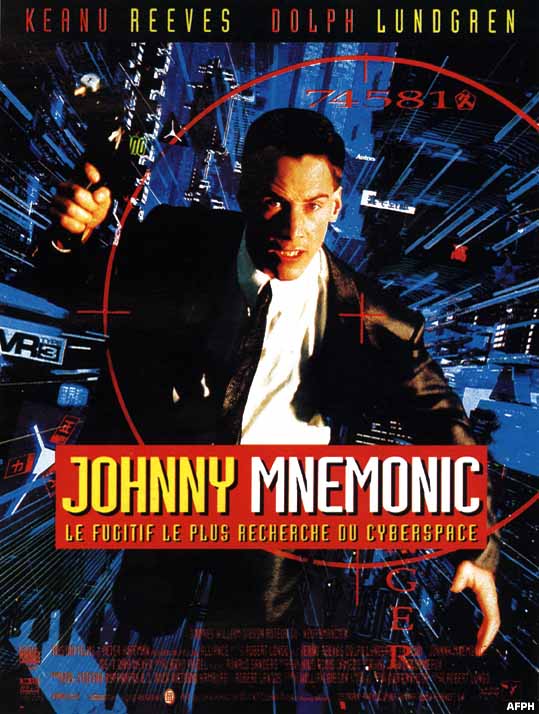
Though it was widely considered one of the worst adaptations in science fiction history, Johnny Mnemonic was nevertheless a faithful representation of William Gibson’s original work (also a Canadian). Set in the “Sprawl” of the 21st century, the story is about a mnemonic courier who uses wetwire implants (i.e. cybernetic brain implants) to carry information around illegally. This is apparently a common practice in the world of the future, where corporate control is absolute and the most precious commodity is information.

Enter into this Johnny (Reaves), a courier who is given a job to carry a package that is twice the size of his capacity. He takes it, knowing the risk it will pose to his brain, because he’s looking for that final payoff which will allow him to have his implants removed and his memory restored. This is something all mnemonic carriers must go through, which is the sacrifice of their own memories in order to make room for all the pirated data they carry.

Quickly, Johnny realizes the package he contains is incredibly valuable, as Yakuza close in and murder his contacts. His own boss betrays him as well, forcing him to turn to a freelance ninja named “Sally Shears” (aka. Molly Millions) for help. Like him, she has enhancements which are beginning to mess with her body, and she recommends they get help from her friend Spider. As a doctor, he is used to dealing with nervous system illnesses, particularly NAS (nervous attenuation syndrome).

When they arrive, Johnny is informed that he is the one who hired him, and that the information he carries comes directly from the pharmaceutical giant Pharma-Kom’s labs. It is nothing less than the cure of NAS, and the company will kill to make sure it doesn’t get it out, seeing as how they make billions off of treatment and will lose out if it is cured. The race is then on for Johnny to download the cure onto the open Net, and with the help of a group of counter-culture fighters named Lo-Tek, they manage to do just that.

Though the movie was generally panned by critics and did quite poorly at the box office, it remains a cult classic to many because of its gritty, cyberpunk feel and faithful adaptation of Gibson’s characteristic themes. It also boasted an all-star cast, which included Keannu Reaves (Canuck!), Dolph Lundgren, Takeshi Kitano, Henry Rollins, Ice-T, Dina Meyer, and Udo Kier. On top of that, it also made use of pioneering special effects to give visual representation to Gibson’s concept of “cyberspace”, the movie also contained all the elements he so loves to include in his stories. Freelancers, Yakuza, mega-corporations, mercenaries, cybernetic enhancements, dirty environments, urban sprawl, hackers and techy geeks. This movie had all that, and is required viewing for fans of Neuromancer and Gibson’s Sprawl Trilogy.

Screamers (1995):
Here’s a cult classic I keep coming back to of late! Based on Philip K. Dick’s “Second Variety”, Screamers is another adaptation of classic sci-fi which was filmed, directed and financed here in the Great White North. And I mean that literally since most of the filming took place in a quarry in Quebec during the dead of winter. And though the story was updated for the post-Cold War world, set on a distant planet and being a war between corporate interests and quasi-national forces, the basic elements remained much the same.

Taking place in 2078 on a planet known as Sirius 6b, the story revolves around an ongoing war between two factions who are fighting for control of the planet. On the one side is the NEB (New Economic Bloc), a super-corporate entity that controls mining in outer space. On the other is the Alliance, a resistance formed out of the former miners and scientists from the colony.

After the NEB bombarded the planet with nukes, turning it into a radioactive wasteland that is perennially experiencing nuclear winter, the Alliance resorted to creating devices known as the “Autonomous Mobile Sword”, a race of self-replicating machines built by a self-sustaining underground factory. These weapons, which tunnel underground and use high-pitched sonic blasts to paralyze opponents, carry the nickname of “Screamers”.

The story opens when a NEB representative comes to the Alliance bunker offering a ceasefire. After investigating the situation, the Alliance commander JOe Hendricksson (played by Peter Weller, aka. Robocop) realizes that the war still rages back home and no one cares what happens to them anymore. He decides to take the NEB up on their offer to end the fight on Sirius 6b, but during his trip to the NEB bunker, learns that new breeds of Screamers are out there. After meeting with Jessica (Jennifer Rubin), the NEB mercenary commander, they attempt to investigate the Screamer factory and learn that there are in fact four varieties now, each of which is becoming more human!

They make it back to the Alliance bunker, only to see that it too has been overrun. In the end, only Hendrickson and Jessica survive and begin making their way to the emergency escape shuttle hidden in the nearby mountains. Once there, Hendrickson learns that Jessica herself is a Screamer when an identical model of her appears and attacks them. Apparently, she is the fifth variety and the most advanced model to date, one that bleed, cry, imitate human emotions, and even have sex. Jessica sacrifices herself to protect him, and Hendrickson learns that her mission was to find the escape shuttle and go back to Earth where they could be sterilizing it of all life as well.

This was in keeping with the Screamer new mandate which was to destroy all human life, not just their enemies. However, that ended when Jessica became over-sympathetic to Hendrickson and broke with her original programming, thus demonstrating the most human characteristic of all, that of empathy. Hendrickson then takes the shuttle himself and leaves the planet, bound for Earth, and safe in the knowledge that the Screamers will never get off Sirius 6b.

Thought it differed in many ways from the original PKD short story, the thematic nature of the movie was accurate. You have the idea of the Screamers, the automonous, self-replicating and intelligent machines that are left to their own devices and end up turning on their own masters. You have the concept of runaway technology erasing the line between what is real and fake. Thought it ended on a happy note, unlike “Second Variety” where a machine made it off planet, the movie still managed to deliver on its message. And it was pretty damn scary too boot!

Cube (1997):
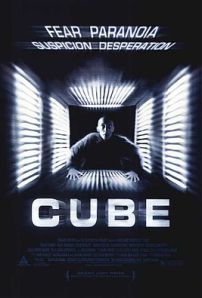
Here is another cult-classic that practically created its own sub-genre in science fiction film making. Directed by Vincenzo Natali and produced by the Canadian Film Centre as its first First Feature Project, Cube became an instant hit due to its paranoid, Kafkaesque feel and psychological thriller tone. Set inside a giant (you guessed it) Cube, made up of countless adjoining rooms that are numbered and contain different booby traps, the story revolves around a series of strangers who wake up inside and must find their way out.

What is immediately apparent to all the characters in the story is that they all possess different abilities and share the same story. Each and every one of them was carrying on with their daily lives, only to wake up and find themselves inside a cube-shaped room. None of them know each other or can remember how they got here, but once they found each other, they agree to work together and find the way out.

Amongst the captives is Quentin (Maurice Dean Wint), a charismatic police officer who takes command, Leaven (Nicole deBoer) a young mathematics student, Holloway (Nicky Guadagni), a doctor and conspiracy theorist, and Worth (David Hewlett), a pessimistic man who refuses to talk about himself. Quentin believes they all have a role to play, Holloway believes they are part of a government experiment, Leaven develops a theory that the room’s numbered in prime are the safe ones, and Rennes follows but seems skeptical of their chances.

As they continue, they find that Quentin’s theory about the prime numbered-rooms is flawed. Tensions also begin to rise within the group because of Holloway’s paranoia, Quentin’s controlling behavior, and Worth’s reticence. The group then experiences a bit of a breakdown, during which time Worth finally reveals that he was one of the architects who helped design the Cube. He never knew what it was for or who even commissioned it, the specs merely passed his desk and he added his own insight. He believes that essentially, the Cube created itself, the result of human stupidity and complacency.

However, Leaven concludes from Worth’s description that the numbers might actually be Cartesian coordinates, and the group begins working its way to one of the outer edges. They also come across a mentally challenged boy named Kazan, who Quentin wants to leave behind by Leaven insists they bring. But in time, their efforts prove futile when another feature of the Cube is revealed, the fact that it periodically shifts its rooms around. Another breakdowns occurs as Quentin becomes paranoid and shows his dark side. After a confrontation with Holloway, he lets her fall to her death, thinking she was out to get him.

The group begins to truly fall apart as Quentin’s true nature is revealed. It seems he is a violent man with a penchant for young girls, the reason why his wife left him with their kids. He begins to run the group through bullying and fear. But a ray of hope emerges when Leaven concludes that the numbers are not primes or coordinates by powers of prime numbers. She cannot calculate them, but the mentally challenged boy Kazan – an apparent autistic savant – can. They continue on their way and Worth incapacitates Quentin, who has now gone completely insane.

Eventually, they find their way to the outer edge and prepare to leave, but Worth wonders if it’s worth it considering that there is nothing out there but “boundless human stupidity”. They are about to step out when Quentin sets upon them. Leaven jumps in to help, and the three are pulled back in as the room’s once again shift. Kazan is left alone to walk out into the light of day, free of the Cube.

Where to begin? This story was a masterful piece of psychological thriller and paranoid fantasy! The fact that we never truly learn who built the Cube, what purpose the “test” really served, and the possibility that complacency and ineptitude is what built it not only makes for a mysterious story, but a big, fat existential allegory! For in the end, are we not all prisoners within a giant maze we can’t discern, who’s maker is unknown and who’s purpose in indistinct? Calling to mind Kafka, Sartre and the “Allegory of the Cave” – a la Socrates – these movie was not only a nail-biting thriller but a fittingly dark philosophical commentary.

Last Night (1998):
Filmed and set in Toronto by writer/actor/director Don McKellar, this apocalyptic sci-fi film tells the story of the last night on Earth, and shows various people choose to spend it. Though the date is not specified, and no explanation is given as to what calamity will be bringing the world to an end, it is made abundantly clear that it will be coming at the stroke of midnight, leaving everyone in the story only a few hours with which to live life to the fullest.

Naturally, the streets are filled with people who have decided to riot, loot and generally wreak havoc. But the main focus of the story is on the lives of various intersecting characters who have chosen to use their time more constructively. One is Patrick (played by McKellar himself), who lost his wife not long ago and is spending the time saying goodbye to family and friends, but who seems to want to spend the last of it alone.

His best friend Craig (Callum Keith Rennie) chooses to spend it in a non-stop sexual marathon as he attempts to fulfill every possible erotic desire he has, not to mention those of his partners. This includes having sex with his former French teacher, a black woman, a virgin, and just about any other scenario he can think of. When Patrick comes to say good-bye, he clumsily tries to encourage him to have sex with him as well. Patrick awkwardly declines, but Craig manages to get a sustained kiss out of him before he goes.

Meanwhile, Sandra (Sandra Oh), who has become stranded in the streets, meets up with Patrick and they get to talking. After realizing their time is short and they have only each other to spend their last hour with, they begin talking and sharing. Many times over, she insists that Patrick open up, saying “make me love you”. They agree to a suicide pact on the roof, listening to “Guantanamera” and drinking wine. In the end, they cannot shoot each other and end their time on the Earth with a heartfelt kiss.

The movie became an instant hit because of its personal nature and the realistic way in which it depicted the end of the world. By not specifying how the world was ending, McKellar kept the focus on the people themselves and how they chose to confront death, bringing out the very best and worst in themselves. While some chose to lose all control and commit murder, others chose to spend it with loves ones, or took a chance on forming new bonds with total strangers.

This last performance, between Sandra Oh and McKellar himself, was the most touching part of the film. We have two people who would never have known each other, both of whom experienced personal tragedy, and who came to experience one brief, shining moment of love – the most life affirming thing of all – before all life ended forever. So sad, yet so poignant. There wasn’t a dry eye in the house!

eXistenZ (1999):
From the same mind that brought you Scanners (David Cronenberg) comes this twisted psychological thriller about reality and the way technology affects our perception of the world around us. Featuring an all star cast that included Jude Law, Jennifer Jason Leigh, Sarah Polley, Don McKellar and Willem Dafoe, this movie received multiple awards and was well received by critics, though its box office gross was overshadowed somewhat by the release of the Matrix that same year.

Set in the not too distant future where organic game consoles known as “game pods” are all the rage, the story revolves around two game companies – Antenna Research and Cortical Systematics – who are competing to create the best in bioware. At the same time, a group of “realists” – people who are opposed to the technology because it “deforms reality” – are engaged in a guerrilla-style fight with both companies.

Enter into this Allegra Geller (Jennifer Jason Leigh), the greatest game designer in the world who works for Antenna and is testing her latest virtual reality game, eXistenZ. During a seminar, she is shot in the shoulder by a realist using an “organic gun” – a device which can pass through security checkpoints – and the console appears to be damaged. As a result, she must plug in and test it with a trusted person and asks Pikul (Jude Law), the security guard to join her.

As they enter the game, reality becomes increasingly distorted as the two undergo behaviors which seem odd to them but are “consistent with their characters.” At the same time, they are stalked by characters that appear to be Realist fighters who are trying to sabotage them. Geller eventually realizes that they have been double-crossed by the people who installed Pikul’s bioport, the interface which is inserted into a gamer’s lower back, in order to infect and destroy her game. On top of that, Cortical Systems personnel are also inside, looking to copy the game for their own purposes. Pikul then reveals that he is in fact a Realist agent who was sent to kill her. She answers by saying she knew for some time and detonating his bioport.

However, in a finay twist, the two then appear on a stage with the other main players from the game and realize they were all part of a virtual reality game called “tranCendenZ”. This game was being played by the cast,  mirroring the first scene, but with electronic devices rather than game pods. The real game designer, Nourish (played by McKellar), feels uneasy because the game started with the assassination of a game designer and had an overall anti-game theme that he suspects originated from the thoughts of one of the testers.

Pikul and Allegra approach him and ask him if he should pay for his “crimes” of deforming reality. As Merle (Sarah Polley), Nourish’s assistant, calls for security, Pikul and Allegra grab hidden pistols  and shoot Nourish and Merle to death. As with the other game, the other players appear more frozen than shocked, suggesting that they are still inside. Pikul and Allegra point their guns at another player, who is at first dismayed, but then asks if they are still in the game. Pikul and Allegra don’t know, and the last scene ends with the fear written on their faces.

Much like the Matrix and Inception, this movie was characterized by it’s mind-bending sequences and unpredictable twists, showing how one’s perception of reality can be distorted thanks to the effects of mind-bending technology. But whereas other films chose to delve into the relative aspects of it all or sought to make an existential point about mind control, Cronenberg’s aim was clearly in showing the dangers of such reality-based technologies by equating them with drugs. All throughout the film, the psychoactive nature of the game is played up, showing how the ability to distort reality and tamper with one’s own psyche can be an addictive form of entertainment. The dangers in this are obvious of course, in that one’s ability to tell reality from fantasy will be worn down, leading to potentially fatal consequences.

*          *          *

Well, that’s movies covered! It will take a few more days to cover the rest, respectively television and literature. These are even more fertile ground than films, so expect some detailed and lengthy posts. I will try to be brief as possible, but this is a tribute to my country of origin so don’t expect any topical treatments. No, sir! In the meantime, Happy Canada Day to all Canucks at home and abroad. Hope you are with the one’s you love and are having a good time. And to you Canada, happy 145th birthday! Cheers!

The Post-Apocalypse in Sci-Fi (Part II)

Akira:
This futuristic tale takes place in Neo-Tokyo, an ultra-modern city that was built on the ruins of the old after an incident touched off World War III. This is a major them in the movie Akira and manga it was adapted from. Throughout the entire story, there is a pervasive sense of shock and horror over the destruction of the old city, and a sense of dread that it might happen again very soon…

Enter into this story the characters of Kaneda and Tetsuo, two orphan boys who belong to a biker gang that is constantly engaged in battles with other gangs for control of the streets. Being children of the system after their parents died in the war, all they really have is each other and the other members of their biker gang. These surrogate families and their ongoing feuds provide a sense of community and an outlet for their pent-up energies, living in a world characterized by boredom and angst and haunted by a past filled with horror.

In addition, you have Colonel Shikishima, a man who witnessed WWIII and has dedicated himself to the rebuilding and ensuring that it never happens again. In addition to being a main character, he is representative of the generational gap in the story. As a stern, disciplined military man who was shaped by apocalyptic events, he is appalled by the sense 0f self-indulgence which he feels has set in with the younger generation.

And the apocalyptic nature of the story is something which is demonstrated over and over through intense scenes and nightmarish visions. In short, it’s an awesome take on the post-apocalyptic scenario, which could only come from firsthand experience.

Alas, Babylon:
This 1959 novel by Pat Frank is one of the first post-apocalyptic stories of the nuclear age and has remained a science fiction ever since. Taking place in small town in Central Florida, Fort Repose, the story opens with a veteran-turned-lawyer named Randy Bragg who gets a cryptic telegram from his brother who works for the Strategic Air Command. He informs his brother that he will be sending his wife and kids to stay with his Randy, and ends it with “Alas Babylon”, a biblical reference which his brother uses as a euphemism ford disaster.

In time, he learns that the bad news concerns a potential Soviet attack, which inevitably takes place after much escalation. After bringing his sister-in-law and her kids to their home, they are all awoken in the night to the sounds of Miami being bombed. They residents awake to witness a mushroom cloud forming over Tampa shortly thereafter, and the events which characterize the following 24 hours they come to name “The Day” – i.e. a one day war.

The story delves into the effects of “The Day”, which are felt differently by people in Fort Repose. Tourists are trapped in their hotels, convicts escape from jails and prisons, the local retirement homes are filled with panicked people, and just about everyone tries to withdraw their money from the local bank and buy up supplies. The only reliable means of news comes through short wave radio.

As chaos begin to set in, Randy begins to organize neighbors to provide housing, food, and water for themselves and organizes the community to defense itself against highwaymen. As an active Army Reserve officer, Randy learns that he has the legal right to exercise martial law, and an order comes in over the short wave from the acting Chief Executive (who is governing from a bunker in Colorado) for any surviving officers to form local militias.

In the end, military helicopters arrive to evacuate people, but are refused as the locals tell them that they want to stay in the new home they have built. They learn the war is over, that the USA prevailed, and that country is now being run from Denver. However, the victory came at a tremendous cost, Millions are dead, entire stretches of the country are irradiated and won’t be habitable for a thousand years, and the US is now a third-rate power that is dependent on third world countries for aid. Faced with this prospect, the people of Fort Repose settle in and decide to face the “thousand year” night that is coming.

This book not only introduced readers to the likely prospect of what would happen in the event of WWIII, it also presented a likely scenario of how that was going to happen. While it the Soviets were apparently planning an attack in the first place, it was an accident that touched everything off. And in the end, how people went about rebuilding and trying to restore some semblance of normalcy was quite classic. In addition to inspiring numerous generations of nuclear holocaust fiction, numerous apocalyptic franchises owe an allegiance to him, not the least of which is the re-imagined series of Battlestar Galactica.

The City of Ember:
This post-apocalyptic story, written by Jeanne DuPrau in 2003, takes place in an underground city named Ember. After many years of continuous habitation, the city is slowly running out of power and supplies. Similar to in tone and structure to Suzanne Martel’s 1963 story The City Under Ground, this city was apparently built to ensure that humanity had a place to live and wait out the effects of nuclear war.

The story begins when a two protagonists, Lina Mayfleet and Doon Harrow, receive a message which is apparently left by “the Builders” containing clues that could lead them back to the outside world. This message was kept in a box that was passed down from mayor to mayor, with instructions that it be opened after two hundred years. Until recently, the box had been lost, but as soon as Mayfleet and Harrow find it, the race is on to decipher it and find a way to the surface.

In the end, the children follow the note’s instructions through a series of caves that lead them towards the surface. When they see the city from above, they realize that they are underground, something which they never knew before. This scene, which calls to mind Plato’s “Allegory of the Cave”, provides the story’s big revelation. The story then ends on a cliffhanger note with the girls trying to alert the other inhabitants of what they’ve found.

The Matrix:
The setting and back story of the Matrix revolve around two fundamental facts: One, that a terrible war between humanity and AI’s took place in the future; and two, that what is left of humanity lives underground due to the devastation wrought on the planet’s surface. Enter into this the concept of the Matrix, a simulated reality where humans are kept docile by being fed the lie that they live in the pre-millenial world, at a time when human’s were still in charge.

But of course, not all human beings are able to accept the program and experience a sort of existential crisis as a result. When Mr. Anderson, hacker alias Neo, is presented with the answers he so desperately seeks, he is horrified to learn the terrible truth. Not only was it the year significantly later than he thought, but the world as he knows it was destroyed long ago. All major cities reduced to rubble, the sky itself has been “scorched”, and the surface rendered a cold, uninhabitable shadow of its former self.

This is a crucial element of the Matrix, which is not just a sci-fi story set in a post-apocalyptic world, but a metaphor for truth and “false consciousness”. With reality so displeasing and harsh, there are many who would prefer the warm comfort of a simulated world, which just happens to be a recreation of happier, stabler times. The metaphor is not just thick, but multi-layered!

It is for this reason that the majority of human beings accept the programming of the Matrix, even if they are only aware of this acceptance on an unconscious level. It is also the reason why those who choose to opt out of it, due to an innate feeling that their reality isn’t real, is a choice which must be made many times over. As Cypher himself demonstrated in the first movie, not everyone has the stomach for the real world, and will willingly betray their comrades for a chance to be put back inside. Others however, find hope in the prophecy of “The One”, the person who’s arrival will herald the end of the war and peace for humanity at last… or so it seems!

The Omega Man:
Released in 1971 and starring (once again) Charlton Heston, this movie post-apocalyptic film is a classic amongst film buffs. Based on the 1954 novel, I Am Legend, this story has gone through many adaptations over the years and has been spoofed and imitated endlessly. Though the plot was updated for the most recent version (2007, starring Wil Smith), much of the elements – a post-apocalyptic world, a lone human survivor, fighting against mutants – have remained the same.

Essentially, the plot takes place in a world that has been devastated after a terrible plague was unleashed and wreaked havoc on the world. In the film versions, this involved biological warfare between the Soviet Union and China – or a mutated cure for cancer – but was only hinted at in the book. In any case, the story revolves around a man named Robert Neville, a doctor who seems to be the last man on Earth, hence the term “Omega Man”.

Though technically not the last living creature, Neville appears to be the last human being who has not succumbed to the most dreaded aspect of the plague – transformation into a flesh-eating mutant. Whereas most of humanity died after exposure, a small minority was converted, leaving an even smaller minority of infected to be hunted as prey. Living in a fortified apartment with an arsenal, Neville spends his days patrolling the abandoned city and killing members of “The Family” – the albino mutants who are hunting him.

At the same time, Neville is dedicated to finding other survivors who have not turned. Eventually, he is saved by one such group of people, but discovers that they are not immune as he is. He decides to treat others using his own blood as a serum, while at the same time escaping to the wilderness to start a new life while leaving the mutants to die in the city. Ultimately, Neville is forced to sacrifice himself to stop the Family from overtaking the rest of them, but the survivors make it out, carrying with them a vial of his blood.

Though significantly different from the original novel, all versions of the story deal with a world in which all of humanity has been wiped out by a biological agent, not nuclear war or a natural disaster.

The Road:
This 2006 novel by Cormac McCarthy, which was adapted into a 2009 movie of the same name, takes place in a post-apocalyptic world where a father and son wander the landscape together. Though it is not specified what caused the destruction they are forced to witness and endure, what is clear is the effect it had on the survivors. Most people have given up hope in the ashen landscape, while others struggle to stay alive and some even turn to cannibalism to survive.

The plot involves an unnamed father and son who are venturing south towards the coast because they have realized that they will not survive the winter where they lived. Though the father is dying and they have barely any possessions to speak of, and the land in between is filled with horrors, the two keep going, fending off roving bands of cannibals and raiders and maintaining hope that the coast will be their deliverance.

All along, is father assures his son that they are the “good guys” who are “carrying the fire” through a dark terrible land. In the end, they find no refuge when they reach the sea and are forced to venture back inland, but the father finally succumbs to his illness and dies. He tells his son to maintain hope and to speak to him in his mind after he is gone, and the boy holds a vigil for days over his father’s body when he finally passes on.

With no idea what to do or where to go, he is eventually found by another family who claim to have been tracking them. The father of the group assures him he is one of the “good guys” and asks the son to join them. With no other options available to him, he agrees to join them and they set off together to find a new home.

Inspired by McCarthy’s own relationship with his son, and a great deal of speculation about what the apocalypse would look like, this story is a very personal take on the end civilization and the struggle to survive. Whereas a great deal of the survivors have resorted to unspeakable acts in order to stay alive, McCarthy redeems humanity by showing the lengths to which regular people will go to protect their families and ensure that good people live on when all the world goes to hell.

The Scarlet Plague:
Here we have a post-apocalyptic classic that predates the nuclear age. Written by Jack London and published in 1912, this story was the original “last man on Earth” scenario which inspired such works as I Am Legend and many others. In addition to being based on the idea of a plague wiping out nearly all of humanity, the stories resolution involves the main character imparting his knowledge to others to ensure that something survives when he is gone.

The story is set in San Francisco in the year 2073, sixty-years after a terrible epidemic, known as the Red Death,has depopulated the planet. Enter into this the story’s protagonist, a man named James Howard Smith, a survivors from the pre-plague era. As an aging man living in the San Francisco area, he is faced with the unpleasant question of what will happen when he dies. As one of the few people who is old enough to remember the pre-plague days, he possesses rare knowledge which will be lost.

Through Howard’s narrative, we learn how the plague spread throughout the world and of the struggles of the handful of survivors it left in its wake. This is apparently being told to his grandchildren, who he has decided to teach everything he knows to ensure that his knowledge will not be lost.

Much like the novels it helped inspire, the Scarlet Plague’s real value lies in its personal nature, relating how the struggle to survive goes beyond the mere physical. In the end, it is when people are facing death that what is most important in life is realized and affirmed. Or to put it is as Commander Adama did, “It’s not enough to survive. One must be worthy of survival.” Sorry! My mind keeps going back to BSG with all this post-apocalyptic talk. More on that one later…

The Terminator:
Central to the story of the Terminator franchise is “Judgement Day”, the day when humanity was nearly destroyed in a nuclear holocaust that was triggered by the sentient machine known as “Skynet”. This serves as the backdrop to the story, along with the ensuing war between the human resistance and the machines its spawned.

Though the majority of the story takes place in modern-day Los Angeles, a great deal of attention is dedicated to the war in the future and what life is like for those who survived Judgement Day. Kyle Reese described his life in the following way: “There was a nuclear war… There were survivors. Here, there. Nobody even knew who started it. It was the machines… I grew up after. In the ruins… starving… hiding from [Hunter-Killers]. Patrol machines built in automated factories. Most of us were rounded up, put in camps for orderly disposal. ”

Eventually, these camps were liberated by John Conner, the leader of the Resistance. After training and equipping the survivors, effectively turning them into a fighting force, Conner led them in a protracted war against the machines. For the most part, the resistance lived and operated out of underground facilities and went out at night to fight HK’s and Terminator’s, guerrilla-style. Survivors and refugees were gathered in these facilities, and their defenders were forced to constantly be on guard against infiltrators. Eventually, John Conner organized all his fighters into a massive offensive force and led them against the Skynet’s central HQ, destroying it and winning the war for humanity.

It was for this exact reason that the machines built their time machine and began sending Terminators back into the past. Since they could not defeat Resistance in the present, they reasoned that eliminating their commander before he was even born was their only recourse. This provides the set up for the entire franchise, with both the machines and the Resistance sending people back in time; the former to kill him and the latter to protect him and ensure that the war could be prevented.

The Walking Dead:
Fans of this franchise will know instantly why I’ve chosen to include it on this list. Not only is it a gritty, realistic take on the zombie apocalypse, but it also manages to capture the essence of survival and the struggle to stay human when everything around you has fallen. Part of what makes this show so bang on is the fact that the character’s personal struggles go well beyond the need to stay alive.

In addition to finding food, ammo, and a place to set down, there’s also the constant battle to keep hope alive. This takes them at first to the CDC, where the expect to find answers, a cure, and some protection. But of course, all they find is a single scientist who can explain how the zombie illness works, but has no idea how to cure it.

And of course, the familiar and realistic themes of loss, suicide, procreation, betrayal, and brutalization play a central role to the development of the story. Everyone who has survived the zombie apocalypse has lost people near and dear to their heart. As a result, many people have a hard time going on, some of whom commit or actively contemplate suicide. Rick and Sarah, the show’s main protagonists, also face a tough choice when they realize she is pregnant. Essentially, they’re not sure it would a good idea to bring a baby into this post-apocalyptic world. Much like the decision to carry on, it often seems that embracing death would be a far more merciful decision.

Amongst the other main characters, there is also the extremely difficult choice between survival at all costs and maintaining one’s humanity. Whereas Shane seems to favor survival, and becomes a hardened, amoral man who will kill anyone who gets in his way, the elderly Dale is committed to not being pulled down into a world of misery and letting it change him. With everyone else, the decision is the same, with people falling to one side or the other and divisions setting in.