NASA Considers Catching Asteroids

CometNASA is apparently considering playing a little catch and release with some giant rocks. Basically, they want to capture an asteroid and deposit in orbit around the Moon by the early 2020s. The announcement of this new plan was made earlier this month, and left many wondering if this has anything to do with the Obama administration’s long term plans for establishing an outpost on the dark side of the moon or sending a manned mission to a near-Earth asteroid.

This makes sense, since if NASA were to place an asteroid in orbit around the Moon, a crewed space craft could practice engaging with it without needing to move beyond the range of a rescue mission. What’s more, such a body would come in handy as a potential stopover base for spaceships looking to refuel and resupply before setting off on deeper space missions – particularly to Mars.
NASA_moonWhat’s more, capturing a near Earth asteroid and bringing it in orbit of the Moon is a safer, cheaper way to perform manned landings on object in the asteroid belt. The nearest proposed target is a space rock named 1999 AO10, an asteroid which is roughly a year’s trip away. Traveling to this body would expose astronauts to long-term radiation since they would be beyond Earth’s protective magnetic field, and would also take them beyond the reach of any possible rescue.

Researchers with the Keck Institute for Space Studies in California have confirmed that NASA is mulling over the plan to build a robotic spacecraft for just such a purpose. They also confirmed that the project would take six to ten years and would involve the launching of a slow-moving spacecraft propelled by solar-heated ions on an Atlas V rocket. After locating and studying the target asteroid, the robot would catch it in a bag measuring about 10 by 15 meters and bring it back towards the moon.

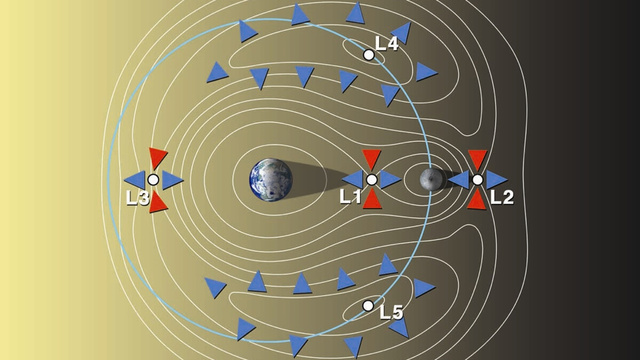
Altogether, the mission would take 6 to 10 years, and cost about 2.6 billion. If successful, it may cut costs when it comes time to place a base in orbit at Lagrange Point 2 – on the dark side of the moon – or when missions to Mars start heating up by 2030. Yes, at this point, I’m thinking the people at NASA are thanking their lucky stars (no pun!) that Obama was reelected back in November. Always good to have powerful friends, especially when they can sign multi-billion dollar checks!

Source: Wired.com, newscientist.com

The Future is Here: Information Encoded in DNA!

dna-computingScientists and researchers have been taking a closer look at DNA in recent years, and not just for the reasons you may know if. No, in addition to unlocking the human genome, some are considering DNA as a new means of data storage. When you think about it, DNA is already used as a storage device, specifically for containing all the information necessary to generate millions of species of plants and animals from a single cell. But as it stands, scientists are considering using artificially-generated DNA to handle the the growing storage needs of today’s information society.

In fact, this past Wednesday an international team of researchers led by Nick Goldman of the European Bioinformatics Institute (EBI) reported that they had managed to successfully store all 154 Shakespeare sonnets, a photo, a scientific paper, and a 26-second sound clip from Martin Luther King Jr.’s “I Have a Dream” speech on a sample of DNA so small it was barely discernible to the naked eye and able to fit into a tiny vial.

binaryMight sound like something out of science fiction, but in fact the process is really quite straightforward thanks to existing technology. Marrying elements of cellular biology to computing, the concept calls for converting digital information from binary code (1’s and 0’s) into the four-letter alphabet of DNA code. Once that code is compiled, synthetic strands of DNA are then created which are then “read” by a machine specifically programmed to recover the encoded information.

At present, the reading process took two weeks, but that’s expected to change in coming years. By accomplishing this act of DNA-writ storage, Goldman and his research team was able to show that the process is feasible. And given time, we could be looking at external hard drives that are little more than a tiny thimble full of genetic material, but which are capable of storing terabytes of information. And given that they themselves are composed of genetic material, it might even be possible to store these devices within our own living tissues. Biotechnological implants, people!

DNA-molecule2At the same time, Goldman and Ewan Birney – another member of the European Bioinformatics Institute – released a research paper which explained the potential of this means of data storage. In it, they stated that in the short term, DNA storage will be useful for storing large amounts of information for centuries, like national historical records or huge library holdings, provided it’s not accessed very often. However, they were also quick to point out that with time and development, it could be commercial viable and much more accessible.

biotech_alienThey also took the opportunity to address potential fears and ethical issues, saying that storage in a human being was not something they intended to pursue, and that encoded information would not be able to mix with a person’s normal DNA. According to the report, artificial DNA is specially encoded and therefore unable to combine with natural DNA, which does not use the same “programming language”.

Well… that is good news for those of us worried about a new form of genetic diseases huh, or the possibility that DNA archives could contain viruses capable of infected both our machinery and our bodies! But of course, the paper didn’t rule out that it would be possible to store information inside a person’s body using this new form of “biotechnology”. Once it’s perfected, it might even become the mainstay of consumers to buy bioelectronics that are stored within their very bodies. I mean, if it’s safe and won’t result in a new age of bio warfare, who’s to say it won’t become all the rage?

NJust one question: will this put us several steps closer to creating artificial humanoid AI’s, aka. Cylons? Just asking…

Source: CBC.ca

Of Search Terms and Hits

0427_Cyber_full_600Recently, I went by my traffic page to see just how many hits I was getting in recent days. Naturally, I was sure to take a gander at the referrals and search term portions of this page, just to see who was looking for what and who else might have led them to me in the first place. Needless to say, it was interesting, and pretty consistent with what I’ve been seeing in the last few months.

Ah, but then, I decided to look at the All-Time totals to see just how much of my traffic I owed to certain subjects. You can tell much about your own page and the impact it’s having by seeing what search term more than any other led people to you. And after looking over the grand totals, I thought I might list the top 15 and see what I could conclude from it.

So, here are the top 15 search terms which have led people to my site since it went online in March of 2011:

  1. Joker:  10,060
  2. The Joker:  4,813
  3. Bath Salts Zombie:  2,267
  4. Bath Salt Zombie:  1,585
  5. Predator:  1,010
  6. Moon:  918
  7. COD (Call of Duty):  887
  8. Bayonet:  820
  9. Tiananmen Square:  607
  10. Firefly Serenity:  607
  11. Firefly:  535
  12. Zombie Apocalypse:  511
  13. Zombie Weapons:  495
  14. Desert Eagle .50 cal:  442
  15. Futuristic Guns:  412

What to conclude from all of this? I’m not sure I want to think about it much. If I did, I might have to admit that maybe my site mainly appeals to gamers, gun enthusiasts and people who like reading about insane clowns, zombies and recreational cannibalism. Not exactly the reason I started writing this thing in the first place!

But then again, I could just as easily conclude that, like me, these people enjoy a good romp through nerd territory, complete with dystopian fiction, post-apocalypticism, cool weapons, cool games and cool franchises. And maybe, just maybe, they enjoy learning about history and engaging in some thoughtful discussion along the way.

Hey, a man can always dream, right? 😉

US Navy’s Killer Drones! Dolphins Get a Repreive

knifefish-drone-640x353Yes, it seems the once heralded killer-dolphins of the US Navy are finally getting the pink slips, and not a moment too soon! With the Cold War now behind us, the use of water mammals as hunter-seekers – a controversial practice at the best of times – finally seems to be coming to an end. In the new age, an age of robots and unmanned vehicles, it seems the Navy will be taking a page from the US Air Force and replacing them with drone like the Knifefish (pictured above).

Designed by the Navy not only as a fiscally responsible and humane replacement for Dolphins, this new drone was also inspired by recent demands from the Pentagon to deal with the problems arising from tensions overseas.  Earlier this year, when Iran threatened to close down the Straight of Hormuz – the waterway between Oman and Iran where 17 million barrels of oil pass through every day – the Pentagon became worried. If such a channel were to be mined, clearing it would be dangerous, time consuming and costly work.

seafoxAlready, they had considered using the the German-made Seafox, a 1.2 meter (4 foot), 45 kilogram (100-pound) semiautonomous drone that is controlled using fiber optic cable. Unfortunately, the limits of this model and the cost ($100,000 per drone) led many to conclude that a more cost-effective option was necessary. Hence, the Knifefish, a 5.8 meter (19 foot) 770 kilogram (1700 pound) robot that has an extended range and improved capabilities.

For starters, it is powered by lithium-ion batteries that give it an operational life of up to 16 hours. It also uses a low-frequency synthetic aperture sonar that can penetrate beneath a soft sea floor, giving it the ability to distinguish mines mines from submerged debris with better accuracy. Mines will be able to be fingerprinted in real time by using resonance patterns obtained during imaging and comparing them to known signatures.

Granted, this is not exactly a cheaper option than importing Seafoxes, but given the benefits to mine sweeping in the Persian Gulf and other potential areas of conflict, the Pentagon considers it a worthy investment. Eight units have been ordered and will be built jointly by General Dynamics and Bluefin Robotics, at a total cost of $20 million. Naval divers are still expected to carry out many mine clearing operations themselves, but drones will reduce dive frequency and associated risk.

The key here is that the Knifefish drones will be responsible for identifying and mapping underwater mines, not destroying them. Responsibility for performing such acts will no doubt be a matter for international bodies and courts to negotiate, applying martime law and international treaties to the mix. Also, the Knifefish is also being proposed as a means for private companies to monitor underwater pipelines and offshore oil rigs. So in addition to aiding in the protection against terrorism or naval blockages, the Knifefish could be used to ensure environmental safety.

Source: Extremetech.com

NASA’s Next-Gen Spacesuit

NASA_suitIt’s like something Buzz Lightyear would be seen in, minus the death ray laser. It’s called the Z-1 spacesuit, a prototype that NASA hopes to incorporate into their equipment lineup by 2015. Not only does this new design offer a wide range of advantages compared with the space agency’s previous suit – the Extravehicular Mobility Unit (EMU) spacesuit – it also represents the first major overhaul in spacesuit technology since 1998.

For example, it boasts a rear-entry hatch which lets an astronaut put on the suit from the back, as opposed to putting on the top, bottom and helmet separately. This hatch also coincides with a feature known as the suit port, which allows the suit to be attached to the outside of a vehicle (such as a rover), thus allowing the astronaut to simply enter the suit from inside the vehicle. This is a big step from the current space suits which must be stored and put on internally.

I don't see a resemblance, do you?
I don’t see a resemblance, do you?

On top of that, the Z-1 excels in the areas of mobility and visibility. The former arises from the fact that the suit comes as a single piece rather than being made up of multiple segments. The larger, bubble dome helmet is what ensures that the astronauts has a better field of view. And finally, NASA plans to address the issue of life support through the portable PLSS 2.0 which condenses all life support systems into one package and does not need external components.

The PLSS 2.0 design also incorporates a massive bonus in the form of the Spacesuit Water Membrane Evaporator temperature regulator, which would actually make it possible for future astronauts to comfortably walk on extraterrestrial planets. According to NASA’s PLSS engineer Carly Watts, the PLSS 2.0 “can be used in a Martian environment. It can be frozen without damaging the unit, and it’s not particularly sensitive to contamination.” Good news for the astronauts heading to Mars in 2030, assuming the budget environment remains friendly after President Obama is no longer in power.

Check out this video of NASA Public Affairs Officer Brandi Dean talking with Cristina Anchondo, Z1 spacesuit test director, about the Z1 spacesuit at the Johnson Space Center.


Source: news.cnet.com

NASA Makes Appearance at 2013 Inauguration

2013_inaugural_nasaThe 2013 Inaugural Parade on January 21st – my birthday, fyi – was quite the sight to see. In addition to the President and First Lady, many floats, and thousands of onlookers, the good folks at NASA also made an appearance. Specifically, two floats featuring the Orion deep space capsule and the Curiosity Rover were part of the parade, passing in front of the White House and the official reviewing stand while President Obama, VP Joe Biden, their families and numerous dignitaries smiling and waving.

The life-sized models were greeted with plenty of fanfare and fair weather as they floated near the front of the procession, and it is estimated that over a million people were on hand to witness the event. NASA was the only federal agency to be asked to take part in the inaugural parade, which goes to show you how important the administration considers their efforts. But given all that NASA has accomplished as of late, that should come as no small surprise.

In the few short months since it landed, Curiosity has uncovered very compelling evidence that water once flowed on Mars, and the Orion capsule is expect to take astronauts back to the moon and father into space than ever before. What’s more, the Obama administration has already granted the funding for NASA to go ahead with its plans to establish an outpost on the Moon in the next few years, as well as a manned mission to the Mars by 2030. In short, NASA and the Obama administration are pretty tight; and if you ask me, both are stronger for it!

Check out the video below of the procession, or go to NASA Flickr page for more photos of the inaugural parade.


Source:
Universe Today.com

The Future is Here: The ASB Glassfloor!

GlassFloor_TitelIt looks like something out of Tron, doesn’t it? In truth, its LED lights underneath a glass surface, but the end result is nothing short of awesome, not to mention convenient. It’s known as the ASB Glassfloor, the latest creation from German manufacturer Germany’s ASB Systembau. Using a system where an aluminum substructure supports the surface and LED’s provide light lines, a gymnasium or sports arena can be converted from a volleyball court, to a basketball court, to a series of tennis courts by simply pushing a button.

What’s more, ceramic dots on the glass re-create the feel of a wooden surface, while special etchings diffuse the LED light and prevent glare from bothering athletes. And for those who worry that the entire thing will shatter as soon as the home team takes the floor, know that this “glass” is actually a high-tech tempered security variety that is actually more durable and longer lasting than a conventional wood floor, meaning it can bear the weight of multiple teams, and is even available in different colors.

And finally, the company also indicated that since the floor’s are basically one large display device, that they can be programmed to broadcast ads in certain spaces, and that the entire floor itself can be turned into a single screen. Hence, while the player’s are playing, people can also enjoy small ads running in the end zone or sidelines, just in case they felt sports weren’t saturated by enough product placements! And at halftime, the floor can put on a show, either on its own or with the help of cheerleaders and a marching band.

My, with all the new display technologies and high-tech surfaces coming out, one would think the entire future is going to be made of “smart glass” and inundated with images and texts. Seems nobody can be satisfied with a simple, non-augmented window or floor anymore. Oh well, it looks cool and that’s what matters!

ASBGlassFloor-3xTo see the Glassfloor in action, click on the gif image above, or watch the video below:

More Plans to Colonize Mars!

mars_lifeFolks may recognize the name SpaceX, the private aerospace company that in May of last year launched a module into space to resupply  the International Space Station. An historic occasion, that was the first time a private spacecraft has has ever docked with the ISS, and signaled a growing trend in the development in commercial space travel. Well, it seems that the company’s founder has more ambitious plans now.

Yes, in a bid to make sure his company is not left behind in any future space endeavors, CEO and billionaire Elon Musk has announced plans to colonize the Red Planet with a population of 80,000. The announcement came back in November at the Royal Aeronautical Society in London, where Musk appeared to receive the Society’s gold medal for helping to advance the commercial space industry.

The first phase of the program, which is contingent on the development of reusable rocket that can take off and land vertically, would start off modestly with only a handful of explorers leaving Earth at a time. To make it happen, SpaceX has already started to work on their next-generation reusable Falcon 9 rocket, known as “Grasshopper”. This rocket has already made two short flights, including one in which it reached a height of 2 meters (6 feet), and another in which it leaped to a height of  5.4 meters (17.7 feet). Small beginnings, as they say!

The projected cost for each colonist looking to make the trip would be roughly $500,000. In short, those who are not rich or extremely adventurous need not apply! What’s more, he estimated that the entire program would cost about $36 billion, an inevitable expense to set up the initial infrastructure and transport. But once that is done, he believes enough people will be interested and find it within their means that the venture will pay for itself.

In an interview with Space.com, Musk’s vision for sending people to Mars was described as follows:

“Accompanying the founders of the new Mars colony would be large amounts of equipment, including machines to produce fertilizer, methane and oxygen from Mars’ atmospheric nitrogen and carbon dioxide and the planet’s subsurface water ice.

“The Red Planet pioneers would also take construction materials to build transparent domes, which when pressurized with Mars’ atmospheric CO2 could grow Earth crops in Martian soil. As the Mars colony became more self sufficient, the big rocket would start to transport more people and fewer supplies and equipment.”

So save your pennies and prepare for the day when tickets go on sale! Hard to say exactly when that will be, but chances are, it will be either feasible or abandoned by 2030. That’s when NASA plans to mount manned missions to the Red Planet. And like I said, men like Musk don’t want to be left behind!

Source: space.com

China’s Drones Trigger Fears of Drone Race

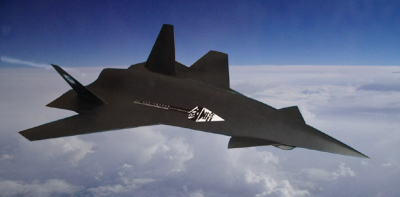
Dark SwordTwice a year, China showcases the latest in military technology at a show held in Zhuhai city, in the Guangdong province.  During the last show, held in November, a series of new unmanned aerial vehicle,s most of which bore a striking resemblance to the American drones that have been conducting attacks in Afghanistan and Pakistan for the past few years. Naturally, observers in the west were rather concerned with the wider implications.

Until recent years, the United States, Britain and Israel have maintained supremacy in the field of UAV’s. But much like stealth technology and naval aviation, the Red Dragon appears to be catching up by leaps and bounds. What’s more, it is likely China intends to take full advantage of using unmanned aerial vehicles to achieve its national interests, which includes their territorial disputes with Taiwan over the Senkaku Islands and South China Sea and Japan.

Sukhoi PAK FAIn response, the Defense Science Board released an unclassified report in they claimed: “In a worrisome trend, China has ramped up research in recent years faster than any other country. It displayed its first unmanned system model at the Zhuhai air show five years ago, and now every major manufacturer for the Chinese military has a research center devoted to unmanned systems.”

The report went on to say that “the military significance of China’s move into unmanned systems is alarming [suggested that China could] easily match or outpace U.S. spending on unmanned systems, rapidly close the technology gaps and become a formidable global competitor in unmanned systems.”

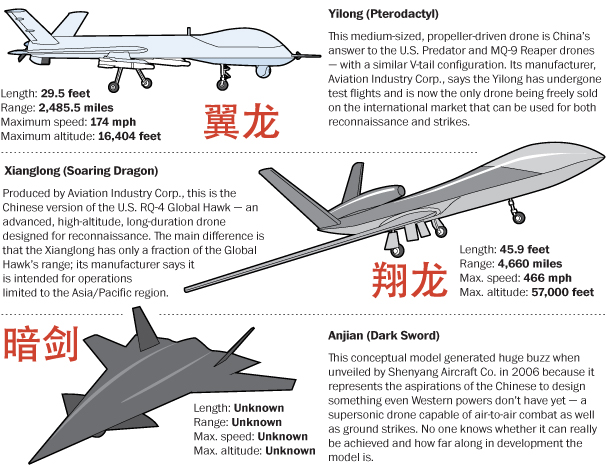
Chinese_dronesTwo Chinese models on display at the Zhuhai show — the CH-4 and the Wing Loong, or Pterodactyl — appeared to be clones of the Reaper and Predator drones that are fixtures in the U.S. arsenal. A larger drone, the Xianglong, or Soaring Dragon, is a long-range, high-altitude model that would seem to be a cousin of the RQ-4 Global Hawk.

Huang Wei, the director of the CH-4 program at the China Aerospace Science and Technology Corporation, told the state-run newspaper Global Times that his lightweight drone can carry cameras, ground-searching radar, missiles and smart bombs. “As the Americans say,” he said, “the U.A.V. is fit for missions that are dirty, dangerous and dull.”

What will this mean for the future? Drone wars? Or a new arms race where increasingly complicated unmanned aerial vehicles and stealth fighters are involved? Difficult to say, but with the advances of such weapons systems in other countries, it was only a matter of time before China followed suit. One can only hope, as the saying goes “that cooler heads prevail” before they are used in an open conflict.

Source: policymic.com, nytimes.com

Wanted: People for Mars!

MarsOneThey’re called Mars One, a nonprofit organization based in the Netherlands that intends to establish a human settlement on the Red Planet by 2023. What began as a proposed Reality TV project that would hopefully recoup the costs of sending people to Mars has since matured into a project for actual, factual colonization. There’s just one thing missing at this point…

They need people to volunteer.

A little over a week ago, they released a document specifying their application criteria. Clearly, they can’t take just anyone. Among the five key categories for qualification are Resiliency, Adaptability, Curiosity (no pun!), Ability to Trust, Creativity and Resourcefulness. Oh, and you must be at least 18 years of age, kind of like getting in to an R-rated movie. No specific technical qualifications are necessary, but if you’ve got a go-getter attitude, a positive outlook and are willing to learn, I’m sure they can teach you.

terraforming-marsThe selection process will begin during the first half of 2013, and will still be based around a reality TV concept. Basically, it will take the form of Mars One experts and viewers of a “global, televised program” choosing who they want to see go. Those ultimately selected will be assembled into teams of four, with at least six teams hoped to be prepared to launch in September 2022. But only one team will make the first trip to the Red Planet, and that team will be decided democratically.

The training process will take eight years, and will include simulated missions, practice in a restricted mobility environment, and lessons in electronics, equipment repair, basic and critical medical care. In 2016, the company plans to begin rocketing supplies to Mars, including spare parts, two rovers, and living units that can be assembled into a base once humans arrive.

It’s a testament to an age where commercial space flight is fast becoming a reality, and internet-based voting, crowdsourcing and information sharing can take the place of space agencies and government sanctioned research. Sure, it still sounds like a pipe dream, but the effort alone is impressive isn’t it? And given all the advances that are made every day, who’s to say what will and won’t be possible within the next few decades?

To read the application in detail, click here. And check out the video of Mars One’s proposed mission:

Source: wired.com, blastr.com