Episode 58 – The Great Migration: Living on Jupiter’s Moons! – is Now Live!

Episode 58 – The Great Migration: Living on Jupiter’s Moons! – is Now Live!

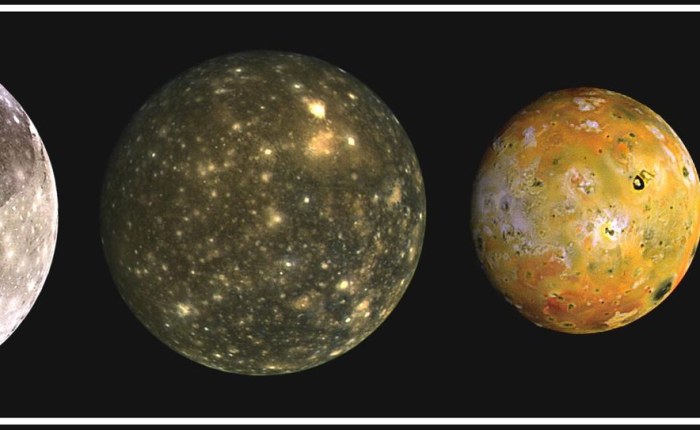
In 1610, Galileo Galilee turned his telescope towards Jupiter and discovered something incredible. What initially appeared like stars surrounding the planet were, in fact, natural satellites! These four satellites, Io, Europa, Ganymede, and Callisto, were named the “Galilean Moons” in his honor. With the dawn of the Space Race, our knowledge and fascination with this system has only deepened. While Jupiter has countless moons and moonlets (95 and counting!), the Galileans are not only the largest but have some pretty unique features as well.

Io is a volcanic moon composed of silica and metals, with mountains on its surface higher than Everest and over 400 active volcanoes, some of which spew lava 400 km (250 miles) high. Europa and Ganymede are frozen worlds largely composed of water ice and volatiles but which have warm and salty oceans in their interior. Callisto is an icy moon covered in massive craters and ringed features, the largest being Valhalla (3000 km; 1864 mi) and Asgard (1400 km; 870 mi).

Since 1979 when the Voyager 1 and 2 probes passed through the system, scientists have speculated that there could be life beneath Europa’s and Ganymede’s icy surfaces. Similarly, science fiction writers and scientific organizations have speculated how humans could live on some (if not all) of these moons with the right strategies, technology, know-how, and precautions. Therefore, living among these moons would present tremendous opportunities but also challenges and ethical considerations.

Follow the links below to get the full story and treatment!

Where to Listen:

Episode 57 – Space is for All: An Interview with Space Policy Analyst Ruvimbo Samanga – is now Live!

Episode 57 – Space is for All: An Interview with Space Policy Analyst Ruvimbo Samanga – is now Live!

This week, I finally got the chance to sit down and speak with a rising star of the modern space age, renowned space policy analyst Ruvimbo Samanga. Samanga began her journey by earning her Master of Law and participating in the Manfred Lachs Space Law Moot Court Competition. In 2018, she was part of the first team from Africa to win the competition. She then became the national point of contact for Zimbabwe with the Space Generation Advisory Council (SGAC).

This global network promotes participation from students and young professionals in the space industry in support of the United Nations Office of Outer Space Affairs (UNOOSA). Since then, she has become a powerful voice in the international community, advocating for sustainable development, education and outreach, and increasing access to space for people worldwide.

She has worked for multiple international organizations and initiatives, including the Space Arbitration Association, Access Space, Inter Astra, and the Charles F. Bolden Group, and is currently an ambassador for the Milo Space Science Institute. She is not slowing down! Have a listen to our conversation by following the links below.

Where to Listen:

Episode 56 – “The Ancient Astronaut Theory – is now Live!

Episode 56 – “The Ancient Astronaut Theory – is now Live!

This week’s episode is dedicated to a theory that is both fascinating and highly controversial. This theory is that in the distant past, extraterrestrial explorers may have visited Earth and even influenced our evolution (cultural or biological). Known as “paleocontact,” this idea has been explored extensively in science fiction, which includes 2001: A Space Odyssey – based on the short stories “Encounter at Dawn” and “The Sentinel” by Arthur C. Clarke – The X-Files, Stargate, and Prometheus.

A number of prominent scientists have also recommended that this idea be taken seriously. This includes Carl Sagan and Igor Shklovskii in their seminal book Intelligent Life in the Universe and Prof. Avi Loeb in his book Interstellar: The Search for Extraterrestrial Life and our Future in the Stars (which I recently reviewed). That being said, there’s also the pseudoscientific and conspiracy theory-laden version of this school of thought, which is epitomized by the theories of Von Daniken and shows like “Ancient Aliens.”

Like I said, it’s controversial, but mainly because there are those who have taken what is fascinating food for thought and turned it into something ignorant and reminiscent of 19th-century racial dogma. Check out the episode to hear more about this idea, where it comes from, and where it departs from scientific curiosity and becomes the kind of stuff that inspires satirical memes (you know the ones I mean!)

Where to Listen:

Episode 54 – The History of SETI: A Conversation with Dr. Rebecca Charbonneau – is now Live!

Episode 54 – The History of SETI: A Conversation with Dr. Rebecca Charbonneau – is now Live!

This week, I sat down with Dr. Rebecca Charbonneau, a science historian and a Karl Jansky Fellow at the National Radio Astronomy Observatory (NRAO). We talked about the history of the Search for Extraterrestrial Intelligence (SETI), the significance of Project Ozma, the Arecibo Message, and the enduring legacy of the late Dr. Frank Drake – the creator of the Drake Equation and someone Dr. Charbonneau knew personally!

As a historian of science (a rare but awesome thing!), Charbonneau is in a rare position to appreciate how the field of SETI has evolved and how it has impacted (and reflected) our history. Have a listen as we talk about what the history of SETI has meant for our species so far and how the future of this field could revolutionize our existence!

Where to Listen:

Episode 53 – The Drake Equation – is now Live!

Episode 53 – The Drake Equation – is now Live!

For this week’s episode, I addressed one of the most important and well-known theories in the Search for Extraterrestrial Intelligence (SETI). It’s known as the Drake Equation, a thought experiment proposed by famed astronomer and SETI researcher Dr. Frank Drake. Drake presented this equation during the first SETI meeting in 1961, held at the Green Bank Observatory in West Virginia and attended by some of the most influential scientists of the day (including Carl Sagan). As Drake later said about his famous equation:

“As I planned the meeting, I realized a few day[s] ahead of time we needed an agenda. And so I wrote down all the things you needed to know to predict how hard it’s going to be to detect extraterrestrial life. And looking at them it became pretty evident that if you multiplied all these together, you got a number, N, which is the number of detectable civilizations in our galaxy.”

The equation basically states that the number of intelligent species we can communicate within our galaxy (N) can be determined by multiplying the average rate of star formation in our galaxy (R*) by the number of stars that have planetary systems (fp), the number of planets that are habitable (ne), the fraction of habitable planets where life will emerge (fl), the fraction of those where intelligent life will emerge (fi), the fraction of those that will develop transmission technologies that are detectable from space (fc), and the average longevity of civilizations (L).

To this day, the equation remains foundational to SETI and is comparable only to the Fermi Paradox and the Kardashev Scale. Dr. Frank Drake passed away on September 2nd, 2022, at the age of 92. He is one of many luminaries to pass on in recent years, like Stephen Hawking (2018) and Freeman Dyson (2020), and he will be missed!

Where to Listen:

Episode 49 – “Where is Everybody?” Our Interstellar Future with Prof. Avi Loeb – is now live!

Episode 49 – “Where is Everybody?” Our Interstellar Future with Prof. Avi Loeb – is now live!

This week I sat down with Israeli-American theoretical physicist Professor Avi Loeb, the Frank B. Baird Jr. Professor of Science at Harvard University, the longest-serving Chair of the Department of Astronomy, the founder of Harvard’s Black Hole Initiative (BHI), and director of the Institute for Theory and Computation (ITC) at the Harvard-Smithsonian Center for Astrophysics. He is also the founder of the Galileo Project, a public project dedicated to the investigation of Unidentified Aerial Phenomena (UAP), and the Chairman of the Advisory Committee of Breakthrough Starshot.

A few years ago, Prof. Loeb became the focus of international attention when he suggested that the interstellar object ‘Oumuamua might be an extraterrestrial probe. With the release of the “UFO File” in 2021 by the Office of the Director of National Intelligence (ODNI), Loeb and many of his colleagues launched Project Galileo to assist with the transition where UAP studies are now the subject of open scientific research rather than a clandestine affair overseen by government agencies. We touched on all these topics during our conversation. Check it out below!

Where to Listen:

Episode 48 – “Where Are All the Aliens? The Dark Forest Hypothesis” – is now Live!

Episode 48 – “Where Are All the Aliens? The Dark Forest Hypothesis” – is now Live!

This week’s episode was dedicated to another proposed resolution to the Fermi Paradox. This one was inspired by the novel of the same name, The Dark Forest, written by Chinese science fiction author Liu Cixin. The book is the second installment in the Memories of Earth’s Past trilogy, which started with The Three-Body Problem. The concept is explained thusly:

“The universe is a dark forest. Every civilization is an armed hunter stalking through the trees like a ghost, gently pushing aside branches that block the path and trying to tread without sound. Even breathing is done with care. The hunter has to be careful, because everywhere in the forest are stealthy hunters like him. If he finds other life — another hunter, an angel or a demon, a delicate infant or a tottering old man, a fairy or a demigod — there’s only one thing he can do: open fire and eliminate them. In this forest, hell is other people. An eternal threat that any life that exposes its own existence will be swiftly wiped out. This is the picture of cosmic civilization. It’s the explanation for the Fermi Paradox.

I got an especially nice surprise while prepping this episode. While looking for possible links to include, I came across a link to the University of Edinburgh. On Halloween night in 2021, Dr. Anna Lisa Varri delivered a lecture at the Higgs Center for Theoretical Physics about the Dark Forest Hypothesis. Guess who she listed as her first source? ME! Or rather, the article I wrote for Universe Today about six months prior! How cool is that? Check it out below…

Where to Listen:

Episode 46/47 – The History of Cosmology – Part I & II – are now Live!

Episode 46/47 – The History of Cosmology – Part I & II – are now Live!

This latest installment is a bit of a double-whammy. When the first installment aired, I foolish forgot to post about it! Lucky for me, such negligence allowed me to announce both parts of the episode together. And it is only together that they can be appreciated fully. Long story short, in this and last week’s episode, I delved into how human perceptions of the cosmos (aka. cosmology) and our place within it have changed over time.

To say these changes have been drastic would be an understatement of cosmic (sorry!) proportions. If anything, they have been seismic, mind-shattering, and exponential. With every new revolution in our understanding, the Universe as we know it has grown by orders of magnitude. The way we perceive the sum total of everything and how that’s changed goes a little something like this:

  • Ancient World: our locale, the Sun, the Moon, the “moving stars,” and the celestial sphere
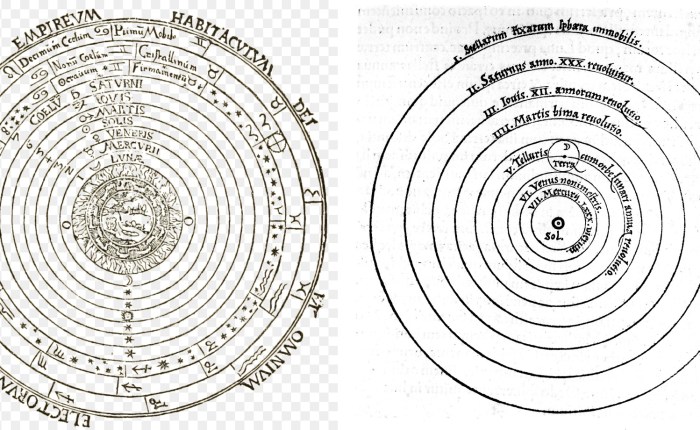
  • Classical Antiquity: Earth orbited by the five planets, the Sun, and the Moon
  • Scientific Revolution: Earth and the five planets (and Moon) orbiting the Sun
  • 18th/19th Century: Our Solar System adrift in the galaxy
  • 20th Century: Our galaxy is one among millions (or more)
  • Mid-to-late 20th Century: Our galaxy is one among billions in the “Cosmic Web”
  • 21st Century: Our galaxy is one of trillions, maybe one of countless Universes as well

As for sizes and scales, that has also been an exponential adjustment. In the past century alone, the expanse of the Universe (in space and time) has grown by several orders of magnitude. Check this out:

  • 1919: 300,000 light-years (infinite)
  • 1929: 280 million light-years (2 billion years)
  • 1955: 4 billion light-years (6 billion years)
  • 1965: 25 billion light-years (10-25 billion years)
  • 1993: 30 billion light-years (12-20 billion years)
  • 2006: 94 billion light-years (13.7 billion years)

Get it? And at every juncture, our understanding of cosmic forces has also taken great leaps. Between the ancient world and the Renaissance, people went from believing that nature was composed of four or five elements (wood, water, fire, air, metal) to reconsidering atomic theory. By the 19th century, scientists had a pretty good idea of what atoms looked like and had a unified system of determining motion, velocity, and gravity (Newtonian Physics).

Then came the 20th century, with Einstein’s Relativity, Quantum Mechanics, Dark Matter, Dark Energy, Hawking Radiation, the Higgs Boson, String Theory, Supersymmetry, and the Theory of Everything. As my history of science teacher once said, “science is like an onion, constantly shedding its skin.” But when it comes to cosmology, it’s more like a creature that molts in order to accommodate its insane growth. Check out the episode by following the links below:

Where to Listen:

Episode 45 – The Great Migration: Living in the Belt – is now Live!

Episode 45 – The Great Migration: Living in the Belt – is now Live!

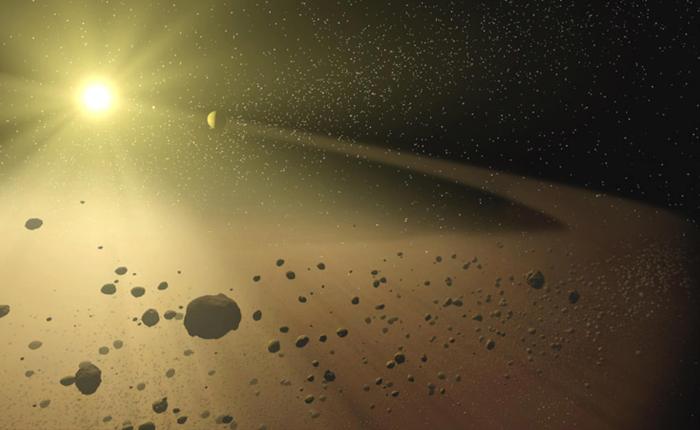
The Great Migration continues! The next stop: the Main Asteroid Belt! The idea that humans could someday settle among the many, many rocks and planetoids that sit between Mars and Jupiter has been explored extensively in science fiction and scientific literature. Beyond the larger bodies, Ceres, Vesta, Pallas, and Hygiea, pinwheel stations or cylinders could be established that could accommodate millions of people in environments that mimic Earth’s biospheres. There are also countless smaller rocks that could be hollowed out and spun up to simulate gravity.

The benefits of settling the Main Belt are also innumerable. Foremost among them, there’s the potential for becoming a post-scarcity species thanks to the incredible abundance of minerals, ores, precious metals, and rare Earth elements. There are also opportunities for scientific research since asteroids are essentially material left over from the formation of the Solar System. On top of that, there’s the opportunities for socio-political experiments. With so many habitats available, countless new cultures and societies could form.

Before long, a thriving economy and a new segment of humanity known as “Belters” could emerge. Check out the episode below:

Where to Listen:


Episode 44 – The Brief Window Hypothesis – is now Live!

Episode 44 – The Brief Window Hypothesis – is now Live!

In this week’s episode, I returned to the well of the Fermi Paradox to address another of my favorite resolutions. While this one is not an official hypothesis, it encapsulates elements from several proposals and asks the big question – is intelligent life doomed? If humanity is any indication, intelligent creatures may eventually outgrow their resource base, ruin their natural environment, and build weapons of mass destruction that they may eventually use. This raises a key parameter of the Drake Equation, the thought experiment created by astronomer and SETI researcher Dr. Frank Drake:

N = R* x fp x ne x fl x fi x fc x L

For those who are unfamiliar, the equation basically states that the number of intelligent species (N) in our galaxy that humanity could communicate with comes down to a series of parameters (planets per star, habitable planets per system, those that have life, etc.,) multiplied by the length of time (L) a species is likely to transmit signals to space. If intelligent life is prone to destructive behavior or has a limited life expectancy, then L is the key parameter for finding evidence of it out there.

Basically, the transmission will begin when a species achieves an advanced state of development and will end when they succumb to their fate. If our antennas are not set to the right frequencies, and we don’t manage to detect their transmissions within this window, then we will never hear from them. There’s also the possibility that intelligent life undergoes a seismic shift at some point, which borrows from the Transcension Hypothesis and the concept of the “Technological Singularity.”

The idea here is that intelligent life will eventually transcend its physical biology and become something radically different. At this point, species may not be likely to communicate via radiowaves but with something radically advanced – like neutrinos or gravitational waves – or may not be interested in communicating at all. Once again, the window will have closed. But in this case, it will be due to a pattern in the evolutionary development of intelligent life. Check it out by following the links below:

Where to Listen: