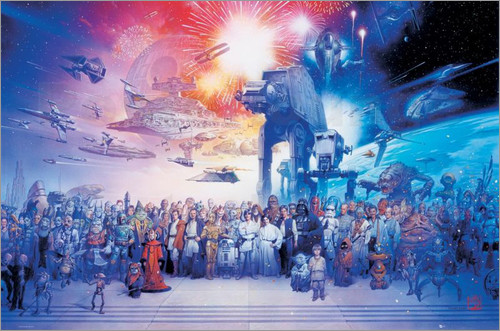
Here we have a video game concept that was proposed by Studio Gigante for the Xbox gaming system. Merging Mortal Kombat/Street Fighter style fights with Star Wars characters and lightsaber moves, the idea never made it to the production line. In fact, until the other day, no one outside of those who worked on it knew this proposed Star Wars combat game even existed.
But thanks to a recent tweet by Josh Tsui, currently of Robomodo and co-founder of the studio that made it, the demonstration video is now making the rounds. As the demo shows, it was a game that was meant to incorporate lightsaber duels, Force moves and some limited hand to hand fighting. You played as your favorite character within various Star Wars settings and, presumably, made you way up to the boss (smart money said it was either the Emperor or Yoda, depending on whether your character was good or evil).
Why he chose to do it on Valentines Day is anybody’s guess, but I’m thinking that might just be coincidental. Nothing says love like a simulated lightsaber in your gut!
If you were to get into a discussion with a true Star Wars fan, it would only be a matter of time before the subject of the Kessel run came up. Long considered one of the biggest enigmas to come out of the franchise, Han’s boast in A New Hope about his ship’s capabilities – with the Kessel Run as a reference – still has some people scratching their noggins and scrambling for explanations today.
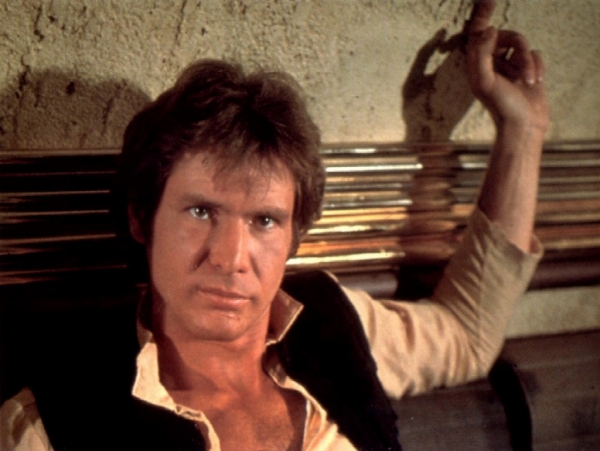
To refresh people’s memory, this is how the boast went down in the course of Han’s introduction to Luke and Obi-Wan at the Mos Eisley Cantina:
Han: “Fast ship? You’ve never heard of the Millennium Falcon?” Obi-Wan: “Should I have?” Han: “It’s the ship that made the Kessel Run in less than twelve parsecs!”
See what I mean? A parsec is a unit of distance, not time, so from an astronomical perspective, it made no sense. How could Han have used it to explain how quickly his ship could travel? Well, as it happens, there are some possible and even oddball explanations that have been drafted as the franchise has expanded over the years.
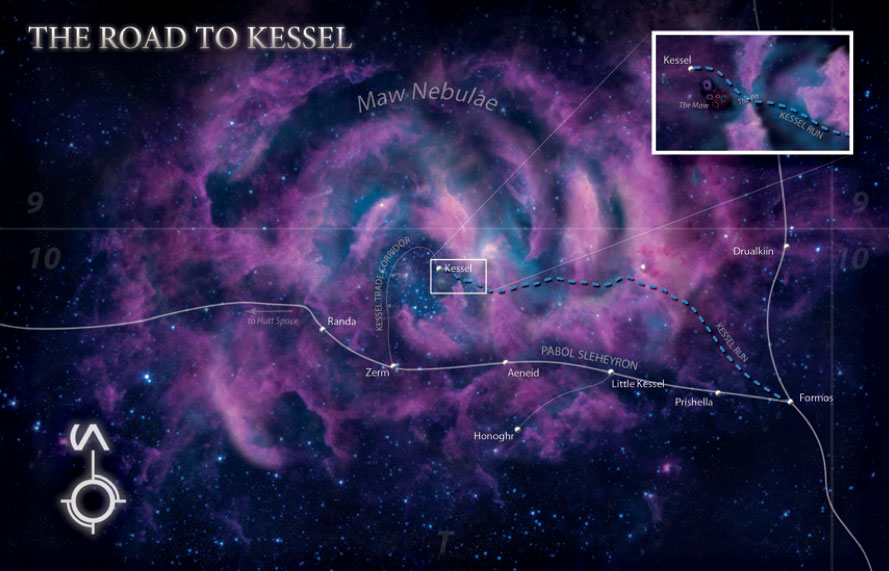
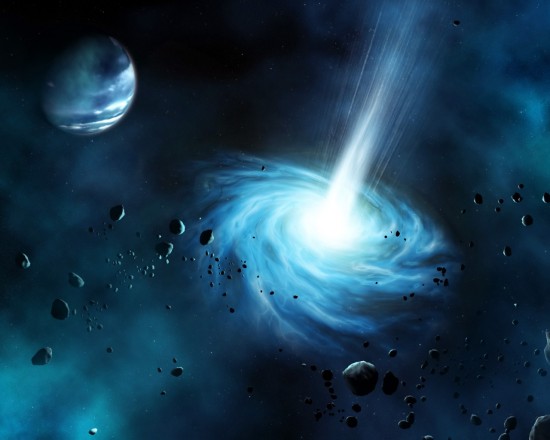
Another important point to make here is about the Kessel Run itself. As a smuggler, Han was deeply involved in running “glimmerstim spice” during his pre-Rebel days (a clear rip off from Dune, but whatever). This took him to and from Kessel, a remote planet located in the Outer Rim that is surrounded by a black hole cluster known as the Maw. As an unnavigable mess, it provided a measure of protection for smugglers running the Imperial blockade that guarded the space lanes near the planet.
All of this comes up in the Jedi Academy Trilogy, a series of novels written by Kevin J. Anderson that are part of the expanded Star Wars universe, and is the first case of the Run being detailed. From these an other sources, we are told that the Run is an 18-parsec route that led away from Kessel, around the Maw, and into the far more navigable area of space known as The Pit. Here, smugglers had to contend with asteroids, but any smuggler worth his salt could find their way through without too much difficulty, and didn’t have to worry about Imperial patrols from this point onward.
To cut down on the distance traveled, pilots could dangerously skirt the edges of the black holes, a maneuver dangerous because it involves getting pulled in by their gravitational forces. If a ship were fast enough, it could risk cutting it closer than most, thus shaving more distance of the route while still being able to break free after it all to complete the run.
Hence we have the first possible explanation to Han’s ambiguous statement. Han’s boast was not about the time taken for him to complete the Run, but the fact that Millennium Falcon was so fast that he was able to cut a full third of the Run off and still make it out. The Falcon would have to be a pretty sweet ship to do that! And it would also fit in with all his other boasts, about how the ship could “make 0.5 past light speed”, and was the “fastest ship in the fleet”.
However, there are other explanations as well. For starters, this expanded universe explanation does not jive with what Lucas himself said, what was presented in the novelization of the original movie, and of course what astronomers and megafans have to say. In the first instance, Lucas claimed in the commentary of the Star Wars: Episode IV A New Hope DVD that the “parsecs” are due to the Millennium Falcon’s advanced navigational computer rather than its engines, so the navicomputer would calculate much faster routes than other ships could.
In the A New Hope novelization, Han says “standard time units” in the course of his conversation with Luke and Ben, rather than “parsecs.” And in the revised fourth draft of A New Hope that was released in 1976, the description for “Kessel Run” is described as a bit of hapless misinformation that Obi-Wan doesn’t believe for a second. In short, Han erred when he said it and didn’t realize it.
And then there is the far more farfetched and mind-bending explanation as made by Kyle Hill in a recent article by Wired magazine. Here, he argues that the true intent of Han’s statement was that he was, in fact, a time traveler. By combining some basic laws of physics – namely that the speed of light (c) is unbreakable and 0.99 ad infinitum is as fast as anything can go – and the details of Han’s boast, a more clear picture of how this works emerges.
First, because the shortened Kessel Run spans 12 parsecs (39.6 light-years), a ship traveling nearly light-speed would take a little more than 39.6 years to get there. Factoring in time dilation, anyone watching the Kessel Run would see Solo speeding along for almost 40 years, but Solo himself would experience only a little more than half a day. So basically, in the time it takes Han to complete just one Kessel Run, the rest of the galaxy continues on its usual path for 40 years, which pushed the date of Han’s birth 40 years into the past.
Confused yet? Well, the idea is that Han would have been born long before events in A New Hope, and even The Phantom Menace took place. After completing his run, no doubt trying to avoid Republic authorities or some such equivalent, he came upon a universe that had gone through the ringer with a Sith coup d’etat, Imperial oppression, and a looming Civil War. What could he do but stick to smuggling and hope to make a living?
REALLY doesn’t make sense in terms of the storyline, does it? Ah, but what can you do? People like to find quirky explanations for things that don’t make sense. It can be fun! But of course, there’s a final and much, much simpler explanation that I haven’t even mentioned yet, and it’s one that’s far more believable given the so-called evidence.
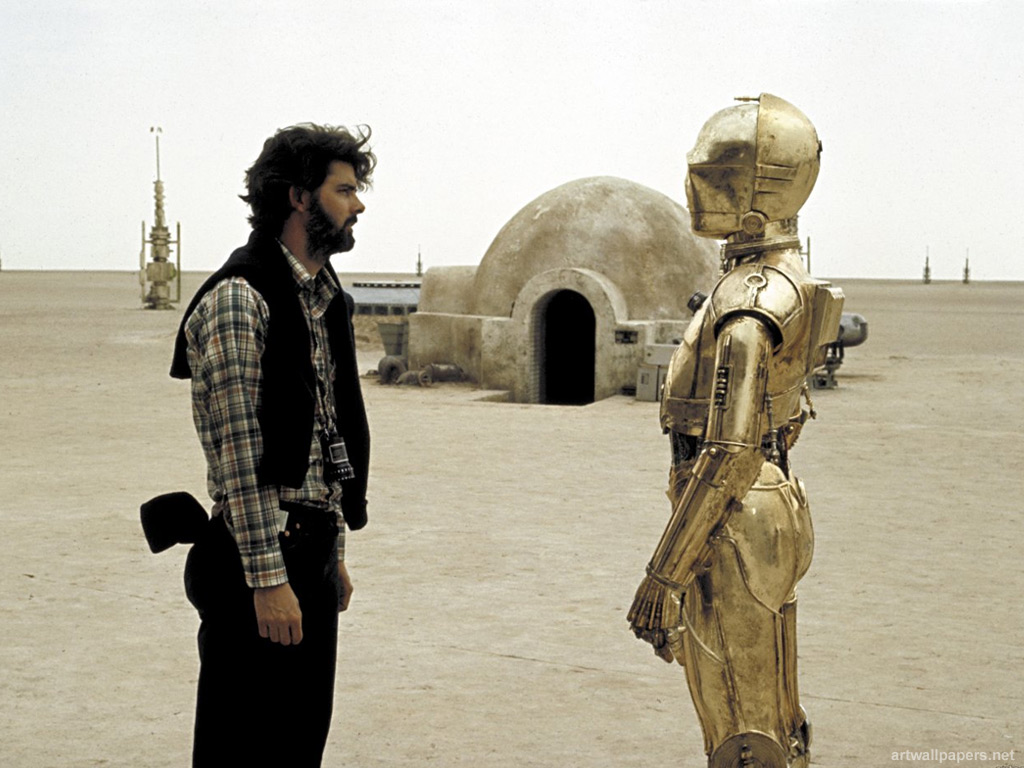
Put simply, Lucas made a mistake. The parsecs line was a misfire, an oversight, and/or brain fart on his part. Nothing more, and all these attempts at explanation are just an obvious attempt to make something that doesn’t fit fit. It makes perfect sense when you think about it: since A New Hope was the first Star Wars movie, that meant Lucas was directing it all by himself. The assistance he sorely needed in terms of directing, writing, editing, etc. didn’t come until the movie was almost complete and he was looking bankruptcy and a nervous breakdown in the eye.
And remember, this is the same movie where a Storm Trooper walked head first into a door aboard the Death Star, Luke yells “Carrie” to Carrie Fisher while they are shooting, the cast and camera can be seen in numerous widescreen shots, and just about every technical problem that could go wrong did go wrong, some of which even made it into the final cut. As far as bloopers, outtakes and errors are concerned, the first Star Wars movie was a mess!
See? So really, is it hard to imagine a simple oversight like a typo could have made it on screen and no one caught it? Hell no! And frankly, I think fandom would be a lot happier if Lucas had remembered these early days of his career and not decided to make the prequels all by himself. Sure, there were plenty of people to catch these kinds of simple errors the second time around, but his many flaws as a movie maker found other ways to shine through – i.e. Jar Jar, lazy directing, too much special effects, wooden dialogue, confused storyline, continuity errors and plot holes galore!
Ah, but that’s another topic entirely. Point is, Star Wars had simple beginnings and plenty of mistakes were made along the way. One can’t expect something so grand and significant in terms of popular culture to be consistent or error free. And Lucas was never really good at producing a seamless product. In the end, it was a fun ride until the new ones came out, and even then he was still making money hand over fist.
And with Disney at the helm now, chances are we’re in for a real treat with some high-budgets and high-production values. And I’m sure there will be plenty of things for the meganerds and uberfans to poke fun at and make compilation videos of. And I of course will be writing about all of it 😉
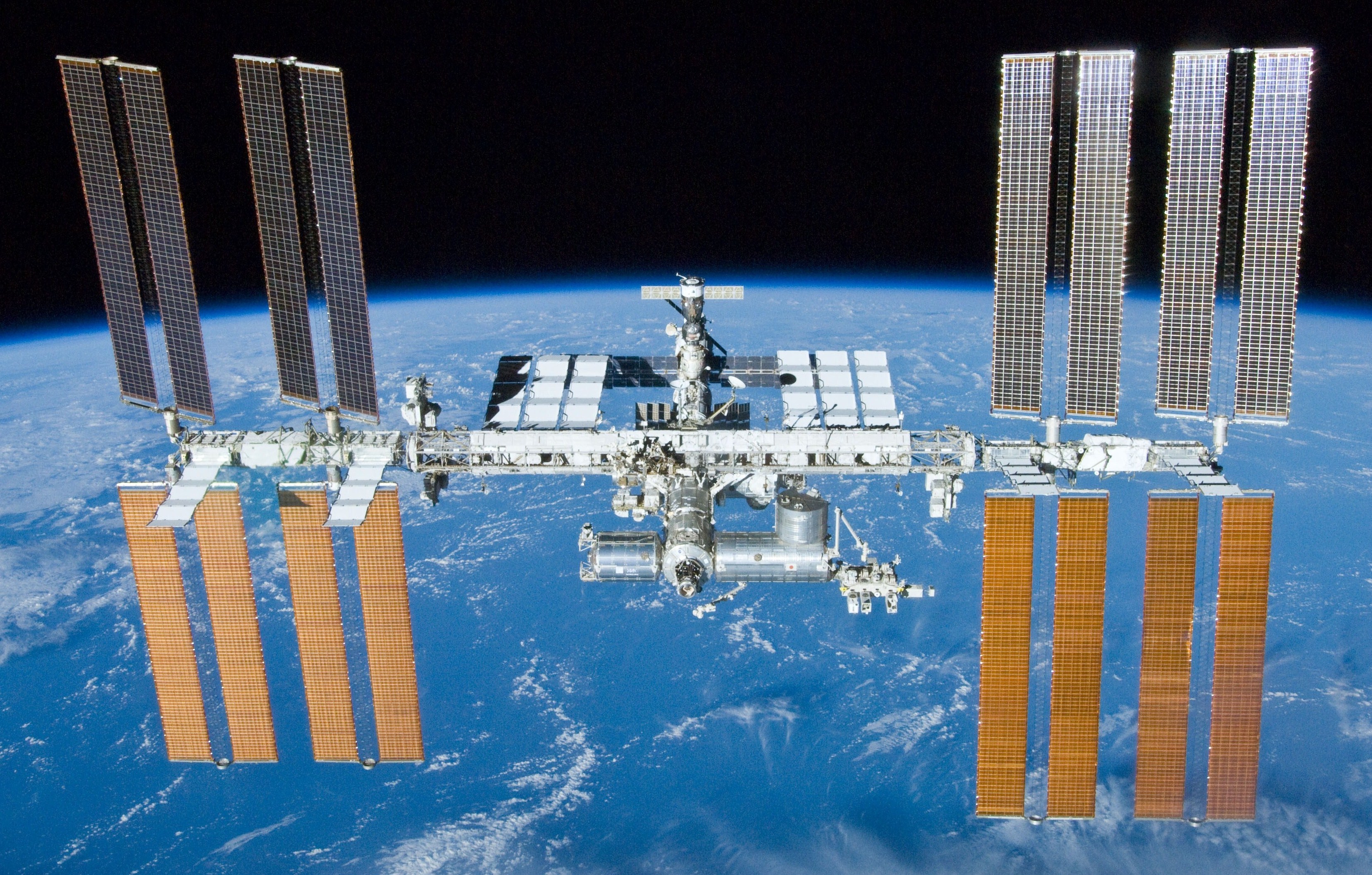
In a move that was sure to give Trekies a collective fangasm, William Shatner made contact with the International Space Station this week. This past Thursday, thanks to the marvels of 21st century communications technology, the man who portrayed Captain Kirk was able to speak to Chris Hadfield, an astronaut on board the International Space Station.
The conversation began when Shatner – ahem! – opened hailing frequencies and contacted the ISS. Hadfield replied and, using some Star Trek sound effects as background, the two had a live, streaming video conversation. The entire conversation was recorded and uploaded to Youtube for the benefit of fans and amateur astronomers everywhere.
Needless to say, when science fiction and reality collide like this, it is an epic day in nerdom! Check out the video below…
Behold the trailer for The Host, a science fiction flick based on the novel of the same name by Stephenie Meyer – author of the Twilight series. I’ll try not to hold that against this movie! Borrowing from the classic Invasion of the Body Snatchers, this story takes place long after the invasion has taken place and Earth is at peace, even though said peace came at a terrible price. Just about all human beings are now vessels for extra-terrestrial life forms.
But of course, there is a small resistance, human beings who remain free and unoccupied by alien minds and wish to stay that way. After after a young woman is seized and “possessed”, her new alien overlords try to access her memories in the hopes of findings others like her. However, soon her old mind reasserts itself and she escapes their custody, hoping to find her way back to the one she loves.
And of course, a chase follows as the alien bad guys try to reclaim her and force her to forget her love and forgo her human half. Kind of a love conquers all story with an alien possession angle! Enjoy the trailer. Several more have been released since this first one, but I personally found this one the most entertaining!
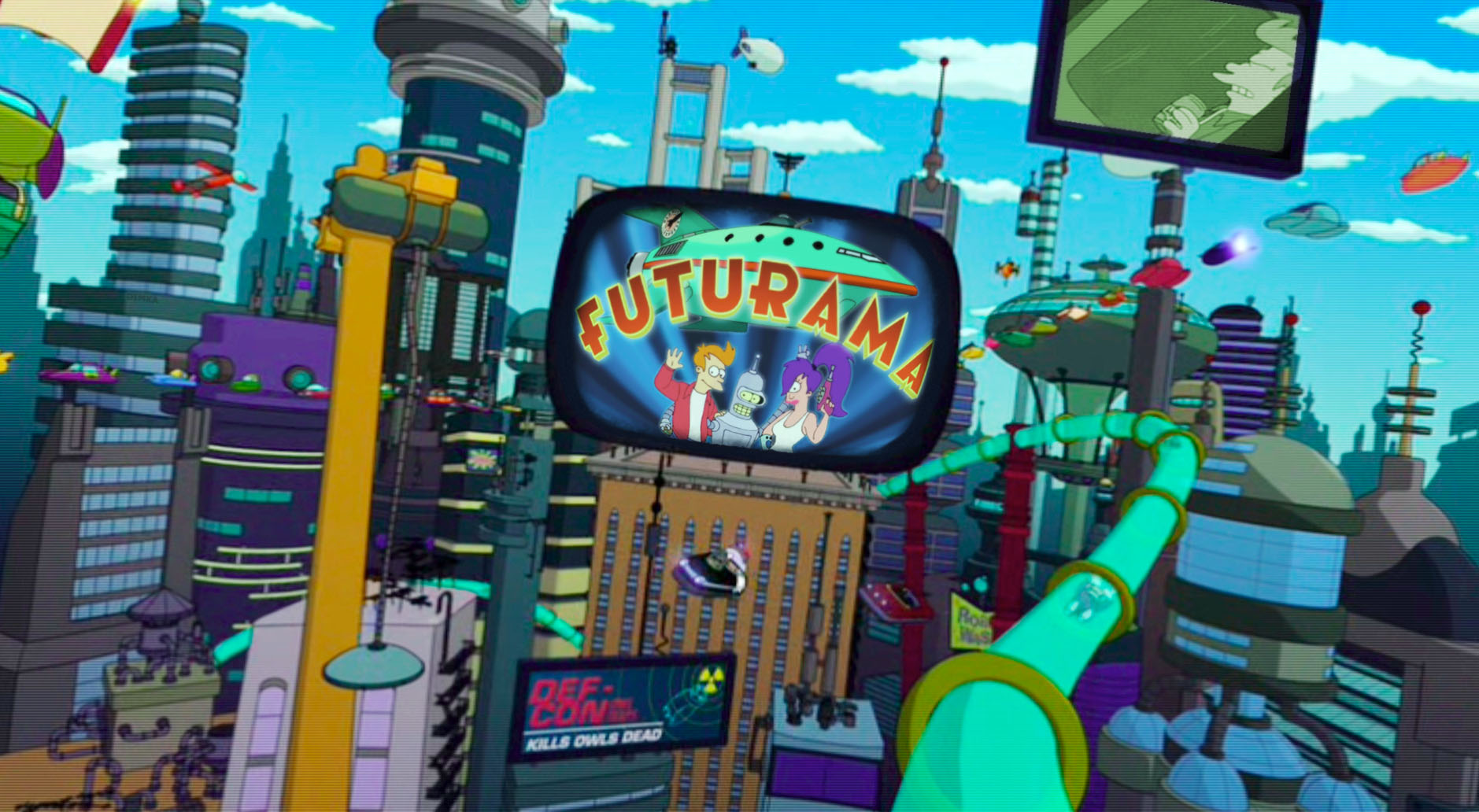
Thanks to IO9 and Raven Lunatick for turning me onto this! For fans of Futurama, the long wait for the second half of season 7 will finally be coming out this summer. And the buzz is pretty interesting, and promises to broach one of the saddest moments in the series. Yes, it seems that they hope to once again revisit the issue of Fry and Seymour – who’s relationship was cut tragically short when he was frozen. Good thing too, I don’t like how they ended that. You talk about a baller moment, and I aint talking basketball!
Other promises include a nod to the Planet of the Apes franchise, a Thing parody, Leela as a tentacle-monster (possibly a further mutation), a war with a Cobra-esque evil organization, and some more appearances from Robot Satan. And of course, we can all count on the return of our favorite characters and their trademark antics, which would include some smack-talk from Bender, some mild senility from the Professor, some incompetence and impoverished references from Zoidberg, and some limboing and thinly-veiled ganja jokes from Hermes.
Enjoy the preview and join me in counting the days!
Patrick Stewart has to be one of the most awesome actors around, and not just because of his Shakespearean training. No, this is a guy who is equally at home being completely irreverent as he is serious, and I love him for it. So in honor of this guy, I thought I’d fish through the vast database known as the internet for some video of this man in action. Here’s a small smattering of the more hilarious stuff he’s done over the years!
Avery Bullock:
Personally, I can’t get enough of Stewart as Bullock, the borderline, cocaine addicted, and sexually masochistic director of the CIA. His antics are pure hilarity, insanity, and pure wackiness. I often wonder how Stewart feels about playing the role, and then think he must be a very silly man at heart.
Dune: This is one of Stewart’s many movie roles, where he played the grizzled swordmaster of House Atreides known as Gurney Halleck. Although the movie was an unmitigated commercial and critical disaster, Stewart brought his usual talent and class to the role and carried more than a few scenes.
Extras: I personally think this was the best case of Stewart parodying himself. That was what was so genius about the show, actors playing themselves but totally making fun of themselves in the process. And Stewart really went to town on this one, acting like a sexual deviant and spoofing on Star Trek all at once!
Family Guy: Seth MacFarlane loves this guy, as attested to by the video known as “I Love Patrick Stewart” (look it up). And here is a smattering of Stewart’s many appearances on the show, either as himself or in the persona of Captain Picard.
In keeping with their usual sarcastic wit and keen observations, the folks at HISHE have released another Star Wars spoof. And as usual, you have to admit, it does present a few inconvenient plot holes, contrived twists and continuity errors that didn’t quite make sense. Especially when one considers the problems arising out of them Star Wars prequels…
Basically, if Anakin didn’t know he had kids in the first place, why didn’t he react more angrily when the Emperor told him? Wouldn’t he have been like, “You don’t me I killed my wife? How did she have kids?” And why did Yoda and Obi-Wan let Luke risk his life to go face Vader? And why didn’t Vader using that little thing known as the Force to keep his son from attempting to fall to his death?
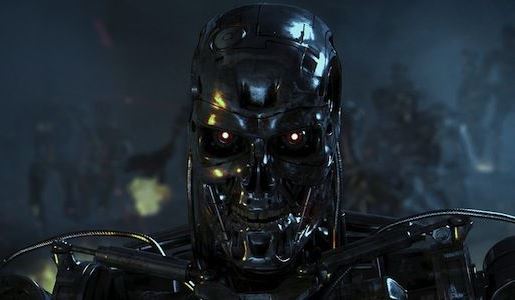
It’s official! Terminator 5 have been announced and some rather interesting news items have been released this month as to who will be attached to it. For starters, the production team of Megan and David Ellison, who brought us such movies as Zero Dark Thirty, Killing them Softly and True Grit will be spearheading it.
In terms of writers, there’s Laeta Kalogridis, a frequent collaborator with James Cameron who helped produce Avatar and also co-wrote the Fantastic Voyage and Battle Angel films and was a writer on Shutter Island, Alexander, Night Watch and the Bionic Woman pilot. She will be paired with Patrick Lussier, the writer/director of Drive Angry and Dracula 2000 and an editor with many films under his belt.
But the biggest of all is that Mr. Terminator himself, Arnold Schwarzenegger, has apparently announced that he will be in the next Terminator movie as well. No telling exactly what role he will be filling, whether it will be an aging T-800 or as a regular human being. Then again, they makers might use his presence to do a little background on who the man was that inspired the original cyborg look.
Who knows? Point is, Arny made the announcement late last month, where he confirmed participation in not only this project, but also a new Conan movie. Wow, two relaunches at the same time. Who does he think he is? Sylvester Stallone? And in the end, it seems clear at least that in this particular cameo, he will not be appearing as a CG cyborg. Though to be honest, that was one of the least lame points of that movie…
It’s no secret that in recent years, the technology behind 3D printing has been growing by leaps and bounds, and igniting a lot of imaginations in the process. And it seems that with every passing day, new possibilities are emerging, both real and speculative. Some are interesting, some are frightening, and some are just downright mind-blowing. Consider this small sampling of what’s emerged most recently and decide for yourself…
First off, it now seems that there is a design for an android that you can download, print and assemble in the comfort of your home – assuming you have access to a 3D printer. Designer Gael Langevin, who calls his project InMoov, has spent the last year perfecting the concept for a voice-controlled android that can be constructed from parts generated by a 3D printer. And not only that, he has made the entire project freely available via open source so that any DIY’er can print it on their own.
Starting with the android’s right hand, Langevin’s idea quickly took off and morphed into a the full-body concept that is now available. Designing the bot with Blender software and printing it on a 3D Touch using ABS plastic as the material, the end product is a fully animated machine that responds to voice control and can “see” and hold objects. And as you can see from the video below, it looks quite anthropomorphic:
Then came the announcement of something even more radical which also sounds like it might be ripped from the pages of a science fiction novel. Just yesterday, a team of researchers at Heriot-Watt University in Scotland announced that they used a new printing technique to deposit live stem cells onto a surface in a specific pattern. This is a step in the direction of using stem cells as an “ink” to fashion artificial organs from a 3D printer, which is their ultimate goal.
The process involves suspending the cells in a “bio-ink,” which they were then able to squeeze out as tiny droplets in a variety of shapes and sizes. To produce clumps of cells, they printed out the cells first and then overlaid those with cell-free bio-ink, forming spheroids, which the cells began grouping together inside. Using this process, they were able to create entire cultures of tissue which – depending on the size of the spheroids – could be morphed into specific types of tissue.
In short, this technique could one day be used to print out artificial tissues, such as skin, muscles and organs, that behave like the real thing. It could even serve to limit animal testing for new drug compounds, allowing them to be tested on artificially-generated human tissue. According to Jason King, business development manager at Roslin Cellab and one of the research partners: “In the longer term, [it could] provide organs for transplant on demand, without the need for donation and without the problems of immune suppression and potential organ rejection.”
And last in the lineup is perhaps the most profound use proposed for 3D printing yet. According to the European Space Agency, this relatively new technology could turn moon dust into moon housing. You read that right! It seems that a London-based design firm named Foster+Partners is planning to collaborate with the European Space Agency to build structures on the Moon using the regolith from the surface.
The process is twofold: in the first step, the inflatable scaffolding would be manufactured on Earth and then transported to the Moon. Once there, a durable shell composed of regolith and constructed by robotically-driven 3D printers would be laid overtop to complete the structures. The scheme would not only take advantage of raw materials already being present on the lunar surface, but offers a highly scalable and efficient model for construction.
Should the plan be put into action, a research expedition or colony would first be established in the southern polar regions of the Moon where sunlight is constant. From there, the scaffolding and components of the printing “foundry” would be shuttled to the moon where they would then be assembled and put to work. Each house, once complete, would be capable of accommodating four people, with the possibility of expansion should the need arise. For now, the plan is still in the R&D phase, with the company looking to create a smaller version using artificial regolith in a vacuum chamber.
Impressed yet? I know I am! And it seems like only yesterday I was feeling disillusioned with the technology thanks to the people at an organization – that shall remain nameless – who wanted to print out “Wiki-weapon” versions of the AR-15, despite the fact that it was this very weapon that was used by the gunman who murdered several small children in the town of Newton, Connecticut before turning the weapon on himself.
Yes, knowing that this technology could be creating life-saving organs, helpful androids and Lunar housing goes a long way to restoring my faith in humanity and its commitment to technological progress. I guess that’s how technology works isn’t it, especially in this day and age. You don’t like what it’s being used for, wait five minutes!
One of my favorite band of comedians and spoof artists – “Barely Political” – posted this video on their Youtube site recently. Perhaps best known for their song parodies performed by the band “The Key of Awesome”, they took a different path this time and decided to make some rather hilarious, satirical predictions of what the new Star Wars movie would look like.
Beginning with a shot at George Lucas, whom they portray as a bit of an overeating tyrant, they go on to predict what the original characters would look like in this day and age, take a few hosts at the prequel trilogy for its long, drawn out scenes of political intrigue and the stupid antics of Jar Jar, and top it all off with a little spoofing on how a Disney movie can’t go five minutes without incorporating a musical number.
Yeah, its all around fun watching! So enjoy and let’s hope the latest addition to the Star Wars saga steers well clear of all this 😉

 Here we have a video game concept that was proposed by Studio Gigante for the Xbox gaming system. Merging Mortal Kombat/Street Fighter style fights with Star Wars characters and lightsaber moves, the idea never made it to the production line. In fact, until the other day, no one outside of those who worked on it knew this proposed Star Wars combat game even existed.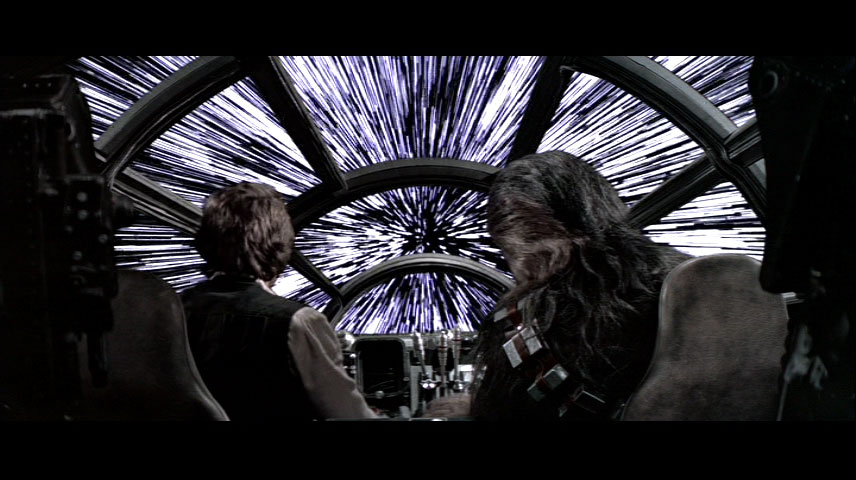




 Stories by Williams