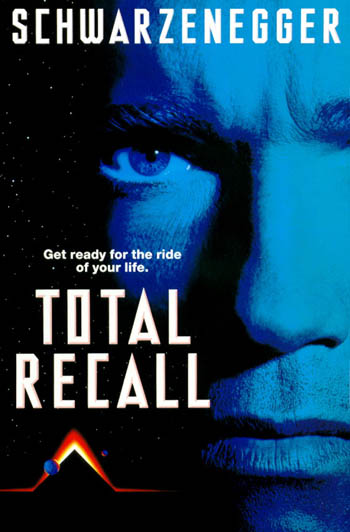
 Remake season continues for me, this week with the 2012 remake of the 1990 original movie Total Recall. Back when it came out, I was seriously questioning what the hell was going on in Hollywood, as this was just another remake in a summer that was packed full of them. But as the saying goes, “put up or shut up” – i.e. if I’m going to complain about the tide of remade movies, I might as well know what I’m talking about.
And much like last time, I figure that a review of this movie should start by paying a little lipservice to the original (which this remake did in spades!)
Total Recall 1990:
 The film is set in the not-so-distant future, where a man named Douglas Quaid is haunted by dreams of Mars and a mysterious woman and seeks an escape from his humdrum life as a metal worker. He learns of a memory-implant service named Rekall which he believes might be the solution, since they can provide a simulated adventure that he has always wanted – to go to Mars and live a life of adventure.
He then goes to Rekall and selects a package that includes a simulation where he is a special agent on a top-secret mission. However, things go terribly wrong when he begins acting out his secret agent character before the company has even had a chance to implant it. They sedate him and put him in a car, hoping to wash their hands of the incident. But when he wakes up, his friends and wife try to kill him, claiming he is not who he says he is.
 He is given a briefcase by a former associate which contains a recording, in which he is telling himself that he’s really a man named Carl Hauser, and that the governor of Mars (Cohaagen) erased his memory because of a secret he carries. Quaid/Hauser then goes to Mars, retracing the path his old self has given him, and finds his way to Melina and the resistance. She then takes him to Kuato, leader of the resistance, to unlock his memories.
They help him recover the secret he’s been carrying – which involves the discovery of an alien artifact under the surface of Mars – but the base is then found and overrun. He and Melina are taken prisoner, and he learns that Hauser was never a double-agent, but a mole working with Cohaagen all along to lead them to the resistance. They strap him and Melina into chairs and try to force Hauser to recover his old self.
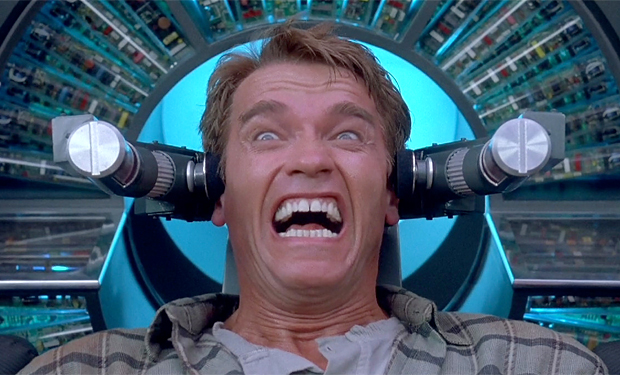 However, Quaid and Melina escape and enter the alien artifact. Cohaagen tries to stop them, claiming its a doomsday device that will destroy the planet, but Quaid manages to activate it before the three of them are sucked out onto the surface. The reactor turns out to be an atmospheric generator that turns Mars’ icy core into breathable air, which then pours out onto the surface, saving Melina and Quaid and making the planet livable.
Quaid kisses Melina, still not sure if what he has experienced is real or a dream.
Total Recall 2012:
 At the end of the 21st century, the world has been devastated by chemical warfare, rendering all but two regions unihabitable. Whereas the wealthy live in the northern hemisphere – in the United Federation of Britain (UFB) – and in the Colony (former Australia). Tensions between the two are high due to the latter demanding independence, and a series of terrorist bombings attributed to a man named Matthias.
Enter into this Douglas Quaid, a factory worker who makes the transit between the Colony and the UFB every day on a massive subterranean lift called “The Fall”. At night, he dreams of fleeing for his life with a woman, and then being taken captive. He attributes these dreams to feeling trapped in his dead end life, and then hears of the memory-implant service known as Rekall.
 Against his friend Harry’s recommendation, he goes to Rekall and requests a memory in which he is a intelligence service agent. The chief technician reveals that any duplication will cause problems, and then stops the process when he learns that Quaid really is a secret agent. Federal agents then break in and shoot everyone and try to take Quaid prisoner. However, he kills his captors and escapes.
Coming home to his wife Lori, he tells her of what happened and she tries to kill him as well. After escaping again, a pursuit begins, and Lori is told by UFB Chancellor Cohaagen to bring Quaid in alive. Meanwhile, Quaid is told by a former coworker to find the “key”, and a hidden message in the call leads him to a safety deposit box containing fake IDs, a holographic disguise, and a recording in which he explains what is happening.
 Apparently, Quaid is actually a man named Hauser who worked for UFB intelligence. He was given the task of infiltrating the Colony’s resistance until he met Melina, who convinced him to change sides. He is instructed to go to the UFB and find it, but upon arrival, he is found out and forced to flee again. He is then rescued by the woman he keeps seeing in his dreams and escape Lori for the second time.
Together, they make it away and Quaid takes them to his old apartment to hide. Here, he finds the “key”, which is a recorded message on his piano that tells him that Cohaagen has been behind the bombings, and that he is planning an invasion of the Colony with an army of synthetics so he can level it and rebuild it as a new living space for the UFB. Luckily, Hauser discovered a kill code for the synthetics, which he must get to Matthias to stop the invasion.
 As they attempt to leave his apartment, they are interrupted by Harry, who claims Quaid is still at Rekall and that he is an implant there to help him wake up to reality. Quaid chooses to shoot him and save Melina, and they are once again pursued by Lori and once again escape. They travel via the Fall to the Colony, where they meet with Matthias to hand over the memory that contains the kill code.
Unfortunately, the memory proves to be a recording of Cohaagen telling them they’ve been had. He then shows up with Lori and several security forces, kill Matthias, and take Melina away. Hauser is told he was given a false code to lead them to the resistance, and that a backup of his memories that predate his betrayal will be restored. Hauser realizes his old colleague is with them, has left his restrain undone, and escapes.
 A fight takes place aboard the Fall, and Hauser and Melina plant a series of bombs on the rails. The Fall arrives and the synthetics begin to deploy, and Hauser begins fighting it out with Cohaagen and his forces. Hauser and Melina defeat Cohaagen and then detonate the bombs, which causes the Fall to begin falling backwards towards the center of the Earth where it explodes.
Hauser loses consciousness and wakes up with Melina inside a medical vehicle. He realizes it is actually Lori wearing his holographic disguise and they fight again, and he finally kills her. He and Melina are reunited, and they stand together and hear how the Colony is now expecting full independence. He sees a Rekall signs and has a moment of doubt, but ignores it and kisses Melina.
Summary:
Once again, I am forced to give this one to the original. Whereas the remake had some signs of quality, which included decent enough performances from Farrel, Biel, Beckinsale, and Cranston. But unfortunately, some decent sets, a whole of lot of chase scenes and big budget special effects were not enough to save this movie from a relatively weak plot and a whole lot, too much CGI, and a whole lot of borrowing.
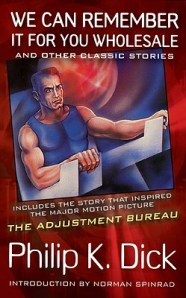 First of all, why did they do away with the whole Mars plot? The story which both the original and the remake are based on – “We Can Remember It For You Wholesale” by Philip K Dick – centered on Mars, though it did not take place there. Including it in the plot seems like a no-brainer. But for some reason, the writers of the remake wanted a story focused on Earth and the dangers of chemical warfare and rezoning.
Second, the story did away with a crucial element this time, which was the good old fashioned mind-fuck of the original. In that version, not only did we not know for certain whether or not Quaid/Hauser was dreaming the whole thing, we truly thought he was a good guy up until they showed otherwise. The plot involving replacing his memories was a ruse by Cohaagen in order to get Hauser past Kuato’s psychic detection.
 In other words, in order to infiltrate the resistance, he had to believe he was an actual traitor. Thus began the convoluted process of making the resistance think he was genuine by erasing his memory and dumping him on Earth, then leading him to retrace his path and find his way to Kuato. Though the information he had about the Martian artifact was real, it was just the bait they dangled in front of the resistance’s nose to get them to give up their location.
Which brings me to item two in the weak plot front. The fact that Quaid/Hauser was actually a good guy in this version made me respect the plot way less. It was cool finding out the hero was a villain, and then seeing him chose to remain with his implanted identity rather than allow himself to be turned back into his old self. It was a big reveal, added a solid twist to the plot, and even raised an existential question or two.
 And then there was the key moment where Quaid/Hauser has to decide what is real. In both versions, this takes the form of someone telling him he’s still dreaming and has to do something he won’t like in order to wake up. In the original, it involved Quaid being handed a pill which the man from Rekall says is a symbol of his desire to wake up, but could just as easily be a sedative. He realizes the man is a fake by the way he’s sweating and shoots him.
In the remake, it takes the form of him being confronted by his friend Harry who tells him he’s dreaming and to shoot Melina, a figment of his imagination. He chooses to shoot his friend Harry and accept that what he is experiencing is real because Jessica Biel begins to cry. But isn’t that be exactly what a fantasy woman would do in that situation? Seemed like quite the gambit there.
 Also, the “secret” that Hauser had stumbled upon in this version was really quite lame. In the original, it involved an alien artifact, which is oodles more interesting than than Cohaagen planning to rezone Australia for more living space. Sure, the idea was laden with scientific inaccuracies – melting an ice core doesn’t instantly terraform a planet! – the ridiculousness of it could always be circumvented by arguing that it really was all a dream.
Last, but not least, there were the many parts of this remake that were obvious shout outs or references to the original. First, you had the three-breasted hooker, who was well cast and easy on the eyes. You also had key lines like – “If I’m not me, then who the hell am I?” “How would I know? I just work here.” And of course, the redheaded woman at the customs line. But these seemed a bit too many and obvious to be a simple wink and a nod.
 Also, Bill Knighy had barely any screen time at all, and only really comes on to paraphrase what Kuato said in the original film. And the bad guys? No comparison! While Kate Beckinsale was believable enough as a villainess, Brian Cranston simply did not hold a candle to the original’s Ronny Cox and Michael Ironside. Those two were perfectly cast as the evil, somewhat over-the-top bad guys, the perfect counter to Arnie’s over-the-top good guy.
But getting past that, there’s the matter of what the movie kinda-sorta did right. The settings were all quite artistic, with the world in the Colony being gritty, crowded, dirty looking, and consisting of a great deal of cultural influences. By contrast, the UFB looked cleaner, brighter, and the design seemed singular by comparison. And the emphasis of shortages of space was summed up nicely by the massive, overlapping layers of structures.
 And the “synthetics” were artfully done and kind of cool looking. As were the flying cars, the aerial traffic lanes, and the three-dimensional elevator pods that crisscrossed the sky. And “The Fall” was a pretty neat idea, especially with the whole “gravity reversal thing”. But in just about all cases, these things have been done before. The sets are reminiscent of Blade Runner, with it’s gritty, crowded streets, signs in Asian characters, and the synthetic humans wandering around.
The robots also looked like a cross between Storm Troopers and the machines from I, Robot, and the flying cars called to mind another Philip K Dick adaptation, namely Minority Report. What can be said about a movie who’s set designs and concept art are quite impressive, but which borrow heavily from several other franchises? It’s like this movie is subtly mocking itself for a lack of originality – which makes sense since it’s a remake.
 And with all the special effects, things looked entirely too fake. People today might find the Kuato puppet and the molded plastic suits of the mutants to be outdated, but those showed a lot of heart versus the extensive use of CGI in this one. In fact, seeing movies like these make me long for the days of old-style effects where costumes, real actors and real sets were built rather than generating everything digitally. George Lucas, I’m looking at you as I say this!
I’d say its blatantly obvious at this point, but this one definitely goes to the original. And much like the Robocop remake, it begs the question: why redo a movie when the original got it right? Sure, the 1990 version of Total Recall wasn’t perfect. It had a lot of cheesy elements and some massive scientific inaccuracies, but it managed to both entertain and impress with the way it played with perceptions, twisted things around and kept people guessing until the end.
In this remake, there really is no mystery, the plot is simplified, the most important element (i.e. Mars) is dropped, some of the best elements are missing, and it borrowed too heavily from multiple sources – not the least of which was the original. So really, why was it even made? In this season of remake review, I find myself asking that question quite a lot! Not a good way to start…
Okay, onto new things. Which may, at this point, include The Teenage Mutant Ninja Turtles relaunch. No promises though 🙂

 For awhile now, I’ve been tinkering with a story idea known as Apocrypha. It first came to me back in 2009 when I decided to move away from space opera and into more hard science fiction. I even decided to relaunch the idea a few months back, which would be the second time I decided to reboot the idea. And now, I’m rebooting it yet again, but with one major change.
 The name of the new story is Reciprocity, which is taken from the Chinese concept of Bao Ying. I chose this as a name because while researching Chinese ancestral religion, I came across a central theme which states that the fate of all human beings is determined by cosmic reciprocity.
 Originally, Apocrypha was all about a group of apocalyptic terrorists who have ties to various anti-modernist, anti-western groups who try to use a Chinese cyber-virus named Hǔnluàn (Chinese for chaos) to accomplish their goals. However, this idea wasn’t panning out in a few ways. Mainly, the antagonists didn’t seem believable to me, especially where their motivations are concerned.
 Borrowing from Russia’s post-Communist experience, I basically foresee China going through many of the same problems in the near future. First, the state would find itself under a great deal of pressure due to ongoing demands for reform, pro-democracy protests, and the memory of Tienanmen Square. And I also imagine the health effects of air pollution and cancer farms would also add to the resistance.
 Ten years later, China would find itself in a state of serious change and facing an ambiguous future. On the one hand, it would remain a major power economically and militarily, but would still be suffering from lingering environmental damage and uneven development. As a result, it would find itself vulnerable to quasi-fascist politicians looking to exploit people’s uncertainty and funnel it towards a revisionist agenda.
 The final installment of The Hunger Games trilogy is coming soon. Or, at least the first half of it. And the first trailer has arrived. As you can see from this just-under two minute promo, the revolution that began at the end of Catching Fire is now in full swing. The games are now over, in both the literal and figurative sense, with Katniss and the President openly sparring for the future of Panem.






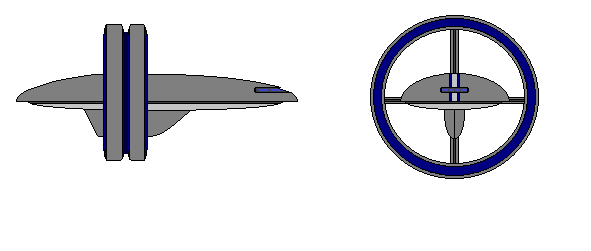

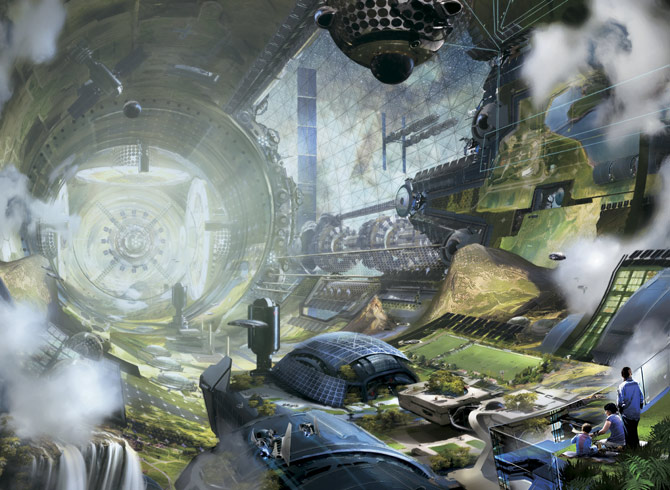
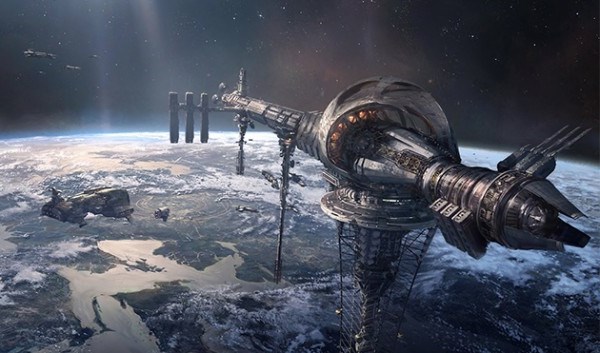
 Lately, I’ve been getting back to work on the space anthology known as Yuva – and for good reason. Not only has our group been blessed with the arrival of some new blood in recent months, but for many of us (me especially), the inspiration bug has bitten after a long hiatus.
 Set in the near-future, the film opens on a Detroit that has become a cesspool of crime, corruption and corporate greed. Having gone bankrupt, the city has signed a deal with Omni Consumer Products (OCP) to run the underfunded police department in exchange for demolishing Old Detroit and building a new metropolis – Delta City – that will renew the city and provide employment.
 To get a “volunteer”, OCP transfers officers to more crime-ridden districts, one of which is officer Alexander Murphy. A dedicated officer, he and his new partner run into criminal kingpin Clarence Boddicker and his gang during their first patrol. After pursuing them to an abandoned steel mill, Murphy is isolated and gunned down. Pronounced dead, his body is then used to create Robocop.
 Meanwhile, Murphy begins to remember his old life and begins hunting for Boddicker and his gang. After capturing him, he learns of Boddicker’s relationship with Jones and attempts to arrest him, but is stopped by a secret Fourth Directive, which prevents him from arresting an executive of OCP. He narrowly escapes OCP headquarters with the help of Lewis, his old partner, and flees to an abandoned factory to recuperate.
 The movie ends with the chairman asking Robocop if he has a name, to which he replied: “Yes. Murphy”.
 The year is 2028, and robotics and automated military systems are now commonplace around the world, enforcing US military policy in places like Iran. Looking to expand, Omnicorp contemplates ways that they will be able to make robots palatable to the American masses, where the Dreyfus Act currently forbids their deployment. All they need is a critically injured policeman to put inside the machine.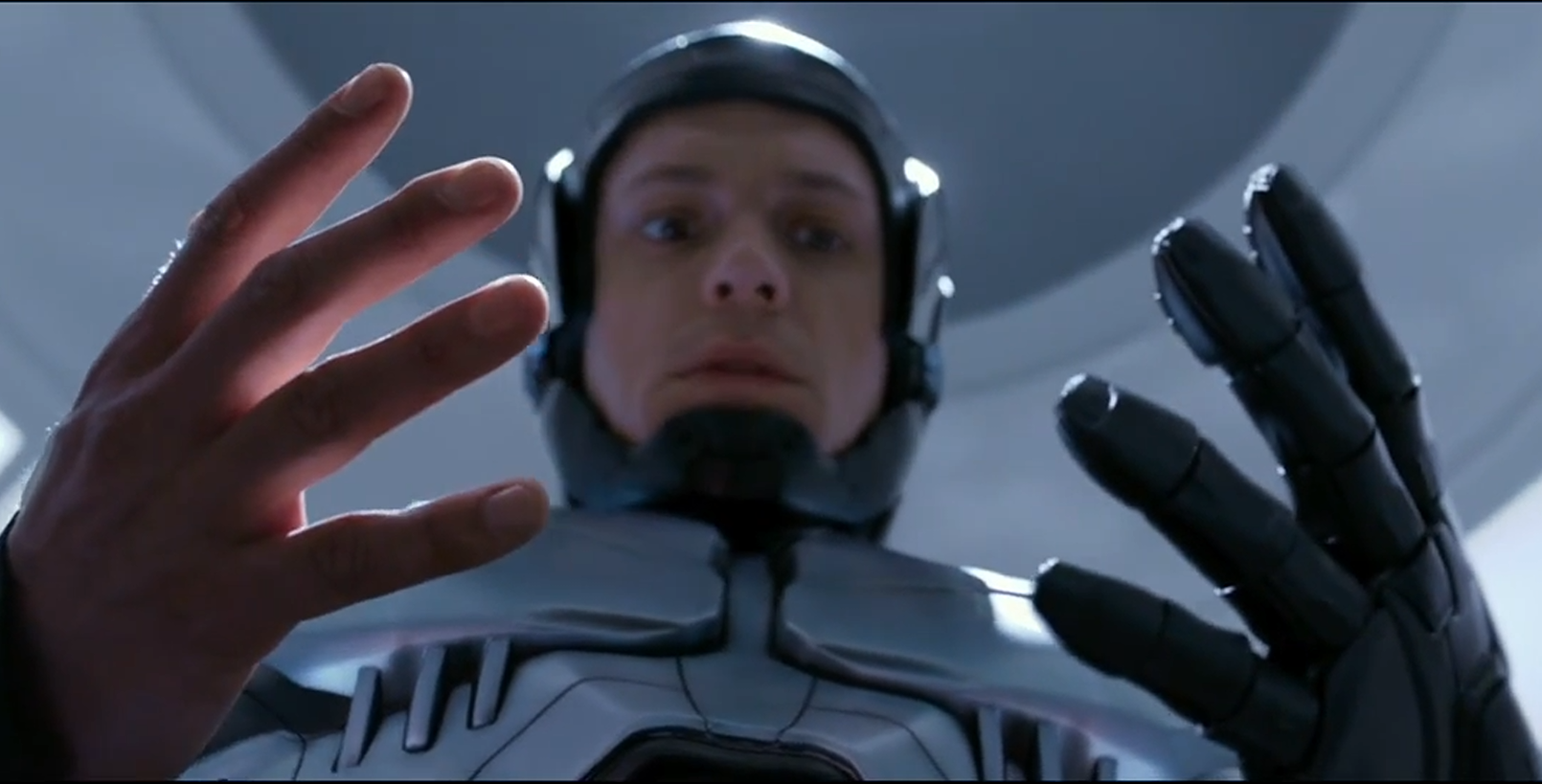
 Murphy’s wife confronts him in the street, which triggers Murphy’s memories and leads him to begin investigating his own death. He tracks down Vallon and destroys his gang in an intense shootout, and then confronts the members of the police department who were supplying him. Seeing this, Omnicorp shuts Murphy’s systems down before he can arrest the police chief and begin to rethink his existence.
 While these issues are certainly very relevant, the way the movie went about presented them seemed at once too subtle and heavy-handed. This is best illustrated by the character of news pundit Pat Novak (played by Samuel L. Jackson), a clear parody of Bill O’Reilly and a slew of other Fox News commentators. In addition to being loud, extremely biased and a corporate shill, he completely hands the message to the audience within the last few seconds of the movie:
 But in this movie, he wakes up inside the machine remembering everything that happened to him and has trouble performing on par with automated robots. To remedy this, they have to go through a convoluted process whereby he’s no longer in control, but thinks he is thanks to the magic of brain-altering software. All of this seemed unnecessary, clunky, and took away from the story. It also begged the question, why not simply erase his memory and avoid all this?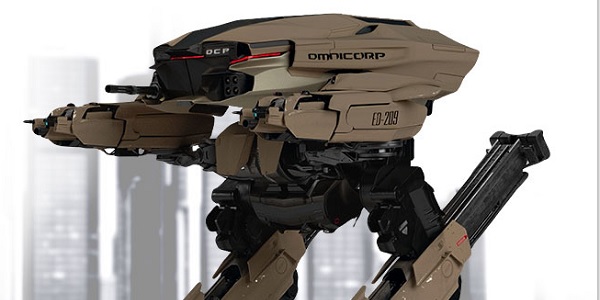



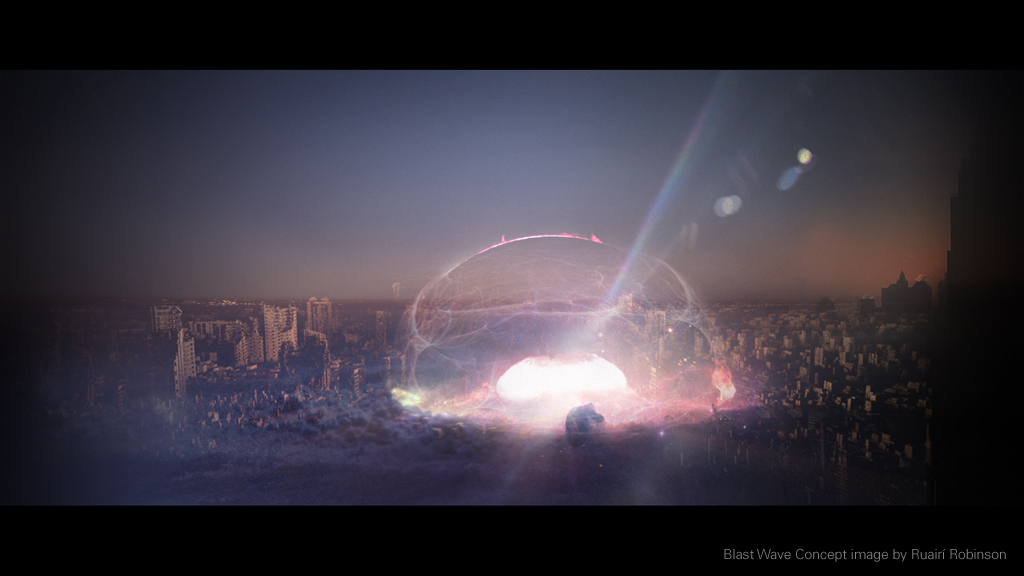 A few years ago, it was reported that director Ruairi Robinson was going to create a live-action American adaptation of the classic anime, Akira! The project has getting a lot of hype, despite what many hardcore fans have to say about an American version of the anime cult classic. And while the attempts to get the ball rolling have continually stalled, with actors and directors constantly dropping and out of the project, it does seem like this is one project that just wont’ die.
 In many of these, you can see Kaneda’s iconic red bike running through the streets. But the larger focus is on the colorful skylines, complete with skyscrapers, neon signs, multiple languages scripts, and a general gritty, cyberpunk feel. And at the bottom, there is a comparison shot showing a shooting location in New York City above a picture of what the proposed Neo-New York City would look like. That name sound at all believable to you?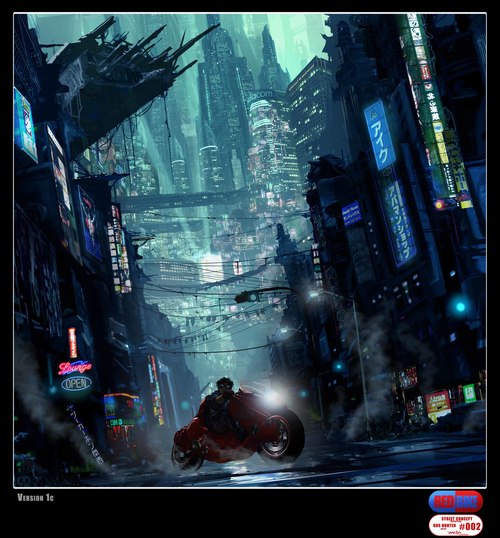
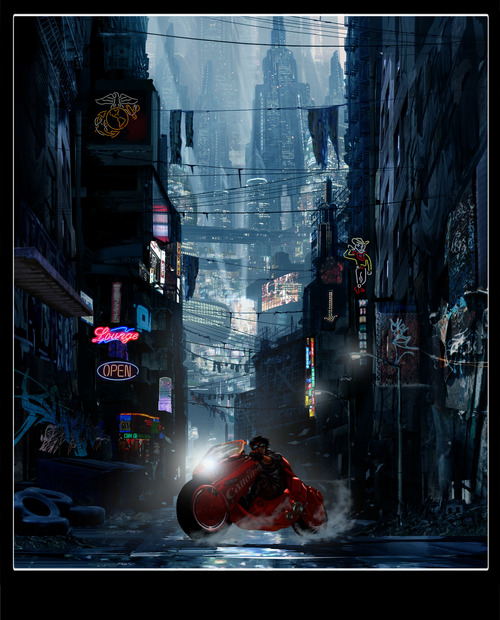

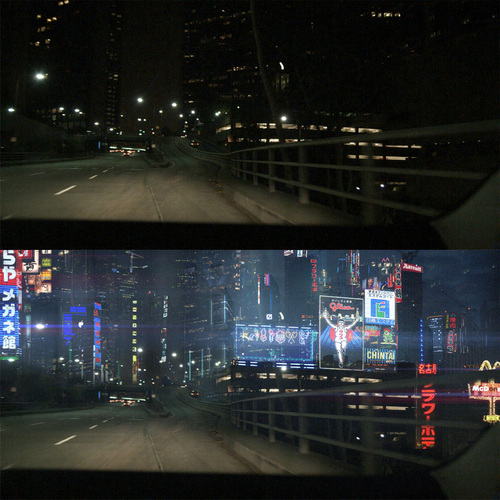
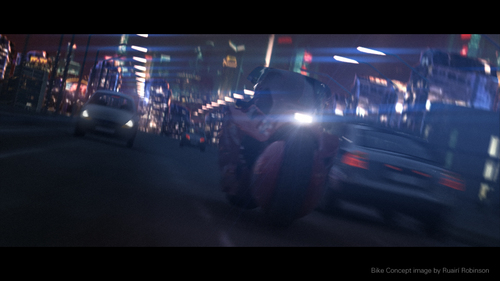

 But what montage of Akira-related images would be complete without scenes depicting the unleashed psychic Tetsuo, demonstrated his newfound powers? Below are a couple that demonstrate the anime’s antagonist in action, in the first, deflecting a missile attack from an attack chopper, and in the second breaking into the Akira vault and discovering the namesake’s remains.
 Not too bad to look at. But with the supposed director, producers, and actors changing every few years, many are wondering if this live-action remake will ever happen. And many fans can see nothing wrong with the idea, provided it is true to the source material. And dropping the whole Americanized angle and setting it back in Neo-Tokyo where it belongs wouldn’t hurt much either! But in the end, it really comes down to being true to the spirit of the Manga, if not the precise format.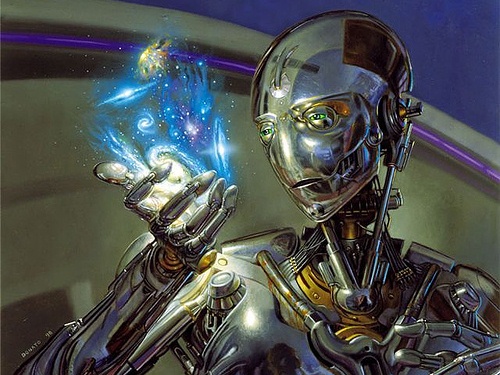
 This is the central focus of the story – and Stross’ particular obsession – which he explores in serious depth. The title, which in Italian means “speeding up” and is used as a tempo marking in musical notation, refers to the accelerating rate of technological progress and its impact on humanity. Beginning in the 21st century with the character of Manfred Mancx, a “venture altruist”; moving to his daughter Amber in the mid 21st century; the story culminates with Sirhan al-Khurasani, Amber’s son in the late 21st century and distant future.
 Part I, Slow Takeoff, begins with the short story “Lobsters“, which opens in early-21st century Amsterdam. Here, we see Manfred Macx, a “venture altruist”, going about his business, making business ideas happen for others and promoting development. In the course of things, Manfred receives a call on a courier-delivered phone from entities claiming to be a net-based AI working through a KGB website, seeking his help on how to defect.
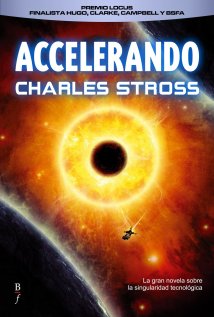 Part II, Point of Inflection, opens a decade later in the early/mid-21st century and centers on Amber Macx, now a teen-ager, in the outer Solar System. The first story, entitled “Halo“, centers around Amber’s plot (with Annette and Manfred’s help) to break free from her domineering mother by enslaving herself via s Yemeni shell corporation and enlisting aboard a Franklin-Collective owned spacecraft that is mining materials from Amalthea, Jupiter’s fourth moon.
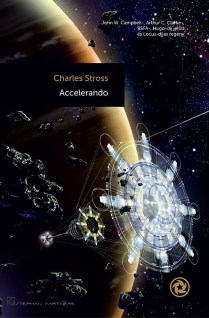 Part III, Singularity, things take place back in the Solar System from the point of view of Sirhan – the son of the physical Amber and Sadeq who stayed behind. In “Curator“, the crew of the Field Circus comes home to find that the inner planets of the Solar System have been disassembled to build a Matrioshka brain similar to the one they encountered through the router. They arrive at Saturn, which is where normal humans now reside, and come to a floating habitat in Saturn’s upper atmosphere being run by Sirhan.
 Stories by Williams