In a recent study, NASA shared a vision that sounds like something out of a science fiction novel. Basically, the plan calls for the creation of robots that could be sent to a nearby asteroid, assemble itself, and then begin mining the asteroid itself. The scientists behind this study say that not only will this be possible within a few generations of robotics, but will also pay for itself – a major concern when it comes to space travel.
A couple of factors are pointing to this, according to the researchers. One, private industry is willing and able to get involved, as attested to by Golden Spike, SpaceX and Planetary Resources. Second, advances in technologies such as 3-D printing are making off-world work more feasible, which can be seen with plans to manufacture a Moon base and “sintering”.
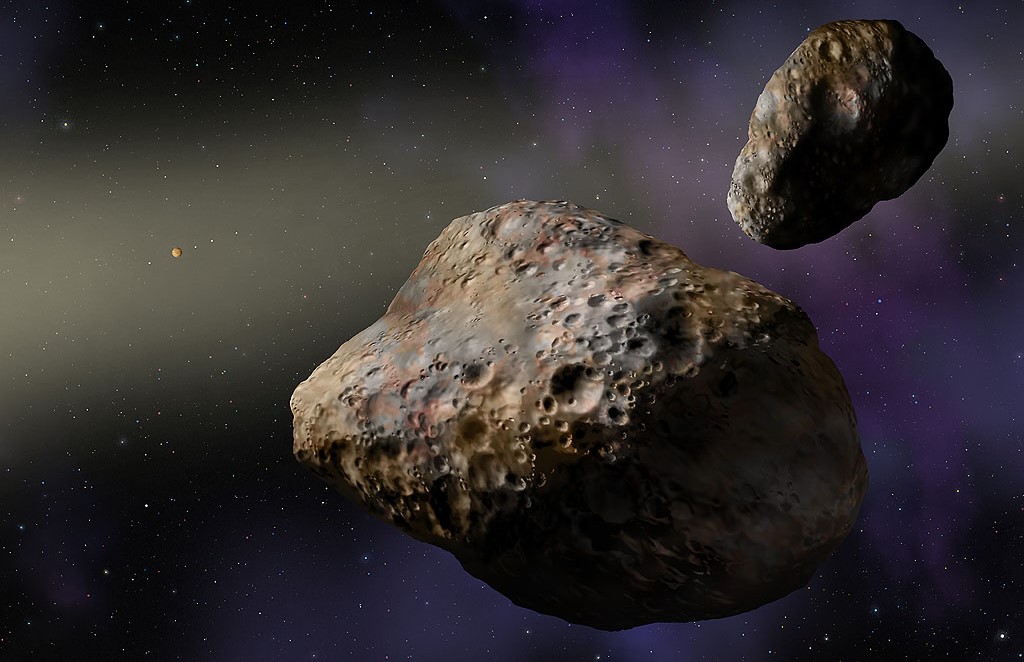
But also, humanity’s surveys of space resources – namely those located in the asteroid belt – have revealed that the elements needed to make rubber, plastic and alloys needed for machinery are there in abundance. NASA proposes that a robotic flotilla could mine these nearby space rocks, process the goods, and then ship them back to Earth.
Best of all, the pods being sent out would save on weight (and hence costs) by procuring all the resources and constructing the robots there. They caution the technology won’t be ready tomorrow, and more surveys will need to be done of nearby asteroids to figure out where to go next. There is, however, enough progress to see building blocks. As the agency stated in their research report:
Advances in robotics and additive manufacturing have become game-changing for the prospects of space industry. It has become feasible to bootstrap a self-sustaining, self-expanding industry at reasonably low cost…
Phil Metzger, a senior research physicist at NASA’s Kennedy Space Center, who led the study, went on to explain how the process is multi-tiered and would encompass several generations of progress:
Robots and machines would just make the metal and propellants for starters… The first generation of robots makes the second generation of hardware, except the comparatively lightweight electronics and motors that have to be sent up from Earth. It doesn’t matter how much the large structures weigh because you didn’t have to launch it.
A computer model in the study showed that in six generations of robotics, these machines will be able to construct themselves and operate without any need of materials from Earth.
At least two startups are likely to be on board with this optimistic appraisal. For example, Deep Space Industries and Planetary, both commercial space companies, have proposed asteroid mining ideas within the past year. And since then, Planetary Resources has also unveiled other projects such as a public space telescope, in part for surveying work and the sake of prospecting asteroids.
And this latest research report just takes thing a step farther. In addition to setting up autonomous 3D manufacturing operations on asteroids, these operations would be capable of setting themselves up and potentially upgrading themselves as time went on. And in the meantime, we could look forward to a growing and increasingly complex supply of manufactured products here on Earth.
On June 16th, 1963, in what was to become a first amongst firsts, Russian Cosmonaut Valentina Tereshkova made history by being the first woman to go into space. Today, exactly fifty years later, Tereshkova’s achievements continue to serve as a reminder that all people – regardless of their gender – are capable of doing just about anything. And at the age of 76, Tereshkova lives on as a national and historic icon, inspiring younger generations of women to follow their dreams.
On Friday, President Vladimir Putin praised Tereshkova during a meeting at his residence. Tereshkova was on hand for the event, which was covered by several major networks and global news agencies, during which time Putin awarded her accomplishments in space by giving her the Order of Alexander Nevsky for meritorious public service, one of the highest Russian honors.
Her historic flight came a little more than two years after the Soviet Union put the first man – Cosmonaut Yuri Gagarin – into orbit. Shortly thereafter, Soviet space officials started considering a space mission by a woman, seeing it as another chance to advertise the nation’s prowess. Much like Gagarin, Tereshkova was part of the Vostok program, the earliest Soviet space missions, and her flight (Vostok-6) was the final mission of the program.
Vostok-6 rocket
Of over four hundred candidates, Tereshkova was selected for a number of reasons. In addition to conforming to the height and weight specifications needed to fit within the Vostok capsule, she was also a qualified parachutist – which given the nature of the Vostok space craft (the re-entry craft was incapable of landing) was absolutely essential. But perhaps most important reason was her background, since she was the daughter of war hero Vladimir Tereshkova who died in Finland during the Second World War.
To make the mission even more spectacular for propaganda purposes, Moscow decided to score another first by making it the first simultaneous flight of two spaceships. Valery Bykovsky blasted off aboard the Vostok-5 ship on June 14, 1963, and Tereshkova followed him on June 16. During her flight, Tereshkova orbited the Earth forty-eight times and spent almost three whole days in space.
Vostok-6 craft
Aside from some nausea, which she would later claim was the result of tainted food, she maintained herself for the full duration and successfully parachuted down upon re-entry. Her landing was a little rough, however, and she experienced some serious bruising of her face. Tereshkova also claimed that during the flight, she noticed a fault in the ship’s controls, which she corrected to prevent from being stranded in space.
With this single flight, Tereshkova logged more flight time than the combined times of all American astronauts who had flown before that date. Tereshkova also maintained a flight log and took photographs of the horizon, which were later used to identify aerosol layers within the atmosphere. Many of the details of her flight, including her nausea, the technical problems, and the hard landing she made, were kept a secret until the collapse of the Soviet Union, since government officials feared they would expose flaws in their program.
Tereshkova received a hero’s welcome after the flight and was showered with awards. A few months later she married cosmonaut Andrian Nikolayev with Soviet leader Nikita Khrushchev presiding over the wedding party. She now holds a Parliament seat on the ticket of the main Kremlin party, serving as deputy chairman of the foreign affairs committee in the lower house.
Tereshkova’s story is all the more poignant due to the fact that none of the other planned missions involving female cosmonauts took place and the Soviet’s cancelled the pioneering woman cosmonaut program in 1969. It would be many years before another woman would go into space, once again with the Soviet space program when Svetlana Savitskaya participated in the Soyuz-T7/T5 space mission on August 19th, 1982. Less than a year later, Sally Ride would become the first American woman to go into space as part of the STS-7 mission that went up on Jun. 18, 1983.
However, as time progressed, more and more women have come to join the space profession, and Tereshkova has been on hand to honor some of them. One such person was South Korea’s first astronaut, biosystems engineering student Yi So-Yeon (picture above). Tereshkova is seen accompanying her while she boards the spacecraft that would take her to the ISS on April 8th, 2008 from the Baikonur Cosmodrome in modern-day Kazakhstan.
Since her time, a total of 56 women have gone into space, and that doesn’t even count the female astronauts who have taken part in mission that didn’t go up or offered technical assistance to crewed missions from the ground. In all cases, these women owe an undeniable debt to Tereshkova, the first woman to enter what was (and still is) considered a man’s profession and who helped pave the way for all those that followed.And in what is an interesting twist, the anniversary of her spaceflight comes just days after the release of a series of declassified documents which reveal the truth of Yuri Gagarin’s death. This seems appropriate since Tereshkova and Gagarin’s stories are connected in so many ways. In truth, it’s virtually impossible to speak of one without mentioning the other, as their careers and destinies were so very intertwined.
In addition to both individuals being pioneering space cosmonauts with the Soviet space program, Gagarin’s death also led to some serious changes in Tereshkova’s career in space. Though she remained an important figure within the program, she was barred from taking part in any more space missions, and for obvious reasons. Having lost one historic figure to tragic circumstances, the Soviet government did not want to lose her as well.
However, Tereshkova expressed nothing but relief to hear the truth about Gagarin’s death, which was apparently caused by a mid-air collision when another pilot accidentally steered his jet plane into the path of Gagarin’s training plane. After 45 years of official silence on the matter, she claimed that “The only regret here is that it took so long for the truth to be revealed. But we can finally rest easy.”
At 76, she is still a model of dignity and class, and in pretty good health too for someone her age! I think I speak for all of us in wishing her many more years of health, happiness and accomplishments. One of the most tragic realities of our time is the loss of people who not only witnessed major turning points in history, but made them happen. As such, I hope the world can continue to hang on to Valentina a little while longer…
On the morning of April 12, 1961, Soviet cosmonaut Yuri Gagarin lifted off aboard Vostok 1 to become the first human in space, becoming an instant hero to many and an historic figure. Tragically, his life was cut short when just seven years later (on March 27th, 1968) the MiG-15 UTI he was piloting crashed. Ever since, his death has been shrouded in confusion and controversy, with many theories being posited as to what actually cause.
And now, some 45 years after the fact, the details about what really happened to cause the death of the first man in space have come out — from the first man to go out on a spacewalk, no less. In an article published online on Russia Today, former cosmonaut Aleksey Leonov — who performed the first EVA on March 18, 1965 — has revealed details about the accident that killed both Yuri Gagarin and his flight instructor Vladimir Seryogin in March 1968.
A soft-spoken and well-mannered man, Gagarin began his journey into space in 1960 when he and 19 other pilots were selected to take part in the Soviet space program. Just three years after making history with the launch of the first artificial satellite into space (Sputnik-1), the Russians were eager to follow this up with a mission that would put a man into low-Earth orbit.
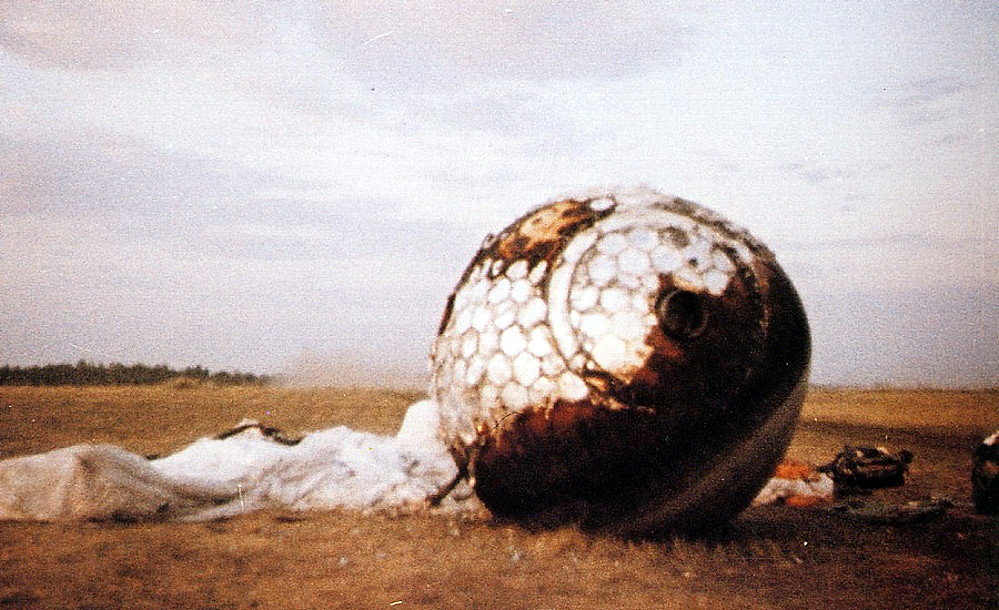
After a grueling selection process involving physical and psychological tests, Gagarin was selected to take the pioneering flight inside the Vostok-1 space capsule. The launch, which was eagerly monitored by people all over Russia and around the world, took place at exactly 9:07 am local time (06:07 UT) on 12 April 1961. After spending just under two hours in orbit, the capsule made reentry, Gagarin exited it and parachuted to the ground, landing at around 11:05 am (08:05 UT) in a farmer’s field outside of Engels.
Observing the landing of Vostok-1 were two school girls, who recalled the site of the capsule hitting the ground with a combination of fascination and fear:
It was a huge ball, about two or three metres high. It fell, then it bounced and then it fell again. There was a huge hole where it hit the first time.
Elsewhere, a farmer and her daughter observed the strange scene of a figure in a bright orange suit with a large white helmet landing near them by parachute. Gagarin later recalled:
When they saw me in my spacesuit and the parachute dragging alongside as I walked, they started to back away in fear. I told them, ‘Don’t be afraid, I am a Soviet like you, who has descended from space and I must find a telephone to call Moscow!’
After the flight, Gagarin became a worldwide celebrity, touring widely abroad to promote the Soviet’s accomplishment in putting a man into space. Upon returning home, he found himself relegated to training and other tasks, due in part to the death of his friend, Vladimir Komarov in the first flight involving a Soyuz spacecraft. Shortly thereafter, he began to re-qualify to become a fighter pilot, and died during one of his training flights.
Officially, reports about Gagarin and Seryogin’s death claim that the plane crashed when Gagarin manuevered the two-seated training version of the MiG-15 fighter craft to avoid a “foreign object”. The report does not specify what this object was, but the term refers to anything from balloons and flocks of birds to airborne debris or another airborne craft. And as you can imagine, people have made some very interesting suggestions as to what this object could have been.
Now, a declassified report, which Leonov has been permitted to share, shows what actually happened during the training flight. Apparently, an “unauthorized Su-15 fighter” flew too close to Gagarin’s MiG, disrupting its flight and sending it into a spin. In his article, Leonov went on to explain in further detail:
In this case, the pilot didn’t follow the book, descending to an altitude of 450 meters. While afterburning the aircraft reduced its echelon at a distance of 10-15 meters in the clouds, passing close to Gagarin, turning his plane and thus sending it into a tailspin — a deep spiral, to be precise — at a speed of 750 kilometers per hour.
The pilot of the SU-15 survived the incident, is apparently still alive, and was not named – a condition of Leonov’s permission to share the information.
Afterwards, the first woman into space, Valentina Tereshkova (also a Soviet cosmonaut) was officially grounded by the government after Gagarin’s death to avoid a loss of another prominent cosmonaut. After the revelation was made about the true cause of Gagarin’s death, she responded by saying that the details come as a bittersweet relief. “The only regret here is that it took so long for the truth to be revealed,” Tereshkova said. “But we can finally rest easy.
Indeed. Rest in peace, Yuri. Like many who have since come and gone, you’re a part of an extremely select few who went into space at a time when doing so was still considered by many to be an impossible dream. And regardless of the Cold War atmosphere in which this accomplishment occurred, it remains an historic first and one of the greatest accomplishments ever made by a human being.
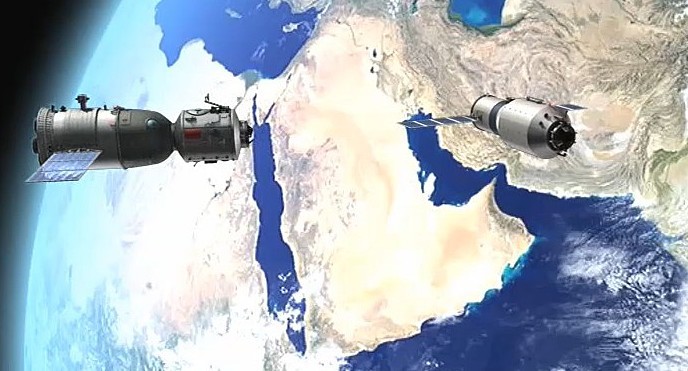
Yesterday, at approximately 5:38 am ET, China took yet another step towards establishing itself as a major player in space. It’s latest manned spacecraft, known as the Shenzhou 10, departed the Jiuquan Satellite Launch Center at the edge of the Gobi Desert, carrying three astronauts on what is planned to be a fifteen day mission that will see them rendezvousing with the prototype Tiangong-1 space lab in Earth’s orbit.
This is China’s fifth manned mission into space and will be its longest to date. The purpose of the mission is to educate young people about science, but for the Chinese state, it also presents an opportunity to flex its muscles as one of the new leaders in space exploration. Much of this has to do with the Tiangong-1, which is intended to serve as an experimental prototype for a much larger Chinese space station that will be launched in 2020.
In this respect, China is hoping to reach beyond its membership as on the three nations to send manned craft into space and join the United States and Russia by being able to send independently maintained space stations into orbit as well. If all goes well, China’s space station will join the likes of Mir and the ISS in Earth’s lower orbit. And with this kind of infrastructure in place, China will be well suited to play a role in future missions to Mars and the outer Solar System.
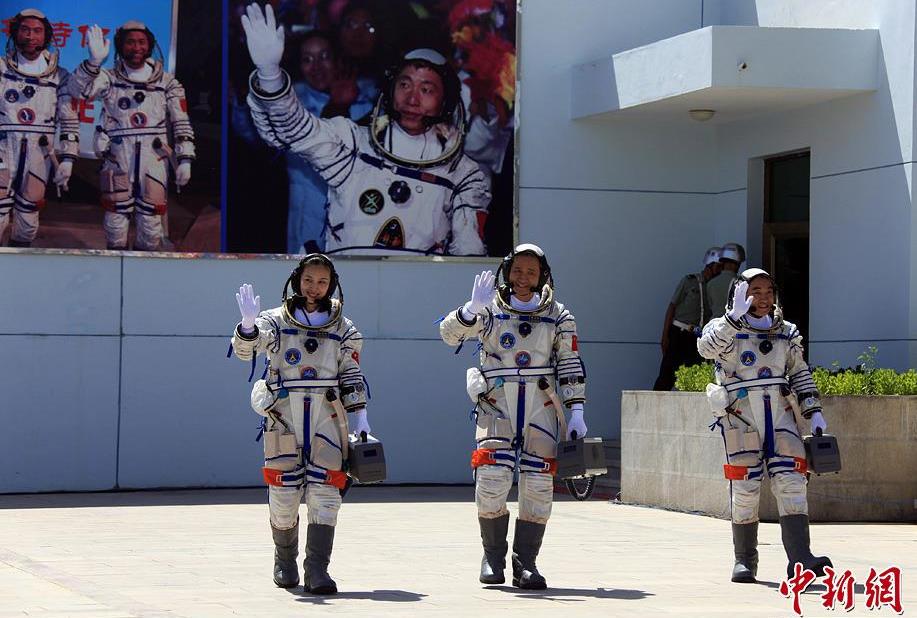
The craft carried two men, mission commander Nie Haisheng and Zhang Xiaoguang, and China’s second female astronaut, Wang Yaping. After rendezvousing with the space lab, the crew will spend a total of 12 days living in zero-gravity and conducting scientific experiments, the results of which will be shared with people on Earth.
Borrowing a page from astronaut Chris Hadfield and his many popular Youtube videos that cataloged his crew’s mission aboard the ISS, the Chinese crew plans to deliver a series of talks to students while aboard the Tiangong. This development of “space classrooms” marks the boldest step so far for the Chinese space program, turning what was a military-backed program into something that will impact on the lives of ordinary Chinese citizens.
Here too, China is following in the footsteps of NASA, which uses student outreach to inspire interest in space exploration and sustain support for its budgets. At a news conference on Monday, Wang said she was “eager to explore and feel the magic and splendor of space with young friends.” Her fellow astronaut Zhang told reporters they would conduct dozens of space science experiments and would “enjoy personalized space foods especially designed by our nutritionists.
On the day of the launch, President Xi Jinping was shown live on television at the launch center. State television showed Xi watching the launch, as well as Premier Li Keqiang who was at the space command center in Beijing. Prior to the launch, Xi delivered a statement to the astronauts, commending them on their efforts and wishing them luck on their journey:
You have made [the] Chinese people feel proud of ourselves. You have trained and prepared yourselves carefully and thoroughly, so I am confident in your completing the mission successfully. I wish you success and look forward to your triumphant return.
The space program is a source of enormous national pride for China, reflecting its rapid economic and technological progress and ambition to rank among the world’s leading nations. Little wonder then why the launch was met with such fanfare and overseen by both the President and Premier. The mission comes at the height of ten years of Chinese space exploration and if successful, will mark China as a true superpower in the space race of the 21st century.
And be sure to check out the video of the launch of the Shenzou 10:
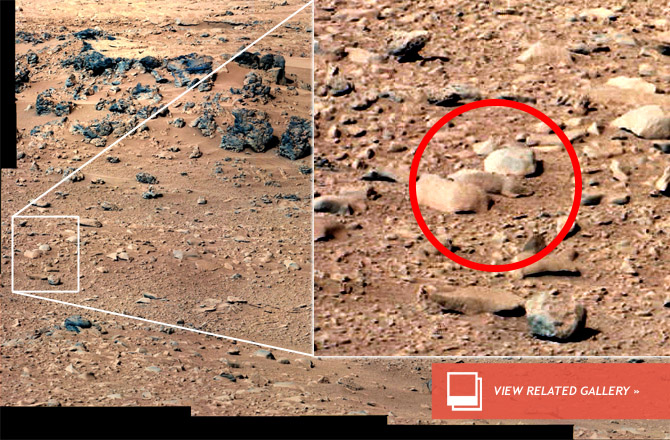
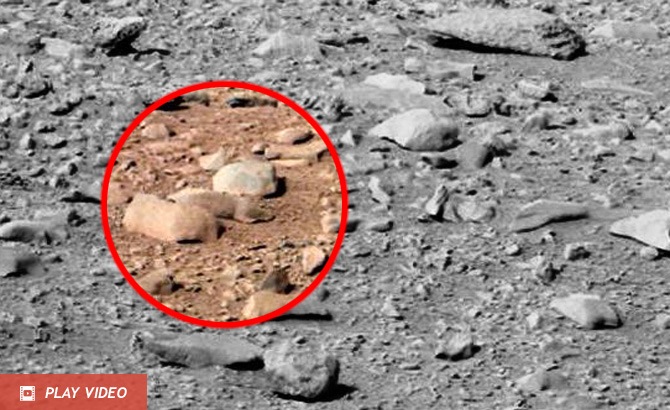
It seems that a new field of study was threatening to emerge with the “discovery” of what appeared to be a Martian rat. The technical term for it is Martian mammology, the study of mammals that are native to Mars. Luckily, proponents of this field did not manage to overpower the good people at NASA, who remain dedicated to serious scientific research. And now, the Curiosity rover is moving on to study bigger and better things.
Yes, the appearance of this would-be rodent did generate a lot of buzz on the internet of late, with some UFO buffs claiming that it may be an indigenous Red Planet lifeform or an Earth rodent Curiosity carried to Mars as part of a secret experiment. But Curiosity scientists were relatively certain that the rat, which was spotted in a zoomed-in portion of a photo taken by the rover in September 2012, was just a rock.
Curiosity deputy project scientist Joy Crisp, of NASA’s Jet Propulsion Laboratory in Pasadena, Calif., told reporters on Wednesday, June 5, what they believed the curiously-shaped rock was the result of:
Clearly, it results from, you know, a lot of things like wind erosion and mechanical abrasion and breakdown chemical weathering of the rocks, as to why they get these weird shapes.
Under the circumstances, NASA does not feel the need to conduct any further studies. And the window to do so will last just a few more weeks, as the Curiosity rover is set to begin an epic drive that will take it far away from the petrified rodent. At the moment, the robot is gearing up for a year-long trek that will take it to the base of Mount Sharp, a mysterious mountain that rises 5.5 km (3.4 miles) into the Red Planet sky.
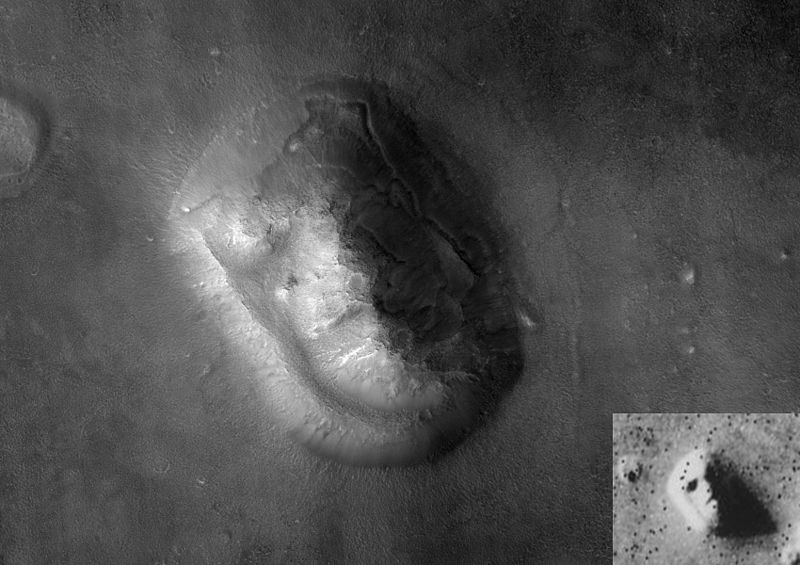
Curiously (no pun!), this is not the first time people have seen faced in the rock surfaces of Mars. Remember the elusive “Face on Mars”? Originally taken by the Viking 1 spacecraft in 1976, this low-resolution picture of the Cydonia region of Mars ignited the imaginations of people all over the world. For years, the face was mentioned in feature films, television series’, video games, comics, and even pop music.
Even after a series of high-resolution photos – taken some twenty years later by a succession of space craft – proved it to just be a simple rock formation, many people still insisted that the “face” was real and proved the existence of intelligent life on Mars. And such examples are hardly reserved to the Red Planet. Every year, there are stories of people witnessing “miracles” as divine visions appear to them in seemingly random objects, either of religious figures or personal heroes.
It’s whats known as pareidolia, a psychological phenomenon which refers to the human brain’s tendency to spot familiar things in random images. According to Crisp, this is not necessarily a bad thing. In truth, she claims NASA scientists get amused when this happens:
It’s fun in a way, too, in that it will attract a lot of the public to look at the images and learn a little bit about Mars by pulling them in this way.
So much like people seeing the Virgin Mary in a wall-stain, Mother Teresa in a cinnamon bun, or the face of Jesus and/or Elvis in their grilled cheese sandwich, the Mars Rat is likely to be with us for awhile yet. Perhaps he’ll go beyond the current internet meme and start a trend, with t-shirts and apparel for all. All he needs is a slogan: “Mars Rat Says ‘That’s My Cheese!'” …I’ll work on it 😉
As the projected date for a manned mission to the Red Planet approaches, the Mars Science Laboratory and Curiosity team continue to conduct vital research into what a human team of explorers can expect to find. Unfortunately, earlier last month, that research led to a discouraging announcement which may force NASA and a number of private companies to rethink their plans for manned missions.
Earlier in May, a number of scientists, NASA officials, private space company representatives and other members of the spaceflight community gathered in Washington D.C. for a three day meeting known as the Humans to Mars (H2M) conference. Hosted by the spaceflight advocacy group Explore Mars, the attendees met to discuss all the challenges that a 2030 manned mission would likely encounter.
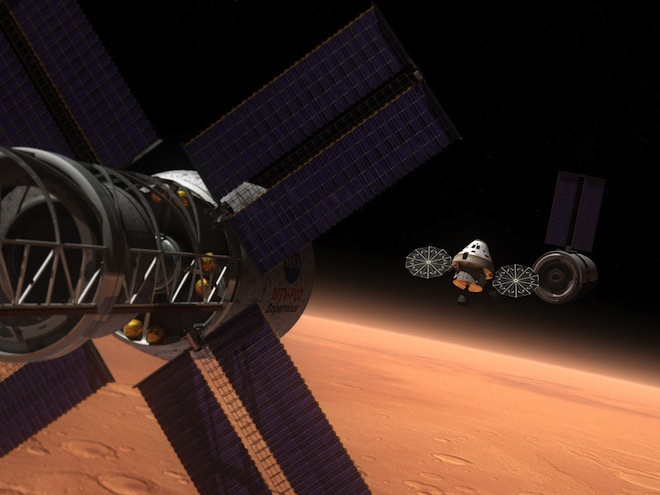
For starters, the human race currently lacks the technology to get people to Mars and back. An interplanetary mission of that scale would likely be one of the most expensive and difficult engineering challenges of the 21st century. Currently, we don’t have the means to properly store enough fuel to make the trip, or a vehicle capable of landing people on the Martian surface. Last, and most importantly, we aren’t entirely sure that a ship will keep the astronauts alive long enough to get there.
This last issue was raised thanks to a recent confirmation made by the Curiosity rover, which finished calculating the number of high-energy particles that struck it during its eight month journey to Mars. Based on this data, NASA says that a human traveling to and from Mars could well be exposed to a radiation dose that is beyond current safety limits.
This was performed with the rover’s Radiation Assessment Detector (RAD) instrument, which switched on inside as the cruise vessel began its 253-day, 560-million-km journey. The particles of concern fall into two categories – those that are accelerated away from our Sun and galactic cosmic rays (GCRs) – those that arrive at high velocity from outside of the Solar System. This latter category is especially dangerous since they impart a lot of energy when they strike the human body, can cause damage to DNA and are hard to shield against.
What’s more, this calculation does not even include time spent on the planet’s surface. Although Curiosity has already determined that planetary levels were within human tolerances, the combined dosage would surely lead to a fatal case of cancer for any career astronaut looking to take part in an “Ares Mission”. Cary Zeitlin from the Southwest Research Institute in Boulder, Colorado, and colleagues reported the Curiosity findings in the latest edition of Science magazine.
They claim that engineers will have to give careful consideration to the type of shielding that will need to be built into a Mars-bound crew ship. However, they concede that for some of the most damaging radiation particles, there may be little that can be done, beyond delivering them to Mars as quickly as possible. This presents an even greater challenge, which calls for the development of something better than existing propulsion technology. Using chemical propellants, Curiosity made the trip in eight months.
However, the good news is that at this juncture, nothing is technologically impossible about a manned Mars mission. It’s just a matter of determining what the priorities are and putting the time and money into developing the necessary tools. Right now NASA, other space agencies, and private companies are working to bring Mars within reach. And with time and further developments, who knows what will be possible by the time the 2020’s roll around?
Some alternatives include plasma and nuclear thermal rockets, which are in development and could bring the journey time down to a number of weeks. What’s more, SpaceX and other agencies are working on cheaper deliver systems, such as the grasshopper reusable rocket, to make sending ships into space that much more affordable. In addition, concepts for improving radiation shielding – like Inspiration Mars’ idea of using human waste – are being considered to cut down on the irradiation factor.
So despite the concerns, it seems that we are still on track for a Mars mission in 2030. And even if there are delays in the implementation, it seems as though a manned mission is just a matter of time at this point. Red Planet, here we come!
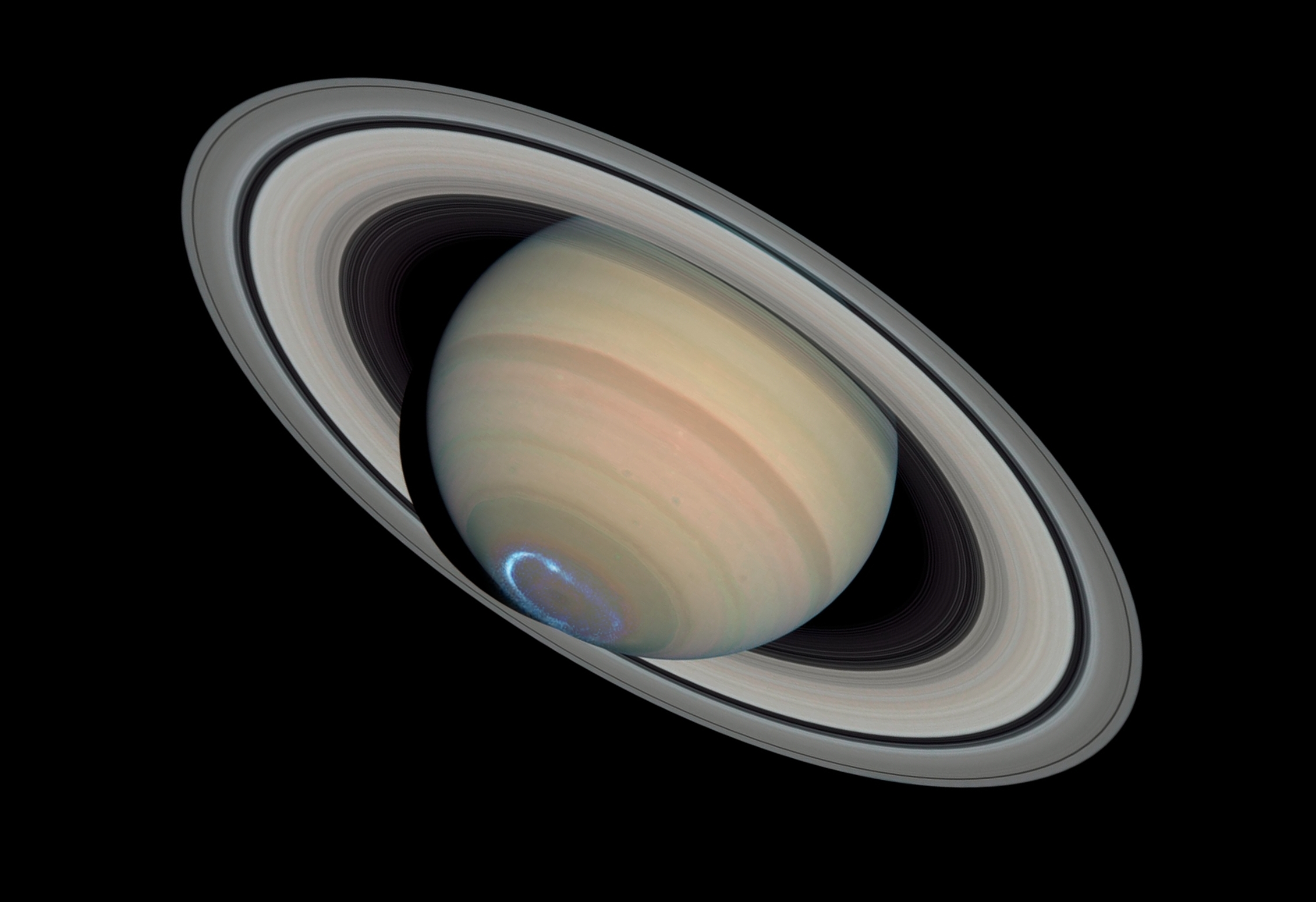
The Cassini Space Probe is at it again, providing the people of Earth with rare glimpses of Saturn and its moons. And with this latest picturesque capture, revealed by NASA, the ESA and ASI back in April, we got to see the moon of Enceladus as it sprayed icy vapor off into space. For some time, scientists have known about the large collection of geysers located at the moon’s south pole. But thanks to Cassini, this was the first time that it was caught (beautifully) on film.
First discovered by Cassini in 2005, scientists have been trying to learn more about how these plumes of water behave, what they are made of and – most importantly – where they are coming from. The working theory is that Enceladus has a liquid subsurface ocean, and pressure from the rock and ice layers above combined with heat from within force the water up through surface cracks near the moon’s south pole.
When this water reaches the surface it instantly freezes, sending plumes of water vapor, icy particles, and organic compounds hundreds of kilometers out into space. Cassini has flown through the spray several times now, and instruments have detected that aside from water and organic material, there is salt in the icy particles.
Tests run on samples that were captured indicate that the salinity is the same as that of Earth’s oceans. These findings, combined with the presence of organic compounds, indicate that Enceladus may be one of the best candidates in the Solar System for finding life.
Much like Europa, the life would be contained within the planet’s outer crust. But as we all know, life comes in many, many forms. Not all of it needs to be surface-dweling in nature, and an atmosphere need not exist either. Granted, these are essential for life to thrive, but not necessarily exist.
What’s more, this could come in handy if manned missions to Cassini ever do take place. Water is key to making hydrogen fuel, and could come in might handy if ever people set down and feel the need to terraform the place. Of course, they might want to make sure they aren’t depriving subterranean organisms of their livelihood first. Don’t want another Avatar situation on our hands!
When it comes to high-tech flight, hypersonic is the undisputed way of the future. Not only is it the next logical step in the long chain from the Wright Brothers to supersonic flight (which humanity achieved in 1947), it is sort of a prerequisite in order for commercial space travel to take place. And on May 1st, the US Air Force tested its latest concept vehicle for going hypersonic, known as the X-51A Waverider.
The test took place at Edwards Air Force Base in California, when a B-52H Stratofortress carried the scramjet to a height of 15,000 meters (50,000 feet) and then released it. A solid rocket booster then kicked in and brought the X-51A to a speed of Mach 4.8 in just 26 seconds. The solid rocket booster then separated and the X-51A’s air-breathing supersonic combustion ramjet – or scramjet – engine pushed it up the rest of the way to Mach 5.1 and up to an altitude of 18,300 meters (60,000 feet).
Four minutes later, its fuel supply was spent and the scramjet nosed down, finally crashing (as planned) into the Pacific Ocean. The previous air speed record for manned flight is just under Mach 3, making this a rather large leap forward. In addition, in just over six minutes, the scramjet traveled over 425 kilometers (264 miles), making it the longest air-breathing hypersonic flight ever.
In addition to being record-breaking, it also tested out an important concept which may soon get more of us here on Earth into orbit. Considering the cost of sending a single rocket into space, concepts for a reusable space craft that could break the Earth’s gravitational pull, fly itself into high-earth orbit, and then land again have been under review for some time. All that was missing was an engine that could accomplish the kind’s of speeds needed without relying on criminally-fuel efficient rockets.
Needless to say, this is a difficult task, since maintaining airspeed above mach 2 is a serious challenge. This is due to the fact that at these speeds, its very difficult for jet engines to continue to intake air. What makes the X-51A special is the fact that it has no moving parts. Whereas scramjets of the past used hydrogen fuel which would be injected into a combustion chamber and mixed with incoming air, the X-51A differs in that it uses a hydrocarbon fuel as sort of a pilot light, effectively“lighting a match in a hurricane.”
This apparently makes more sense logistically, and therefore could allow the technology to be applied on a broader scale. As it stands, this test involved the last of four X-51As to be constructed, the previous tests having taken place between 2004 and 2012. No plans exist for the construction of future X-51A vehicles, perhaps because the program cost a staggering $300 million. Nevertheless, Air Force officials indicated that the Waverider has left a valuable legacy.
And certainly think so! Not only has the Waverider established a new air speed record, and set a hypersonic distance record, it has also taken an important step as far as the next generation of space flight is concerned. In time, and perhaps in conjunction with rocket boosters, we could be seeing commercial spacecraft capable of breaking the atmosphere very soon.
Think of it, aerospace flights making deliveries to the ISS, and perhaps even beyond… Also, check out the video of the X-51A below making it’s historic, record-breaking flight:
My good buddy, Fraser Cain, a co-inventor and publisher over at Universe Today, has just unveiled a new podcast series which I strongly recommend to anyone who loves space, science, and fiction pertaining to them. Those who follow this site may recognize the name, as Universe Today just happens to be my go-to source for all things space related. From the Curiosity Rover and the Cassini Probe to the mysteries of life on Earth and the universe at large, these guys can be trusted to be in the know!
I even had the honor of writing articles to them for about a year and a half, and I credit this experience with honing my ability to take hard science, gain a basic understanding of it, and then convey it to a general audience in an understandable fashion. Yes, before I worked for these guys, I was truly a geek-in-waiting, someone who didn’t know their quasars from their quarks. Now… well, I’m a little better!
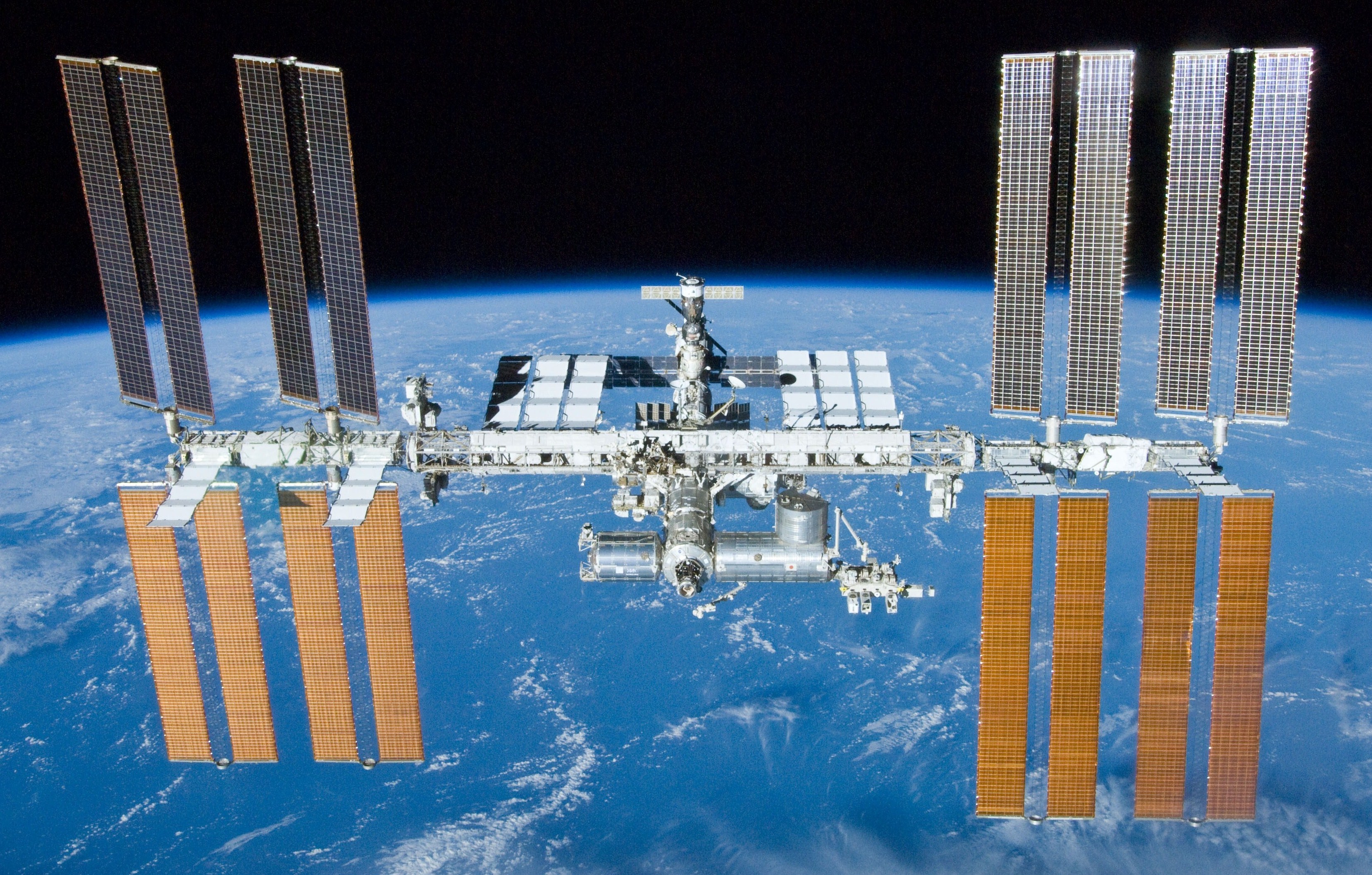
In any case, the podcast series is called Space Stations, and comprises four episodes that take a look at man-made structures in space, beginning with Salyut and Skylab – the earliest Soviet and American attempts to put a manned station into orbit – and then moving onto Russia’s Mir space station, the International Space Station (ISS), and then taking a look at what the future holds for humans living and working in space.
You can check out the series at their website here, or just head on over to Astronomy Cast, the site for Universe Today‘s podcasts, and start listening willy-nilly. Me, my favorite is the fourth and final episode which takes a look at the future of space stations, and anyone claiming to know the first thing about me will not wonder why! I mean, c’mon, future of space, what’s not to love about that???
And of course, you can check out their voluminous archives, which contain podcasts on subjects ranging from Aliens to Physics, Astronomy to Planetary Science, and the history of space flight to current missions and the future of space exploration. I can promise you that if you’re the kind of person who finds the science jokes in The Big Bang Theory hilarious, you will feel like a kid in a candy store!
Trivia Question: Where does the name Universe Today come from? If you answer this question (no Googling!) you will have my enduring respect forever!
Planetary Resources made quite the impression last year when they announced their plans to begin prospecting near-Earth asteroids with in the intention of mining them in the near future. Alongside such companies as SpaceX and Golden Spike, they are part of a constellations of private interests looking to establish commercial space travel and tourism. But their latest proposal goes a step further, bringing crowdfunding and the realm of space exploration together.
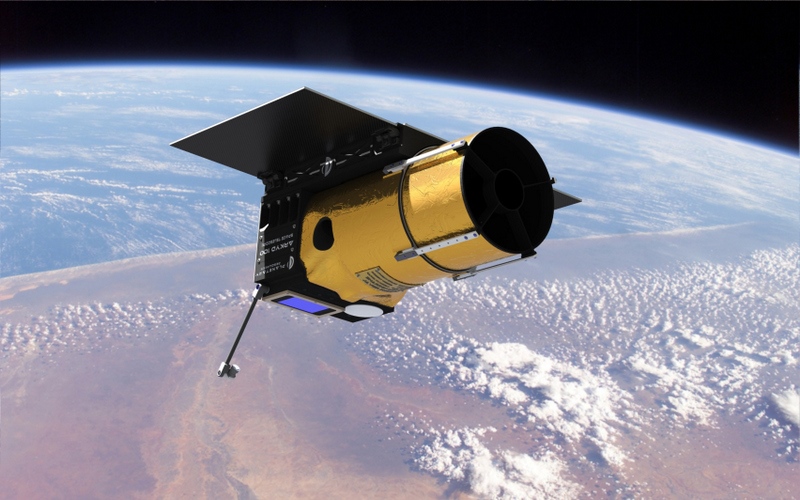
That’s the idea behind a Kickstarter campaign that the company began to raise money for a crowdfunded space telescope. Known as the Arkyd 100, the company claims that this new telescope will provide unprecedented public access to space and place the most advanced exploration technology into the hands of students, scientists and a new generation of citizen explorers.
To make their campaign successful, they need to raise $1 million in Kickstarter pledges by the end of June 2013. Once the telescope is up and running, it will allow them to better map the asteroid belt, thus assisting them in finding the rocks they want to mine for precious metals and trace elements. And with public financial backers making it happen, anyone pledging money will be able to own a piece of the prospector!
During a webcast on May 28th to announce the Kickstarter campaign, Chris Lewicki, President and Chief Engineer for Planetary Resources, gave a rundown on the details of the telescope. And interestingly enough, the Planetary Resources’ technical team that designed it also worked on every recent U.S. Mars lander and rover. So if you do choose to invest, you will do so with the knowledge that the same people who helped build the Opportunity and Curiosity rovers are behind this project. If that doesn’t inspire investor confidence, I don’t know what will!
A wide array of scientists, space enthusiasts and even Bill Nye the Science Guy have voiced their support for Planetary Resources’ new public space telescope. And those who invest will have the chance of recouping certain rewards, depending on how much they choose to pledge. Those pledging the minimum donation of $25 will receive the “Your Face in Space” benefit, where you will have you picture placed on the Arkyd and receive a picture of said photo the telescope with Earth in the background. Higher pledges will provide access to the telescope for students and researchers worldwide.
After less than 2 hours into their campaign, Planetary Resources had raised over $100,000. And as of this article’s writing, just one day shy of a week, the campaign has reached $710,945 of their $1 million goal, and they still have 27 days left. I guess people want a piece of this project. And who can blame them, since it is a scientific and historic first!
Check out the promotional video for the Arkyd and Planetary Resources below. To make a donation or get information about the Kickstarter campaign, visit the campaign page here.

 In a recent study, NASA shared a vision that sounds like something out of a science fiction novel. Basically, the plan calls for the creation of robots that could be sent to a nearby asteroid, assemble itself, and then begin mining the asteroid itself. The scientists behind this study say that not only will this be possible within a few generations of robotics, but will also pay for itself – a major concern when it comes to space travel.
 But also, humanity’s surveys of space resources – namely those located in the asteroid belt – have revealed that the elements needed to make rubber, plastic and alloys needed for machinery are there in abundance. NASA proposes that a robotic flotilla could mine these nearby space rocks, process the goods, and then ship them back to Earth.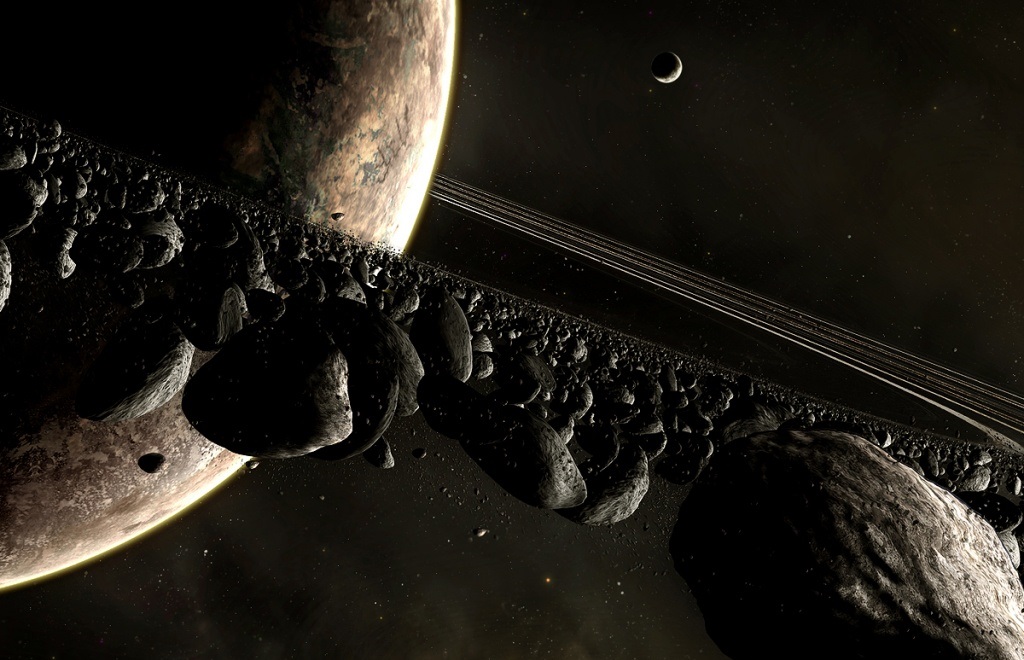














 Stories by Williams