Asteroid 1998 QE2 Flies Past Earth

1998_QE2Today, at approximately 20:59 GMT, a rock so big that it has its own moon safely flew past Earth. It’s name is 1998 QE2, an asteroid that is roughly 500,000 times larger than the one which made that near-Earth flyby back in February. But of course, scientists had been letting the public know well in advance that this one would miss us to, and by a much wider margin.

In fact, whereas the last rock missed us by a mere 27,700km (17,200mi), this one passed at a much safer distance of about 5,800,000 km (3,600,000 miles). Good news for anyone who’s been caught up in all the asteroid/meteoroid frenzy of late. And while it might seem that a lot more stellar objects have been hurling towards us lately, a simple review of our Solar Systems turbulent history will confirm that this is pretty much business-as-usual.
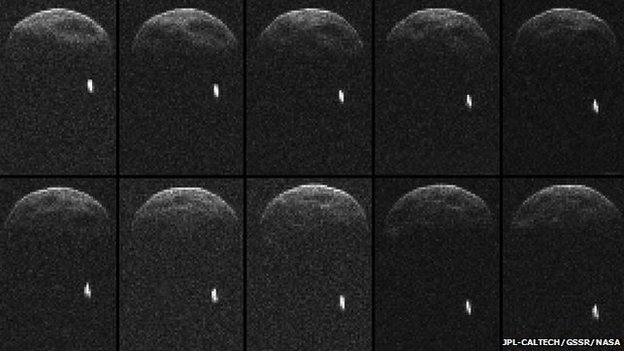
1998_QE2_caltechWhat’s more, this most recent flyby provided scientists and astronomers with yet another opportunity to study an asteroid as it passed close to Earth. Using radar telescopes, they were due to record a series of high-resolution images, the purpose of which was to study what the asteroid was made of and where exactly in the Solar System it came from.

Prof Alan Fitzsimmons, an astronomer at Queen’s University Belfast, said:

It’s a big one. And there are very few of these objects known – there are probably only about 600 or so of this size or larger in near-Earth space… We already know from the radar measurements, coupled with its brightness, that it appears to be a relatively dark asteroid – that it’s come from the outer part of the asteroid belt.

What’s more, the curious nature of the asteroid – in that it has its own moon – is something which makes it a scientific curiosity. Approximately 15% of asteroids have the mass that they are capable of supporting their own satellite, but rarely does one fly this close to Earth. Early observations of this “moon” indicated that it is roughly 600m in diameter, and would have been visible during the flyby to amateur astronomers with a sufficient enough telescope.

1998_QE2_trajAfter this, asteroid 1998 QE2 will hurtle back out into deep space where it will stay for some time. In fact, Friday’s visit was the closest it has been to Earth for at least two centuries. And not surprisingly, researchers are becoming increasingly interested in potential hazards in space. So far they have counted more than 9,000 near-Earth asteroids, and they spot another 800 new space rocks on average each year.

And given the potential for harm if one made contact with Earth, as they have been known to do in the past, the information gleamed from observation and study is sure to come in handy as far as planetary defense is concerned. As Fitzsimmons himself pointed out about this particular asteroid:

…if something this size did hit us one day in the future, it is extremely likely it would cause global environmental devastation, so it is important to try and understand these objects.

Source: bbc.co.uk

Alien Matter Found on the Moon!

blue moonYes, it may sound like the setup for a really bad movie. And in truth, it’s more than just a little misleading. But in this case, “alien matter” refers to minerals deposits that were recently discovered on the surface of the Moon which may not belong there. These deposits include Magnesium-rich spinel and olivine found in the central peaks of lunar craters, which scientists previously believed to be indigenous to the surface.

Spinel forms, it should be noted, can be found here on Earth and are the product of high-pressure and temperatures, conditions which do not exist on the Moon’s surface. Hence, scientists were forced to conclude that the presence of such minerals on the surface had to have come from somewhere else. Most likely a meteoric impact, which the Moon – as its pockmarked surface can attest to – get’s no shortage of.

moon-asteroid-impact-1600However, in the past, it was generally accepted that any collision that big would melt or vaporize the impacting material, leaving behind only geochemical traces and tiny fragments. The quantities that were noticed more recently defied this interpretation, consisting or relatively large deposits and not mere fragments.

However, Jay Melosh and his colleagues from Indiana’s Purdue University were able to show through a series of computer simulations that asteroids are capable of still producing these craters at lower impact speeds, giving them greater chance of survival. What’s more, this would leave their mineral compositions unvaporized, allowing for more generous deposits of material.

In a paper recently published in Nature Geoscience, the team explains their process and what they were able to determine:

We find that for … impact velocities below about 12 kilometres per second, the projectile may both survive the impact, and be swept back into the central peak of the final crater as it collapses… We focused on a simulation of the 93-kilometre diameter Copernicus crater because of the reports of olivine and magnesium-spinel in its central peak… The olivine observed in the central peaks of Copernicus and other lunar craters may be a remnant of the projectile and thus does not indicate deep excavation of the lunar mantle or lower crust.

Overall, their simulations revealed that roughly a quarter of lunar impacts occur at speeds below 12 kilometres per second, which is slow enough for a significant fraction of the impacting object to remain largely intact. According to astronomer Michael Brown of Melbourne’s Monash University, their conclusions about low-velocity asteroid impacts are entirely plausible.

NASA_moonWhat’s more, Brown indicated that previously-held notions about meteors and asteroids impacting the Moon may be biased by our experience here on Earth, where impacts occur at much higher velocities.

When a large asteroid hits Earth, because of the Earth’s gravity and because of the velocity of the asteroid, you’re looking at impact speeds of 20-30 kilometres per second.

But of course, he also added that there are concentrations of spinel on the Moon’s surface which cannot be explained by impact events. How and why these were brought to the surface is something that future generations of astronauts will have to study, no doubt with the help of interior examinations of the planet and surface digs.

ESA_moonbaseWhich brings up another important aspect of this information. Given that the Moon is prone to meteors and asteroids, something we don’t have to worry nearly as much about on Earth due to our protective atmosphere, any plans to colonize it will have to take surface impacts into account. How exactly are people going to be able to live, work, and enjoy themselves on the surface if they have to contend with periodic massive impacts?

And in the meantime, check out this video from CBC about the March 17th impact, the largest impact in recent history which was visible from Earth:

http://www.cbc.ca/player/News/TV%2BShows/The%2BNational/Technology%2B&%2BScience/ID/2387906092/

Sources: cbc.ca, (2)


Opportunity Finds Evidence of Life!

opportunityThe Opportunity Rover is at it again! A little over a week ago, it set the record for longest distance traveled by a vehicle on another planet. Well it seems that NASA’s longest-running rover wasn’t finished hogging the limelight just yet. Yes, after ten years of service on what was originally planned to be a three-month journey, Opportunity struck gold by discovering the strongest evidence to date for an environment favorable to ancient Martian biology.

It began just two weeks ago, when Opportunity conducted an analysis of a new rock target named “Esperance”. According to a statement released by NASA, the rover confirmed that the rock target was composed of a “clay that had been intensely altered by relatively neutral pH water – representing the most favorable conditions for biology that Opportunity has yet seen in the rock histories it has encountered.”

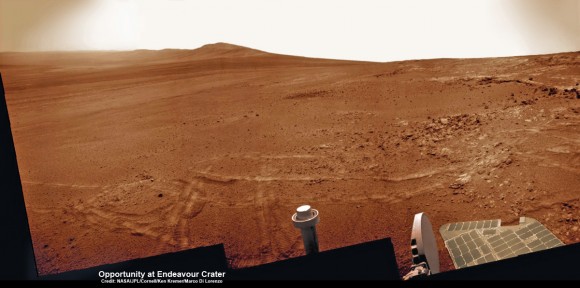
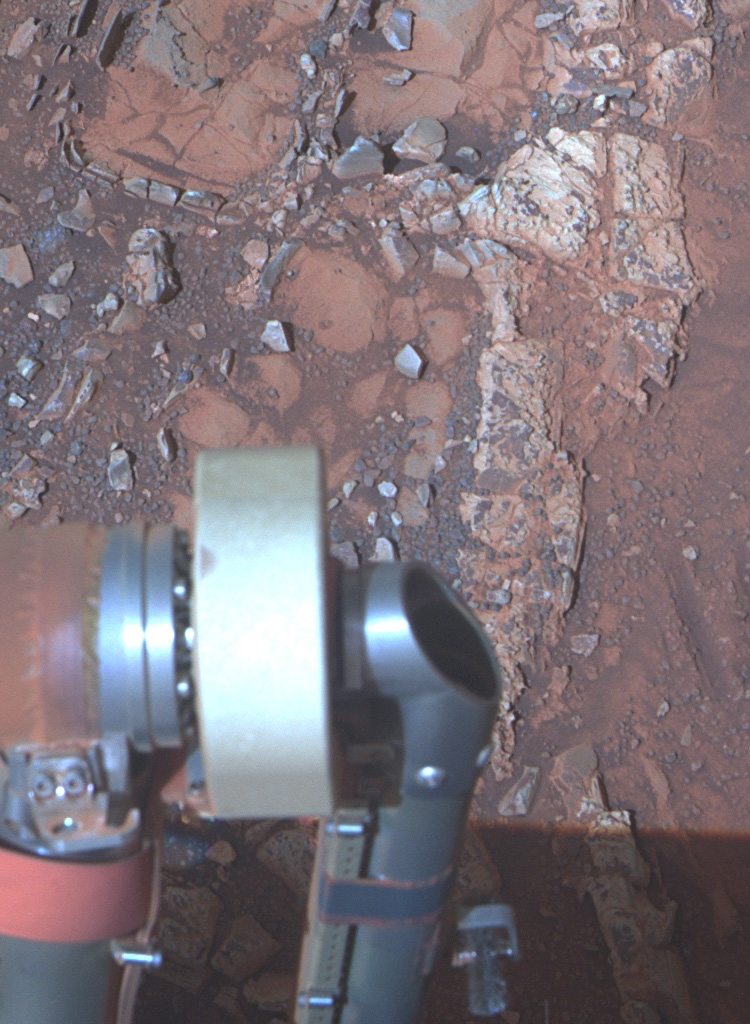
Opportunity-Sol-3309_Aa_Ken-Kremer-580x288The process involved Opportunity using it still-functioning Rock Abrasion Tool (RAT) to expose the interior of Esperance and then examine it with its microscopic camera and X-Ray spectrometer, both of which that are mounted at the end of her nearly 1 meter (3 foot) long robotic arm. Inside, it found a rock surface loaded with clay minerals that was clearly formed with the help of flowing liquid water.

The robot made the discovery at the conclusion of a 20 month long science expedition circling around a low ridge called “Cape York”, a region of great important to Mars scientists. Scott McLennan of Stony Brook University, a long-term planner for Opportunity’s science team, explained why:

What’s so special about Esperance is that there was enough water not only for reactions that produced clay minerals, but also enough to flush out ions set loose by those reactions, so that Opportunity can clearly see the alteration.

opportunity_esperanceEsperance is unlike any rock previously investigated by Opportunity, containing far more aluminum and silica which is indicative of clay minerals and lower levels of calcium and iron. Most, but not all of the rocks inspected to date by Opportunity were formed in an environment of highly acidic water that is extremely harsh to most life forms. Clay minerals typically form in potentially drinkable, neutral water that is not extremely acidic or basic.

These findings amount to the discovery of an environment in which life could have thrived, which amounts to a scientific home run for the senior rover. As Prof. Steve Squyres of Cornell University, the mission’s principal scientific investigator, put it:

Water that moved through fractures during this rock’s history would have provided more favorable conditions for biology than any other wet environment recorded in rocks Opportunity has seen.

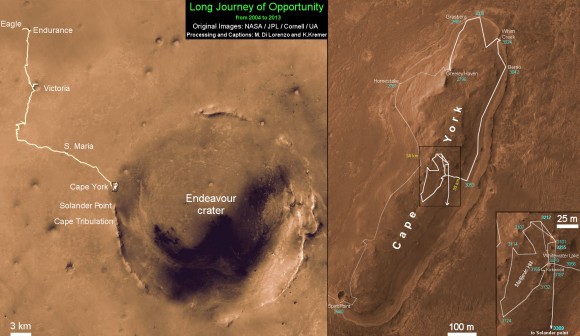
What’s next for Opportunity? Well, now that she’s finished at Cape York, Opportunity has set sail for her next crater destination at “Solander Point”, an area about 2.2 km (1.4 miles) south of the Cape. Eventually, she will continue further south to a rim segment named “Cape Tribulation” which holds huge caches of clay minerals. Along the way, there’s likely to be plenty more evidence of what Mars looked like many millions of years ago.

You know, with all this Opportunity-related news coming in, I’m beginning to wonder what Curiosity is up to. While it’s nice to see her partner-in-crime breaking records and turning up such important finds, I do wonder if Curiosity is likely to feel a little left out. At this rate, one might think a game of one-upmanship could break out between the rovers teams!

Source: universetoday.com

NASA’s Eyes the Bennu Asteroid

Osiris_spacecraftNot long ago, NASA announced its plan to to visit an asteroid in our Solar System and towing it closer to Earth. And with their funding secure, NASA announced earlier this month that they had taken some key steps towards making this happen.  The first came on Wednesday, May 15th, when the spacecraft that will be performing the mission – the Origins-Spectral Interpretation Resource Identification Security Regolith Explorer, or Osiris-Rex – got the green light for development.

The second came shortly thereafter, when NASA announced where the robot craft would be headed – the asteroid now known as Bennu. Originally known as 1999 RQ36, the rock was renamed as part of a contest involving suggestions from thousands of schoolchildren. It was a nine-year-old named Michael Puzio who suggested the name, claiming that the the Touch-and-Go Sample Mechanism (Tagsam) arm and solar panels on Osiris-Rex resembled the neck and wings of Bennu, better known as the Phoenix.

Asteroid-ToutatisNASA claims that Bennu could hold clues to the origin of the solar system, hence why samples will be brought back to determine their composition. The new spacecraft will rendezvous with Bennu in 2018 and begin collecting measurements and samples of surface material, and then return to Earth by 2023. Ultimately, the mission is part of NASA’s larger aim at capturing an asteroid and towing it back it to Earth so that the entire body can be studied.

Of course, there are larger plans at work here too. NASA’s truly long-term aims also involve improving asteroid defense, which includes capturing asteroids that are on a potential collision course with Earth and towing them off course. And then there’s the plan to put astronauts on an asteroid by the 2020’s, establishing a Moon outpost in the same decade, and on Mars by 2030. In the end, all roads converge on putting boots on soil that is not of Earth!

And be sure to check out the video simulation of the Osiris-Rex in action, courtesy of NASA:


Source: cnet.news.ca

100,000 Stars: An Interactive Exploration of the Milky Way

100,000starsWith interactive maps becoming all the rage, I had a feeling it was only time before someone premiered an interactive browser that would let you explore the cosmos. And now there is, and it goes by the name 100,000 stars. Personally, I would have preferred Google Galaxy, like I suggested before, but forget it! You can’t teach these big time web developers anything 😉

In any case, 100,000 stars is an experiment for Chrome web browsers, but it will also work with Firefox, Safari, or just about any other WebGL you might have. Open it up, and you can see where our Solar System is in relation to the Orion Arm of the Milky Way Galaxy. Then zoom in to see the local star groups that are closest to us, our sun, and the planets and asteroids that make up our Solar System.

Also, I should note that the site provides a guided tour for the newly-initiated. I recommend you use that first, then try tinkering with the settings a little before mucking about to get a look at our little corner of the universe. The site can be a bit clunky at times, but keep in mind that there’s plenty of graphic info that’s being streamed at any given time. But if your machine and/or internet connection is faster than mine (a distinct possibility) you might have no trouble at all.

Simply click here and start exploring!

Source: thisiscolossal.com

Going to Mars: Now Taking Volunteers, Names and Poems

mars_lifeLooking at my site, I’ve come to notice that news concerning the Red Planet has been a bit sparse of late. Lucky for me, I had several interesting stories sitting in my inbox which were just waiting to be read, and more than a few had to do with Earth’s closest neighbor. And as we are all no doubt aware, there are quite a few of us here on Earth that believe that she is the future of planetary exploration and colonization.

But would it surprise you to know that there are plans to visit Mars that go beyond NASA’s projected mission of 2030, which will involve sending live astronauts for the first time? Take the Mars One Project as an example. Conceived by Dutch entrepreneur Bas Landorp, this project involves using existing technology and private sponsorship to fund a one-way trip to Mars and establish the first permanent settlement there by 2023, thus putting them ahead of NASA’s plans to send explorers there by almost a decade.

mars-one-brian-versteegAnnounced back in January, the project put out an open call for volunteers, and some 80,000 people have applied thus far. Thirty-five of those applicants hail from my own country (Canada), with the vast majority of them being men who are still in their 20’s. Those who apply are apparently asked some rather grueling and personal questions designed to test their aptitude and beliefs, which includes the meaning of life itself. I’m guessing more than one person answered “space exploration”!

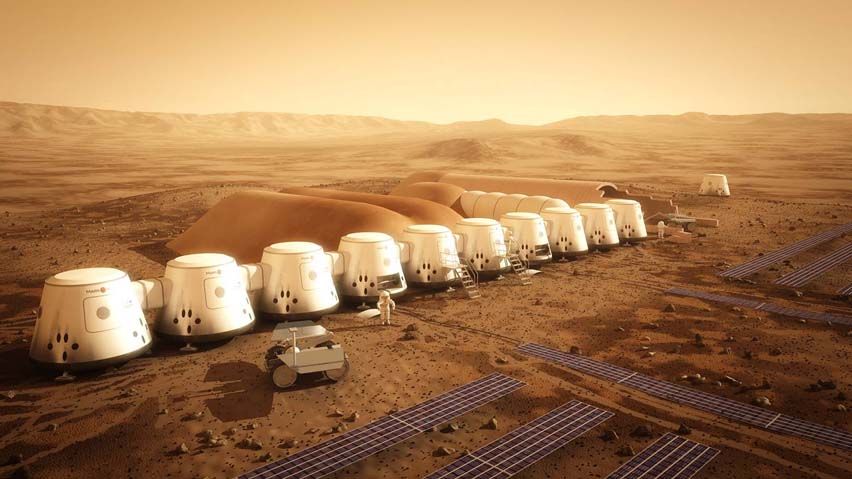
The first things to be sent will be the modules themselves, followed shortly thereafter by the first of six teams, with each team of four arriving every two years. In time, the home base would consist of habitation modules with oxygen, water and provisions, but would expand to include solar panels. Landorp has also indicated that primary funding will come from an as-yet-unspecified “global media event” that will feature the astronauts and their preparation.

In short, it’s like a reality TV event featuring the first people who will make the seven month trip.

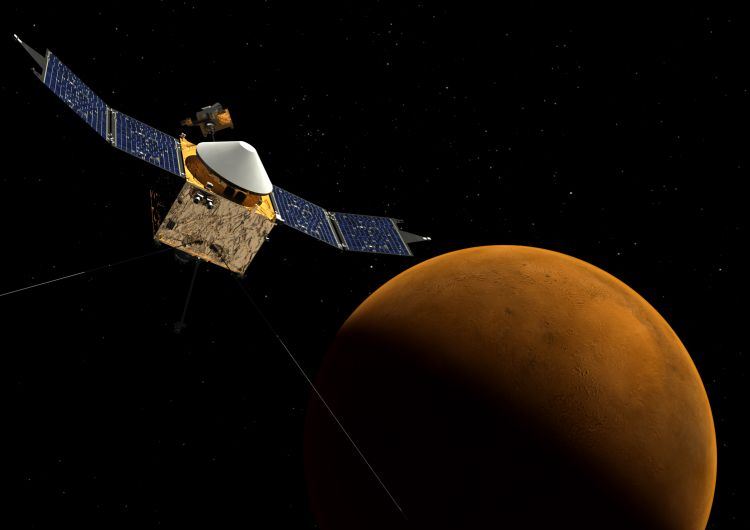
??????????????????????????????But for those who don’t feel like making the trip, or who would like to send something to Mars other than themselves, there’s also NASA’s MAVEN mission. As part of the “Going to Mars” campaign that is being managed by the University of Colorado at Boulder’s Laboratory for Atmospheric and Space Physics (CU/LASP), the MAVEN mission is a chance for the general public to send their name and a short poem to the Red Planet via NASA’s latest Mars satellite.

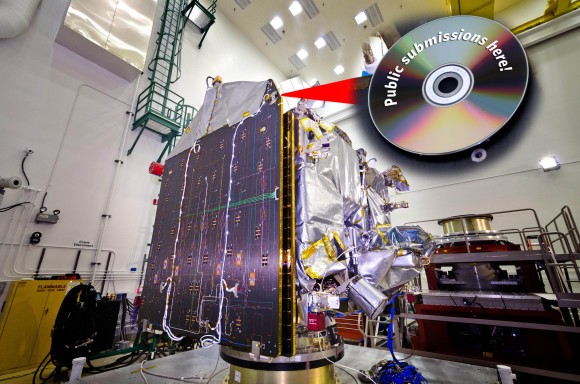
MAVEN – which stands for Mars Atmosphere and Volatile EvolutioN – is due to be launched in November from the Florida Space Coast. Attached to the front of the orbiter will be a DVD featuring the names of everyone who applies to take part in the campaign. In addition, of those poems submitted (which is to be written in the form of a haiku), three will be selected for the mission as well.

MAVEN_DVD-580x384

Voting will be done by the public online, and over 1 million people have already submitted their names. The rules for the contest can be found on the mission website here. Children are allowed to participate, but must do so through a participant of 18 years of age or older, preferably a parent or guardian. Activity opened at the beginning of the month and ends July 1st, so get your names of poems in soon!

Since the campaign and contest are open to people of all ages, walks of life, and is indiscriminate of education or qualification, it’s a pretty good way for the public to participate in the ongoing exploration of space and our Red planetary neighbor. And when considered alongside the many and increasing private efforts to send people to Mars, it says about the increasingly democratic nature of space exploration.

Sources: cbc.ca, universetoday.com, lasp.colorado.edu

Bad News From Space!

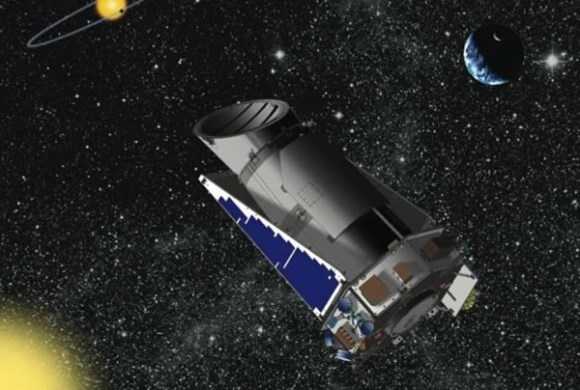
Kepler-telescope-580x448Between the Mars rovers, deep space probes, and long-term plans to mine asteroids and colonize Earth’s neighbors, there’s just no shortage of news from space these days. Unfortunately, not all of it is good. For instance, NASA recently announced that the Kepler space telescope, which was launched back in 2009 for the purpose of identifying Earth-like exoplanets, is suffering from malfunctions and may be broken down.

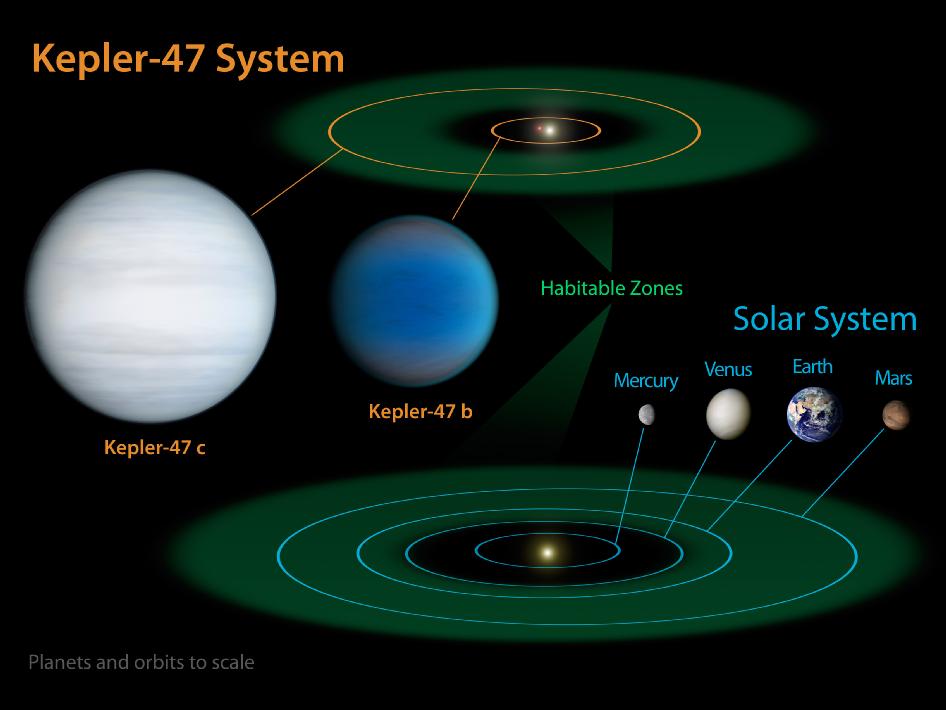
And in the course of its operational history, it did manage to identify a number of exoplanets that existed within the habitable zones of their parent stars. In fact, it had found a total of 2,740 candidate exoplanets spread across 2,046 stars systems, and a confirmed total of 132 that have the potential to support life. Unfortunately, during the early month of April during its weekly communication, NASA  found that the space observatory was in safe mode, a sign that something was amiss.

keplerAfter looking into the problem, they realized that it had lost its ability to precisely point toward stars because one of the reaction wheels – devices which enable the spacecraft to aim in different directions without firing thrusters – had failed. This was especially bad since last year an different wheel failed, meaning it only had two wheels remaining. The probe needs at least three working in order to properly aim itself, but now that seems impossible.

But the Kepler team said there are still possibilities of keeping the spacecraft in working order, or perhaps even finding other opportunities for different scientific pursuits. Either way, the team is not ready to throw in the towel on the telescope. And since NASA already approved to keep the mission going through 2016, a lot is still riding on it remaining functional.

Charles Sobeck, the Kepler deputy project manager, addressed the team’s efforts to get the telescope working again during their daily briefing earlier in May:

Initially, they did see some movement on the wheel but it quickly went back to zero speed, indicative of internal failure on the wheel. Our next step is to see what we can do to reduce the fuel consumption, as we would like to extend the fuel reserve as long as we can.

In terms of the malfunctioning wheel, he indicated that there are a few things they can still do to get it working again. One possibility is “jigging it” or running it in reverse.

We can try jiggling it, like you’d do with any wheel here on Earth, commanding it to move back and forth, so we can try to bring the wheel back in service. Or perhaps since wheel #2 hasn’t been turned on for eight months, it may come back if we turn it on. It will take us awhile to come up with a plan.

Sobeck also explained they are currently using thrusters to stabilize the spacecraft, and in its current mode, the onboard fuel will last for several months. But they hope to soon put the spacecraft into what is called a “Point Rest State” – a loosely-pointed, thruster-controlled state that minimizes fuels usage while providing a continuous X-band communication downlink. This ought to keep the fuel consumption down to the point where the telescope could keep going for several more years.

kepler47.jpgWhat’s more, the team also indicated that there is still terabytes of information gathered by the probe that has yet to be sifted through. They estimate that it will take at least two years for them to process it all and determine what other exoplanets exist nearby in our galaxy. And as Paul Hertz – NASA’s astrophysics director – put it, with the work it has already performed, Kepler has essentially carried out its task:

We’ll continue to analyze the data to get the science that Kepler was designed to do. Even though Kepler is in trouble, it has collected all the data necessary to answer its scientific objectives. Kepler is not the last exoplanet mission, but the first. It has been a great start to our path of exoplanet exploration.

In the end, its too soon to say if Kepler is deep in space (literally), or just experiencing a lull while her technicians get her back on track. And even if this does prove to be the end of her, the many thousands of planet she managed to identify during her years of service will certainly prove useful to humanity as we begin to set our sights on interstellar exploration and, God willing, colonization. And I imagine more than a few will bare the proud name of Kepler, in honor of her namesake and the telescope itself!

Sources: universetoday.com, Wired.com

Big News in Quantum Computing!

^For many years, scientists have looked at the field of quantum machinery as the next big wave in computing. Whereas conventional computing involves sending information via a series of particles (electrons), quantum computing relies on the process of beaming the states of these particles from one location to the next. This process, which occurs faster than the speed of light since no movement takes place, would make computers exponentially faster and more efficient, and lead to an explosion in machine intelligence. And while the technology has yet to be realized, every day brings us one step closer…

One important step happened earlier this month with the installment of the D-Wave Two over at the Quantum Artificial Intelligence Lab (QAIL) at the Ames Research Center in Silicon Valley, NASA has announced that this is precisely what they intend to pursue. Not surprisingly, the ARC is only the second lab in the world to have a quantum computer.  The only other lab to possess the 512-qubit, cryogenically cooled machine is the defense contractor Lockheed Martin, which upgraded to a D-Wave Two in 2011.

D-Wave’s new 512-qubit Vesuvius chip

And while there are still some who question the categorization of the a D-Wave Two as a true quantum computer, most critics have acquiesced since many of its components function in accordance with the basic principle. And NASA, Google, and the people at the Universities Space Research Association (USRA) even ran some tests to confirm that the quantum computer offered a speed boost over conventional supercomputers — and it passed.

The new lab, which will be situated at NASA’s Advanced Supercomputing Facility at the Ames Research Center, will be operated by NASA, Google, and the USRA. NASA and Google will each get 40% of the system’s computing time, with the remaining 20% being divvied up by the USRA to researchers at various American universities. NASA and Google will primarily use the quantum computer to advance a branch of artificial intelligence called machine learning, which is tasked with developing algorithms that optimize themselves with experience.

nasa-ames-research-center-partyAs for what specific machine learning tasks NASA and Google actually have in mind, we can only guess. But it’s a fair bet that NASA will be interested in optimizing flight paths to other planets, or devising a safer/better/faster landing procedure for the next Mars rover. As for Google, the smart money says they will be using their time to develop complex AI algorithms for their self-driving cars, as well optimizing their search engines, and Google+.

But in the end, its the long-range possibilities that offer the most excitement here. With NASA and Google now firmly in command of a quantum processor, some of best and brightest minds in the world will now be working to forward the field of artificial intelligence, space flight, and high-tech. It will be quite exciting to see what they produce…

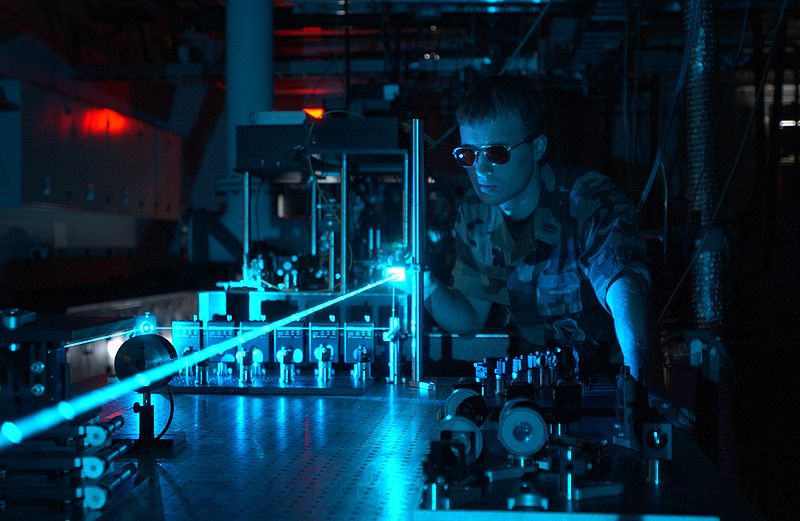
photon_laserAnother important step took place back in March, when researchers at Yale University announced that they had developed a new way to change the quantum state of photons, the elementary particles researchers hope to use for quantum memory. This is good news, because it effectively demonstrated that true quantum computing – the kind that utilizes qubits for all of its processes – has continually eluded scientists and researchers in recent years.

To break it down, today’s computers are restricted in that they store information as bits – where each bit holds either a “1″ or a “0.” But a quantum computer is built around qubits (quantum bits) that can store a 1, a 0 or any combination of both at the same time. And while the qubits would make up the equivalent of a processor in a quantum computer, some sort of quantum Random Access Memory (RAM) is also needed.

Photon_follow8Gerhard Kirchmair, one of Yale researchers, explained in a recent interview with Nature magazine that photons are a good choice for this because they can retain a quantum state for a long time over a long distance. But you’ll want to change the quantum information stored in the photons from time to time. What the Yale team has developed is essentially a way to temporarily make the photons used for memory “writeable,” and then switch them back into a more stable state.

To do this, Kirchmair and his associates took advantage of what’s known as a “Kerr medium”, a law that states how certain mediums will refract light in a different ways depending on the amount shined on it. This is different from normal material materials that refract light and any other form of electromagnetic field the same regardless of how much they are exposed to.

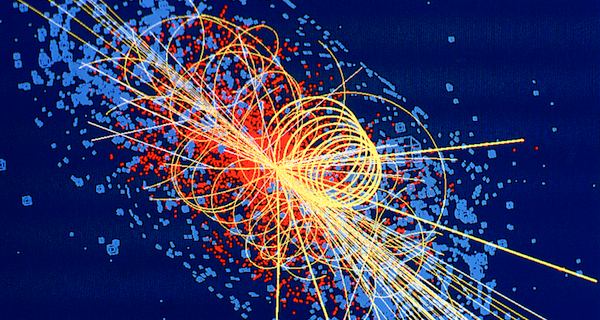
Higgs-bosonThus, by exposing photons to a microwave field in a Kerr medium, they were able to manipulate the quantum states of photons, making them the perfect means for quantum memory storage. At the same time, they knew that storing these memory photons in a Kerr medium would prove unstable, so they added a vacuum filled aluminum resonator to act as a coupler. When the resonator is decoupled, the photons are stable. When resonator is coupled, the photons are “writeable”, allowing a user to input information and store it effectively.

This is not the first or only instance of researchers finding ways to toy with the state of photons, but it is currently the most stable and effective. And coupled with other efforts, such as the development of photonic transistors and other such components, or new ways to create photons seemingly out of thin air, we could be just a few years away from the first full and bona fide quantum processor!

Sources: Extremetech.com, Wired.com, Nature.com

News From Space: Opportunity Hits New Record!

opportunityWith the Curiosity Rover blazing a trail across Mars to find evidence of what the planet once looked like, people often forget about it’s venerable predecessor – the Opportunity Rover. Luckily, Opportunity recently broke a record that put it back in the public eye and into the history books. After nine years into what was initially meant to be a 90 day mission, Opportunity smashed yet another space milestone this week by establishing a new distance driving record.

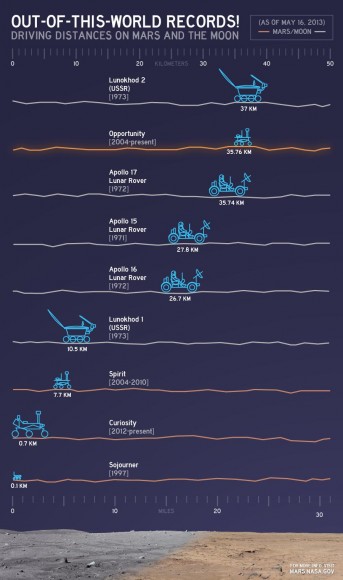
On Thursday, May 16, the Opportunity rover drove another 80 meters (263 feet) on the Martian surface, bringing her total odometry since landing on the 24th of January, 2004 to 35.760 kilometers (22.220 miles). This effectively put her ahead of the 40 year old driving record set by the Apollo 17 astronauts Eugene Cernan and Harrison Schmitt back in December of 1972.

Apollo_17_lunar-rover-577x580On that mission, Cernan and Schmitt performed America’s final lunar landing mission and drove their Lunar Roving Vehicle (LRV-3) a total of 35.744 kilometers (22.210 miles) over the course of three days on the moon’s surface at the Taurus-Littrow lunar valley. And interestingly enough, Cernan was a very good sport about his record being broken. In a statement made at NASA’s Goddard Space Flight Center in Greenbelt, Md, he said:

The record we established with a roving vehicle was made to be broken, and I’m excited and proud to be able to pass the torch to Opportunity.

And since Opportunity still has plenty of juice left, it is now eying the ‘Solar System World Record’ for driving distance on another world, a record that is currently held by the Soviet Union’s remote-controlled Lunokhod 2 rover. In 1973, Lunokhod 2 traveled 37 kilometers (23 miles) on the surface of Earth’s nearest neighbor. With Opportunity setting course for her next crater rim destination, named “Solander Point”, she is likely to overtake Lunokhod 2’s record in short order!

Opportunity-Route-Map_Sol-3309_Ken-Kremer-580x336Thereafter, Opportunity will rack up ever more distance as the rover continues driving further south to a spot called “Cape Tribulation”. This point is believed to hold caches of clay minerals that formed eons ego when liquid water flowed across this region of the Red Planet. In so doing, Opportunity will not only establish a new record that will last for years to come, it will also be obtaining data that will assist in Curiosity’s own efforts to determine what life was like on Mars in the past.

Far greater than this record-breaking news is the fact that Opportunity has lasted so far beyond her design lifetime, 37 times longer in fact than her initial 3 month “warranty”.

And be sure to check out the full list of record holders for “out-of-this-world” driving, below:

out-of-this-world_recordsSources: universetoday.com, news.cnet.com

Preventing the Apocalypse: NASA’s Asteroid Lasso Mission

asteroid_lasso

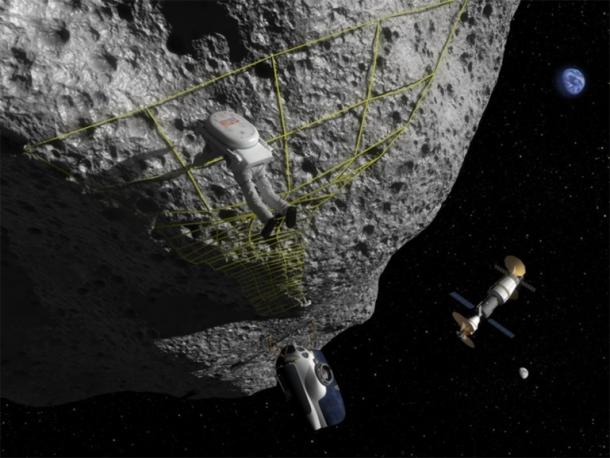
Shortly after that large meteor hit Russia, President Obama and NASA administrator Charles Bolden both announced that work would begin on a series of asteroid tracking technologies that would ensure that more severe Earth collisions would be prevented. Earlier this month, Bolden spoke at the Mars Summit in Washington, D.C. and said that a robotic spacecraft mission is currently being planned with this goal in mind.

The plan calls to mind such films as Armageddon and Deep Impact, but differs in that it involves lassoing an asteroid instead of detonating a small nuke inside it. The ultimate goal here is to tow an asteroid out of the path of Earth, but then to deposit it in orbit so that it can be visited by astronauts. These astronauts will then collect samples and conduct research that could one day assist in a mission to Mars or save Earth from a catastrophic collision.

Asteroid-Toutatis

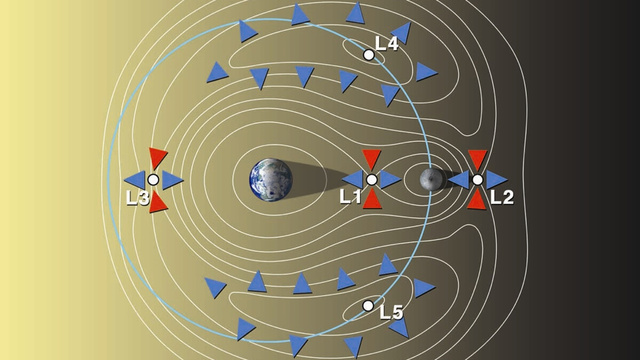
This is in keeping with the Obama administrations’ pledge of putting a man on a near-Earth asteroid by 2025 and a manned mission to Mars by 2030. It’s also in the same vein as NASA’s plan to catch and deposit an asteroid around the Moon, an idea that was proposed back in January of this year as part of the agencies plan to establish an outpost at Lagrange Point 2 early in the next decade.

And even though NASA has expressed that the massive 22 million ton asteroid Apophis will not impact planet Earth in 2036, it didn’t rule out that other, smaller rocks could possibly reach us in that time. Capturing them and towing them to where they could be safely deposited in orbit would present many opportunities, not the least of which could be commercial.

asteroid_foundry

For example, asteroid prospecting is slated to begin in 2015, with companies like SpaceX and Deep Space Industries leading the charge. Once property rights are assigned to various celestial bodies, these and other companies hope to send missions out to mine them and establish automated 3D manufacturing facilities, places that use “sintering” to process ore into metal and other materials that can then be shipped back.

NASA’s science mission directorate associate administrator John Grunsfeld also spoke about the importance of the lasso mission at the Human to Mars Summit on Monday. Above all else, he emphasized the importance of using the knowledge and skills gained from the research to achieve the long-term goal of survival:

We have a pretty good theory that single-planet species don’t survive. We don’t want to test it, but we have some evidence of that happening 65 million years ago [when an asteroid killed much of Earth’s life]. That will happen again someday … we want to have the capability [to leave the planet] in case of the threat of large scale destruction on Earth.

Yeah, its a rocky universe. And if we intend to survive in it, we had best learn how to deflect, capture and destroy any that come our way and get too close. And of course, we need to learn how to harness their endless supply of minerals and trace elements.

asteroid_belt1Source: news.cnet.com