The Future of Space: A Space Elevator by 2050?

space_elevatorIn the ongoing effort to ensure humanity has a future offworld, it seems that another major company has thrown its hat into the ring. This time, its the Japanese construction giant Obayashi that’s declared its interest in building a Space Elevator, a feat which it plans to have it up and running by the year 2050. If successful, it would make space travel easier and more accessible, and revolutionize the world economy.

This is just the latest proposal to build an elevator in the coming decades, using both existing and emerging technology. Obayashi’s plan calls for a tether that will reach 96,000 kilometers into space, with robotic cars powered by magnetic linear motors that will carry people and cargo to a newly-built space station. The estimated travel time will take 7 days, and will cost a fraction of what it currently takes to bring people to the ISS using rockets.
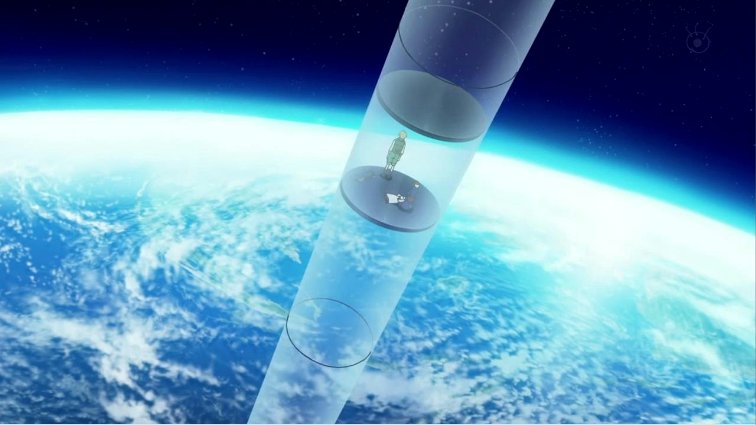
space_elevator_liftThe company said the fantasy can now become a reality because of the development of carbon nanotechnology. As Yoji Ishikawa, a research and development manager at Obayashi, explained:

The tensile strength is almost a hundred times stronger than steel cable so it’s possible. Right now we can’t make the cable long enough. We can only make 3-centimetre-long nanotubes but we need much more… we think by 2030 we’ll be able to do it.

Once considered the realm of science fiction, the concept is fast becoming a possibility. A major international study in 2012 concluded the space elevator was feasible, but best achieved with international co-operation. Since that time, Universities all over Japan have been working on the engineering problems, and every year they hold competitions to share their suggestions and learn from each other.

space_elevator3Experts have claimed the space elevator could signal the end of Earth-based rockets which are hugely expensive and dangerous. Compared to space shuttles, which cost about $22,000 per kilogram to take cargo into space, the Space Elevator can do it for around $200. It’s also believed that having one operational could help solve the world’s power problems by delivering huge amounts of solar power. It would also be a boon for space tourism.

Constructing the Space Elevator would allow small rockets to be housed and launched from stations in space without the need for massive amounts of fuel required to break the Earth’s gravitational pull. Obayashi is working on cars that will carry 30 people up the elevator, so it may not be too long before the Moon is the next must-see tourist destination. They are joined by a team at Kanagawa University that have been working on robotic cars or climbers.

graphene_ribbonsAnd one of the greatest issues – the development of a tether that can withstand the weight and tension of stresses of reaching into orbit – may be closer to being solved than previously thought. While the development of carbon nanotubes has certainly been a shot in the arm for those contemplating the space elevator’s tether, this material is not quite strong enough to do the job itself.

Luckily, a team working out of Penn State University have created something that just might. Led by chemistry professor John Badding, the team has created a “diamond nanothread” – a thread composed of carbon atoms that measures one-twenty-thousands the diameter of a single strand of human hair, and which may prove to be the strongest man-made material in the universe.

diamond_nanothreadAt the heart of the thread is a never-before-seen structure resembling the hexagonal rings of bonded carbon atoms that make up diamonds, the hardest known mineral in existence. That makes these nanothreads potentially stronger and more resilient than the most advanced carbon nanotubes, which are similar super-durable and super-light structures composed of rolled up, one atom-thick sheets of carbon called graphene.

Graphene and carbon nanotubes are already ushering in stunning advancements in the fields of electronics, energy storage and even medicine. This new discovery of diamond nanothreads, if they prove to be stronger than existing materials, could accelerate this process even further and revolutionize the development of electronics vehicles, batteries, touchscreens, solar cells, and nanocomposities.

space_elevator2But by far the most ambitious possibility offered is that of a durable cable that could send humans to space without the need of rockets. As John Badding said in a statement:

One of our wildest dreams for the nanomaterials we are developing is that they could be used to make the super-strong, lightweight cables that would make possible the construction of a ‘space elevator’ which so far has existed only as a science-fiction idea,

At this juncture, and given the immense cost and international commitment required to built it, 2050 seems like a reasonable estimate for creating a Space Elevator. However, other groups hope to see this goal become a reality sooner. The  International Academy of Astronautics (IAA) for example, thinks one could be built by 2035 using existing technology. And several assessments indicate that a Lunar Elevator would be far more feasible in the meantime.

Come what may, it is clear that the future of space exploration will require us to think bigger and bolder if we’re going to secure our future as a “space-faring” race. And be sure to check out these videos from Penn State and the Obayashi Corp:

John Badding and the Nanodiamond Thread:


Obayashi and the 2050 Space Elevator:


Sources:
cnet.com
, abc.net.au, science.psu.edu
The Future of Space: Smart, Stretchy, Skintight Spacesuits

biosuitSpacesuits have come a long way from their humble origins in the 1960s. But despite decades worth of innovation, the basic design remains the same – large, bulky, and limiting to the wearer’s range of movement. Hence why a number of researchers and scientists are looking to create suits that are snugger, more flexible, and more ergonomic. One such group hails from MIT, with a skin-tight design that’s sure to revolutionize the concept of spacesuits.

The team is led by Dava Newman, a professor of aeronautics and astronautics and engineering systems at MIT who previewed her Biosuit – playfully described by some as a “spidersuit” – at the TEDWomen event, held in San Fransisco in December of 2013. Referred to as a “second skin” suit, the design incorporates flexible, lightweight material that is lined with “tiny, muscle-like coils.”

mit-shrink-wrap-spacesuitSpeaking of the challenges of spacesuit design, and her team’s new concept for one, Dava Newman had the following to say in an interview with MIT news:

With conventional spacesuits, you’re essentially in a balloon of gas that’s providing you with the necessary one-third of an atmosphere [of pressure,] to keep you alive in the vacuum of space. We want to achieve that same pressurization, but through mechanical counterpressure — applying the pressure directly to the skin, thus avoiding the gas pressure altogether. We combine passive elastics with active materials.

Granted, Newman’s design is the first form-fitting spacesuit concept to see the light of day. Back in the 1960’s, NASA began experimenting with a suit that was modeled on human skin, the result of which was the Space Activity Suit (SAS). Instead of an air-filled envelope, the SAS used a skin-tight rubber leotard that clung to astronaut like spandex, pressing in to protect the wearer from the vacuum of space by means of counter pressure.

SAS_spacesuitFor breathing, the suit had an inflatable bladder on the chest and the astronaut wore a simple helmet with an airtight ring seal to keep in pressure. This setup made for a much lighter, more flexible suit that was mechanically far simpler because the breathing system and a porous skin that removed the need for complex cooling systems. The snag with the SAS was that materials in the days of Apollo were much too primitive to make the design practical.

Little progress was made until Dava Newman and her team from MIT combined modern fabrics, computer modelling, and engineering techniques to produce the Biosuit. Though a far more practical counter-pressure suit than its predecessor, it was still plagued by one major drawback – the skintight apparatus was very difficult to put on. Solutions were proposed, such as a machine that would weave a new suit about the wearer when needed, but these were deemed impractical.

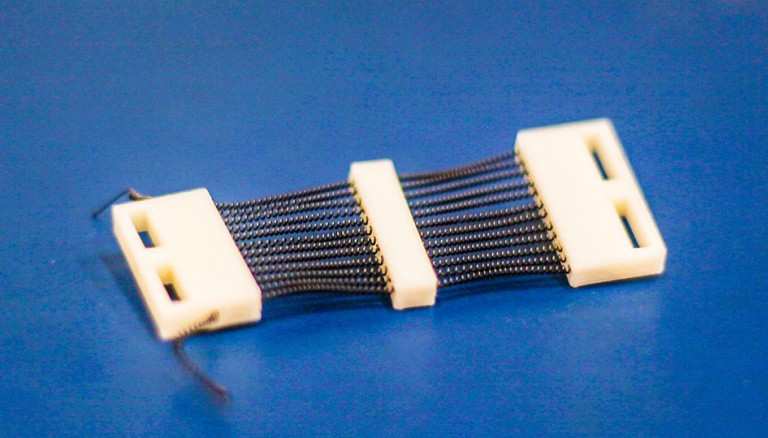
mit-shrink-wrap-spacesuit-0The new approach incorporates coils formed out of tightly packed, small-diameter springs made of a shape-memory alloy (SMA) into the suit fabric. Memory alloys are metals that can be bent or deformed, but when heated, return to their original shape. In this case, the nickel-titanium coils are formed into a tourniquet-like cuff that incorporates a length of heating wire. When a current is applied, the coil cinches up to provide the proper counter pressure needed for the Biosuit to work.

Bradley Holschuh, a post-doctorate in Newman’s lab, originally came up with the idea of a coil design. In the past, the big hurdle to second-skin spacesuits was how to get astronauts to squeeze in and out of the pressured, skintight suit. Holschuh’s breakthrough was to deploy shape-memory alloy as a technological end-around. To train the alloy, Holschuh wound raw SMA fiber into extremely tight coils and heated them to 450º C (842º F) to fashion an original or “trained” shape.

mit-shrink-wrap-spacesuit-3 When the coil cooled to room temperature, it could be stretched out, but when heated to 60º C (140º F), it shrank back into its original shape in what the MIT team compared to a self-closing buckle. As spokespersons from MIT explained:

The researchers rigged an array of coils to an elastic cuff, attaching each coil to a small thread linked to the cuff. They then attached leads to the coils’ opposite ends and applied a voltage, generating heat. Between 60 and 160 C, the coils contracted, pulling the attached threads, and tightening the cuff.

In order to maintain it without continually heating the coils, however, the team needs to come up with some sort of a catch that will lock the coils in place rather than relying on a continuous supply of electricity and needlessly heating up the suit – yet it will still have to be easy to unfasten. Once Newman and her team find a solution to this problem, their suit could find other applications here on Earth.

Image converted using ifftoanyAs Holschuh explained, the applications for this technology go beyond the spacesuit, with applications ranging from the militarized to the medical. But for the moment, the intended purpose is keeping astronauts safe and comfortable:

You could [also] use this as a tourniquet system if someone is bleeding out on the battlefield. If your suit happens to have sensors, it could tourniquet you in the event of injury without you even having to think about it… An integrated suit is exciting to think about to enhance human performance. We’re trying to keep our astronauts alive, safe, and mobile, but these designs are not just for use in space.

Considering the ambitious plans NASA and other government and private space agencies have for the near-future – exploring Mars, mining asteroids, building a settlement on the Moon, etc. – a next-generation spacesuit would certainly come in handy. With new launch systems and space capsules being introduced for just this purpose, it only makes sense that the most basic pieces of equipment get a refit as well.

And be sure to check out this video of Dava Newman showing her Biosuit at the TEDWomen conference last year:


Sources:
gizmag.com, motherboard.vice.com
, newsoffice.mit.edu

News from Space: New Horizons Passes Neptune

new-horizons-neptuneIt certainly has been a momentous few weeks for space exploration! Between the final weeks of August and the month of September, we’ve seen the Curiosity rover reach Mount Sharp, the Rosetta spacecraft created the first full map of a comet’s, the completion of the Orion space module, and the MAVEN orbiter reach Martian orbit. And before the month is out, India’s Mars Orbiter Mission (MOM) will also arrive in orbit around the Red Planet.

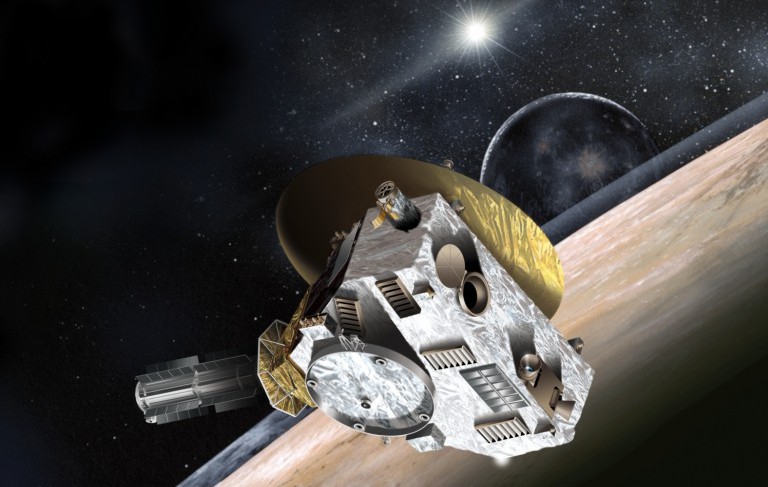
Despite all these developments, that occurred (relatively) close to home, there was even more news to be had, coming all the way from the edge of the Solar System no less. At the tail end of August, NASA announced that the New Horizons space probe passed Neptune orbit and is on its way to Pluto. Launched back in 2006 for the purpose of studying the dwarf planet, the probe is expected to arrive on July 14th of next year.

new-horizons-neptune-8NASA says that the the craft passed the Neptunian orbit at 10:04 pm EDT on Monday August 25th, which coincided with the 25th anniversary of Voyager 2’s flyby of Neptune in 1989. But where Voyager came within 4,950 km (3,080 mi) of the gas giant, the New Horizons craft passed by at a distance of 3.96 billion km (2.45 billion mi). The spacecraft is now almost 4.42 billion km (2.75 billion mi) from Earth, and is the fastest man-made object ever sent into space.

Nevertheless, New Horizons’ Long Range Reconnaissance Imager (LORRI) was still able to capture images of Neptune and its giant moon Triton. As you can see from the image below, Neptune appears as the large white disc in the middle, while Triton is the small black dot passing in front and sitting slightly to the ride. NASA says that Triton may be very similar to Pluto and the information gathered by Voyager 2 may prove helpful in the coming encounter.

new_horizons_plutoRalph McNutt of the Johns Hopkins University Applied Physics Laboratory.

There is a lot of speculation over whether Pluto will look like Triton, and how well they’ll match up. That’s the great thing about first-time encounters like this – we don’t know exactly what we’ll see, but we know from decades of experience in first-time exploration of new planets that we will be very surprised.

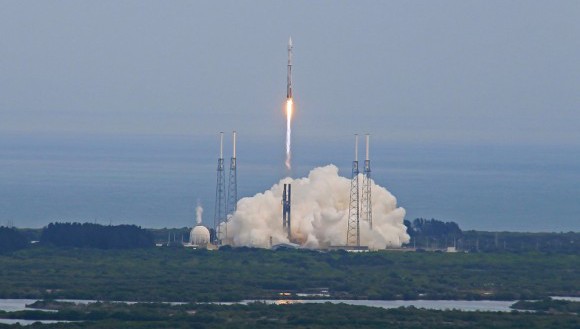
The first mission in NASA’s New Frontiers program, the New Horizons mission was launched on January 19, 2006 atop an Atlas V rocket from Cape Canaveral, Florida. It broke the record for the fastest man-made object on lift off with a speed of 58,536 km/h (36,373 mph). The 478 kg (1,054 lb) spacecraft was sent on a 9.5-year mission to fly by Pluto – a distance so far that radio signals from the nuclear-powered probe take four hours to reach Earth.

new-horizons-neptune-7Sent on a slingshot trajectory using the gravitational pull of Jupiter, which tacked on another 14,480 km/h (9,000 mph) to its speed, New Horizons will pass Pluto in July of next year at a distance of 13,000 km (8,000 mi). After this encounter, it will continue on out of the Solar System, during which it will be in the distant Kuiper belt studying one or more Kuiper belt objects (KBOs).

Though this will still not rival Voyager 1’s accomplishments, which left our Solar System last year, New Horizons promises to gather far more information on the Outer Solar System and what lies beyond. All of this will come in mighty handy when at last, humanity contemplates sending manned missions into deep space, either to Alpha Centauri or neighboring exoplanets.

Sources: gizmag.com, nasa.gov

News from Mars: MAVEN Orbiter Arrives!

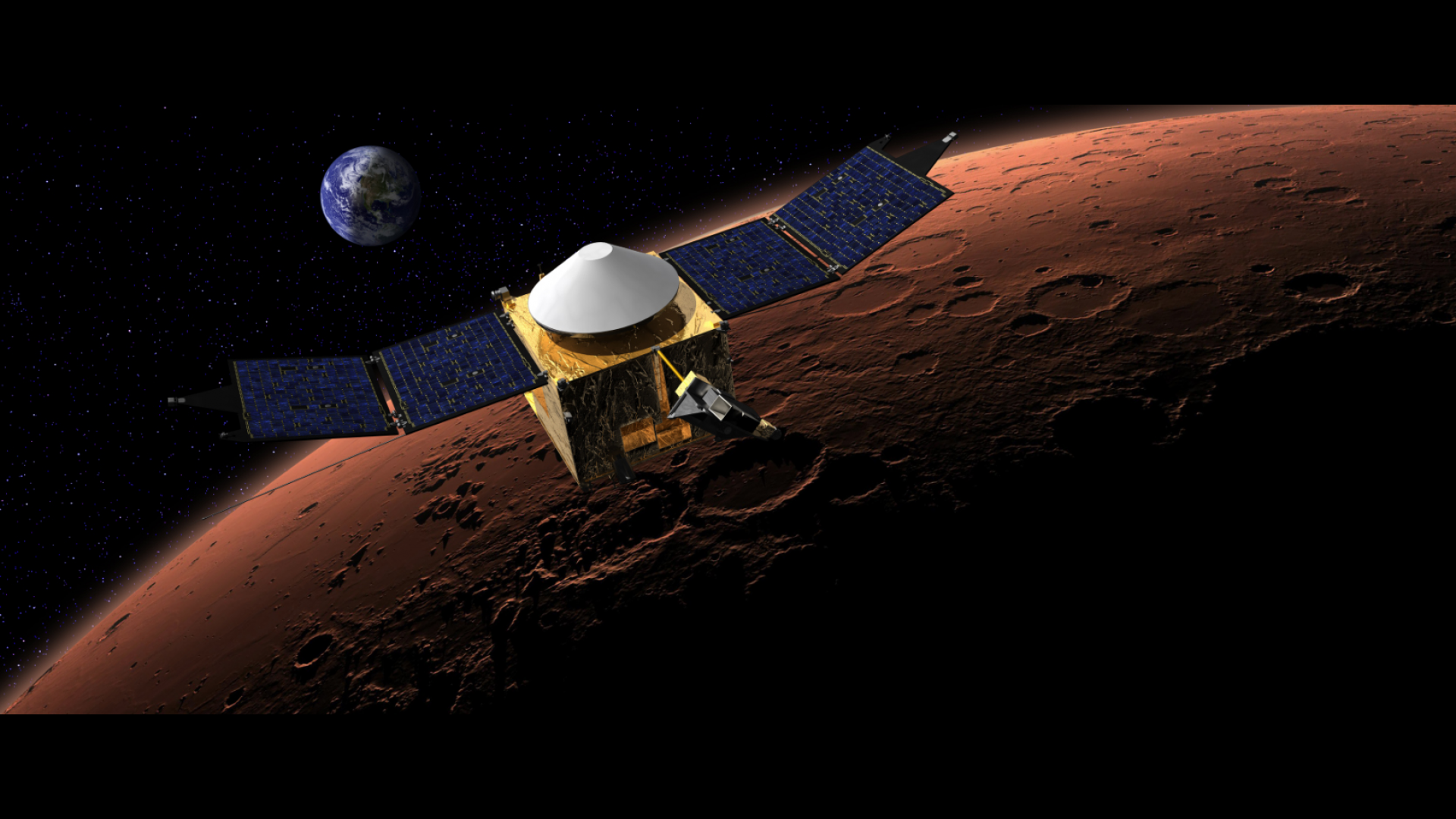
maven_tv_backdropIn November 2013, NASA launched the Mars Atmosphere and Volatile Evolution (MAVEN) space probe from Cape Canaveral. Described as a “time machine” for Mars, the orbiter would spend the next ten months traversing space, assuming an orbit around the Red Planet, and look for an answer as to how Mars went from being a planet with an atmosphere and water to the dried out husk that we know today.

And this evening, after trekking some 711 million kilometers (442 million-mile) across our Solar System, MAVEN will have arrived in orbit around Mars and will begin its year-long mission to study the planet’s upper atmosphere. The arrival will be broadcast live, courtesy of NASA TV and Space.com. The live webcast will run from 9:30 p.m. to 10:45 p.m. EDT (0130 to 0245 GMT), and if all goes well, MAVEN will enter orbit around Mars at 9:50 p.m. EDT (0250 GMT).

maven_launchAs David Mitchell, NASA’s MAVEN project manager at the Goddard Space Flight Center in Greenbelt, Maryland, said in a statement:

So far, so good with the performance of the spacecraft and payloads on the cruise to Mars. The team, the flight system, and all ground assets are ready for Mars orbit insertion.

Though plans to study Mars’ atmosphere in detail have been in the works for years, the MAVEN program received a big push from the ongoing efforts from the Curiosity rover. During its ongoing mission to study the surface of Mars, Curiosity was able to confirm that Mars had extensive surface water billions of years ago. This revelation came very early in the mission, and indicated some rather interesting things about Mars’ past.

Mars-snow-header-640x353For instance, although Mars is now too cold for flowing water today, it might have had a thicker atmosphere in the past that warmed its surface and allowed the liquid to remain stable on the surface. And while scientists have a pretty good idea how it was lost (i.e. too far our Sun, too low a gravity field), the rate of loss and when it disappeared are just some of the questions that MAVEN will attempt to answer.

Much of what scientists know about Mars’ upper atmosphere comes from just a few minutes’ worth of data from the two Viking landers that took measurements as they made their way to the Martian surface in the 1970s. This time around, NASA will be able to collect data for an entire year, gathering far more data than either the Viking landers or any other spacecraft has since had the opportunity to do.

maven_atmo1As Bruce Jakosky, the mission’s principal investigator at the University of Colorado, Boulder’s Laboratory for Atmospheric and Space Physics, explained it:

The MAVEN science mission focuses on answering questions about where did the water that was present on early Mars go, about where did the carbon dioxide go. These are important questions for understanding the history of Mars, its climate, and its potential to support at least microbial life.

NASA scientists understand that Mars’ upper atmosphere acts as an escape zone for molecules floating dozens of miles from the planet’s surface. They theorize that as the solar wind hits the atmosphere, the radiation strips away the lighter molecules and flings them into space forever. To test this hypothesis, MAVEN will be examining the state of Mars’ upper atmosphere, and ionosphere to determine its interactions with the solar wind.

maven_atmosphereIn so doing, NASA hopes to determine what the current rates of escape are for neutral gases and ions, and thus get a better picture of how long it took for the atmosphere to degrade and when it began degrading. The upper atmosphere of Mars likely changes as the sun’s activity increases and decreases, which is why MAVEN investigators hope to run the mission for longer than a year.

MAVEN will began making science measurements around Nov. 8, due to it taking a short break from its commissioning phase to watch Comet Siding Spring pass close by on Oct. 19. The $671 million MAVEN spacecraft is one of two missions that launched toward Mars last November and which are making their arrival this month. The other probe is India’s Mars Orbiter Mission, which launched just before MAVEN and will arrive at the Red Planet this Wednesday (Sept. 24).

It is an exciting time for space exploration, and the coming years are sure to be characterized by an escalating and accelerating rate of learning. Be sure to head on over to Space.com to watch the arrival broadcast live. And be sure to check out the following videos – the Mars Arrival trailer; NASA Goddard Center’s “Targeting Mars” video; and the NASA MAVEN PSA, hosted by LeVar Burton:

MAVEN Mars Arrival Trailer:


Targeting Mars:


LeVar Burton Shares MAVEN’s Story:


Sources:
space.com, (2), nasa.gov

News from Space: Orion Spacecraft Completed

orion_arrays1NASA’s return to manned spaceflight took a few steps forward this month with the completion of the Orion crew capsule. As the module that will hopefully bring astronauts back to the Moon and to Mars, the capsule rolled out of its assembly facility at the Kennedy Space Center (KSC) on Thursday, Sept. 11. This was the first step on its nearly two month journey to the launch pad and planned blastoff this coming December.

Orion’s assembly was just completed this past weekend by technicians and engineers from prime contractor Lockheed Martin inside the agency’s Neil Armstrong Operations and Checkout (O & C) Facility. And with the installation of the world’s largest heat shield and the inert service module, all that remains is fueling and the attachment of its launch abort system before it will installed atop a Delta IV Heavy rocket.

Orion-at-KSC_Ken-KremerThe unmanned test flight – Exploration Flight Test-1 (EFT-1) – is slated to blast off on December 2014, and will send the capsule into space for the first time. This will be NASA’s first chance to observe how well the Orion capsule works in space before it’s sent on its first mission on the Space Launch System (SLS), which is currently under development by NASA and is scheduled to fly no later than 2018.

The Orion is NASA’s first manned spacecraft project to reach test-flight status since the Space Shuttle first flew in the 1980s. It is designed to carry up to six astronauts on deep space missions to Mars and asteroids, either on its own or using a habitat module for missions longer than 21 days. The development process has been a long time in the making, and had more than its share of bumps along the way.

Orion-at-KSC_Ken-Kremer1As Mark Geyer, Orion Program manager, explained:

Nothing about building the first of a brand new space transportation system is easy. But the crew module is undoubtedly the most complex component that will fly in December. The pressure vessel, the heat shield, parachute system, avionics — piecing all of that together into a working spacecraft is an accomplishment. Seeing it fly in three months is going to be amazing.

In addition to going to the Moon and Mars, the Orion spacecraft will carry astronauts on voyages venturing father into deep space than ever before. This will include going to the Asteroid Belt, to Europa (to see if there’s any signs of life there), and even beyond – most likely to Enceladus, Titan, the larger moons of Uranus, and all the other wondrous places in the Solar System.

oriontestflightThe two-orbit, four and a half hour EFT-1 flight will lift the Orion spacecraft and its attached second stage to an orbital altitude of 5,800 km (3,600 miles), about 15 times higher than the International Space Station (ISS) – and farther than any human spacecraft has journeyed in 40 years. It will be an historic occasion, and constitute an important step in what is sure to be known as the Second Space Age.

And be sure to watch this time-lapse video of the Orion Capsule as it is released from the Kennedy Space Center to the Payload Hazardous Servicing Facility in preparation for its first flight:


Sources:
gizmag.com, universetoday.com

News from Space: Rosetta Maps Comet Surface

Rosetta_and_Philae_at_cometLast month, the European Space Agency Rosetta’s space probe arrived at the comet known as 67P/Churyumov–Gerasimenko, thus becoming the first spacecraft to ever rendezvous with a comet. As it continues on its way to the Inner Solar System, Rosetta’s sensing instruments have been studying the surface in detail in advance of the attempted landing of it’s Philae probe.

Because of this, Rosetta has been able to render a map of the various areas on the surface of the comet, showing that it is composed of several different regions created by a range of forces acting upon the object. Images of the comet’s surface were captured by OSIRIS, the scientific imaging system aboard the Rosetta spacecraft, and scientists analyzing them have divided the comet into several distinct regions, each characterized by different classes of features.

rosettamap-1All told, areas containing cliffs, trenches, impact craters, rocks, boulders and parallel grooves have been identified and mapped by the probe. Some of the areas that have been mapped appear to be caused by aspects of the activity occurring in and around the nucleus of the comet, such as where particles from below the surface are carried up by escaping gas and vapor and strewn around the surface in the surrounding area.

So detailed are these images that many have been captured at a resolution of one pixel being equal to an area of 194 square centimeters (30 square inches) on the comet surface. Dr. Holger Sierks, OSIRIS’ Principal Investigator from the Max Planck Institute for Solar System Science, puts it into perspective:

Never before have we seen a cometary surface in such detail. It is a historic moment – we have an unprecedented resolution to map a comet… This first map is, of course, only the beginning of our work. At this point, nobody truly understands how the surface variations we are currently witnessing came to be.

Rosetta_and_Philae_at_comet_node_full_imageThe newly-generated comet maps and images captured by the instruments on Rosetta will now provide a range of detail on which to finalize possible landing sites for the Philae probe to be launched to the surface . As such, the Rosetta team will meet in Toulouse, France, on September 13 and 14 to allocate primary and backup landing sites (from a list of sites previously selected) with much greater confidence.

At the same time, Rosetta has revealed quite a bit about the outward appearance of the comet, and it aint pretty! More often than not, comets are described as “dirty snowballs” to describe their peculiar composition of ice and dust. But Rosetta’s Alice instrument, which was installed by NASA, has sent back preliminary scientific data that shows that the comet is more akin to a lump of coal.

Rosetta_Artist_Impression_Far_625x469Alice is one of eleven instruments carried aboard Rosetta and one of three instrument packages supplied by NASA for the unmanned orbiter. Essentially, it’s a miniature UV imaging spectrograph that looks for thermal markers in the far ultraviolet part of the spectrum in order to learn more about the comet’s composition and history. It does this by looking specifically for the markers associated with noble gases, such as helium, neon, argon, and krypton.

The upshot of all this high-tech imaging is the surprising discovery of what 67P/Churyumov-Gerasimenko looks like. According to NASA, the comet is darker than charcoal. And though Alice has detected oxygen and hydrogen in the comet’s coma, the patches of barren ice that NASA scientists had expected aren’t there. Apparently, this is because 67P/Churyumov-Gerasimenko is too far away from the warmth of the sun to turn the ice into water vapor.

rosetta-1Alan Stern, Alice principal investigator at the Southwest Research Institute in Boulder, Colorado, had this to say about the revelation:

We’re a bit surprised at just how unreflective the comet’s surface is and how little evidence of exposed water-ice it shows.

Launched in 2004, Rosetta reached 67P/Churyumov-Gerasimenko by a circuitous route involving three flybys of Earth, one of Mars, and a long detour out beyond Jupiter as it built up enough speed to catch up to the comet. Over the coming months, as the Rosetta spacecraft and comet 67P move further into the solar system and approach the sun, the OSIRIS team and other instruments on the payload will continue to observe the comet’s surface for any changes.

alice-first-findings-3Hence why this mission is of such historic importance. Not only does it involve a spacecraft getting closer to a comet than at time in our history, it also presents a chance to examine what happens to a comet as it approaches our sun. And if indeed it does begin to melt and breakdown, we will get a chance to peer inside, which will be nothing less than a chance to look back in time, to a point when our Solar System was still forming.

Sources: gizmag, (2), jpl.nasa.gov, nasa.gov

News from Mars: Curiosity Arrives at Mount Sharp

curiosity-mars-self-portrait-crop-640x353After two years exploring the Martian surface, the Curiosity Rover has finally reached its primary science destination – the foot of Mount Sharp, officially known as Aeolis Mons. Now that it’s there, it will begin its ascent of the rock formation, drill into rocks and analyze the different strata in the hopes of learning more about the history of the Red Planet. This is an event a long time in the making, and may prove to yield some of the greatest scientific discoveries ever made.

Located in the heart of the Gale Crater, Mount Sharp is like a layer cake, holding a chronology of past events reaching back billions of years. Because of this, it is an ideal place to find evidence that the Martian surface and atmosphere were once capable of supporting life. It took two years and one month for Curiosity reach the foot of this mountain, which lies some 5500 meters (18,000 feet) above the floor of Gale Crater.

MarsCuriosityTrek_20140911_AThe mountain is the central peak in a crater that measures 154 km/96 miles in diameter and which was formed when a meteor impacted the surface between 3.5 and 3.8 billion years ago. Beyond a certain size, and depending on the gravity of the planet, craters like this all have a central peak. But Mount Sharp represents something much more, otherwise NASA and the Jet Propulsion Laboratory wouldn’t be bothering with it.

Basically, Mars scientists believe that after its creation, the Gale crater was completely filled with sedimentary material from a series of huge floods, or by dust and ice deposits like those that happened at the Martian polar caps. The deposition over 2 billion years left a series sedimentary layers that filled the crater. Following the deposition of the layers, there was a long period of erosion which has finally led to the condition of the crater today.

mountsharp_galecraterThe erosion by some combination of aeolean (wind) forces and water (additional flooding), scooped out the huge crater, re-exposing most of the original depth. However, covering the original central peak are many sedimentary layers of debris. Gale crater’s original central peak actually remains completely hidden and covered by sedimentation. And it is this that attracted scientists with the Curiosity rover to the base of Mount Sharp.

Within the sedimentary layers is a sequential record of the environmental conditions on Mars going back over 2 billion years. While at the base, Curiosity will be able to examine the oldest sedimentary layers; but as it climbs the flanks of the mountain, it will be able to step forward in time. Each layer and its age will reveal information such as how much water was present, whether the water was alkaline or acidic, if there is any organic compounds.

john_klein_curiosity-2The discovery of organic compounds on Mount Sharp could be “Earth shaking”, since the discovery of organics is of very high importance to this mission. Already, over the two year trek, Curiosity has seen numerous signs of the flow of water and sedimentation. Interestingly enough, evidence began to turn up way back in Yellowknife Bay — one of its first destinations, which it visited almost two years ago. But as of yet, signs of organic compounds have remained illusive.

What’s more, Curiosity sadly lacks the necessary equipment to look for evidence of microbial fossils or other signatures of life. Fortunately, the next rover – the Mars 2020 rover – will be equipped with the necessary tools to work out whether Mars ever harbored life. In any case, because of the lack of organic compounds in Yellowknife, NASA decided to continue to Mount Sharp, which is currently the best place to dig up scientific data about Mars’ past.

MSL_TraverseMap_Sol0743-2048Curiosity is currently at the base of Mount Sharp, in a region called the Pahrump Hills, where it will continue on to the Murray Formation. Once there, it will take a drill sample of some rock and then continue up Mount Sharp towards the Hematite Ridge where two drill sites await. This farthest site is about 8 km (5 mi) away from its present position, and Curiosity has driven only 9 km since it landed in 2012. So there’s plenty of trekking and work ahead!

One of the greatest challenges is finding a path that will reduce the stress on Curiosity’s wheels, which have been put through some serious wear and tear in the past two years. Because of this, the rover is being driven in reverse for the time being, and the team is looking the path with the least amount of sharp rocks. However, the Mars Curiosity remains confident that the mobility system will be capable of surviving the ten year life span of the rover’s power supply.

And be sure to check out this “Curiosity Rover Report” that talks about this historic accomplishment, courtesy of NASA’s Jet Propulsion Laboratory:

Sources: universetoday.com, extremetech.com, jpl.nasa.gov, space.com

News from Mars: ExoLance Project to Hunt for Life

exolance-2The search for life on Mars has been ongoing, and predates the deployment of the Curiosity rover by many years. However, it is becoming increasingly clear that if signs of life are to be truly found, they won’t turn up by scratching around on the surface. Beyond Curiosity’s own slated inspection of Mount Sharp (where it just arrived!) NASA has some long-range plans that reach deeper.

Outside of NASA’s InSight Lander, which is set to launch in the spring of 2016, there’s Explore Mars’ plan to look for signs of life beneath the surface. A private organization made up technologists and former NASA engineers, their plan is to drop supersonic lances onto the planet that will penetrate deep into the Martian soil to seek out protected, potentially wet strata where life might still exist.

exolanceKnown as ExoLance, the project is designed to take up where the Viking missions of the late 1970s left off. In these first successful Mars landers, there was an experiment on board that looked for signs of life in the Martian soil. This consisted of the Viking lander scooping up soil, depositing it inside the automatic laboratory in the lander, squirted a nutrient solution into the sample, and analyzing the gases given off that might indicate the presence of life.

The Viking experiment did give off gases that seemed like they were due to living organisms, but it later discovered that these were due to chemical reactions due to the extremely dry conditions and constant bombardment of UV radiation. Because of this, NASA has preferred to focus more on geology to gain a better understanding of the Martian environment rather than looking for life directly.

exolance-3But Explore Mars wants to go back to the direct approach by combining an experiment similar to the Viking lab with a delivery system based on the US Air Force’s bunker-buster weapons. They also hope to incorporate technology developed for the Curiosity rover, which includes reusing the aeroshell that protected the Curiosity rover as it made its descent to the Martian surface in 2012.

When the shell reaches Mars, it will open up to reveal a delivery vehicle similar to the Skycrane that delivered Curiosity to the surface by hovering under rocket power while it winched the lander down. In the case of the ExoLance, the vehicle – which is appropriately called a Quiver – will hover in place. But instead of lowering a rover, it will fire multiple penetrator probes at the ground.

exolance-1These perpetrators, called Arrows, are small, lightweight versions of the bunker-buster bombs that were developed by the US forces during the 1991 Gulf War. However, instead of exploding, the Arrows will strike the surface at supersonic speeds to bore deep into the ground and (similar to NASA’s Deep Space 2 probe) split in two to deploy a cache of scientific equipment packed into the nose.

While the tail section remains on the surface to act as a transmitter back to Earth, the nose bores about 5 m (16 ft) into the surface to find protected layers that may contain water, but which are shielded against the deadly surface radiation. Once in position, the Arrow activates its experiment, which is designed to not only detect signs of living organisms, but also to determine if the life signs are those of microbes similar to those found on Earth, or have a completely different origin.

exolance-4The mission is the subject of an Indiegogo crowdfunding campaign aimed at raising US$250,000. The group says that within a year of raising its Indiegogo funding, it would develop and build Arrow prototypes and test them in the Mojave Desert by dropping them from aircraft. The idea is not only to see if the experiments can survive the impact, but also to make sure that the penetrators don’t dig in too deep or too shallow.

In addition, the group expects the design to change as they deals with problems, such as the volume of the cylinder, batteries, deploying the tether linking the two segments, and making sure the components can withstand the impact. In the second year, the group plans to enact Phase II, which would concentrate on developing the microbial experiments. If this is successful, they plan to approach NASA or commercial companies to arrange delivering ExoLance to Mars.

The crowdfunding campaign will run until September 29th, and has raised a total of $15,680 of their projected goal. To check out this campaign, or to contribute, click here. And be sure to check out Explore Mars’ promotional video below:


Source:
gizmag.com, exploremars.org, indiegogo.com

News From Space: SpaceX Booster Explodes in Flight

spacex-falcon-9-octaweb-640x427Last week, during a test flight in McGregor Texas, a new space SpaceX Falcon 9 Reusable Development Vehicle 1 (F9R Dev 1) exploded in midair. This three-engine variant of the F9 is the latest in SpaceX’s arsenal of vertical takeoff, vertical landing (VTVL) rockets designed to allow for easy recovery and reuse. Previously, Grasshopper had only used a single Merlin rocket engine; but for this test, a three-engine version of the vehicle was being used.

The F9R Dev 1 is a second-generation test vehicle rocket based on the SpaceX Grasshopper. Built as part of SpaceX’s program to develop a fully reusable launcher system and spacecraft with all components capable of a powered landing, the F9R has lighter, retractable landing legs and is 50 percent longer than the Grasshopper. It made its first flight last April and is capable of flight operations up to 3,000 m (10,000 ft).

https://i0.wp.com/www.extremetech.com/wp-content/uploads/2014/08/exploding-spacex-rocket-grasshopper-f9r-640x357.jpgThis marks the first major failure for SpaceX’s commercial space launch program, and in a statement, SpaceX says the initiated its self-destruct sequence automatically after detecting an anomaly. Nearby residents saw the fireball and local television station KXXV caught the incident on video. From the footage (seen below), the new test rocket is seen going up, turning 90 degrees to horizontal, and then detonating with a rather neat fireball.

Mercifully, no one was harmed (including the local livestock). Following the incident, Elon Musk tweeted that the vehicle “auto-terminated,” but there were no injuries or near-injuries, and that “Rockets are tricky …” SpaceX also released the following statement saying:

Earlier today, in McGregor, Texas, SpaceX conducted a test flight of a three engine version of the F9R test vehicle (successor to Grasshopper). During the flight, an anomaly was detected in the vehicle and the flight termination system automatically terminated the mission.

Throughout the test and subsequent flight termination, the vehicle remained in the designated flight area. There were no injuries or near injuries. An FAA representative was present at all times.

With research and development projects, detecting vehicle anomalies during the testing is the purpose of the program. Today’s test was particularly complex, pushing the limits of the vehicle further than any previous test. As is our practice, the company will be reviewing the flight record details to learn more about the performance of the vehicle prior to our next test.

SpaceX will provide another update when the flight data has been fully analyzed.

spacex-falcon-9-rocket-largeIn short, SpaceX was attempting something new and exciting and it didn’t quite go as planned. And although it cost them millions of dollars, rocket scientists know from experience that a controlled detonation in the air is far better than an uncontrolled one on the ground. Should a rocket lose control and crash into the Earth, it will detonate all of its unspent fuel and can cause extensive damage and loss of life.

At this point it’s impossible to say what kind of anomaly was experienced by the rocket, but SpaceX is poring over the gigabytes of flight telemetry data to try and find out what went wrong. In the meantime, space enthusiasts are hoping people will remember that mishaps are part of the development process, and that we’ve come very far since the early days of NASA and Project Mercury, where mistakes and deaths were far more common.

And if SpaceX wants to create the world’s first reusable space launch system, and crack the cheap, commercial space travel market wide open, there are going to be a few fireballs along the way. But as long as it’s just the test launches that explode, we should count our blessings. And in the meantime, be sure to check out the footage obtained by KXXV of the failed test flight:


Sources:
extremetech.com, gizmodo.com

News From Space: Earth Organisms Found In Space!

space_organismDuring a routine spacewalk to clean the outside of the space station, a team of Russian astronauts reportedly found organisms clinging to the side of the International Space Station. After analyzing the samples they took, they identified the organisms as sea plankton that likely originated from Earth, but couldn’t find a concrete explanation as to how these organisms made it to the ISS — or how they managed to survive.

Though NASA has so far been unable to confirm whether or not the Russians truly did discover sea plankton clinging to the exterior of the station. But according to the chief of the Russian ISS orbital mission, Vladimir Solovjev, these findings are legitimate and “absolutely unique.” And there is some scientific precedent for certain creatures being able to survive the vacuum of space.


tardigrade-electron-scanning-colorizedConsider tardigrades, for example. These water-dwelling microscopic invertebrates that are known to be able to survive a host of harsh environments. They can survive extreme temperatures (slightly above absolute zero to far above boiling), amounts of radiation hundreds of times higher than the lethal dose for a human, pressure around six times more than found in the deepest parts of the ocean, and the vacuum of space.

The organisms found on the ISS aren’t tardigrades, but the little invertebrates show that some living organisms from Earth can indeed survive the harshness of space. But the real mystery is how they made it all the way up there, 330 km (205 miles) above Earth. The scientists have already dismissed the possibility that the plankton were simply carried there on a spacecraft from Earth, as the plankton aren’t from the region where any ISS module or craft would’ve taken off.

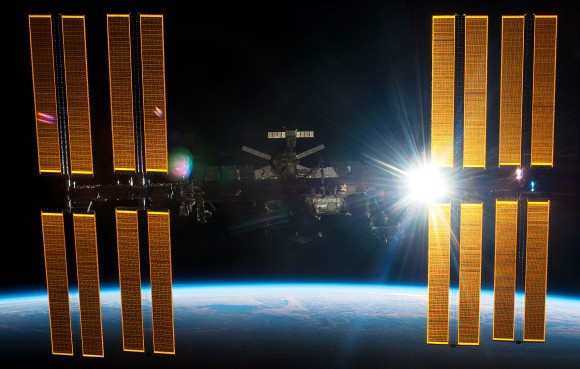
International-Space-Station-ISS-580x441The working theory is that atmospheric currents could be scooping up the organisms then carrying them all the way to the space station, though that would mean the currents could travel to astonishing altitudes. Living organisms have been found far above Earth before, such as microbes and bacterial life discovered at altitudes of 16 to 40 kms (10 and 24.8 miles) respectively into the atmosphere.

Though these numbers are a far cry from 330 km. For now, all that can be done is to wait and see if the Russian team confirms the findings with NASA. Then, maybe the two factions can work together in order to figure out how plankton made it all the way up into space, and perhaps even discover exactly why the plankton can survive. The organisms aren’t exactly the first confirmed discovery of alien life, but they do pose another fascinating mystery.

Sources: extremetech.com, sploid.gizmodo.com, en.itar-tass.com