Vote for Gliese 581g to be Renamed “Yuva”

alien-worldPeople who follow this blog may recall how, recently, I posted a story about Uwingu, a non-profit organization that sells the naming rights to exoplanets and (now) Martian craters. Well, as I explained in that last post, it’s not so much a matter of naming rights as naming suggestions, ones which are then voted on and then made into a crowdsourced map of an extra-terrestrial planet or the stars.

Far from this being some kind of scam or false promise, Uwingu does this in order to spur public participation in space exploration, and uses half of the proceeds to fund scientific research. After reading up on what they do and what the process for it all is, I began to think it might be fun for my writer’s group to pitch a suggestion of their own.

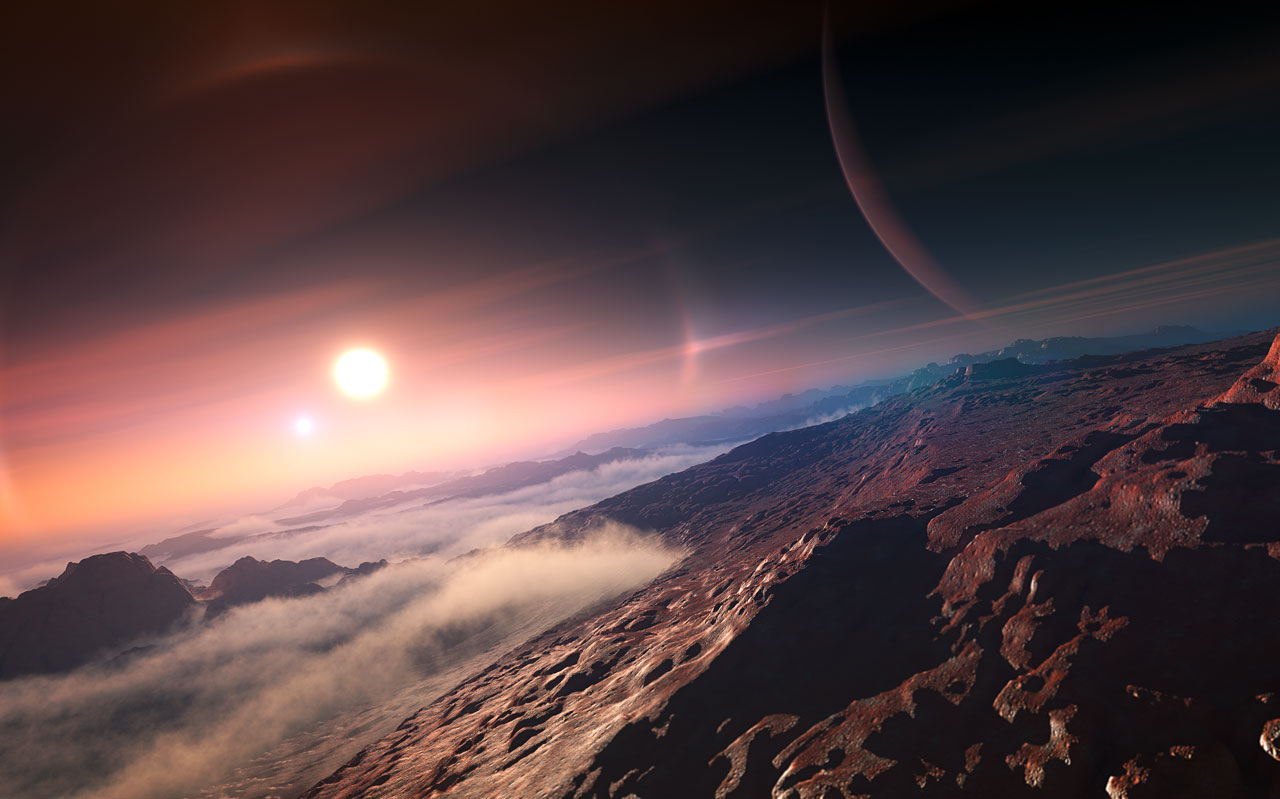
gliese_581gFor some time, we’ve been working on the Yuva Anthology – a series of shorts that tell the story of a future colonization effort on Gliese 581g. Not only is the planet real, but it was considered by NASA to be the most Earth-like exoplanet yet discovered in the known universe. So naturally I wondered, what if we voted to name it Yuva?

And now it’s been done! Uwingu has received my suggestion (and payment for the transaction), and printed me out the certification of authorization that you see below. Now all we need is people willing to spend $0.99 to make it a reality. Simply click here, select the name Yuva from the list, and confirm your payment of ninety-nine cents – but only if you’re comfortable doing so of course.

Uwingu_Certificate_19840Also, for those who’ve got a pile of digital currency just burning a hole in their accounts, be advised that you can vote as many times as you want. As the saying goes “vote early, vote often!” Just keep in mind that have to pay $0.99 each time you do. Unlike naming rights, there’s no bulk discount to be had here. That seem right to you?

Thank you in advance to anyone who supports this project and helps to make it a reality! And I do sincerely hope myself and my group can get the anthology out by this summer. It’s been a long haul, and coordinating the efforts of over a dozen writers is difficult at the best of times! Until next time, keep your eyes on the stars!

News from Mars: Put Your Name on a Crater!

mars_lifeMars is a interesting and varied place, with enough mysteries to sate appetites both subtle and gross. But as we come to study it up close and get to know it better, a peculiar challenge arises. Basically, there are thousands of geological features on the Martian surface that don’t yet have names. Up until now, only those mountains, hills and craters that are observable from space have been designated.

With the Mars rovers pouring over the surface, each new feature is being named and designated by NASA scientists – The Gale Crater, Yellowknife Bay, Mount Sharp, etc. But what of the public? Given that this is the age of public space travel where regular people have access to the process, shouldn’t we be able to toss our hats in the ring and get a chance at naming Martian features?

Mars_impact_craterThat’s the goal of Uwingu, a non-profit organization dedicated to increasing public participation in space exploration. In addition to naming exoplanets, they have begun a project to that gives people the opportunity to name over 550,000 craters on Mars. By getting people to pledge donations in exchange for naming rights, the company hopes to raise over $10M to help fund space science and education.

The project touched off in late February, with their map of Mars uploaded to the site and half a million plus craters indicated. Just like how Apollo astronauts have named landing site landmarks during their Moon missions or how Mars scientists have named features they’ve encountered on robotic missions, Uwingu proclaims that, “Now it’s your turn.”
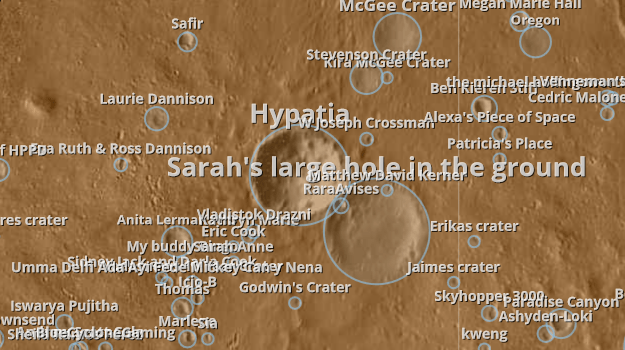
Mars_cratersNot only are there craters to name, but people can also help name the map grid rectangles of all the Districts and Provinces in Uwingu’s “address system” – which they say is the first ever address system for Mars. Prices for naming craters vary, depending on the size of the crater, and begin at $5 dollars apiece. For each crater a person purchases and names, Uwingu gives them a shareable Web link and a naming certificate.

In the past, Uwingu has been a source of controversy, particularly with the International Astronomical Union (IAU), which is responsible for naming celestial objects and planetary features. In general, they are opposed to Uwingu’s methods of selling naming rights to the public. As the organization states on their website:

The IAU is the internationally recognized authority for naming celestial bodies and surface features on them. And names are not sold, but assigned according to internationally accepted rules.
Mars_craters1But Alan Stern, NASA’s former science program and mission director, claims that Uwingu is independent. He also stated that in 50 years of Mars exploration, only about 15,000 features have ever been named. What’s more, he and the rest of the Uwingu team – which includes several space notables, historians and authors – know that the names likely won’t officially be approved by the IAU.

Nevertheless, they claim that they will be similar to the names given to features on Mars by the mission science teams (such as Mt. Sharp on Mars –the IAU-approved name is Aeolis Mons) or even like Pike’s Peak, a mountain in Colorado which was named by the public, in a way. As early settlers started calling it that, it soon became the only name people recognized. Uwingu hopes that their names will also stick, given time.

mountsharp_galecraterIn the past, Stern has admitted that having people pay to suggest names with no official standing is sure to be controversial, but that he’s willing to take the chance – and the heat – to try and innovative ways to provide funding in today’s climate of funding cuts. As he stated in a series of recent interviews:

Mars scientists and Apollo astronauts have named features on the Red Planet and the Moon without asking for the IAU’s permission… We’re trying to do a public good. It’s still the case that nobody in this company gets paid. We really want to create a new lane on that funding highway for people who are out of luck due to budget cuts. This is how we’re how we’re trying to change the world for a little better.

He also pointed out that Uwingu is independent, and that this map is one they are generating themselves through crowdfunding and public participation. Whether or not the names stick is anybody’s guess, but the point is that the process will not be determined by any single gatekeeper or authority – in this case, the IAU. It will reflect a new era of public awareness and involvement in space.

mars-mapIn the past, Uwingu’s procedure has been to put half of the money they make into a fund to be given out as grants, and since they are a commercial company, the rest of the money helps pay the their bills. So no matter what – even if you pitch a name and its outvoted by another, or the names just fail to stick when the cartographers finish mapping Mars – you’ll still be raising money for a good cause.

For those interested in naming a crater on the Red Planet, click on the link here to go to Uwingu’s website. Once there, simply click on a spot on the map, select the crater you want (the price for the crater is indicated when you select it), offer a name and explain why you’ve chosen it. And be sure to check out some of the one’s that have been named already.

Sources: news.cnet.com, universetoday.com, uwingu.com

News from Space: Biggest Lunar Explosion Ever Seen!

moon-asteroid-impact-1600Back in September of 2013, something truly amazing happened on the surface of the Moon. Granted, small objects impact with Earth’s only satellite all the time, hence its cratered surface. But this time around, Earth-based instruments observed an impact that was caused by an object the size of a small car, ten times bigger than any previously-recorded impacts.

The burst occurred on Sept. 11, 2013, at about 20:07 GMT in a area on the moon known as Mare Nubium, producing a flash that would have been visible from Earth. It was caused by a meteor that is believed to measure between 0.6- and 1.4-meters wide, weighed some 400 kg (880 pounds) and generated a crater with a diameter of about 40 meters.

Mars_impact_craterJudging from the explosion and the crater it left behind, scientists estimate that the rock hit Mare Nubium at a speed of 61,000 kph (38,000 mph), generating an explosion equivalent to roughly 15 tons of TNT. This beats the previous record, which occurred in March 2013 when a 40 kg meteoroid 0.3 or 0.4 meters wide struck the moon at about 90,000 km/hr (56,000 mph) and caused an explosion equivalent to 5 tons of TNT.

These findings appeared in the February issue of Monthly Notices of the Royal Astronomical Society (MNRAS), in a paper entitled “A large lunar impact blast on 2013 September 11”. According to the paper’s authors – Jose M. Madiedo, from the University of Huelva and Jose L. Ortiz, from the Institute of Astrophysics of Andalusia – the impact was the longest and brightest impact ever observed, as the “afterglow” remained visible for 8 seconds.

moonIn a subsequent press release, Madiedo and Ortiz said that:

Our telescopes will continue observing the Moon as our meteor cameras monitor the Earth’s atmosphere. In this way we expect to identify clusters of rocks that could give rise to common impact events on both planetary bodies. We also want to find out where the impacting bodies come from.

Knowing how often such collisions happen on the moon could be important for future lunar explorers, one reason why NASA has set up a specific program – Lunar Impacts, working out of the Marshall Space Flight Center – to study them. This campaign started in 2005 and has already proved that lunar impacts happen about 10 times more frequently than scientists previously expected.

Russian_meteorBecause the moon is our next-door neighbor, and a place where human beings may someday live in large numbers, knowing the frequency and severity of meteoric impacts is certainly important. These latest findings also suggests that the Earth might get hit more often than we previously thought by objects of a similar size. And given the damage associated with such impacts, knowing all we can is certainly prudent.

In the meantime, check out this outreach video provided by J.M. Madiedo (co-author of the MNRAS paper) that discusses this record-breaking lunar impact:


Source:
universetoday.com, wired.com, nasa.gov

News from Space: First Detailed Map of Ganymede

ganymedeLast week, researchers released the first-ever geological map of Ganymede, Jupiter’s largest moon and the largest planetary satellite in the Solar System. Led by Geoffrey Collins of Wheaton College, these scientists produced the first global geologic map that combines the best images obtained by NASA’s Voyager 1 and 2 spacecraft (1979) and the Galileo orbiter (1995 to 2003).

The information of these probes was pieced together as a mosaic image of the planet, giving us our first complete image of the geological features of the world. This image has now been published by the U. S. Geological Survey as a global planar map. The 2D version of the planet surface illustrates the varied geologic character of Ganymede and is the first global, geologic map of the icy, outer-planet moon.

ganymede_mapAnd its about time too! As Robert Pappalardo of NASA’s Jet Propulsion Laboratory in Pasadena, California put it:

This map illustrates the incredible variety of geological features on Ganymede and helps to make order from the apparent chaos of its complex surface. This map is helping planetary scientists to decipher the evolution of this icy world and will aid in upcoming spacecraft observations.

Since its discovery in January 1610 by Galileo Galilee, Ganymede has been the focus of repeated observation; first by Earth-based telescopes, and later by the flybys and orbiting spacecraft. These studies depict a complex, icy world whose surface is characterized by the striking contrast between the dark, very old, highly cratered regions, and the lighter, somewhat younger regions marked with an extensive array of grooves and ridges.

Ganymede-JupiterMoon-GeologicMap-SIM3237-20140211The map isn’t just aesthetically pleasing; it also informs our understanding of Ganymede’s geological history. Researchers have identified three geological periods – one involving heavy impact cratering, followed by tectonic upheaval, and then a decline in geological activity. The more detailed images let them study the ridges and groves, and have revealed that the formation of cryovolcanos is rare on Ganymede.

Baerbel Lucchitta, scientist emeritus at the U.S. Geological Survey in Flagstaff, Ariz., who has been involved with geologic mapping of Ganymede since 1980, had this to say:

The highly detailed, colorful map confirmed a number of outstanding scientific hypotheses regarding Ganymede’s geologic history, and also disproved others. For example, the more detailed Galileo images showed that cryovolcanism, or the creation of volcanoes that erupt water and ice, is very rare on Ganymede.

ganymede_ridges_craters_600According to the Jet Propulsion Laboratory, Ganymede is an especially valuable body to study because it is an ice moon with a richly varied geology and a surface area that is more than half as large as all the land area on Earth. The Ganymede map will also enable researchers to compare the geologic characters of other icy satellite moons, since most features found on other icy satellites have a similar feature somewhere on Ganymede.

Laszlo Kestay, the director of the United States Geological Survey (USGS) Astrogeology Science Center, explained the implications of this in a statement:

After Mars, the interiors of icy satellites of Jupiter are considered the best candidates for habitable environments for life in our solar system. This geologic map will be the basis for many decisions by NASA and partners regarding future U.S. missions under consideration to explore these worlds.

The project was funded by NASA through its Outer Planets Research and Planetary Geology and Geophysics Programs, and the images can all be downloaded by going to the Jet Propulsion Laboratory’s website at the California Institute of Technology (Caltech). And be sure to check out the animated version of the Ganymede planetary map below:


Sources:
IO9.com, (2), jpl.nasa.gov, space.com

New Video: Quantum Entanglement Explained

quantum-entanglement1If you’re like most people, the concept of quantum entanglements confuses and perplexes you. But considering its important to quantum science, the future of computing and (maybe, just maybe) space travel, it’s something we should all strive to understand. Luckily, this educational video produced by PHD Comics, and narrated by physicists Jeff Kimble and Chen-Lung Hung, explains it in easy-to-understand terms.

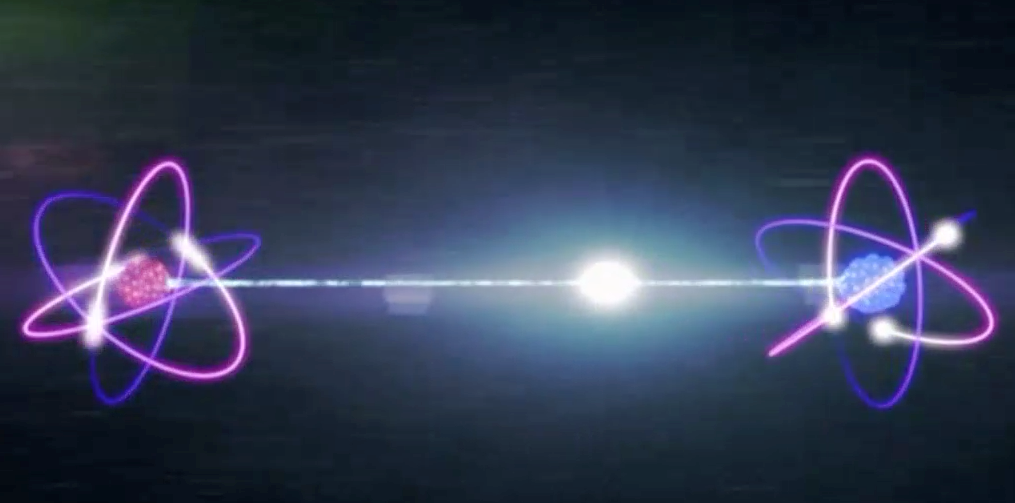
To break it down succinctly, quantum entanglement is the unusual behavior where elementary particles become linked so that when something happens to one, something happens to the other; no matter how far apart they are. This bizarre behavior of particles that become inextricably linked together is what Einstein supposedly called “spooky action at a distance.”

Understanding how this works may very well unlock the mysteries of the universe, shedding light on the unusual behavior of black holes, how gravity interacts with the other fundamental forces and yielding a Grand Unifying Theory/Theory of Everything (TOE)- and even let us circumvent “natural” barriers like the speed of light. So enjoy the video, and be sure to listen carefully. Simplified or not, this is still some pretty heavy stuff!


Source: universetoday.com

News From Space: Asteroid Misses Earth (Again!)

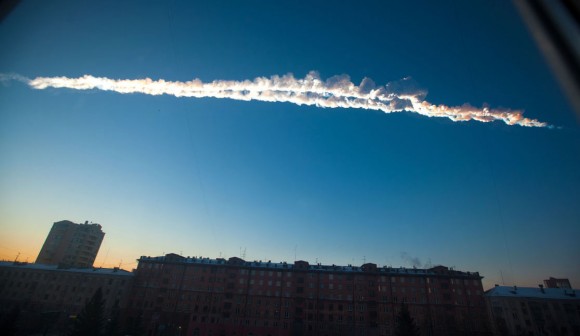
2000EM26_1Yesterday, an asteroid estimated to be the size of three football fields passed Earth by. Traveling at 43,000 kilometers per hour and passing at a distance of 8.8 lunar distances of Earth, the asteroid showed up just one year after a similar asteroid exploded over Russia and injured 1,200 people. The only problem was, the good people of Earth missed the show!

Slooh, an online “community observatory” that streams images from ground-based telescopes online during celestial events, was supposed to broadcast the approach of the asteroid as it raced past the planet, starting at 9 p.m. ET (2 a.m. MT).  Unfortunately, Slooh’s flagship observatory on Mount Teide in Spain’s Canary Islands was iced over and unable to catch the asteroid – named 2000 EM26 – as it passed us by.

2000EM26_2014_logoShortly thereafter, Slooh’s robotic telescope tried to snap pictures attempted to snap pictures of the asteroid but failed to capture an image at the predicted position. And now, the asteroid has gone missing in the deep sea of space, giving rise to the nickname “Moby Dick”. This means that either the asteroid’s predicted path was in error, or the object was much fainter than expected.

Paul Cox, Slooh’s technical and research director, said that the asteroid should be somewhere in the visible star field. And rather than accept failure at retracing its path, he and the other folks at Slooh are calling upon amateur astronomers to conduct a photographic search for it in the next few nights. Finding it is not just a matter of honor, but of determining how much the space rock has shifted over time.

2000EM26_2Since the asteroid was last observed 14 years ago for only 9 days, it isn’t too surprising that uncertainties in its position could add up over time, shifting its position and path to a different part of the sky by now. As Cox pointed out:

Discovering these Near Earth Objects isn’t enough. As we’ve seen with 2000 EM26, all the effort that went into its discovery is worthless unless follow­up observations are made to accurately determine their orbits for the future.  And that’s exactly what Slooh members are doing, using the robotic telescopes at our world­-class observatory site to accurately measure the precise positions of these asteroids and comets.

Naturally, there were some who worried that this elusive rock might threaten Earth, given its proximity to our own orbit and the fact that it’s path may have changed. But there is no reason to fear, as these changes are not likely to bring it into our path and it won’t be returning anytime soon. And before it does, we ought to have eyes on it again and be able to accurately chart its course.

2000EM26And above all, similar sized asteroids, including ones passing even closer to Earth, zip by every month. 2000 EM26 received a lot of coverage yesterday in part because it arrived close to the anniversary of the Chelyabinsk meteorite fall over Russia. And though it remains hidden for now, eyes are on the sky to find the asteroid again and refine its orbit.

Hopefully the beast won’t get away next time!


Sources: cbc.ca, universetoday.com

News From Mars: Jelly Donut Rock Mystery Solved

mars_donut1In the course of investigating the surface of Mars, NASA has uncovered some rather interesting and curious rock formations. And if once in awhile those rocks should resemble something odd and Earth-like then one should expect the media maelstrom that follows. And the sudden appearance of what people referred to as the “jelly doughnut” rock in January was no exception to this rule.

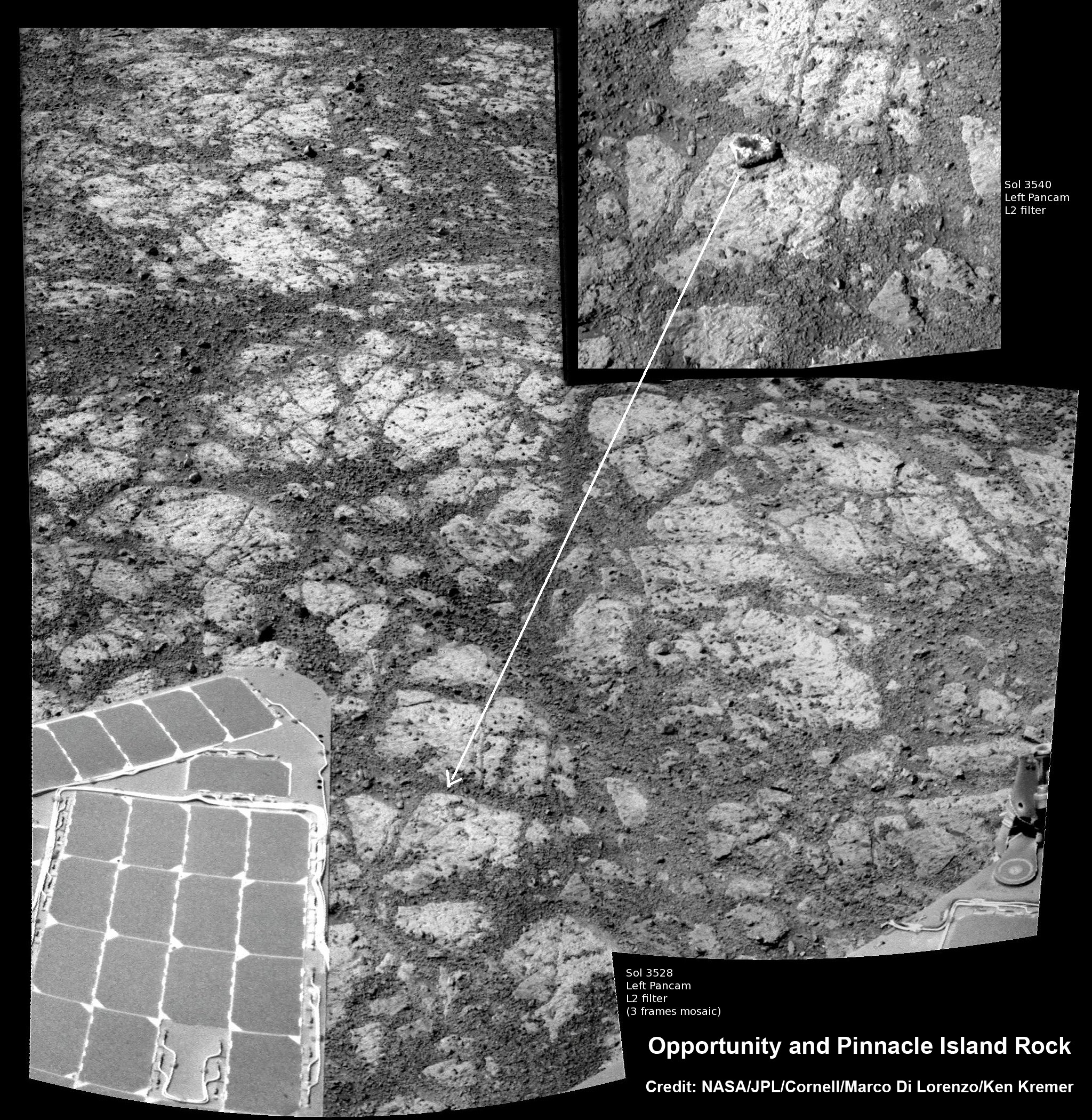
Much the Martian “rat” discovered last summer, the appearance of the doughnut rock was met with all kinds of speculation. The rock – now dubbed “Pinnacle Island” – first appeared on January 8th in a series of pictures taken by the Opportunity Rover. Measuring only about 4 centimeters (1.5 inches) in diameter with a noticeable white rim and red center, the rock quickly picked up the nickname “jelly doughnut”.

mars_donutAccording to pictures taken just four days earlier by Opportunity, during which time it had not moved an inch, that area had been free of debris. In response, wild theories began to emerge, with some thinking it was an indication that rocks were falling from the sky. Others, looking to explain how something so odd in appearance could suddenly have appeared, claimed it was a heretofore undetected Martian surface beings.

Luckily, the ongoing work of mission scientists solved the by determining that the rock was actually created by an “alien invader” – the Opportunity Rover! Apparently, the mysterious rock was created when Opportunity unknowingly drove over a larger rock formation on Solander Point, where she is currently located. It then crushed the rock, sending fragments across the summit.

Opportunity-Route-map_Sol-3560_Ken-KremerOne piece, the ‘Pinnacle Island’ fragment, unwittingly rolled downhill where Opportunity caught it on camera a few days later. This explanation became apparent when the Opportunity was moved a tiny stretch and took some look-back photographs. Another fragment of the rock that was eerily similar in appearance to the ‘Pinnacle Island’ doughnut appeared, indicating that it had left a trail of such debris in its wake.

Ray Arvidson, Opportunity’s Deputy Principal Investigator, explained in a recent NASA statement:

Once we moved Opportunity a short distance, after inspecting Pinnacle Island, we could see directly uphill an overturned rock that has the same unusual appearance. We drove over it. We can see the track. That’s where Pinnacle Island came from.

Opportunity-and-Pinnacle-Island_Sol-3540_1_Ken-KremerTo gather some up-close clues before driving away, the rover deployed its robotic arm to investigate ‘Pinnacle Island’ with her microscopic imager and APXS mineral mapping spectrometer. According to Arvidson, the results revealed high levels of the elements manganese and sulfur which suggest that:

[these] water-soluble ingredients were concentrated in the rock by the action of water. This may have happened just beneath the surface relatively recently, or it may have happened deeper below ground longer ago and then, by serendipity, erosion stripped away material above it and made it accessible to our wheels.

The Solander Point mountaintop is riven with outcrops of minerals, including clay minerals, that likely formed in flowing liquid neutral water conducive to life – a potential scientific goldmine. Thus, the presence of such water-soluble minerals in this particular rock indicates quite strongly that the Opportunity brought it with her while rolling through the area.

mars-map

Meanwhile, on the opposite side of Mars, Opportunity’s younger sister rover Curiosity is trekking towards gigantic Mount Sharp and just crested over the Dingo Gap sand dune. She celebrated 500 days (Sols) on Mars on New Years Day, 2014. And a pair of new orbiters are streaking to the Red Planet to fortify Earth’s invasion fleet- NASA’s MAVEN and India’s MOM.

So expect more surprises from the Red Planet soon enough, which will include more information on surface conditions and the history of Mars’ atmosphere and how it disappeared. And maybe, just maybe, one of the rovers will uncover the existence of the long-sought after organic molecules – thus demonstrating unequivocally that life still exists on Mars.

Stay tuned!


Source: universetoday.com

News From Space: Hawkings’ U-Turn on Black Holes

blackholeA recent paper published by Hawking, in which he reversed himself on several of his previous theories about black holes, has created quite a stir. In fact, his new found opinions on the subject have been controversial to the point that Nature News declared that there is no such thing as black holes anymore. This, however, is not quite what Hawking has claimed.

But it is clear that Hawking, one of the founders of modern theories about black holes, now believes that he he may have been when he first proposed his ideas 40 years ago. Now, he believes that black holes may NOT be the the final graveyard for matter that gets sucked in by the gravitational pull caused by a collapsing star, or that they prevent light from escaping.

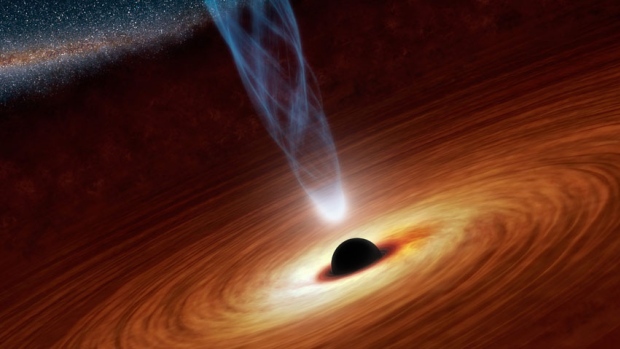
stephen_hawkingBasically, he was wrong in how he attempted to resolve the paradox of black holes, because apparently they don’t exist. It all comes down to what is known as the “firewall paradox” for black holes.  The central feature of a black hole is its event horizon, the point of no return when approaching a black hole.  In Einstein’s theory of general relativity, the event horizon is where space and time are so warped by gravity that you can never escape.


This one-way nature of an event horizon has long been a challenge to understanding gravitational physics.  For example, a black hole event horizon would seem to violate the laws of thermodynamics, which state that nothing should have a temperature of absolute zero.  Even very cold things radiate a little heat, but if a black hole traps light then it doesn’t give off any heat and would have a temperature of zero.

quantum_entanglementThen in 1974, Stephen Hawking demonstrated that black holes do radiate light due to quantum mechanics. In quantum theory, the exact energy of a system cannot be known exactly, which means it’s energy can fluctuate spontaneously so long as its average remains constant. What Hawking demonstrated is that near the event horizon, pairs of particles can appear where one becomes trapped while the others escape as radiation.


While Hawking radiation solved one problem with black holes, it created another problem – aka. the firewall paradox. When quantum particles appear in pairs, they are entangled; but if one particle is captured by the black hole, and the other escapes, then the entangled nature of the pair is broken. In quantum mechanics, the particle pair would be described as in a “pure state”, and the event horizon would seem to break that state.

blackhole_birthLast year it was shown that if Hawking radiation is in a pure state, then either it cannot radiate in the way required by thermodynamics, or it would create a firewall of high energy particles near the surface of the event horizon.  According to general relativity, if you happen to be near the event horizon of a black hole you shouldn’t notice anything unusual.

In his latest paper, Hawking proposed a solution to this paradox by proposing that black holes don’t have event horizons. Instead they have apparent horizons that don’t require a firewall to obey thermodynamics, hence the declaration of “no more black holes” in the popular press. However, all these declarations may be a bit premature, as the problem Hawking’s sought to address may not exist at all.

black-holeIn short, the firewall paradox only arises if Hawking radiation is in a pure state. And in a paper presented last month by Sabine Hossenfelder of Cornell University shows that instead of being due to a pair of entangled particles, Hawking radiation is due to two pairs of entangled particles. One entangled pair gets trapped by the black hole, while the other entangled pair escapes.

The process is similar to Hawking’s original proposal, but the Hawking particles are not in a pure state, which means there’s no paradox to be had.  Black holes can radiate in a way that agrees with thermodynamics, and the region near the event horizon doesn’t have a firewall, just as general relativity requires.  So basically, Hawking’s proposal is a solution to a problem that doesn’t exist.

FTL_MEWith black holes, its always two step forwards, one step back. And this is hardly the only news in recent months when it comes to these mysterious and confounding phenomena. I imagine that the new theory from MIT, which states that wormholes may exist between black holes and be responsible for quantum entanglements (and resolve the problem of how gravity works) may also need revision next!

Too bad too. I was so looking forward to a universe where FTL wasn’t junk science…

Sources: universetoday.com, cbc.ca

The Future is Here: The Holodeck Video Trainer

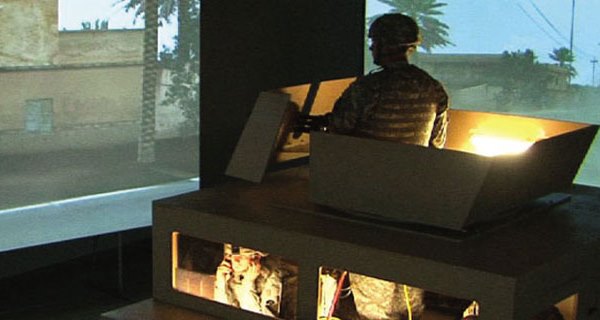
VIPE1A current obsession of military planners is keeping up with the latest in battlefield challenges while also dealing with troop reductions and tightened budgets. Video games are one solution, providing soldiers with  training that does not involve real munitions or loss of equipment. Unfortunately, most of these games do not provide a real-world immersive feel, coming as close to the real thing as possible while still being safe.

Hence why the the Army Contracting Command enlisted the help of Northrop Grumman this past January to integrate their Virtual Immersive Portable Environment (VIPE) “Holodeck” into the US Army’s training program. Much like the CAVE2, a VR platform created by the Electronic Visualization Laboratory (EVL) at the University of Illinois, this latest holodeck is a step towards fully-realized VR environments.

VIPE_HolodeckUsing commercial, off-the-shelf hardware combined with gaming technology, the VIPE Holodeck virtual training system provides users with a 360 degree, high-fidelity immersive environment with a variety of mission-centric applications. It can support live, virtual and constructive simulation and training exercises including team training, cultural and language training and support for ground, air and remote platform training.

Last year, the VIPE Holodeck took first place in the Federal Virtual Challenge – an annual competition led by the U.S. Army Research Laboratory’s Simulation and Training Technology Center – for the system’s Kinect integration navigation sensor, which gives users the ability to crawl, walk, run, stop, jump, and move side to side in the virtual environment.

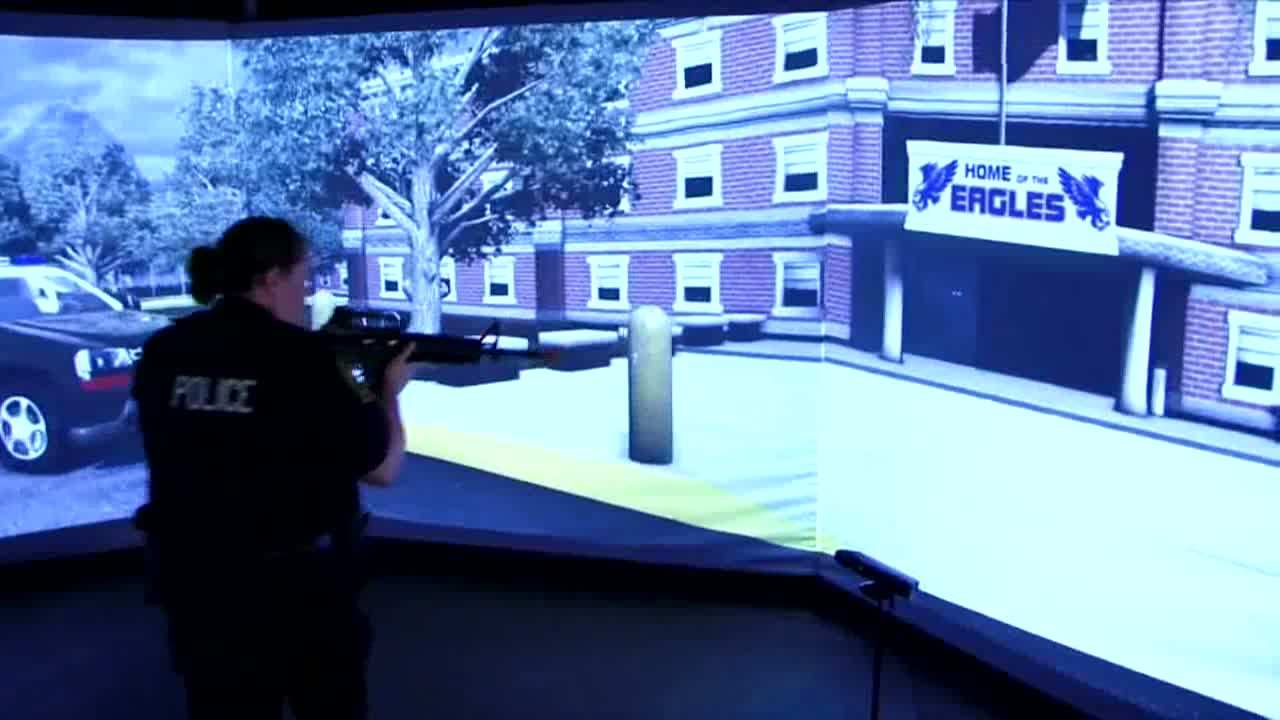
?????????????????????????????????According to Northrop, the VIPE Holodeck moves ahead of other virtual simulators thanks to its advanced situational training, where service members can walk through an area in the replicated virtual environment and prepare for what they may encounter in real life. This works not only for infantry and target practice, but for vehicle drivers and police officers looking to simulate various situations they are likely to encounter.

To enhance that training, operators can drop threats into the environment, including IEDs and enemy shooters, as well as signals that should tip them off to potential threats and see how they respond before they actually find themselves in that situation. This sort of versatile, multi-situational complexity is precisely what the Army is looking for.

VIPE3Brig. Gen. Michael Lundy, deputy commanding general at the Army Combined Arms Center, said during the AUSA Aviation symposium earlier this month:

For us to be able to execute realistic training — good training — we have to be able to bring that operational environment [into the virtual world]. We want to get away from having multiple environments, virtual gaming and instruction, and go to one synthetic environment, get to a lower overhead and integrate the full operations process … according to the common operating picture.

But looking ahead, the applications for this type of technology are virtually (no pun!) limitless, never mind the fact that we are realizing something directly out of Star Trek. Northrop says it’s also exploring options for VIPE as a stepping stone to live-training within the medical field, as well as law enforcement and first responders for situations such as live-shooter or hostage scenarios.

ESO2Immersive virtual reality also figures quite prominently in NASA’s and other space agencies plans for future exploration. Given that manned missions are expensive, time-consuming, and potentially dangerous, mission planners are investigating Telexploration as a possible alternative. Here, orbiters and rovers would transmit visual information in real-time, while VR decks would be used to give the appearance of being on location.

As Ryan Frost, Northrop’s program manager for the VIPE Holodeck, put it:

The great thing about virtual reality and gaming technology [is that] it’s moving so rapidly that really it has endless possibilities that we can do. If you can think it, we can create it, eventually.

And be sure to check out this video from Northrop Grumman showing the VIPE Holodeck in action:


Sources:
wired.com, northropgrumman.com

News From Mars: New Impact Crater and Landslides

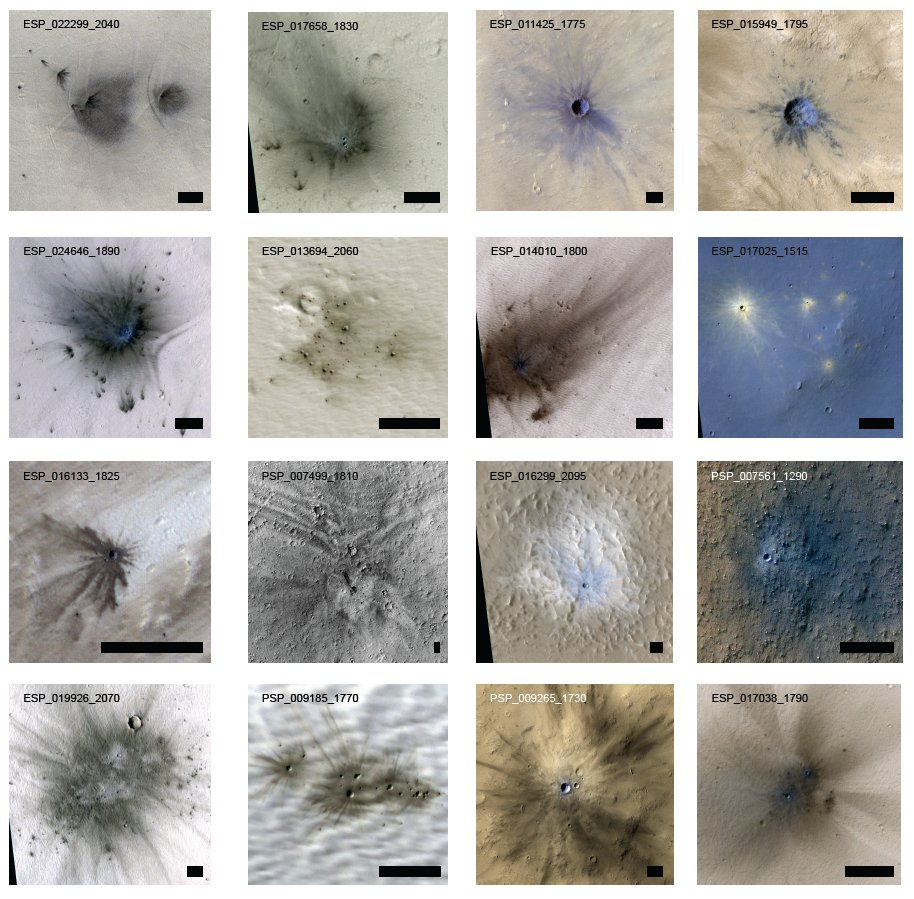
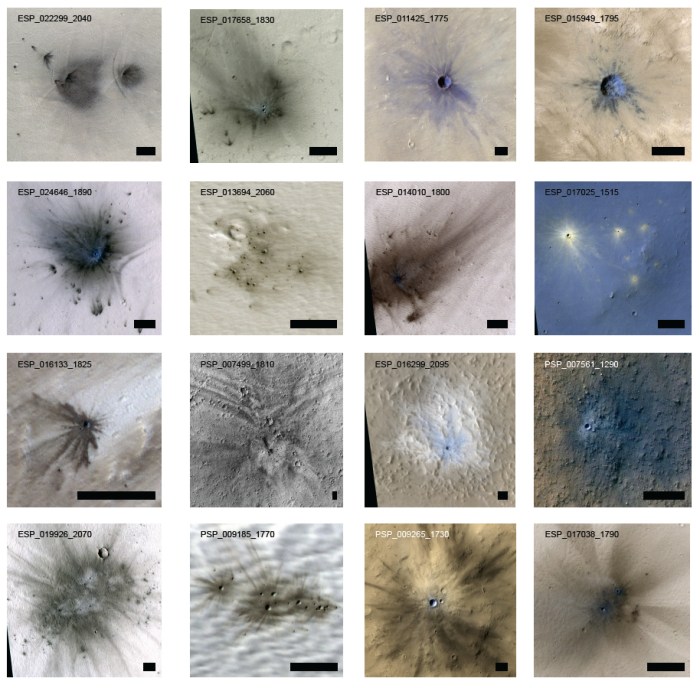
Mars_impact_craterThe Mars Reconnaissance Orbiter, which has been in operation around Mars since March of 2006, has provided ongoing observation of the planet. Because of this, scientists and astronomers have been able to keep track of changes on the surface ever since. This new impact crater, which was formed by a recent meteor impact, is just the latest example.

The image was taken by the Orbiter’s High Resolution Imaging Science Experiment (HiRISE) camera on Nov. 19, 2013. Since that time, NASA scientists have been working to enhance the image and rendering it in false color so the fresh crater appears.The resulting image shows the stunning 30-meter-wide crater with a rayed blast zone and far-flung secondary material surrounding.

Mars_Reconnaissance_OrbiterResearchers used HiRISE to examine this site because the orbiter’s Context Camera had revealed a change in appearance here between observations in July 2010 and May 2012, when the impact was thought to have occurred. After examining the impact site, scientists estimate the impact and resulting explosion threw debris as far as 15 kilometers in distance.

Before-and-after imaging that brackets appearance dates of fresh craters on Mars has indicated that impacts producing craters at least 12.8 feet (3.9 meters) in diameter occur at a rate exceeding 200 per year globally. But most of those are much smaller than this new one, and leave scars are as dramatic in appearance. This latest impact was definitely one for the history books.

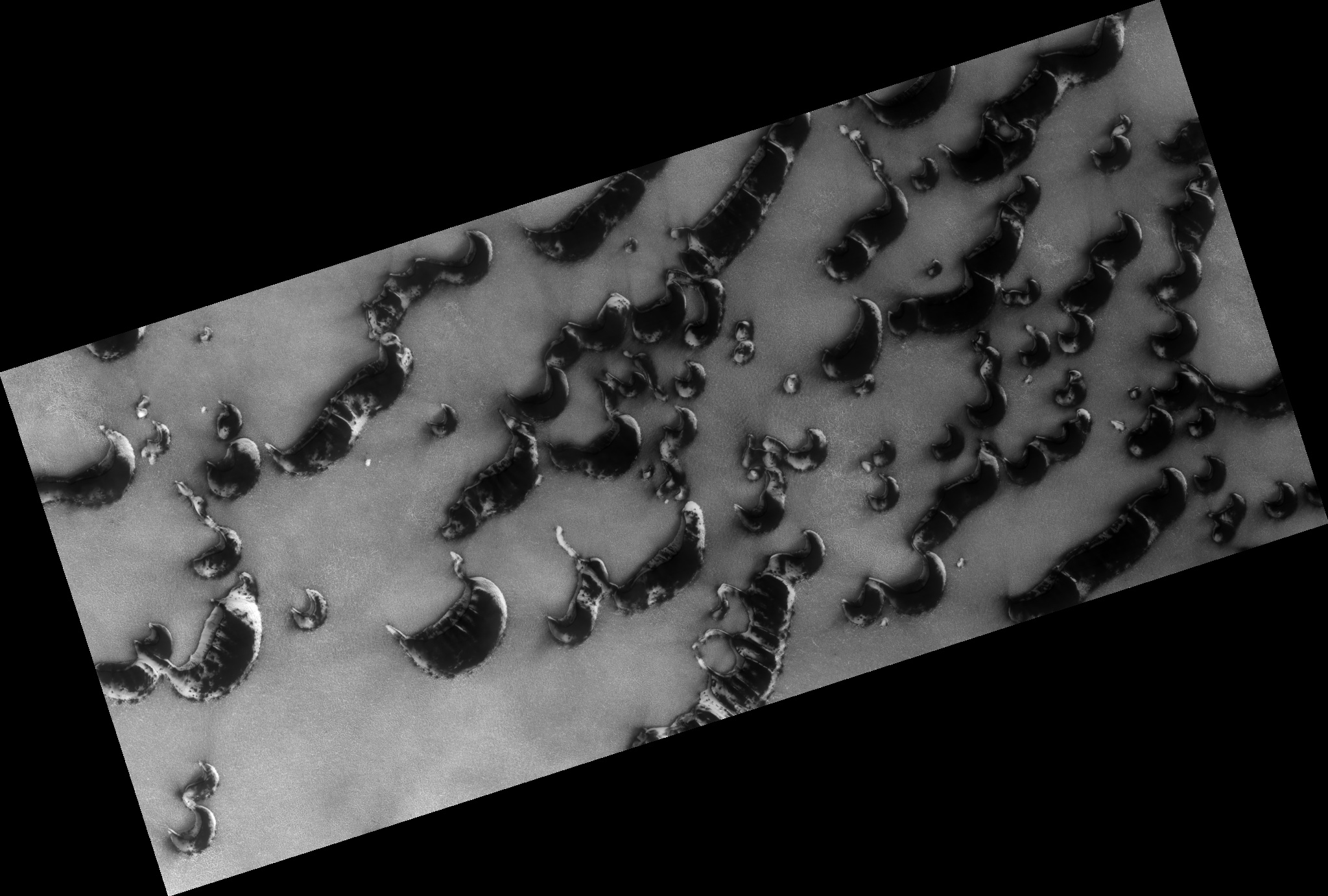
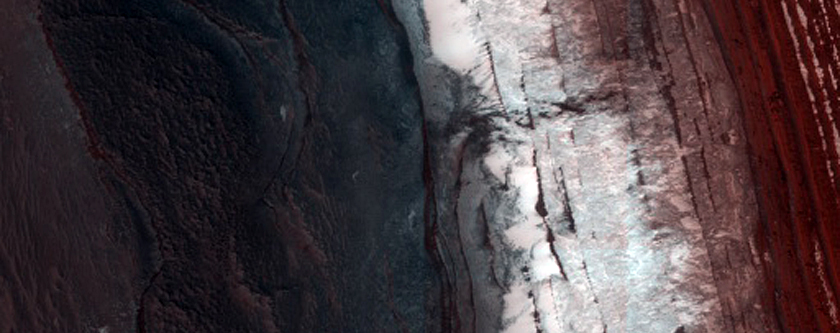
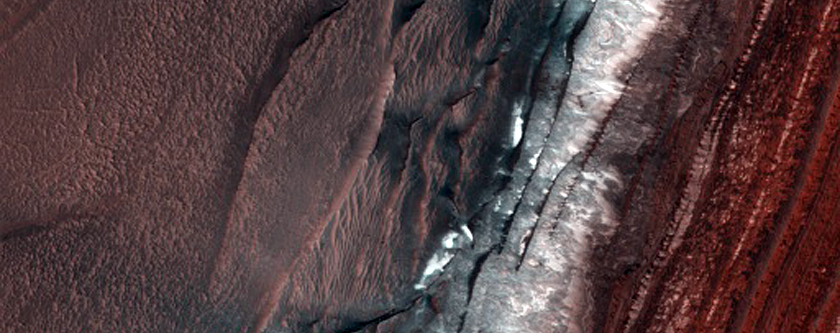
Mars_dunesSpeaking of dramatic, these recent releases from the HiRISE laboratory captured some truly magnificent activity, which included a series of avalanches and defrosting dunes on the surface. Snow, dust and wind are combining to make the incredible images that were captured. The raw images appear in black and white (as the snowy dunes pictured above).

The colorized versions, as show below, indicate the presence of snow, ice and red surface dust. These latest pictures, perhaps more than any previous, illustrate the awe and wonder the Red Planet holds. And as humanity’s contact and involvement with the planet and continues, they remind us that nothing from that world is to be taken for granted.

mars_avalanche mars_avalanche1 mars_avalanche2 mars_avalanche3And as we get closer to 2030, when a manned mission is scheduled to take place – not to mention private missions that aim to put colonists there by 2023 – chance encounters with the surface like this are certain to inspire excitement and anticipation. Right now, these events and surface features are being watched from above or by rovers on the surface.

But someday soon, people will be standing on the surface and looking upon it with their own eyes. Their feet will be crushing into red sand, romping through Martian snow and ice, and standing in the middle of craters and looking up at Olympus Mons. What will they be thinking as they do it? We can only wonder and hope that we’ll be able to share it with them…