
 No one likes the idea of having to clean their homes or living spaces. Its time consuming, repetitive, and never seems to end. But thanks to some new concepts, which were featured this year at the Electrolux Design Labs competition, a day may be coming when all such maintenance can be handled by machines, and not the large, bulky kinds that are often featured in sci-fi shows and novels.
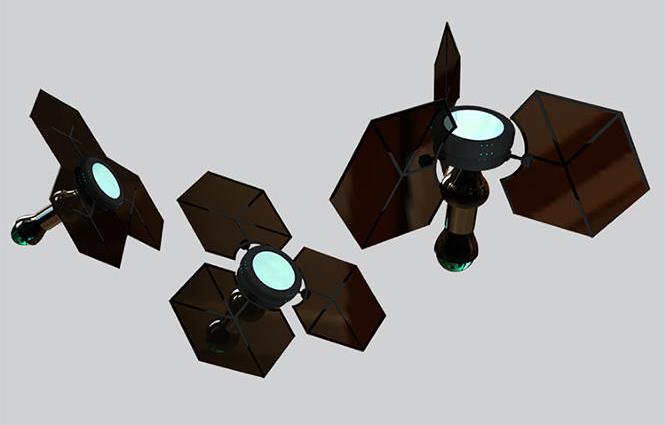
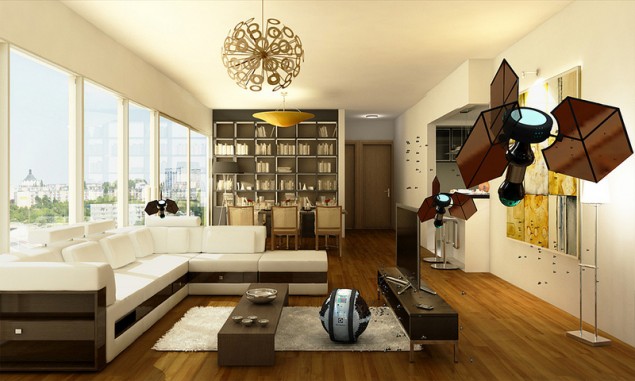
Instead, the new concept for household cleaning robots focuses on the growing field of swarm robotics. That was the concept behind Mab, a series to tiny robots that fly around the house and determine what needs cleaning. Designed by Adrian Perez Zapata, a 23-year old student from Bolivia, the Mab concept utilizes swarm programming to allow all 908 of its insect-like robots to carry out group functions.
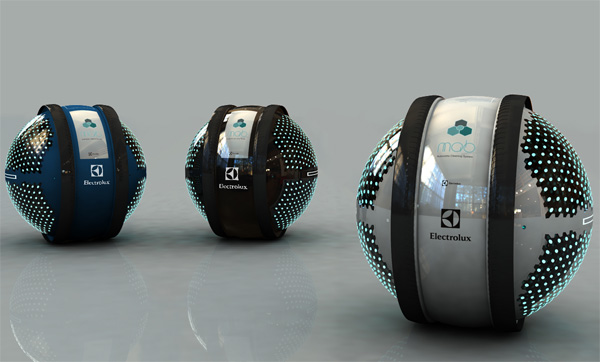 Each of the tiny robots lives within a spherical core (picture above), and once they are released, they venture out and depositing tiny amounts of water and cleaning solution onto surfaces that have been identified as dirty. Then, having sucked up the dirty liquid, the swarm returns to their core where they unload and await further instructions or the next schedules cleaning cycle.
The robots fly around by means of several tiny, spinning propellers, and their energy comes from built-in solar panels and a battery unit that is recharged whenever they are in the core unit. Zapata claimed that he derived much of his inspiration for the design from the “robo-bee” research being conducted at Harvard, but initially got the idea from watching actual insects at work one day:
I was in my university gardens when I observed the controlled flight of bees pollinating a flower, and how magical it is to see swarms of bees working together. My concept Mab only requires a short initial configuration to function autonomously, so you could arrive home and see a swarm of mini-robots roaming around cleaning independently. This means you could sit back and relax, as you observe with great astonishment the little Mab fairies working their magic.
 Zapata’s design won first place in the 2013 Electrolux Design Labs competition, an annual contest created to encourage designer students from all over the world to come up with ideas and solutions for future living. This year’s theme was Inspired Urban Living, featuring three focus areas to choose from: Social Cooking, Natural Air and Effortless Cleaning, and drew some rather impressive ideas!
For example, second place went to Luiza Silva of Brazil for her design concept known as Atomium, a home 3-D printer for food that uses molecular ingredients to construct food layer by layer. You simply draw the shape of the food you would like to eat and show it to the Atomium, which then scans the image and prints the specified food in the desired shape.
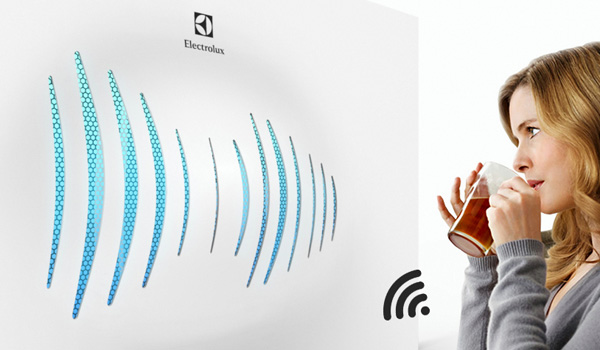
 Third place went to Jeabyun Yeon from South Korea for the Breathing Wall, an “air cleaning concept which pulsates and changes shape as it cleans the air.” Inspired by fish gills, It can also be customized to suit individual needs as it scents the air you breathe and changes color according to your choice.
After that, the finalists included: Nutrima, a device for instantly assessing food’s nutritional value and possible toxicity; Kitchen Hub, an app to keep track of food in the fridge, encourage healthy eating, and reduce waste; OZ-1, an air purifier worn as a necklace; 3F, a shape-shifting autonomous vacuum cleaner; and Global Chef, a hologramatic device for bringing virtual guests to the dinner-table.
 Taken together, these small bits of innovation are indicative of a much larger trend, where touchscreens, 3-D printing, scanners, swarm robots, and smart environments address our needs in ways that are intuitive, automated, efficient, and very user friendly. The only downside… they are likely to make us ever lazier than we already are!
In the meantime, check out these videos of the Mab, Atomium, Breathing Wall, and other cool inventions that were featured at the 2013 Electrolux Design Labs competition:
Mab:
Atomium:
Breathing Wall:
Nurtima:
Kitchen Hub:
OZ-1:
3F:
Global Chef:
Sources: fastcoexist.com, (2), electroluxdesignlabs.com





 For several decades now, the widely accepted theory is
 To do this, DarkLight will use the particle accelerator at the Jefferson
 But if we can pinpoint the basis of dark matter, it would be a monumental finding that would greatly our enhance our understanding of the universe, and dwarf even the discovery of the Higgs Boson. After that, the only remaining challenge will be to find a way to observe and understand the other 68% of the universe!
 For some time now, classroom cameras have been used to see what teachers do in the course of their lessons, and evaluate their overall effectiveness as educators. But thanks to a recent advances in facial recognition software, a system has been devised that will assess teacher effectiveness by turning the cameras around and aiming at them at the class.
 After a lesson, a teacher could boot up EngageSense and see, with a glance at the dashboard, when students were paying rapt attention, and at what points they became confused or distracted. Beyond that, the concept is still being refined as SensorStar Labs looks both for funding and for schools to give EngageSense a real-world trial.
 At the present time, the biggest obstacle would definitely be privacy concerns. While the software is designed for engaging student interest right now, it would not be difficult at all to imagine the same technology applied to police interrogations, security footage, or public surveillance.
 And these connections are extensive, with more than 550,000 fiber optic cables running along the ocean floor that are responsible for transmitting trillions upon trillions of interactions per day. According to the Washington Post, these cables “wrap around the globe to deliver emails, web pages, other electronic communications and phone calls from one continent to another.”
 Given our immense and increasing reliance on the internet for business, personal communications, entertainment and shopping, one would that we as a people would possess at least a passing knowledge of how it works. But as Eric Schmidt, Google’s executive chair, claimed in his book The New Digital Age: “The internet is among the few things humans have built that they don’t truly understand.”
 And just in case this doesn’t provide a clear picture, there are numerous images that have been created by organizations like Telecom Maps and The Fiber Optic Association. These show just how immense, extensive, and crisscrossed the cables that bring us all our emails, videos, blog feeds, and ability to surf are.

 The resulting haze measured 1000 micrograms per cubic meter. That’s three times the concentration deemed hazardous by the World Health Organization, and many dozen times what is considered safe. To remedy the situation, city authorities are now coordinating with Dutch designer Daan Roosegaarde to launch what he calls an “electronic vacuum cleaner” to suck up 50 meter-high cylinders of polluted air.
 Roosegaarde has had experience working with electrostatic fields in the past. Last year, he proposed using electromagnetic charging strips to charge cars on “smart,” communication-enabled highways, which won the designer an INDEX award in 2013. He also claims the project is safe, “pacemaker proof”, and really no different than the waves of WiFi downtown areas are already inundated with.
 As for the resulting particles that are collected from the air, Roosegaarde believes they could be refashioned into useable products, such as jewelry. But as he himself put it, the concept is about dealing with a serious problem in a practical, new way:





 Stories by Williams