The Future is Here: The 3D Scanner!

makerbot3dOkay, that title might be a bit of a mislead, but after years of developing the technology, it seems that we might have something which is essentially the next best thing. Until recently, 3D printers were designed for use exclusively by trained technicians. And despite the ease with which modern 3D printers can be used, it is still difficult to design and prep the requisite models, which still requires expertise in modelling software.

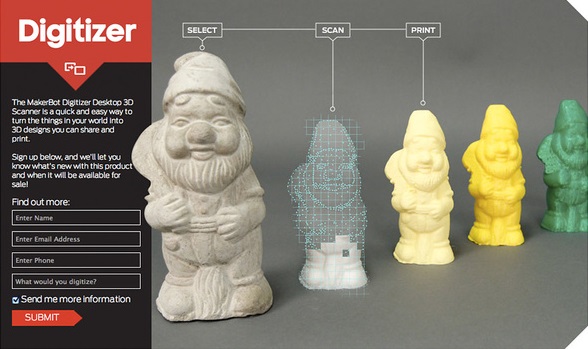
But that too could be changing, thanks to the new MakerBot’s Digitizer Desktop 3D Scanner. Designed to supplement their printer (the Replicator 2) this device is capable of scanning any object, creating a three-dimensional model, and then uploading it to your printer where it will then be molded into solid form, bit by bit. In effect, people can now create objects as easily as they could print off an inkjet document.

makerbot-replicator2The Digitizer was revealed for the first time at the South by South West (SXSW) Conference in Austin, Texas earlier today, where emerging technologies are being showcased alongside the latest in entertainment and music. And while the device was merely a prototype, one which is still undergoing testing and refining, MakerBot announced that they plan to begin commercial production very soon.

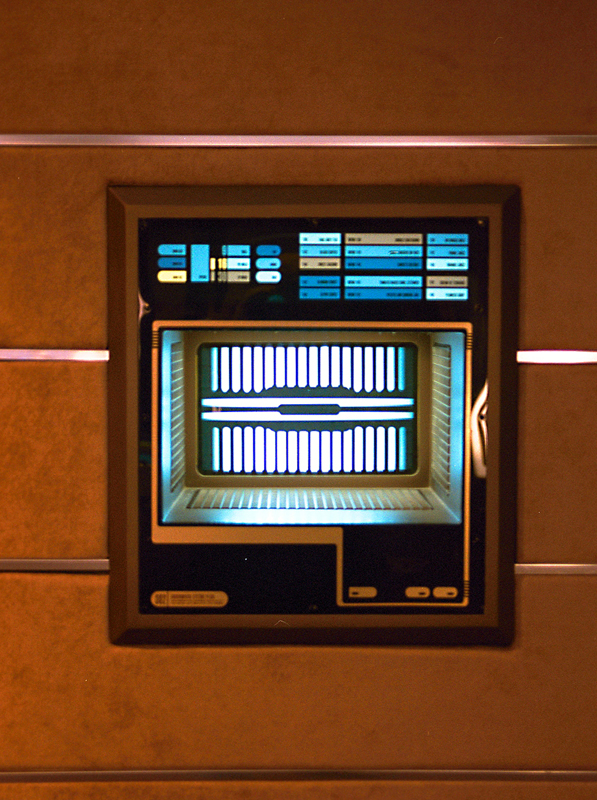
Which makes it official. Human beings now have access to Replicator technology and is one step closer to living in a Star Trek universe! Granted, were not quite to the point where we can generate anything, including food and precious metals, but this latest development has revealed to us a future where DIY can encompass just about anything. If a an appliance breaks in your home, just scan the faulty component and download it into your printer. No need to contact the manufacturer and activate that troublesome warranty!

Foods comes out here
Foods comes out here, waste goes in the recycling unit!

Naturally, there are concerns about the controversy this will create as well. While the Digitizer Desktop 3D Scanner will certainly be another big step towards making 3D printing more accessible, it’s also sure to add fuel the debate over the legality and copyright issues of duplicating real world objects. What’s more, the cost of each unit (most likely a few thousand dollars each) is pretty prohibitive for most households, raising the question of real access.

Nevertheless, this is still pretty exciting news. Since the beginning of recorded history, our collective economic models have been based on the idea of resource scarcity. But with further refinements and the ability to generate objects out of more materials (including the organic), all our economic models are likely to change and we could very well be embarking on a future where scarcity has effectively become obsolete.

Yes, with a little more time, research and cool gadgets, we could be witnessing the collapse of financial history. Where all units of value will be made useless and as a species, we’ll be one step closer to economic equilibrium! And I have to admit, this is one area of change that I find exciting, as opposed to scary!

Source: Gizmodo.com

The Singularity: The End of Sci-Fi?

singularity.specrepThe coming Singularity… the threshold where we will essentially surpass all our current restrictions and embark on an uncertain future. For many, its something to be feared, while for others, its something regularly fantasized about. On the one hand, it could mean a future where things like shortages, scarcity, disease, hunger and even death are obsolete. But on the other, it could also mean the end of humanity as we know it.

As a friend of mine recently said, in reference to some of the recent technological breakthroughs: “Cell phones, prosthetics, artificial tissue…you sci-fi writers are going to run out of things to write about soon.” I had to admit he had a point. If and when he reach an age where all scientific breakthroughs that were once the province of speculative writing exist, what will be left to speculate about?
Singularity4To break it down, simply because I love to do so whenever possible, the concept borrows from the field of quantum physics, where the edge of black hole is described as a “quantum singularity”. It is at this point that all known physical laws, including time and space themselves, coalesce and become a state of oneness, turning all matter and energy into some kind of quantum soup. Nothing beyond this veil (also known as an Event Horizon) can be seen, for no means exist to detect anything.

The same principle holds true in this case, at least that’s the theory. Originally coined by mathematician John von Neumann in the mid-1950’s, the term served as a description for a phenomenon of technological acceleration causing an eventual unpredictable outcome in society. In describing it, he spoke of the “ever accelerating progress of technology and changes in the mode of human life, which gives the appearance of approaching some essential singularity in the history of the race beyond which human affairs, as we know them, could not continue.”

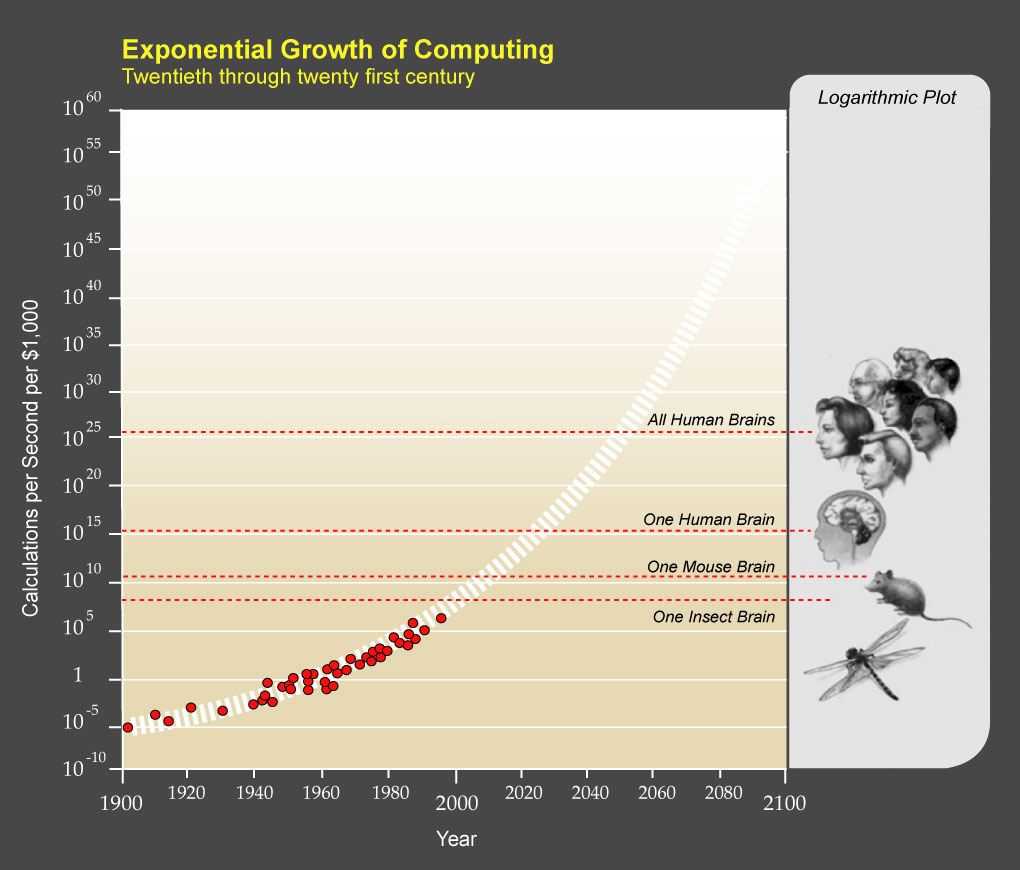
exponential_growth_largeThe term was then popularized by science fiction writer Vernor Vinge (A Fire Upon the Deep, A Deepness in the Sky, Rainbows End) who argued that artificial intelligence, human biological enhancement, or brain-computer interfaces could be possible causes of the singularity. In more recent times, the same theme has been picked up by futurist Ray Kurzweil, the man who points to the accelerating rate of change throughout history, with special emphasis on the latter half of the 20th century.

In what Kurzweil described as the “Law of Accelerating Returns”, every major technological breakthrough was preceded by a period of exponential growth. In his writings, he claimed that whenever technology approaches a barrier, new technologies come along to surmount it. He also predicted paradigm shifts will become increasingly common, leading to “technological change so rapid and profound it represents a rupture in the fabric of human history”.
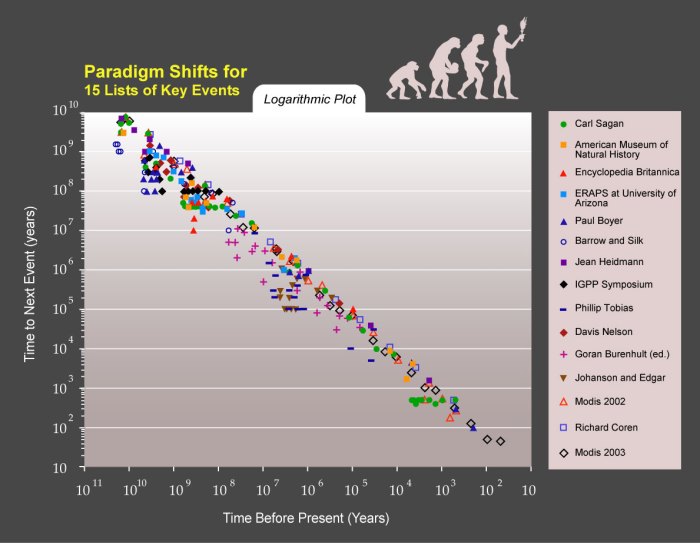
kurzweil-loglog-bigLooking into the deep past, one can see indications of what Kurzweil and others mean. Beginning in the Paleolithic Era, some 70,000 years ago, humanity began to spread out a small pocket in Africa and adopt the conventions we now associate with modern Homo sapiens – including language, music, tools, myths and rituals.

By the time of the “Paleolithic Revolution” – circa 50,000 – 40,000 years ago – we had spread to all corners of the Old World world and left evidence of continuous habitation through tools, cave paintings and burials. In addition, all other existing forms of hominids – such as Homo neanderthalensis and Denisovans – became extinct around the same time, leading many anthropologists to wonder if the presence of homo sapiens wasn’t the deciding factor in their disappearance.
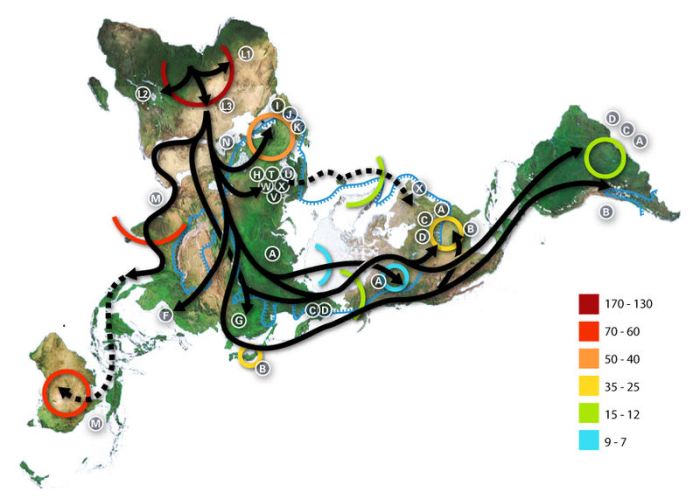
Map-of-human-migrationsAnd then came another revolution, this one known as the “Neolithic” which occurred roughly 12,000 years ago. By this time, humanity had hunted countless species to extinction, had spread to the New World, and began turning to agriculture to maintain their current population levels. Thanks to the cultivation of grains and the domestication of animals, civilization emerged in three parts of the world – the Fertile Crescent, China and the Andes – independently and simultaneously.

All of this gave rise to more habits we take for granted in our modern world, namely written language, metal working, philosophy, astronomy, fine art, architecture, science, mining, slavery, conquest and warfare. Empires that spanned entire continents rose, epics were written, inventions and ideas forged that have stood the test of time. Henceforth, humanity would continue to grow, albeit with some minor setbacks along the way.

The_Meeting_of_Cortés_and_MontezumaAnd then by the 1500s, something truly immense happened. The hemispheres collided as Europeans, first in small droves, but then en masse, began to cross the ocean and made it home to tell others what they found. What followed was an unprecedented period of expansion, conquest, genocide and slavery. But out of that, a global age was also born, with empires and trade networks spanning the entire planet.

Hold onto your hats, because this is where things really start to pick up. Thanks to the collision of hemispheres, all the corn, tomatoes, avocados, beans, potatoes, gold, silver, chocolate, and vanilla led to a period of unprecedented growth in Europe, leading to the Renaissance, Scientific Revolution, and the Enlightenment. And of course, these revolutions in thought and culture were followed by political revolutions shortly thereafter.

IndustrialRevolutionBy the 1700’s, another revolution began, this one involving industry and creation of a capitalist economy. Much like the two that preceded it, it was to have a profound and permanent effect on human history. Coal and steam technology gave rise to modern transportation, cities grew, international travel became as extensive as international trade, and every aspect of society became “rationalized”.

By the 20th century, the size and shape of the future really began to take shape, and many were scared. Humanity, that once tiny speck of organic matter in Africa, now covered the entire Earth and numbered over one and a half billion. And as the century rolled on, the unprecedented growth continued to accelerate. Within 100 years, humanity went from coal and diesel fuel to electrical power and nuclear reactors. We went from crossing the sea in steam ships to going to the moon in rockets.

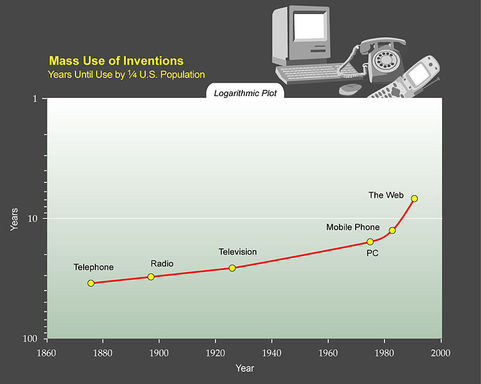
massuseofinventionsAnd then, by the end of the 20th century, humanity once again experienced a revolution in the form of digital technology. By the time the “Information Revolution” had arrived, humanity had reached 6 billion people, was building hand held devices that were faster than computers that once occupied entire rooms, and exchanging more information in a single day than most peoples did in an entire century.

And now, we’ve reached an age where all the things we once fantasized about – colonizing the Solar System and beyond, telepathy, implants, nanomachines, quantum computing, cybernetics, artificial intelligence, and bionics – seem to be becoming more true every day. As such, futurists predictions, like how humans will one day merge their intelligence with machines or live forever in bionic bodies, don’t seem so farfetched. If anything, they seem kind of scary!
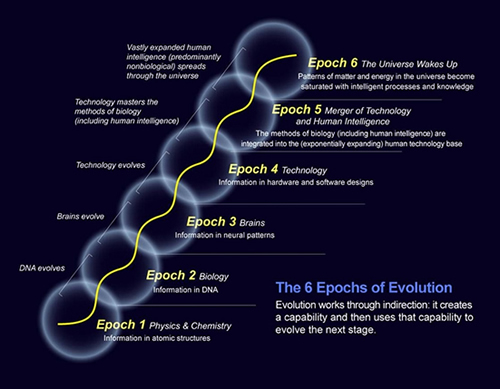
singularity-epocksThere’s no telling where it will go, and it seems like even the near future has become completely unpredictable. The Singularity looms! So really, if the future has become so opaque that accurate predictions are pretty much impossible to make, why bother? What’s more, will predictions become true as the writer is writing about them? Won’t that remove all incentive to write about it?

And really, if the future is to become so unbelievably weird and/or awesome that fact will take the place of fiction, will fantasy become effectively obsolete? Perhaps. So again, why bother? Well, I can think one reason. Because its fun! And because as long as I can, I will continue to! I can’t predict what course the future will take, but knowing that its uncertain and impending makes it extremely cool to think about. And since I’m never happy keeping my thoughts to myself, I shall try to write about it!

So here’s to the future! It’s always there, like the horizon. No one can tell what it will bring, but we do know that it will always be there. So let’s embrace it and enter into it together! We knew what we in for the moment we first woke up and embraced this thing known as humanity.

And for a lovely and detailed breakdown of the Singularity, as well as when and how it will come in the future, go to futuretimeline.net. And be prepared for a little light reading 😉

The Future is Here: The 3D Doodler

3d_doodler_home3D printing technology has been making some serious waves in the scientific, engineering and biomedical community. It seems that every day, more and more possibilities and applications are being discovered for this revolutionary new process. However, cost remains an obvious issue. With an individual printers being large, expensive and trying to maintain, most people can’t exactly afford to put one in their home and go town with it.

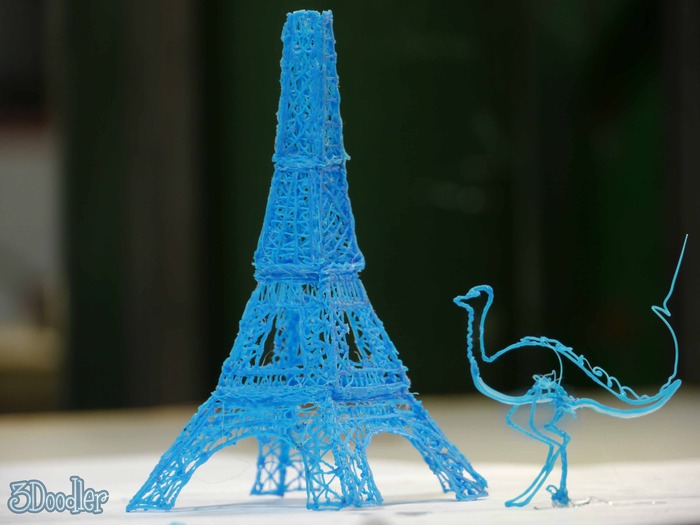
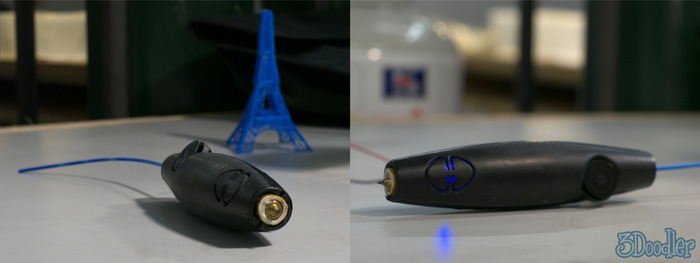
Enter the 3D Doodler, the world’s first 3-dimensional printing pen that allows you to draw in the air. Much like a standard 3D printer, it employs heated ABS plastic which then cools the moment it is excreted from the devices, instantly cooling and taking shape. And much like a pen or pencil, it is compact, hand-held, and allows people to literally draw designs into being! It also requires no software or computers, making it inexpensive and easy to use.

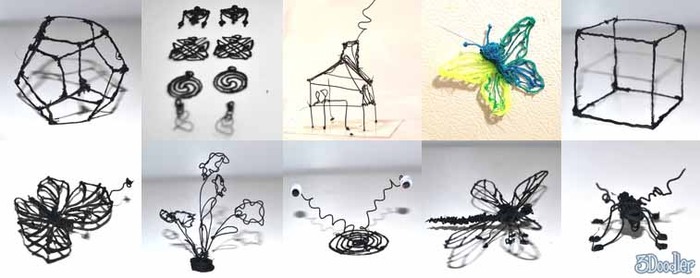
3D_doodlerAnd the range of what one can create is pretty much limitless. Using stencils, one can create 3D models for architecture, design specs, and proposed prototypes. Or, if you should so choose, just put the pen to any surface and begin composing shapes, designs and words out of thin air. Art is also an obvious application, since it give the user the ability to create an endless array of abstract or realistic designs. And of course, modeling, as shown in the video, could become a very popular (and competitive) outlet for its use.

3D_doodler1

And in another ultra-modern twist, the designers of the 3D Doodler are using their website to elicit funds to help them crowd-fund their idea and make it commercially viable. No trouble there! Of the $30,000 needed to get the prototype off the ground, they have managed to illicit a total of $2,106,977 as of this article’s publication. Guess people really do want to see these things getting onto the shelf. Look for it at your local hardware or art supply store!

And while you’re waiting, check out the video below to see the pen in action and what things it can make.

RIP Hugo Chavez: Venezuelan Strongman and Master Troll

hugo_chavezThe death of Hugo Chavez, which took place on March 5th, has not only left a vacuum in Venezuelan politics, but deprived the world of one of its most prolific trolls. In his many years dominating South American politics, Chavez distinguished himself as more of a nuisance than a threat to US and western interests. But what a nuisance! And his tool of choice in this onslaught? Social media!

While he once thought Twitter was a tool of terrorism, Chavez became convinced it was an asymmetric tool to combat what he called a “conspiracy” of pro-American opponents. As a lover of hyperbole and over-the-top statements, how could he not take to a forum that rewarded such behavior? And like all good trolls, Chavez was evangelical in his vitriol, comparing his enemies to fascists and barbarians, making grandiose boasts, and dispensing exclamation points from a virtual pez dispenser!

And of course, his tweets kept pace with political intrigue, both domestic and foreign. In May 2011, when the U.S. State Department imposed sanctions against the Venezuelan state-run oil company PDVSA for selling gasoline reformate to Iran, Chavez’s cash-cow was blocked from receiving U.S. export licenses. In response, Chavez tweeted:

Sanctions against the homeland of [Simon] Bolivar? Imposed by the gringo imperialist government? Well: Welcome Mr Obama! Do not forget we are the children of Bolivar!

When Tripoli fell, the result of rebellions against Gadhafi and Coalition support, the long-time supporter of the Libyan dictator responded in the following way:

We must stop the unleashed imperial madness! World, good world, humane world, do not be overwhelmed by the barbarism!

And when Syria’s Alawite regime began to show signs of going the same way, also the result of uprisings from pro-democracy groups, Chavez moved quickly to declare his support for the Bashar Assad. In the midst of the regime using live fire to murder civilians, Chavez declared openly:

I talked a few minutes with the Syrian President, our brother Bashar. Syria is the victim of a fascist attack. God help Syria!!

And of course, he used Twitter plenty to disseminate plenty of self-serving propaganda at home. He dispensed advice on dealing with “traitors”, which amounted to a “raging socialist revolutionary offensive!” On accusations about poverty in Venezuela, he replied: “There is no poverty in Venezuela! Factory capitalism is poverty!” He also trolled an opposition primary debate: “The opposition is once again a fool!”

The US did not engage in flame wars with the former presidente, but the White House did release a statement offering condolences over his death. However a statement from President Obama on Tuesday evening was admittedly curt and seemed to hint that they were happy to be rid of his influence:

At this challenging time of President Hugo Chavez’s passing, the United States reaffirms its support for the Venezuelan people and its interest in developing a constructive relationship with the Venezuelan government.

Without a doubt, Chavez’ successor will have his hands full with regards to Venezuela’s economy and its internal political divisions. And I have to say, regardless of Chavez’s ongoing and annoying bombastic personality, he did pull much of Venezuela’s working class out of poverty. And even if you hated him, you had to admit, the man was interesting! RIP Hugo Chavez, you annoying bastard! Can’t imagine how quiet it’s going to be without you…

The Future is Here: The Sensory Prosthetic Hand

prosthetic_originalMuch has been made of the advancements made in mind-controlled prosthetics lately. For many, the advancements made in this field have led to comparisons with the prosthetic hand that Luke Skywalker received at the end of the Empire Strikes Back. Remember that, how he got a robotic hand that not only looked real but also allowed him to feel pain? Well as it stands, we may be closer to that than previously thought.

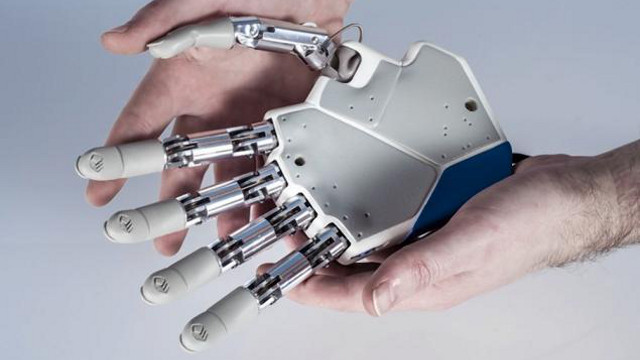
Witness the new era of robo-prosthetic devices, ones that will not only restore motion to a amputees and people born without limbs, but also sensory perception! Developed by Silvestro Micera of the Ecole Polytechnique Federale de Lausanne in Switzerland, it’s the first prosthetic that will provide real-time sensory feedback to its owners. Later this year, a man by the name of Pierpaolo Petruzziello, who lost half his arm in a car accident, will receive the first of its kind, once all the tests are concluded.

prostheticMuch like the mind-controlled prosthetics that have been making the rounds in recent years, this new device is wired directly to the user’s nervous system with electrodes, allowing them to control its movement. However, in this updated model, the process works both ways. Once the hand’s electrodes are clipped onto two of the arm’s main nerves, the median and the ulnar nerves, it will form a cybernetic connection allowing for the fast and bidirectional flow of information between the patient’s nervous system and the artificial hand.

In this respect, the arm works much as a real one does, using electrical stimuli to both send commands and receive sensory information. Announcing the development of the hand at the recently concluded AAAS conference in Boston, Micera was sure to highlight this aspect of the prosthetic, claiming that increased sensory feelings will improve acceptance of artificial limbs among patients.

prosthetic2Interestingly enough, this model is an updated version of one Micera and his team produced back in 2009, again for use by Petruzziello. He was able to move the bionic hand’s fingers, clench them into a fist and hold objects, and also reported feeling the sensation of needles pricked into the hand’s palm. However, this earlier version of the hand had only two sensory zones whereas the latest prototype will send sensory signals back from all the fingertips, as well as the palm and the wrists to give a near life-like feeling in the limb.

Once the hand and patient are united, he will wear it for a month in order to get a proper feel for the prosthetic and test out its many functions. Based on that test-drive, Micera hopes to develop a fully-functional and commercially viable model within the next two years.

Just think of it: prosthetics for amputees that will not only allow them to interact with their world again, but will provide them with the sensory information they need to actually feel like a part of it. One step closer to truly providing accident victims and people born without limbs a new and fully-functional lease on life. And perhaps to posthumanism as well!

transhuman3

Source: independent.co.uk, neurogadget.com

The Future is Here: Brain to Brain Interfaces!

?????????????????And I thought the month of February was an already exciting time for technological breakthroughs! But if a recent report from Nature.com is any indication, February will go down in history as the biggest month for breakthroughs ever! Why just last week, researchers in Natal, Brazil created the first ever electronic link between the brains of two living creatures.

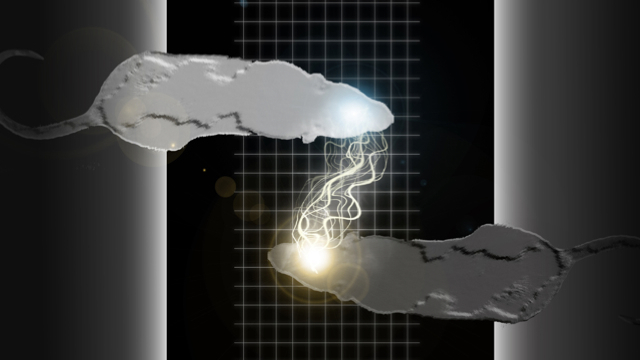
The creatures in question were rats, and the link between their brains enabled one to help the other solve basic puzzles in real time — even though the animals were separated by thousands of kilometers of distance. The experiment was led by Miguel Nicolelis of Duke University, a pioneer in the field of brain-machine interfaces (BMIs), and a team of neurobiologists who’ve been working in the field for some time.

BMIHere’s how it works: An “encoder” rat in Natal, Brazil, trained in a specific behavioral task, presses a lever in its cage which it knows will result in a reward. A brain implant records activity from the rat’s motor cortex and converts it into an electrical signal that is delivered via neural link to the brain implant of a second “decoder” rat. The second rat’s motor cortex processes the signal from rat number one and – despite being thousands of km away and unfamiliar with what rat one is up to — uses that information to press the same lever.

MMIBack in 2011, Nicolelis and his colleagues unveiled the first such interface capable of a bi-directional link between a brain and a virtual body, allowing a monkey to not only mentally control a simulated arm, but receive and process sensory feedback about tactile properties like texture. And earlier this month, his team unveiled a BMI that enables rats to detect normally invisible infrared light via their sense of touch.

However, this latest experiment really takes the cake. Whereas brain-machine interfaces have long been the subject of research, generally for the sake of prostheses, a brain-to-brain interface between two living creatures in something entirely new, especially one that enables realtime sharing of sensorimotor information. And while it’s not telepathy, per se, it’s certainly something close, what Nicolelis calls “a new central nervous system made of two brains.”

Obviously, this kind of breakthrough is impressive in its own right, but according to Nicolelis, the most groundbreaking application of this brain-net (or n-mind) is yet to come:

These experiments demonstrated the ability to establish a sophisticated, direct communication linkage between rat brains, so basically, we are creating an organic computer that solves a puzzle. We cannot predict what kinds of emergent properties would appear when animals begin interacting as part of a brain-net. In theory, you could imagine that a combination of brains could provide solutions that individual brains cannot achieve by themselves.

neural-networksNaturally, there are some flaws in the process, which were made evident by the less-than-perfect results. For starters, the untrained decoder rats receiving input from a trained encoder only chose the correct lever around two-thirds of the time. Those results could not be the result of random odds, but they are also a far cry from the 95% accuracy where the signals were reversed, going from the untrained decoder to the trained encoder. As any student of science knows, one-way results are not the basis of a sound process.

And I imagine the people who are lobbying to make biosoldiers illegal and limit the use of autonomous drones will be on this like white on rice! Hence why we can probably look forward to many years of research and development before anything akin to human trials or commercial applications of this technology seem realizable.

And of course, there is a video demonstrated the mind link at work. a word of warning first though. If you’re an animal lover, like me, the video might be a little difficult to take. You be the judge:


Source:
IO9, nature.com

Origins of Russian Meteor Found!

meteorJust over a week after a meteor exploded across the sky above the Chelyabinsk region of Russia, a group of astronomers published a paper that reconstructs where the rock came from. The men in question were Jorge Zuluaga and Ignacio Ferrin at the University of Antioquia in Medellin, Colombia. And the method they used was quite unconventional, and is perhaps a testament to the age we live in.

Basically, Zuluaga and Ferrin used the many sources of dashboard and security cameras that captured the event on film. Using the trajectories shown in the videos posted on YouTube, the researchers were able to calculate the trajectory of the meteorite as it fell to Earth and use it to reconstruct the orbit of the meteoroid before its fell to Earth and cause the shockwave that damaged buildings and shattered windows.

From their calculations, they were able to determine the height, speed and position of the meteorite as it fell to Earth. According to the team’s paper:

“…the Chelyabinski meteor started to brighten up when it was between 32 and 47 km up in the atmosphere. The velocity of the body predicted by our analysis was between 13 and 19 km/s (relative to the Earth) which encloses the preferred figure of 18 km/s assumed by other researchers.”

They then used software developed by the US Naval Observatory (called NOVAS) and the Naval Observatory Vector Astrometry to calculate the likely orbit. From all this, they came to the preliminary conclusion that the meteorite came from the Apollo class of asteroids, a well-known class of rocks that cross Earth’s orbit.

This conclusion has some worried, since the Apollo group, which orbits the Sun in the vicinity of Venus and Earth, contains over 2000 asteroids that are larger than 1 km in diameter. And considering that this one meteor, which measured between 17 and 20 meters, caused 1491 injuries and damage to over 4000 buildings in the area.

Lucky for us, NASA and every other space agency on the planet has some defensive strategies in mind. And of course, early warning is always the most important aspect of disaster preparedness. In the near future, we can expect some of the proposed observation satellites that will be going up to ensure there will be a better degree of early warning.

Source: universetoday.com

Eyes in the Sky: The Future of Asteroid Defense

asteroid_beltWith the recent passage of DA14 – an asteroid half as large as a football field and packing the power of a hydrogen bomb – and the rather explosive display that occurred above Russian skies, it’s little wonder then why NASA and other space agencies are publicizing various existing and proposed solutions to our “asteroid problem”.

Granted, there really isn’t much of a threat of an asteroid colliding with the Earth in the foreseeable future. And we also know that the meteor that graced the skies over the Urals was unrelated to the DA14 behemoth. But given that an impact could mean an Extinction Level Event, similar to the Cretaceous-Paleogene event that caused the extinction of the dinosaurs, a little planning doesn’t hurt.

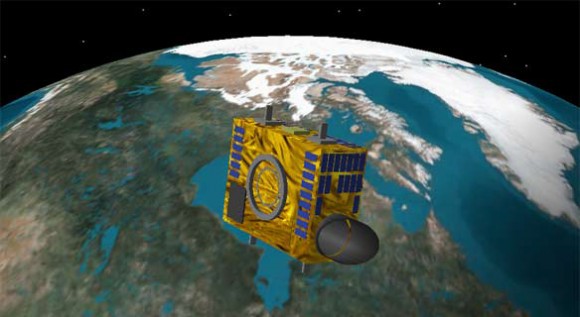
neossat-580x317The first in a series of three existing or proposed designs is the NEOSSat – Short for Near-Earth Object Surveillance Satellite – that was built in Canada and was deployed last week on an Indian rocket with six others. In addition to watching space debris in orbit and tracking their movements, it will also be keeping a sharp eye out for asteroids that may swing by Earth in the future.

AIDA_mission_conceptThen there is the ESA’s proposed Asteroid Impact and Deflection Assessment mission (or AIDA), a group of planetary defense satellites that will are designed to collide with an asteroid, then push it off course. And after two years of planning, research teams from the US and Europe have selected the mission’s target – a so called ‘binary asteroid’ named Didymos – that AIDA will intercept when it passes the Earth by a mere 11 million km in 2022.

The third and final proposed solution is something that sounds ripped from the pages of a science fiction novel. Known as the DE-STAR, or Directed Energy Solar Targeting of Asteroids and exploRation, this satellite is essentially a orbiting laser that would be capable of destroying approaching asteroids 10 times larger than the DA14 and at a distance as far away as the Sun.

NASA_destarProposed by two California scientists – UC Santa Barbara physicist and professor Philip M. Lubin, and Gary B. Hughes, a researcher and professor from California Polytechnic State University – the satellite is designed to harness the power of the sun and convert it into a massive phased array of laser beams that can destroy asteroids that pose a potential threat to Earth. At the same time, it will be capable of changing an asteroid’s orbit – deflecting it away from Earth, or into the Sun.

Feel safer? Well, considering that the odds of Earth getting anytime soon are pretty low, and are likely to fall even farther once we get these rock killers destroyed. Once more, it seems that sane planning and sensible solutions are winning out over doomsday predictions. Good for us!

Robots Meet the Fashion Industry

robot_fashionRobotics has come a long way in recent years. Why, just take a look at NASA’s X1 Robotic exoskeleton, the Robonaut, robotaxis and podcars, the mind-controlled EMT robot suit, Stompy the giant robot, Kenshiro and Roboy, and the 3D printed android. I suppose it was only a matter of time before the world of fashion looked at this burgeoning marketplace and said “me too!”

And here are just some of the first attempts to merge the two worlds: First up there’s the robot mannequin, a means of making window shopping more fun for consumers. Known as the MarionetteBot, this automaton has already made several appearances in shops in Japan and can expected to be making debut appearances across Asia, in North America and the EU soon enough!

Check out the video below to see the robot in action. Designed by the Japanese robotics company United Arrows, the mannequin uses a Kinect to capture and help analyze the movements of a person while a motor moves a total of 16 wires to match the person’s pose. Though it is not yet fast or limber enough to perfectly mimic the moves of a person, the technology shows promise, and has provided many a window-shopper with plenty of entertainment!


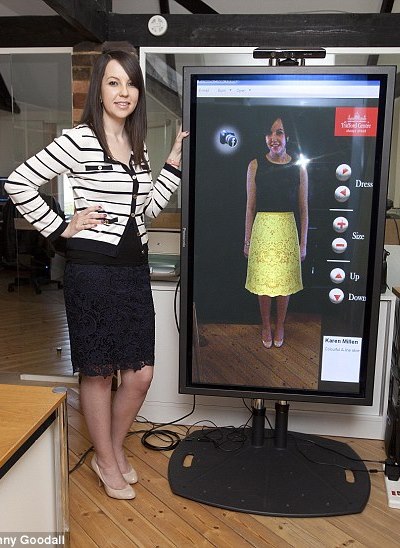
And next up, there’s the equally impressive FitBot, a shape-shifting mannequin that is capable of emulating thousands of body types. Designed by the British virtual shopping company Fits.Me, the FitBot is designed to help take some of the guesswork out of online shopping, where a good 25% of purchases are regularly returned because they were apparently the wrong size.

But with the FitBots, along with a virtual fitting room, customers will be able to see right away what the clothes will look like on them. The only downside is you will have to know your exact measurements, because that’s what the software will use to adjust the bot’s body. Click here to visit the company’s website and see how the virtual fitting room works, and be sure to check out there video below:


What does the future hold for the fashion industry and high-tech? Well, already customers are able to see what they look like using Augmented Reality technology displays, and can get pictures thanks to tablet and mobile phone apps that can present them with the image before making a purchase. Not only does it take a lot of the legwork out of the process, its much more sanitary as far as trying on clothes is concerned. And in a world where clothing can be printed on site, it would be downright necessary.

The "magic mirror"
The “magic mirror”

But in the case of online shopping, its likely to take the form of a Kinect device in your computer, which scans your body and lets you know what size to get. How cool/lazy would that be? Oh, and as for those AR displays that put you in the clothes you want? They should come with a disclaimer: Objects in mirror are less attractive than they appear!

Source: en.akihabaranews.com, technabob.com

The Future is Here: The Transparent Smartphone and USB Stick

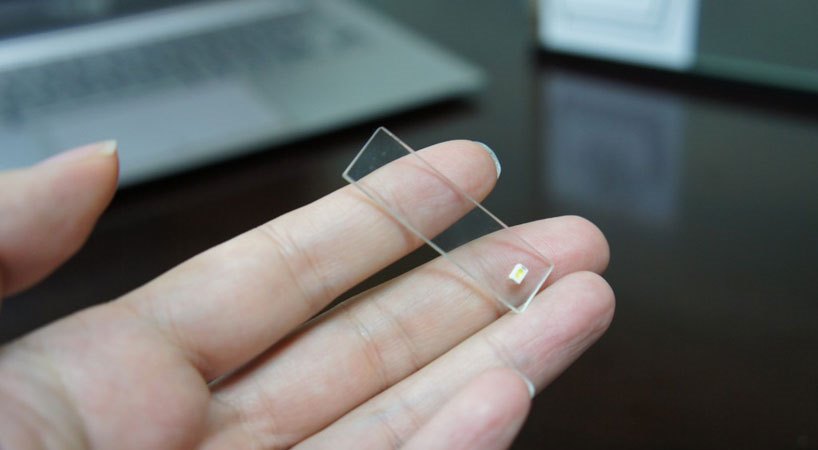
transphoneTwo years ago, Samsung made a big splash with the release of their concept video for a thin, transparent, AMOLED display tablet. Having showed a great deal of promise, thanks to the combination of paper thin technology and the Active-Matrix Organic Light-Emitting Diode display, they had to admit a fully transparent device was still many years away.

And in that respect, they were hardly alone. After the Consumer Electronics Show of 2010 and 2011, it seemed that every major company had their own concept for a transparent device, still many years in the making. Well, as it turns out they all may have spoken a little too soon!

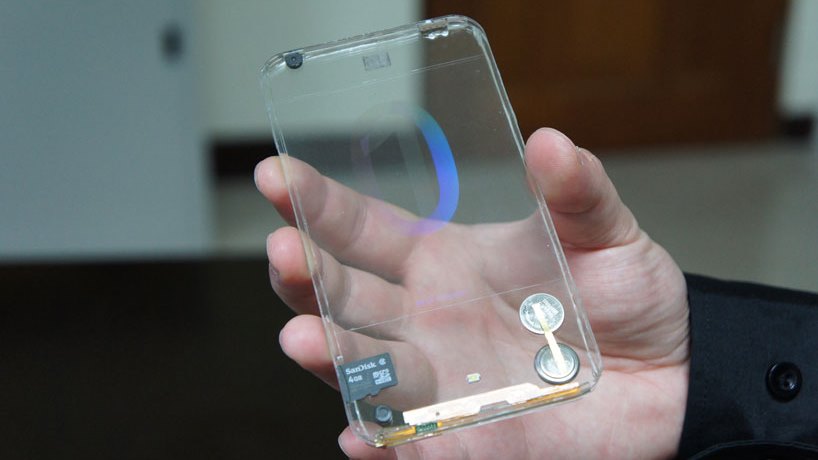
In a recent story, a Taiwanese group named polytron introduced their concept for a transparent smartphone and USB stick. As purveyors of smart glass – glass with built-in LED displays, “privacy” glass, holographic glass, touchscreen glass, etc – this latest invention effectively combines what they do best with the world of computing and communications and has jump started efforts to create to completely transparent devices.

transphone1

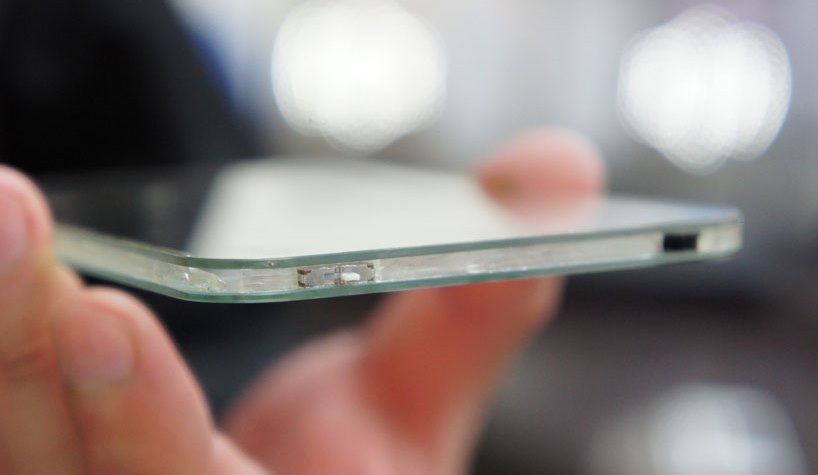
As you can see from the pics and video below, the phone has a thin frame, a slot for a SIM card, speakers mounted in the top, and is powered by two button cell batteries. It also boasts and LED screen, and is clearly still very much in the research and development phase. In the future, the company plans to mount a case across the bottom to hide the electronics, and an operating system will come as standard.

Much the same is true of their transparent USB stick. Combining an internal chip, a transparent case, and an embedded LED light to let you know when it’s plugged in, this device is likely to become the next generation of USB drives. And according to official rumors, the glass USB stick will also be made available with storage capacities of 4, 8, 16, and 32 gigabytes. No telling when it will be commercially available as of yet, but in all likelihood, sooner than the transparent phone.

transphone2

Be sure to check out these videos by Mobile Geeks, and follow the links at the bottom of the page to learn more about polytron’s smart glass products. I assure you, its really quite inspired!


Source: designboom.com, polyvision.com