Zombie Smashing: Z Nation Premieres!

https://i0.wp.com/www.blastr.com/sites/blastr/files/styles/blog_post_media/public/Znation_bat.jpgNever let it be said that the zombie apocalypse is going out of vogue, as it now seems that The Walking Dead has some competition. It’s called Z Nation – a show that premiered on Sept 12th on the SyFy channel – and which takes a similar, but altogether different approach for dealing with the zombie pandemic. Whereas the former is dark in tone and the characters seem to lurch from one tragedy to the next, this new series is all about zombie smashing!

As creator Karl Schaefer said of his creation, comparing it to its immediate rival:

If you’re going to go through the apocalypse, would you rather be with the people onThe Walking Dead, who are always kind of miserable and not having any fun, or our guys that are out to go kick some zombie ass?

I know my answer, and I have to say I’m a little peeved as well as impressed. Kicking zombie ass was what my series Whiskey Delta was supposed to be about! In fact, reviewers of that series have said how much they like a story where, for once, the military isn’t totally incompetent and knows how to deal with the infected and the undead hordes. Man, I haven’t felt this ripped-off since J J Abrams’ Revolution first aired!

https://i0.wp.com/www.cinemablend.com/images/sections/67248/Z_nation_67248.jpgBut enough about my half-assed grievances. As with The Walking Dead, World War Z, and a slew of other zombie franchises, the storyline revolves around a motley group of survivors who have come together in the aftermath of the collapse of civil order. In addition, the zombie concept is based on a virus that takes people over and reanimates their bodies once they die. But alas, there’s a big twist, which you will see in the trailer below.

Z Nation debuted to 1.6 million views for its premiere on Friday, September 12th, which is fairly modest for a Syfy drama series. But the network pointed out that this is a record for an acquired show produced by an outside party (Sharkado production company The Asylum made Z Nation), and that noted more viewers watched Z Nation than the most recent telecasts of The Leftovers on HBO, Teen Wolf on MTV and Doctor Who on BBCA.

https://i0.wp.com/www.cinemablend.com/images/sections/66519/_1406817935.jpgAnd interestingly enough, those ratings were comparable to the premier of The Walking Dead‘s fourth season fall premier, provided you add a decimal point in there. Yes, in a strange case of convergence, the WD episode “30 Days Without an Accident” garnered a total of some 16 million viewers, beating out the 2014 Winter Olympics AND the Beatles TV movie entitled The Beatles: The Night That Changed America.


So yes, it’s got some catchup work to do if it wants to be a contender for the top spot, but it’s really just getting started. Suffice it to say, I will be watching this show from now on! Check out the trailer and see if you agree:


Sources:
blastr.com, insidetv.ew.com

Drone Wars: China’s Rainbow Drone Unveiled

CH-4RainbowAs part of their ongoing efforts to become a world power, China has spared no investment when it comes to the development of Unmanned Aerial Vehicle (UAV) technology. And after several successful missile tests, the People’s Liberation Army (PLA) is all set to receive the next-generation aerial drone. Known as the CH-4, the development of this UAV is just the latest in China’s attempt to catch up to western developers.

Although China’s drone technology may be several years behind top manufacturers in the US and Israel, the country’s UAV manufacturers are hoping that their mid-range prices and middling technology will lure potential customers from developing nations. During the unveiling, which took place at the beinnial Zhuhai Air Show in late August, officials from Kenya, Russia and other countries were on hand to witness this an other examples of China’s exportable UAVs.

CH-4Rainbow2 Representatives from China Aerospace Long-March International, a division of the state-owned China Aerospace Science and Technology Corporation (CASC), were on hand at the presentation and spoke with relative candor about the CH-4 and two other drones the company was showing for the first time. Guo Qian, a director at a division of CASC, when talking about the interest and marketability of the company’s military grade drones, had the following to say:

We’ve been contacting many countries, especially from Africa and Asia. They are quite interested in the intermediate and short-range UAVs because they are portable and low-cost.

Similarly, Li Pingkun , the head of the Rainbow 4 project at the aerospace corporation, told state television the drone could make a long-distance hit on a target with a margin of error of less than 1.5 metres. He said the system was very precise because it used several methods to guide missiles or smart bombs to their target. As he told ChinaNews, the drone is “well-positioned to carry out the subsequent missions.”

CH-4Rainbow1The unveiling of this drone comes at a time when the PLA is actively and publicly promoting the use of drones by its military personnel. During the show, the CASC also displayed a handful of smaller short range drones and set up a flashy ground-to-ceiling UAV attack simulation compete with a dozen technicians glued to computer screens in a the make-believe war room. As Guo explained:

Our company has set up a pretty aggressive sales target for UAVs, but the global market competition is quite fierce. There are many similar products in the global market and they are quite mature, so we haven’t had a big impact in the market. It will take some time for our products to be known and accepted.

The Rainbow 4 is the CASC’s latest creation, and is intended to act as the PLA’s answer to the MQ-9 Reaper – a hunter-killer drone mainly used by the US military for reconnaissance and high-precision air strikes. The CH-4 can carry a payload of 345 kg (760 lbs) of missiles of precision-guided bombs, can reach an altitude of 8 km (26000 feet), has a range of 3,500 kilometers, and fly for up to 30 hours depending on how heavy a payload it is carrying.

China_dronetestHowever, it remains much slower than the Reaper, which can fly at a top speed of 482 km/h compared to the Rainbow’s 235 km/h. In addition, the MQ-9 has a much higher payload of 1700 kg  (3800 lbs), which works out to six Hellfire missiles or precision-guided bombs. And while it has greater range – 3000 km vs. the MQ-9’s 1850 km – the Reaper has a service ceiling of up to 18,000 meters.

The PLA also has limited experience in using drones in combat zones; whereas for the USAF, drone use has become second nature. But above all, the most glaring aspect of the “drone gap” is the fact that this latest Chinese drone was not the result of indigenous design or innovation. Much like other aspects of China’s stealth and weapon’s development, it is the result of mimicry.

(U.S. Air Force photo/Staff Sgt. Brian Ferguson)(Released)Nevertheless, China’s plan to market the technology to other nations does mean that the use of UAVs is likely to become much more universal in the coming years. Beyond the US, NATO, Israel, Russia and China, middle powers like India, Pakistan, Brazil and various Sub-Saharan African nations are likely to have their own soon. In addition, certain “rogue states” – i.e. Iran, North Korea, Syria – are likely to have their own as well.

The term “Drone Wars” is likely to become very literal as a result!

Source: gizmodo.com, scmp.com, globalpost.com

Is the Universe One Big Hologram?

universe_nightsky“You know how I can tell we’re not in the Matrix?  If we were, the food would be better.” Thus spoke Sheldon Cooper, the socially-challenged nerd from The Big Bang Theory. And yet, there is actually a scientific theory that posits that the universe itself could be a 2D hologram that is painted on some kind of cosmological horizon and only pops into 3D whenever we observe it (aka. always).

And in what may be the most mind-boggling experiment ever, the US Department of Energy’s Fermi National Accelerator Laboratory (Fermilab) seeks to test this theory for the first time. Their tool for this is the Holometer, a device which has been under construction for a couple of years. It is now operating at full power and will gather data for the next year or so, at which time it will seek to uncover if the universe is a hologram, and what it’s composed of.

big_bangThe current prevailing theories about how the universe came to be are the Big Bang, the Standard Model of particle physics, quantum mechanics, and classical physics. These hypotheses and models don’t fully answer every question about how the universe came to be or continues to persist – which is why scientists are always investigating other ideas, such as supersymmetry or string theory.

The holographic universe principle is part of string theory – or at least not inconsistent with it – and goes something like this: From our zoomed out vantage point, the universe seems to be a perfectly formed enclave of 4D spacetime. But what happens if you keep zooming in, past the atomic and subatomic, until you get down to the smallest possible unit that can exist in the universe?

fermi_holometer-3In explaining their theory, the scientists involved make much of the analogy of moving closer to an old-style TV until you can see the individual pixels. The holographic principle suggests that, if you zoom in far enough, we will eventually see the pixels of the universe. It’s theorized that these universal pixels are about 10 trillion trillion times smaller than an atom (where things are measured in Planck units).

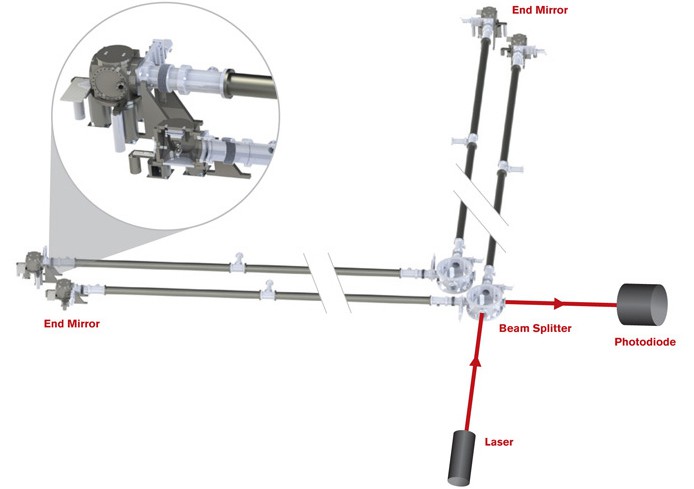
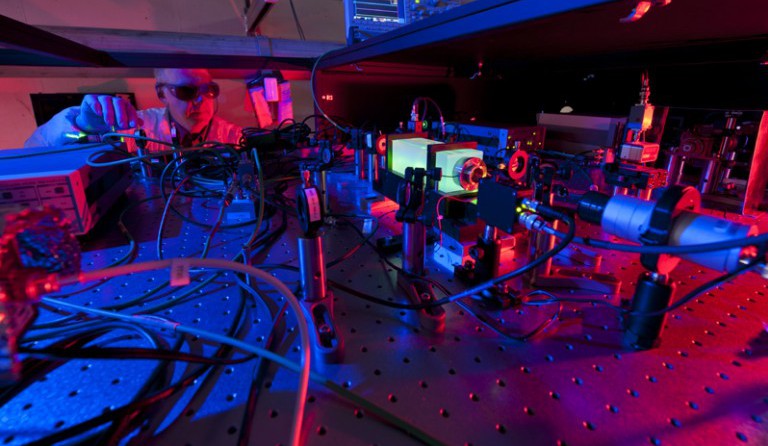
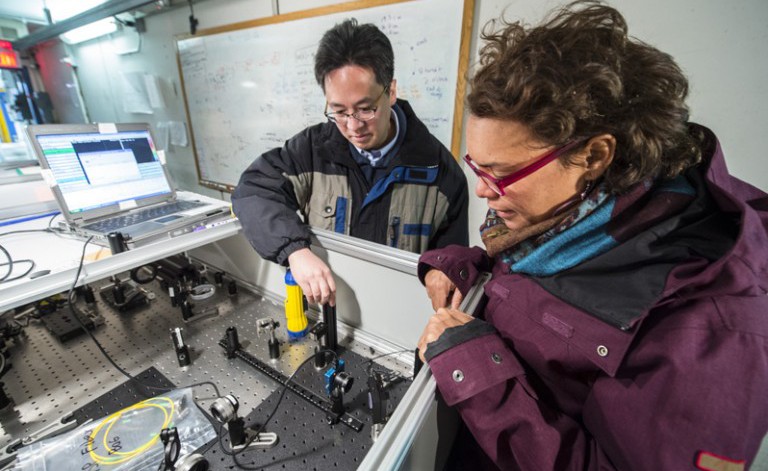
The Holometer at Fermilab, which on the hunt for these pixels of the universe, is essentially an incredibly accurate clock. It consists of a twin-laser interferometer, which – as the name suggests – extracts information from the universe by measuring interference to the laser beams. Each interferometer directs a one-kilowatt laser beam at a beam splitter and then down two 40-m (130-ft) arms located at right-angles to one another.

holometer-interferometer-diagramThese beams are then reflected back towards the source, where they are combined and analyzed for any traces of interference. As Craig Hogan, the developer of the holographic noise theory and a director at Fermilab, explained:

We want to find out whether space-time is a quantum system just like matter is. If we see something, it will completely change ideas about space we’ve used for thousands of years.

After any outside influences are removed, any remaining fluctuations – measured by slightly different frequencies or arrival times – could be caused by the ever-so-slight quantum jitter of these universal pixels. If these universal pixels exist, then everything we see, feel, and experience in the universe is actually encoded in these 2D pixels. One major difficulty in such a test will be noise – aka. “Holographic noise” – which they expect to be present at all frequencies.

fermi_holometerTo mitigate this, the Holometer is testing at frequencies of many megahertz so that motions contained in normal matter are claimed not to be a problem. The dominant background noise of radio wave interference will be the most difficult to filter out, according to the team. As Holometer lead scientist Aaron Chou explained:

If we find a noise we can’t get rid of, we might be detecting something fundamental about nature – a noise that is intrinsic to space-time.

This would have some serious repercussions. For a start, it would mean that spacetime itself is a quantum system, just like matter. The theory that the universe consists of matter and energy would be annulled, replaced with the concept that the universe is made of information encoded into these universal pixels, which in turn create the classical concepts of matter and energy.

fermi_holometer-1And of course, if the universe is just a 3D projection from a 2D cosmological horizon, where exactly is that cosmological horizon? And does this mean that everything we know and love is just a collection of quantum information carrying 2D bits? And perhaps most importantly (from our point of view at least) what does that make us? Is all life just a collection of pixels designed to entertain some capricious audience?

All good and, if you think about it, incredibly time-honored questions. For has it not been suggested by many renowned philosophies that life is a deception, and death an escape? And do not the Hindu, Buddhist and Abrahamic religions tells us that our material existence is basically a facade that conceals our true reality? And were the ancient religions not all based on the idea that man was turned loose in a hostile world for the entertainment of the gods?

Well, could be that illusion is being broadcast in ultra-high definition! And getting back to The Big Bang Theory, here’s Leonard explaining the hologram principle to Penny, complete with holograms:


Sources:
extremetech.com, gizmag.com

The Future is Here: Sweat-Powered Smart Tatoo

smart_tatoosSmart tattoos are the hot ticket item of modern medicine, combining ultra-thin electronics with flexible materials. When they become commonplace, they will be a great way to monitor vital signs and health. The only thing that seems to be holding them back, is finding a way to power them. Tiny batteries are one possibility, but lack practicality, and microwaves are several years away from being feasible.

Luckily, Joseph Wang – a researchers from UCSD – has come up with a way to generate power for these devices without using any external equipment. The secret, is to harness electrons from lactate acid secreted in sweat. These acids are produced when our muscles work to exhaustion, a waste product that causes muscles to “burn”, but which the brain thrives upon. Hence why it is the endpoint in lactate’s metabolization cycle.

https://i0.wp.com/www.extremetech.com/wp-content/uploads/2014/08/Tattoo-640x353.jpgWhen lactate was discovered to be released in sweat, exercise physiologists began developing sensor technology to measure its levels in the sweat and blood. Wang has taken the next logical step of adding provisions to accumulate charge when lactate is enzymatically sensed. By embedding enzymes that process lactate into the tattoo, he was able to extract 70 microwatts per cm² of skin.

The only catch with this tattoo is that you need to be hot – as in pedaling your heart out on a bike for 30 minutes – to get the lactate out. That, however, may not be a barrier to this technology, since it is possible to selectively activate the sympathetic nerves that control the sweat glands in a discrete patch of skin. That way, you override the normal control and can sweat without the heat or exertion.

flexible_elecThe other part of the puzzle would be to actually generate the lactic acid. Preferably, this would be done locally as well, rather than having to have high levels circulating in the blood. But in the end, such steps would not even be necessary considering that a vitals and health monitoring that occurs into a workout – after an initial warm-up and good sweat have taken place – could be just what the doctor ordered (no pun intended!).

Other researchers have already imagined e-tattoos to read your thoughts and desires, either by reading unvocalized words or EEG readings. And compared to past generations of sensor devices, these tattoos represent a sophisticated electronic package with on-board signal processing and communications. With a discrete way to power such devices, a formidable tool for self discovery might be had.


Source:
extremetech.com
, acs.org

News from Space: Space Launch Systems Good to Go!

SLS_goNASA’s Space Launch System, the US’s first exploration-class spacecraft since the Space Shuttle, is a central component in the agency’s plan to restore its ability to independently launch missions into space. An after a thorough review of cost and engineering issues, NASA managers formally approved the mammoth rocket past the whiteboard formulation stage and moved it into full-scale development.

As the world’s most powerful rocket ever built and is intended to take astronauts farther beyond Earth into deep space than ever before possible. This includes the first-ever manned mission to Mars, the Asteroid Belt, and perhaps other planets and moons throughout the Solar System as well. The first SLS mission should lift off no later than 2018, sending the Orion capsule around the Moon, with asteroid and Mars-bound missions following after 2030 or 2032.

Space_Shuttle_Atlantis_launchNASA began the SLS’s design process back in 2011. Back then, the stated goal was to try and re-use as many Space Shuttle components and get back into deep space as quickly and as cost effectively as possible. But now that the formulation stage has been completed, and focus has shifted to actually developing and fabricating the launch system’s millions of constituent components, what kind of missions the SLS will be capable of has become much clearer.

At a press briefing that took place at their Operations Mission Directorate in Washington, Aug. 27th, NASA officials shared  details about the maiden test launch. Known as EM-1, the launch is targeted for November 2018 and will involve the SLS  carrying an uncrewed Orion spacecraft on a journey lasting roughly three weeks that will take it beyond the Moon to a distant retrograde orbit.

Orion_with_ATV_SMPreviously NASA had been targeting Dec. 2017 for the inaugural launch from the Kennedy Space Center in Florida. But the new Nov. 2018 target date has resulted from the rigorous assessment of the technical, cost and scheduling issues. The decision to move forward with the SLS comes after a wide ranging review of the technical risks, costs, schedules and timing known as Key Decision Point C (KDP-C).

As Associate Administrator Robert Lightfoot, who oversaw the review process, said at the briefing:

After rigorous review, we’re committing today to a funding level and readiness date that will keep us on track to sending humans to Mars in the 2030s – and we’re going to stand behind that commitment. Our nation is embarked on an ambitious space exploration program. We are making excellent progress on SLS designed for missions beyond low Earth orbit. We owe it to the American taxpayers to get it right.

spaceX-falcon9The SLS involved in the test flight will be configured to its 70-metric-ton (77-ton) version. By comparison, the Saturn V — which took NASA astronauts to the Moon — had a max Low-Earth Orbit (LEO) payload capacity of 118 metric tons, but it has long since been retired. SpaceX’s Falcon Heavy, which is a much smaller and cheaper rocket than the SLS, will be able to put 55 metric tons into LEO.

With the retirement of the Space Shuttle, there aren’t really any heavy lift launchers in operation. Ariane 5, produced by commercial spacecraft manufacturer Arianespace, can only do 21 metric tons to LEO, while the Delta IV (United Launch Alliance) can do 29 metric tons to LEO. In short, NASA’s Space Launch System should be by far the most powerful operational rocket when it arrives in 2017-2018.

CST_Main_Header2-process-sc938x350-t1386173951SpaceX could decide to scale-up the Falcon Heavy, but the rocket’s main purpose is to compete with United Launch Alliance and Arianespace, which currently own the incredibly lucrative heavy lift market. A payload capacity of 55 tons is more than enough for that purpose. A capacity of 150 tons is only for rockets that are intended to aim at targets that are much farther than geostationary orbit — such as the Moon, Mars or Europa.

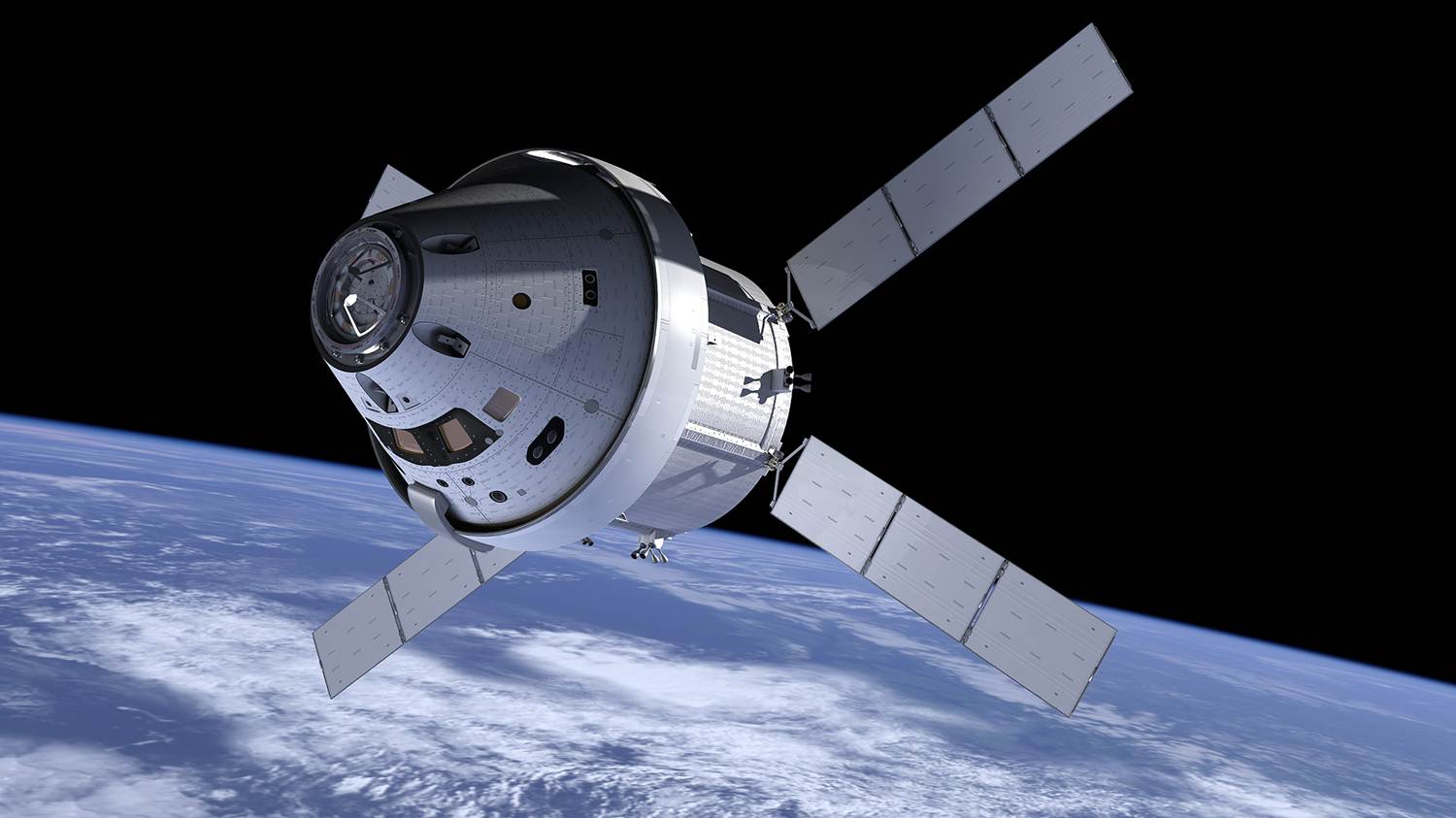
The SLS’s primary payload will be the Orion Multi-Purpose Crew Vehicle (MPCV), though it will undoubtedly be used to send other large spacecraft into deep space. The Orion capsule is what NASA will use to land astronauts on the Moon, captured asteroids, Mars, and any other manned missions throughout the Solar System. The first manned Orion launch, to a captured asteroid in lunar orbit, is scheduled to occur in 2021.

mars_roverCombined with SpaceX’s crewed Dragon spacecraft, Boeing’s CST-100, and a slew of crowd-funded projects to place boots on Mars and Europa in the next few decades, things are looking up for human space exploration!

Source: universetoday.com, extremetech.com

News from Mars: Beam Me to Mars

marsIn the latest ambitious plan to make space exploration accessible to the general public, Uwingu has unveiled a new campaign where people can send messages and pictures to the Red Planet. It’s called “Beam Me to Mars”, and the company is inviting people to contribute, for a fee, to a “digital shout-out” that will send messages from Earth to Mars on Nov. 28 — the 50th anniversary of Mars exploration.

The first successful Mars mission, NASA’s Mariner 4 – launched on Nov. 28, 1964 – performed the first flyby of the Red Planet and returned the first pictures of the Martian surface. This was the first time that images were captured of another planet and returned from deep space. and their depiction of a cratered, seemingly dead world largely changed the view of the scientific community on life on Mars.

beam-me-to-mars-uwinguAccording to representative from Uwingu, “Beam Me to Mars” celebrates that landmark effort in a new and original way by inspiring people to get on board with Martian exploration. Other goals include raising lots of money to fund space science, exploration and education (Uwingu’s stated chief purpose) and letting policymakers know how important space exploration is to their constituents.

As CEO Alan Sterm, a planetary scientist and former NASA science chief, said in an interview with Space.com:

We want it to inspire people. There has never been an opportunity before for people of Earth to shout out across the solar system their hopes and wishes for space exploration, for the future of mankind — for any of that… We want to make an impression on leaders. The more messages, the bigger impression it makes. If this thing goes viral, and it becomes the thing to do, then it’ll make a huge impression.

ESO2For $4.95, people can beam their name (or someone else’s) to Mars, whereas $9.95 gets people a chance to beam a name and a 100-character message. $19.95 gets a 1,000-character note instead of the shorter one, and for those willing to spend $99 will be able to send their name, a long message and an image of their choosing. All messages submitted for “Beam Me to Mars” will also be hand-delivered to Congress, NASA and the United Nations.

Submissions must be made via uwingu.com by Nov. 5. And the company – whose name means “sky” in Swahili – and its transmission partner, communications provider Universal Space Network, will use radio telescopes to beam the messages at Mars on Nov. 28 at the rate of 1 million bits per second. The transmission, traveling at the speed of light, will reach the Red Planet on that day in just 15 minutes.

mariner-4-poster-art.enFor comparison, it took Mariner 4 more than seven months to get to Mars a half-century ago. The probe didn’t touch down, but its historic flyby in July 1965 provided the first up-close look at the surface of another planet from deep space. Mariner 4’s observations revealed that Mars is a dry and mostly desolate world, dashing the hopes of those who had viewed it as a world crisscrossed by canals and populated by little green men.

Already, several celebrities have signed on to the campaign, including actors Seth Green and wife Clare Grant, George (“Sulu”) Takei of Star Trek fame and his husband Brad, Bill Nye “The Science Guy”, astronaut and former ISS commander Chris Hadfield, commercial astronaut Richard Garriott, former NASA senior executive Lori Garver, Pulitzer winning author and playwright Dava Sobel, and Author and screenwriter Homer Hickam.

Uwingu-CelebritiesThis is not the first Mars effort for Uwingu, which was founded in 2012. In February, the company launched its “People’s Map of Mars,” asking the public to name Red Planet landmarks for a small fee. To date, people have named more than 12,000 Mars craters, and Uwingu has set aside more than $100,000 for grants. And when it comes to getting the general public involved with space science and travel, they are merely one amongst many. The age of public space exploration is near, people!

Sources: space.com, uwingu.com, (2)

News From Mars: Mysterious “Thigh Bone” Revealed!

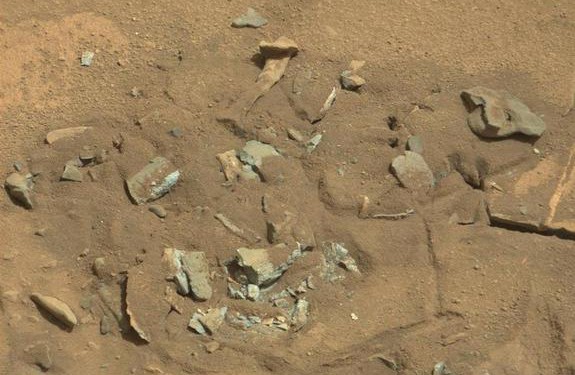
mars-thigh-bone-illusion-curiosity-photoTwo weeks ago, the Curiosity rover spotted an object on the surface of Mars that bore a striking resemblance to a femur (aka. athigh bone). This sighting caused a bit of a media stir and fueled speculation – mainly by conspiracy and UFO theorists – that proof of life on Mars had finally been found. This claim was quickly picked up by media outlets and began to spread like a bad strain of flu.

Alas, NASA has since announced that the finding, much like the Martian “donut” and “rat”, was just another piece of oddly-shaped rock. Mission scientists believe that here too, the rock was sculpted into its unusual shape by wind or water erosion. NASA announced all this when they released Curiosity’s “thigh bone” photo with a science explanation on Thursday (Aug. 21). In the caption, they said that:

No bones about it! Seen by Mars rover Curiosity using its MastCam, this Mars rock may look like a femur thigh bone. Mission science team members think its shape is likely sculpted by erosion, either wind or water.

If life ever existed on Mars, scientists expect that it would be small simple life forms called microbes. Mars likely never had enough oxygen in its atmosphere and elsewhere to support more complex organisms. Thus, large fossils are not likely.

MARS-COMET-surfaceIn short, the long-sought after signs of life that NASA is searching for have yet to be found. The Curiosity rover has found evidence that Mars was once a habitable place in the ancient past, mainly by determining with certainty that it once held water and a viable atmosphere. However, to date, there is no evidence that creatures large enough to leave a bone behind ever existed on the planet.

There is a long tradition of seeing shapes in Mars rocks that don’t reflect reality. The phenomenon in which the human brain perceives faces, animals or other shapes that aren’t really there is known as pareidolia; and when it comes to Mars, there is a long and fertile history of this taking place. In fact, in 1877 when astronomer Giovanni Schiaparelli looked up at Mars when it was in opposition, he spotted a network of lines that ran along the planet.

martian_canalsLater astronomers confirmed these sightings and erroneously thought them to be canals, an observation which was quickly seized upon by the popular imagination and spawned an entire mythos of there being a civilization on Mars. This civilization, made up of little green men known as Martians, is the entire basis of alien mythology which would go on to inspire 20th century works as The War of the Worlds and The Martian Chronicles.

And for those old enough to recall, the “Martian face”, which was captured by the Viking Orbiter in 1976, is a more modern example. As you can see from the picture below (lower right hand), the low-resolution photos of the Cydonian mesa led many people to see a human face in it. This led to much speculation and more than a few crackpot theories about a civilization on Mars.

mars_faceHowever, high-res photos taken in 2001 by the Mars Global Surveyor probe (center) put these claims largely to rest by showing that the “face” was just an optical illusion. However, many of these same theorists moved on to claim that pyramid-like formations in that same region (Cydonia) so closely resembled those of Giza that there had to be a common explanation – i.e. aliens built the pyramids.

And in all cases, the golden rule seems to apply: never let little a thing like the facts or plausibility get in the way of a good story! As the rover continues on its long mission to find evidence of life on Mars, I am sure there will be plenty more pictures being seized upon by oddball theorists who are looking to peddle their oddball theories. Some of them are sure to be entertaining, so stay tuned!

Sources: cbc.ca, space.com

Powered by the Sun: Breakthrough Solar Cells

solar1In addition to becoming cheaper, and increasing in efficiency and yields, solar cell technology is also growing in terms of innovative design. By going beyond the conventional design of silicon panels and electrical cables, researchers are ensuring that solar technology can go farther. And the latest advances in design are especially far-sighted, aiming to merge solar technology with just about any surface, and even sending it into space.

In the former case, researchers at Michigan State University have created a fully transparent solar concentrator, which could turn any window or sheet of glass – from highrise buildings to the screens on smartphones and tablets – into a photovoltaic solar cell. And whereas other “transparent” solar panels have been designed in the past, this one is the first that truly lives up to the word.

transparent-solar-cellScientifically, a transparent solar panel is something of an oxymoron. Solar cells, specifically the photovoltaic kind, make energy by absorbing photons and converting them into electrons. If a material is transparent, by definition it means that all of the light passes through the medium. This is why previous transparent solar cells have actually only been partially transparent, and usually cast a colorful shadow.

To get around this limitation, the Michigan State researchers use a slightly different technique for gathering sunlight. Instead of trying to create a transparent photovoltaic cell, they used a transparent luminescent solar concentrator (TLSC), which consists of organic salts that absorb specific non-visible wavelengths of ultraviolet and infrared light, which they then luminesce (glow) as another wavelength of infrared light (also non-visible).

https://i0.wp.com/www.extremetech.com/wp-content/uploads/2014/08/transparent-luminescent-solar-concentrator-colorful.jpgThis emitted infrared light is guided to the edge of plastic, where thin strips of conventional photovoltaic solar cell convert it into electricity. Currently, the Michigan TLSC has an efficiency of around 1%, but they think 5% should be possible. On their own, these aren’t huge figures, but on a larger scale — every window in a house or office block — the numbers quickly add up to a significant electrical yield.
Moreover, the researchers are confident that the technology can be scaled all the way from large industrial and commercial applications, down to consumer devices, while remaining “affordable.” So far, one of the larger barriers to large-scale adoption of solar power is the intrusive and ugly nature of solar panels. But if large amounts of solar power can be produced from sheets of glass and plastic, it would go a long way to making the scaling process feasible.

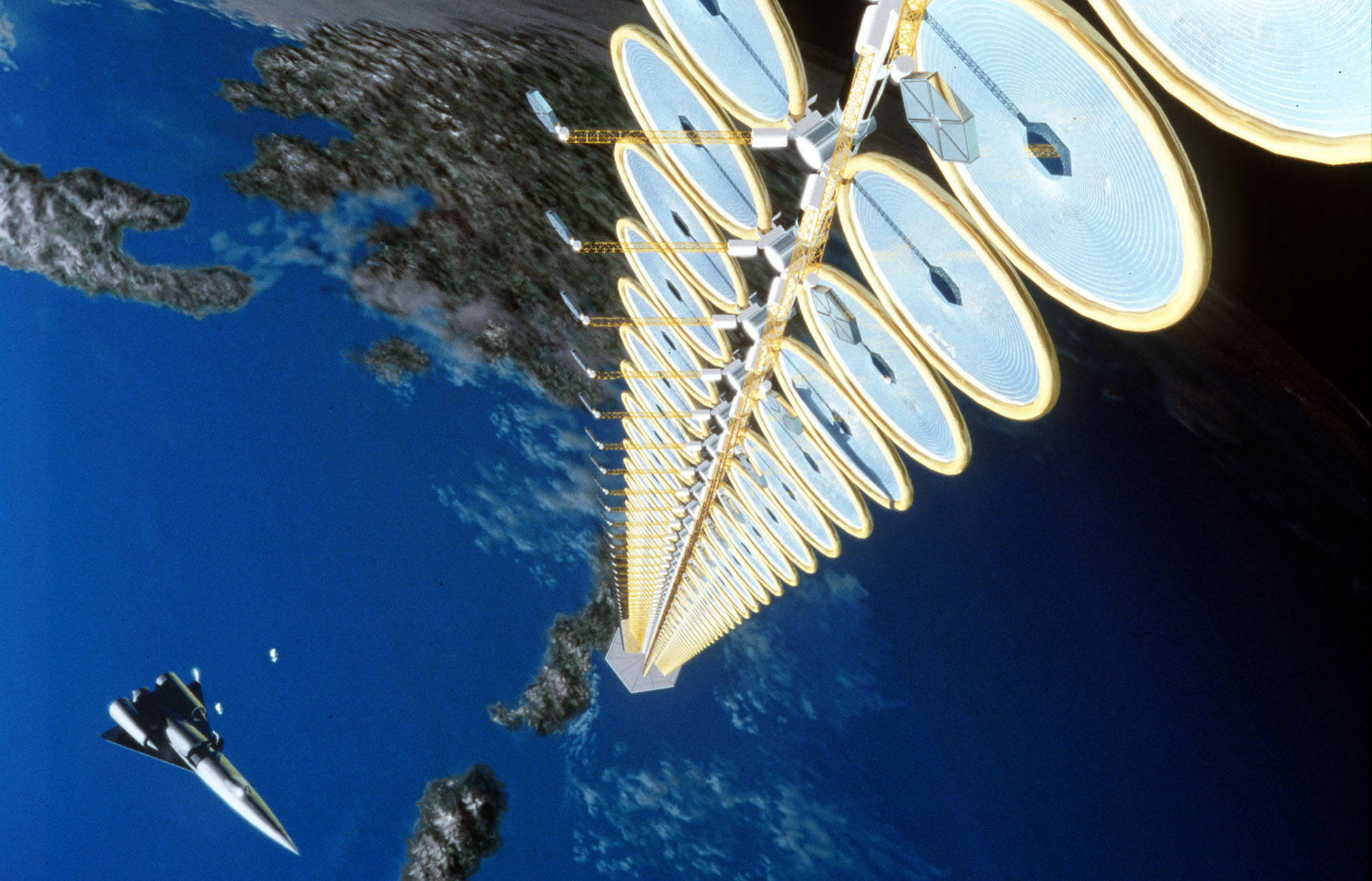
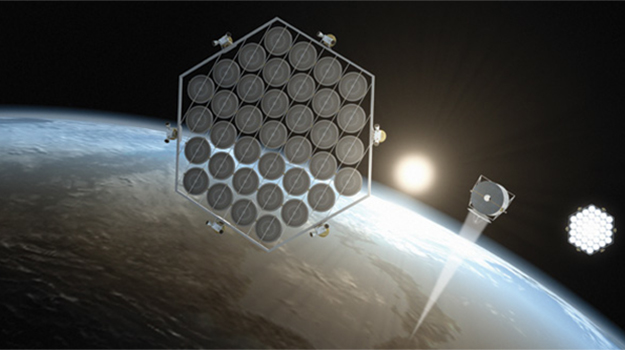
solar_panel_origamiAnother major innovation comes from Brigham Young University, where researchers have been working with NASA’s Jet Propulsion Laboratory to address the challenge of Space-Based Solar Power. For some time, scientists have understood that a solar array in orbit of Earth would be ideally suited for solar power collection, since it would be immune to weather, cloud cover or diurnal cycles (aka. nighttime).

Unfortunately, getting solar cells into space is a bit of a problem. In order to be effective, solar panels need to be thin have a large surface area to soak up more rays. This makes it difficult to transport them into orbit, and requires that they be broken down,and flown up piece by piece, and then assembled once in orbit. Given the cost of mounting a sending a single rocket into orbit, this prospect becomes very costly very fast.

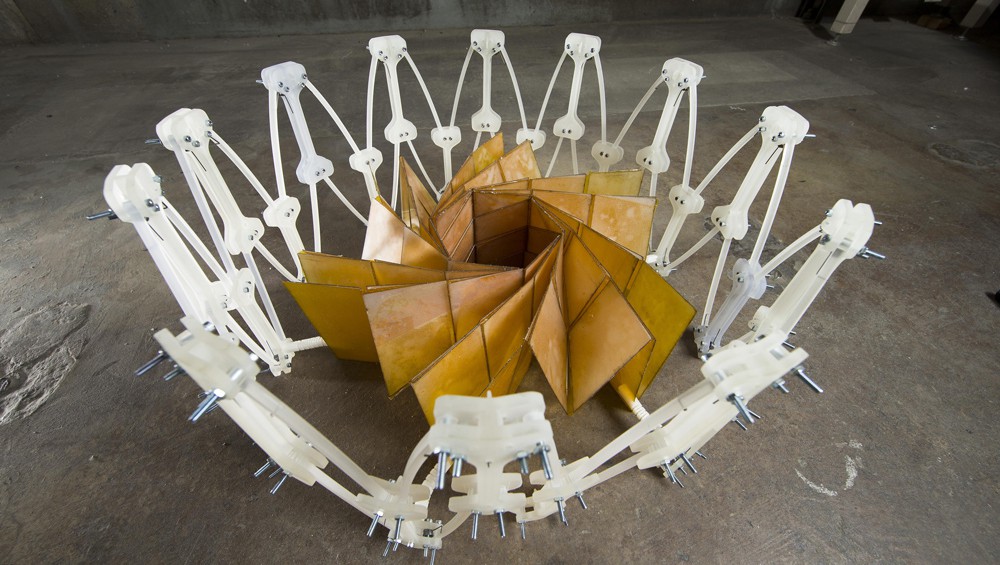
solar_panel_origami1However, the Brigham team came up with a simple and elegant solution to this problem, and found it in the form of origami. By working with complex origami folds, they were able to design a solar array that can shrink down to one-tenth of its original size. Folded up, the device is 2.7 meters (8.9 feet) across and can easily wrap around a spacecraft. Once it reaches space, the array would then unfold to become as wide as 25 meters (82 feet).

Given that solar panels deal with large, flat, thin structures, the origami concept seems like a natural fit. And this is not the first time that it has been used in space equipment design – in the 1990’s, Japanese astrophysicist Koryo Miura created a prototype for another folding solar panel. However, that project was abandoned for various reasons, not the least of which was lack of funding.

space-solar-headTo make the concept work and renew interest in the application, he Brigham team worked with Robert Lang, a world-renowned origami expert who also happens to be a mathematician and engineer and once worked at JPL himself. As Brian Trease, a mechanical engineer at the Jet Propulsion Laboratory, said:

He was trained as a physicist, used to work at JPL, and then got tired of the formal bureaucracy and left to start folding paper. Now he’s a world expert… We see value in going directly to any artist, even if they don’t have his credentials, because they have the thousands of hours or folding and tinkering to realize what can and can’t be done. Anytime you can bring in other disciplines, they just visualize things differently and bring in different solutions to your problems.

The new solar panels could be used to power spacecraft and potentially also on orbiting power stations that could wirelessly send energy to Earth via microwaves. A similar design could also be used on Earth to provide new options for portable solar power in remote locations. The same type of design might also be used in architecture or product design because of its unusual looks and function.

NASA_suntowerAccording to Trease, the Department of Defense has already been in touch with them regarding applications for soldiers in the field:

Soldiers right now might carry around 100 pounds, 15 of those pounds are batteries and fuel. If you can eliminate that, you’ve dramatically reduced their load… It’s different from opening an umbrella, because it can accommodate rigid material. You could do something like a deployable glass chandelier or a table. When it’s deployed, it looks like a flower blooming–it’s got a nice aesthetic to it.

In the next few weeks, Trease will also meet with other experts to consider different potential applications for space equipment, like antennas and reflectors, that could also deploy using origami. And given the rapidly-dropping prices associated with placing objects into orbit, this could prove to be the basis for the dream of Space-Based Solar Power – where all our energy needs are met by solar arrays in orbit that then beam them to Earth.


Source: extremetech.com, fastcoexist.com

Universe Today: Are Intelligent Civilizations Doomed?

Gaia_galaxyMy friend over at Universe Today, Fraser Cain, has been busy of late! In his latest podcast, he asks an all-important question that addresses the worrisome questions arising out of the Fermi Paradox. For those unfamiliar with this, the paradox states that given the age of the universe, the sheer number of stars and planets, and the statistical likelihood of some of the supporting life, how has humanity failed to find any indications of intelligent life elsewhere?

It’s a good question, and raised some frightening possibilities. First off, humanity may be alone in the universe, which is frightening enough prospect given its sheer size. Nothing worse than being on a massive playground and knowing you only have but yourself to play with. A second possibility is that extra-terrestrial life does exist, but has taken great pains to avoid being contacting us. An insulting, if understandable, proposition.

alien-worldThird, it could be that humanity alone has achieved the level of technical development necessary to send out and receive radio transmissions or construct satellites. That too is troubling, since it would means that despite the age of the universe, it took this long for an technologically advanced species to emerge, and that there are no species out there that we can learn from or look up to.

The fourth, and arguably most frightening possibility, is the Great Filter theory – that all intelligent life is doomed to destroy itself, and we haven’t heard from any others because they are all dead. This concept has been explored by numerous science fiction authors – such as Stephen Baxter (Manifold: Space), Alastair Reynolds (the Revelation Space universe) and Charles Stross (Accelerand0) – all of whom employ a different variation and answer.

kardashev_scaleAs explored by these and other authors, the biggest suggestions are that either civilizations will eventually create weapons or some kind of programmed matter which will destroy – such as nuclear weapons, planet busters, killer robots, or nanotech that goes haywire (aka. “grey goo”). A second possibility is that all species eventually undergo a technological/existential singularity where they shed their bodies and live out their lives in a simulated existence.

A third is that intelligent civilizations fell into a “success trap”, outgrowing their resources and their capacity to support their numbers, or simply ruined their planetary environment before they could get out into the universe. As usual, Fraser gives a great rundown on all of this, explaining the Fermi Paradox is, the statistical likelihood of life existing elsewhere, and what likely scenarios could explain why humanity has yet to find any proof of other civilizations.

Are Intelligent Civilizations Doomed:


And be sure to check out the podcast that deals strictly with the Fermi Paradox, from roughly a year ago:

The Fermi Paradox Explained:

News from Space: Dream Chaser Airframe Unveiled

dream-chaser-dockedWith the cancellation of the Space Shuttle program, and the termination of NASA’s operations with the Russian Federal Space Agency (Roscosmos), NASA has been pushing ahead with several programs designed to restore their access to low Earth orbit and the International Space Station (ISS). One such program is the Dream Chaser, a joint venture between the Sierra Nevada Corporation and Lockheed Martin that aims to create a winged mini-shuttle.

Earlier this month, the program reached an important milestone when the composite airframe structure was unveiled at a joint press conference by Sierra Nevada Corporation and Lockheed Martin at the Fort Worth facility. The assembly of the airframe took place at NASA’s Michoud Assembly Facility (MAF) in New Orleans, where Lockheed Martin is busy fabricating the structural components for the composite structure.

Dream Chaser at autoclave FP141497 07_31_14From here, the completed components are shipped to Lockheed Martin’s Aeronautics facility in Fort Worth, Texas for integration into the airframe and assembly. Designed to be launched into orbit atop a United Launch Alliance (ULA) Atlas V rocket and then fly back and land on its power, the Dream Chaser will carry a mix of cargo and up to a seven crewmembers to the ISS before landing on commercial runways anywhere in the world.

According to Mark N. Sirangelo, corporate vice president of Sierra Nevada’s Space Systems, the company chose to partner with Lockheed Martin because of its long history in the development of commercial aerospace technology:

As a valued strategic partner on SNC’s Dream Chaser Dream Team, Lockheed Martin is under contract to manufacture Dream Chaser orbital structure airframes… We competitively chose Lockheed Martin because they are a world leader in composite manufacturing, have the infrastructure, resources and quality control needed to support the needs of an orbital vehicle and have a proven track record of leading our nation’s top aviation and aerospace programs. Lockheed Martin’s diverse heritage coupled with their current work on the Orion program adds an extra element of depth and expertise to our program. SNC and Lockheed Martin continue to expand and develop a strong multi-faceted relationship.

dream-chaser-test1Dream Chaser measures about 9 meters (29 feet) long with a 7 meter (23 foot) wide wing span, and is about one third the size of the Space Shuttle Endeavor and all other NASA orbiters – which were retired beginning in 2011. Upon completion of the airframe manufacturing at Ft Worth, it will be transported to SNC’s Louisville, Colorado, facility for final integration and assembly.

SNC announced in July that they successfully completed and passed a series of risk reduction milestone tests on key flight hardware systems that brought the private reusable spacecraft closer to its critical design review (CDR) and first flight. The Sierra Nevada Corporation is now moving ahead with plans for the Dream Chaser’s first launch and unmanned orbital test flight in November of 2016, which will take place atop an Atlas V rocket from Cape Canaveral, Florida.

dream_chaserDream Chaser is among a trio of US private sector manned spaceships being developed with seed money from NASA’s Commercial Crew Program in a public/private partnership to develop a next-generation crew transportation vehicle to ferry astronauts to and from the International Space Station by 2017 – a capability totally lost following the space shuttle’s forced retirement in 2011.

These include the SpaceX Dragon and Boeing CST-100 ‘space taxis’, which are also vying for funding in the next round of contracts to be awarded by NASA around September 2014. Between a reusable mini-shuttle, a reusable space capsule, and reusable rockets, NASA not only hopes to restore indigenous space capability, but to drastically cut costs on future space missions.

Commercial-Crew-vehicles_Ken-Kremer-

Source: universetoday.com