New Trailer: Star Wars Episode VII – Trailer #2

star-wars-episode-7Here it is, at last! The second teaser trailer for the upcoming release of Star Wars Episode VII – The Force Awakens, just hit the internets! As always, the bastards as being sparse with their hints and giving us droplets that only make us thirstier. Still, the highlights in this one are pretty darn clear.

First, we get some more glimpses of how the legacy of the Skywalkers and the battle between the good and the dark sides continues. We get shots of a resurgent Empire and some Sith badguy  fighting it out with the good guys. There’s an ominous scene where Luke (or someone else) is holding Vader’s crumbled helmet. And to top it all off, we get Han and Chewie showing their faces for the first time!

Check it out. And if you were to tell me that you’re not counting down the days until December, I will call you a lying scumbag!

Universe Today – Total Views for December

GLOBAL-INTERNET-USEWell, it’s a new day and a new year. And unless I’m mistaken, that means that it’s time for taking stock and setting new goals. It also means that I’ve just received my tally for the month of December from Universe Today. And it seems that the longer I’m there, the more people are willing to read what I have to say. Makes sense. Still, I’ve never seen these kinds of traffic statistics before. Not with my own site, that’s for sure!

To break it down, here’s how I’ve been doing over the course the past two and half months. In October, which was my first month with UT, I garnered a total of 50,044 views for 11 articles. In November, that went up to 171,852 views for 26 articles. And for the month of December, I received 225,577 views for 23 articles. That represents a 343% increase from Oct-Nov, and a 76% increase over last month. Numbers like this make me happy!

What Percent of Earth is Water? 16,029
John Dalton’s Atomic Model 15,794
Planets Could Travel Along with Rogue ‘Hypervelocity’ Stars, Spreading Life Throughout the Universe 3,656
The Inner Planets of Our Solar System 8,918
Meteorite May Contain Proof of Life on Mars, Researchers Say 6,104
10 Facts About the Milky Way 25,643
Earth May Have Lost Some Primoridial Atmosphere to Meteors 1,234
The Science of Heat Transfer: What Is Conduction? 5,258
Solar System History: How Was the Earth Formed? 5,768
How Strong is the Gravity on Mars? 12,264
A Universe of 10 Dimensions 37,742
NASA’s RoboSimian And Surrogate Robots 932
What Causes Day and Night? 11,563
Just in Time for the Holidays – Galactic Encounter Puts on Stunning Display 1,398
What is the Average Surface Temperature of the Planets in our Solar System? 16,333
SpaceX Continues to Expand Facilities, Workforce in Quest for Space 4,413
Compromises Lead to Climate Change Deal 795
Meteoric Evidence Suggests Mars May Have a Subsurface Reservoir 2,916
The Milky Way’s New Neighbor May Tell Us Things About the Universe 2,519
What is the Average Surface Temperature on Venus? 4,722
Elon Musk’s Hyperloop Might Become A Reality After All 11,476
Student Team Wants to Terraform Mars Using Cyanobacteria 21,312
Making the Trip to Mars Cheaper and Easier: The Case for Ballistic Capture 8,788
Total Views 225,577

If there is one goal I’d like to set for the new year, its to turn some of that readership towards this here site, the sister site HeroX, and possibly towards some book sales as well. Those numbers have been comparatively pitiful lately, and I don’t think it would be too crass of me to hope for some additional readership in the New Year.

And here’s hoping the New Year proves to be a lucrative, fun and interesting time for my fellow bloggers and indie writers too (not necessarily in that order). What projects do you all have for 2015? What resolutions (if any) have you made?

Universe Today – Total Views for November

InternettrafficHey folks! As is customary on the tenth of every new month, the folks over at Universe Today do an official tally of all the articles published by their authors for the previous month. And it seems that November was a pretty good one for me, even though it wasn’t exactly much of a competition. This is only my second month working for UT, and I began almost halfway through the month of October so I published way fewer articles.

Still, going from 50,444 to 171,852 is pretty good! That’s a threefold increase, and then some. The full list appears below, along with the date of publication. If any of these sound interesting, just go click on the Articles at Universe Today link under Pages on the right there.

And to my fellow bloggers, freelancers, articlers and indie writers out there – as my friend James K Bowers would say “keep hammering away at those keys!” The breaks are coming for us all!

11/18/2014 How Do Planets Form? Semarkona Meteorite Shows Some Clues 989
11/19/2014 “Spotters Guide” for Detecting Black Hole Collisions 1,245
11/3/2014 Welcome to Mars! – Hi-SEAS and Mars Society Kick Off New Season of Missions 1,295
11/4/2014 VLTI Detects Exozodiacal Light Around Exoplanets 1,419
11/13/2014 Weather Forecasting on Mars Likely to be Trickier Than on Earth 1,609
11/7/2014 Canadian Micro-Rover and Lander “Northern Light” Aim for Launch to Mars in 2018 1,661
11/28/2014 “Eye of Sauron” Galaxy Used For New Method of Galactic Surveying 2,358
11/10/2014 NASA’s Next Exoplanet Hunter Moves Into Development 2,408
11/18/2014 Warm, Flowing Water on Mars Was Episodic, Study Suggests 2,586
11/19/2014 Elusive Dark Matter Could Be Detected with GPS Satellites 2,611
11/25/2014 Africa’s First Mission to the Moon Announced 2,669
11/1/2014 A Red Moon – NOT a Sign of the Apocalypse! 2,779
11/19/2014 Amazingly Detailed New Maps of Asteroid Vesta 3,056
11/7/2014 It’s Complicated: Hubble Survey Finds Unexpected Diversity in Dusty Discs Around Nearby Stars 3,230
11/5/2014 Where Have All the Pulsars Gone? The Mystery at the Center of Our Galaxy 3,382
11/21/2014 Subaru Telescope Spots Galaxies From The Early Universe 4,399
11/21/2014 NASA’s “Remastered” View of Europa is the Best Yet 5,411
11/14/2014 Concerns over ESA’s Data Release Policy Amidst Rosetta Comet Landing 5,816
11/20/2014 Two New Subatomic Particles Found 6,040
11/15/2014 Macro View Makes Dark Matter Look Even Stranger 6,820
11/29/2014 Astronomers Poised to Capture Image of Supermassive Milky Way Black Hole 9,210
11/25/2014 The Search for Dark Energy Just Got Easier 10,796
11/27/2014 NASA’s Van Allen Probes Spot Impenetrable Radiation Barrier in Space 18,021
11/21/2014 Earth’s Orbit Around The Sun 18,279
11/29/2014 The “Potsdam Gravity Potato” Shows Variations in Earth’s Gravity 23,686
11/10/2014 What Did Isaac Newton Discover? 30,077
Total Views 171,852

ESA’s Rosetta Mission Lands on Comet!

Rosetta_and_Philae_at_comet_node_full_imageOne hundred years ago, Europeans were engaged in the most brutal, inhuman struggle in history – one that saw millions of people killed and entire countrysides devastated. Today, Europeans stood together, hand in hand, to witness the momentous occasion of the Philae Lander setting down on the 67P/Churyumov-Gerasimenko comet. Not only was history made in this one act, it put a whole lot of history into perspective.

And my good friends over at Universe Today have been covering this news in a very as-it-happens fashion. So have countless other news sources all over the planet, and for good reason. This is the first time human beings have ever landed a robotic rover on a comet’s surface. Due to the high-speed, transitory nature of these celestial bodies, we’ve been forced to sit back and watch up until now.

Mars_comet_flybyIn fact, comets have been around for billions of years and date back to a time when the Solar System was still in its early stages of formation. For human beings, the sight of a comet in the night sky was often seen as a bad omen. For example, the presence of Halley’s Comet in the Inner Solar System is still believed by many to be a bringer of doom. During it’s last appearance in 1986, it became the first comet be observed in detail by spacecraft.

But with the Rosetta space mission, we finally have the opportunity to study the surface of a comet in detail, and up close! Who knows what mysteries lie beneath that icy surface. Most likely, there’s a whole lot of dust that is billions of years old and can tell us things about what our Solar System looked like way back when. But you never know…

Nice to know that humanity has made some progress in the past century.

Aerospace Travel: Los Angeles to Tokyo in One Hour

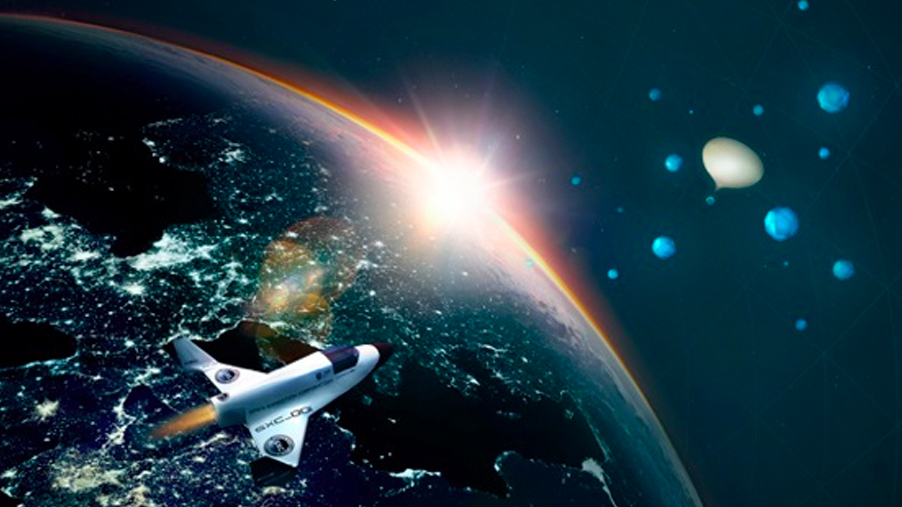
spaceshiptwo_flightGiven my busy schedule of late, some stories have been sitting in my stack for some time and I haven’t been able to write about them. But one’s like this are too cool to pass up, so here’s a belated acknowledgement. It seems that Virgin Galactic, having now demonstrated its ability to conduct aerospace tourism, has decided to enter into phase two of its plans for the future: aerospace travel!

In the scenario they are proposing, their planes would fly customers from Los Angeles to Tokyo, and the transit would take one hour. The takeoff system would be similar to the midair launch the company uses now with the SpaceShipTwo. Basically, a large plane flies the spacecraft off the ground, drops it in midair, a hybrid rocket engine ignites, and the spacecraft ascends into lower orbit.

spaceshiptwo-2nd-flight-2A system like this would allow patrons to fly from the West Coast to Japan in an hour, or from the United Kingdom to Australia in two hours. This is according to statements made by Virgin Galactic’s CEO, George Whitesides, back in September at a company event at New York City’s Museum of Natural History:

You can imagine a SpaceShipThree or a SpaceShipFour going outside the atmosphere, then coming back down outside an urban area and landing. We don’t have to accept the status quo. We can imagine a vehicle using liquid oxygen or liquid hydrogen to get us across the Pacific in an hour. You could do that.

For those following Branson’s exploits, this announcement should come as no surprise. For years, he has been attempting to create a supersonic airline of his own. But when a paradigm-shifting idea like “point-to-point suborbital space transportation” becomes possible, he began to sets his sights a little higher (so to speak).

Spaceshiptwo-580x256Naturally, there are a few things that need to be worked out and tested before that’s possible, but it’s entirely within the realm of possibility. In fact, the European Space Agency has been researching the idea and claimed that SpaceShipOne and SpaceShipTwo are the most promising space launch mechanisms they’ve seen to date.

Naturally, there is the nagging question of cost. If aerospace travel does become feasible, who exactly will be able to afford it? So far, Virgin Galactic’s suborbital spaceflight have attracted hundreds of customers, but at a cost of $250,000 per head. It seems unlikely that these same people would pay a quarter of a million dollars just to travel halfway around the world. And some experts maintain that the industry will fail strictly because of the costs involved.

space-trip-klmDerek Webber, is one such person. As the executive director of Spaceport Associates, he wrote a paper in 2008 that explored the idea:

Credible market studies have not been done, or at least published. The optimum technical design has not been established. The ground infrastructure is not in place… Price levels are uncertain. It is not even clear whether such flights are best characterized as tourism or as transportation; whether the passengers would be primarily tourists or business persons on urgent trips.

Nevertheless, these doubts are doing nothing to stem the flow of investment and research being made by aerospace organizations and companies. For years, KLM Royal Dutch Airlines – the national air carrier of the Netherlands – has been developing a rocket-powered sub-orbital craft of its own. California-based XCOR Aerospace also has the Lynx – a hypersonic plane that could fly between New York and Tokyo in just 90 minutes.

XCORReaction Engines Limited is also developing the Skylon hypersonic engine for commercial spacecraft, much in the same way that Boeing and NASA are  developing the X-37B space plane. While these efforts are aimed at creating reusable spacecraft that could deploy satellites and deliver crew and supplies into orbit, they are also laying the groundwork for commercial transportation that takes people into orbit.

Meanwhile, DARPA and the US Marine Corps have been working on developing their own point-to-point rockets for delivering supplies and people for roughly a decade now and the Federal Aviation Administration’s 2010 report noted that:

[the] potential for the rapid global transport of passengers and the fast distribution of goods and services make point-to-point transportation an attractive space technology concept worth exploiting.

So while a price breakdown may be lacking, and the expected costs limiting, the technology is still in its infancy and it seems likely that the future of transportation lies in space. Beyond rapid transit and space tourism, it may very well be how airlines ferry people to and from their destinations in the not-too-distant future.

Source: motherboard.vice.com

The Fate of Humanity

the-futureWelcome to the world of tomorroooooow! Or more precisely, to many possible scenarios that humanity could face as it steps into the future. Perhaps it’s been all this talk of late about the future of humanity, how space exploration and colonization may be the only way to ensure our survival. Or it could be I’m just recalling what a friend of mine – Chris A. Jackson – wrote with his “Flash in the Pan” piece – a short that consequently inspired me to write the novel Source.

Either way, I’ve been thinking about the likely future scenarios and thought I should include it alongside the Timeline of the Future. After all, once cannot predict the course of the future as much as predict possible outcomes and paths, and trust that the one they believe in the most will come true. So, borrowing from the same format Chris used, here are a few potential fates, listed from worst to best – or least to most advanced.

1. Humanrien:
extinctionDue to the runaway effects of Climate Change during the 21st/22nd centuries, the Earth is now a desolate shadow of its once-great self. Humanity is non-existent, as are many other species of mammals, avians, reptiles, and insects. And it is predicted that the process will continue into the foreseeable future, until such time as the atmosphere becomes a poisoned, sulfuric vapor and the ground nothing more than windswept ashes and molten metal.

One thing is clear though: the Earth will never recover, and humanity’s failure to seed other planets with life and maintain a sustainable existence on Earth has led to its extinction. The universe shrugs and carries on…

2. Post-Apocalyptic:

post-apocalypticWhether it is due to nuclear war, a bio-engineered plague, or some kind of “nanocaust”, civilization as we know it has come to an end. All major cities lie in ruin and are populated only marauders and street gangs, the more peaceful-minded people having fled to the countryside long ago. In scattered locations along major rivers, coastlines, or within small pockets of land, tiny communities have formed and eke out an existence from the surrounding countryside.

At this point, it is unclear if humanity will recover or remain at the level of a pre-industrial civilization forever. One thing seems clear, that humanity will not go extinct just yet. With so many pockets spread across the entire planet, no single fate could claim all of them anytime soon. At least, one can hope that it won’t.

3. Dog Days:

arcology_lillypadThe world continues to endure recession as resource shortages, high food prices, and diminishing space for real estate continue to plague the global economy. Fuel prices remain high, and opposition to new drilling and oil and natural gas extraction are being blamed. Add to that the crushing burdens of displacement and flooding that is costing governments billions of dollars a year, and you have life as we know it.

The smart money appears to be in offshore real-estate, where Lillypad cities and Arcologies are being built along the coastlines of the world. Already, habitats have been built in Boston, New York, New Orleans, Tokyo, Shanghai, Hong Kong and the south of France, and more are expected in the coming years. These are the most promising solution of what to do about the constant flooding and damage being caused by rising tides and increased coastal storms.

In these largely self-contained cities, those who can afford space intend to wait out the worst. It is expected that by the mid-point of the 22nd century, virtually all major ocean-front cities will be abandoned and those that sit on major waterways will be protected by huge levies. Farmland will also be virtually non-existent except within the Polar Belts, which means the people living in the most populous regions of the world will either have to migrate or die.

No one knows how the world’s 9 billion will endure in that time, but for the roughly 100 million living at sea, it’s not a going concern.

4. Technological Plateau:

computer_chip4Computers have reached a threshold of speed and processing power. Despite the discovery of graphene, the use of optical components, and the development of quantum computing/internet principles, it now seems that machines are as smart as they will ever be. That is to say, they are only slightly more intelligent than humans, and still can’t seem to beat the Turing Test with any consistency.

It seems the long awaited-for explosion in learning and intelligence predicted by Von Neumann, Kurzweil and Vinge seems to have fallen flat. That being said, life is getting better. With all the advances turned towards finding solutions to humanity’s problems, alternative energy, medicine, cybernetics and space exploration are still growing apace; just not as fast or awesomely as people in the previous century had hoped.

Missions to Mars have been mounted, but a colony on that world is still a long ways away. A settlement on the Moon has been built, but mainly to monitor the research and solar energy concerns that exist there. And the problem of global food shortages and CO2 emissions is steadily declining. It seems that the words “sane planning, sensible tomorrow” have come to characterize humanity’s existence. Which is good… not great, but good.

Humanity’s greatest expectations may have yielded some disappointment, but everyone agrees that things could have been a hell of a lot worse!

5. The Green Revolution:
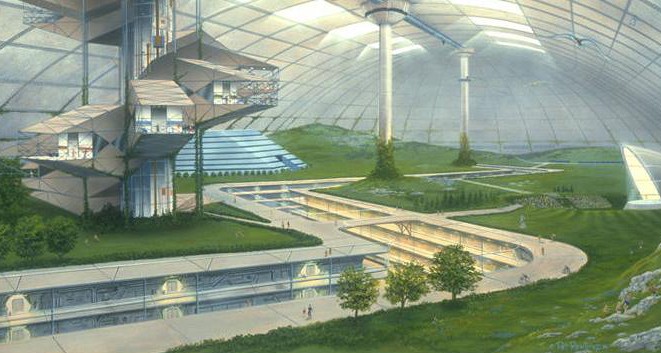
MarsGreenhouse2The global population has reached 10 billion. But the good news is, its been that way for several decades. Thanks to smart housing, hydroponics and urban farms, hunger and malnutrition have been eliminated. The needs of the Earth’s people are also being met by a combination of wind, solar, tidal, geothermal and fusion power. And though space is not exactly at a premium, there is little want for housing anymore.

Additive manufacturing, biomanufacturing and nanomanufacturing have all led to an explosion in how public spaces are built and administered. Though it has led to the elimination of human construction and skilled labor, the process is much safer, cleaner, efficient, and has ensured that anything built within the past half-century is harmonious with the surrounding environment.

This explosion is geological engineering is due in part to settlement efforts on Mars and the terraforming of Venus. Building a liveable environment on one and transforming the acidic atmosphere on the other have helped humanity to test key technologies and processes used to end global warming and rehabilitate the seas and soil here on Earth. Over 100,000 people now call themselves “Martian”, and an additional 10,000 Venusians are expected before long.

Colonization is an especially attractive prospect for those who feel that Earth is too crowded, too conservative, and lacking in personal space…

6. Intrepid Explorers:
spacex-icarus-670Humanity has successfully colonized Mars, Venus, and is busy settling the many moons of the outer Solar System. Current population statistics indicate that over 50 billion people now live on a dozen worlds, and many are feeling the itch for adventure. With deep-space exploration now practical, thanks to the development of the Alcubierre Warp Drive, many missions have been mounted to explore and colonizing neighboring star systems.

These include Earth’s immediate neighbor, Alpha Centauri, but also the viable star systems of Tau Ceti, Kapteyn, Gliese 581, Kepler 62, HD 85512, and many more. With so many Earth-like, potentially habitable planets in the near-universe and now within our reach, nothing seems to stand between us and the dream of an interstellar human race. Mission to find extra-terrestrial intelligence are even being plotted.

This is one prospect humanity both anticipates and fears. While it is clear that no sentient life exists within the local group of star systems, our exploration of the cosmos has just begun. And if our ongoing scientific surveys have proven anything, it is that the conditions for life exist within many star systems and on many worlds. No telling when we might find one that has produced life of comparable complexity to our own, but time will tell.

One can only imagine what they will look like. One can only imagine if they are more or less advanced than us. And most importantly, one can only hope that they will be friendly…

7. Post-Humanity:

artificial-intelligence1Cybernetics, biotechnology, and nanotechnology have led to an era of enhancement where virtually every human being has evolved beyond its biological limitations. Advanced medicine, digital sentience and cryonics have prolonged life indefinitely, and when someone is facing death, they can preserve their neural patterns or their brain for all time by simply uploading or placing it into stasis.

Both of these options have made deep-space exploration a reality. Preserved human beings launch themselves towards expoplanets, while the neural uploads of explorers spend decades or even centuries traveling between solar systems aboard tiny spaceships. Space penetrators are fired in all directions to telexplore the most distant worlds, with the information being beamed back to Earth via quantum communications.

It is an age of posts – post-scarcity, post-mortality, and post-humansim. Despite the existence of two billion organics who have minimal enhancement, there appears to be no stopping the trend. And with the breakneck pace at which life moves around them, it is expected that the unenhanced – “organics” as they are often known – will migrate outward to Europa, Ganymede, Titan, Oberon, and the many space habitats that dot the outer Solar System.

Presumably, they will mount their own space exploration in the coming decades to find new homes abroad in interstellar space, where their kind can expect not to be swept aside by the unstoppable tide of progress.

8. Star Children:
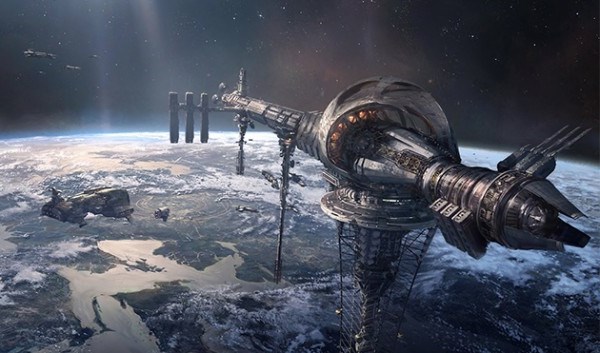
nanomachineryEarth is no more. The Sun is now a mottled, of its old self. Surrounding by many layers of computronium, our parent star has gone from being the source of all light and energy in our solar system to the energy source that powers the giant Dyson Swarm at the center of our universe. Within this giant Matrioshka Brain, trillions of human minds live out an existence as quantum-state neural patterns, living indefinitely in simulated realities.

Within the outer Solar System and beyond lie billions more, enhanced trans and post-humans who have opted for an “Earthly” existence amongst the planets and stars. However, life seems somewhat limited out in those parts, very rustic compared to the infinite bandwidth and computational power of inner Solar System. And with this strange dichotomy upon them, the human race suspects that it might have solved the Fermi Paradox.

If other sentient life can be expected to have followed a similar pattern of technological development as the human race, then surely they too have evolved to the point where the majority of their species lives in Dyson Swarms around their parent Sun. Venturing beyond holds little appeal, as it means moving away from the source of bandwidth and becoming isolated. Hopefully, enough of them are adventurous enough to meet humanity partway…

_____

Which will come true? Who’s to say? Whether its apocalyptic destruction or runaway technological evolution, cataclysmic change is expected and could very well threaten our existence. Personally, I’m hoping for something in the scenario 5 and/or 6 range. It would be nice to know that both humanity and the world it originated from will survive the coming centuries!

The Walking Dead – Season Five Premiere!

WD_Season5“They’re f@$!#ing with the wrong people!” Those were the words that capped off the season four finale. At least, they were before the show’s writers decided to censor themselves and changed it to “screwing”. In any case, the show ended with Rick and his party arriving at Terminus only to find that the advertised oasis was a lie – a trap designed to lure unsuspected people in for some nefarious purpose.

Naturally, the blogosphere explodedediately after with various people offering their own theories as to what Terminus represented and what they intended for Rick and his crew. The smart money appeared to be on cannibalism, as it seemed most consistent with what happened in the comics, not to mention the odd room with all candles and the words “NEVER AGAIN. NEVER TRUST. WE FIRST, ALWAYS” written on the wall.

In the weeks leading up to the premiere, fans were also warned that this season would be darker and bloodier, and the preview poster – which showed Rick sporting a new beard – had the words “hunt or be hunted” scrolled across it. Between all these hints and warning, the fanbase was pretty much stoked and there was no surprises when the premiere opened at a record-breaking 17.3 million viewers, beating out their previous record of 16.1 million.

And this past Sunday, the big reveal happened in an episode that was appropriately titled…

No Sanctuary:
https://storiesbywilliams.com/wp-content/uploads/2014/10/913a6-the-walking-dead-5-temporada-trailer-07.jpgThe episode opens with a flashback where two residents of Terminus – Chris and Alex – are being held prisoner. They reflect on how they chose to remain human in the midst of the crisis, and suffered for it. Flashing back to the present, we see Rick and the others preparing to make a break for it as soon as the door to the railcar is opened. However, they are surprised when a flashbang is thrown in through the roof and they are then carried out.

Rick, Glenn, Daryl, and Bob are then taken to a kill room where they see a body being carved up. Four others are positioned alongside them over a metal trough, and two men begin butchering them one by one. Chris comes in to take stock and pauses the killing long enough to ask Rick about the bag he stashed out in the woods. Things are about to start again when shooting from outside and an explosion sends everyone to the ground.

http://i2.wp.com/geektasticpodcast.com/wp-content/uploads/2014/10/walking-dead-trailer.jpg?resize=620%2C344Outside of town, Tyreese, Carol and Judith continue on their way towards town when they come across a herd. They hide and are saved when gunfire distracts and lures the herd away. They proceed towards the source, and find Alex out on sentry duty and talking over a walkie-talkie about Carl and Michonne. They take him prisoner in a small shed and Carol goes on ahead while Tyreese remains behind to watch him with Judith.

After covering herself with gore and mud, she proceeds to the edge of town and sees Rick, Daryl, Bob and Glenn being taken inside. At the same time, the herd begins to approach the fence line and the guards begin to run away. Using her sniper rifle, Carol shoots a gas tank sitting by the fence and uses a firework to detonate it, killing a dozen Walkers and breaching the fence in the process.

https://i0.wp.com/www.geekchicelite.com/wp-content/uploads/2014/10/twdno1.jpgChaos ensues as the Walkers move in and begin attacking the town and Carol slips in amongst them. Chris leaves the kill room to assess the situation while Rick uses a piece of sharpened wood to saw through his restraints. He kills the two men and then sets the others free, and the four proceed out into the compound. Fighting against both Walkers and guards, they seize weapons and free the others.

Back at the shed, the noise from the explosions and gunfire begins to draw Walkers. Alex gets free, takes Judith hostage and forces Tyreese to disarm and go outside. He steps out and is grabbed by several Walkers, but all noise stops a moment later. Alex takes Tyreese’s knife and begins inching towards the door, and Tyreese breaks back in, slams him on the grounds and begins beating him to death.

https://i0.wp.com/i.dailymail.co.uk/i/pix/2014/10/13/1413173366927_wps_50_The_Walking_Dead_Season_P.jpgMeanwhile, Carol begins looking for Rick and the others inside. After finding her way into a building, she comes across a stash of stolen goods and finds Daryl’s crossbow. Eventually, she comes to the strange room where she is confronted by Mary, the town matriarch. They fight, Carol gets the upper hand, and Mary explains how the town became the place that it is:

The signs… they were real. It was a sanctuary. People came and took this place. And they raped, and they killed, and they left… over weeks! But we got out, and we fought, and we got it back! And we heard the message: you’re the butcher, or you’re the cattle…

Carol shoots Mary in the leg, and then lets a group of Walkers in to finish her. In the rail car, the rest try to decide whether they should break out into the chaos or wait. Sasha asks Eugene what the cure is, and he explains that he once worked for the Human Genome Project as part of a team that weaponized viruses to fight other weaponized viruses. He claims that with his knowledge, they can kill all the Walkers if they can get to Washington DC.

https://i0.wp.com/cdn.bloody-disgusting.com/wp-content/uploads/2014/10/BzysAj2IUAEZ2yV.png-large-620x400.pngRick then shows up and lets them out, and they all fight their way to the fence. They make it out and proceed into the woods, where Rick digs up the pack he buried and tells them they are going back to finish the job. The group tells Rick its pointless since they are as good as dead, Carol emerges from the trees and is embraced by Daryl and Rick. She tells them to follow her up the road, where they rejoin Tyreese and Judith.

Rick is elated to learn his baby girl is still alive and Sascha her brother. They decide to move on up the rails again, and Rick finds a sign pointing towards Terminus and wipes out all but two words: “No Sanctuary”. The episode ends with another flashback where Chris, Alex and Mary are being held together, and Chris says they will take it back, repeating the adage: “You’re either the butcher, or you’re the cattle.”

https://i0.wp.com/i.dailymail.co.uk/i/pix/2014/10/13/1413173605905_wps_66_The_Walking_Dead_Season_P.jpgAnd in a post-episode peek, we are shown a figure who is following the tracks and comes across the sign. He spots symbols carved into the trees and begins following them. Once he removes his mask, we learn that it’s Rick’s old friend Morgan.

Summary:
I quite enjoyed this episode, and for a few reasons. For one, it delivered on its promise of a darker, bloodier feel, even though this was hardly lacking in the previous seasons. It also handled the whole “good people gone evil” theme very well. Despite everything they do and the evil they commit, the people portraying the Terminites (Terminans?) managed to capture the inherent sense of desperation and anger powering them.

This is the very core Robert Kirkman’s The Walking Dead, which is how otherwise good and civilized people can do terrible things when push comes to shove. And since it was something that didn’t happen in the comics, but was loosely based on it, it made for just enough of a surprise. And of course, few people could argue with the fact that the action was pretty badass too, and the reunions pretty heartfelt.

The only things I would criticize is the character arc of Carol. By now, people can’t fail to notice that she’s become the female version of Rambo. At the end, Rick asks her “did you do that?” And by that, he means rescuing them by single-handedly blowing up a section of wall, letting a herd overrun a small town, and then taking out the town’s matriarch. Yes, somehow, a “thank you” and a “welcome back” would seem appropriate.

But this really doesn’t seem fitting for Carol. As I’ve said before, she went from being an abused, put-upon housewife to a bereaved mother, then an independent woman, then a character who had little to do, all before becoming some ruthless woman who immolated people to prevent the spread of disease. Now, she’s a one-woman army who kicks ass and takes names.

It’s cool, but it’s not exactly realistic. What’s more, Michonne is supposed to be the ass-kicking heroine of that bunch, not Carol. The way her character kind of got sidelined in this episode really drove that home for me. And Sasha is also a strong female presence, same as Maggie. So I do wonder if her character’s not just a bit superfluous at this point. And considering she was long-dead by now in the comics, I have a hard time taking her seriously.

Also, Tyreese’s character has seemed just a little too gentle for my tastes. I very much liked how he took out several Walkers with his bare hands and then beat that Alex kid to death. This is the Tyreese I know and remember from the comics, a big, strong, troubled man who did what he had to, even though he didn’t enjoy it one bit. The TV show’s Tyreese, while certainly likeable, seems too much like a big teddy bear to me.

Otherwise, I like what they’ve done so far this season and where they are going. At this point, Morgan is poised to rejoin the group, and from the previews, it seems clear that they are now converging back on comic book material (i.e. finding a preacher and taking him in), all the while working their way towards Washington DC.

*As a side note, I should point out that, despite what some fans saw in the ending, the producers have indicated that that was NOT Negan making an appearance near the end of the episode. However, I imagine that’s what the shows producers intended when they cast that look alike, as the intro of Negan could turn out to be season 5 material. Stay tuned!

Writing for HeroX and Universe Today!

good_news_farnsworthGood news, everyone! My services as a freelance writer were recently enlisted by the good folks who run HeroX and Universe Today. Thanks to my old friend and mentor, Fraser Cain (who consequently got me started in the indie publishing bizz), I’m going to be bringing the experience I’ve garnered writing my own blog to a more professional format – writing about space exploration, innovation and technological development.

As you can imagine, this means I’ll be doing less in the way of writing for this here website. But I promise I’ll still be around! After all, I’ve got lost more work to do on my stories, and there are always articles and headlines that need to be written about that I won’t get a chance to cover at those other sites. So rest assured, storiesbywilliams will be in operation for a long time to come.

XPRIZE_GooglePlus_Cover_2120x1192For those unfamiliar, HeroX is a spinoff of the XPRIZE Foundation, the non-profit organization that runs public competitions intended to encourage technological development and innovation. It’s directors includes such luminaries as Google’s Elon Musk and Larry Page, director James Cameron, author and columnist Arianna Huffington, and businessman/ philanthropist Ratan Tata, and more. In short, they are kind of a big deal!

Fraser Cain, founder of Universe Today, began HeroX as a way of combining the best of the XPRIZE with a crowdfunding platform similar to Kickstarter. Basically, the site brings together people with ideas for new inventions, finds the people with the talent and resources to make them happen, and funnels contributions and donations to them to bankroll their research and development.

big_bangUniverse Today, on the other hand, is kind of an old stomping ground for me. Years back, I did articles for them that dealt with a range of topics, including geology, natural science, physics, environmentalism, and astronomy. In both cases, I’ll be doing write ups on news items that involve technological development and innovation, and doing interviews with some of the people in the business.

If possible, I’ll try to link articles done for these sources to this page so people can check them out. And stay tuned for more updates on the upcoming release of Flash Forward, Oscar Mike, and my various other projects. Peace out!

The Future of Space: Building A Space Elevator!

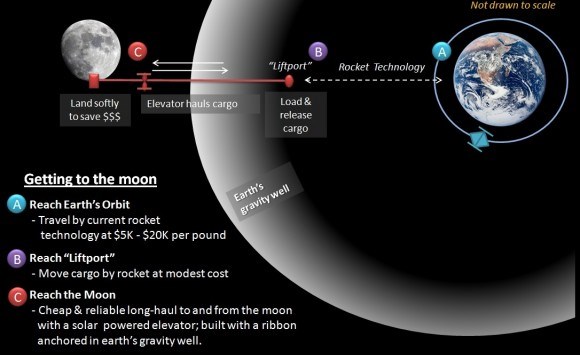
space_elevator2Regularly scheduled trips to the Moon are one of many things science fiction promised us by the 21st century that did not immediately materialize. However, ideas are on the drawing board for making it happen in the coming decades. They include regular rocket trips, like those suggested by Golden Spike, but others have more ambitious plans. For example, there’s LiftPort – a company that hopes to build a space elevator straight to the Moon.

When he was working with NASA’s Institute for Advanced Concepts in the early 2000s, LiftPort President Michael Laine began exploring the idea of a mechanism that could get people and cargo to space while remaining tethered to Earth. And he is certainly not alone in exploring the potential, considering the potential cost-cutting measures it offers. The concept is pretty straightforward and well-explored within the realm of science fiction, at least in theory.

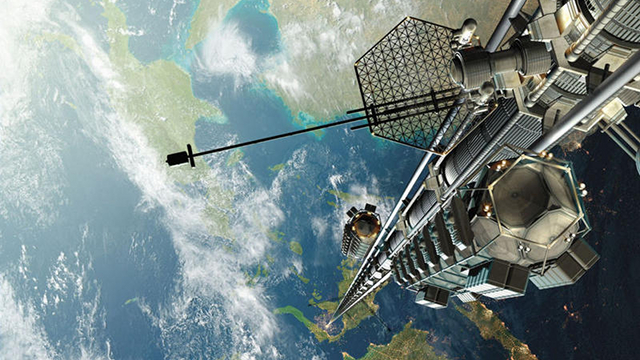
space_elevatorThe space elevator concept is similar to swinging a ball on a string, except it involves a tether anchored to the Earth that’s about 500 km long. The other end is in anchored in orbit, attached to a space station that keeps the tether taut. Anything that needs to be launched into space can simply be fired up the tether by a series of rocket-powered cars, which then dock with the station and then launched aboard a space-faring vessel.

Compared to using rockets to send everything into space, the cost using the elevator is far less (minus the one-time astronomical construction fee). And while the materials do not yet exist to construct 0ne, suggestions have been floated for a Lunar Elevator. Taking advantage of the Moon’s lower gravity, and using the Earth’s gravity well to stabilize the orbital anchor, this type of elevator could be built using existing materials.

space_elevator_lunar1One such person is Laine, who believes the capability exists to build an elevator that would reach from to the Moon to a distance of 238,000 km towards the Earth. Hence why, started two and a half years ago, he struck out to try and bring this idea to reality. The concept behind the Moon Elevator is still consistent with the ball on the string analogy, but it is a little more complicated because of the Moon’s slow orbit around the Earth.

The solution lies in Lagrangian points, which are places of gravitational equilibrium between two bodies. It’s here that the gravitational pull of both bodies are equal, and so they cancel each other out. Lagrangian point L1 is about 55,000 kilometers from the Moon, and that’s the one Laine hopes to take advantage of. After anchoring one end of the “string” on the Moon’s surface, it will extend to L1, then from L1 towards Earth.

lunar_space_elevatorAt the end of the string will be a counterweight made up of all the spent pieces of rocket that launched the initial mission to get the spike into the Moon. The counterweight will be in the right place for the Earth to pull on it gravitationally, but it will be anchored, through the Lagrange point, to the Moon. The force on both halves of the “string” will keep it taut. And that taut string will be a space elevator to the Moon.

What’s more, Laine claims that the Moon elevator can be built off-the-shelf, with readily available technology. A prototype could be built and deployed within a decade for as little as $800 million, he claims. It would be a small version exerting just a few pounds of force on the anchor on the Moon, but it would lay the groundwork for larger follow-up systems that could transport more cargo and eventually astronauts.

liftportTo demonstrate their concept, LiftPort is working on a proof-of-concept demonstration that will see a robot climb the tallest free­standing human structure in existence. This will consist of three large helium balloons held together on a tripod and a giant spool of Vectran fiber that is just an eighth of an inch think, but will be able to support 635 kilograms (1,400 pounds) and withstand strong winds.

Vectran is the same material was used by NASA to create the airbags that allowed the Spirit and Opportunity’s rovers to land on Mars. Since it gets stronger as it gets colder, it is ideal for this high altitude test, which will be LiftPort’s 15th experiment and the 20th robot to attempt an ascent. Laine doesn’t have a prospective date for when this test will happen, but insists it will take place once the company is ready.

LiftPort1Regardless, when the test is conducted, it will be the subject of a new documentary by Ben Harrison. Having learned about Liftport back in 2012 when he stumbled across their Kickstarter campaign, Harrison donated to the project and did a brief film segment about it for Engadget. Since that time, he has been filming Liftport’s ongoing story as part of a proposed documentary.

Much like Laine, Harrison and his team are looking for public support via Kickstarter so they can finish the documentary, which is entitled “Shoot the Moon”. Check out their Kickstarter page if feel like contributing. As of the time of writing, they have managed to raise a total of $14,343 of their $37,000 goal. And be sure to check out the promotional videos for the Liftport Group and Harrison’s documentary below:

Lunar Space Elevator Infrastructure Overview:


Shoot the Moon – Teaser Trailer:


Sources:
 motherboard.vice.com
, lunarelevator.com

News from Space: MOM Arrives!

MOM_orbiterHistory was made this week as India’s Mars Orbiter Mission successfully fired its braking rockets and arrived in Mars’ orbit. The arrival of India’s maiden interplanetary voyager was confirmed at 7:30am, India Standard Time (02:00 UTC, or 8:00pm EDT in the U.S. on Tuesday, Sept 23rd). MOM is the nation’s first attempt to explore the Red Planet, and represents a new era is space exploration.

By putting a probe in orbit around Earth’s neighbor, India has officially joined the elite club of only three other entities who have launched probes that successfully investigated Mars – i.e. Russia, the United States, and the European Space Agency (ESA). It also represents an expansion in the space exploration, a competition once confined to two superpowers, to five major participants – the US, Russia, ESA, India and China.

India_Mars_Orbiter1It took over ten months for MOM to cross the roughly 225 million kilometers (140 million miles) of interplanetary space that lie between Earth and Mars. Nevertheless, the 12.5 minutes that it took for the signal to reach Earth were far more intense and exciting. And the good news, which arrived at 10:30pm EDT (Sept. 23rd) or 8:00 IST (Sept. 24th) was met with wild applause and beaming smiles at India’s Bangalore mission control center.

MOM’s Red Planet arrival was webcast live worldwide by the Indian Space Research Organization (ISRO), India’s space agency which designed and developed the orbiter. ISRO’s website also gave a play by play in real time, announcing the results of critical spacecraft actions along the arrival timeline just moments after they became known. Indian PM Narenda Modi was watching the events unfold at ISRO’s Telemetry, Tracking and Command Network (ISTRAC).

MOM_arrivalUpon the announced arrival, Modi addressed the team, the nation and a global audience, lauding the accomplishment and outlining the benefits and importance of India’s space program. In a speech that echoes John F. Kennedy’s own from 50 years ago, Modi also implored the team to strive for even greater space exploration challenges:

India has successfully reached Mars! History has been created today. We have dared to reach out into the unknown and have achieved the near-impossible. I congratulate all ISRO scientists as well as all my fellow Indians on this historic occasion… We have gone beyond the boundaries of human enterprise and imagination. We have accurately navigated our spacecraft through a route known to very few. And we have done it from a distance so large that it took even a command signal from Earth to reach it more than it takes sunlight to reach us.

MOM’s success follows closely on the heels of NASA’s MAVEN orbiter which also successfully achieved orbit barely two days earlier on Sept. 21. Together, they will assess the extent to which Mars’ atmosphere decayed over the course of billions of years, and hopefully be able to reconstruct what it once looked like, and how it came to deteriorate. From all this, scientists hope to learn whether or not Mars once hosted life, and still is in some form.

maven_tv_backdropMOM now joins Earth’s newly fortified armada of seven spacecraft currently operating on Mars surface or in orbit – which includes MAVEN, Mars Odyssey (MO), Mars Reconnaissance Orbiter (MRO), Mars Express (MEX), Curiosity and Opportunity. Bruce Jakosky, MAVEN Principal Investigator, related well-wished on behalf of NASA in a post on the ISRO MOM Facebook page:

Congratulations to the MOM team on behalf of the entire MAVEN team! Here’s to exciting science from the two latest missions to join the Mars fleet!

MOM was launched on Nov. 5, 2013 from India’s spaceport at the Satish Dhawan Space Centre, Sriharikota, atop the nations indigenous four stage Polar Satellite Launch Vehicle (PSLV). The flight path of the approximately $73 Million probe was being continuously monitored by the Indian Deep Space Network (IDSN) and NASA JPL’s Deep Space Network (DSN) to maintain its course.

MOM_trajectoryThe do-or-die breaking maneuver that put MOM into orbit, known as the Mars Orbital Insertion (MOI), involved the craft’s engines firing for 24 minutes and 13 seconds. The entire maneuver took place autonomously under the spacecrafts preprogrammed sole control due to the long communications lag time and also during a partial communications blackout when the probe was traveling behind Mars and the signal was blocked.

As the ISRO said in a statement:

The events related to Mars Orbit Insertion progressed satisfactorily and the spacecraft performance was normal. The Spacecraft is now circling Mars in an orbit whose nearest point to Mars (periapsis) is at 421.7 km and farthest point (apoapsis) at 76,993.6 km. The inclination of orbit with respect to the equatorial plane of Mars is 150 degree, as intended. In this orbit, the spacecraft takes 72 hours 51 minutes 51 seconds to go round the Mars once.

MOM_pathMOM is expected to investigate the Red Planet for at least six months. Although it’s main objective is a demonstration of technological capabilities, it will also study the planet’s atmosphere and surface using five indigenous instruments – including a tri color imager (MCC) and a methane gas sniffer (MSM). Methane on Earth originates from both geological and biological sources – and could be a potential marker for the existence of Martian microbes.

Both MAVEN and MOM’s goal is to study the Martian atmosphere , unlock the mysteries of its current atmosphere and determine how, why and when the atmosphere and liquid water was lost – and how this transformed Mars climate into its cold, desiccated state of today. This will shed light not only on whether or not Mars supported life in the past, but if it still does in some form, and could possibly do so again.

This is an exciting time for space exploration, when ground-breaking news is happening on a regular basis and promises to lead to potentially Earth-shattering news in the future! And in the meantime, be sure to check out this video that recap’s MOM’s historic mission and arrival, courtesy of WorldBreakingNews:


And this animation of the MAVEN and MOM orbit:


Sources:
universetoday.com, (2), nasaspaceflight.com