It’s been awhile since I checked HISHE, and it seems they tackled a few gems while I was out doing other things. The latest in their lineup is this, a parody on Peter Jackson’s latest adaptation from the Tolkien universe. While I have yet to see the movie, I read the book and am familiar with just about everything the movie did by reputation alone. And I think these guys stuck it pretty good, as usual!
In fact, I would recommend checking out the site when you’re done watching this video and seeing what they did for Lord of The Rings as well. Not only do they tie together, but are a pretty example of how a more sensible ending can cut down on some serious screen time!
And we’re back from Mars with another slew of updates and breaking news! It seems that ever since the Curiosity Rover landed back in early August, the revelations and interesting facts have been pouring in non-stop. With each bit of news, we learn a little more about the Red Planet’s composition, its history, and how both are so similar to our own.
And in recent weeks, ever since Curiosity moved into Yellowknife Bay, there have been a number of interesting developments. One came back in January when the Rover found a series of calcium-rich deposits, similar to the kind observed here on Earth. These types of deposits are observed wherever and whenever water circulates through cracks and rock fractures. This is just the latest in a long string of discoveries which support the conclusion that Mars was once home to vast rivers.
The images above show the similarity between the sulfate-rich veins seen by Curiosity rover to sulfate-rich veins seen on Earth. The view on the left is a mosaic of two shots from the remote micro-imager on Curiosity’s Chemistry and Camera (ChemCam) instrument which were taken on Dec. 14, 2012, or the 126th sol (Martian day) of operations. The image on the right is from the Egyptian desert here on Earth, which a pocket knife included for scale.
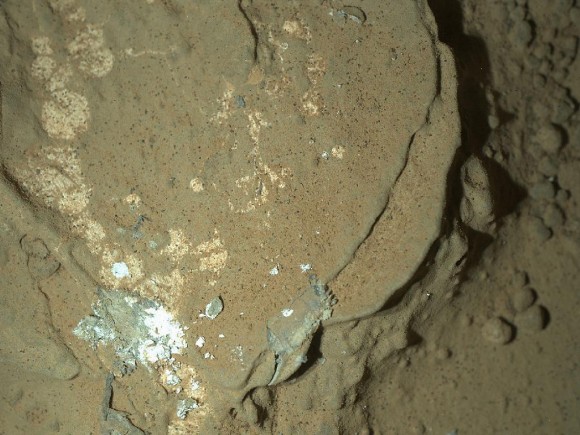
The next bit of news came on January 25th when Curiosity’s high resolution robotic arm camera – also known as the Mars Hand Lens Imager (MAHLI) – snapped its first set of nighttime images. The images were illuminated by both an ultraviolet and white light emitting LED’s (shown above and below). The rock outcropping – named “Sayunei”, located at the site of the “John Klein” outcrop – was just one of many to be found in Yellowknife Bay where Curiosity has been conducting ongoing surveys.
In this case, it was breaking the rock apart in an effort to try and expose fresh material, free of obscuring dust. Once exposed, the pictures were meant to determine the internal makeup of the rock. “The purpose of acquiring observations under ultraviolet illumination was to look for fluorescent minerals,” said MAHLI Principal Investigator Ken Edgett of Malin Space Science Systems, San Diego. “If something looked green, yellow, orange or red under the ultraviolet illumination, that’d be a more clear-cut indicator of fluorescence.”
In addition, certain classes of organic compounds are also fluorescent. Yes, that search continues!
And last, but not least, came the news at the end of January that indicated that Curiosity’s long-awaited test of its high-powered drill will finally be taking place. This first drilling operation entailed hammering a test hole into a flat rock at the John Klien formation for the purposes of making sure everything works as needed. If things pan out, then the team would conduct many more tests and collect the drillings for analysis by the Rover’s CheMin and SAM analytical labs in the coming days.
In anticipation of the planned drilling operation, the rover carried out a series of four ‘pre-load’ tests on Monday (Jan. 27), whereby the rover placed the drill bit onto Martian surface targets at the John Klein outcrop and pressed down on the drill with the robotic arm. Engineers then checked the data to see whether the force applied matched predictions. The next step was an overnight pre-load test, to gain assurance that the large temperature change from day to night at the rover’s location would not add excessively to stress on the arm while it is pressing on the drill.
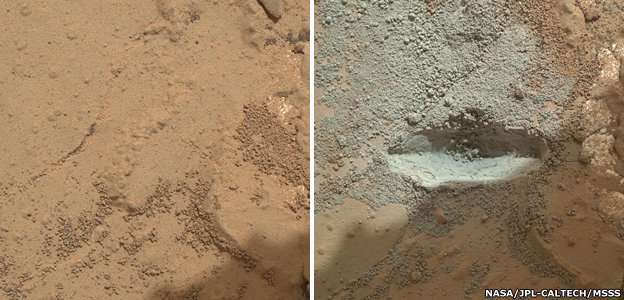
The photo above shows the before and after shots of the rock where the drill conducted its hammering. And as you can see, the rock powered and is of a different color inside – slate gray as opposed to rust red. If the MSL lab deems the slab suitable, a number of test holes are likely to be drilled – using the rotation as well the percussive action – before a powdered sample is picked up and delivered to Curiosity’s onboard laboratories.
And so far, according to Curiosity project scientist John Grotzinger, things are looking good:
“The drilling is going very well so far and we’re making great progress with the early steps. The rock is behaving well and it looks pretty soft, so that’s encouraging,” he told BBC News.”
Ultimately, the purpose of the rover’s mission is to try to determine whether Gale has ever had the environments in the past that were capable of supporting bacterial life. Detailing the composition of rocks is critical to this investigation as the deposits in the crater will retain a geochemical record of the conditions under which they formed. Drilling a few centimetres inside a rock provides a fresh sample that is free from weathering or radiation damage, both of which are common to the Martian surface.
There is more to follow, for sure. And in the meantime, check out this video of the Mars Science Labs providing the latest Curiosity Rover Report explaining their finds for the month of January and plans for February.
I’m not sure why, but I’ve been inundated with movie previews lately, ones which I feel I must pass on to others. And this is just the latest and most awesome! Seriously, it was like this thing was created with me and my fellow nerds in mind! Some might think it an overly-appropriate commentary, others might sense some irony, but I look at it and just see fandom, nerdom, geekdom goodness!
As would be expected, this low-budget indie film was written and directed by relative newcomers, but happens to star some real heavyweights of the sci-fi, fantasy and horror genres. They include Peter Dinklage (Tyrion Lannister from HBO’s A Game of Thrones), Summer Glau (River Tam on Firefly and Serenity) and Ryan Kwanten (Jason Stackhouse from True Blood).
And of course, the plot is something that will appeal to the nerd in all of us. It begins when a group of friends travel into the woods to do some LARPing (Live Action Role Playing for those not nerdy enough to know). After the wizard of the group accidentally casts a real magic spell, the group must contend with a real-life succubus and an army of dark forces that are suddenly summoned to Earth. In short, a group of people who specialize in make-believe are called upon to become real life heroes and save the world from the forces of hell.
See? I told you it was an awesome concept! Between some genuine talent, a hilarious premise, and a metaphor that couldn’t be more frank, this movie has a lot of promise. The film previewed during ComicCon 2011, but is yet to be released to theaters. And did I mention it stars Peter Dinklage and Summer Glau? Their presence alone in this flick alone are worth the price of admission! Check out the trailer below…
Military necessity has been an engine for creation since the beginnings of recorded history. With soldiers constantly looking for new ways to kill each other, as well as save the lives of their own, one can always expect to see new and exciting technologies taking the field. And often as not, these developments have a way of trickling down and impacting society as a whole.
Take the AirMule, a compact, unmanned, single-engine vehicle that is being developed by Urban Aeronautics. Based in Israel, this company is dedicated to the creation of Vertical-Takeoff-and-Landing (VTOL) craft that utilize internal lift rotors to get in and out of tight areas, ostensibly for the purpose of supporting military personnel, evacuating the wounded, and conducting remote reconnaissance missions.
In an age where military forces are relying increasingly on unmanned aerial vehicles, the AirMule is designed to be used in operations that fit the 3 D’s: Dirty, Dangerous or Dull. In addition, it is controlled through remote operation and Tele-Presence, meaning the pilots who operate it do so from the safety of a base behind the front lines. The addition of this technology allows remote operators to stay safe while still feeling like they are physically on the scene.
The immediate benefits of this vehicle lie in the fact that it is able to fly at extremely low altitudes, allowing it to pass beneath enemy fields of fire and radar. At the same time, it is capable of taking off and landing in regions that are not accessible by conventional CasEvac craft, such as helicopters. This represents another concern for military planners, who are forced to contend with the fact that wars are increasingly fought against insurgents in places like cities, villages and other inaccessible environments.
The vehicle is capable of airlifting a 500 kg load, which can take the form of wounded personnel or 500 kilos of supplies. In this way, the AirMule is able to provide point to point logistic support as well as life-saving evac missions for wounded soldiers. However, it also has a number of applications for non-military use, such as assisting EMTs in rescuing injured people, delivering supplies to disaster-stricken areas, and offering assessment capabilities to companies who need to conduct inspections in potentially hazardous zones.
No telling when the AirMule will be taking the field, but in all likelihood, it won’t be more than a few years. What’s more, with the nature of military engagements changing and unmanned technology on the rise, just about every advanced military on the planet is likely to be following suit. And as always, we can expect the technology to trickle down to society as a whole, with robotic hovercraft replacing ambulances and medevac choppers within a decade’s time.
Check out the video of the AirMule concept and its field tests. It’s a few minutes long, but quite interesting:
In and amongst the many sequels, prequels, and relaunches coming out this year, there are a few gems to speak of. I came across this one in the course of reading about upcoming sci-fi films that previewed at Comic Con. Known as “Pacific Rim”, the story takes place in a dark future when giant aliens – known as “Kaiju” – rise up from the depth of the Pacific Ocean to inflict a losing war on humanity.
And to combat this new threat, a special breed of massive robots known as Jaegers are produced to fight them. Controlled by human pilots via a neural link, these machines are the last, besrink kikuchit hope humanity has for defeating the alien menace. But of course, this too doesn’t go so well, and the entire war comes down to two unlikely pilots, a classic old Jaeger design, and a last ditch effort.
Directed by Guillermo del Toro (Blade II, Hellboy, Pan’s Labyrinth), the movie stars Edris Elba (The Losers, Thor, Prometheus) Charlie Hunnam (Children of Men, Sons of Anarchy), and Ron Perlman (Quest for Fire,Hellboy, Enemy at the Gates, Conan) and Rinko Kikuchi (Shanghai, Norwegian Wood, 47 Ronin) in the leading roles.
A more classic story there is not! An alien invasion, giant monsters, giant robots, a desperate war to save humanity, and unlikely heroes. What’s not to love?
I know, I complain pretty bitterly about all the unnecessary sequels and remakes that are coming out these days. But a Die Hard sequel is one thing you will never hear me complain about. I mean, c’mon, it’s Die Hard! Pure, smashy, action, death-defying goodness! And when a new trailer for the upcoming A Good Day to Die Hard comes along, especially one that boasts this kind of action-pornographic goodness, I’m sure to post it!
Note that this trailer expands on the last one by sticking to the main points of interest, but adding some key details. Basically, we’re given a bit more info on who the bad guys are and what their agenda is before getting into a big father and son shoot em up! And I couldn’t approve of the setting more. There’s just something about a post-Cold War Moscow. So beautiful, rich in culture and history, but with a dark and unseemly underbelly! Perfect place for an action tour de force.
So watch the movie, experience a fangasm, and then join me in trying to book some early tickets. This one comes out soon, set for a February 14th release. Yep, the perfect Valentines Day movie date! I don’t need to remind you there’s likely to be some lineups…
The 2013 Inaugural Parade on January 21st – my birthday, fyi – was quite the sight to see. In addition to the President and First Lady, many floats, and thousands of onlookers, the good folks at NASA also made an appearance. Specifically, two floats featuring the Orion deep space capsule and the Curiosity Rover were part of the parade, passing in front of the White House and the official reviewing stand while President Obama, VP Joe Biden, their families and numerous dignitaries smiling and waving.
The life-sized models were greeted with plenty of fanfare and fair weather as they floated near the front of the procession, and it is estimated that over a million people were on hand to witness the event. NASA was the only federal agency to be asked to take part in the inaugural parade, which goes to show you how important the administration considers their efforts. But given all that NASA has accomplished as of late, that should come as no small surprise.
In the few short months since it landed, Curiosity has uncovered very compelling evidence that water once flowed on Mars, and the Orion capsule is expect to take astronauts back to the moon and father into space than ever before. What’s more, the Obama administration has already granted the funding for NASA to go ahead with its plans to establish an outpost on the Moon in the next few years, as well as a manned mission to the Mars by 2030. In short, NASA and the Obama administration are pretty tight; and if you ask me, both are stronger for it!
Check out the video below of the procession, or go to NASA Flickr page for more photos of the inaugural parade.
They’re called Mars One, a nonprofit organization based in the Netherlands that intends to establish a human settlement on the Red Planet by 2023. What began as a proposed Reality TV project that would hopefully recoup the costs of sending people to Mars has since matured into a project for actual, factual colonization. There’s just one thing missing at this point…
They need people to volunteer.
A little over a week ago, they released a document specifying their application criteria. Clearly, they can’t take just anyone. Among the five key categories for qualification are Resiliency, Adaptability, Curiosity (no pun!), Ability to Trust, Creativity and Resourcefulness. Oh, and you must be at least 18 years of age, kind of like getting in to an R-rated movie. No specific technical qualifications are necessary, but if you’ve got a go-getter attitude, a positive outlook and are willing to learn, I’m sure they can teach you.
The selection process will begin during the first half of 2013, and will still be based around a reality TV concept. Basically, it will take the form of Mars One experts and viewers of a “global, televised program” choosing who they want to see go. Those ultimately selected will be assembled into teams of four, with at least six teams hoped to be prepared to launch in September 2022. But only one team will make the first trip to the Red Planet, and that team will be decided democratically.
The training process will take eight years, and will include simulated missions, practice in a restricted mobility environment, and lessons in electronics, equipment repair, basic and critical medical care. In 2016, the company plans to begin rocketing supplies to Mars, including spare parts, two rovers, and living units that can be assembled into a base once humans arrive.
It’s a testament to an age where commercial space flight is fast becoming a reality, and internet-based voting, crowdsourcing and information sharing can take the place of space agencies and government sanctioned research. Sure, it still sounds like a pipe dream, but the effort alone is impressive isn’t it? And given all the advances that are made every day, who’s to say what will and won’t be possible within the next few decades?
To read the application in detail, click here. And check out the video of Mars One’s proposed mission:
Score one for Canadian researchers and ingenuity! Oh, and Intel and Plastic Logic helped out a little bit 😉 It’s known as the PaperTab, a revolutionary concept which builds on the paper-thin smartphone and recent advances in AMOLED flexible displays. The design made the rounds at this year’s Consumer Electronics Show in Las Vegas, and it turned quite a few heads!
As already noted, the PaperTab incorporates the latest in display and flexible technology to create a 10.7-inch e-ink touchscreen display, powered by a Core i5 processor. Users control it by bending and flexing, touching the screen, and tapping one tab to the next. But instead of using it like a normal tablet, the idea is that you have lots of PaperTabs, with each tablet representing a different app – such as email, a typeface, a browser, a and so on.
This might sound like a bit of a downgrade, but the coolest thing about this new computing paradigm is that each PaperTab is aware of other PaperTabs in its proximity. You might push two PaperTabs together to extend an app onto two screens, or you could attach a file to an email by simply tapping one PaperTab on another. In this way, a PaperTab functions like an ordinary document, but with the added benefit of being electronic and transferable.
As it stands, the concept is merely a tech demo being put on by researchers from Queen’s University and corporate reps from Intel and Plastic Logic. No other information is currently available from any of these sources, but it’s likely more will trickle down to the market now that CES 2013 has wrapped up and they don’t need to keep us guessing anymore. And if I were a betting man, I’d say they’ll be available in packs of five or ten, for roughly the same price as an IPad 7 since they’ll probably be coming out at the same time.
Check out the video below of the PaperTab on display at CES 2013 and the demo the team provided:
I’m a big fan of the show American Dad, in part because of the hilarious and often sociopathic exploits of the alien Roger Smith. In this clip from the season six premier (100 A.D. Part One), we see Roger and Steve in their “Wheels and the Legman” roles while out looking for Hailey. Unfortunately, Roger gets high on some Turkish amphetamines he scored in a men’s bathroom and promptly goes nuts, right after he made a speech about the virtues of moderation!
Pure roger, and quite hilarious! Hope this clip finds you all in good spirits and relatively stress free as we go into the New Year and return to the grindstone.













 Stories by Williams