Back in 2006, a series of millionaires shelled out a hefty 20 million dollars for a round trip to the International Space Station. At the time, this was considered quite the privilege, seeing as how civilian personnel almost never get to go into space or spend time on the ISS. But as it turns out, this story may be on its way to becoming small potatoes, thanks in part to a new company that has announced plans to mount commercial voyages to the moon by 2020.
The company is called Golden Spike, a company made up largely of former astronauts and personnel who want to use existing and future technology to make private Lunar trips possible. Its current chairman is Gerry Griffin, Apollo flight director and former director of NASA’s Johnson Space Center. The president and CEO is planetary scientist Alan Stern, former head of all NASA science missions.
Given the cost, Golden Spike is mainly focused on offering its services to governments at the moment, much like how Russia has offering its services to governments looking to get to the ISS in the past few years. In that case and this one, these would be nations that would like to participate in space and planetary exploration but can’t afford a program of their own. But of course, should there be private citizens who want to book a ride and can afford it, they are not likely to be turned away!
Granted, at one time, science fiction writers were predicting that humanity would have bases on the moon by the early 21st century. But those predictions were largely abandoned thanks to the scrapping of the Apollo program and the fact that the ISS was Earth’s only orbiting space station by the turn of the century. And of course, the only way to get there cost private citizens 20 million bucks!
But this announcement, which comes on the heels of several encouraging developments, may have reignited these hopes. First, there was Reaction Engines Ltd’s announcement of the concept for the Skylon hypersonic engine , followed shortly thereafter by Virgin Galactic’s successful deployment of SpaceShipTwo. Given the pace at which aerospace is evolving and progressing, commercial flight to the moon may be coming, though a little later than previously expected.
However, making it affordable remains a daunting task. As it stands, Golden Spike’s own estimates place the cost of a single trip to the Moon at roughly 1.5 billion dollars. Naturally, the company has also indicated that they intend to make the process more affordable so all people can make the trip. No telling how this will be achieved, but if history is any indication, time has a way of making technology cheaper and more commercially viable.
So… vacation on the moon anyone? Hell, I can envision an entire line of spas, time shares and getaways on the Lunar surface in the not-too-distant future. Sure, it may not be the Mediterranean or the Mayan Riviera, but I can think of plenty of fun activities for people to do, and the novelty factor alone ought to sell tickets. Rover tours, visits to the Apollo landing sites, low-g sports and anti-aging therapies. Oh, and if Alan Shepard and the Apollo 14 mission are any indication, you can even play golf there!
Check out this video of Golden Spike’s proposed tours to the Moon, or learn more about the company by visiting their website.
Ah, I imagine people are getting tired of these. But permit just one more! In the midst of so many new products and developments in the fields of smartphones, tablets, augmented reality, and wireless technology, Microsoft was sure to add its two cents. Releasing this concept video back in 2011, shortly after the Consumer Electronics Show, amidst all the buzz over flexible screens and paper-thin displays, Microsoft produced this short entitled “Productivity Future Vision”.
In addition to showcasing their Window Phone (shameless!), the video also features display glasses, “smart” windows, self-driving cars, 3D display technology, virtual interfacing, paper-thin and flexible display tablets, touchscreens, teleconferencing, and a ton of internet browsing and wireless connectivity. All of the technologies featured are those that are currently under development, so the video is apt in addition to being visually appealing.
But of course, the real purpose of this video is to demonstrating to the world that Microsoft can bring these technologies and build the future of business, travel, education and play. Or at the very least, they seeks to lay their claim to a good portion of it. It’s Microsoft, people, they didn’t get to being a mega-corporation by writing checks or playing nice.
And based on this video, what can be said about the future? All in all, it looks a lot like today, only with a lot more bells and whistles!
Here’s a little musical inspiration for all those people returning to work in the New Year. For educators, it’s especially inspired, and may be making its way into the high school poetry curriculum in the near future (if I have anything to say about it)! Released by hip hop artist Blackalicious back in 2008. Can’t believe I didn’t now about it until last week!
NASA recently took a challenge to produce a music video parodying Psy’s “Gangnam Style”. Entitled “NASA Johnson Style!” the song takes its name from NASA’s Lyndon B. Johnson Space Center, a facility which houses educational programs for interns and students aspiring to progress further into the field of space science. It was there that this video was made, by several such young people who were very inspired (or perhaps had too much time on their hands).
According to the video’s description, the eclectic group of youths claimed that the parody was intended to “inform the public about the amazing work going on at NASA and the Johnson Space Center.” And in addition to its cheeky lyrics, the video also features some rather famous characters, such as veteran astronauts Tracy Caldwell Dyson, Mike Massimino and Clay Anderson.
Hello all! As you may recall, Nokia made a rather interesting announcement back at the Consumer Electronics Show in 2011 with the promotional video for the Kinetic Device – a flexible smartphone which responds to user commands through twists and bends in the device’s frame. However, it seems that the telecommunications giant wasn’t satisfied with displaying their upcoming line of smartphones.
In addition, they saw fit to produce a future concept video for what they have named the Human Form. This is a futuristic smartphone which also boasts the new “bend and flex” method of use, touchscreen technology, and has a frame that is (in the words of the company) “humanized”. In essence, this means that the phone is extremely user friendly and intuitive, responding to the user’s own manipulations, touch and gestures, while the frame itself acts as a single display device.
But the biggest surprise, for my money, is the tactile feature which allows users to “feel” images. What this means exactly is a bit unclear, but the promotional video seems to be suggesting that the phone will be able to simulate sensations, allowing a person to literally feel features of the image. This sort of technology not only requires a surface which is capable of adjusting its own properties down to the micro level, but an internal processor which is incredibly smart, perhaps even on the order of an AI.
No telling when Nokia plans to begin developing this phone for commercial use. Obviously, the promo video was designed to build upon their current project of building flexible smartphones and touchscreens. But given the current pace at which digital devices are developing, we could be seeing smartphones very much like this one before the decade is out. So save your pennies, because they aren’t going to come cheap!
Check out the promotional video in its entirety below:
It seems NASA spends untold resources trying to debunk conspiracy theories and doomsday predictions. Sad, when you consider all the wonderful uses this time and energy could be dedicated towards, like putting people on Mars! In any case, and in anticipation for this coming Friday (and Saturday, if all goes well!), I thought I’d share this video NASA released to put people’s minds at ease. The world will NOT end on Dec. 21st, 2012, it claims, and presents the scientific findings that say so.
Set on Dec. 22nd, 2012, the video approaches the apocalypse as if it is something that has already come and gone and proceeds to explain how the myth of the 2012 End of the World scenario began in the first place. In examining the actual Mayan Calendar, the reasons for why the calendar ends when it does, and taking a look at all the stellar and terrestrial phenomena which are believed to coincide with the date (but which won’t), NASA shows why we have nothing to worry about.
In fact, if anything, the date in question will be a time of rejoicing. Not only is it the holiday season for people worldwide, it is also the natural turning point in the Mayan Calendar, the date at which the ancient astronomers reckoning of time would “reset” in accordance with their ancient theology. This was a regular pattern as far as the Yucatan-based civilization was concerned, and is a testament to their long and expansive concepts of time and cosmology.
Nothing destructive was ever mentioned or implied in the Mayan belief system, merely a rolling over of the odometer and an entrance into a new age. If anything, it was western apocalyptics and cultists, with their preconceived notions of the End of Days and astrology, that attached this significance to the date. Astrological phenomena, such a meteor striking Earth, an inversion of our gravitational field, a massive solar flare, or another planet colliding with us, were all added as a means of explaining how. But, as the experts as NASA show, none of this stuff is happening or in danger of happening in the next few days.
In short, we can all look forward to another holiday season with plenty of food, family, in-laws and swag. As my grandpa used to say “the sun will still rise in the east and set in the west”, the world will keep on spinning, and people will keep on waiting for the end of the days to come. Fear not the End of Days, fear waking up tomorrow and realizing that you still have to get up, go to your job, and tolerate all the little annoyances we all deal with on a daily basis. And while your at it, be thankful you’re alive and STOP WISHING FOR IT ALL TO END!
And if that is still not enough to convince the doomsayers that life will go on, perhaps a quick look at their track record will be enough to convince the rest of us of how often they are wrong. Consider…
30-36 – 2012 C.E:After the death of Jesus and the spread of early Christianity, believers begin to prepare for the “coming of the Lord”. After several centuries, it is clear that the End of Days isn’t just around the corner, so believers begin to settle in and create Monasteries in the hopes of living how the Savior would have wanted. Two-thousand years later, we’re all still waiting!
410 C.E.: Rome is sacked, leading many Christians to fear that the Barbarian hordes are the harbingers of the Apocalypse. However, St. Augustine of Hippo allays much of these fears with his book City of God, where he states that though the corporeal capital of Christianity may have been sacked, the city of God abides. People promptly calm down…
900 C.E.: The fall of the Western Roman Empire leads to renewed fears that the world is ending. However, despite the decline in education, wealth, central leadership, life expectancy, and an upsurge in violence, life goes on…
1000 C.E.: Europe becomes consumed by apocalyptic predictions with the coming of the Millennium. On Dec. 31st, 999, nothing happens! The sun rises on the following day and people go back about their business…
1206-1294 C.E.: The Mongol Hordes, a vast and terrible army, reach Europe from Asia and begin a campaign of conquest and slaughter. People everywhere believe they are the Four Horsemen of the Apocalypse foretold in the Book of Revelation. However, Mongol expansion soon ceases, the Empire is subdivided amongst Ghengis Khan’s sons and vassals, and life continues. Just another Horde from the East that failed to deliver on the Apocalypse I guess!
1348-1350 C.E.: The Black Death strikes Europe. People everywhere believe this is God’s judgement and the Rapture is sure to follow. Flagellants punish themselves for the good of humanity, witches are burned, Jews are murdered, cats hung, and any and all traces of “wicked behavior” and people are scapegoated and purged. However, within two years, the plague passes, one-third of Europe has died, but life goes on and a period of rapid recovery soon follows.
1914 C.E.: The outbreak of the Great War leads many to believe that Armaggedon, the last great battle that will signal the end of time, is upon them! After four years of brutal, protracted warfare, all sides agree to a ceasefire and previously held romantic notions of warfare are shattered. Henceforth, Remembrance Day, Veteran’s Day, Memorial Day, and a series of other national and international holidays mark the occasion and remind us how foolish and horrible war really is. However, the world does not end…
1918 C.E.:“Red October” shakes the world, with many predicting that the victory by the “Godless Communists” is a sign of the Apocalypse. However, despite the terrible crimes that follow in the Marxist-Leninists wake, especially where Joseph Stalin, Mao Zedong and Pol Pot are concerned, the world keeps on spinning, even after the conflict becomes nuclear in scope (see next).
1945 – 1991 C.E.: The advent of nuclear weapons and the beginning of the Cold War lead to a resurgence in Apocalyptic predictions, with many claiming that “The End is Near” on a regular basis. However, numerous close shaves pass without incident, the Cold War ends by 1991, and all predictions as to how “Nuclear Holocaust” will take place fail to be realized. In the end, many people realize that the human race isn’t suicidal or quite as stupid as previously thought. Others continue to ponder how WWIII will happen, but produce no realistic scenarios.
1948 C.E. – : The Arab-Israeli Conflict begins and escalates with such events as the Suez Crisis (1956), the Six Day War (1967), and Yom Kipper (1973). Religious scholars and believers begin to claim that these events were foretold in Scripture, and foretell of the coming battle of Armageddon – which will take place at Tel Meggido in modern day Israel. However, land for peace and a detente have prevented any full-scale wars since 1973, and the Oslo Accords of 1992 seem to suggest that a permanent peace between Israel and the Palestinians is just a matter of time.
1980’s C.E.: The growing awareness of the AIDS virus prompts many religious nuts and homophobes to claim that “Gods Judgement is Here” and is taking the form of a virus that strikes down sinners. However, public education and about thirty years with no Rapture lead most to conclude that this is a terrible disease which merits no religious condemnation. Public decrying of victims remains, but few people take them seriously.
1994/5 C.E.: Renewed outbreaks of the Ebola virus leads to new fears of a global pandemic. Movies like The Stand, Outbreak and just about any scenario involving biological warfare do great at the box office, but the apocalyptic nightmare never comes true. And when people realize that casualties are largely reserved to African nations, they generally stop caring!
1990 – 2000 C.E.: Y2K histeria sets in as people get wind of a possible bug that could shut down the world’s computers. People begin hoarding and stocking their shelves in preparation for the pandemonium and chaos that is expected. When the clock strikes midnight of Dec. 31st 1999, nothing happens! The world keeps spinning, the computers keep working, and the nuts go looking for another reason to panic. There are still plenty to choose from…
And let’s not forget 9/11, Hurricane Katrina, the Bath Salts Zombies and every other major disaster that has befallen the world in recent years. Seems every day weirdos and nutjobs are finding reasons to think we’re all going to die. One would think they wanted it to happen or something…
In the meantime, enjoy the video and all its sane and sensible points!
November saw some rather interesting developments in the field of robotics. First, there was the unveiling of Disney’s charming juggling robot, an automaton capable of playing catch with a human being. This robot is intended for use in Disneyland parks as a form of entertainment for guests, but many people wonder if this is an eerie precursor to a machine that is capable of throwing other things as well…
While Disney was scant with the details of how the robot works, they did explain that a camera tracks the balls being thrown, while an algorithm works out exactly where the ball is going to land and positions the robot arm accordingly. Combining video tracking and software, the robot is able to anticipate where its catching hand needs to be, much like the human brain does. Check out the video of it playing catch with a human stand-in below:
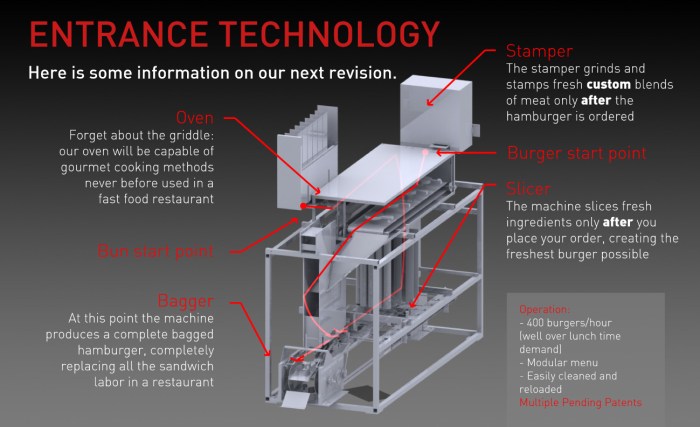
Also in the news, Momentum Machines unveiled a new automated burger robot chef last month. After being successfully tested on the line, the company announced its plans to introduce this robot to fast food chains everywhere, saving companies millions of dollars in staffing costs. According to projections, Momentum Machines says that its automated burger robot — which does everything from flipping burgers, to slicing tomatoes, to toasting the bun — could save the fast food industry $9 billion in wages.
Of as yet, no video is available of the burger robot doing a demonstration, but this helpful infographic does give a breakdown of the robots structure and basic functions (below). Granted, this might seem like a callous and insensitive move, especially to the over 2 million workers currently employed in fast food in the US alone. But with just about every other production line having been automated already, this seems to many like the next logical step. Good luck Momentum Machines; hope the angry mob outside your offices doesn’t scare you!
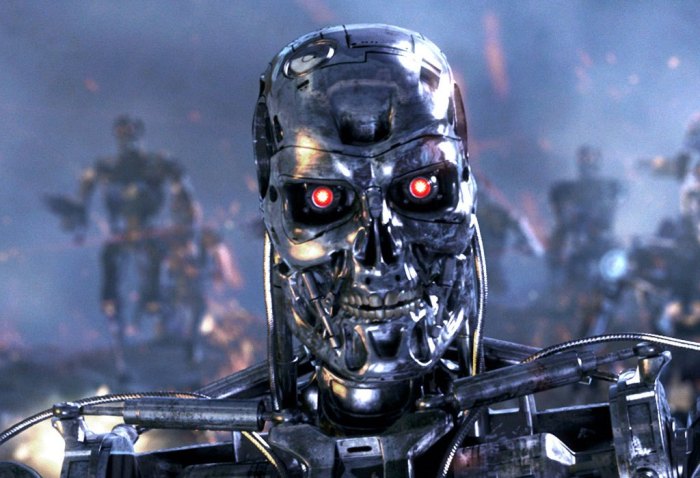
Granted, this may all still seem like a far cry from Skynet and Cylons, but under the circumstances, is it any wonder that Cambridge University founded the Center for the Study of Existential Risk (CSER) to evaluate new technologies? Clearly, some people are worried robots are going to be doing more than just chucking balls and flipping our burgers.
Behold, the cool scenes from every science fiction movie ever made, all in one video. Well, not necessarily all of them; in fact, true geeks may noticed that some of their favorites might be lacking. However, I think you’ll agree, this is a pretty good sampling of a wide array of classic films. In fact, the creators merged footage from 100 movies here, a collection of classic and more recent sci-fi films, and set it all to music (Glitch Mob remix of “Monday,” by Nalepa). Enjoy!
Came across this trailer while making one of my usual rounds of the internets! And I have to say, it looks both intriguing and incredibly heartwarming. In this film, which has already won a slew of awards – People’s Choice Award and the Young Jury Award at the 2011 Les Arcs European Film Festival, and the Audience Award and ‘Special Mention’ of the Jury at the Mamer-en-Mars European Film Festival – a young boy draws comics of an invincible superhero while he struggles with his own mortality.
Based on a New Zealand novel of the same name and filmed in Ireland, the movie splices animated segments with real footage in order to capture the spirit of the text and to posit real-life experiences with imaginative renderings. In addition to showing the power people have to shape their reality and use fictional escapes to deal with life, it also serves as a sort of commentary on the enduring power of superheroes and mythology in the modern world.
I shall be watching it forthwith! I recommend you do the same 😉
In this little gem, produced by the internet comedians Auralnauts, we see a very different type of Bane character at work, thanks to the magic of voice-over. Among the high points are Bane’s ongoing concern about Gothamites fiber intake, some Mortal Kombat moves, Bane freestyle rapping to a crowded stadium, and the Bat’s all-90’s retro music playlist! Much fun!

 Back in 2006, a series of millionaires shelled out a hefty 20 million dollars for a round trip to the International Space Station. At the time, this was considered quite the privilege, seeing as how civilian personnel almost never get to go into space or spend time on the ISS. But as it turns out, this story may be on its way to becoming small potatoes, thanks in part to a new company that has announced plans to mount commercial voyages to the moon by 2020.
 The company is called Golden Spike, a company made up largely of former astronauts and personnel who want to use existing and future technology to make private Lunar trips possible. Its current chairman is Gerry Griffin, Apollo flight director and former director of NASA’s Johnson Space Center. The president and CEO is planetary scientist Alan Stern, former head of all NASA science missions.
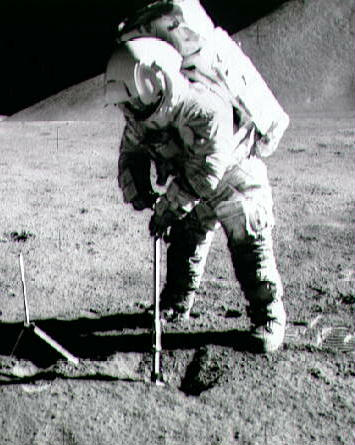 So… vacation on the moon anyone? Hell, I can envision an entire line of spas, time shares and getaways on the Lunar surface in the not-too-distant future. Sure, it may not be the Mediterranean or the Mayan Riviera, but I can think of plenty of fun activities for people to do, and the novelty factor alone ought to sell tickets. Rover tours, visits to the Apollo landing sites, low-g sports and anti-aging therapies. Oh, and if Alan Shepard and the Apollo 14 mission are any indication, you can even play golf there!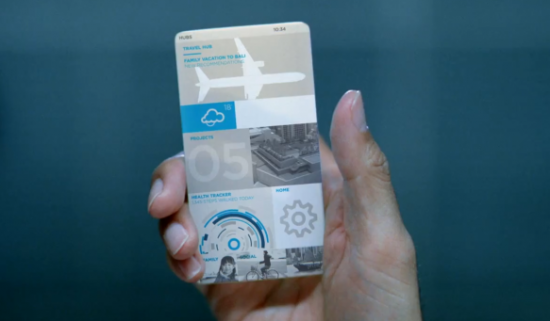




 Stories by Williams