
Though he’s passed on, Bradbury still manages to offer inspiration from the grave!
More News From the Red Planet!
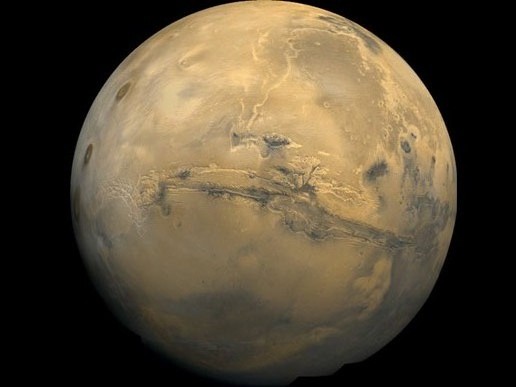 Big news from and about Mars this week! Yes, the Red Planet is showing no signs of slowing down when it comes to making the headlines. But in the past week, the biggest stories have been roughly 100 million kilometers apart. That’s the current distance between the Earth and Mars, give or take a few meters.
The first bit of news came three days ago, when NASA scientists went batty over the discovery of a shiny object sitting in Curiosity’s path, which it quickly began to examine. The second came from Morocco, where a meteorite that landed in the desert 14 months ago was revealed to have come from the Red Planet itself, prompting a team of scientists from the University of Alberta to bring it back for research.
Though seemingly unrelated, both stories had one thing in common. By examining objects on the martian surface, and those which break off from time to time and fall to Earth, scientists may be able to reconstruct what conditions on the surface of the planet were once like.
 Unfortunately, the first bit of news turned out to be a bit of a hoax. After examining the shiny object, the Curiosity team determined that it had come from Curiosity itself. At least, that was there initial conclusion when they realized that the object was most likely plastic, which is not something you find sitting on the surface of a dead planet. An image of the object taken by the rover’s micro-imager ChemCam shows it looking very different from the Martian surface around it (click to get a better view).
As for the meteorite, research there may prove to be more lucrative. According to Chris Herd, a geologist with the University of Alberta, the meteorite holds traces of Mars’ atmosphere from when it split off, roughly 600 million years ago. Apparently, the meteorite started out as a typical volcanic rock on the surface of Mars until it was launched off the planet by the impact of an asteroid.
 As Herd puts it, when the meteorite struck the martian surface, “a shock wave shot through the rock. Cracks and fissures within the rock were sealed instantly by the heat, trapping components of Mars’ atmosphere inside, and forming black, glassy spots.” These glassy spots are the real point of interest because they reveal “evidence of weathering at the Martian surface.”
This is further evidence that Mars boasted water on its surface, and as recently as within the last few hundred million years. It does not definitively prove whether or not it also boasted life, but at least it helps to confirm what Curiosity has been observing in recent weeks. It’s also exciting news because it means that Mars could one day be made to accommodate water again. This will come in mighty handy should humans ever decide to settle there!
Stay tuned for more Red Planet news!
Sources: cbc.ca, news.cnet.com
Batman: Nightwing Short
There’s something to be said about short fan videos. Oftentimes, they are of low-quality and really don’t boast a lot of thought or creativity. But every so often, you get something of real value. Star Wars fans have been treated to some rather appealing videos over the years where fans, using their own imaging and rendering software, produced videos of lightsaber fights that weren’t half bad. And more recently, I came across this video which is the first in a proposed series of Batman shorts that were inspired by the original comics.
This one is entitled Batman: Nightwing and follows the exploits of Dick Grayson, the original Robin who went on to become his own superhero after leaving Batman’s side. Here we see him being called in to deal with the Red Hood, a villain in that emerged relatively recently in the franchise who turned about to be Jason Todd, the second Robin. For those who are unfamiliar with the comics, this is the Robin who was murdered by the Joker and then was resurrected, and returned to Gotham as a villain.
Personally, I like the video because it takes two characters who are important in their own right, but rarely the focus in the franchise, and squares them off against each other. There’s also a sense of generational conflict since we basically have the original Robin and his successor fighting, the one who went independent fighting the one who went bad. It just feels appropriate and significant, don’t you think?
The producer, Danny Shepherd, indicated that this video would become part of a series, and that was when it reached its first 100,000 hits. Now, it’s hovering at just over 540,000! Yeah, I’m thinking there’s going to be a sequel or two 😉 Check out the video:
3D GIF of Rotating Nebula

Pretty freakishly cool isn’t it? Personally, I never really got onto this GIF thing. It’s like, if it fits on the page and looks cool, it’s all good. However, this one was too cool to ignore. The brain-child of Finnish astrophotographer J-P Metsävainio, this GIF depicts IC 1396, a nebula where stars are born.
This nebula is a little over 2000 light years away, toward the constellation of Cepheus, and is well over a hundred light years across. Even at its tremendous distance, it’s wider than six full Moons in our sky. For some time, Metsävainio has been making impressive images of this nebula, but that didn’t seem to be enough for the erstwhile stargazer. And so, he began playing with 3D images in the hopes of creating a model of the structure of the nebula, one which showed it from different angles.
Granted, some have gone on record as saying this is more art than astronomy, and not all the features are one-hundred percent accurate. But the animation does give you a good sense of the nebula’s composition, as well as a glimpse of what the heart of a star-birthing nebula looks like. Notice the large blue star in the middle that is the ionizing source – i.e. the hot, young, massive star blasting out ultraviolet light which makes the nebula glow. The dark strands on the outside are filaments of dust which appear that way because absorb the visible light emitted from the center of the nebula.
The color pattern is also quite accurate, with blue on the inside and red without. This color change is due to the presence of oxygen gas within the cloud which glows blue because of its proximity to the central stars. Farther out, the starlight is too weak to make oxygen glow, so all you see is the ruddy glow from hydrogen. And fyi, that star is mu Cephei, a massive red supergiant which happens to be one of the most luminous stars in the Milky Way, possibly over 300,000 times more luminous than the Sun.
Pretty cool huh? Hat’s off to you Metsävainio. I can’t speak for everyone, but you’ve certainly blown my mind! Click on the photo to watch the animation, and if you want to download it, don’t be surprised if it takes a while. The damn thing is 7 megabytes!
Worlds First Medimachine!
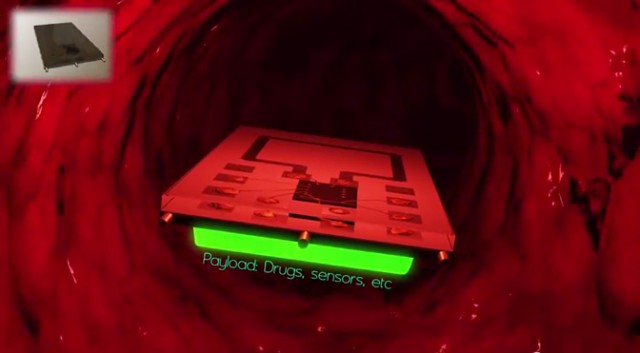 Medimachine: noun, a nanotechnological device used for medical applications. Granted, that’s not a working definition, but it does encompass what the technology is all about. And, as it happens, researchers at Standford created the world’s first device which is capable of traveling through the human bloodstream and which is controlled and powered wirelessly just this past year.
This development came in the midst of a similar significant development over at MIT. In January of this year, they announced that they had developed the world’s first implantable microchip that could deliver drugs directly into the bloodstream. This chip is also controlled wirelessly, and is the first step towards remote implants that could contain an entire pharmacy.
According to Ada Poon, the lead developer of the Standford team, the next step in the development of this device will be creating models that incorporate sensors and drug delivery systems for the ultimate in pin-point accurate medicine. If successful, Poon and her team could very well be responsible for creating the prototype device that will inspire entire generations of medical machines that are conducting exploratory exams, cleaning our arteries, removing tumors, destroying pathogens and viruses, and even repairing internal injuries.
And just think, if this development triggers further research and development, it could very well lead to nanomachines which are capable of making even tinier nanomachines. These devices could in turn manipulate matter on the mitochondrial level, correcting faults in our DNA and turning harmful or unwanted cells into something more useful for our bodies.
Just another step on the road to transhumanism and post-mortality!
Source: Extremtech.com
Three Scenarios for Life on Mars
As usual, the Red Planet is capturing the imagination of scientists and people all over the world, thanks in no small part to ongoing discoveries made by Curiosity and her predecessors. At the center of all the speculation is the big question: was there ever life on Mars? Recently, Curiosity Scientist Ashwin Vasavada sat down with the good folks from thinkrtv to discuss that questions and present some viable scenarios as to what that life might have looked like.
According to thinkrtv, this video is the first installment in an ongoing series called EPIPHANY which “invites impassioned thought leaders across all disciplines to reveal the innovative, the improbable, and the unexpected of their worlds.” Based on that description, I’m thinking they will be moving onto places like Europa, Titan, Dione and Enceladus next, all moons in our Solar System which may boast or be capable of supporting life.
Cool stuff, and some rather intriguing ideas presented here. Click on the video below or follow the link to see Vasavada’s interview:
Source: thinkrtv
How Prometheus Should Have Ended
I came across this video some time ago on the HISHE website, but hesitated to post it with the others. For one, I liked the movie, and these guys, in their signature, trademark way, dealt it some pretty smarting blows. But of course, all they were doing was highlighting the plot holes which were pretty clear to anyone who has seen Alien and remembers the particulars of that classic. For one, the Engineer/Space Jockey was discovered in the pilot’s seat, was he not?
But then again, the planet where the Derelict was discovered in Alien and the Sulaco returns to in Aliens was LV-426, not LV-223 where the Prometheus traveled to. So… what gives? Clearly, this is not the planet where Alien took place, but that just raises more questions, questions which are rumored to be answered in subsequent prequels. Now didn’t they say that Prometheus would be the movie that answered all these questions?
Yeah, basically I feel that enough time has passed that I can raise these plot holes and not worry about spoiling the movie for anyone. And this video is a pretty good start. In addition, it’s also quite funny. Enj0y!
Arcology in Popular Culture
 Hello and good evening. Welcome to the third and final installment in my Arcology series, addressing the use of the concept in various popular culture sci-fi franchises. After researching the term and learning all about Paolo Soleri and the concept he created, I’ve come to see that his vision of future cities where the needs of ten of thousands of inhabitants could be met in sustainable ways helped to inspire the a great deal of speculative fiction.
Here are just a few examples that I can recall or have been able to find…
Chi-Town:
 Many years ago, some friends of mine came to me with a new RPG by the name of RIFTS. A sort of sci-fi/fantasy crossover, the game was set in a post-apocalyptic world where inter-dimensional gateways, known as “Rifts” had led demons, monsters and mythical creatures into our universe, where they began wreaking havoc. After many years, several new nations emerged, the most powerful of which were the Coalition States, a dictatorship dedicated to fighting the invasion and reestablishing order.
The seat of this government is a large arcological city known as Chi-Town, which was built on the ruins of Old Chicago (hence the name). A self-contained city, the structure is somewhere between a pyramid and a rectangle in terms of shape. And of course, its hierarchical structure mirrors the social divisions at work within. The lower levels are the most densely populated, have the most indigents, and experience the most crime, while the upper levels are more spacious, opulent, and well-maintained.
In addition to being a fortress city and a safe haven for human beings in the ruins of the United States, Chi-Town is also a fitting example of an arcology. Within its walls, all things, including water, air, food and energy, are providing by internal systems and subject to recycling and treatment. Again, the issue of quality is dependent on where someone finds themselves within the structure, but the principle is still the same. In a world that has been devastated and rendered inhospitable, the response was to create a mega-structure that could both shield and provide for its many, many inhabitants.
Coruscant:
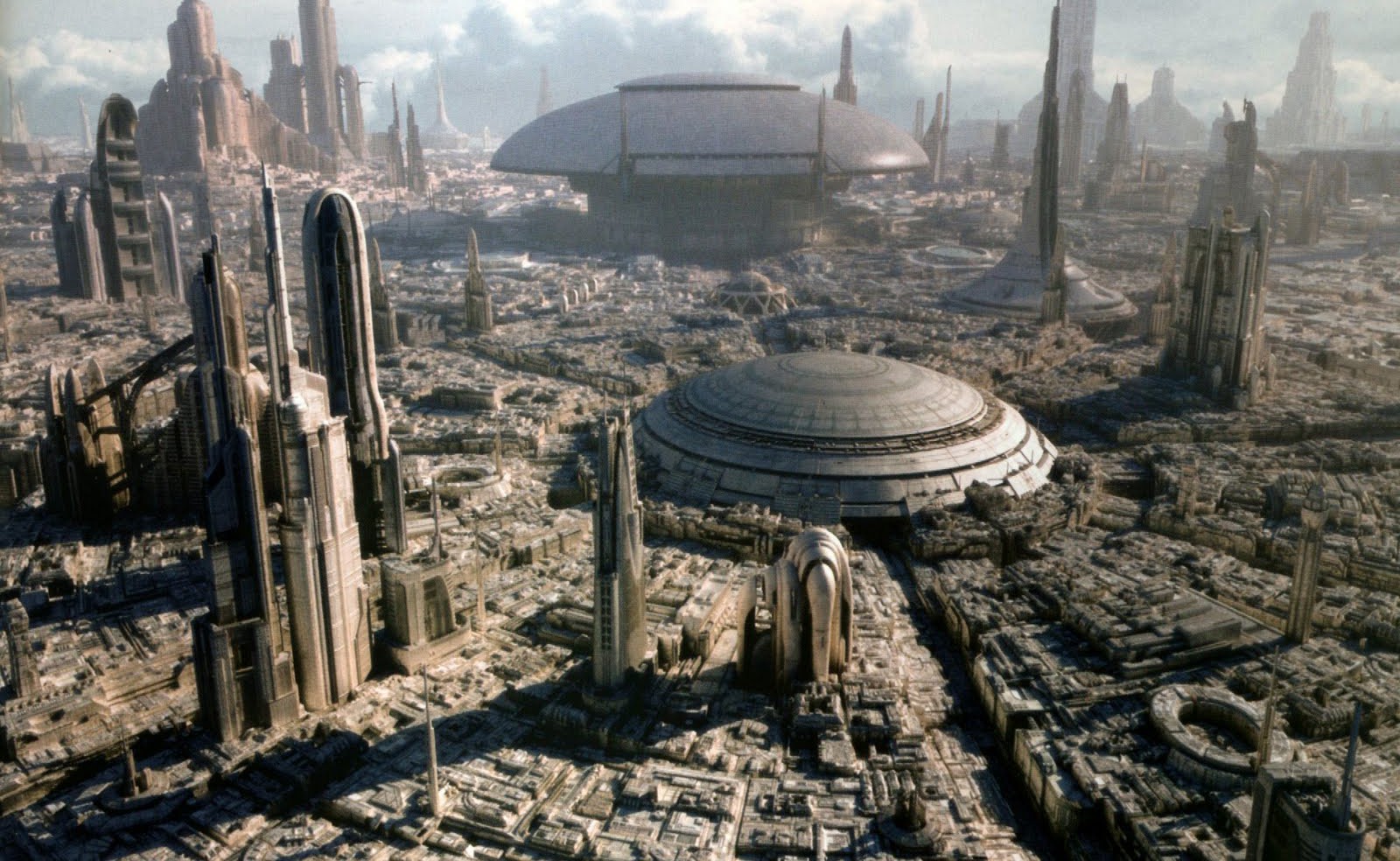 Fans of the Star Wars franchise are certainly familiar with this planet-encompassing city, even before it was featured in the prequel trilogy. As the capitol of the Old Republic, Empire and New Republic, respectively, it has a very long history of habitation, and a very sizable population! As a result, its architects and engineers had to get very creative with the use of space on this planet, and several massive buildings were the result.
In truth, Coruscant was not so much a single city as thousands upon thousands of interconnected arcologies that ran across its surface. These various mega structures measured roughly a kilometer in height, dwarfing even the nearby mountain chains, and housed hundreds of thousands of residents each. In addition, the need to feed and provide for the staggering number of inhabitants required that every structure come equipped with a massive network for recycling water, waste and food.
Officially divided into megablocks and levels, every section of the city had its own means for providing food, water, and manufactured goods. This in turn required the presence of internal systems for processing air, drinking water, food waste, human waste, and industrial waste from its manufacturing warrens. In addition, in the sub-city where natural light did not reach, holograms and artificial lights were also built in to the environment to provide its inhabitants with illumination. In addition, it is also indicated in a number of sources that agricultural operations were housed in various sections and relied on recycled water and either artificial or filtered light.
Though food and waste still required a great deal of shipping and processing, which resulted in a staggering amount of transport traffic, much of the cities needs were taken care of by means of these internal measures. This ensured that the roughly three trillion inhabitants of the planet would never become wholly dependent on outside sources of food and goods, as well as ensuring that pollution and harmful waste wouldn’t accumulate to disastrous levels.
Habitats:
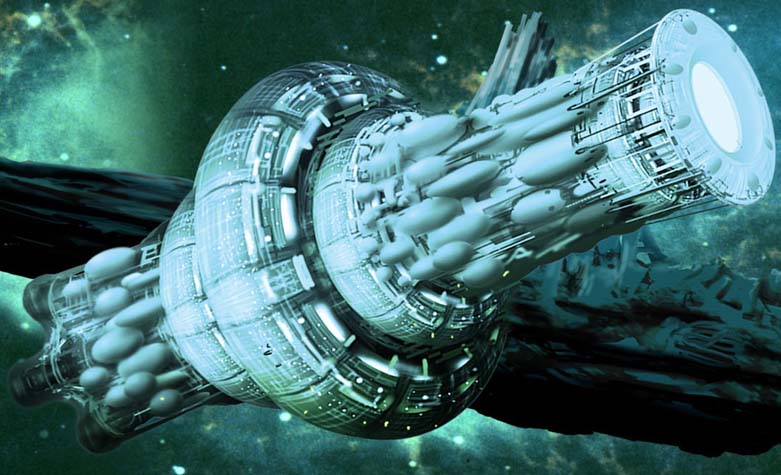 In the works of Peter F. Hamilton, particularly the Night’s Dawn Trilogy, much attention is given to the kinds of futuristic living spaces humanity will someday occupy. For starters, there is planet Earth in this future setting, which is so overrun by human beings that all cities have evolved to become self-contained arcologies. On top of that, there are what’s known as “Habitats”, floating megacities which exist out amongst the stars.
One of the most notable of these is Eden, the first ever habitat to be created, and in orbit around Jupiter. As the closest thing to a capitol in the Edenic culture, it was built using Bitek – aka. Biotechnology – which resulted in a living structure that was psychically linked to its inhabitant through a process known as affinity.
Here, as with other Habitats, the structures are massive, measuring several kilometers in length and width. In addition, each is entirely self-supporting, providing food, water, electricity and artificial gravity to its inhabitants. The latter is created through the rotation of the whole structure around its axis, while a central light tube which runs the length of the station provides light. Food and water are produced via biological processes and are recycled to ensure minimal waste, which in turn is also processed and converted for later use. In addition, interstellar material is frequently intercepted by the habitat and converting into any and all goods which its people require.
Ultimately, the only thing a habitat needs is a supply of external matter which it will use to grow and mature during its formative cycle, and an external power supply to maintain its functions. This is last necessity is provided by a series of external conductor cables which grow on the outer hull of the structure where they are positioned to pick up charges. Due to the rotation, these cables then cross the electromagnetic flux of the nearby gas giant and thus produce electrical energy. All is provided and nothing goes to waste. A true future city!
Urban Monads:
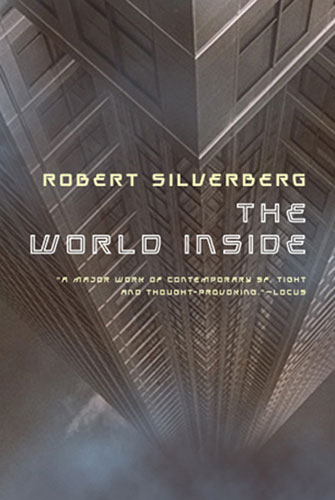 The setting of Robert Silverberg’s fictional study in overpopulation, The World Inside occurs almost entirely within the hyperstructure known as Urban Monad 116. As the name implies, this massive, three-kilometer high city tower is but one of many on the planet, which have become necessary now that war, disease and starvation have been eliminated, but people still continue to procreate without restriction. During the telling of the story, which takes place in 2381, the total population has reached 75 billion.
Much attention is given in the novel to how urban monads (or “Urbmons”) are arranged and meet the needs of their 800,000 respective inhabitants. For starters, groups of these skyscrapers are arranged in “constellations” so that one’s shadow does not fall upon another. Each Urbmon is divided into 25 self-contained “cities” with 40 floors each, in ascending order of status, with administrators occupying the highest level with population and production centers sequestered below.
In order to see to the needs of this rapidly expanding population, all arable land not currently occupied by Urbmons is dedicated to agriculture. However, within the Urbmon communities, resource management still counts for a lot, with all foods and goods being held in common and the people expected to share them. Beyond that, however, sustainability is not exactly the name of the game, as the right to engage in free expressions and sex and reproduction are considered the highest forms of activity.
Hence, Silverberg’s Monads break a few of the basic rules of arcology, but the basic premise is still there. Designed to house a rapidly expanding population that threatens to overpower the Earth, Urbmons take advantage of the concepts of megastructures and 3-D planning to ensure that every living soul is housed and provided for. Now if they could just stop reproducing so much, they’d be in business!
Tyrell Corp Building:
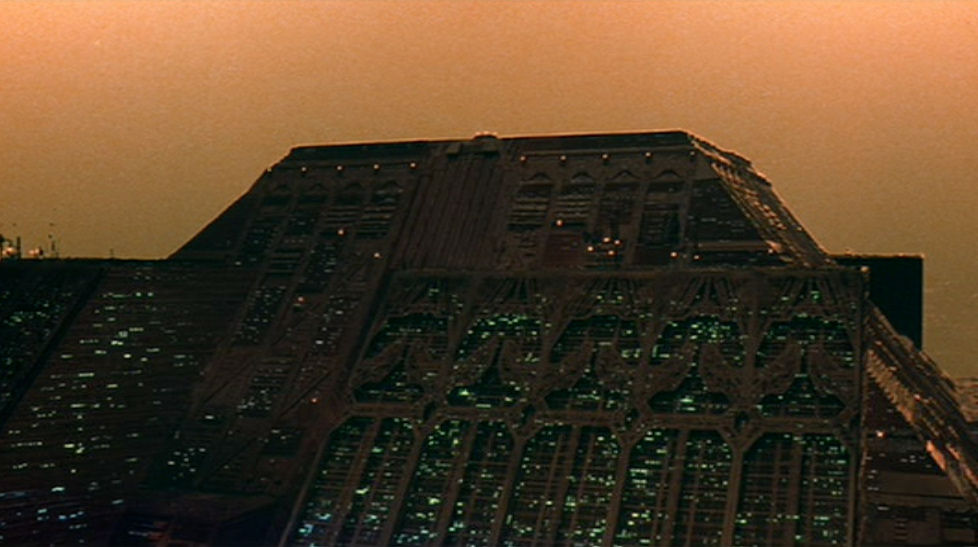 Though not specified as an arcology in the strictest sense, I couldn’t possibly make this list without including the infamous Tyrell Corp building. I mean just look at the thing. Imposing, Gothic, and very, very big! And let’s not forget highly symbolic, as the design, size and scale of the thing was meant to evoke the feeling of awesome power that the corporation held.
Though not much is made clear of what life inside the building is like, it was clear that it was made up of many, many levels and sections, each of which fulfilled a different purpose. At ground level, the building was protected by automated systems which “fried” one of the story’s Nexus 6’s when they tried to break in. Farther up are various industrial areas that are dedicated to the production of the company’s Replicants, as well as office spaces and administrative areas. Another Replicant was detected in one of these sections, right before it shot the man who had detected it – Detective/Blade Runner Holden.
At the apex of the building is the living area for Tyrell and Rachel, the experimental Nexus unit that was modeled on his niece. This level is accessible only by elevator which runs along the outer edge of the building, and can only be accessed by authorized personnel. Here, Tyrell lives amidst opulent surroundings, vast marble floors, stone columns, and even an aviary for his pet owl. Although it is not explicitly said, it appears that Tyrell spends all of his time here, never venturing to the outside city or to another domicile. Hence, we can only assume that all of his needs are seen to here, even if everything he consumes is flown in and all the waste produced is shipped out.
Mega-City One:
 The setting of the Judge Dredd franchise, Mega-City One is essentially a massive urban sprawl which stretches from the Quebec-Windsor City corridor to the peninsula of Florida in the south, growing out of the Northeast Megalopolis to occupy Southern Ontario the entire Eastern Seaboard. And in addition to stretching so very far and wide, this city is also made up of arcologies in order to see to the needs of its roughly 800 million inhabitants.
These arcologies come in the form of huge apartment blocks which house roughly 50,000 people each. Within each block, citizens are attended to by automated systems which recycle everything, waste, water, and even food. As for manufactured products and consumer goods, these too are largely created in industrial warrens that housed within specific blocks.
This system of every need being handled by automated systems and machines was designed to ensure that the survivors of the nuclear holocaust (aka. The Apocalypse War) would be tended to. However, it had the unwanted side-effect of also leading to rampant unemployment and listlessness amongst the population. This is one of the main reasons why Mega-City One is awash in petty criminals and organized crime syndicates. This, in turn, is what led to the creation of the Judicial System and its army of Street Judges.
Trantor:
 Perhaps the first example of a ecumenopolis appearing in fiction, Trantor went on to become a source of inspiration for many science fiction franchises. And according to Asimov, it represented what he believed would be the end result of industrialization and human technology, which was an encapsulated population living in cities that spanned entire planets.
Consisting of buildings that reached deep into the ground and reached several kilometers above sea level, Trantor was home to roughly 45 billion people at the height of the Empire. It’s overall population density was 232 per km², and just about every human being was dedicated to the administration of the Empire or the needs of its population. Though by the time of Foundation, most of the population’s needs were met by importing food and basic necessities from every major planet in the region.
However, according to Prelude to Foundation, Trantor’s basic food needs were once fulfilled by the planet’s vast system of subterranean microorganism farms. Here, yeast and algae were produced as basic nutrients, which were then processed with artificial flavors to create palatable food sources. These farms were tended to entirely by automated robots, but their eventual destruction during an uprising forced the planet to turn to external sources
The Sprawl:
 Also known as the Boston-Atlanta-Metropolitan-Axis (or BAMA for short), this mega-city is the setting for the majority of William Gibson’s Sprawl Trilogy. Encompassing the classic cyberpunk tales of Neuromancer, Count Zero, and Mona Lisa Overdrive, the concept of arcology is raised on numerous occasions in reference to the massive apartment blocks that make up the city.
On such building is Barrytown, an arcology in the projects which is the setting for much of the second novel. Throughout the novel, it is indicated that the people here generate their own food, such as the catfish farms that exist near the top of the building. Trees are also grown on specific levels to generate oxygen which is then fed into the building’s air recirculation system. And finally, mentions are made that there are air turbines on the roof of many project buildings which generate electricity for the inhabitants.
Being such a massive, futuristic city, the Sprawl features many such structures, all of which are described as giant skyscrapers that house tens of thousands of people within their tall frames. And ultimately these are all contained beneath the a series of geodesic domes which encapsulate the city and generate peculiar weather patterns consistent with micro-climates. In this way, the BAMA itself is one massive structure, containing hundreds of millions of people under a single roof.
Zion:
 The last remaining free city that humanity could still call home, Zion was not a megastructure per se, but nevertheless fit the definition of an arcology to a tee. An underground habitat that was home to roughly 250,000 men, women and children, Zion was the picture perfect representation of a self-contained living space that handled all the needs of its inhabitants internally.
As Councilman Hamann intimated in Matrix Reloaded as he and Neo walked along the Life0-Support Level, all of Zion’s needs are attended to by machines. These provide power, heat, water, and are constantly recirculating and recycling them. Meanwhile, food seems to be either grown in special hydroponic areas, or synthesized in bio facilities dedicated to that purpose.
In terms of its internal layout, Zion is ovoid in structure and consists of many levels, each with its specific purpose. At the apex rests the Dock, where Zion’s army of hovercrafts are stationed and automated defenses protect against intruders. Beneath that are the Gathering Spaces, where new arrivals who have not yet been assigned permanent quarters are temporarily housed.
The middle section is entirely dedicated to habitation, made up of family quarters, and the Council Chambers which houses Zion’s ruling council. The lower levels consist of the Meeting Hall, Life-Support Level, and Geo-Thermal Generation, where the cities power and heat are supplied from. At the very bottom lies the Temple, a large cavern where religious gatherings are held and people gather to hold celebrations and mourn the dead. This area also serves as a last defensive position in the event that the automated defenses were destroyed and the Dock overrun. This of course became the case in Matrix: Revolutions when the machines attacked Zion and nearly destroyed it.
___
What did I tell ya? Clearly, the idea has made the rounds since Soleri’s time. And in all likelihood, we are sure to see the concept popping up more and more as the problems of overpopulation and environmental impact become more acutely felt. There are some who might express disgust and even fear at the idea of living an encapsulated existence, but given the growing need for sustainability and places to put people, will we really have a choice? One can only hope!
Hilarious Game of Thrones “Birther” Video
In spite of their annoying tendency to cling to stupid, conspiratorial notions that are quite racist in nature, the so-called “Birther” movement is at least good for a laugh or two – especially when their antics inspire videos like this one. Using Game of Thrones as their subject matter, the political satirists from Mother Jones Video have produced this movie which questions King Joffrey’s lineage, as well as blame him for everything that’s gone wrong in the kingdom. Enjoy!
The Most Ambitious Skydive in History
Skydiving is something that just about everyone contemplates at some point in their existence, but few of us really get around to. In fact, I’d wager that just about every “Bucket List” that has ever been made has skydiving on it, most likely in the top ten. However, just about all of these “controlled descents” involve a tandem jump with an instructor, and rarely exceed ten to fifteen thousand feet.
But imagine, if you will, that a certain extreme athlete named Felix Baumgartner sought to attempt the most ambitious skydive in history by jumping from a staggering 120,000 feet. That would place him at the very edge of space, making it an stratospheric HALO jump and the longest freefall in human history to boot. As the culmination of Red Bull Stratos Project, the jump will involve a balloon, a space suit, and a chute which will not be deployed until he is well withing Earth’s atmosphere.
Already, Felix has performed his test flight, jumping from a staggering 96,000 feet to test out his suit, the ascension balloon, and all the assorted equipment that is making this jump possible. However, the 120,000 feet will be distinguished by being the jump that breaks not one, but four world records.The first three were all set by a U.S. Air Force Captain named Joe Kittinger, who accomplished the highest skydive, manned balloon flight, and longest freefall in human history back in 1960.
However, Felix’s jump will also accomplish something which no human being has ever accomplished. In the course of his jump, his body will accelerate to to supersonic speeds, making him the first human who has ever broken the speed of sound without the use of an aircraft. Even NASA scientists say that they have no idea what effect this will have on a human body, though it is assumed that his spacesuit will protect him from the worst effects of it. And by the time he reaches the lower atmosphere, wind resistance should slow him down enough that by the time he pulls his chute, his organs won’t be turned to pulp from the sudden deceleration.
The big jump was scheduled for this morning; unfortunately, the jump was aborted at the last minute due to weather. For this jump to be successful, Felix must be jumping into conditions where there can be no clouds, storms, and wind speed closest to the ground are no more than 3.2 km/hour. Seems kind of finicky for a man risking life and limb to break so many records, but what do I know? I’m not an extreme sport, HALO jumping daredevil!
Check out the footage from Felix’s test jump below, and stay tuned for more updates on this historic jump:
 Stories by Williams