 At long last, the third and final installment in the Lord Of The Rings series! It feels like such a long time ago that I read this book, and going over the salient points makes me want to re-read the entire series. By this point in things, I felt myself becoming so immersed in Tolkien’s mythical universe that I felt both saturated yet wanting. There was so much there to absorb, and yet the greater mysteries of his world still seemed unknown. No wonder I picked up the Silmarillion and devoured it shortly thereafter. Man that book was dense!
But of course, that was after the third and final installment. As I said last time, the second book really impressed the hell out of me. But it was tempered by the fact that the greatest battles and climaxes were yet to come. Frodo and Sam had yet to reach Mordor and Mount Doom, Gollum’s true role in the Quest was yet to be revealed, and the battle for Gondor and Middle Earth was yet to truly begin. I awaited on these with eager anticipation…
And then it came! The Battle for Middle Earth was joined! The War of the Ring came to its grand climax and was resolved for all time. And here’s the pertinent stuff and what I thought about it…
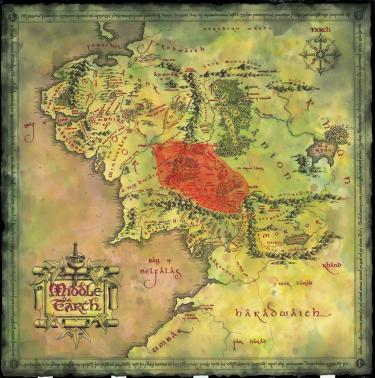
Plot Summary:
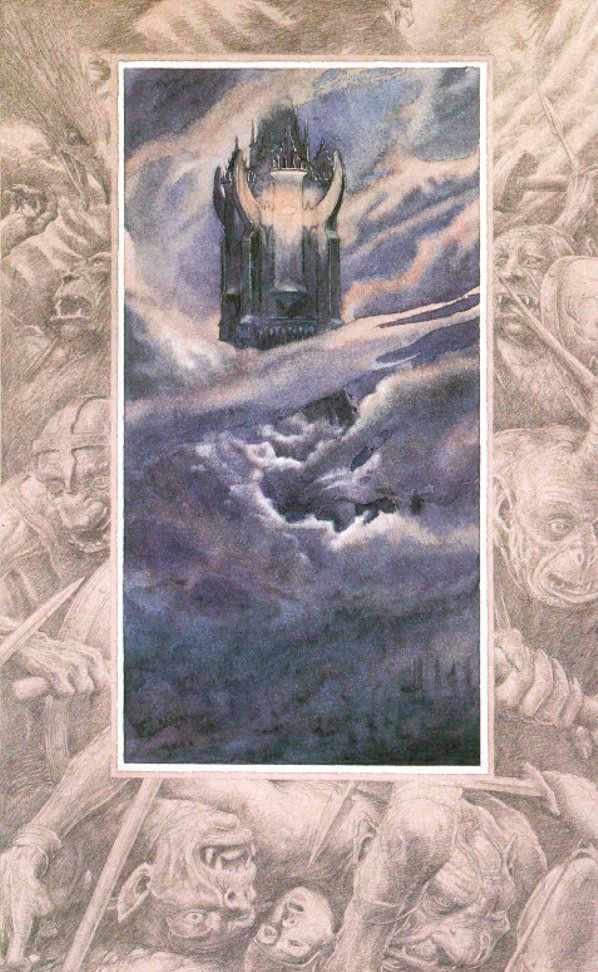
The book opens where the last left off, with Gandalf, Aragorn, Gimli and Legolas returning with Theoden to Edoras to rally their forces and plan for the enxt phase of battle. Though Saruman has been thoroughly defeated, there remains the danger from Mordor, where Sauron is still amassing his armies of Orcs, Southrons and Easterlings and preparing for his assault on Gondor.
At the same time, Sam must find Frodo and rescue him from the grasp of the Orcs. In the wake of Gollum’s betrayal, their Quest has hit a sort of intermission. Until he finds Frodo and returns the Ring to him, it cannot resume, for only Frodo is the true Ringbearer.
Book V: The War of the Ring
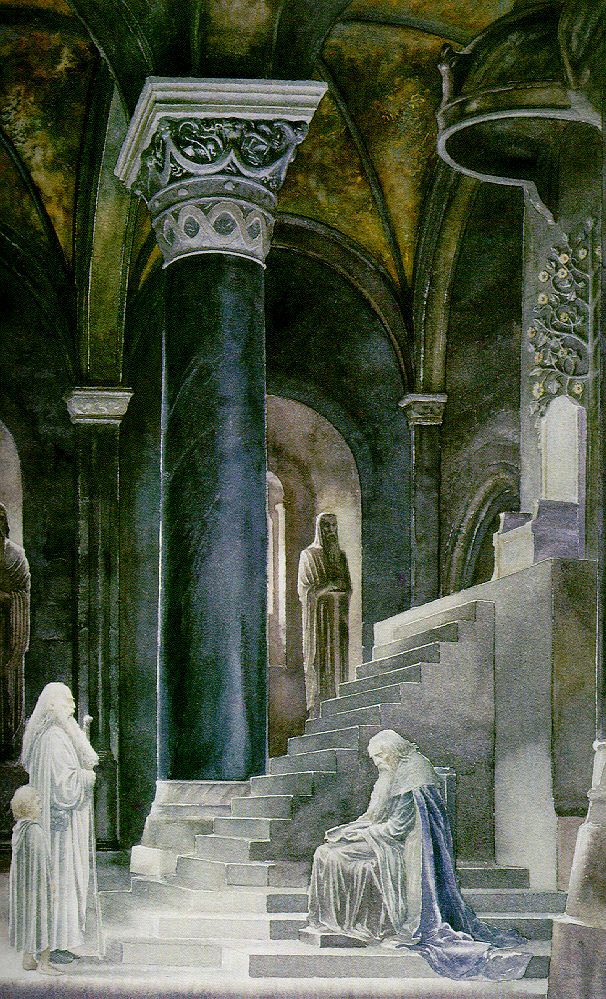
 Gandalf and Pippin arrive at Minis Tirith to speak with Denethor, the Steward of Gondor, and warn him that an attack on the city is imminent. Denethor announces that he knows of Boromir’s death, and Pippin enters Denethor’s service as a repayment for the debt he owes to his son for saving his life. Now in the service of the tower guard, he is given a view of the fields of Pelenner and is able to bear witness to the approaching war.
Meanwhile, Osgiliath falls to the advancing Orcs and Denethor begins to fall into a dark mood. He orders Faramir, the lesser of his two heirs in his mind, the task of retaking it with his forces. Unfortunately, he is mortally wounded and his riders return broken. Denethor falls into a deep, dark state and believes his son is dead. He orders a funeral pyre built for the two of them and asks that they be burnt like the Kings of old as the city becomes encircled by a host of 200,000 Orcs.
 To the north, Aragorn and his companions have traveled to the White Mountains to find the Paths of the Dead, a mountain hall where the oathbreakers from the War of the Last Alliance still dwell. Helped by his companions, Legolas and Gimli as well as the “Grey Company” – a group of Rangers from Arnor in the north – he sets out to recruit them.
As Aragorn departs on his seemingly impossible task, King Théoden musters the Rohirrim to come to the aid of Gondor. Merry, eager to go to war with his allies, is refused by Théoden several times. Finally Dernhelm, one of the Rohirrim, takes Merry up on his horse, and secretly rides with the rest of the Rohirrim.
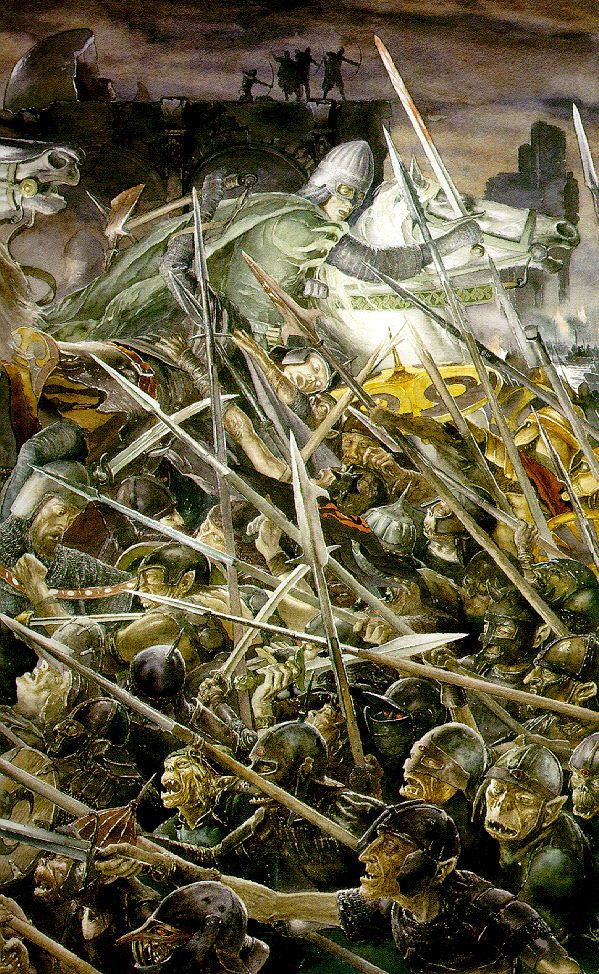
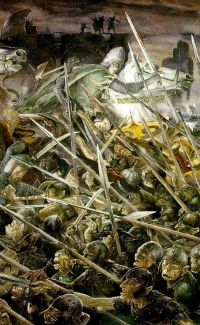 At Minas Tirith, under the leadership of the Witch King of Angmar, the forces of Mordor break through the city’s gates. However, the Rohirrim show up and begin to ride them down. Gandalf arrives in the King’s Hall to confront Denethor and stop him from burning himself and his son.
Denethor cuts the cushion from his thrown and reveals the Palantir inside, and says he has seen visions of the battle which show their ultimate defeat with the arrival of a Corsair fleet from Umbar. Gandalf and Pippin manage to save Faramir from the fires but Denethor is consumed.
 The battle appears is poised as the Riders of Rohan are engaged with Orcs and the Southron war Oliphants when the Corsairs arrive. Sauron’s forces initially rejoice at their appearance, but then realize the ships have been commandeered by Aragorn and the host of the Oathbreakers. With these ships and additional troops added to the fight, the host of Sauron is outflanked and near defeat.
However, the Witch King still manages to wound Theoden mortally before Dernhelm intervenes. Dernhelm is also wounded, and then saved when Pippin sticks his sword in the Ring wraith’s leg. Dernhelm removes her helmet and reveals that she is Eowyn, who then strikes the Witch King dead.
 The siege is broken, but at a heavy cost. In addition to the death of many warriors, Theoden is dead, Eowyn and Pippin are both seriously wounded, and Faramir himself is still facing death. On top of all that, they know that Sauron is not yet defeated and they will not be able to thwart another attack.
Aragorn is called upon to heal them as well as Faramir. They recover, and Faramir and Eowyn become acquainted as they both convalesce. In time, she forgets her infatuation with Aragorn and learns to embrace Faramir’s gentle and wise nature.
 Knowing that it is only a matter of time before Sauron attacks again, and that they do not have the strength to thwart him a second time, Aragorn and Gandalf propose a bold plan. They will attack the Black Gates in order to draw out the host of Mordor, thus clearing the way for Frodo and Sam to reach Mt. Doom unnoticed.
Upon their arrival, they are approached by the Mouth of Sauron, chief amongst his dark emissaries. He dictates punitive terms to the army of Men, and backs it up by claiming that Frodo is dead and shows them his effects as proof. They begin to despair, but Gandalf refuses to believe it, claiming that his is just another of Sauron’s deceptions. Were he in possession of the Ring, says Gandalf, he himself would be coming forward to meet them.
Having been refused, the Mouth of Sauron returns to the Gate and the host of Mordor falls upon them. They appear to be getting overrun, and Pippin is pinned under the body of a Troll after it is killed. All seems lost, just as the Great Eagles begin to come in and fight off the Ring Wraiths…
Book VI: The Return of the King
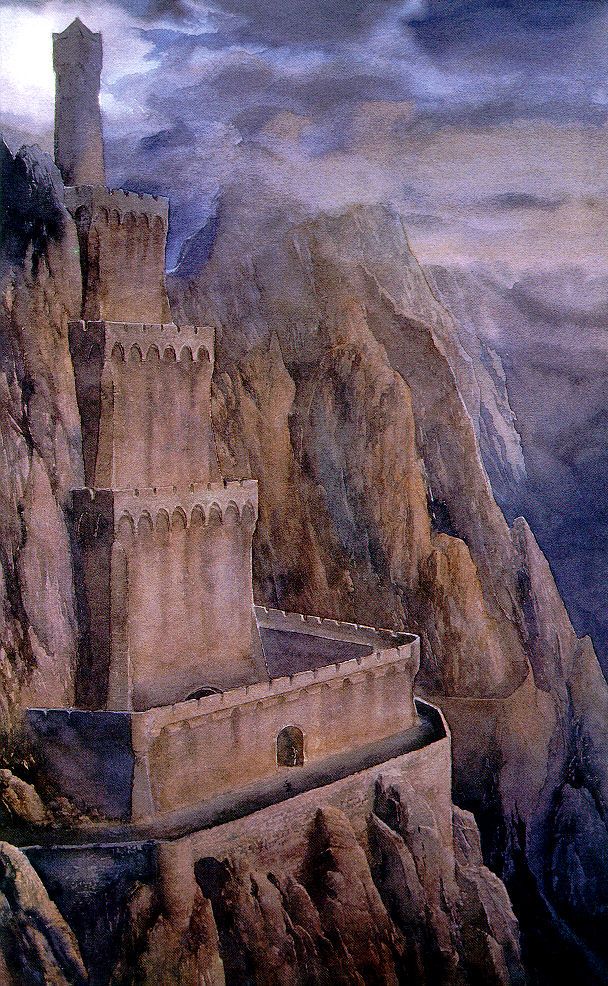
 Sam finds Frodo’s body in the tower of Cirith Ungol. After fighting off his captors, Frodo awakens and takes the Ring from Sam. They descend the stairs into the land of Mordor and steal some Orcish armor and vestments so they can blend in with the host. However, they find the land largely empty as the armies are being called away to deal with a threat at the Black Gate.
Sam and Frodo are absorbed by the host temporarily, but manage to break away and make for the Mount Doom. With the land all but emptied and the eye fixed on the Black Gate, they make their final approach on the mountain itself. They pause temporarily to look back on all they’ve accomplished and the vast distance they’ve crossed, and realize that their Quest is almost over.
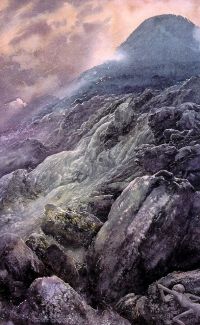 Once inside the mountain, and ready to cast the Ring into the Cracks of Doom, Frodo finally succumbs to the power of the Ring and declares he’s keeping it for himself. However, Gollum appears suddenly and tries to take it from him. He bites off Frodo’s finger and claims it, but loses his footing and falls into the Cracks, which consume him and the Ring together. Sauron and the Ring are at last destroyed!
At the Gates, Sauron appears as a dark shadow who tries to reach out and attack the Army of Men. However, his shadow is blown away by the wind, and his forces flee when they realize their master has been destroyed. The Southrons and Easterlings surrender and are given mercy, and the Great Eagles are flown in by Gandalf to pluck Frodo and Sam from the side of the mountain.
 Back at Minas Tirith, Aragorn is crowned King and takes Arwen as his Queen. Faramir takes Eowyn as his wife and is given the title of Prince of Ithilien. The White Tree, which has been dying for some time, blossoms and begins to show signs of life. All of Gondor begins to sprout with trees after Aragorn plants and ancient seed, and Gandalf indicates that the Northern Kingdom, where Aragorn’s ancestors used to rule, will be reclaimed and rebuilt.
Frodo, Sam, Merry and Pippin and are honored as heroes during the coronation ceremony. After a series of goodbyes, they return to the Shire, only to find it in ruins. They learn that Lotho Sackville-Baggins, one of Frodo’s relatives and usually referred to as “The Chief” or “The Boss”, has been oppressing the locals, but himself is being controlled by someone named Sharky. This man has imposed a program of deforestation and industrialization which has left the Shire scarred and near ruin.
 After rallying the locals, they confront Lotho and Sharky’s men at the Battle of Bywater. Victorious, they march on Sharky’s hideout and confront Sharky himself, who turns out to be Saruman, accompanied by Grima. Apparently, the name Sharky is an Orcish word which means “old man”, which his Uruk-hai used to refer to him. Obstinate in defeat, Saruman abuses Grima and turns to leave. However, Grima stabs Saruman in the back and is himself felled by many arrows.
Time passes and everyone appears to have settled down happily. However, Frodo is unable to overcome the injuries he sustained at the hands of the Witch King. Eventually, he departs for the Havens where he meets with Gandalf, Bilbo Baggins, and many Elves, ending the Third Age. They sail into the West, to the lands of Aman, the “Undying Lands”, while Sam returns to the Shire where he is greeted by his wife and daughter, Rosie Cotton and Elanor, and delivers his final spoken words of the book: “Well, I’m back”.
Summary:
Though not as exciting to me as the second book, I nevertheless loved the third and final installment. Naturally, many critics and readers over the years have cited some weaknesses in the book, such as the extended ending where Frodo and his friends return to the Shire to save it from Saruman. This felt like an added climactic moment which occurred after the big one, which can seem a little out of place for a story, even one as epic as this one.
However, it was intrinsic in demonstrating Tolkien’s views on industrialization and labor relations. In short, he was a man who delighted in the natural world, and saw the intrusion of industry and an industrialized workforce as oppressive. And hell, you couldn’t beat the references: “The Boss”, the corrupt workmen, the smokestacks and the ruined countryside. It was like a worker’s pamphlet and a description of 19th century Manchester all rolled into one.
There were several more asides in this book, something Tolkien was famous for. And although they seemed like third act additions, they all seemed to be of particular importance to the author himself. For example, the scene where Theoden and the Aragorn are having an audience with the leader of the Pukel Men in order to find the path through the mountains, this was important in that it showed Tolkien’s views on native peoples, how they have been historically used and abused and were deserving of more respect.
The fact they are asking the help of people that Rohan usually hunts and goes to war with was also an interesting allegory. Much like how the British, French and American colonists called upon their Native neighbours for help in the French and Indian War, the War of Independence, and the War of 1812, Rohan is calling on people it typically considers to be enemies for help against a greater foe. As such, I found the scene quite interesting; and rather than detract from the overall narrative, I felt it added to the richness of Tolkien’s world. An editor would have surely told him to nix it, but that was something else about Tolkien. He refused to let editors tell him what to do, beyond mere spell checks and grammatical corrections.
In terms of the film adaptation, I once again had some issues with how it was done. But to be fair, I was a full-blown Rings geek at this point and saw the book as something akin to canon, so any changes were likely to be seen as just plain sacrilege. Still, it was awesome to witness the battle of Pelennor Fields on the big screen, not to mention seeing Minas Tirith rendered in visual form. These were the big climactic scenes to the story and I approved quite highly with how Jackson rendered it all.
When it came to the battle itself, there was the same conveyance of hopelessness and the feeling that everything was lost, right up until the reinforcements arrive and the day is saved! And personally, I can’t get enough of the scene where the Riders of Rohan start riding down the Orcs! Seeing those ugly bastards get their ranks clobbered was so pleasing after all the people they killed and evil shit they pulled! But of course, the battle got a little hokey after this, as Legolas begins doing his acrobatics and the ghost men show up to the fight.
This latter part wasn’t in the book; the Oathbreakers having done their part to secure the fleet in the first place. Having them also destroy all the Orcs inside the gates of Minis Tirith also made it look like the forces of Gondor did very poorly in the fight, which was really not the case in the book. Granted, they were losing, but their contribution on the fields helped turn the tide of battle and ensured that they still had plenty of foces to send to the Black Gate at the end.
Oh, and that farewell scene between Theoden and Eowyn. All I can say is “Ick!” “I’ve got to save you,” says she, to which he replies “You already have…” Not only was this ripped straight from Return of the Jedi, but it made no sense. How did she save him? Sure, she killed the Witch King, but he’s dying. She didn;’t redeem him the way Luke did his father. So where did the saving come in? What, did she save him from his sexist views? Great, but… you’re still dead, Theoden! Luckily, the fight with the Witch King overshadowed all of that for me. Sure, he too was a bit of a ripoff of Darth Vader, but who cares? He was badass!
Of course, Sam and Frodo’s part in this book was rather truncated. It is for this very reason that Peter Jackson chose to take material from Book IV and place it here, where it could be used to pad their story. However, this worked quite well in the book in that we were brought to a veritable climax when the Book V ended at the Black Gates. With so much hanging in the balance, Book VI manages to carry things on and not keep the reader waiting too long before showing the resolution and tying things up.
That was one thing I didn’t really approve of in the movie, which was the amount of padding they placed in Sam and Frodo’s part. Those who have read the books will know what I mean. The fact that they kept the scenes from Shelob’s Lair for this movie made perfect sense, but the additional parts which didn’t happen in the book – Gollum turning Frodo against Sam, Gollum attacking them twice after betraying them, Frodo falling and getting a vision of Galadriel to help him up – all seemed like needless filler. Oh, and don’t forget the extra added scenes of Arwen looking on and crying, again!
But other than that, zero complaints! Kudos to Peter Jackson for taking on the task of turning one of the best stories of high fantasy and mythos into a full-length movie series, complete with battle scenes that were awesome in their size and scale! And an even bigger kudos to Tolkien, for giving countless generations something which they have been able to enjoy, draw inspiration from, and feel all the richer for having read. Few people have had the same impact as this venerated author, and very few works have ever come to rival its scope and influence.
If you haven’t read it, do it now! Even if you don’t generally approve of fantasy, you’ll find something to love here. I guarantee it!

 Here in Canada, few historical events from World War II inspire as much anger, sadness, and remembrance than the anniversary of the Dieppe Raid. It was 70 years ago today that Canadian Forces, in what was to be the first offensive of the war, attacked the European coastline near the small French town of Dieppe. The raid, as it was classified, was a total failure, resulting in 913 dead, almost 3000 captured, and countless more wounded. Out of the nearly 5000 men who went in, less than half made it home.
 Earlier today, I read some articles that spoke of the surviving veterans, the youngest of whom is 90, as they arrived at Dieppe to take part in the commemorative ceremonies.
 Naturally, when these veterans tell their stories again to reporters or the many who wabted to hear them, they conveyed some rather mixed emotions. There were moments of anger and pride intermixed with a general tone of lament, and in that respect, they are joined by all Canadians who remember. Even now, 70 years later, there is still ample speculation about the Dieppe raid.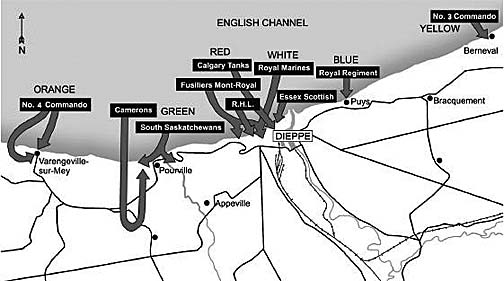
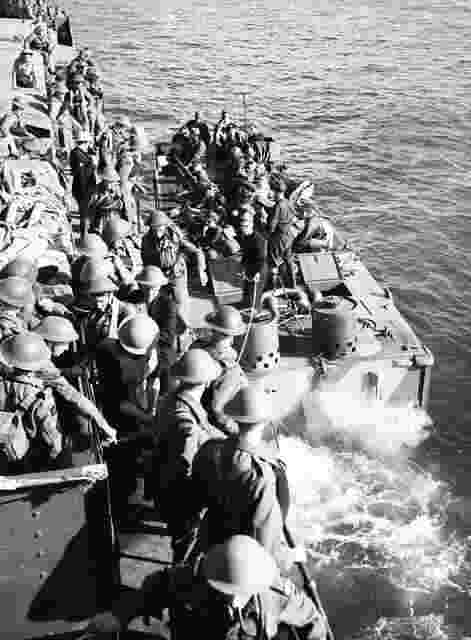 Ultimately, the raid was a failure for numerous reasons, all of which proved intrinsic to helping the Allies draft Operation Overlord – the invasion of Normandy – roughly two years later. First off, the raid had little support to speak of. Aside from the 5000 men and tanks heading onto the coastline, their were very ships ships and aircraft standing by to blast German positions and take on the coastal defenses.
 Third, the plan was changed over and over again so that less and less forces would be committed to the fold. This led many to question whether the raid would even have enough men or firepower to achieve their mission. However, Allied planners dismissed these objections by emphasizing that the attackers would have the element of surprise. That was not the case though, since Allied Command had been publicizing the attack for some time before it happened.








 Stories by Williams