After many years of starts and stops, the fandom community has been pretty excited that we are finally getting a Blade Runner sequel. Whether or not it will be the sequel we want remains to be seen (we all remember Jar Jar!). In any case, the first teaser trailer has just come out. As you can see, it shows Ryan Gosling in the lead role, with Harrison Ford reprising his role as Rick Deckard.
As was likely the intent, this trailer establishes that there is a passing of the torch between Ford and Gosling, who has become a Blade Runner himself. And if I had to guess, I would say the whole exchange (which takes place at gunpoint) indicates that the plot will center on what Deckard did at the end of the previous movie – which was to run off with Rachael (a Replicant) to make a life with her.
The movie is scheduled for release in October of 2017, and includes performances by Jared Leto, Robin Wright, Mackenzie Davis, and Ana de Armas. Check it out!
First off, let me apologize for not announcing this sooner. But as with all good things, I didn’t want to announce anything prematurely or risk jinxing it. To put it simply, I have been approached by a publisher about my current work in progress – The Cronian Incident. And while nothing has been put in writing just yet, if all goes well, it will be part of Space Dock’s 2017 publishing catalog – which is the sci-fi subsidiary for a UK publisher.
To start at the beginning, back in October, this publisher sent me a message via Facebook. It seemed that we were part of the same writer’s group, and he had heard me going on about The Cronian Incident and all the ideas I was exploring to create it. Apparently, this is something lots of publishers do these days, which is rely on social media to look for aspiring authors.
Anyhoo, I replied to him that I would be interested, and that the manuscript (though not yet complete) was coming along nicely. Over the course of the next few weeks, we did the usual back and forth. He explained what they were looking for and asked me about my long-term plans, I told him about the overall story and how I hoped to write sequels to it.
Jupiter’s larger (Galilean) moons, Callisot, Europa, Io and Ganymede. Credit: NASA
He then asked me to send the first four chapters to see if it had promise. Here too, I learned something valuable. These days, its the first four chapters (not five, not three) that make-or-break many online sales. You see, people using Amazon are able to download these as a sample and will base their decision to buy the whole book depending on whether or not it’s grabbed their interest.
So the first notes the publisher gave me was that he liked the idea, but also stressed that the beginning needed “a hook”. There was little in the first four chapters of my original draft to introduce the overall plot, they said, and things kind of built slowly. So I revised it, added a prologue that contains the “inciting event” of the story (a kidnapping) and sent it back. This met with his approval, and he sent it on to one of his editors for a second look.
And just a few days ago, they got back to me again. Once again, I got some kudos on the story, but more concerns that things take too long to develop. However, this time around, it was more in the form of a suggestion. I took this to be a good sign, but of course I took the suggestion seriously. These people know what readers are likely to buy, so I’m not about to disregard their recommendations.
Terrafomed Mars, one of the focal points of the story. Credit: ittiz
So I’m doing a second round of edits now, and working to complete the novel so its ready for the 2017 publishing season. At this point, I’m over 70,000 words into the story, and I imagine there’s about ten more chapters to go. At this rate, I can estimate that the final product will be probably be about 100,000 words (though that is likely to come down after all the editing is finished).
And like I said, nothing has been signed yet so nothing is written in stone. But so far, I’m pretty enthused about how things are going. It’s taken me over ten years to actually get to the point where a publisher was interested in my work and contacted me. In the meantime, feel free to join me in being cautiously optimistic!
Hey again, folks! I find myself with some free time again, and wanted to continue telling people about my family and my trip to Europe this past June. Last time, I recounted our trip to Northern France and our lovely time we spent in the small town of Grangues, where we got to pay our respects to those who died during D-Day and the liberation of Normandy – which included my great uncle Wilmot Pettit.
Today, I would like to mention everything else we did while in Normandy during the D-Day celebrations. There was plenty to do, plenty to see, and plenty to experience at the time. Literally, an entire region was on its feet celebrating the 72nd anniversary of their liberation, complete with recreations, guided tours, and countless commemorative ceremonies.
Bayeux:
While in France, we stayed just outside the town of Bayeux, the historic location of the Bayeux Tapestry (which tells the story of William the Conquerors conquest of England) and one of the first towns to be liberated during the Battle of Normandy. Before moving on to Grangues, we stayed in a lovely bed and breakfast called the Ferme de la Gronde, which is a converted country estate.
Ferme de la Gronde, France
One of the things that we immediately noticed when checking in was the lovely, musty smell of the place. Everything smelled like old stone walls and plaster, like we were staying in a medieval church or castle. But of course, that’s understandable, since the estate itself surely dates back to the Middle Ages and the same construction techniques that went into the Bayeux Cathedral were surely used.
The first day was tough. When we arrived, we were running on very little sleep and had been in transit for almost twelve hours. And then there was the nine hour time different to factor in. And the first night, our sleep was a bit restless. There’s nothing like exhaustion and jet lag to disturb your sleep! But we happened to see some wonderful things on our way into town and our first day reconnoitering.
For instance, the town of Bayeux was already packed with veterans from across the Channel. And the poppies and signs that said “Welcome to our Liberators” were out in full force. So the streets were pretty busy throughout the day, and pretty packed at night. The Bayeux Cathedral was also holding ceremonial services to mark the anniversary of the liberation. Basically, despite our fatigue, an energizing mood was in the air!
And after our first (restless) sleep, we began plotting our tour of the Normandy Beaches! And here’s what we got up to…
Arromanches:
Our first stop was to the town of Arromanches, located on the coast. During D-Day, this town was the site of Gold Beach landings, and also became the locations where the Allies placed one of their Mulberry Harbors (the other being installed at Omaha Beach). These artificial ports
The town of Arromanches, with a view of the English Channel
In 2014, my folks, my wife, and I visited this lovely town and took a tour of the D-Day museum there. But this time around, the attraction was the bagpipers, crowds, and celebrations marking the 72nd anniversary of the liberation. As soon as we arrived, we got swept up in the festivities. And after walking the beach, ascending the hill in town (at the top is a Sherman tank), and grabbing some lunch, we moved onto our next stop!
Point-du-Hoc:
Any American readers ought to instantly recognize this name. During D-Day, the US Army Ranger Assault Group scaled the cliffs (while under fire) at this point along the Normandy coast to take out a series of German heavy guns. Once they reached the top, they realized that the guns have been relocated, and fought their way inland to find the guns and destroy them.
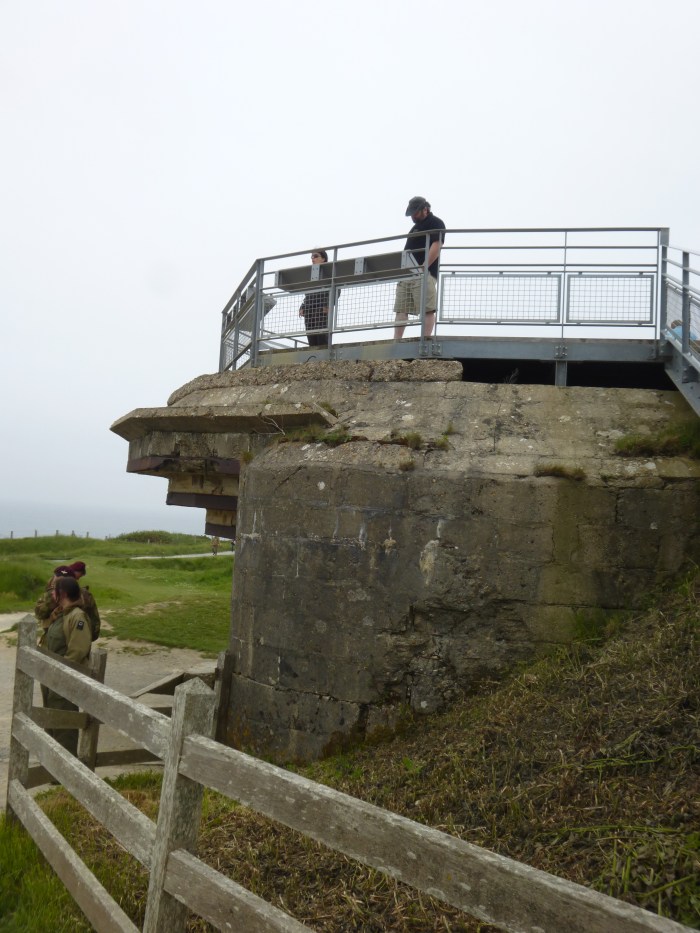
Today, this site is well preserved. Not only are the craters from where Allied naval artillery hit still evident, but the crews that tend the grounds have done a good job ensuring that most of the fortifications have remained intact.
Empty gun emplacement at Point-du-Hoc, June, 2016And that’s me atop one of the gun emplacements at Point-du-Hoc
I was reminded of Longues-sur-Mer, a coastal battery that we visited in 2014, in many ways. At both sites, the old cement bunkers still sit in the earth, worn and weathered. Even the ones that were hit during D-Day and destroyed are still a testament to what happened there, over 70 years ago.
And like everywhere else in Normandy at the time, the place was flooded with tourists and re-enactors were everywhere, dressed up in US Army Ranger uniforms and conducting tours. And much like the other sites along the Normandy coast where the Allies came ashore, there is a museum there, maintained by the American Battle Monument Commission.
One thing we were a little baffled by was the monument that overlooks the cliffs. One the one hand, it kind of resembles a sword with a cross guard sticking out of the ground. On the other hand, it looks like a menhir, which may be culturally significant as far as the region’s ancient inhabitants are concerned. Any other comparisons are ones I will not make (and I respectfully ask that nobody else do so either!). Needless to say, we all thought it looked a bit weird.
The Ranger Monument at Pointe du Hoc in France. Credit: abmc.gov
Juno Beach:
Next, we traveled to the town of Courseulles-sur-Mer, a relatively quiet town that sits on the Normandy Coast. This town is made famous due to the fact that it sits next to the 8 km (5 mi) stretch of beach where the Canadian liberation force – which consisted of 14,000 troops belonging to the Canadian 3rd Infantry Division and the 2nd Canadian Armored Brigade – came ashore on D-Day.
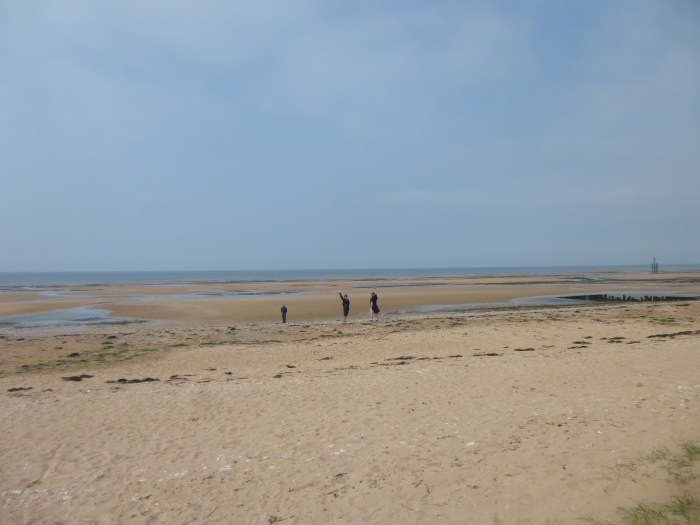
This was the second time my family and I visited this site together, and about the fourth or fifth time my mother and father had. And in addition to walking the beach again to see if we couldn’t put ourselves into the mindset of the soldiers that came ashore under fire, we also visited the Juno Beach Center. As a point of interest, my aunt – who is a high-school principal back in Brantford, Ontario and the the one who introduced my father to the battlefield tours – sits on the museum’s board of directors.
My wife, father, and I, approaching my mother on Juno Beach, Normandy Coast, June 2016
As such, my father will drop her name any time we are there to see if they know her. So typical of him, always proud of his sister! However, this year, we didn’t take the tour of the museum (as we had in 2014). This was just our second day of our trip, and we were all still very jetlagged and tired. And after visiting three major D-Day sites, we were more than a little bit tired. As such, after grabbing some lunch from the vendors that line the waterfront, we decided to make one last stop at the Commonwealth cemetery at Beny-sur-Mer before heading back to Bayeux.
It is here that Canadians soldiers who died on D-Day are interred. And after paying our respects and laying Canadian flag pins on the graves of any Williams’ and Wilson’s (my father and mother’s family names) as is our custom, we headed back to Bayeux to enjoy some delicious food at the same place we dined the night before – Le Garde Manger, which sits in the shadow of the Bayeux Cathedral. Some Affligem beers and some tasty entrees, and we were ready to call it a night!
The Juno Beach Center, Courseulles-sur-Mer, France. Credit: junobeach.org
And that was just the first two days! What followed is what I covered in the first installment. This included packing up and leaving Bayeux, traveling to the small town of Grangues, and participating in their commemorative ceremony to remember all those who died to liberate their country (of which my great uncle, Wilmot Pettit, was one), and those who died in both WWI and WWII. You can read about that experience here.
Given that I’ve really been taking my time to write these, I apologize for the fact that they are only covering a few things at a time. I promise to be speedier in giving the next one… and the next one. Hopefully, I can cover the entirety of the trip and the significance it had in just a few more posts. Wish me luck, and a happy belated Remembrance Day/Veteran’s Day/Armistice Day to all!
There’s a potentially Earth-like planet around the closest star to Earth—that’s the space headline that captured the world’s imagination this summer. But here’s something that was easy to forget in all that furor over Proxima Centauri. Our neighboring star doesn’t look anything like the Sun.
We humans have known only one life-sustaining planet in the universe: a green-and-blue globe called Earth. So perhaps we can be forgiven for thinking the ideal ingredients for creating life must resemble what we se here: a bunch of planets around a medium-sized yellow star.
Mind-expanding missions like the Kepler Space Observatory, however, have scientists questioning whether a solar system like ours really is the perfect place to hunt for new Earths and the possibility of life beyond our planet. Lately, astronomers have been taking a closer look at red dwarfs—stars with low mass, low temperatures, and slow rates of fusion.These stars don’t look much like our life-giving Sun, but they make up almost 70 percent of the observable stars in the sky and could survive for trillions of years—far longer than our star.
If we’re going to find life beyond our solar system, many scientists believe it will be orbiting a red dwarf. Here’s why.
Artist’s impression of a sunset seen from the super-Earth Gliese 667 Cc. Credit: ESO
The Alien Worlds of Red Dwarfs
In the past, planet-hunters thought the odds of finding potentially habitable worlds around red dwarfs were quite low. Because of their low mass and temperature, red dwarfs emit just 3 percent as much light as our sun. For an orbiting planet not to freeze into an uninhabitable iceball, it would need to be as close to the star as Mercury is to our Sun. Unfortunately, being so close to a star means the planets probably would be tidally locked, where one side is constantly facing the star and the other side always faces away. Not ideal conditions for creating life.
Red dwarfs are also far less stable compared to larger stars, undergoing sudden rises and drops in the amount of light and heat they emit. This creates big variations in temperature, adding yet another challenge for budding life.
If we’re going to find life beyond our solar system, it will likely be orbiting a red dwarf.
It’s not all bad news, though. Red dwarfs have a considerable advantage over other stars in their incredible lifespans. Our Sun has been around for 4.57 billion years, yet humanity has existed for just 200,000 years. Life takes a long time, and complex life even more so.
Time is one thing red dwarfs have plenty of—they can exist for trillions of years because of their low mass and slow rate of nuclear fusion. Since they’re also so common in our cosmos, the odds of finding planets within that habitable Golidlocks zone is statistically high. For astronomers, the pros are starting to outweigh the cons.
Artist’s impression of what the surface of Proxima b could look like. Credit: ESO
The Case for Going Red
In 2005, astronomers from around the world converged on Mountain View, California, for a workshop sponsored by The Search for Extraterrestrial Intelligence (SETI) where scientists argued the case that red dwarf stars could be the best place to look for aliens. In the end, it comes down to sheer probability. Within 33 light years of Earth there were 240 known red dwarfs at the time, compared to just 21 stars like ours.
Although red dwarfs are hard to find because they’re dim, once they’re spotted it’s much easier to see how many chunks of rock are in orbit. The so-called transit method of finding exoplanets, which the Kepler telescope used to great effect, relies on looking for changes in brightness caused by a planet passing in front of its star. It looks something like this:
Because planets orbiting a red dwarf are likely to hug their stars so tightly, the orbital period is often just a few days long, which makes for pretty good odds of seeing such a transit.
New Worlds Emerge
Since that SETI conference more than a decade ago, oodles of new planets orbiting red dwarfs have been discovered. Between 2005 and 2010, astronomers found six exoplanets orbiting Gliese 581, a red dwarf located about 20 light years from Earth. Two of these planets, Gliese 581-c and -d, lie on the inner and outer edge the star’s habitable zone. Another exoplanet, Gliese 581-g, may also have an orbit fit for habitability (though its existence is still contested).
In 2012, the European Southern Observatory (ESO) published the results of a spectrographic survey that examined 102 red dwarf stars in the Milky Way over the course of six years. They found that red dwarf stars were more likely to have an Earth-like planet orbiting them than a gas giant. Two years later, another ESO study concluded that virtually all red dwarfs in the universe have at least one exoplanet orbiting them. At least a quarter of them have a super-Earth (a planet like ours but slightly bigger) orbiting within their habitable zones.
Artist’s impression of the planet orbiting Proxima Centauri. Credit: ESO/M. Kornmesser
The drumbeat goes on. This past July, researchers from the Harvard Smithsonian Center for Astrophysics (CfA) released a study in which the team calculated the likelihood of Earth-like planets forming within our universe over cosmic timescales, starting with the first stars to form, billions of years ago, and continuing into the distant future. They determined that low-mass red dwarf stars would be more likely than giant stars to maintain a system of planets long enough for life to emerge, and that likelihood only increased with time.
“We considered the likelihood of ‘life as we know it’ to form between the appearance of the first stars and the death of the last stars,” Professor Avi Loeb, a science professor at Harvard University and the lead author on the paper, told PM. ” We found that the likelihood peaks in the distant future around low-mass stars, simply because these stars live much longer than the Sun.”
Other discoveries made in the past five years have also bolstered the case for habitable planets around red dwarf stars with exoplanet candidates around Innes Star, Kepler 42, Gliese 832, Gliese 667, Gliese 3293, and most recently Proxima Centauri. All of these star systems are located relatively close to our own, though still impossibly out of reach with only today’s space-faring technology.
In the coming years, as more exoplanet hunters like the James Webb Telescope and the Transiting Exoplanet Survey Satellite look to the sky, it’s probable that scientists and astronomers will focus much of their efforts on nearby red dwarf stars.
“One of the great discoveries made in the past decade or so is that it seems like there are planets all over the place,” TESS project scientist Stephen Rinehart told PM, “even around these small stars so different from our own.”
Just came across these new trailers for a series that will be premiering on Nov. 14th. The show tackles the increasingly-relevant concept of a crewed Mars mission. Such a series is very timely right now as NASA gears up for its “Journey to Mars”, and quite understandable given the recent popularity of The Martian.
As you can see, the show chronicles the first crewed mission to Mars, which involves a ship based on the
The series is directed by Ron Howard and Brian Grazer (director of Apollo 13), and some big names had input into the series. This included SpaceX founder Elon Musk, famed science communicator Neil deGrasse Tyson, and Robert Zubrin. For those familiar with proposed Mars missions, these names should be instantly recognizable. Musk is the man pushing for regular missions to Mars in the coming decade (using his Interplanetary Transport System – or ITS), while deGrasse Tyson is the successor to Carl Sagan, communicating the wonders of science through public outreach and the show Cosmos.
Here is the description from the National Geographic Channel:
The year is 2033, and humanity’s first crewed mission to Mars is about to become a reality. A unique blend of scripted drama and modern-day interviews with the field’s best and brightest, Mars tells the story of how we will one day call the red planet home through groundbreaking research and innovation. The global series event premieres Monday, November 14, at 9/8c on the National Geographic Channel.
Don’t know about you, but I will be watching every episode!
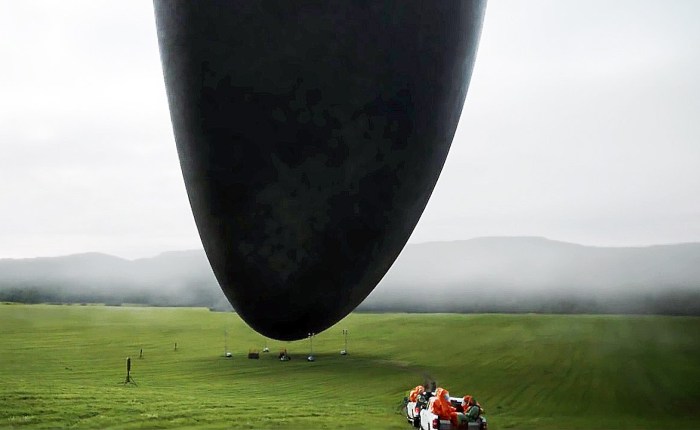
This trailer is now making the rounds, which previews the upcoming science-fiction, first contact thriller Arrival. Based on the short story, “Story of your Life” by Ted Chiang, this film tells the tale of aliens coming to Earth, and the arduous process that follows as we try to figure out their intentions, communicate with them, and not provoke a “War of the Worlds” scenario.
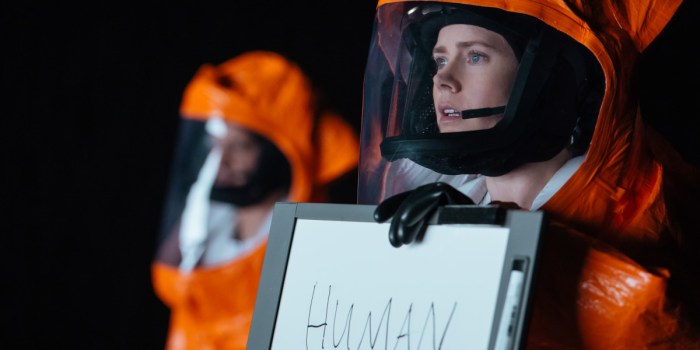
In the lead roles are Amy Adams (famous for her role as Lois Lane in Man of Steel), Jeremy Renner (of Avengers and Bourne Legacy fame) and Forest Whitaker, who just finished up working on Rogue One. Adams plays Dr. Louise Banks, the world’s foremost linguist who is called in to find a way to communicate with the aliens. Renner plays Ian Donnelly, a mathematician, who’s present because math is considered the only universal language. And Whitaker plays Colonel Weber, the requisite military man who’s there to disagree with the scientists and emphasize security.
Credit: Paramount Pictures
As you can see from the trailer and gauge from the description, the story is one that has been told many times, but never gets old! In many ways, the plot, themes and aesthetics call to mind such movies as War of the Worlds, 2001: A Space Odyssey, Contact, Sphere, and even more recent ones like Prometheus. And from what I saw, I am desperately hoping they choose to take the more complex and nuanced approach, and avoid any Independence Day messiness with this one! If there’s one thing that’s been done to death, its the idea of scary aliens coming to kill us all. If anything, I am hoping they take a more Childhood’s End approach with this one.
After all, if we found another intelligent species which we could make contact with, and our level of technology was more sophisticated than theirs, would we kick in the door and just decide to conquer willy-nilly? Or would we take a slow approach, try to get to know them first, and go to war once we screwed all that up? Exactly!
The movie comes out this November 11th, 2016, on Remembrance Day (also Veterans Day and Armistice Day, depending on where you live). One has to wonder if there’s some subtle message there, eh? Enjoy the trailer:
Hi folks. My apologies for not talking about this sooner, but it’s been pretty hectic these past few weeks. The good news is, the wife and I returned from Europe about two weeks ago. And we had a wonderful trip. Much like our Eurotrip 2014 edition, this trip was all about visiting the battlefield tours and monuments in Northern France and Belgium, but with some slight modifications.
For one, we got in a few different battlefields and monuments this time around. Second, we cast our net a bit further, getting as far as Utretch in Holland. And third, and most importantly, the main reason for this year’s trip was to take part in the remembrance ceremony put on every year in the small town of Grangues in Normandy.It was here (we learned two years ago) that my mother’s first cousin, once removed, Wilmot Pettit died on D-Day after being shot down over the French countryside.
But it’s a long story, so bear with me…
Grangues, France:
Back in 2014, while we were planning our trip to Europe, my mother learned from her mother that a cousin of hers had died on D-Day and that we might be able to find where he was buried. Doing her research, my mother learned that he had been shot down over the small hamlet of Grangues.
For people familiar with D-Day, this story should sound familiar. Pettit was a pilot with the Royal Canadian Air Force and on D-Day, he was flying in the Eastern Sector of the Normandy landing zone. Flying a Sterling aircraft, he was responsible for towing a glider filled with members of the British 7th Airborne to their landing zone in the countryside.
My mother and the rest of us, meeting with the mayor of Grangues in 2014.
Unfortunately, the German air defenses in this sector proved more tenacious than expected. Much like in the Western sector, where the 101st Airborne was scattered all over the countryside due to German anti-aircraft fire, the British 7th Airborne suffered a lot of losses due to all the flak they experience. After flying near Grangues, my cousin and his crew were hit by German flak and the plane went down. During the crash, he and several of the Airborne soldiers were killed on impact. The rest were taken prisoner by the local SS garrison, and then shot on the next day.
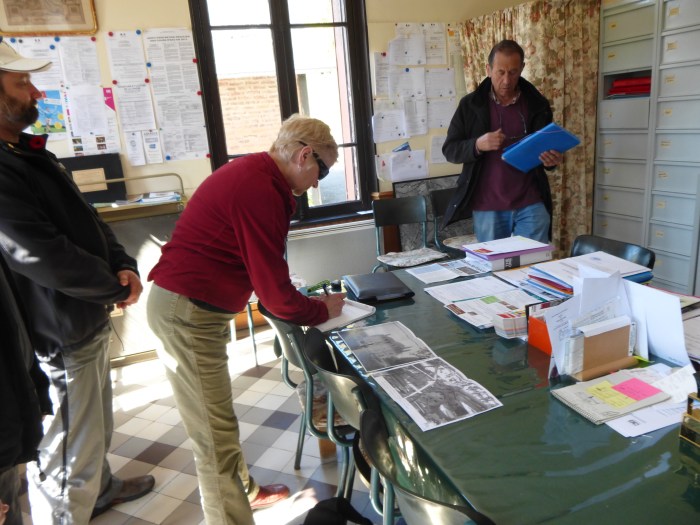
And while we were in France, she looked up the small hamlet and visited the mayor’s office, which is right next door to the town’s church. When we arrived, we were buffaloed. In the mayor’s office, a painting hung of the plane my cousin piloted being shot down. He had a glass case filled with artifacts of the plane crash. The mayor then took the time to share old photos with us of the crash, showed us the site, and even told us where Wilmot was now buried (in the nearby town of Ranville).
We also learned that every year on June 7th (the day the captured soldiers were executed) that the townspeople, veterans from the UK, and people from all over the region, turn up to pay their respects and honor the memory of those who died liberating their country. They also pay their respects to those French soldiers from the region that died during World War I in defense of their country.
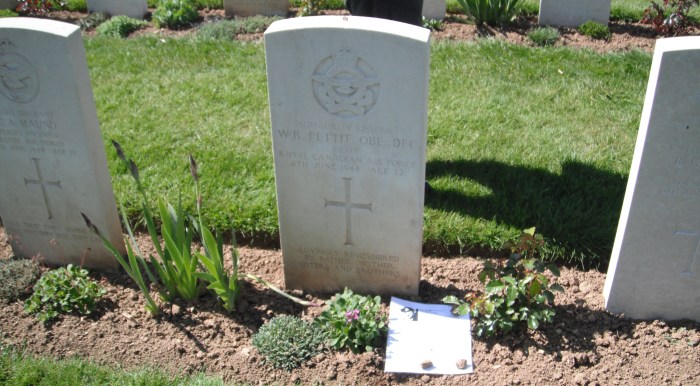
Wilmot Pettit’s headstone, Ranville War Cemetery
While we could not stay for the ceremony back in 2014, we decided to go this year after the mayor emailed us an invite. The rest of our trip, which we’d been planning ever since the last one, was to be scheduled around this ceremony.
When we arrived, a few days after landing in Paris, we got to the town and settled in at the local B and B. On the following day, we went to the small town’s church, where we were greeted by a large crowd of veterans, some men carrying flags, babgpipers, and a whole lot of people turned out in their Sunday best. The mayor came over to greet us, at which point, we began to practice our French.
At first, he heard us speaking English and asked for his translator. But my mother and I jumped in by telling him, in French, that we were the family of Wilmot Pettit. At one point, one of us must have said pilot, because that jogged his memory.
“Le pilote?” The mayor asked. We all said yes. And instantly, he remembered us. From that point onward, we were treated like honored guests. We attended the ceremony in the town’s cemetery, we stood in the front row amongst veterans who were 90 years old, and my mother was invited up to say a few words. She thanked the townspeople, the mayor, and honored her cousin in impeccable French (though she denied it!)
My mother and the mayor of Grangues speaking at the after-ceremony, July 7th, 2016
The national anthems of France, Britain and Canada all played. They flew the flags of all three countries. And of course, the mayor gave a speech which was translated into English. Afterwards, we talked to the people and shared drinks in the town hall! It was really quite amazing.
One of the most profound things about it was the sense of inclusion. Here we were, foreigners and strangers to so many people – many of whom witnessed D-Day and participated in it – and they treated us like honored guests. We all remarked afterwards how surreal and moving it was. And even now, months later, I find its still hard to wrap my head around.
More to follow, as that was just the first few days. Stay tuned!
Hey folks! With every passing week, I am making (meager) progress towards the conclusion of The Cronian Incident. And in addition to designing a cover, formatting the interior, I’ve decided to create a trailer for its upcoming release. Here is the rough-cut, which features images of the planets involved, and a basic description.
I’m thinking of sexing it up with some colored script, some additional images or animations, and any other features I can think of before the book’s release. Let me know what you think in the comments.
The latest trailer for the upcoming Star Wars: Rogue One movie was released just yesterday, which fans had to suffer through endless hours of Olympic coverage to see. Okay, maybe suffered is the wrong word, the Olympics are awesome. But so is this trailer. Bask in it. BASK I SAY!
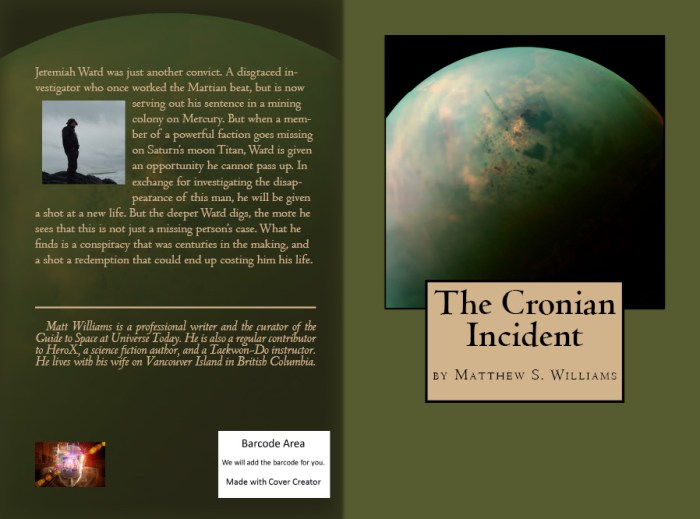
Okay, so I finally finished work on a few possible covers for The Cronian Incident. I recently got my CreateSpace account reactivated and used the lovely cover creator feature to get some visuals going. The problem is, I’ve been having trouble deciding which one I want t use. On the one hand, I can’t choose to between two themes – one that put text boxes over a full cover image, and another that uses a solid background on the front page, a shadow on the back, and puts the main image and title in boxes.
Then, I found that I couldn’t decide which image I wanted to use after all. Initially, I was all set on the green image of Titan that you can see in the first two options. But there’s also the Cassini image of Titan that shows its hazy atmosphere being illuminated from behind, giving it an eerie, yellow glow. I thought this one worked pretty well too in the mockups. So in the end, I made four covers, using both themes and both images, and figured I’d entertain some outside opinions.
Which one do you think works best? Be sure to vote below…


















 Stories by Williams