News from Space: Orion Spacecraft Completed

orion_arrays1NASA’s return to manned spaceflight took a few steps forward this month with the completion of the Orion crew capsule. As the module that will hopefully bring astronauts back to the Moon and to Mars, the capsule rolled out of its assembly facility at the Kennedy Space Center (KSC) on Thursday, Sept. 11. This was the first step on its nearly two month journey to the launch pad and planned blastoff this coming December.

Orion’s assembly was just completed this past weekend by technicians and engineers from prime contractor Lockheed Martin inside the agency’s Neil Armstrong Operations and Checkout (O & C) Facility. And with the installation of the world’s largest heat shield and the inert service module, all that remains is fueling and the attachment of its launch abort system before it will installed atop a Delta IV Heavy rocket.

Orion-at-KSC_Ken-KremerThe unmanned test flight – Exploration Flight Test-1 (EFT-1) – is slated to blast off on December 2014, and will send the capsule into space for the first time. This will be NASA’s first chance to observe how well the Orion capsule works in space before it’s sent on its first mission on the Space Launch System (SLS), which is currently under development by NASA and is scheduled to fly no later than 2018.

The Orion is NASA’s first manned spacecraft project to reach test-flight status since the Space Shuttle first flew in the 1980s. It is designed to carry up to six astronauts on deep space missions to Mars and asteroids, either on its own or using a habitat module for missions longer than 21 days. The development process has been a long time in the making, and had more than its share of bumps along the way.

Orion-at-KSC_Ken-Kremer1As Mark Geyer, Orion Program manager, explained:

Nothing about building the first of a brand new space transportation system is easy. But the crew module is undoubtedly the most complex component that will fly in December. The pressure vessel, the heat shield, parachute system, avionics — piecing all of that together into a working spacecraft is an accomplishment. Seeing it fly in three months is going to be amazing.

In addition to going to the Moon and Mars, the Orion spacecraft will carry astronauts on voyages venturing father into deep space than ever before. This will include going to the Asteroid Belt, to Europa (to see if there’s any signs of life there), and even beyond – most likely to Enceladus, Titan, the larger moons of Uranus, and all the other wondrous places in the Solar System.

oriontestflightThe two-orbit, four and a half hour EFT-1 flight will lift the Orion spacecraft and its attached second stage to an orbital altitude of 5,800 km (3,600 miles), about 15 times higher than the International Space Station (ISS) – and farther than any human spacecraft has journeyed in 40 years. It will be an historic occasion, and constitute an important step in what is sure to be known as the Second Space Age.

And be sure to watch this time-lapse video of the Orion Capsule as it is released from the Kennedy Space Center to the Payload Hazardous Servicing Facility in preparation for its first flight:


Sources:
gizmag.com, universetoday.com

News from Space: Rosetta Maps Comet Surface

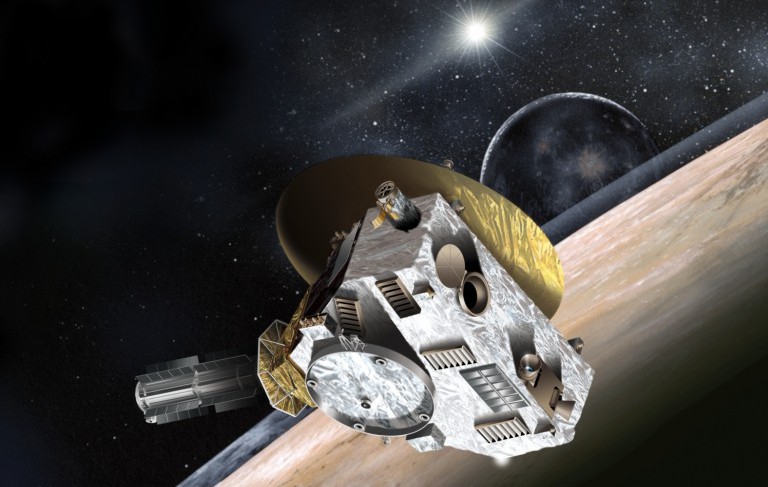
Rosetta_and_Philae_at_cometLast month, the European Space Agency Rosetta’s space probe arrived at the comet known as 67P/Churyumov–Gerasimenko, thus becoming the first spacecraft to ever rendezvous with a comet. As it continues on its way to the Inner Solar System, Rosetta’s sensing instruments have been studying the surface in detail in advance of the attempted landing of it’s Philae probe.

Because of this, Rosetta has been able to render a map of the various areas on the surface of the comet, showing that it is composed of several different regions created by a range of forces acting upon the object. Images of the comet’s surface were captured by OSIRIS, the scientific imaging system aboard the Rosetta spacecraft, and scientists analyzing them have divided the comet into several distinct regions, each characterized by different classes of features.

rosettamap-1All told, areas containing cliffs, trenches, impact craters, rocks, boulders and parallel grooves have been identified and mapped by the probe. Some of the areas that have been mapped appear to be caused by aspects of the activity occurring in and around the nucleus of the comet, such as where particles from below the surface are carried up by escaping gas and vapor and strewn around the surface in the surrounding area.

So detailed are these images that many have been captured at a resolution of one pixel being equal to an area of 194 square centimeters (30 square inches) on the comet surface. Dr. Holger Sierks, OSIRIS’ Principal Investigator from the Max Planck Institute for Solar System Science, puts it into perspective:

Never before have we seen a cometary surface in such detail. It is a historic moment – we have an unprecedented resolution to map a comet… This first map is, of course, only the beginning of our work. At this point, nobody truly understands how the surface variations we are currently witnessing came to be.

Rosetta_and_Philae_at_comet_node_full_imageThe newly-generated comet maps and images captured by the instruments on Rosetta will now provide a range of detail on which to finalize possible landing sites for the Philae probe to be launched to the surface . As such, the Rosetta team will meet in Toulouse, France, on September 13 and 14 to allocate primary and backup landing sites (from a list of sites previously selected) with much greater confidence.

At the same time, Rosetta has revealed quite a bit about the outward appearance of the comet, and it aint pretty! More often than not, comets are described as “dirty snowballs” to describe their peculiar composition of ice and dust. But Rosetta’s Alice instrument, which was installed by NASA, has sent back preliminary scientific data that shows that the comet is more akin to a lump of coal.

Rosetta_Artist_Impression_Far_625x469Alice is one of eleven instruments carried aboard Rosetta and one of three instrument packages supplied by NASA for the unmanned orbiter. Essentially, it’s a miniature UV imaging spectrograph that looks for thermal markers in the far ultraviolet part of the spectrum in order to learn more about the comet’s composition and history. It does this by looking specifically for the markers associated with noble gases, such as helium, neon, argon, and krypton.

The upshot of all this high-tech imaging is the surprising discovery of what 67P/Churyumov-Gerasimenko looks like. According to NASA, the comet is darker than charcoal. And though Alice has detected oxygen and hydrogen in the comet’s coma, the patches of barren ice that NASA scientists had expected aren’t there. Apparently, this is because 67P/Churyumov-Gerasimenko is too far away from the warmth of the sun to turn the ice into water vapor.

rosetta-1Alan Stern, Alice principal investigator at the Southwest Research Institute in Boulder, Colorado, had this to say about the revelation:

We’re a bit surprised at just how unreflective the comet’s surface is and how little evidence of exposed water-ice it shows.

Launched in 2004, Rosetta reached 67P/Churyumov-Gerasimenko by a circuitous route involving three flybys of Earth, one of Mars, and a long detour out beyond Jupiter as it built up enough speed to catch up to the comet. Over the coming months, as the Rosetta spacecraft and comet 67P move further into the solar system and approach the sun, the OSIRIS team and other instruments on the payload will continue to observe the comet’s surface for any changes.

alice-first-findings-3Hence why this mission is of such historic importance. Not only does it involve a spacecraft getting closer to a comet than at time in our history, it also presents a chance to examine what happens to a comet as it approaches our sun. And if indeed it does begin to melt and breakdown, we will get a chance to peer inside, which will be nothing less than a chance to look back in time, to a point when our Solar System was still forming.

Sources: gizmag, (2), jpl.nasa.gov, nasa.gov

The Future of Tanks: Ground X and Scout Specialist Vehicles

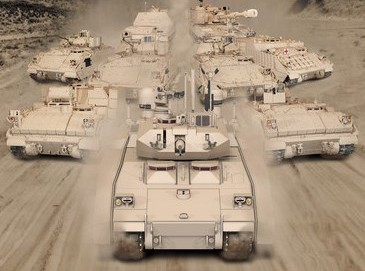
hybrid_IFVfleetAs armies continue to modernize, the challenge of creating new fighting vehicles that withstand the latest in battlefield conditions, and at the same time be more cost-effective, is a constant. And, as the latest announcements made by DARPA and General Dynamics over the course of the summer can attest, its been known to produce some pretty interesting and innovate design concepts.

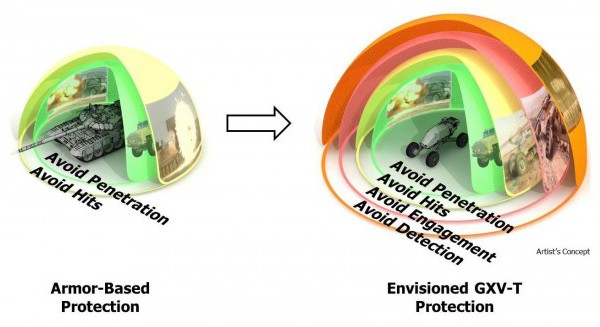
Known as the Ground X-Vehicle Technology (or GXV-T for short) the aim of this DARPA-funded program is to develop a lighter, more agile successors to the tank. Whereas tanks in the past have always responded to the development of more and better anti-tank weapons with heavier more elaborate armor, the focus of the GXV-T will be on protection that does not result in yet another bigger, badder, and way more expensive tank.

MBT_muzzleBeginning in 1917, the development of the tank led to a revolution is modern warfare, which has led to an ongoing arms race ever since. In just the last half-century, the guns used to take out tanks have been joined by rockets, guided missiles, and high-tech rounds designed to penetrate the thickest steel. Tank designers have responded with composite armor, reactive armor, and even electric countermeasures to detonate warheads before they make contact.

The result of this is a spiral of larger weapons, leading to larger tanks, leading to larger weapons until the mainline tanks of today have become behemoths so large that they are difficult to deploy, very expensive and can only be used in certain environments. To prevent this, DARPA wants to not just produce a more advanced tank, but one that moves away from relying so heavily on armor for survival.

gxv-t-6The GXV-T is intended to pursue technologies that move away from armor with the goal of making tanks 50 percent smaller, with crews half their present size, able to move at double the present speed, make them capable of operating over 95 percent of the terrain, and make them harder to detect and engage. As Kevin Massey, DARPA program manager, explained:

GXV-T’s goal is not just to improve or replace one particular vehicle – it’s about breaking the ‘more armor’ paradigm and revolutionizing protection for all armored fighting vehicles. Inspired by how X-plane programs have improved aircraft capabilities over the past 60 years, we plan to pursue groundbreaking fundamental research and development to help make future armored fighting vehicles significantly more mobile, effective, safe and affordable.

What this amounts to is finding ways to build tanks that can move around the battlefield like off-road vehicles, can dodge incoming fire rather than taking it, reposition its armor to its most effective angle, provide the crews with full situational awareness similar to that afforded fighter pilots, and make them stealthy against both infrared and electromagnetic detection.

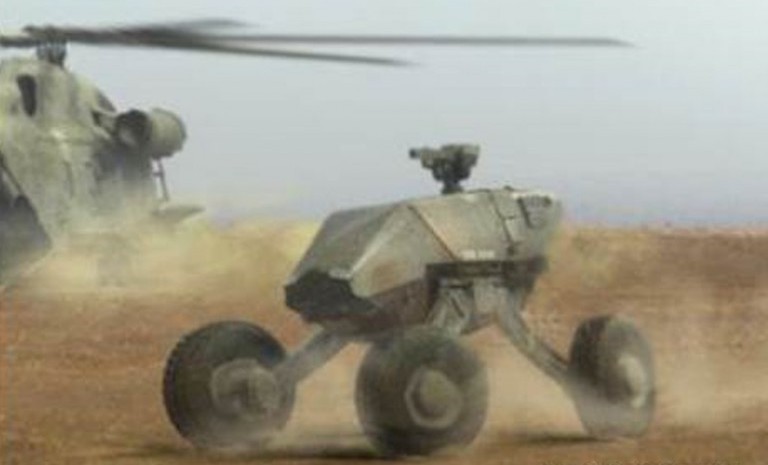
gxv-t-5To achieve this, DARPA is soliciting new concepts and new technologies for designers. As you can see from the concept art above, some ideas have already been floated, but they remain very much in the design stage for now. The agency says that it hopes to see new GVX-T technologies emerge two years after the first contracts – which are slated to be awarded in April next year – with the hopes that the new technologies can be fast-tracked into demonstrators.

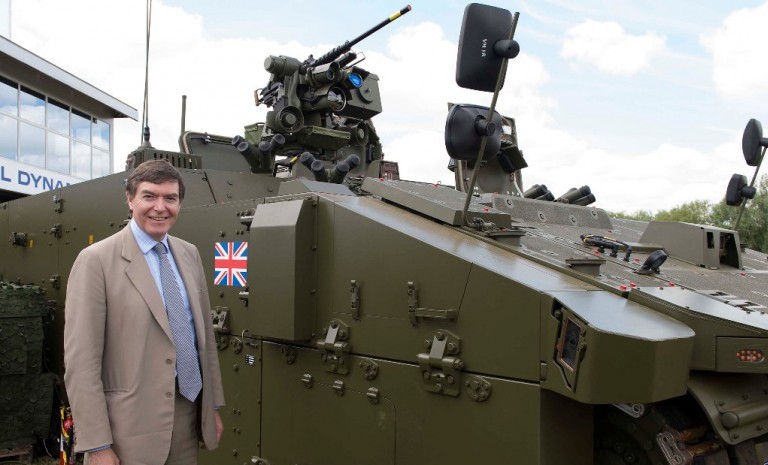
Meanwhile, General Dynamics is busy producing what will amount to the next-generation of armored vehicles. As part of a contract with the British Ministry of Defence (MoD), the company has been contracted to deliver 589 light-armor Scout Specialist Vehicles (SV) to the Army between 2017 and 2024. The tracked, medium-weight armored vehicle is designed to provide state-of-the-art, best-in-class protection for its crews.

gd-british-army-tank-5The Scout SV is intended to fill an important role in the British Army’s Intelligence, Surveillance, Target Acquisition and Reconnaissance (ISTAR) capability. The Scout comes in six variants based on a common platform with shared mobility, electronics, and survivability systems, has an open electronic architecture, a modular armor system, and places emphasis on the ability to upgrade in order to incorporate new technology and meet new threats.

The Scout variants include Reconnaissance, Protected Mobility Reconnaissance Support (PMRS), Command and Control, Engineering Reconnaissance, Repair, and Recovery. According to General Dynamics, these are designed to provide the basics of protection, survivability, reliability, mobility and all-weather ISTAR capabilities for a wide range of extended military operations at a reduced cost.

gd-british-army-tank-3The Scout’s main armament in its turret-mounted 40-mm cannon, but it also comes equipped with acoustic detectors, a laser warning system, a local situational awareness system, an electronic countermeasure system, a route-marking system, and a high-performance power pack. The announced contract also includes the provision of support and training by General Dynamics for the delivered vehicles.

The deal represents the single biggest contract for armored vehicles that the British Army has signed since the 1980s. It also comes on the eve of a NATO Summit, and at a time when Britain is contemplating the future of its forces as it prepares for future operations similar to what it experienced in Afghanistan and Iraq. In these cases, the warfare was unconventional and prolonged, requiring a whole set of strategies.

gd-british-army-tank-0As British Prime Minister David Cameron declared when speaking of the deal:

With the second largest defence budget in NATO, meeting NATO’s two per cent of GDP spending target and investing in new capabilities to deal with the emerging threats we are ensuring Britain’s national security, staying at the forefront of the global race and providing leadership within NATO.

As the saying goes: “necessity is the mother of invention”. Well, there is nothing more necessary in war than making machines that are practical, effective, and not cost the taxpayers an arm and a leg. Between dwindling budgets, improved technology, and the fact that future operations are likely to take place in war-torn and impoverished areas, the race to build a weapon-system that can handle it all is sure to be both interesting and productive!

Sources: gizmag.com, (2)

New Movie Trailer: Mockingjay Part I

https://i0.wp.com/www.celebitchy.com/wp-content/uploads/2014/09/mockingjay0.jpgThe final installment of The Hunger Games trilogy is coming soon. Or, at least the first half of it. And the first trailer has arrived. As you can see from this just-under two minute promo, the revolution that began at the end of Catching Fire is now in full swing. The games are now over, in both the literal and figurative sense, with Katniss and the President openly sparring for the future of Panem.

However, it is also clear that the capitol has Peeta (Josh Hutcherson) in their clutches and is using him to stop the revolution before it spreads. And true to form, Katniss wants to go and rescue him. Man, that guy is truly annoying! He’s like the male version of Bella, another superfluous character who is always in need of rescuing. And worse, the love triangle is becoming disturbingly like that Team Edward/Team Jacob crapfest!

mockingjay-set-photos-16In any case, Julianne Moore is new to this film, playing the role of Alma Coin (leader of the resistance). Liam Hemsworth reprises his role as Gale, Woody Harrelson is back as Haymitch; and of course, Donald Sutherland is back in the austere and hauntingly-voiced role of President Snow. Part I airs this Nov. 21st, and Part 2 won’t be released until sometime in 2015.

Seriously, what’s with these money-grubbing Hollywood producers and YA franchises? First Harry Potter, then Twilight, and now this!

Drone Wars: China’s Rainbow Drone Unveiled

CH-4RainbowAs part of their ongoing efforts to become a world power, China has spared no investment when it comes to the development of Unmanned Aerial Vehicle (UAV) technology. And after several successful missile tests, the People’s Liberation Army (PLA) is all set to receive the next-generation aerial drone. Known as the CH-4, the development of this UAV is just the latest in China’s attempt to catch up to western developers.

Although China’s drone technology may be several years behind top manufacturers in the US and Israel, the country’s UAV manufacturers are hoping that their mid-range prices and middling technology will lure potential customers from developing nations. During the unveiling, which took place at the beinnial Zhuhai Air Show in late August, officials from Kenya, Russia and other countries were on hand to witness this an other examples of China’s exportable UAVs.

CH-4Rainbow2 Representatives from China Aerospace Long-March International, a division of the state-owned China Aerospace Science and Technology Corporation (CASC), were on hand at the presentation and spoke with relative candor about the CH-4 and two other drones the company was showing for the first time. Guo Qian, a director at a division of CASC, when talking about the interest and marketability of the company’s military grade drones, had the following to say:

We’ve been contacting many countries, especially from Africa and Asia. They are quite interested in the intermediate and short-range UAVs because they are portable and low-cost.

Similarly, Li Pingkun , the head of the Rainbow 4 project at the aerospace corporation, told state television the drone could make a long-distance hit on a target with a margin of error of less than 1.5 metres. He said the system was very precise because it used several methods to guide missiles or smart bombs to their target. As he told ChinaNews, the drone is “well-positioned to carry out the subsequent missions.”

CH-4Rainbow1The unveiling of this drone comes at a time when the PLA is actively and publicly promoting the use of drones by its military personnel. During the show, the CASC also displayed a handful of smaller short range drones and set up a flashy ground-to-ceiling UAV attack simulation compete with a dozen technicians glued to computer screens in a the make-believe war room. As Guo explained:

Our company has set up a pretty aggressive sales target for UAVs, but the global market competition is quite fierce. There are many similar products in the global market and they are quite mature, so we haven’t had a big impact in the market. It will take some time for our products to be known and accepted.

The Rainbow 4 is the CASC’s latest creation, and is intended to act as the PLA’s answer to the MQ-9 Reaper – a hunter-killer drone mainly used by the US military for reconnaissance and high-precision air strikes. The CH-4 can carry a payload of 345 kg (760 lbs) of missiles of precision-guided bombs, can reach an altitude of 8 km (26000 feet), has a range of 3,500 kilometers, and fly for up to 30 hours depending on how heavy a payload it is carrying.

China_dronetestHowever, it remains much slower than the Reaper, which can fly at a top speed of 482 km/h compared to the Rainbow’s 235 km/h. In addition, the MQ-9 has a much higher payload of 1700 kg  (3800 lbs), which works out to six Hellfire missiles or precision-guided bombs. And while it has greater range – 3000 km vs. the MQ-9’s 1850 km – the Reaper has a service ceiling of up to 18,000 meters.

The PLA also has limited experience in using drones in combat zones; whereas for the USAF, drone use has become second nature. But above all, the most glaring aspect of the “drone gap” is the fact that this latest Chinese drone was not the result of indigenous design or innovation. Much like other aspects of China’s stealth and weapon’s development, it is the result of mimicry.

(U.S. Air Force photo/Staff Sgt. Brian Ferguson)(Released)Nevertheless, China’s plan to market the technology to other nations does mean that the use of UAVs is likely to become much more universal in the coming years. Beyond the US, NATO, Israel, Russia and China, middle powers like India, Pakistan, Brazil and various Sub-Saharan African nations are likely to have their own soon. In addition, certain “rogue states” – i.e. Iran, North Korea, Syria – are likely to have their own as well.

The term “Drone Wars” is likely to become very literal as a result!

Source: gizmodo.com, scmp.com, globalpost.com

News from Mars: Curiosity Arrives at Mount Sharp

curiosity-mars-self-portrait-crop-640x353After two years exploring the Martian surface, the Curiosity Rover has finally reached its primary science destination – the foot of Mount Sharp, officially known as Aeolis Mons. Now that it’s there, it will begin its ascent of the rock formation, drill into rocks and analyze the different strata in the hopes of learning more about the history of the Red Planet. This is an event a long time in the making, and may prove to yield some of the greatest scientific discoveries ever made.

Located in the heart of the Gale Crater, Mount Sharp is like a layer cake, holding a chronology of past events reaching back billions of years. Because of this, it is an ideal place to find evidence that the Martian surface and atmosphere were once capable of supporting life. It took two years and one month for Curiosity reach the foot of this mountain, which lies some 5500 meters (18,000 feet) above the floor of Gale Crater.

MarsCuriosityTrek_20140911_AThe mountain is the central peak in a crater that measures 154 km/96 miles in diameter and which was formed when a meteor impacted the surface between 3.5 and 3.8 billion years ago. Beyond a certain size, and depending on the gravity of the planet, craters like this all have a central peak. But Mount Sharp represents something much more, otherwise NASA and the Jet Propulsion Laboratory wouldn’t be bothering with it.

Basically, Mars scientists believe that after its creation, the Gale crater was completely filled with sedimentary material from a series of huge floods, or by dust and ice deposits like those that happened at the Martian polar caps. The deposition over 2 billion years left a series sedimentary layers that filled the crater. Following the deposition of the layers, there was a long period of erosion which has finally led to the condition of the crater today.

mountsharp_galecraterThe erosion by some combination of aeolean (wind) forces and water (additional flooding), scooped out the huge crater, re-exposing most of the original depth. However, covering the original central peak are many sedimentary layers of debris. Gale crater’s original central peak actually remains completely hidden and covered by sedimentation. And it is this that attracted scientists with the Curiosity rover to the base of Mount Sharp.

Within the sedimentary layers is a sequential record of the environmental conditions on Mars going back over 2 billion years. While at the base, Curiosity will be able to examine the oldest sedimentary layers; but as it climbs the flanks of the mountain, it will be able to step forward in time. Each layer and its age will reveal information such as how much water was present, whether the water was alkaline or acidic, if there is any organic compounds.

john_klein_curiosity-2The discovery of organic compounds on Mount Sharp could be “Earth shaking”, since the discovery of organics is of very high importance to this mission. Already, over the two year trek, Curiosity has seen numerous signs of the flow of water and sedimentation. Interestingly enough, evidence began to turn up way back in Yellowknife Bay — one of its first destinations, which it visited almost two years ago. But as of yet, signs of organic compounds have remained illusive.

What’s more, Curiosity sadly lacks the necessary equipment to look for evidence of microbial fossils or other signatures of life. Fortunately, the next rover – the Mars 2020 rover – will be equipped with the necessary tools to work out whether Mars ever harbored life. In any case, because of the lack of organic compounds in Yellowknife, NASA decided to continue to Mount Sharp, which is currently the best place to dig up scientific data about Mars’ past.

MSL_TraverseMap_Sol0743-2048Curiosity is currently at the base of Mount Sharp, in a region called the Pahrump Hills, where it will continue on to the Murray Formation. Once there, it will take a drill sample of some rock and then continue up Mount Sharp towards the Hematite Ridge where two drill sites await. This farthest site is about 8 km (5 mi) away from its present position, and Curiosity has driven only 9 km since it landed in 2012. So there’s plenty of trekking and work ahead!

One of the greatest challenges is finding a path that will reduce the stress on Curiosity’s wheels, which have been put through some serious wear and tear in the past two years. Because of this, the rover is being driven in reverse for the time being, and the team is looking the path with the least amount of sharp rocks. However, the Mars Curiosity remains confident that the mobility system will be capable of surviving the ten year life span of the rover’s power supply.

And be sure to check out this “Curiosity Rover Report” that talks about this historic accomplishment, courtesy of NASA’s Jet Propulsion Laboratory:

Sources: universetoday.com, extremetech.com, jpl.nasa.gov, space.com

Firearm Safety: Colorado Student Invents Smart Gun

smartgun1In the course of considering the rash of gun violence and mass shootings that have swept the US in recent years, a great deal of attention has become focused on “smart guns”. Incorporating the latest in biometrics, fingerprinting and wireless connectivity, these weapons are designed to only be usable by their rightful (and presumably, legal) owners. One such concept comes from Colorado – which has a history of gun violence – and from a high school student, no less.

His name is Kai Kloepfer, a 17 year-old a high school student from Boulder who just won the $50,000 Smart Tech for Firearms Challenge for his smart gun prototype. Inspired by the recent school shooting in Connecticut and undeterred by the lack of legislative change in Washington DC, the Smart Tech Foundation believes that ingenuity, technology and the invisible hand of the free market will persevere where the federal government has failed.

smartgun_markAngel investor and gun reform advocate Ron Conway became the main backer of the $1 million Smart Tech prize to spur gun safety solutions earlier this year. As he said to the SF Examiner in January of this year, he hopes people will “use innovation to bring about gun safety. Let’s not rely on Washington”. According to the Smart Tech Foundation, a total of 15 innovators will receive a part of that million dollar prize.

Kloepfer is the first to get the award. His gun design works by creating a user ID and locking in the fingerprint of each user allowed to use the gun. The gun will only unlock with the unique fingerprint of those who have already permission to access the weapon. According to Kloepfer, all user data is kept on the gun and nothing is uploaded anywhere else, so it would be very difficult to hack. This potentially makes it ideal for military use as well.

smartgunKloepfer came up with the idea two years ago when he needed something for his high school science project. The Aurora, Colorado shooting had recently happened just an hour’s drive on his home, and was on everyone’s mind at the time. Kloepfer’s parents helped him in monetary increments to get the parts needed for each improvement. It would eventually cost $3000 for the whole thing to come together, maturing from phase to phase with each science fair.

As he explains the inspiration and development process:

The idea came to me right as I was falling asleep. It was kinda in the back of my mind because of the shooting. I scribbled it down before I went to bed and fell asleep and then in the morning I began my research… At first it was just a concept on paper. Right now it’s a prototype on a plastic model. Its not entirely there but it works.

kai-kloepfer-smart-tech-13Some of the $50,000 has already been used to purchase a 3D printer to create new parts for his prototype. Kloepfer, who will graduate from Fairview High School this year, plans to use the rest of it toward the integration of a fingerprint scanner. Ultimately, he hopes his and other designs like it will make a dent in the problem of gun violence and help to reduce the needless deaths caused by it:

Every 30 minutes in the U.S. a kid dies from a gun. I want my gun to help reduce accidental deaths and injuries, and to prevent tragedies.

His intentions are certainly well-placed. According to the Center for Injury and Research Policy, 1500 kids die from a gun and many more are seriously injured every year. And according to the Smart Tech Challenges Foundations own website, 2 million children live in a home with a firearm that is both loaded and unlocked. So beyond gun violence, gun safety advocates are sure to see the value in developing the technology.

smartgun_lockKloepfer also spoke about his biometric smart gun tech this past week at the TEDx Mile High: CONVERGENCE in Denver, Colorado. Stay tuned, for I plan to post the video of his talk as soon it becomes available! And in the meantime, be sure to check out the Smart Tech Challenge Foundation’s website for more information on the winners of the challenge.

Source: techcrunch.com, sfexaminer.com, smarttechfoundation

Hidden Archaeology of Stonehenge Revealed

Stonehenge,_Condado_de_Wiltshire,_Inglaterra,_2014-08-12,_DD_09Ever since it was first uncovered, Stonehenge has remained a mystery for archaeologists, historians and folklorists alike. First constructed in the Neolithic Era, the purpose and function of these standing stones – set within a dense complex of burial mounds and monuments – are still a matter of speculation and debate. But now, researchers have revealed hundreds of previously unknown features which might shed light on this mysterious site.

As part of the Stonehenge Hidden Landscapes Project, the researchers used a comprehensive array of remote sensing technology and non-invasive geophysical survey equipment to scan deep beneath the ground. These finds include images of dwellings that date from the Iron and Bronze Ages, as well as details of buried Roman settlements that have never before been seen.

Stonehenge_renderIncluded in the findings are many dozens of burial mounds, including a long barrow entombment structure that predate the construction of Stonehenge itself. Revealed in great detail by the team’s geophysical instruments, the structure appears to have been a very large timber building. The researchers believe this may have been a preparation room where the dead were defleshed before burial, a popular practice amongst tribes inhabiting the area at the time.

Later structures that were built around the well-known circular form were also revealed by this new research, with seventeen previously unidentified ritual monuments being discovered and mapped. These types of results show how new applications of geophysical technology can add to the understanding of archaeological sites; in this case, it is shedding light on the hidden landscape of a site that is 11,000 years in the making.

stonehenge-2As British project leader Professor Vincent Gaffney of the University of Birmingham explained:

Despite Stonehenge being the most iconic of all prehistoric monuments and occupying one of the richest archaeological landscapes in the world, much of this landscape in effect remains terra incognita. This project has revealed that the area around Stonehenge is teeming with previously unseen archaeology and that the application of new technology can transform how archaeologists and the wider public understand one of the best-studied landscapes on Earth.

The techniques included magnetic gradiometer systems, ground and airborne laser-scanning, and ground-based radar, all of which were mapped to GPS systems to provide total GIS (Geographic Information System) coverage. The research also revealed that the Durrington Walls “super henge,” located just two miles (3.2 km) north-west of Stonehenge, had once been surrounded by a circle of massive posts or standing stones.

stonehenge-4Believed to have consisted of up to 60 posts or stones some 12 ft (3 m) tall, the geophysical mapping suggests that some of these may still even be intact somewhere under the enormous earthen banks surrounding the monument. Viewable only through the advanced technology used in the project, this discovery and mapping work has already added yet another dimension of knowledge to this vast and mysterious edifice. According to Professor Gaffney:

New monuments have been revealed, as well as new types of monument that have previously never been seen by archaeologists. All of this information has been placed within a single digital map, which will guide how Stonehenge and its landscape are studied in the future.

What’s more, the project uncovered large burial tombs containing more gold and jewelry than graves anywhere else in Britain, indicating that the area was a cemetery for the rich and powerful. Some of the treasures found by archaeologists were made with materials and techniques originating from the European continent. All of the findings are explored in “Stonehenge Uncovered”, the season premiere of CBC’s The Nature of Things that will be airing on Oct. 9.

stonehenge-0British and U.S. versions of the film will air on BBC and the Smithsonian Channel respectively. Terence McKeown, president of Lightship Entertainment and the film’s Canadian executive producer, said that before working on the film, he had the impression that Stonehenge was always an isolated monument in a landscape populated by little more than a “handful of monks.”

The Hidden Landscapes Project – and the new film – reveal a very different picture. As McKeown put it:

What Stonehenge appears to have been was the spiritual centre of a sophisticated culture. The population around Stonehenge clearly included accomplished engineers, surgeons, artisans, and there’s evidence they had close ties to Europe that advanced their skills.

To check out the episode, either bookmark the CBC link here for live streaming, or tune in to The Nature of Things on CBC-TV on Oct. 9th at 8pm (EDT). And be sure to check out the video below, produced by the University of Birmingham, shows the research team and their instruments in action at Stonehenge.


Source:
cbc.ca, gizmag.com

News from Mars: ExoLance Project to Hunt for Life

exolance-2The search for life on Mars has been ongoing, and predates the deployment of the Curiosity rover by many years. However, it is becoming increasingly clear that if signs of life are to be truly found, they won’t turn up by scratching around on the surface. Beyond Curiosity’s own slated inspection of Mount Sharp (where it just arrived!) NASA has some long-range plans that reach deeper.

Outside of NASA’s InSight Lander, which is set to launch in the spring of 2016, there’s Explore Mars’ plan to look for signs of life beneath the surface. A private organization made up technologists and former NASA engineers, their plan is to drop supersonic lances onto the planet that will penetrate deep into the Martian soil to seek out protected, potentially wet strata where life might still exist.

exolanceKnown as ExoLance, the project is designed to take up where the Viking missions of the late 1970s left off. In these first successful Mars landers, there was an experiment on board that looked for signs of life in the Martian soil. This consisted of the Viking lander scooping up soil, depositing it inside the automatic laboratory in the lander, squirted a nutrient solution into the sample, and analyzing the gases given off that might indicate the presence of life.

The Viking experiment did give off gases that seemed like they were due to living organisms, but it later discovered that these were due to chemical reactions due to the extremely dry conditions and constant bombardment of UV radiation. Because of this, NASA has preferred to focus more on geology to gain a better understanding of the Martian environment rather than looking for life directly.

exolance-3But Explore Mars wants to go back to the direct approach by combining an experiment similar to the Viking lab with a delivery system based on the US Air Force’s bunker-buster weapons. They also hope to incorporate technology developed for the Curiosity rover, which includes reusing the aeroshell that protected the Curiosity rover as it made its descent to the Martian surface in 2012.

When the shell reaches Mars, it will open up to reveal a delivery vehicle similar to the Skycrane that delivered Curiosity to the surface by hovering under rocket power while it winched the lander down. In the case of the ExoLance, the vehicle – which is appropriately called a Quiver – will hover in place. But instead of lowering a rover, it will fire multiple penetrator probes at the ground.

exolance-1These perpetrators, called Arrows, are small, lightweight versions of the bunker-buster bombs that were developed by the US forces during the 1991 Gulf War. However, instead of exploding, the Arrows will strike the surface at supersonic speeds to bore deep into the ground and (similar to NASA’s Deep Space 2 probe) split in two to deploy a cache of scientific equipment packed into the nose.

While the tail section remains on the surface to act as a transmitter back to Earth, the nose bores about 5 m (16 ft) into the surface to find protected layers that may contain water, but which are shielded against the deadly surface radiation. Once in position, the Arrow activates its experiment, which is designed to not only detect signs of living organisms, but also to determine if the life signs are those of microbes similar to those found on Earth, or have a completely different origin.

exolance-4The mission is the subject of an Indiegogo crowdfunding campaign aimed at raising US$250,000. The group says that within a year of raising its Indiegogo funding, it would develop and build Arrow prototypes and test them in the Mojave Desert by dropping them from aircraft. The idea is not only to see if the experiments can survive the impact, but also to make sure that the penetrators don’t dig in too deep or too shallow.

In addition, the group expects the design to change as they deals with problems, such as the volume of the cylinder, batteries, deploying the tether linking the two segments, and making sure the components can withstand the impact. In the second year, the group plans to enact Phase II, which would concentrate on developing the microbial experiments. If this is successful, they plan to approach NASA or commercial companies to arrange delivering ExoLance to Mars.

The crowdfunding campaign will run until September 29th, and has raised a total of $15,680 of their projected goal. To check out this campaign, or to contribute, click here. And be sure to check out Explore Mars’ promotional video below:


Source:
gizmag.com, exploremars.org, indiegogo.com

The Future of Medicine: The “Human Body-on-a-Chip”

bodyonachip One of the aims of modern medicine is perfecting the way we tests treatments and drugs, so that the lengthy guess-work and clinical trials can be shortened or even cut out of the equation. While this would not only ensure the speedier delivery of drugs to market, it would also eliminate the need for animal testing, something which has become increasingly common and controversial in recent years.

Over the last century, animal testing has expanded from biomedical research to included things like drug, chemical, and cosmetic testing. One 2008 study conducted by The Guardian estimated that 115 million animals are used a year for scientific research alone. It is therefore no surprise that opposition is growing, and that researchers, regulators and even military developers are looking for more accurate, efficient, and cruelty-free alternatives.

bodyonachip1Enter the National Insitute of Health in Besthesda, Maryland; where researchers have teamed up with the FDA and even DARPA to produce a major alternative. Known as the “Human Body-on-a Chip”, this device is similar to other “Organs-on-a-chip” in that it is basically a small, flexible pieces of plastic with hollow micro-fluidic channels lined with human cells that can mimic human systems far more effectively than simple petri dish cell cultures.

Dan Tagle, the associate director of the NIH’s National Center for Advancing Translational Sciences, explained the benefits of this technology as follows:

If our goal is to create better drugs, in a way that is much more efficient, time and cost-wise, I think it’s almost inevitable that we will have to either minimize or do away with animal testing.

https://i0.wp.com/images.medicaldaily.com/sites/medicaldaily.com/files/styles/large/public/2014/03/18/new-technology-may-obviate-need-animal-testing.jpgWhat’s more, chips like this one could do away with animal testing entirely, which is not only good news for animals and activists, but drug companies themselves. As it stands, pharmaceutical companies have hit a wall in developing new drugs, with roughly 90% failing in human clinical trials based on safety and effectiveness. One reason for this high rate of failure is that drugs that first seem promising in rodents often don’t have the same response in people.

In fact, so-called “animal models” are only typically 30% to 60% predictive of human responses, and there are potentially life-saving drug therapies that never make it to human clinical trials because they’re toxic to mice. In these cases, there’s no way to measure the lost opportunity when animals predict the wrong response. And all told, it takes an average of 14 years and often billions of dollars to actually deliver a new drug to the market.

bodyonachip2According to Geraldine Hamilton, a senior staff scientist at Harvard University’s Wyss Institute for Biologically Inspired Engineering, it all began five years ago with the “lung-on-a-chip”:

We’ve also got the lung, gut, liver and kidney. We’re working on skin. The goal is really to do the whole human body, and then we can fluidically link multiple chips to capture interactions between different organs and eventually recreate a body on a chip.

This has led to further developments in the technology, and Hamilton is now launching a new startup company to bring it to the commercial market. Emulate, the new startup that will license Wyss’s technology, isn’t looking to literally create a human body but rather to represent its “essential functions” and develop a platform that’s easy for all scientists and doctors to use, says Hamilton, who will become Emulate’s president and chief scientific officer.

lung-on-a-chip-5Borrowing microfabrication techniques from the semiconductor industry, each organ-on-a-chip is built with small features – such as channels, vessels, and flexible membranes – designed to recreate the flow and forces that cells experience inside a human body. All that’s needed are different chips with different culture of human cells; then researchers can performed tests to see how drugs work in one region of the body before being metabolized by the liver.

This might one day help the military to test treatments for biological or chemical weapons, a process that is unethical (and illegal) with humans, and cruel and often inaccurate with animals. Hospitals may also be able to use a patient’s own stem cells to develop and test “personalized” treatments for their disease, and drug companies could more quickly screen promising new drugs to see if they are effective and what (if any) side effects they have on the body’s organs.

It’s a process that promises speedier tests, quicker delivery, a more cost-effective medical system, and the elimination of cruel and often inaccurate animal testing. Can you say win-win-win?

Source: fastcoexist.com, ncats.nih.gov, wyss.harvard.edu, theguardian.com