The Future is Here: The Holodeck Video Trainer

VIPE1A current obsession of military planners is keeping up with the latest in battlefield challenges while also dealing with troop reductions and tightened budgets. Video games are one solution, providing soldiers with  training that does not involve real munitions or loss of equipment. Unfortunately, most of these games do not provide a real-world immersive feel, coming as close to the real thing as possible while still being safe.

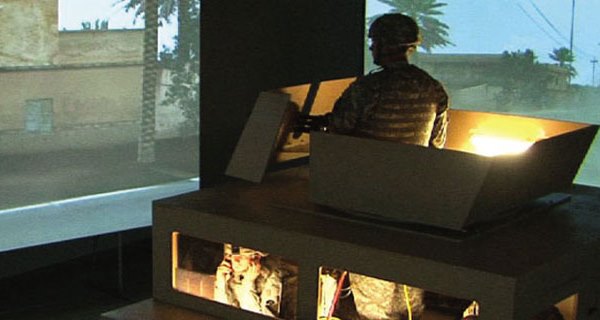
Hence why the the Army Contracting Command enlisted the help of Northrop Grumman this past January to integrate their Virtual Immersive Portable Environment (VIPE) “Holodeck” into the US Army’s training program. Much like the CAVE2, a VR platform created by the Electronic Visualization Laboratory (EVL) at the University of Illinois, this latest holodeck is a step towards fully-realized VR environments.

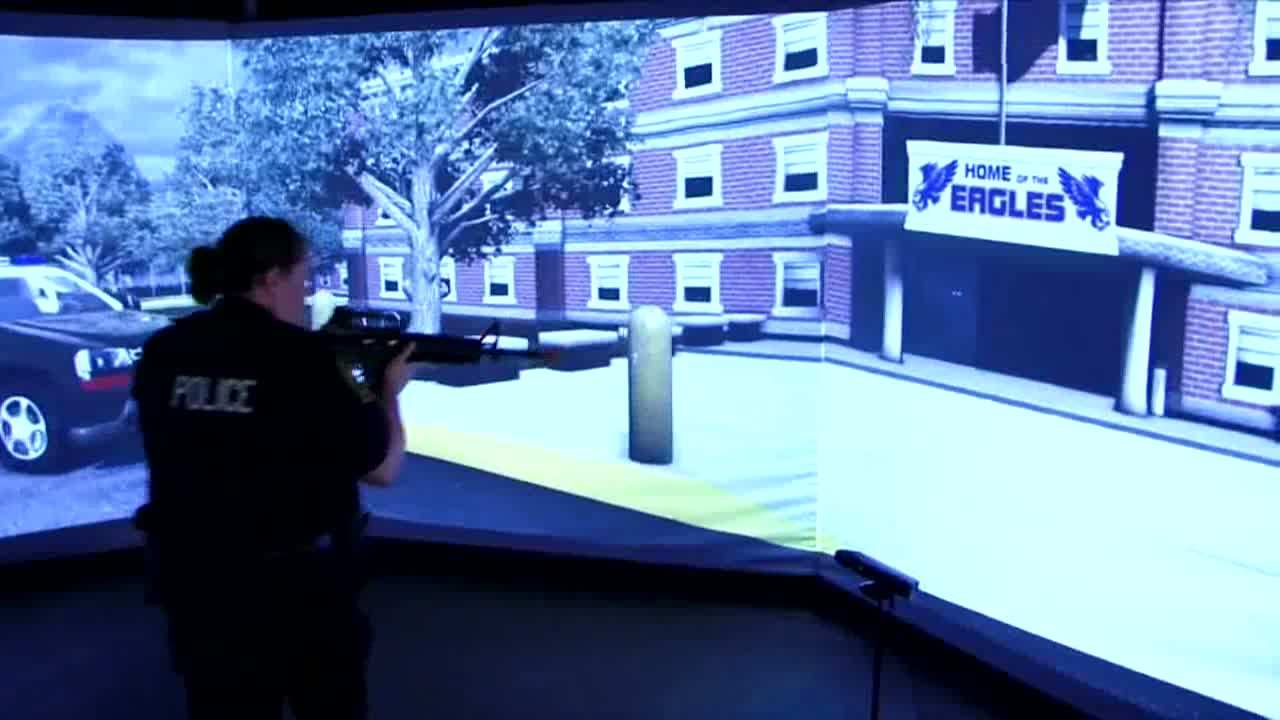
VIPE_HolodeckUsing commercial, off-the-shelf hardware combined with gaming technology, the VIPE Holodeck virtual training system provides users with a 360 degree, high-fidelity immersive environment with a variety of mission-centric applications. It can support live, virtual and constructive simulation and training exercises including team training, cultural and language training and support for ground, air and remote platform training.

Last year, the VIPE Holodeck took first place in the Federal Virtual Challenge – an annual competition led by the U.S. Army Research Laboratory’s Simulation and Training Technology Center – for the system’s Kinect integration navigation sensor, which gives users the ability to crawl, walk, run, stop, jump, and move side to side in the virtual environment.

?????????????????????????????????According to Northrop, the VIPE Holodeck moves ahead of other virtual simulators thanks to its advanced situational training, where service members can walk through an area in the replicated virtual environment and prepare for what they may encounter in real life. This works not only for infantry and target practice, but for vehicle drivers and police officers looking to simulate various situations they are likely to encounter.

To enhance that training, operators can drop threats into the environment, including IEDs and enemy shooters, as well as signals that should tip them off to potential threats and see how they respond before they actually find themselves in that situation. This sort of versatile, multi-situational complexity is precisely what the Army is looking for.

VIPE3Brig. Gen. Michael Lundy, deputy commanding general at the Army Combined Arms Center, said during the AUSA Aviation symposium earlier this month:

For us to be able to execute realistic training — good training — we have to be able to bring that operational environment [into the virtual world]. We want to get away from having multiple environments, virtual gaming and instruction, and go to one synthetic environment, get to a lower overhead and integrate the full operations process … according to the common operating picture.

But looking ahead, the applications for this type of technology are virtually (no pun!) limitless, never mind the fact that we are realizing something directly out of Star Trek. Northrop says it’s also exploring options for VIPE as a stepping stone to live-training within the medical field, as well as law enforcement and first responders for situations such as live-shooter or hostage scenarios.

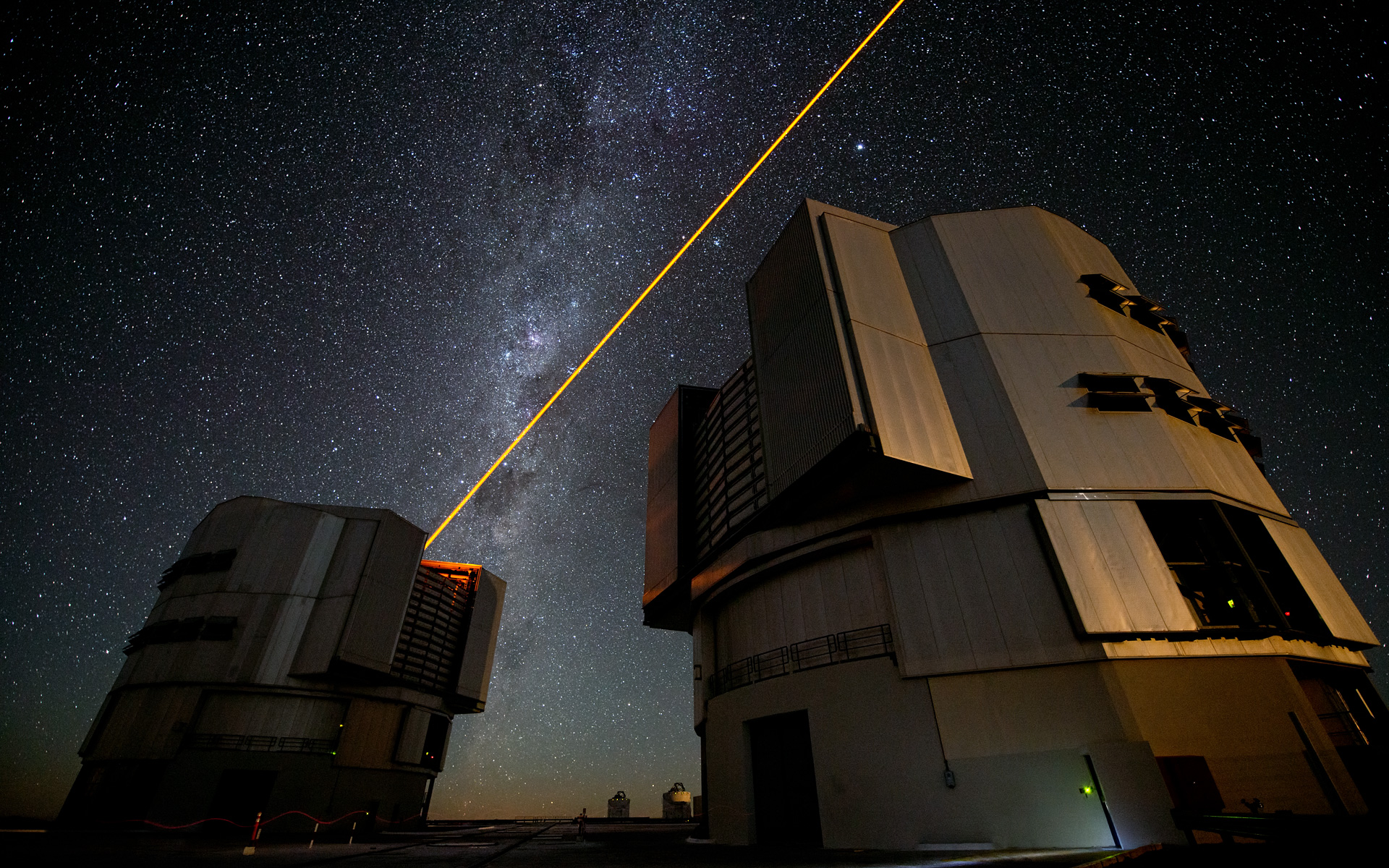
ESO2Immersive virtual reality also figures quite prominently in NASA’s and other space agencies plans for future exploration. Given that manned missions are expensive, time-consuming, and potentially dangerous, mission planners are investigating Telexploration as a possible alternative. Here, orbiters and rovers would transmit visual information in real-time, while VR decks would be used to give the appearance of being on location.

As Ryan Frost, Northrop’s program manager for the VIPE Holodeck, put it:

The great thing about virtual reality and gaming technology [is that] it’s moving so rapidly that really it has endless possibilities that we can do. If you can think it, we can create it, eventually.

And be sure to check out this video from Northrop Grumman showing the VIPE Holodeck in action:


Sources:
wired.com, northropgrumman.com

The Future of Transit: The Solar-Powered Jetliner

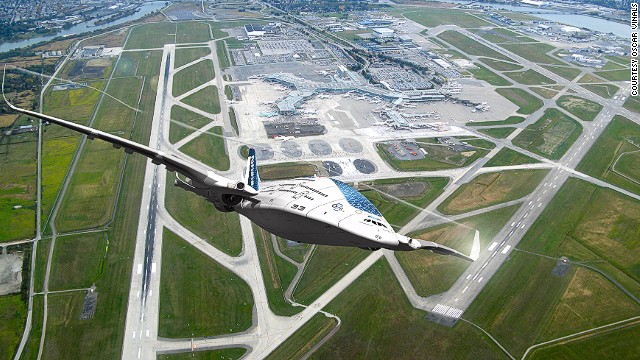
skywhale1Solar-powered airplanes have already proven feasible, but only in the sense of single-seat, turboprop powered plane.s When it comes to a long-range, commercial jet aircraft, the field remains pretty sparse so far. But thanks to a Spanish designer, and some unconventional thinking, “whale planes” that are eco-friendly and combine the convenience of air travel with the luxury of a cruise ship might soon be a reality.

Oscar Viñals, from Barcelona, envisioned the “AWWA Sky Whale” concept plane as a mixture of today’s current designs and future concepts that don’t yet exist. The end result is like an Airbus A380, but with considerable expansion and designed to be powered by micro solar panels and four large hybrid electric engines that would rotate to ease takeoff and landing.

skywhale_specsIn addition to reducing noise and pollutants, it would also significantly reduce fuel burned during what is currently one of the least green modes of getting to a destination. Despite the introduction of more fuel-efficient and less polluting turbofan and turboprop engines, the rapid growth of air travel in recent years has contributed to increasing CO2 emissions in the upper atmosphere.

In fact, in the European Union alone, greenhouse gas emissions from aviation increased by a total of 87% between 1990 and 2006. In 2005, global aviation contributed roughly 5% to the overall “radiative forcing” effect that our annual emissions of CO2 have on Global Warning, but the added effects of water vapor and the disruption to cirrus cloud formations also enhances this role to a varying degree.

skywhale4One of the reasons aviation’s role in Climate Change is overlooked is because the focus tends to be on urban infrastructure and automobiles, which account for the vast majority of carbon emissions. But given the current trend of increasing travel, international economic development, and growth in tourist industries, aviation is likely to get a bigger slice of that pie down the road and clearer methods need to be devised.

Hence the concept for the Sky Whale, which Viñals imagines would come with other futuristic components . These include a self-healing skin with adaptable opacity, active wings that change shape as needed, and ceramic and fiber composite materials. He even has a plan for the plane to break apart on an emergency landing, with the wings separating from the fuselage to limit damage to the passenger compartment.

skywhale3The three-story aircraft, which could accomodate 755 passengers, would have a wingspan and height greater than any of today’s biggest carriers – 88 meters in comparison to the 80 meters on an Airbus A380-900 – making it the largest commercial aircraft in existence. However, the combination of active wings (which would also reduce drag) and the hybrid-electric systems would render it the most fuel efficient.

Another thing that Viñals imagines would make it into the design is virtual reality windows – aka. display glass that allows people to go online, watch movies, and experience in-flight entertainment simply by looking outside. Can’t imagine why this would be necessary, as the range of personal devices people are likely to have by this time ought to be entertainment enough. And failing that, the view should be enough to inspire!

skywhale5Naturally, much of this technology – particularly the healing smartskin – is still many years away. But judging by the reaction to his designs, there is definitely some hunger for innovation in how we fly. Given the range of ideas for mass transit (like the Hyperloop, podcars, etc.) and personal transit (robot cars, robotaxis), it’s only a matter of time before the way we fly becomes smarter, sleeker, and cleaner.

Sources: fastcoexist.com, cnn.com, gov.uk, europa.eu

Biomedical Breakthroughs: Bionerves and Restored Sensation

restoring_mobilityThese days, advances in prosthetic devices, bionic limbs and exoskeletons continue to advance and amaze. Not only are doctors and medical researchers able to restore mobility and sensation to patients suffering from missing limbs, they are now crossing a threshold where they are able to restore these abilities and faculties to patients suffering from partial or total paralysis.

This should come as no surprise, seeing as how the latest biomedical advances – which involve controlling robotic limbs with brain-computer interfacing – offer a very obvious solution for paralyzed individuals. In their case, no robotic limbs or bionic attachments are necessary to restore ambulatory motion since these were not lost. Instead, what is needed is to restore motor control to compensate for the severed nerves.

braingate1Thanks to researchers working at Case Western University in Ohio, a way forward is being proposed. Here, a biomedical team is gearing up to combine the Braingate cortical chip, developed at Brown University, with their own Functional Electric Stimulation (FES) platform. Through this combination, they hope to remove robots from the equation entirely and go right to the source.

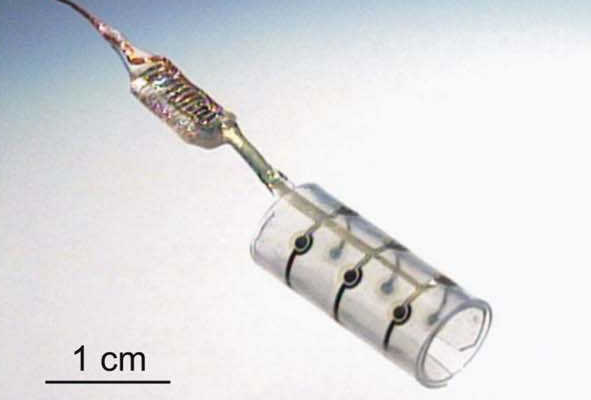
It has long been known that electrical stimulation can directly control muscles, but attempts to do this in the past artificially has often been inaccurate (and therefore painful and potentially damaging) to the patient. Stimulating the nerves directly using precisely positioned arrays is a much better approach, something that another team at Case Western recently demonstrated thought their “nerve cuff electrode”.

cuff-electrodeThis electrode is a direct stimulation device that is small enough to be placed around small segments of nerve. The Western team used the cuff to provide an interface for sending data from sensors in the hand back to the brain using sensory nerves in the arm. With FES, the same kind of cuff electrode can also be used to stimulate nerves going the other direction, in other words, to the muscles.

The difficulty in such a scheme, is that even if the motor nerves can be physically separated from the sensory nerves and traced to specific muscles, the exact stimulation sequences needed to make a proper movement are hard to find. To achieve this, another group at Case Western has developed a detailed simulation of how different muscles work together to control the arm and hand.

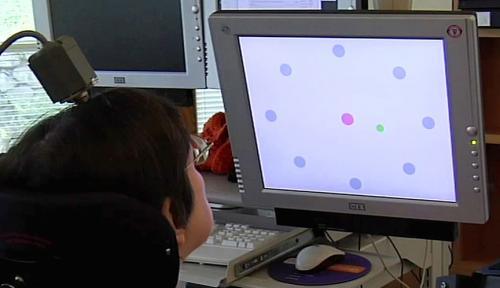
braingate2-img_assist_custom-500x288Their model consists of 138 muscle elements distributed over 29 muscles, which act on 11 joints. The operational procedure is for the patient to watch the image of the virtual arm while they naturally generate neural commands that the BrainGate chip picks up to move the arm. In practice, this means trying to make the virtual arm touch a red spot to make it turn green.

Currently in clinical trials, the Braingate2 chip is being developed with the hope of not only stimulating muscles, but generating the same kinds of feedback and interaction that real muscle movement creates. The eventual plan is that the patient and the control algorithm will learn together in tandem so that a training screen will not be needed at all and a patient will be able to move on their own without calibrating the device.

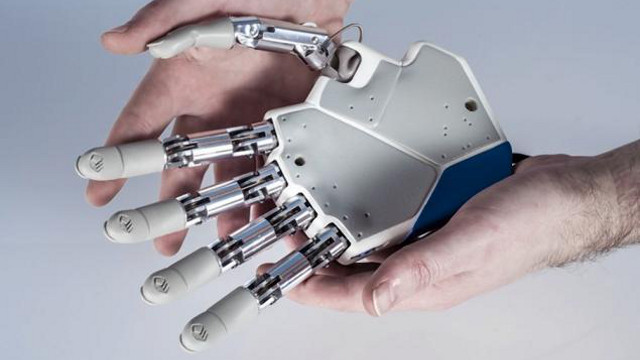
bionic-handBut at the same time, biotech enhancements that are restoring sensation to amputee victims are also improving apace. Consider the bionic hand developed by Silvestro Micerna of the École Polytechnique Fédérale de Lausanne in Switzerland. Unlike previous bionic hands, which rely on electrodes to receive nerve signals to control the hand’s movement, his device sends electronic signals back to simulate the feeling of touch.

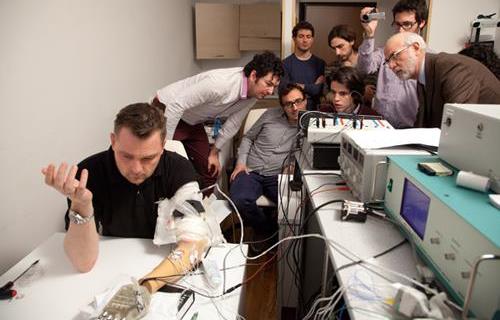
Back in February of 2013, Micerna and his research team began testing their bionic hand, and began clinical trials on a volunteer just last month. Their volunteer, a man named Dennis Aabo Sørensen from Denmark, lost his arm in a car accident nine years ago, and has since become the first amputee to experience artificially-induced sensation in real-time.

prosthetic_originalIn a laboratory setting wearing a blindfold and earplugs, Sørensen was able to detect how strongly he was grasping, as well as the shape and consistency of different objects he picked up with his prosthetic. Afterwards, Sørensen described the experience to reporters, saying:

The sensory feedback was incredible. I could feel things that I hadn’t been able to feel in over nine years. When I held an object, I could feel if it was soft or hard, round or square.

The next step will involve miniaturizing the sensory feedback electronics for a portable prosthetic, as well as fine-tuning the sensory technology for better touch resolution and increased awareness about the movement of fingers. They will also need to assess how long the electrodes can remain implanted and functional in the patient’s nervous system, though Micerna’s team is confident that they would last for many years.

bionic-hand-trialMicerna and his team were also quick to point out that Sørensen’s psychological strength was a major asset in the clinical trial. Not only has he been forced to adapt to the loss of his arm nine years ago, he was also extremely willing to face the challenge of having experienced touch again, but for only a short period of time. But as he himself put it:

I was more than happy to volunteer for the clinical trial, not only for myself, but to help other amputees as well… There are two ways you can view this. You can sit in the corner and feel sorry for yourself. Or, you can get up and feel grateful for what you have.

The study was published in the February 5, 2014 edition of Science Translational Medicine, and represents a collaboration called Lifehand 2 between several European universities and hospitals. And although a commercially-available sensory-enhanced prosthetic may still be years away, the study provides the first step towards a fully-realizable bionic hand.

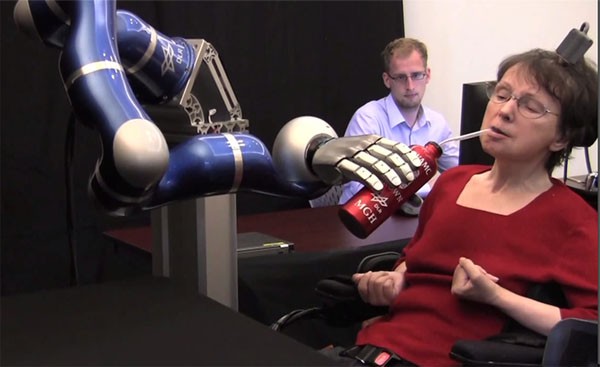
braingate_drinkassistYes, between implantable electronics that can read out brainwaves and nerve impulses, computers programs that are capable of making sense of it all, and robotic limbs that are integrated to these machines and our bodies, the future is looking very interesting indeed. In addition to restoring ambulatory motion and sensation, we could be looking at an age where there is no such thing as “permanent injury”.

And in the meantime, be sure to check out this video of Sørensen’s clinical trial with the EPFL’s bionic hand:


Sources:
extremetech.com, actu.epfl.ch, neurotechnology.com

Papa Zulu – Impending Release!

shutterstock_103Well, the day seems to finally be upon me. After six months of rereading, rewriting, and editing, Papa Zulu is set to be released in about a week’s time. While I was hoping to get it out in time for Valentine’s Day, a bit of deliberate irony on my part, I am pretty sure at this point that I will need a few extra days to make sure everything’s in order.

Wanting to avoid the same mistakes I made last time with early publication, I have opted for the slow road and I hope to maintain that until I’m sure the book is as polished as it can be. Needless to say, I am pretty happy with the end result and it has tested pretty well with those who’ve read it thus far. I’ve also taken the liberty of preparing advance copies for people who have agreed to give it an early review.

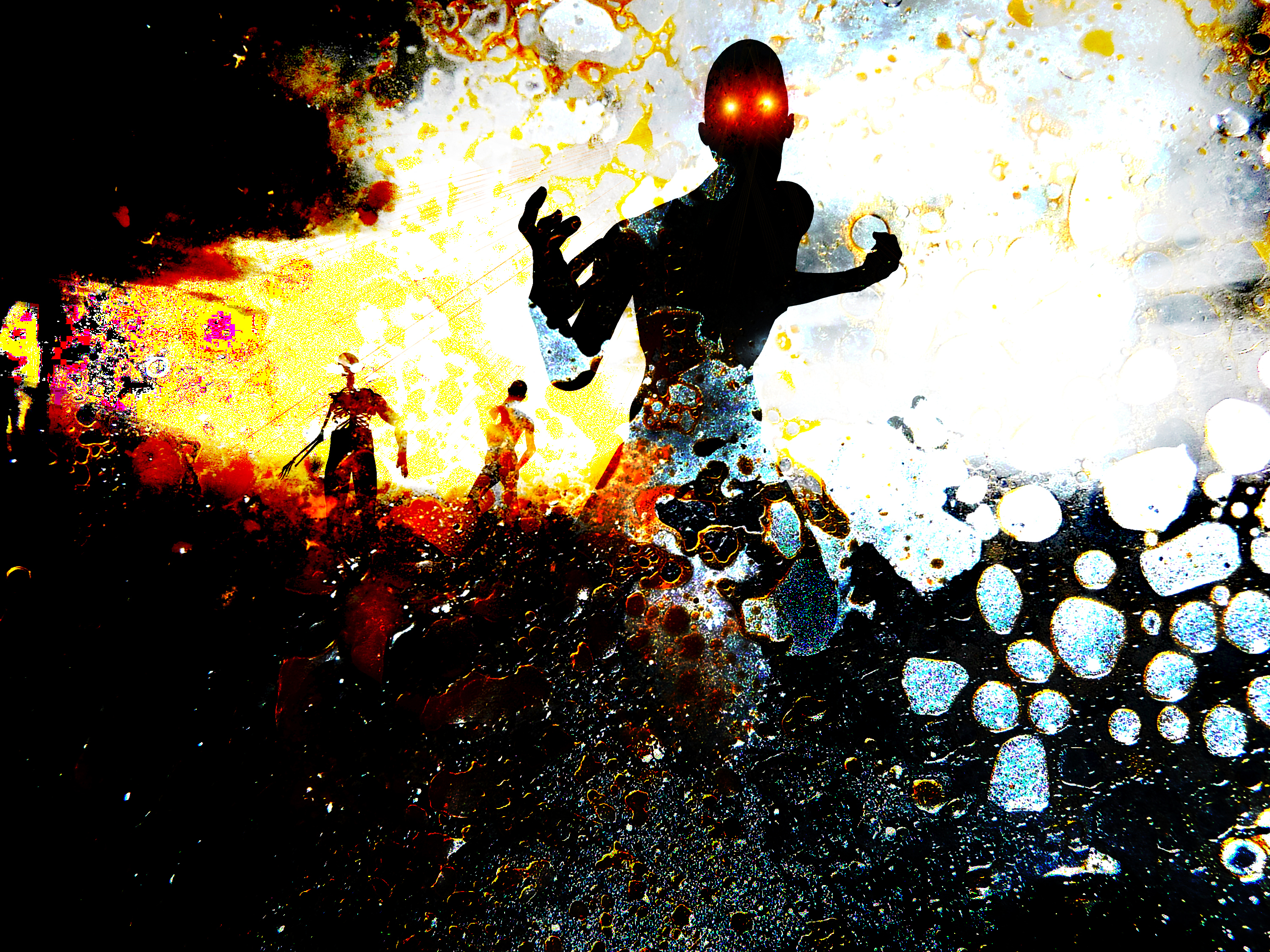
papa_zuluNeedless to say, the book picks up where the last left off, bringing new enemies into the fray and revealing new details about this post-apocalyptic world. Consistent with the Three Act Play scenario, the second book is where things go dark, the heroes are put in a harm’s way, and people die! If you want details, you’re going to have to red it…

So as you can imagine, I’m pretty excited! By this time next week, the long wait will be over and the sequel to Whiskey Delta will be published! And maybe then I will be able to get to penning the third installment without thinking I’m getting ahead of myself. In the meantime, I thought I’d share the cover art (above) and the promo trailer (below) one last time:

The Walking Dead – Season 4, Episode 9

The-Walking-Dead-season-4-wallpapers-7The Walking Dead has returned! After last year’s mid-season cliffhanger, the return of this show was one of the most anticipated events this television season. And in fact, yesterday’s premiere even beat out the Olympics in terms of ratings. Kind of a downer, really. But people love their zombies and were waiting for months for their WD fix. And we see the Winter Games every what, four years?

In any case, the midseason premiere opened much as expected. With the prison overrun and the survivors scattered to the four winds, the focus on the most important group in the diaspora – Rick and Carl. Along with the other members of the group, their struggle to carry on mirrors the groups, and humanity’s itself, in this post-post-apocalyptic world.

After:
WD4_after1
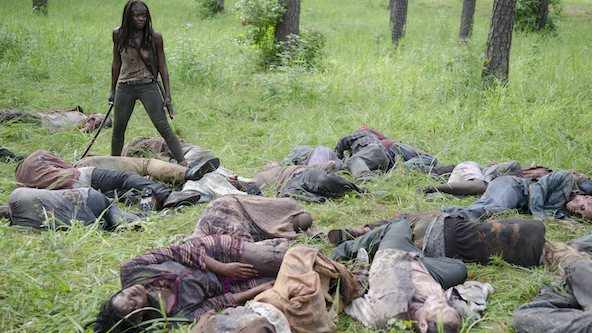
The episode opens with Michonne looking upon a ruined and overrun prison. After killing Hershel’s now resurrected corpse, she lures two Walkers into a trap, removes their arms and jaws, and binds their necks. With them as her protection, she sets off again on the road. Farther on, Rick and Carl are struggling along, looking for food and shelter for the night, with Rick lagging behind because of his wounds.

They find their way to a diner and procure some rations, and Carl seems visibly angry with Rick. Farther on, they find an empty house and set down for the night, and by morning, Carl wakes up and finds Rick comatose on the couch. After trying unsuccessfully to rouse him, he begins to voice all his anger, blaming Rick for their situation, the death of the Judith, and the loss of their friends.

WD4_after2His yelling draws two Walkers to their door which try to break in. Sneaking out back, Carl lures these two away quietly, but is then set upon by a third. He is forced to fire his gun multiple times, but survives. He then tells Rick he doesn’t need him anymore, goes out again in search of food, and once more runs afoul of a Walker, wastes the last of his ammo, and is forced to trap it in a bedroom and escape.

Elsewhere, Michonne sets down for the night and dreams of her life before the Walkers came. She recalls a time when she, her boyfriend, their mutual friend and her son were all together, but the dream quickly turns into a nightmare. We see here that these two men were her Walker escorts before, that she was forced to mutilate their bodies and use them for cover.

WD4_after3Continuing on, she begins to pick up many Walker followers, and begins to notice that one even resembles her. She eventually draws her sword and kills this woman, and then is forced to kill the rest as they close in on her. Eventually, she does, and even takes out her escort. Alone again, she breaks down and cries, but eventually manages to pick up Rick and Carl’s trail…

Back at their house, Carl is awakened by Rick making strange sounds and reaching out at him. He grabs his father’s gun, thinking Rick died in his sleep and has now turned. Carl is unable to pull the trigger and cries, telling Rick that he was wrong. But Rick then calls out his name and tells him to “go outside… stay safe.” Carl holds Rick and tells him he’s scared.

wd4_after4Finding her way to the diner where Rick and Carl passed before, Michonne rests and begins speaking to her departed boyfriend. She says she’s figured out the answer, by which she means why they should carry on amidst everything around them. Back at the house, Rick and Carl talk and resolve things. Carl apologizes for risking his life while Rick admits that things will never be the same again.

At last, Michonne comes to the house and sees Rick and Carl inside, and begins to cry. She knocks at the door, Rick looks through the peephole and begins to laugh. When Carl asks, Rick replies “It’s for you”.

Summary:
Admittedly, this episode was pretty slow by the show’s own standards, placing it firmly in the category of pacing episode. But this is to be expected after the midseason climax, and it managed to still be effective. And it was quite cool to see Michonne do her thing, and accurately. Last season, her role was played down to a large extent that it was good to see out and about, and kicking ass!

This episode also gave them a chance to develop her character and get into some of things that has been glossed over previously. For example, we only hear about how she talks to her boyfriend once, which was something central to her character when she entered the story. Alone for so long, she comforted herself and found strength by imaging him there, talking to her and sharing in her trials.

walking-dead-season-4-whos-still-aliveAlso, the interplay between Rick and Carl in this episode was pretty faithful to the comic book. After being caught in the wilderness together, Carl found himself having to take charge and at one point thought Rick had turned. But there, Rick was struggling with the death of Judith and Lori, and dealt with it by talking to her on a broken phone (which instead was moved up to season three).

At this point, I’d say the rest of the season has a pretty predictable arc. The rest of the crew will find their way through the wilderness, they will eventually meet up with Rick, Michonne and Carl, I anticipate Morgan will join them too, and they will find their way back to (*SPOILERS!) where they will meet (*SPOILERS!) and then head off to find (*BIG SPOILERS!)

But that still leaves plenty of room for surprises between now and then, and I will be watching!

The Future of Energy: Cold Fusion for US and China

NASA_coldfusionThe science behind cold fusion has been a source of constant controversy for decades. Not only has this pursuit turned up its share of phony claims, the fact that it also promises to yield clean, abundant energy on the cheap has led to no shortage of romantic endorsements and vocal detractors. But if it could be made to work, there is no doubt that our energy problems would be solved, and in a way that is not harmful to our environment.

Last February, NASA made waves by announcing that they were working towards cold fusion through low-energy nuclear reaction (LENR) technology. Then in September, the National Ignition Facility (NIF) in California announced a major milestone when they managed to produce a controlled reaction that provided more energy that was required to start it.

e-cat1But all of that seemed to pale in comparison to the announcement by Andrea Rossi’s that he managed to create a fusion power plant that was reportedly capable of generated a single megawatt of power. Known as the E-Cat 1MW Plant (short for Energy-Catalyser), Rossi announced its creation back in November, and indicated that he and his company were taking pre-orders and that they would start deliveries by 2014.

Today, the big news is that a large US investment company has acquired the rights to the cold fusion LENR technology. That investment company is Cherokee Investment Partners, and they appear to be interested in deploying the cold fusion tech commercially in both China and the US to meet both countries existing and projected energy needs.

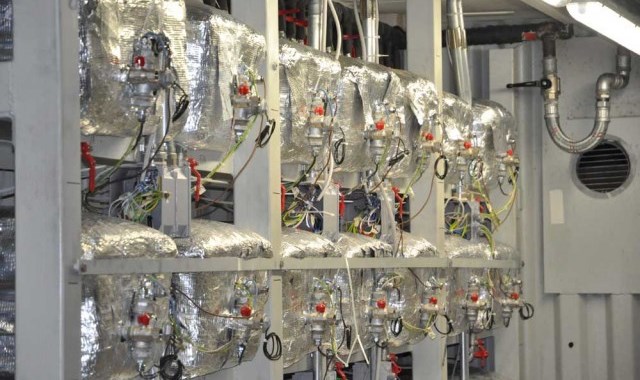
fusion_energyRelying on the same process as other LENR technology, the E-Cat generates cold fusion by taking nickel and hydrogen and fusing them into copper – a process that has 10,000 times the energy density of gasoline, and 1,000 times the power density. Rossi says he’s found a special catalyst that makes the process work, but many scientists remain unconvinced.

Regardless of whether or it not it can deliver, it now seems that Rossi’s previously allusions to an American partner are true after all. Much like everything surrounding Rossi, he chose to be nebulous about the identity of the company that was supporting him. However, with this latest deal, Cherokee and its CEO Thomas Darden, a man who has a history of investing in clean energy, is a believer in the design.

e-cat3In addition to preparing the patents through a Limited Liability Company – known as Industrial Heat – there are also reports that Darden recently visited China to showcase the E-Cat to Chinese officials and businesspeople. China is reportedly looking at using the E-Cat to significantly reduce its carbon footprint and meet its the energy needs of its growing cities in a way that won’t generate more air pollution.

Needless to say, this deal has bolstered Rossi’s and the E-Cat’s credibility, but the technology remains unproven. Rossi says that he has a team of international scientists that are planning to do another round of tests on the E-Cat which are slated to end in March, with a peer-reviewed report to follow sometime after that. Fingers crossed, those rounds of test will provide conclusive proof.

Then, we can all get to work dreaming about a bright, clean future, and the thousands of applications such plants will have!

Source: extremetech.com
Climate Crisis: Where are the Bees Going?

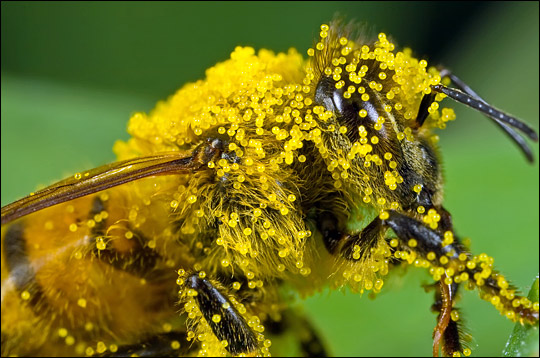
bee_pollen_macroOne of the greatest threats to our planetary ecosystem is the threat of bees going extinct, a phenomenon that is often filed under the heading of Colony Collapse Disorder (CCD). Because of their role in pollination, bees are an integral part of the environment, and their disappearance would mean the sudden collapse of all life on the planet in just a few years time.

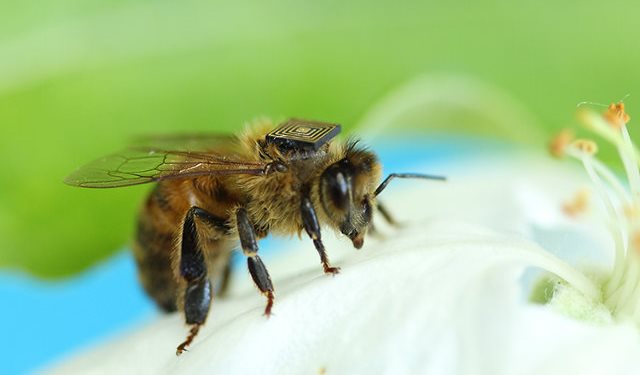
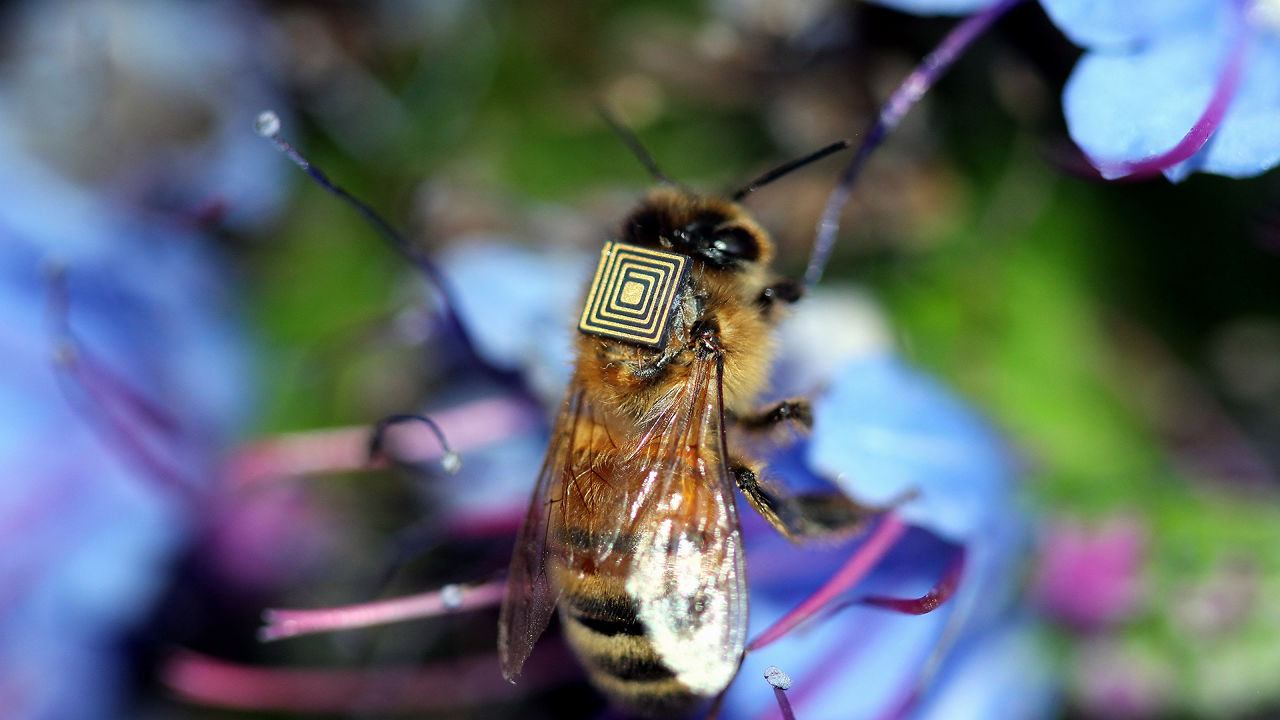
Because of this, environmentalists and entomologists are looking for ways to address the disappearance of bees. One solution, as put forward by a team of Australian scientists working in Tasmania, is to outfit bees with tiny microchip trackers to monitor their movements. By turning them into an army of mobile data-collectors, the team hopes to determine why the local bees are abandoning their hives.

bee_chipsFor the past five months, this team has been capturing hundreds of bees, refrigerating them, shaving them, and gluing tiny sensors – which weigh about 1/4000th of a paperclip – to their backs. So far, the team has captured, tagged and released hundred bees, but the team plans to engineer a total of 5000 with these chips for the sake of their research.

Dr. Paulo de Souza, the lead scientist on the project, explained the capture and tagging process as follows:

The bees are very sensitive to temperature. We take the bees to the lab in a cage, we put them in a fridge with temps around 5 degrees Celsius, and in five minutes, all the bees fall asleep, because their metabolism goes down. We rub a bit of glue on them, and then attach the sensor. We carry them back, and in five minutes the bees wake up again.

colony_collapse_disorderBy monitoring their behavior, the scientists are trying to prevent Colony Collapse Disorder, the mysterious phenomenon in which worker bees suddenly abandon their hives. As it stands, no one is entirely sure what causes CCD, but  biological diversity, diet, management of the hives, radiation, and pesticide use are all possible influences on the bees’ behavior.

Colony Collapse Disorder remains a mystery that not only effects bees, but entire industries. If bees don’t pollinate fruit crops well enough, production decreases, prices rise, and local ecosystems can collapse. Tasmania, who’s huge agricultural tracts accounts for 65% of all Australian crop exports, could be devastated. Hence why de Souza and his colleagues are using it as a testing ground for their research.

bee_chips1In addition to monitoring the bees movements and checking in with them via RFID readers installed near hives and feeding stations, they’ve also created an experiment which exposes some bees to environmental contaminants (like pesticides) where other hives remain pesticide-free. By examining the effect on bees’ movements, they’ll be able to determine which factors cause bee disorientation and abnormal behavior.

As DeSouza explains it, the tagging and tracking process works a lot like a swipe card:

When you go to your office, you swipe a card to gain access. We assign different numbers to the devices on the bees, so we have 5,000 of these micro-sensors with one specific number. We follow not only the swarm, but each of the individuals to see what they’re doing.

colony_collapse_disorder1The scientists will also be able to examine bee data through several generations within the hive. When the contaminated pollen turns to nectar, other bees within the hive feed on it, and pass contamination on to their offspring. To de Souza’s knowledge, this is the first time scientists have attempted to measure hive contamination on this scale.

Right now, their main goal is to understand CCD before it reaches Australia’s shores and effects its agricultural operations. But the research is expected to have far-reaching implications, helping to address a major ecological concern that effects the entire world. And in the long run, de Souza and his team are looking to refine the process and take it even further.

HoneyBeesOnYellowFlowersThis includes adding more features to the chips and applying them to other species of crucial and threatened insects. Key to this, says de Souza, is miniaturization:

As the chips go down in size, we’ll also be able to use this in other insects. Fruit flies, for example, are another insect incredibly important for biosecurity in Australia.

An interesting concept, isn’t it? Big data meets entomology meets ecology, and all for the sake of preserving a crucial part of the food industry and an integral part of our environment. Because ultimately, its not just about preventing colonies from collapsing, but the Earth’s ecosystems as well.

Source: fastcoexist.com
News From Mars: New Impact Crater and Landslides
Mars_impact_craterThe Mars Reconnaissance Orbiter, which has been in operation around Mars since March of 2006, has provided ongoing observation of the planet. Because of this, scientists and astronomers have been able to keep track of changes on the surface ever since. This new impact crater, which was formed by a recent meteor impact, is just the latest example.

The image was taken by the Orbiter’s High Resolution Imaging Science Experiment (HiRISE) camera on Nov. 19, 2013. Since that time, NASA scientists have been working to enhance the image and rendering it in false color so the fresh crater appears.The resulting image shows the stunning 30-meter-wide crater with a rayed blast zone and far-flung secondary material surrounding.

Mars_Reconnaissance_OrbiterResearchers used HiRISE to examine this site because the orbiter’s Context Camera had revealed a change in appearance here between observations in July 2010 and May 2012, when the impact was thought to have occurred. After examining the impact site, scientists estimate the impact and resulting explosion threw debris as far as 15 kilometers in distance.

Before-and-after imaging that brackets appearance dates of fresh craters on Mars has indicated that impacts producing craters at least 12.8 feet (3.9 meters) in diameter occur at a rate exceeding 200 per year globally. But most of those are much smaller than this new one, and leave scars are as dramatic in appearance. This latest impact was definitely one for the history books.

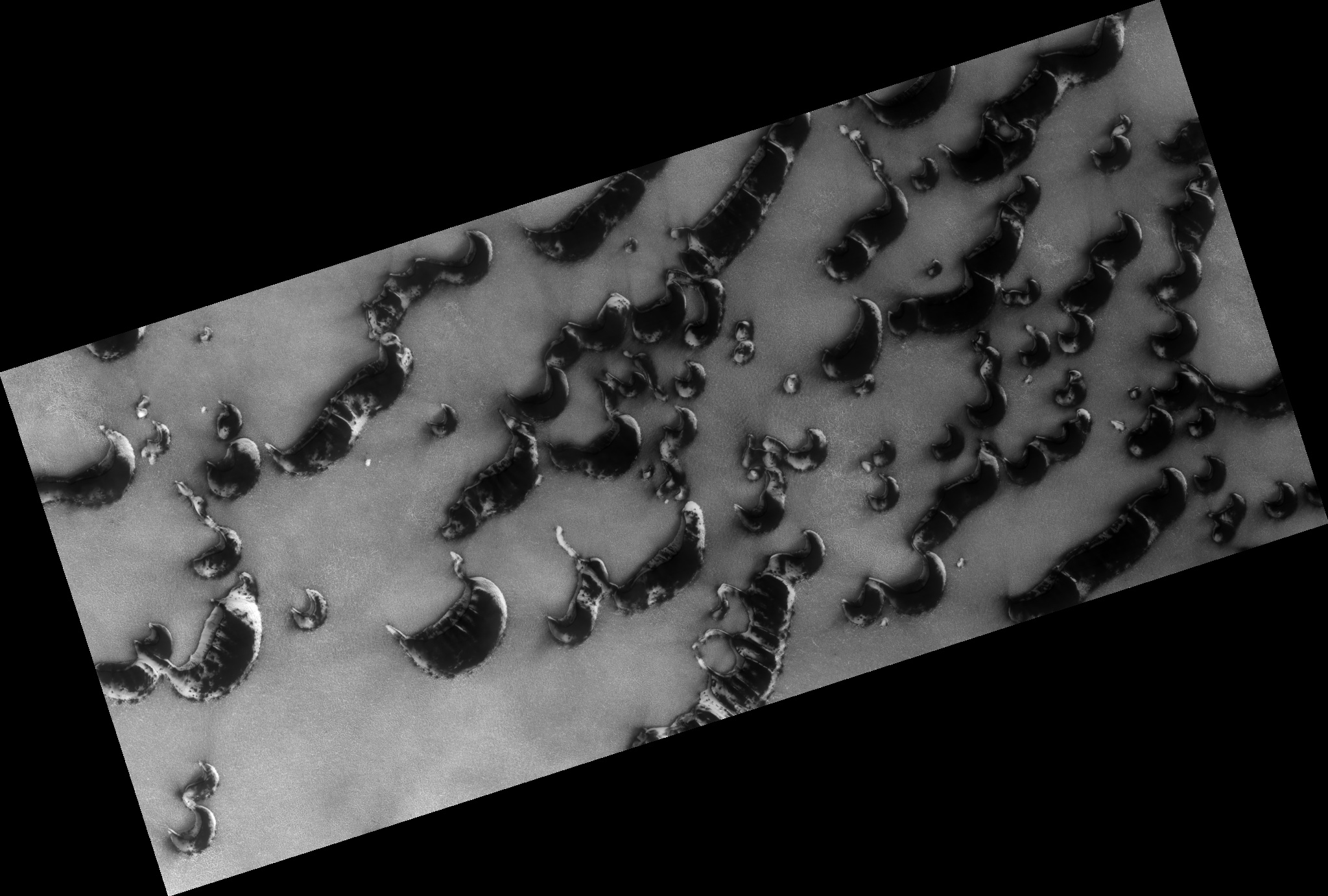
Mars_dunesSpeaking of dramatic, these recent releases from the HiRISE laboratory captured some truly magnificent activity, which included a series of avalanches and defrosting dunes on the surface. Snow, dust and wind are combining to make the incredible images that were captured. The raw images appear in black and white (as the snowy dunes pictured above).

The colorized versions, as show below, indicate the presence of snow, ice and red surface dust. These latest pictures, perhaps more than any previous, illustrate the awe and wonder the Red Planet holds. And as humanity’s contact and involvement with the planet and continues, they remind us that nothing from that world is to be taken for granted.

mars_avalanche mars_avalanche1 mars_avalanche2 mars_avalanche3And as we get closer to 2030, when a manned mission is scheduled to take place – not to mention private missions that aim to put colonists there by 2023 – chance encounters with the surface like this are certain to inspire excitement and anticipation. Right now, these events and surface features are being watched from above or by rovers on the surface.

But someday soon, people will be standing on the surface and looking upon it with their own eyes. Their feet will be crushing into red sand, romping through Martian snow and ice, and standing in the middle of craters and looking up at Olympus Mons. What will they be thinking as they do it? We can only wonder and hope that we’ll be able to share it with them…

News From Space: Alpha Centauri’s “Superhabitable” World

alpha_centauri_newsScientists and astronomers have learned a great deal about the universe in recent years, thanks to craft like the Kepler space probe and the recently launched Gaian space observatory. As these and other instruments look out into the universe and uncover stars and exoplanets, it not only lets us expand our knowledge of the universe, but gives us a chance to reflect upon the meaning of this thing we call “habitability”.

Basically, our notions of what constitutes a habitable environment are shaped by our own. Since Earth is a life-sustaining environment from which we originated, we tend to think that conditions on another life-giving planet would have to be similar. However, scientists René Heller and John Armstrong contend that there might be a planet even more suitable in this galaxy, and in the neighboring system of Alpha Centauri B.

alpha_centauriBb1For those unfamiliar, Alpha Centauri A/B is a triple star system some 4.3 light years away from Earth, making it the closest star system to Earth. The nice thing about having a hypothetical “superhabitable” planet in this system is that it makes it a lot easier to indulge in a bit of a thought experiment, and will make it that much more easy to observe and examine.

According to the arguments put forward by Heller, of the Department of Physics and Astronomy, McMaster University, Hamilton; and Armstrong, of the Department of Physics, Weber State University in Ogden, this planet may be even more suitable for supporting life than our own. It all comes down to meeting the particulars, and maybe even exceeding them.

habitable_sunsFor example, a habitable planet needs the right kind sun – one that has existed and remained stable for a long time. If the sun in question is too large, then it will have a very short life; and if it’s too small, it might last a long time. But the planet will have to be very close to stay warm and that can cause all sorts of problems, such as a tidally locked planet with one side constantly facing the sun.

Our own sun is a G2-type star, which means it has been alive and stable for roughly 4.6 billion years. However, K-type dwarfs, which are smaller than the Sun, have lives longer than the age of the universe. Alpha Centauri B is specifically a K1V-type star that fits the bill with an estimated age of between 4.85 and 8.9 billion years, and is already known to have an Earth-like planet called Alpha Centauri B b.

alpha_centauriBb2As to the superhabitable planet, assuming it exists, it will be located somewhere between 0.5 and 1.4 astronomical units (46 – 130 million mi, 75 – 209 million km) from Alpha Centauri B. All things being equal, it will have a circular orbit 1. 85 AU (276 million km / 172 million miles) away, which would place it in the middle of the star’s habitable zone.

Also, for a planet to sustain life it has to be geologically active, meaning it has to have a rotating molten core to generate a magnetic field to ward off cosmic radiation and protect the atmosphere from being stripped away by solar winds. A slightly more massive planet with more gravity means more tectonic activity, so a better magnetic field and a more stable climate.


PlutoHowever, the most striking difference between the superhabitable world and Earth would be that the former would lack our continents and deep oceans – both of which can be hostile to life. Instead, Heller and Armstrong see a world with less water than ours, which would help to avoid both a runaway greenhouse effect and a snowball planet that an overabundance of water can trigger.

Our superhabitable planet might not even be in the habitable zone. It could be a moon of some giant planet further away. Jupiter’s moon Io is a volcanic hellhole due to tidal heating, but a larger moon that Heller and Armstrong call a “Super Europa” in the right orbit around a gas giant could heat enough to support life even if it’s technically outside the star’s habitable zone.


alien-worldAccording to Heller and Armstrong, this world would look significantly different from our own. It would be an older world, larger and more rugged, and would provide more places for life to exist. What water there was would be evenly scattered across the surface in the form of lakes and small, shallow seas. And, it would also be slightly more massive, which would mean more gravity.

This way, the shallow waters would hold much larger populations of more diverse life than is found on Earth, while the temperatures would be more moderated. However, it would be a warmer world than Earth, which also makes for more diversity and potentially more oxygen, which the higher gravity would help with by allowing the planet to better retain its atmosphere.

panspermia1Another point made by Heller and Armstrong is that there may be more than one habitable planet in the Alpha Centauri B system. Cosmic bombardments early in the history of the Solar System is how the Earth got its water and minerals. If life had already emerged on one planet in the early history of the Alpha Centauri B system, then the bombardment might have spread it to other worlds.

But of course, this is all theoretical. Such a planet may or may not exist, and may or may not have triggered the emergence of life on other worlds within the system. But what is exciting about it is just how plausible its existence may prove to be, and how easy it will be to verify once we can get some space probes between here and there.

Just imagine the sheer awesomeness of being able to see it, the images of a super-sized Earth-moon beamed back across light years, letting us know that there is indeed life on worlds besides our own. Now imagine being able to study that life and learning that our conceptions of this too have been limited. What a time that will be! I hope we all live to see it…


Sources: gizmag.com, universetoday.com