The Anniversary of Pearl Harbor

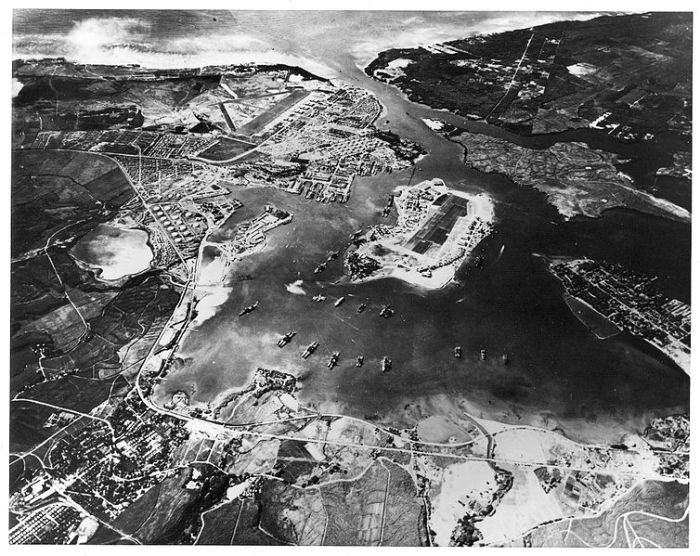
Aerial photo of Pearl Harbor, Oct. 1941

Hello fellow bloggers and blogger-followers! As you know, there are times I like to break with my usual subject matter to mark an important anniversary. Not always are these dates which accord with major scientific breakthrough or accomplishments. Sometimes, they are just about the anniversary’s of major historic events that are important to us for any number of reason. And today people all over the world, including several friends and family members of mine, stop to remember the events of Dec. 7th, 1941 – the day of the attack on Pearl Harbor.

Given the importance of this anniversary for so many people, not to mention the sheer historical importance of it, I couldn’t possibly let the day go by without saying something. And though I managed to acknowledge the 70th anniversary of Dieppe and the 100th anniversary of the War of 1812 this year, I neglected to say anything on the subject of the 68th anniversary of D-Day and never got over it! So in an attempt to not let another chance to pay my respects and acknowledge a major turning point in history pass me by, here are my thoughts on this somber anniversary. Please feel free to share your own…

_____

“Yesterday, December 7th, 1941, a date which live in infamy, the United States was suddenly and deliberately by naval and air forces by the Empire of Japan.”

These historic words by President Franklin D. Roosevelt, which were part of his famous “Day of Infamy” speech, came just one day after Japanese forces struck at Pearl Harbor, signalling the entrance of the US into the Second World War and a major turning point in history. In addition to 2,402 souls that died and the 1,282 that were wounded, the attack forever altered American’s perceptions of themselves.

USS Arizona, burning after the attack

Until the end of 1941, most US citizens lived with the notion that their nation could remain uninvolved in the global conflict which was happening overseas. As Hitler overran Europe and the Japanese occupied much of China, Southeast Asia, and the Pacific Ocean, the majority of citizens remained committed to non-involvement, citing the state of their economy or the fact that America wasn’t “prepared for another war” as reasons to stay out of the fighting.

B-29 assembly line
B-29 assembly line

All of that changed on Dec. 7th. For the first time, all people in the US, not just FDR and a hand full of analysts, came to understand that neutrality was not, and perhaps never was, an option. Some seven million men volunteered for military service within days, and American industry was fired up to produce all the tanks, aircraft, ships and munitions that would be needed to take on the Japanese Empire and the Axis Powers. Within three and a half years, total victory was won, though not without incredible sacrifice.

Little wonder then why this day is considered so important to historians and common people alike. Not only was it a tragic day, characterized by shock, loss and fear, it also was a day which led to one of the greatest national efforts ever seen, which in turn led to a victory that remains unparalleled in the annals of history. As just about every historian would say, Pearl Harbor “galvanized” the US and turned it from a semi-isolationist country that was still recovering from the Great Depression to a superpower which helped destroy Hitler, Fascism, and win the greatest and worst war in the history of civilization.

FDR delivering "Infamy" speech before Congress, Dec. 8th, 1941
FDR delivering “Infamy” speech before Congress, Dec. 8th, 1941

However, while the history books claim that it was Pearl Harbor which galvanized the US and erased its isolationist tendencies, FDR’s historic speech had a great deal of influence as well. When news of the attack first reached the public, the mood was one of shock, fear, and uncertainty. For years now, Americans had been fearing the specter of war and now that it was upon them, no one knew how to react or what would happen next.

But when people tuned in to listen to their President speak on the following day, they heard a stalwart man praising the efforts of US personnel and calling the citizenry to stand together against an evil power that was threatening not only them, but the entire world. Knowing that a man like FDR was at the helm, the same man who had seen them  through the worst of the Depression and was famous for uttering the words “You have nothing to fear but fear itself” was as much responsible for this turnaround as the attack itself.

USS Arizona Memorial, Peal Harbor
USS Arizona Memorial, Pearl Harbor

Years later, the significance and the true nature of this event are still the subject for debate. Since the initial days after the attack itself, there were some who speculated that the attack had been allowed to take place in order to achieve US involvement in the war. In fact, nine inquiries were conducted between the years of 1941 and 1946. However, due to secrecy and clearance concerns, especially where the issue of cryptography was concerned, the full details of the attack were not made clear to the public until 1992.

Reaction to the report was mixed. The findings seemed to emphasize that a combination of secrecy, a lack of inter-departmental communication, and an underestimating the Japanese forces capabilities and intentions prevented US forces from stopping the attack. However, some have claimed that these findings did not go far enough to probe the possibility that an attack was known of in advance and was allowed to take place, mainly for political reasons.
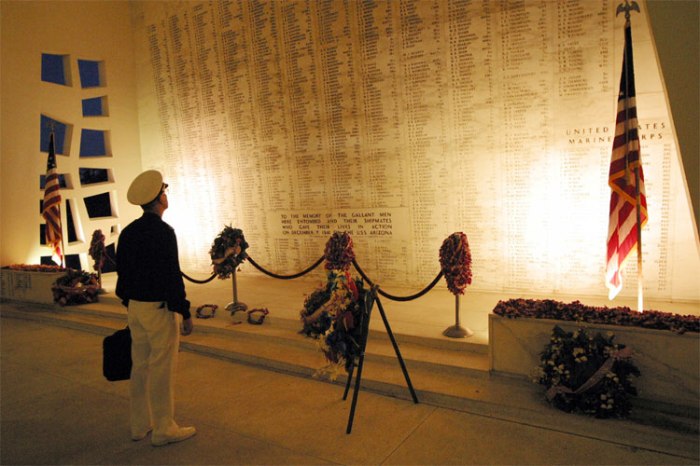
USS Arizona Memorial, interior

Much like with 9/11, it seemed that there were many questions and grey areas that were likely to give rise to speculation. When all is said and done though, hindsight is always capable of making it seem that their is intent and continuity to events, when in fact all things happen on an ad hoc basis and no one can see the outcome. In the end – and in this historians opinion – those who died on Dec 7th were victims of human error and the capacity for senseless violence.

To all those who perished at Pearl Harbor on that fateful day, to all those who died as a result of World War II and all wars previous and since; I think I speak for everyone when I say rest to peace on this day.

The 70th Anniversary of the Dieppe Raid

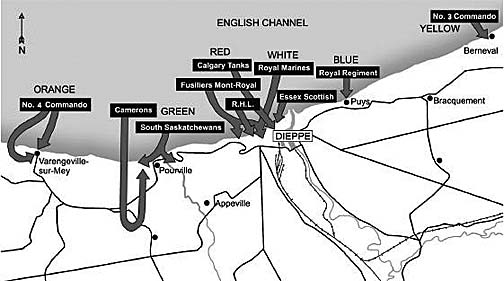
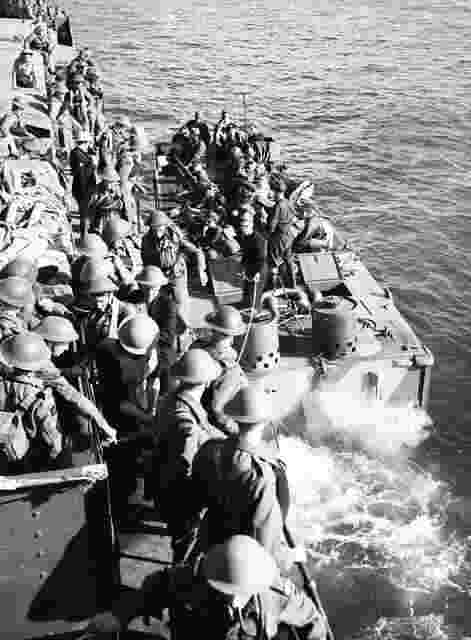
Here in Canada, few historical events from World War II inspire as much anger, sadness, and remembrance than the anniversary of the Dieppe Raid. It was 70 years ago today that Canadian Forces, in what was to be the first offensive of the war, attacked the European coastline near the small French town of Dieppe. The raid, as it was classified, was a total failure, resulting in 913 dead, almost 3000 captured, and countless more wounded. Out of the nearly 5000 men who went in, less than half made it home.

Earlier today, I read some articles that spoke of the surviving veterans, the youngest of whom is 90, as they arrived at Dieppe to take part in the commemorative ceremonies.

Countless French people welcomed them by hanging Canadian flags from their balconies and volunteering to show them about town. For the locals, honoring the veterans who fell while trying to liberate their town has become a way of life, similar to the Belgian people of Ypres and the Dutch who honor how Canadian forces liberated their country in 1944.

Naturally, when these veterans tell their stories again to reporters or the many who wabted to hear them, they conveyed some rather mixed emotions. There were moments of anger and pride intermixed with a general tone of lament, and in that respect, they are joined by all Canadians who remember. Even now, 70 years later, there is still ample speculation about the Dieppe raid.

Taking place in 1942, during the height of the war when the Allies were still on the losing end, the planned raid on Dieppe represented the culmination of many hopes, fears, and political considerations. For over a year, Soviet leader Joseph Stalin had been asking – in fact, pleading – with the Allies for a Second Front in Europe that would take pressure off the Russian forces. Ever since the Germans moved into his country roughly a year before, Russians were dying by the millions and the Red Army was struggling to hold them back.

At the same time, the Allies had been contemplating plans for the liberation of France ever since it had been overrun two years earlier. For the British and French, the memories of the summer of 1940, beginning with the invasion of Belgium, the outflanking maneuver through the Ardennes Forest, the fall of Paris and the evacuation of Dunkirk, were still phantoms they wanted to dispel. With Germany pushed out of France, the Allies would have a major ally back in the fight and put an end to Germany’s expansion, which had continued unabated since the war began.

And last, the Canadian Armed Forces were desperate to get into battle, hoping to demonstrate some of the same zeal that had popularized their forces in World War I. And with the US finally entering the war on the Allied side, there was an added push to score a victory before the Yanks got in and claimed all the glory 😉 A commando-style raid against a section of the Atlantic Wall seemed like just the thing to bolster morale and show the world that the Canadian Expeditionary Force was still a force to be feared!

Ultimately, the raid was a failure for numerous reasons, all of which proved intrinsic to helping the Allies draft Operation Overlord – the invasion of Normandy – roughly two years later. First off, the raid had little support to speak of. Aside from the 5000 men and tanks heading onto the coastline, their were very ships ships and aircraft standing by to blast German positions and take on the coastal defenses.

Second, the planners did not take into account the challenging terrain along the beaches. Rather than being sandy shores, they were composed of tiny little rocks which played havoc with tank treads, making them virtually useless. As a result, the Canadian soldiers found themselves running into German machine guns and mortar positions with no cover or support.

Third, the plan was changed over and over again so that less and less forces would be committed to the fold. This led many to question whether the raid would even have enough men or firepower to achieve their mission. However, Allied planners dismissed these objections by emphasizing that the attackers would have the element of surprise. That was not the case though, since Allied Command had been publicizing the attack for some time before it happened.

In short, the mission was the perfect recipe for failure, leading some to speculate that that had been the goal all along. With Stalin pleading for a Second Front and the Allies unable to convince him that they were not ready, some claimed that Dieppe was meant to fail as a way of illustrating their point.

In addition, new evidence is being brought to light that suggests that the raid was a diversion for a covert operation that involved commandos attacking the secret German naval headquarters in the town in order to capture a working model Germany’s new four-rotor Enigma machine and their most recent code books. At the head of this operation, so the argument runs, was Mr. Ian Fleming himself, the man who would later create James Bond.

A very interesting interpretation, and which explains quite clearly why the raid was so publicized. In keeping with Allied counterintelligence plays, it was customary to let the Germans know exactly what they were doing in the hopes that they would chomp at the bit and not realize it was a feint to cover their true aims.

What’s more, if this latter interpretation should prove to be true, it would mean that politics and incompetence was not the reason for the Dieppe Raid. Instead, it would have been a vital intelligence mission which went wrong for a number of reasons. However, this still would not change the fact that the operational planning suffered from the fact that the raid failed to take into accounts some key problems. Nor would it change the outcome.

In any case, some good did come out of the operation. Four months after the raid, the Allies managed to crack the 4-wheel Enigma code and went back to winning the intelligence war. In addition, Soviet Forces began to defeat the Germans on all fronts and initiated the slow process of pushing them back into their old stomping grounds. And in the Mediterrenean and North Africa, the German Navy and Afrika Corps began to get their asses kicked.

But most importantly of all was the operation that would succeed where Dieppe had failed. Taking on June 6th of 1944 in the Normandy region of France, Operation Overlord was the largest invasion in history, and several key factors had been adapted from the Dieppe Raid. In addition to committing all kinds of men, materiel, ships, and planes to a cohesive, multi-phased invasion plan, the Allies also conducted a vast counter-intelligence operation well in advance to trick the Germans into thinking that their real invasion force would be coming in the Pas de Calais region.

So today, like all good Canadians, I wish to honor the veterans who are currently overseas, receiving their well-deserved honors and recounting the historic Dieppe Raid that they took part in so many years later. I’d also like to salute those soldiers who are no longer with us, many of whom were wounded, captured and forced to spend the rest of the war in army hospitals and German POW camps. And I would especially like to pay tribute to those who didn’t make it back, who died on those rocky shores as the result of either politics and ineptitude, or desperation and intrigue.

Even after 70 years, surely we must be learning something from all this…