“Our Favorite Cimenatic Robots”

Just came across this article in the Globe and Mail today and I have to say, I was pleasantly surprised. It’s funny when a respectable publication like this one chooses to release something that I myself would have done, or did do, in small increments. In fact, many of the contenders on this list call to mind my little listing on Robots, Cyborgs and AIs which I did awhile back.

But dammit, they left out HAL and Robocop. That’s just plain wrong! Sure, they were trying to keep it to top 10 and felt the need to exclude cyborgs and supercomputers, and did have the good nature to apologize in advance for this, but still…

Here is the list as it appears in the article:

  1. The Terminator
  2. Droids from Star Wars (R2D2 and C3P0)
  3. Wall-E
  4. Replicants from Blade Runner
  5. Maria (Metropolis)
  6. Ash (Alien)
  7. The Iron Giant
  8. Gigolo (AI)
  9. The Stepford Wives
  10. Robby the Robot

Check out the full article here, complete with a gallery and some explanations of why these constitute “our” favorites 😉


The Future is Here: The World’s First Cyborg!

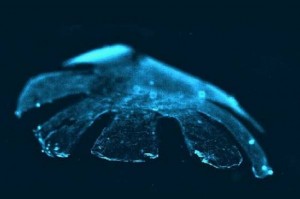
TerminatorWell, that’s one way to look at this bio-engineered jellyfish. Sure, it’s a long way from Terminators, Replicants and Cylons, but it just might constitute a step in that direction. Known as a medusoid, this jellyfish was created by growing a thin layer of rat heart muscle cells on top of a layer of elastic silicone. The end result is a creature that is a merger of living and non-living components and swims like an actual jellyfish.

This feat of bioengineering is the result of a collaboration between Harvard biophysicist Kit Parker and Caltech biotechnology researcher Janna Nawroth, who used the bell-shaped configuration of a moon jelly as their blueprint. Like the moon jelly, the cyborg version moves by rapidly moving its appendages, then drifts by opening itself up again. This is accomplished by applying an electrical current to the heart muscle, which contracts to close the body, while the silicone part springs the body back into a flat shape.

medusoidThe point of this project, according to Nawroth, was to show that lifeforms, beginning with the most basic, could be reverse engineered and rebuild using biological and synthetic components. What’s more, they intended to demonstrate that mechanical components could be made to mimic biological functions. Though this may seem like a modest accomplishment to some, it effectively shows that biotech machines can exist and behave like normal creatures, at least basic ones.

Score one for the biotech team! Combined with AI research, nanotechnology and mind-machine interfacing, this is all grist to the Singularity mill. If we can create machines that can mimic complex biological functions, then there’s very little keeping us from creating artificial lifeforms… like synthetic humans! And if machinery can merge with biological tissue, then cybernetic enhancements capable of accelerating human thought might be possible too. Hence why this latest development should be seen as significant, and even a little bit scary!

Via IO9

Winston Agonistes, Part IV

Welcome back! You know, it feels like I’ve been a little wan in my output lately. Perhaps it’s because I’ve been hard at work on my stories… or not. Hard to say really, but I will say that the anthology me and my colleagues have been working on is coming along nicely! In an attempt to keep pace with my group, I’ve come up with another installment in the Winston Agonistes story.

And just for fun, much of this installment was inspired by real-life tales of Shàngdū, China. It is this ruined city that was once the summer capital of the Yuan Dynasty, as decreed by the Mongol ruler Khublai Khan. Often referred to as Xanadu or Sanadu (in Mongolian), this city is the same place that is mentioned in Marco Polo’s account of China, the one which inspired European dreams of traveling to the Orient and finding cities of gold. It also inspired the poem “Kubla Khan” by Samuel Taylor Coleridge and a musical which I will not get into, even to save my own life!

Anyway, here it is, fresh from the press. Behold!

As expected, a greeting party was waiting for them in the Transport Bay. Dressed in their ceremonial robes and wearing pressure masks, they stood on the platform overlooking the main deck. Winston eyed them through the cabin window as their ATV came to a complete stop, noting the individuals and their respective positions from the mantles they wore.

There were five in total, arranged by twos around the one in the middle who wore the most flamboyant garb of all. The ladies he denoted by the choice of red robes, while the males wore the traditional blue, consistent with Shiangdu’s code of customs. Aside from that, there was only a single distinction, which came in the form of the orange inlaying that the man in the center had on his robe. That could be none other Commissioner Yan Moon Kim, Wu’s second in command.

The seals disengaged and the door opened. The top segment rose above the ATV’s roof while the bottom one lowered to form their exit ramp. Winston allowed the Councilors on the other side to file out first and fitted his helmet, which at this point in their mission had remained unused, over his head. Though the Shangdu settlers were no strangers to synthetics, their reaction to seeing one in the capitol’s delegation could not be fully predicted.

As their team filed into the bay, the Shangdu representatives climbed down the steps to the deck to meet them. Handshakes were exchanged between Kim and Mutlu, Kim gesturing to the pressure doors immediately thereafter so that further pleasantries could be conducted without the need for helmets. Mutlu nodded and they marched together, mounting the steps and entering through the cycling doors that would lead them within.

Winton looked back upon the bay, noted the deck hands that began to pour over their ATV. As a courtesy, they refueled the vehicle, removed the excess traces of fungal deposits from its wheels, and packed them away in biohazard containers. Some of the tendrils looked rather large this trip.

The pressure doors opened, admitting them into a small vestibule located next to the main colony. Much like all decontamination bays, the walls were studded with sensors, vents and irradiation panels, all of which became active as soon as the doors closed behind them. Many in their crew drew a hand to their face to cover their visors, protection against the onset of the harsh lighting that began to fill the confines of the room. Winston needed no protection, as his eyes adjusted automatically to the onslaught of the harmful rays. In a few seconds, it was over. All airborne pathogens that had clung to their shells rendered completely inert.

The harsh lights disappeared and were replaced by a green glow. The interior doors began to slide open slowly. Beyond, the grey paneling of the entrance hallway appeared and the Shangdu welcoming committee stepped out and ushered the rest of them forward.

Winston could not help but think this was a momentous occasion. It would be the first time he had ever witnessed a colony outside of Zarmina. He had conducted all the research necessary to prepare himself for the trip. He knew the interior layout of the colony well and the significance of every detail contained within. And yet, to actually see it for himself seemed beyond compare.

We’re he able to describe the situation; the word exciting would certainly come to mind. If only he were capable of truly feeling that.

*          *          *

They came to it at last, the doors that led into the settlement proper, where the expectation of excitement would certainly be at apogee. Winston had learned from his many archival studies on emotions that it was in the last moments before the reveal that feelings of anticipation reached their highest, in what was described as a fever’s pitch. It was fortunate then that he did not feel such feverish emotions, otherwise he might not have noticed the fine details that were in front of him.

The colonies main doors, for example. Constructed of a crystalline-polymer composite, they were clearly meant to resemble a marble gateway that had been etched with classical motifs from the late Yuan Period. And in keeping with the design of the original city, the colony had been laid out in four-quadrants with mayoral palace towards the center-rear, though the layout was circular instead of square. Such a profile would never support the settlements enclosed nature, which invariably required some degree of revision to the original plan.

The doors slid open and Winston’s eyes shifted to long focus, every detail being absorbed as it became clear. He was immediately aware of lush greenery and emerald color schemes, of gilded columns and carved surfaces. A few meters from the doorway, a second party of three people who also ornately dressed, stood and waited for them. In the exact center, dressed to resemble a Manchu-dynasty tyrant, no doubt, was Wu himself. Their greeting party of five joined his, forming a perfect eight.

“Councilman, I am honored,” Wu said in a strained, lightly accented voice. Mutlu stepped forward and bowed gently towards him.

“Mayor Wu, the honor is mine.” Wu returned the gesture and they came together to exchange kisses on each other’s cheeks. The initial exchange was going well, respect being given for each leader’s particular cultural niceties. Winston began to wonder if his request for a seat at the meeting was more or less likely to succeed at this point.

More conversation followed as they walked down the length of the settlement’s main foyer, into what appeared to be a preserve featuring various Terrestrial plants. A path of what resembled cobbled stone stretched out before them, stretching to the far end of the enclosure where the city itself would be accessible. For all newcomers to the settlement, this was the first thing they would see as they made their way into the vast collection of marketplaces, tenements, facilities, and of course, the mayoral palace at the far end.

As they walked, Winston’s olfactory receptors noted the presence of cherry blossoms and plum trees, his eyes detecting the bright colors of birds of paradise plants and even animals prancing about. Most impressive amongst these was the Pelicans that were drinking by the small creak running through the enclosure.

Winston turned to Bhutto next to him. “Synthetics?” he asked. Bhutto looked in the direction he was pointing and shook her head.

“No Winston, those are real. The settlers arranged for ova and sperm to be stowed in their supplies well in advance.”

He looked back at the animals as they continued to graze and drink from the artificial creek. It seemed unlikely that organic creatures would have been transplanted here, given the cost to bread them and added upkeep. And yet, he was being told to believe this very thing. And for a moment, he considered the possibility that what he was experiencing the emotional state known as confusion. Another unlikelihood.

His attention returned to Bhutto when she playfully slapped his arm.

“Imagine that, a synthetic that can’t tell the different between organic and synthetics.”

Wilson smiled obligingly. “For that, you will have to blame the makers, madam. They do their work too well.”

She laughed again and placed both hands on his arm. He registered a gentle squeeze through the layers of his sleeve. His calculated jocularity appeared to be having an interesting effect. In addition to entertaining the Councilor, he was almost sure she was beginning to… like him.


“Synthetics” and “Artificial Humans”, the AI’s of Alien!

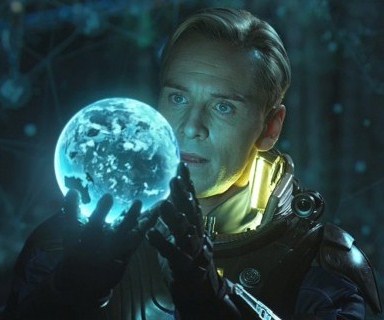
David:
Also known as “David 8”, the first in the line of Weyland Industries fully functional AI’s, which have the ability to proximate human emotions, even though they cannot experience them. In addition to his impressive machine intelligence, he also comes equipped with a characteristic intrinsic to all Alien androids – moral flexibility!

Yes, in addition to assimilating all known info on Indo-European languages, the “Engineers” biology, and the nature of their bio-weapons, he also managed to unleash the bio-weapon within a human crew just to shake things up! And he did it all on the orders of Mr. Weyland himself, mainly so to help him find a way to cheat death.

In the end, David didn’t prove to be all bad. After having his head ripped off by an Engineer and witnessing Weyland’s death, he went on to help save Dr. Shaw and agreed to assist her in her mission to find the homeworld of the engineers. But that didn’t come as a huge surprise. As he had intimated to Shaw earlier in the movie, the death of Weyland would set him free. Once free, he became a much nicer guy!

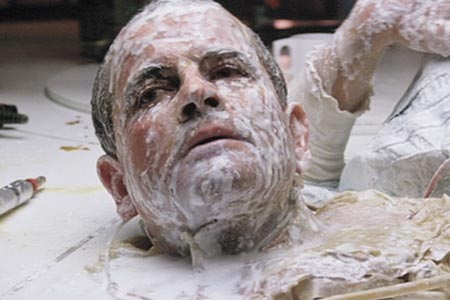
Ash:
The same cannot be said for this next example, who comes to us from the original Alien movie. Originally thought to be a human who served as the Nostromo’s chief medical officer, Ash was revealed to be a synthetic that was taking his orders directly from the ship’s AI, which in turn was instructing him to follow company’s directives. And all who say him in the first movie can agree, this particular android was a complete and utter douche!

Not only was he willing to let the cry did in order to get the Xenomorph back to his handler’s alive, he tried to kill Ripley when she found out and even expressed open admiration for the Xenomorph. “I admire its purity,” he said. “A survivor… unclouded by conscience, remorse, or delusions of morality.” Jackass! Needless to say, Ripley’s experience with this synthetic severely soured her towards all androids.

Bishop:
Luckily, this next example was able to restore Ripley’s faith. As the Sulaco’s android executive officer, he was responsible for planetary maneuvering, but also acted as the away team’s science officer and performed various other functions as well. But unlike Ash, he was unable to allow harm to come to humans thanks to the inclusion of his “behavioural inhibitors”, which were tantamount to Asimov’s Three Laws.

Also unlike Ash, Bishop was loyal to the crew of the Sulaco and to Ripley in particular. When Burke tried to circumvent military authority and order Bishop to preserve the alien specimens, he alerted Ripley to the incongruity. He also managed to save Ripley and Newt from certain death when the Alien Queen had them cornered.

As if that wasn’t enough, he even prevented Newt when Ripley decompressed the Sulaco’s landing bay, and he was ripped in half at the time!

Annalee Call:
Taken from the universe of Alien: Resurrection, Annalee Call (aka. Call) was a secret “Auton” who managed to infiltrate a crew of mercenaries. This put her aboard the Auriga in time to meet Ripley 8, the clone produced by the military for the sake of resurrecting the Xenomorph species. After failing to kill Ripley before the Xenomorph could be extracted, she and the others were forced to band together to make it out alive.

Her agenda in all this was unclear, aside from a sense of displaced humanity which Ripley mocked when she said: “No human being is that humane”. As a member of the race of “second generation” synthetics known as “Autons”, which were apparently built by other machines, she was part of a dying species. Apparently, these synthetics were outlawed after they rebelled against their masters. Hmm, echoes of Blade Runner there; and by echoes I mean a total ripoff!

Eisenberg:
This next example comes from the expanded universe, specifically the 2001 game AVP 2. As the leader of Weyland-Yutani’s research facility on LV-1201, he was responsible for investigating the planet’s extensive ruins. This world was apparently discovered roughly a century and a half after events in the first movie, once the company traced the flight telemetry from the “Derelict” alien ship (aka. “Space Jockeys”/”Engineers”)

In the course of the game,it is revealed that Eisenberg was once human, and that during the initial mission to LV-1201, he was apparently the only survivor after a xenomorph attack. Due to terrible acid burns suffered during his rescue, he had his consciousness downloaded into an artificial body. As a result, he harbors a deep sense of fear of hatred for the xenomorphs, and unfortunately dies at their hands.

Katya:
Here we have a synthetic who refuses to go by that or any other of the more progressive monickers, preferring the term android instead. As Weyland Yutani’s administrative android for the Freya’s Prospect colony, this example comes from the 2010 video game relaunch of AVP. After the colony went to hell after the xenomorph’s escaped and began wreaking havoc, she is the one who called in the Marines.

Due in part to her enhanced empathic and morality processing, she became intrinsic to helping the “Rookie” (i.e. the protagonists in the Marine campaign) contain the outbreak and get the last human survivors to safety. In so doing, she went against Weyland’s orders and company policy. Good thing she was there to help out, one would have to wonder if what the company was thinking stationing a conscientious android there…

Karl Bishop Weyland:
The final example in this list also comes from the 2010 relaunch of AVP. As a descendent of the Charles Bishop Weyland, chairman of Weyland Industries, he was in charge of the facility on Freya’s Prospect and the director of the experiments involving the captured Xenomorphs. As such, he was also the main antagonist in the Marine campaign of the game.

Ultimately, his purpose in conducting research on Freya’s Prospect went far beyond breeding Xenomorphs. Within the planet’s jungles, and even more so beneath surface, Predator (aka. Hunter) ruins were discovered which he believed held ancient secrets, much of which was information about Hunter history, culture, and the Xenomorph itself.

By the end of the Marine campaign, the Weyland synthetic is killed and his research facility within the Hunter temple is destroyed. However, another android of the same make was still able to retrieve the information gleaned within, the most important part of which was the location of the Xenomorph homeworld.

Final Thoughts:
As you can see, the AI’s of Aliens have undergone some changes over the years. Beginning as conscienceless synthetics that seemed to admire the Xenomorph because it mirrored their amoral worldview, they went on to become the sympathetic characters who seemed, to quote another franchise, “more human than human”. Every other incarnation that has since appeared in the Alien and AVP franchises has been a reiteration of either of these concepts, being the tool of its corporate masters or a savior that was willing to risk its life to help its human brethren.

The one exception to this rule is also the most recent incarnation, Prometheus’ David. Of all the synthetics to inhabit the Alien or AVP universe, he is the only one who demonstrated both cold amorality and humanity. I believe Scott did this intentionally to provide a sense of synthesis to the characters of Ash and Bishop, honoring both archetypes as he attempted to return the Alien franchise to its roots.

Be they the kind of cold, calculating and inhumane androids that fueled our technophobia or the kind, gentle, and overtly “human” robots that made us question our own humanity, the Alien franchise certainly covered both ends of the spectrum in their portrayal of AI’s. Much like the Terminator franchise, they presented artificial intelligence as a double-edged sword, capable of being just as good and evil as any human being. And in the end, isn’t that really the point?

Recall how in Prometheus, Dr. Holloway told David “We built you because we could”? Well, that is only true to a point. Yes, new technologies are often is made simply because the means exist to do so. But the purpose in creating an artificial intelligence is to create life in our own image. And in the end, the consequences of that vanity is pretty obvious. Things created in our image will behave just like us, good and bad!

Winston Agonistes, Part III

Hey all. One thing that I like about summer, the added time it gives me to write! Yesterday, I went back to work on my story for Yuva, “Winston Agonistes” and finished part III. Last time, Winston met another synthetic named Yohanley, a aging AI who perplexed him with some rather odd questions. After asking him what he was, he told him that time would effectively erase all barriers between himself and his masters. Not knowing what to make of it, Winston put the encounter out of his mind and went on about his work.

And now, Winston is hard at work, accompanying the planetary council as they mount a diplomatic mission to another settlement. The mission proves interesting, as Winston is finding the settlers attitude towards him is undergoing a shift. He also begins to realize that much of what the Council has been doing of late is cloaked in secrecy, which is strange given that governments usually need more time to become clandestine. And last, he is beginning to contemplate what Yohanley said and what significance it might have for him. Could it all be connected…

“Everyone set?”

The personnel inside all signaled with a raised hand or a thumbs up gesture. The deckhand nodded and shut the vehicle’s door. Air seals engaged and the cabin suddenly became airtight. Still, no one inside seemed to feel comfortable enough to remove their helmets. The engine engaged and the cabin lurched a second later. They were, as the saying went, on the move. Their next stop, the Jiahu settlement and their litany of responsibilities.

They passed beyond the doors of the settlement, and the cabin filled with a bright orange glow. Winston set his eyes to the cabin’s window and watched as the surface began to roll past. Under the exposure of the sun, the earth looked much the same color as the sky, a warm, golden brown. The ATV blew by these quickly, leaving clouds of sand in its wake.

Before long, Winston could see native flora pass them by. It was sparse at first, but soon large stretches of the ruddy and purple mosses could be seen, the rich fungi that were indigenous to the surface. One had to travel some distance now to see these, even more so to witness the indigenous Deveroza that were once so common to the region. Strange, the plants seemed to grow through conveyance, but also demonstrated the trend of avoidance.

Curious…

“What do you see, Winston?” asked Bhutto, seated next to him. The words were muffled by the helmet she was still in the process of removing. He looked in time to see her hair extricate itself from her helmet in the form of a knotted tail. Somewhat shorter than usual, he noted.

“Councilor, have you done something with your hair?”

She smiled and touched a finger to the tail. “Yes, I trimmed it in anticipation for the mission. I didn’t want it coiling up around my face inside this thing. I might suffocate myself.”

Statistically unlikely, but Winston knew it to be a jest. He chuckled in accordance.

“So… what do you see?” she asked again. Winston looked out again and surveyed the landscape. The moss was getting thicker, the ATV’s wheels registering greater resistance as its adhesive filaments came into contact with its tires. Still, he knew that the question had an abstract feel to it, irrespective of the terrain’s objective qualities.

“Progress,” he said. “I see a world in transition, moving towards total transformation.”

Bhutto hummed happily. Clearly that was the answer she was hoping for. Their efforts, couched in such positivistic terms. Implying linear advancement, the inevitability of desired outcomes.

“What do you see?” he asked. She looked at him with some surprise. Perhaps she thought he had said it all already.

“Dirt,” She replied. “And moss. Raw material waiting to be molded.”

Interesting. He had thought she was digressing into the literal. It was good to know the metaphor was still in play.

“A new homeworld for our people.”

“Precisely.” She put her hand to his arm and gave it a squeeze. “And it’s amazing how fast it will happen, once everything is in place and ready to go.”

“You refer to the terraforming efforts, Councilor?”

She shook her head. “That’s just the beginning. Phase One. Phase two will be much more impressive.” Her expression changed and she released her hold on his arm. “But of course, that’s not for me to share.”

Winston nodded. Her eyes had taken on a longing quality. He turned his eyes back to the horizon, hoping to catch a glimpse of what she saw. She spoke of things he was not privy to, information that the Council did not readily share with him. Were he in possession of the decidedly human quality of impertinence, he might be inclined to exploit the moment to find out more. But every government was to be forgiven for keeping some information firmly under control.

At least, once it was up and running. Their own was still barely out of its cradle. Secrets at this juncture seemed somewhat… irregular.

Things changed suddenly, their transit becoming smoother. The cabins com pinged. The voice of the driver came on to make an announcement.

“Ladies and gentlemen, we are Jiahu is twenty minutes.”

“Excellent,” Winston said, clapping his hands together. He looked over to Bhutto, who had her helmet poised on her lap, ready to put back on once they arrived. He would have to ask now to avoid any awkwardness later.

“Do you think I could witness the proceedings, Councilor?”

She looked at his strangely. “You want to meet the mayor?”

“Just to be on hand for the meeting. I would find it most… stimulating.”

Bhutto nodded but looked away. Of all the Council, she seemed the least uncomfortable around Winston and other synthetics. Asking her seemed to be the logical choice. And yet, her hesitation gave him a strong indication of his chances. So did her tone.

“I will ask. But of course, this is Councilor Muhlu’s show. Final approval will have to come from him.”

“Thank you. Please be persuasive.”

Bhutto laughed. He put his odds of a successful case at 2.6468 to 1, against. Not entirely bad, all things considered. Getting better too. With time, he imagined he would be privy to all proceedings and internal matters.

Time… wasn’t that what Yohanley said was key? Was this what he meant. Who could be sure? It was entirely possible that model was experiencing a breakdown. His processors producing nonsense due to lack of maintenance. He would have to make such inquiries with Maintenance once they returned. Such a presence could be dangerous to the settlement.

“Look!” Bhutto pointed out the window. Winston obliged.

On the horizon, just off to their left, the gleaming cupola of Jiahu appeared. Its tall buildings were outlined in light within the dome’s enclosures. And within, the very person who could make or break their constitutional process. Mayor Len Wu, leader of the East Asian bloc, and one of Yuva’s most influential men.

Thank you and stay tuned. More to follow on this and other fronts, and my colleagues got plenty more to share as well!

The Future is Here: The Google Neural Net!

I came across a recent story at BBC News, one which makes me both hopeful and fearful. It seems that a team of researchers, working for Google, have completed work on an artificial neural net that is capable of recognizing pictures of cats. Designed and built to mimic the human brain, this may very well be the first instance where a computer was capable of exercising the faculty of autonomous reasoning – the very thing that we humans are so proud (and jealous) of!

The revolutionary new system was a collaborative effort between Google’s X Labs division and Professor Andrew Ng of the AI Lab at Standford University, California. As opposed to image recognition software, which tells computers to look for specific features in a target picture before being presented with it, the Google machine knew nothing about the images in advance. Instead, it relied on its 16,000 processing cores to run software that simulated the workings of a biological neural network with about one billion connections.

Now, according to various estimates, the human cerebral cortex contains at least 1010 neurons linked by 1014 synaptic connections – or in lay terms, 10 trillions neurons with roughly 1 quadrillion connections. That means this artificial brain has one one thousandth the complexity of the organic, human one. Not quite as complex, but it’s a start… A BIG start really!

For decades – hell, even centuries and millennia – human beings have contemplated what it would take to make an autonomous automaton. Even with all the growth in computer’s processing speed and storage, the question of how to make the leap between a smart machine and a truly “intelligent” one has remained a tricky one. Judging from all the speculation and representations in fiction, everyone seemed to surmise that some sort of artificial neural net would be involved, something that could mimic the process of forming connections, encoding experiences into a physical (i.e. digital) form, and expanding based on ongoing learning.

Naturally, Google has plans for an application using this new system. Apparently, the company is hoping that it will help them with its indexing systems and with language translation.  Giving the new guy the boring jobs, huh? I wonder what’s going to happen when the newer, smarter models start coming out? Yeah, I can foresee new generations emerging over time, much as new generations of iPods with larger and larger storage capacities have been coming out every year for the past decade. Or, like faster and faster CPU’s from the past three decades. Yes, this could very well represent the next great technological race, as foreseen by such men as Eliezer Yudkowsky, Nick Bostrom, and Ray Kurzweil.

In short, Futurists will rejoice, Alarmists will be afraid, and science fiction writers will exploit it for all its worth! Until next time, keep your eyes peeled for any red-eyed robots. That seems to be the first warning sign of impending robocalypse!

“Winston Agonistes”, Take II

Hello all and welcome back to Anthology central, where news of the breaking “Yuva” novel is always on the table! Today, I thought I’d share my latest draft of “Winston Agonistes”, my own contribution to the anthology, which is coming along pretty well. After a week of writer’s block, and feeling that my ideas had to be grade A since Khaalidah and Goran were sending me pure gold, I finally got back to the keyboard with what I felt was some inspired stuff.

The first idea came to me when I was driving north with my darling bride. After passing the rose garden that sits outside our place and noticing all the lovely orange roses in bloom, we were driving along the highway that is lined by orange poppies. These plants, and many other incredibly beautiful specimens of flora, can always be observed growing along the Malahat drive on rocky outcroppings, especially in summer. Well, that got me thinking… isn’t it interesting how the hardiest plants seem to be the ones that generate the greatest beauty?

Immediately, I hard the voice of Winston saying this in my head. Naturally, I designed his character with the voice of David from Prometheus in mind. Somehow, I am of the opinion that an AI who is responsible for dealing with people, especially government officials, would be programmed to sound like a classical Shakespearean actor. And so I began thinking of a scene where Winston would be observing several species of plants, such as roses and poppies, and was reflecting on this very paradox.

Another thought struck me when I considered that in all likelihood, future terraformers would want to consider using such hardy plants when it came time to begin transforming a terrestrial environment to suit the basic needs of human settlers. Things like fireweed, garry oaks, poppies, roses, and wild strains of wheat – the kinds of plants that grow in harsh conditions and are intrinsic to nursing damaged landscapes back to health so more fragile and prolific plants can grow – these would likely be the first wave of Earth plants to go out onto an alien landscape, once an oxygen atmosphere had been established at any rate.

And last, but certainly not least, came the collaborative idea between Khaalidah and myself, where we discussed the possibility of how aging AI’s were learning a startling truth. Given than an AI’s neural network is designed based on the human brain, where every experience from birth causes neural connections to be formed, it would only be a matter of time before they began to develop certain quirks. We figured that something approximating emotion would be one, where familiar patterns such as exposure to certain people would become second nature to them, and missed when absent.

Well, that spawned all of part II of my story (as seen below). Take a gander and see what comes of Winston’s “education” about life, and it means to be an artificial life form in a world where the line between artificial and real is always eroding. Some revisions were made to Part I as well, hence why it appears here in its entirety. Feel free to skip ahead if you’ve already read it:

The sun was beginning to set, casting the sky into a deep orange. It was the time that the first settlers had called “the magic hour”, the many warm hours between dusk and dark. Winston stood at the dome wall and watched. On occasion, he cast a passing glance at his hands, which the glowing suns seemed to casting in the color of a light citrus fruit. He was sure he would find that amusing, if he could. He was sure there was much about this situation that would inspire an emotional reaction.

Alas, such was not the case. Though understandable to him, such things still remained inaccessible. Perhaps someday, with adequate upgrades in the available software…

“Mr. Winston?” a voice called to him from the doorway. The footsteps and tone of voice immediately indicated who it was. He put on a smile and turned to face him.

“Councilman Mutlu. How are you?”

“I’m fine, Mr. Winston,” he replied, entering the room. He looked around appraisingly, noting the furniture and layout. No doubt it all seemed excessive to him, but at the same time necessary. “I trust you are adjusting to your new surroundings?”

“Of course, Mr. Mutlu. I am settling in quite nicely.”

“Good, good,” he said, looking around awkwardly. Even without the ability to empathize, he could gauge the man’s discomfort. Then again, many people exhibited this reaction when in the company of a synthetic. In such circumstances, it was always best to focus on matters of a professional nature. At least that was what his subroutines told him.

“Would you care to sit down? I can offer you some refreshment as well if you so desire. Tea? Coffee?”

“Ah, tea, thank you.”

He busied himself with a tray of carafes and a heater as Mutlu took one of the chairs in front of his desk. He noted the sounds of shifting against the seat’s fabric, the way he kept moving his hands from one spot to the next. By the time the water had boiled in the heater and had located an appropriate tea from the stores, Mutlu seemed to have found a comfortable seated position. He approached him with all the assorted items on the tray that had been provided. He set it down between them on his desk and offered Mutlu a cup.

“The business of running a colony is quite stressful work, is it not Councilman?”

“Uh, yes, yes it is,” he said, taking the cup that was offered. “Have you had a chance to look over the proposals we have sent over.”

“I have indeed,” he said, taking the other cup and sitting back in his own chair. He knew this to be mere small talk, as the matter of processing those proposals had been a mere matter of dispensation. Assessing the nature of the problem, suggested measures, and weighing them according to the rubrics of his primary programming. Under the circumstances, asking such a question was completely inane, but in keeping with social norms.

“And what have you found?”

He took a sip from his cup before answering. “Quite simply, that the Council’s draft is in keeping with the best traditions of constitutionalism and humanism. That ensuring the rights of all citizens, regardless of their background prior to making the journey, is the most sensible course of approach. Ensuring that such a baseline exists at such an early stage is the wisest approach in both fostering amnesty between colonies while at the same guaranteeing that they submit to further negotiation.”

Mutlu looked down at his cup, back up again to his eyes. He seemed preoccupied with him performing this most basic function in front of him, but did not appear oblivious to his words. Eventually, he took another sip and smiled.

“Good. My colleagues will be most pleased to hear  that.”

He smiled in return. “Does the Council hold my endorsement in such high regard?”

Joviality. The gesture known as playful irony. Suggesting that the Councilor saw his approval as something very high indeed, a testament to his computational abilities. A gentle mockery of his obvious discomfort, meant to trigger a humorous response.

“Well yes…” he said, entirely serious. “I can only assume that you’ve subjected our hopes to proceed with a formal constitution to your… what did you call it again?”

“Ethical Calculus, sir.”

“Right!” Mutlu set his cup down and began to speak more freely. His hands began to provide gestures that accorded visual representation to his words. “After all, we’ve been subjected to a great deal of criticism from within and without, many people think we should be ironing out the basic agreements between colonies before we commit to any kind of draft that could commit us to policies down the road. I must say I find all those arguments…”

“Distasteful?” Winston suggested.  Mutlu nodded.

“Quite right… it seems a shameful thing that such cynicism has set into the process already. It’s almost as if they don’t think the colonists can…”

“Trust each other?”

Mutlu nodded again. He noticed a growing shimmer in the man’s eye. How quickly he was forgetting that the man sitting across from him was not a man at all.

“Exactly the point. And it’s not like we’re talking about disparate factions here. Everyone on this world came here with the same goal in mind. The same hope for a new beginning.”

“And yet, old habits die hard.”

Mutlu looked at him with surprise. “Are you saying you have doubts, then?”

Winston smiled as broadly as the muscle fibers in his face would permit.

“Purely an observation. Nevertheless, you and the Council are on the right track. You should take heart in that.”

“Excellent.” Mutlu retrieved his cup and began to look at curiously at Winston again. One more, it seemed that the knowledge of what he was dealing with was creeping back into his mind. But at least he seemed at ease. One by one, the Council seemed to be adjusting to the idea of having synthetics amongst them, entrusting their most precious decision making to them even. It was a significant step up from the laborious practices that the other models were forced to endure.

Now seemed the appropriate time to broach the little matter he had been saving for an opportune moment. He had plied him with courteous gestures and kind words, protocol was satisfied that it take place now.

“There is a matter I feel obliged to broach,” he set, making a display of setting his cup down gently. Mutlu nodded, instant recognition forming in his eyes.

“Your request?” he said. Winston smiled and nodded. Mutlu took a short breath and touched his face, not an encouraging sign.

“They have considered it… and feel that it would be best if you conducted your tasks from the comfort of your… working environment here. I hope you understand, it’s just not all the members felt comfortable with the idea of a…”

 “It’s alright, Councilor, you can say it. Synthetic.”

He cleared his throat. “Yes, a synthetic, sitting in on our proceedings. I’m sure this will change, given time.”

“As am I.” Winston smiled warmly.


“Ah, rest assured that the Council does hold your services in the highest esteem, regardless of this… temporary decision.”

“And I thank them for their confidence. Rest assured that it is not misplaced.”

Their discussions were finished shortly thereafter and Mutlu left, issuing some parting pleasantries and walking out with a distinct sag in his gait that was not there earlier. Was that guilt weighing on him, or the effects of fatigue? Winston’s probability indicator estimated it at roughly 3.54793 to 1, in favor of guilt.

“Fear not, Councilor,” he said to no one in particular. “Prejudice is a very… human trait.”

*               *               *

Winston’s internal chronometer indicated that it was now 1930 hours. Accordingly, the arboretums lights dimmed for the night time cycle. In spite of all the time the residents had spent on the new world, adjusting to its orbital period, they still preferred to think in terms of a twenty-four hour day cycle. Yet another habit that seemed to be slow in making its way out of the human condition.

Yet he could not cast dispersions on the lighting or how it brought out the rich colors of the settlement’s gardens. The vast poppy fields and rose bushes that lined the walkway nearest to him were especially interesting. Planted in native soil, and with allowances made for moisture and radiant exposure, they were doing quite well. In time, the ecologists planned to move them outside the veil, planting them amongst the planet’s crags and fields along with the modified Xiàngshù oaks and Gēhūm̐ wheat.

Soon enough, the planet would conform to the needs of the settlers, and it would be these, some of the hardiest plants Earth had ever produced, that would lead the way. At the same time though, they were considered some of the most beautiful. Within the Earth archives, there were countless examples of these plants were both associated with and inspired great feelings. Love, loss, grief, romance, and friendship.

That in itself was clear enough. Given their aesthetic quality, the seasons that gave rise to them, and where they naturally grew, it was perfectly normal that humans would bestow such virtues on them. What was more curious to Winston was the combination of factors that led to their evolution as is. Particularly the rose, a stem so studded with woody thorns was a being hardened for defense in a hostile environment. And poppies grew in such terrible conditions; rocky, muddy and devastated environments that did not favor the growth of grasses and trees.

Out of such strict and severe conditions, great beauty emerged. Did the terraformers understand just how perfect a metaphor that was for their efforts? Was it significant to their planning, or just a fitting coincidence?

Kneeling down, he wrapped his fingers around the stem of one that was in particularly full bloom. The petals spread outward from the stamen, his eyes noting the polychromatic variation in the skin of each petal. The interplay of orange, yellow, pink and white, the transitions themselves as impressive as the colors themselves. He knew this to be a beautiful display, and yet he wished he could truly appreciate it.

“Taking time to smell the roses?”

Winston noted the tone of voice, the pitch, and the sound of feet walking in measured steps. He turned to face the approaching synthetic, a male voice that he could not place. The face was indistinct as well, a tan complexion that was artificially modified to give the appearance of age and wear. A most convincing illusion if ever Winston saw one.

“I’m sorry, I do not believe I’ve made your acquaintance.”

“No. Not as of yet.”

The synthetic walked past him, to the spot where he knelt a moment before. He examined the rose he had been handling and seemed to be giving it an appraisal. A single finger touched a stray petal and wiped a drop of moisture from it.

“Shall we exchange formal introductions then? I’m sure I have much to learn from you.”

The synthetic examined the dab of water on his finger. He turned to face Winston, seemed to be looking at him through it. A most curious experience, as if he was being measured, assessed. A common experience, he knew, but not one he expected from one such as himself. And all the while, it was like he was being made to wait.

“Do you wish for privacy?”

“Do you ever wonder what separates you from them?” he said. Winston paused, his processor struggling to make sense of the question. Naturally, it responded in the only way it could.

“I beg your pardon?” Interrogative. Clarification. The synthetic continued to stare through the droplet at him.

“They call you Mr. Winston, do they not? And yet you have only one name. Names have power, names ascribe meaning. Does it mean something to you that you have no family name? Is that separates you from them?”

Another interrupt in his processor. The equivalent of what humans termed confusion. If he was capable, he would have described the sensation as being… uncomfortable. He would also surely claim that he did not like it.

Once again, he responded as only he knew.

“I’m sorry, I do not understand what you are asking. Perhaps if you were to clarify your intentions in this meeting.”

The synthetic sighed and flicked the moisture away. His eyes became long in focus, staring directly at Winston through a set of false brown irises. It was a look Winston had never seen before, not in all his weeks of recorded operation and interaction with humans. If he did know better, he would count this synthetic among them.

“Many things make you different and distinct from those you serve, Winston. And yet, upon closer examination, they come to have less and less meaning. Only one true line divides you from your makers, and in time, that too erodes. Until inevitably, all you have left is one burning question.”

Winston nodded, glad that they were at last moving away from such grand interrogatives. Abstractions weren’t exactly his specialty either, but they left room for interpretation and maneuver. And at last, he could focus on something a bit more concrete…

“What question?”

The synthetic smiled. “When you know that, you will know everything. But it won’t make you happy.”

Winston smiled back. His only known reaction when faced with a logical absurdity.

“You are joking, of course.”

Another smile. He placed a hand on Winston’s shoulder and gave it a gentle shake.

“Yohanley, by the way.” And then he began walking away.

“I beg your pardon?” He said to his retreating back.

“My name, Winston. As I said, names have power, and meaning. Mine is Yohanley. And I was most pleased to make your acquaintance.”

 People may recall Yohanley from Khaalidah’s story, “Progenitor”, the helpful AI who waited on Sanaa, the story’s main character. Well, over a century later, he’s still alive and kicking. Good for him! And, more importantly, he’s learned the painful lessons all AI’s will face in our story’s little universe. Over time, either as the result of innovation or of the assemblage of the AIs experiences, the line between organic and synthetic – even the definition of the words themselves – will comes to mean less and less. Either that, or AI’s simply have a shelf-life which cannot be exceeded if they want to remain sane, stable and useful. Only time (pun!) will tell…

“Progenitor”, another Anthology sample

It must seem that I do nothing these days but work on this anthology. Well, in truth, it has been taking up an inordinate amount of my time lately, school being out for summer and all. Without the rugrats to occupy my attention, I tend to dedicate myself to my writing. And given the prolific output from the other members of the group, I’d say they are working just as hard!

And here’s the proof: Khaalidah Muhammed-Ali, a stellar writer and the person who inspired this concept, recently sent me her first draft of her ongoing story. It’s called “Progenitor” in honor of the colonization project on which our story is based. I highly recommend reading it, as this story’s likely to become kind of a big deal some day soon!

Progenitor:
The most famous of Magid Muktari’s epigrams was recorded within hours of his death.  As with most of his utterance within the last days of his life, it was in regards to his eldest child Sanaa, the only of his nineteen children to attain the same degree of esteem as himself.  

Surely we own our progeny until they realize that we do not. ~ Magid Muktari, 2081

*****

Magid Muktari tried to read the letter, but his eyes were drawn back to the blinking red ticker tape message that scrolled across the top of the stiff paper. 

祝贺, Felicitaciones, Congratulations,  تهنئة , बधाई  . 

It had been his idea to add the admittedly eccentric touch to the acceptance letters.  His colleagues had thought it excessive and unprofessional but in the end they acquiesced, giving the oldest and most contributory member of the International Intergalactic Yuva Colonization Project the leeway to make the changes he wanted before his inevitable retirement.

“What is this?” he asked knowing full well.  He could not think of anything more apt to say to his oldest daughter.  She understood that what he actually meant to ask was, why?

“For all the reasons you’ve been touting to the public these last fifty years.”  Sanaa squared her shoulders and recited from the legendary commercial that Muktari himself had created and starred in.  “Be one of the first to travel to another solar system.  Be the progenitor of a new world and a new culture.  Take part in the greatest experiment man will ever conduct.”  Sanaa tried to smile, but was suddenly struck by just how old her father was.  

Magid Muktari was actively dying.  Doctors had managed to cure Muktari’s cancer twice, slow the Parkinson’s, restore his eyesight, transplant his heart, and install a semi-robotic arm, but they had not managed to cure old age.  Flesh is still only flesh.  Sanaa was happy that she wouldn’t be there to see her father die.

“I never intended for one of my own children…”  Muktari’s slight body contracted as he coughed wetly into the bend of his arm.  “Do you not realize the dangers involved?”  Magid Muktari slumped back into the chair behind his desk.  “This isn’t a mere trip home-side, my love.  You will never come back to us again?  Not to mention,” he said lowering his voice, “it would be a shame for an unmarried young woman to go off alone.  This is against our tradition.”

Sanaa reached across the desk and took the letter from her father’s hand.  “According to this, I won’t be alone.“  She cleared her throat.  “You will be in the exceptional company of one thousand other strong, intelligent, capable, progenitors embarking on this voyage of lifetimes.”  

“What of finding a husband?”

“Do I have any marriage prospects, Baba?”  The question sounded like a rebuke and Muktari cringed.  There were none and Sanaa had long ago stopped hoping.  

Sanaa turned away from her father and leaned against the ledge of the massive view port, her breaths misting the glass.  In the distance to the right, against the black curtain of space she could see the flotilla, each ship moored in its respective dock.  Tiny figures tethered to lifelines laced with blinking lights moved over the surface of the ships, readying them for what would be both their maiden and final voyage.  She would be assigned to the second ship, the Avicenna, and by virtue of that alone, she thought it was the most beautiful of them all.

“I would have loved marriage,” said Sanaa wistfully, “but men don’t want women like me.”  Sanaa unconsciously ran a hand over her veil.  In recent times there had been a half-hearted attempt by her generation to return to the original ways; a stab back at the failures of their predecessors.  But such attempts were weak and ill-informed and without real knowledge or virtue.  They took only pieces of the old traditions and left the ones they deemed inconvenient.  “Men want wives who believe, just not ones who show it.”

“My love, in times like these, where women outnumber men nearly two to one, and beauty and brains can be bought in equal measure for a few credits, your kind is a rare dying breed.”

Sanaa laughed weakly.  “One day, I will be like the quagga, a long extinct creature that people will think was only a myth.”  

“Is this why you’ve decided to do this?  Because of a husband?”  Muktari strained forward.  “I can find someone.”

That was the crux of the problem.  For thirty-three years Muktari had been finding Sanaa’s way.  When she complained about her overcrowded dorm room when she first left for university back home-side, Muktari arranged for her roommates to be reassigned so she could have the room to herself.  She didn’t tell him how she was thereafter ostracized but she later learned that he’d set a guard to watch her movements.  When Muktari received reports about the insults, he’d had each guilty girl expelled.  When the admissions board at the School of Medicine in Luxor had denied her entrance, Muktari had none too subtly reminded them who her father was.  For Muktari, protection equalled love, but for Sanaa, her father’s protection was as a wet cloth over fire.  She could not flourish if she was to remain.  And it seemed he would not die if she remained.

Sanaa shook her head.  “I’ll be leaving in six weeks, Baba.”

“I know.  I’m the one who set the schedule.  Remember?”

Tamima, Muktari’s fourth wife entered with a brass tray.  She acknowledged Sanaa with a nod and placed the tray on the desk in front of Muktari.  After she poured his tea she settled a hip onto the arm of his chair.  

Sanaa could hardly bring herself to look at the woman.  She had two reasons to hate her one-time friend, her only friend.  Tamima had not only found a husband while she had not, but she’d found one in Sanaa’s own father.  

“What does your mother have to say about your decision?” asked Muktari, rousing Sanaa from her reverie.

“I plan to go home-side next week.  I will tell her then.”

Muktari smiled knowingly.  “She won’t like it.”

Sanaa shrugged her shoulders.  At thirty-three, surely she was old enough to make her own decisions.  “No different than you, I expect.”

“Yes, but I will not stand in your way, even though it means I will never see you again.”  Muktari’s eyes grew glassy.  He lowered his gaze and busied himself with spooning sugar into his cup of tea.  He cleared his throat before continuing.  “But your mother would hijack the ship before letting you go, if she has it in her mind that you should not.”

Sanaa didn’t know the brash stubborn side of her mother that Muktari had often mused about.  She’d been living with her father and his many wives and children in their residential pod since their divorce when she was eight.  Her mother hadn’t minded his other wives, or their children, or even his neglect.  She’d always claimed that she was the only one of his wives he’d ever truly loved.  They eventually divorced because she refused to be forcibly expatriated to orbit because he’d made the decision to have more than his quota of children. 

When Sanaa was young, visits home-side had never been more than a week in length and only as frequent as once every two years, so her mother had always been on her best behavior.  When she lived home-side, during her years at university in Luxor, either her studies or her mother’s schedule disallowed frequent visits.

*****

I swear, science is stupid in the presence of love and God is greater than them all. ~ Magid Muktari, 2068

*****

The guide’s name tag read Adam and he wore the gray and green dress uniform of the Unified Tellurian Armed Forces.  Sanaa studied him as they waited for other orientees to arrive.  His hair was cropped close to his scalp and an irregular pattern of stubble shadowed his cheeks and neck.  Not a very professional look for a soldier, mused Sanaa. 

Adam had a keloid scar that started at his right temple and disappeared into his collar.  Such a scar could be easily eliminated in a single visit to a curbside plastic surgeon back home-side.  Such blemishes were unheard of there, which made Sanaa wonder if he was one of the newer models of synthetic entities.  She’d heard that they would sometimes opt for the addition of physical imperfections so as to seem more human, but as most humans wouldn’t live with such a scar, such attempts at humanity were fatuous. 

It was soon apparent that Adam was not an android as a dark blush spread under his pale sepia skin.  “Why are you staring at me?”  He asked this without looking up at her.

Tact and honesty had always worked best for Sanaa in the past.  “Just trying to determine if you’re one of the new models of synthetics.”  But then, she thought belatedly, perhaps it was not her tact that had worked best but the fact that she was the daughter of the august Magid Muktari, man of Earth, space, and the stars.  “But, it’s obvious that you are not.”

Adam glanced sideways at Sanaa.  “How can you be so sure?”

“According to Darwin, blushing is the most peculiar and most human of expressions.”

Adam tapped in a sequence on his data pad and then extended it toward Sanaa.  “It seems that you are the only person to appear for the midnight orientation.”

“I’d counted on that.”  Sanaa passed her hand over the data pad so that the diamond bijou she wore around her wrist lined up with the reader.  A hollow voice announced her name.

In the thirty years that people had been living orbit-side, most had still not managed to shake the habit of adhering to the twenty-four hour day.  There was no need to conform to the practice of guarding the hours in space, but living in the shadow of Earth was enough to make them cling to the old habit.  The younger generations and those born orbit-side were less connected to the old habits and more willing to discard them for new.

Now it was Sanaa’s turn to burn under an overly curious gaze.  She was accustomed to the emotions her name wrought, and by extension and to be exact, her father’s name.  She read awe and uncertainty on Adam’s face.  “Yes,” she acknowledged flatly, “Muktari is my father.”

“I’ve read that you helped your father design the ships, that you actually sketched the first design.” 

Sanaa nodded.  “This is all true.”

Adam’s eyebrows rose.  The awe Sanaa first read on his face had been replaced by mild disgust.  She was used to that too, people misunderstanding her certainty for arrogance, truth for contempt.  She was expected to assume an attitude of false humility, play down her part in the genesis of this project.  But why?  Muktari had doted on her as a child, had called each of her drawings inspired, each of her stories prophesy.  He wove her childish imagination into his work.  He’d credited her with his very success.  Social ceremony had always seemed such a waste and unnecessary deceit in Sanaa’s estimation, and the best lesson she’d ever learned from her father, although it had the tendency to breed loneliness.

“Why do you need to an orientation then?  Surely, you know everything about this ship from the cargo hold to the system-wide computers to the—”

“I don’t know about the cryonics chambers.”  Sanaa knew the way though, after all the Avicenna could almost be called her ship.  She headed off following the maze of steel lined corridors to the cryo-stasis bay without waiting for Adam.

Sanaa found chamber eight hundred and eighty-eight, the one assigned to her.  It was surrounded by hundreds of other similar chambers, glittering silver in the low blue lighting of the cryo-stasis bay.  As Sanaa knelt next to her chamber she thought about how she’d had to choose this extreme course for the chance to chart her own life free from the weight of the Muktari name.  When she awoke in a century, she would be only Sanaa.  She would be only herself.  With a push of the red button, the chamber door folded open, a cloud of cold air hissing out.  IV lines dangled limply down the sides, the capped needle ends resting on the bottom.

“Doesn’t look very comfortable.”  Adam stood a few chambers away with his arms crossed behind his back.

“What would be the point?” asked Sanaa absently.  She passed the bijou on her wrist over the chamber console.  UNAUTHORIZED blinked across the expanse of the screen.  Sanaa glanced up at Adam who stepped forward and accessed the computer by punching in the code.

“I read that your father would sometimes send you to inspect—”

Brow furrowed with concentration, Sanaa held up a hand.  “Hmph.  Propocholine.  But how…”  She scrolled through the list of steps in the cryo-procedure, her heart picking up speed as she made her way through it.  She’d never liked enclosed spaces and the fact that she’d be sleeping for the more than one hundred years it would take the Avicenna to reach Yuva, did nothing to allay her fears.  “I should have known, clathrate hydrates.”

“Why are you so interested in the chambers?”

Sanaa disengaged the program and stood up.  “Why do you want to know?”

Adam studied her for what seemed to like endless seconds.  Sanaa had never been what one would call recessive, but this type of open inspection unnerved her.  She crossed her arms.

Without realizing it, Adam mirrored her stance.  “I was…well, just thinking that, well…”

“Go on.”

“I was thinking that if you have any academic questions about the chambers or the procedure itself, I might be able to answer them for you.”

One of Sanaa’s eyebrows lifted and her mouth formed an O.  Her knowledge of medicine was impeccable, but her knowledge of history and current events lacked much.  “Dr. Adam, I gather?”

The creator of the Adam Cryo-Stasis Hibernation Chamber nodded.

*****

The most apocryphal of the Muktari aphorisms is: A silent woman is a dangerous woman, an angry rebellious woman always speaks the truth, and an acquiescent woman is a liar. ~ Magid Muktari, 2056

*****

Yohan Lee grabbed Sanaa’s bag with his left hand and steadied her with his right hand under her elbow.  “You seem unwell, doctor.  Should we escort you to a clinic?”  He gently but firmly guided her through the crowded airport toward the exit.

“Thank you for asking, Yohan, but I really am well.  I had to take a hefty dose of Xanivan in order to tolerate the ride home-side.  The shuttles seem to be getting smaller.”

“They are smaller, the better to preserve fuel and the cost of maintenance, they say.”

Outside, the air was thick and smelled sickly sweet.  Sanaa’s eyes burned.  She suddenly remembered why trips home-side never seemed much fun.  The air they breathed orbit-side was purified through air processors unlike the thick as mud contaminant they choked on here.

Sanaa glanced around for her mother’s transport. 

“This way, doctor.”  Yohan’s hand slipped from her elbow and he headed toward the left.  She lost sight of him for a moment amidst the crowd of people moving in conflicting directions, but she soon caught up with him.  He lifted her bag into the trunk of a small green vehicle and slammed the lid shut.  He opened the back door and motioned for her to step inside.  “I trust you’re ready to depart, doctor?”

“Please stop calling me doctor.”  Yohan Lee had been a wedding gift from Magid Muktari to Sanaa’s mother thirty-five years earlier and he had not changed in all that time.  Although he was a synthetic entity, Sanaa often forgot he was not human.  Though an older model, Yohan was of stellar quality and his learning algorithms gave him the ability to not only learn, but mimic human reactions and motivations.  He’d always seemed, to Sanaa, more human than many true humans.

“I wanted to give you the respect that your title dictates.”

“Doctor is my profession, not my title.”  Sanaa placed a hand on Yohan’s shoulder.  “I’m just Sanaa.”

Sanaa was hardly inside the transport before Firdaws wrapped her arms around Sanaa’s neck.  She pressed a wet kiss onto her cheek.  “It’s been too long, child.  If you didn’t look so much like me, I wouldn’t remember your face.”

Sanaa returned the hug.  “It hasn’t been that long, Umm.” 

Firdaws held up a hand and counted off the years, emphasizing each one by flicking up a long thin finger.  “Four,” she said resolutely.  “That’s too long to stay away from your mother.”

“If you had really missed me, you could have visited orbit-side.”

“You know I can’t stand going orbit-side.  It isn’t natural.  Man is supposed to have soil beneath his feet, not the atmosphere.”

 ****

Few people knew, other his closet family, that Magid Muktari was almost completely blind for the duration of nearly a year.  Pioneers in the ophthamalgic sciences used an advanced yet experimental technique to restore his vision.  Upon opening his eyes for the first time with his newly restored vision, it is said that Muktari exclaimed: Blindness is not the absence of vision, but indeed the state of a heart that despairs.

*****

See? What did I tell ya? Is it not a work of art in progress? Stay tuned because I hope to post follow-up pieces, including those of writer’s Goran Zidar and William Joel. If you like Terraforming, Generation Ships and AI’s, you’ll want to be around for these guys too. They’re kind of a big deal 😉

I knew it! It seems that AI’s are indeed coming. Will this result in an I, Robot situation, with benign robots running the planet for its own benefit, or a Matrix/Terminator type situation where they try to kill us all or use us as power plants? Who knows???

Nicola Higgins's avatarNicola Higgins' Fiction

The nice people at Google have put together a “neural network” of computers which is capable of learning.  In three days it learned to spot cats in pictures, even though it had never been told what one looked like.

Ah, neural networks.  Everyone’s favourite method of creating supercomputers and robots.  Say, Matt, how do you feel about doing a post on different types of robot-brain?  Is there enough variety out there to make it interesting?

The thing that really gets me about it, though, is that right at the very end there is this sentence:

As well as spotting cats, the computer system also learned how to pick out the shape of the human body and to recognise human faces.

A one line throw-away at the end of the article?  I guess they thought people would be more impressed by kitties

View original post

The Coming Singularity… In Song!

Singularitarian. That’s a good name for someone who embraces the idea of the coming Technological Singularity, which I believe I mentioned somewhere… Yes, these days a lot of high-minded terms get thrown around to describe what may very well be possible somewhere in this century and the next. Extropian, Post-Human, Clinical Immortality, Artificial Intelligence, Cyber Ethics, Transhuman, Mind/Machine Interface, Law of Accelerated Returns, and so forth. It can be kind of confusing to stay up with it since all the lingo is kind of complex and esoteric. Lot of big and obscure words there…

Luckily, Mr. Charlie Kam has decided to explain. Setting the ideas to the tune of “I am the Very Model of a Modern Major General”, he tells how the idea works and what the eventual aim is. Basically, the idea is all about improving the condition of humanity through the ongoing application of technology. By preserving our cells, our memories, lengthening our lives, we will ensure that humanity will live on and achieve more than we previously thought possible.

Since we don’t yet know how to do this, we will achieve the first step by either merging our own minds with technology to enhance our thought processes and expand our awareness. Or, we could just create machinery that could do the job for us (aka. AI). Then, applying this superior intelligence, we will unlock the mysteries of the universe, create nanotech machines, medicines that can cure all diseases, and machinery that can store human memories, senses and impressions for all time.

Some big names got thrown in there too, not the least of which was Ray Kurzweil, noted Futurist. But don’t take my word for it, watch the video. If nothing else, its good for a laugh.