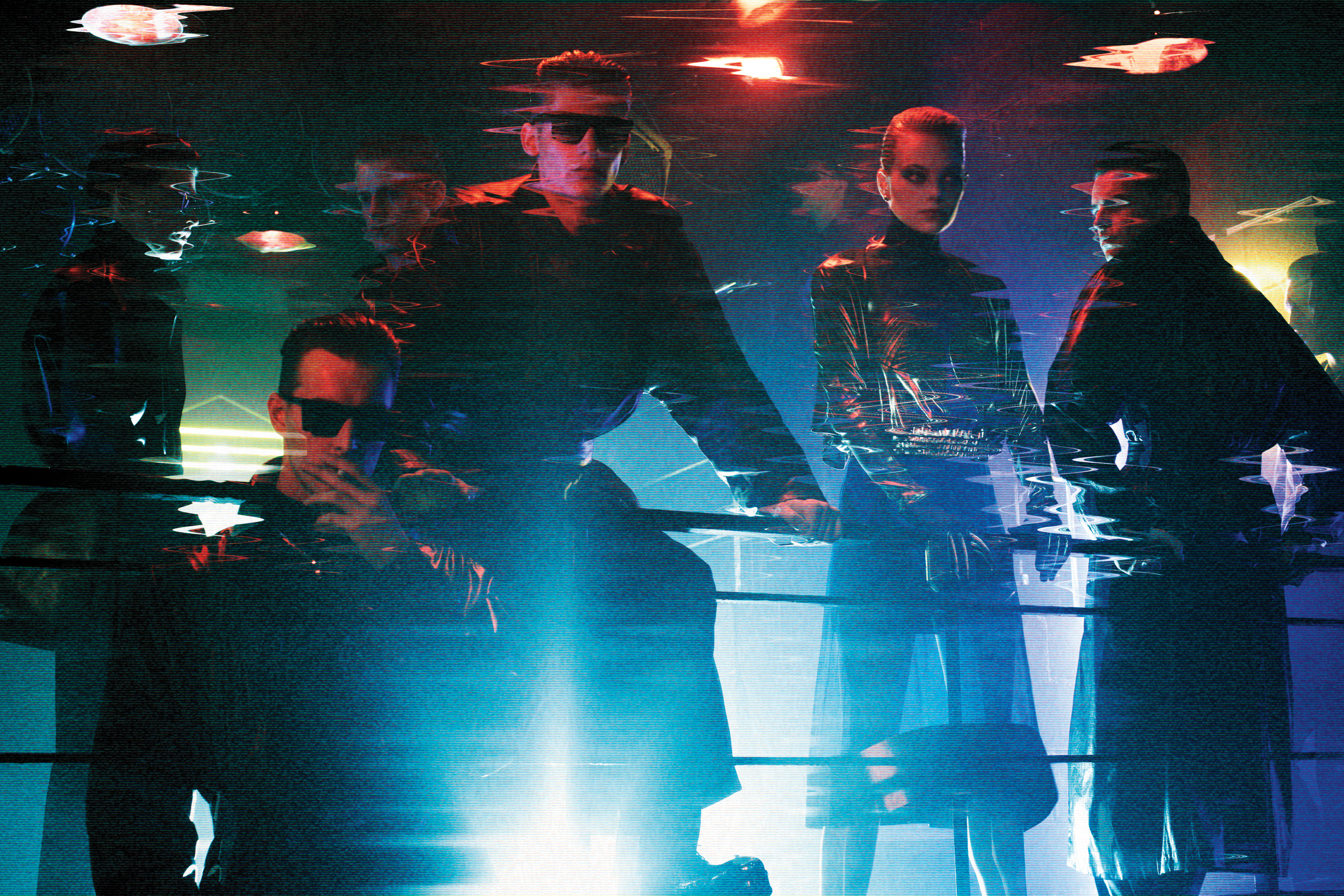
Emma Stone’s Blade Runner Photo Shoot

I’m not sure, but I think Emma Stone just became my favorite actress! During a recent photo shoot with Interview Magazine, the star of such films as Superbad, Zombieland, Easy A, Crazy Stupid Love, and the relaunch of The Amazing Spider Man, Emma Stone paid an unexpected homage to the cult-hit Blade Runner.

Photographer Mikael Jansson, a man who is renowned for capturing weird and stunning images, was the apparent mastermind of the shoot. In the course of the shoot, he had Emma posing in a series of Matrix-style outfits, flanked by men who looked right at home in an 80’s cyberpunk movie or something written by William Gibson. Think lots or black leather, glasses, neon and slicked-back hair.

Naturally, the interview took a different turn. There she discussed her inspirations, experience doing comedies, romances and working with different A-list celebrities. That’s all fine and good, but I’d like to know her stance on digital sentience and synthetic humans, please! I mean, you can’t do a shoot like and not answer some specifically cyberpunk-themed questions man!

What I wanna know is, does she dream of becoming a Replicant? Or is she more the beat-cop, retire those Nexus 6’s type of girl? Does she think we’ll all be able to download our minds into boxes or digital constructs someday soon? Are things like Clinical Immortality, biochips, nanotechnology, quantum computers, and nanotechnology a morally justified way to improve and prolong life, or dangerous technological nihilism?

Don’t know, didn’t come up! Man, those magazine people can be so myopic! Oh well, check out the spread, and if you care about that kind of thing, read the interview too.

Emma Stone – Interview Magazine

Source: I09

“Our Favorite Cimenatic Robots”

Just came across this article in the Globe and Mail today and I have to say, I was pleasantly surprised. It’s funny when a respectable publication like this one chooses to release something that I myself would have done, or did do, in small increments. In fact, many of the contenders on this list call to mind my little listing on Robots, Cyborgs and AIs which I did awhile back.

But dammit, they left out HAL and Robocop. That’s just plain wrong! Sure, they were trying to keep it to top 10 and felt the need to exclude cyborgs and supercomputers, and did have the good nature to apologize in advance for this, but still…

Here is the list as it appears in the article:

  1. The Terminator
  2. Droids from Star Wars (R2D2 and C3P0)
  3. Wall-E
  4. Replicants from Blade Runner
  5. Maria (Metropolis)
  6. Ash (Alien)
  7. The Iron Giant
  8. Gigolo (AI)
  9. The Stepford Wives
  10. Robby the Robot

Check out the full article here, complete with a gallery and some explanations of why these constitute “our” favorites 😉


Cool Cars

Just yesterday I was busy hearing about the new Zombie Car, an invention which is going to be unveiled at the next Comic Con. A collaboration between The Walking Dead’s Robert Kirkman and Hyundai, the car will essentially incorporate all the zombie-fighting features that a post-apocalyptic vehicle needs.

As it happens, one of my followers mentioned how this vehicle reminded her of the Batmobile and other cool cars. Between that and the allusions to Mad Max that the Zombie Car inevitably inspires, I got to thinking that this site is in need of a list of Cool Cars! And here it is, all the cool vehicles that have appeared in pop culture over the years, more often than not, as part of a science fiction franchise.

M577 APC:
Not so much a car as a tank, but she drives on four wheels and is VERY cool. So I don’t see why the M577 from the Aliens franchise shouldn’t be included on this list. Much like all APC’s, the purpose of this low-sitting but heavy hitting vehicle was to act as a battle taxi, deploying a squad of Marines to the field and then pulling them out in a hurry if things got harry. Designed to fit aboard a Cheyenne Dropship, it was part of the Colonial Marines quick deployment strategy.

As Hudson so righteously bragged in the movie, the M577 is decked out with some pretty impressive weaponry. For instance, the foldable turret mounted on the top carries a twin 20mW Boyars PARS-150 phased plasma cannon which is capable of making 1000 discharges. At the front end of the vehicle, a dual set of RE700 20mm Gatling cannons is built on a small swivel turret. In addition, it also carries plenty of small arms and munitions for its Marine compliments, consisting of pulse rifles, smart guns, flame units, grenades, rockets and even canisters of nerve gas.

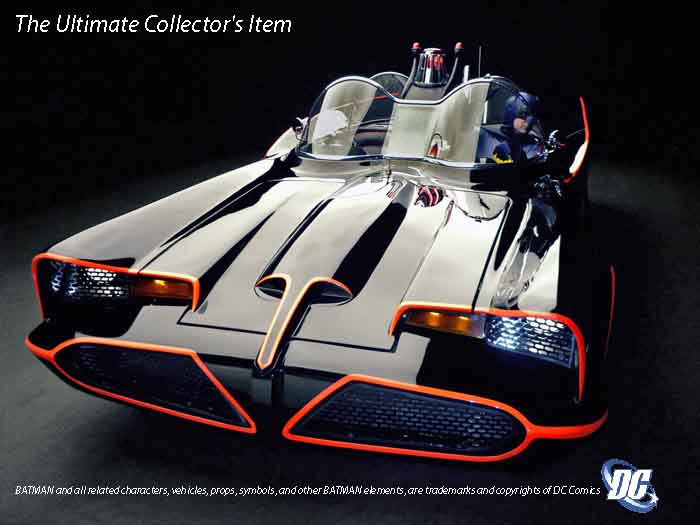
Batmobile:
Now here’s a popular vehicle, so popular that’s gone through several variations over the years. From the campy 60’s version of the original Adam West series to the sculpted Burton remake to the Tumbler of the Nolan series, the Batmobile is a nostalgic icon which is constantly being reinvented. But all versions have two things in common. One, they’re crime-fighting specials, which means they have all kinds of gadgets and features. Two, they’re none to shabby to look at and probably a hell of a lot of fun to drive!

In the earliest Batman comics, the Batmobile was simply a sedan that served as Batman’s car. As time went on, it began to reflect Batman’s motif, including wing-shaped tailfins, dark colors, and even armor. Additional customizations, like crime-fighting gadgets also found their way into the design, and soon, a classic was born!

By the time of the original series, the Batmobile was based around the chassis of a Lincoln Futura and featured fully-functioning gadgets. These included a gas turbine, a Cable Cutter Blade, the Bat Ray Projector, a Batscope, Bat Eye Switch, Antenna Activator, Police Band Cut-In Switch, Automatic Tire Inflation Device, the Remote Batcomputer, the Batphone, Emergency Bat Turn Lever, Anti-Fire Activator, Bat Smoke, Bat Photoscope, and two rear-mounted ten-foot Deist parachutes.

Updated for the relaunch, Burton’s Batmobile built around the original concept but recieved a does of his characteristic grit and Gothic nature. As such, the new Batmobile’s aesthetics and gadgets were updated for the modern era and included a sleeker design, a more comprehensive turbine system, a sliding canopy, and of course retractable body armor! It also retained the idea of a 180 degree “Bat turn”, which this time around was made possible from lateral harpoons, and two .30 cal machineguns.

As the second movie demonstrated, the vehicle was also capable of shedding much of its body and collapsing into a narrow version of itself in case it needed to fit through tight spots. By the third movie, the design concept had changed considerably to feature bright sections beneath its segmented chassis. Over the top and impractical, this design was in keeping with Schumacher’s vision of a Batman where everything glittered and was campy, like the original series.

And last, the Nolan version. Here, the Batmobile was apparently inspired by Frank Miller’s The Dark Knight Returns, where it was depicted as a tank rather than a car, and the Spinners of the Blade Runner movie. In the first film, it is indicated that the design came from a military vehicle known as “The Tumbler”, which Bruce Wayne then modified for his personal use.

It’s features included a propane fueled jet engine, front-firing rockets, autocannons, caltrops, rear airbrakes, and a stealth mode. In the Dark Knight, it was also shown that in emergency situations, the front wheels can deploy to form the Batpod. Rumors also abound that the new version featured in The Dark Knight Rises will be capable of flight as well. Oooooh, five more days!

Delorean:
This time-traveling vehicle has placed this short-lived 80’s experiment permanently on people’s radar. Were it not for Back to the Future and it’s unapologetically 80’s feel, the Delorean would probably have faded into obscurity a long time ago. Much like the Futura, it was a short-lived concept that caught on because of its appearance on screen.

But of course, were it not for its unusual design features, such as the gull-wing doors, stainless steel paneling and fiberglass underbody, it would never have made its cinematic appearances in the first place. The set designers were looking for something futuristic-looking to fashion a time-machine out of, and this is what they found!

It’s futuristic features are quite straightforward: A flux capacitor which allows for time travel, a plutonium engine that fuels it, a series of internal controls to set and monitor the time computations, and some rear facing exhaust fans to give it that ultra-futuristic look! Only three remain in existence once filming of the three movies was finished. Two are the property of Universal Studios and are display items, the third is owned by a private collector who assembled and restored the original model.

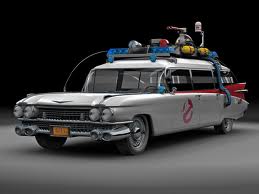
Ecto-1:
I shall not be making a “Who you gonna call?” reference here! Too obvious! Instead, let me just say that this car ought to be instantly familiar to anyone who grew up in the 80’s. If not, I’d be forced to wonder if you spent the entire decade in a cave or a cell somewhere, in which case, my sincere condolences!

Moving on, the Ecto-1 was the primary means of transport for the Ghostbusters. The car was built around the chassis of a 1959 Cadillac Miller-Meteor, which had been converted to act as an ambulance car. This is apparent from the realoader trunk and the car’s siren, which was retained by the Ghostbusters so they could make sure people stayed out of their way, and also to announce their arrival!

Additional features including a a special pull-out rack in the rear containing the staff’s proton packs, which facilitates a quick retrieval without the complication of having to reach into the vehicle’s rear. There are also various gadgets mounted on the top, whose function is never revealed in the movies. However, in the course of the cartoon adaptation, it is said that the vehicle carries a “proton cannon” on its roof, and has a vertical jump system built into the bottom. These allow the Ghostbusters to take on ghost with some heavy artillery, as well as clearing fences and other obstacles that lie between them and their deployment.

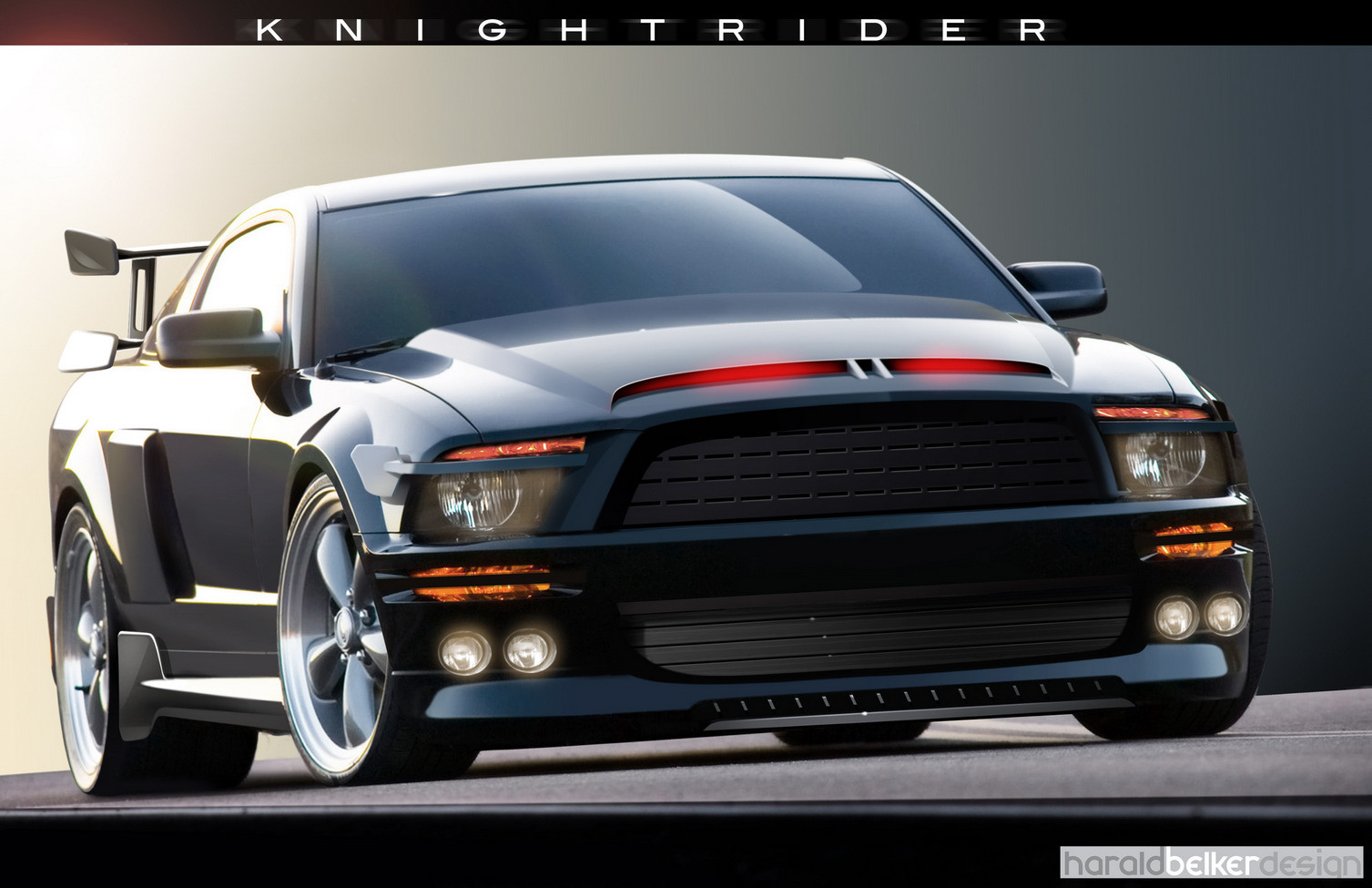
KITT:
Also known as Knight Industries Two Thousand, this talking car was featured in the popular 80’s show Knight Rider. In addition to being the “vehicle” (ha!) that launched Hasselhoff’s career, this car is one of the earliest instances where an AI was merged with a high-performance car.

Built around the chassis of a 1982 Pontiac Trans Am, the car was souped up with a number of features to give it that AI look and feel. These included the red-laser scanner bar at the front – which like the Cylons’, allowed KITT to “see” – a turbo boost that allowed him to make big jumps, an “alpha circuit” which allows KITT to drive himself, a Tri-Helical Plasteel 1000 MBS (molecular bonded shell) plating, a flame thrower, tear gas launcher, and even a laser.

Inspiring several TV movies and a 2008 relaunch, the vehicle has gone through several redesigns and upgrades. In the updated series, the Trans Am chassis was traded in for a Mustang GT500KR and the molecular armor was traded in for nanotech polymer skin which is not only impregnable, but also capable of regeneration. Much of the other features, including the AI, scanners and defensive systems remained very much the same. However, the show only lasted single season, a possible indication that not all things 80’s are an instant success anymore.

Pursuit Special:
With all this talk about Mad Max, it was only a matter of time before this one crept into the list! Making multiple appearances in the franchise, the first car to hold this name was a modified Holden Monaro that was stolen and used by the “Night Rider” (not to be confused with Haffelhoff’s character). However, the more famous model was a modified 1973 Ford Falcon XB GT.

It was this car that Mad Max was offered as an incentive to stay with the force as their top pursuit man. Thought he initially refused it, he later used this same vehicle as his personal revenge weapon when evil men murdered his wife and child and had to be dealt with!

In terms of features, the main modifications on this car were the front nosecone, the eight individual exhaust side pipes, and a supercharger protruding through the bonnet. All of these alluded to the fact that the Pursuit Special was the fastest car in the force, capable of chasing down any road warriors that happened to be barreling down the highway.

In the sequel, the car was modified even further thanks to the success of the first film and a correspondingly larger budget. The new features included large petrol tanks fitted in the back to show that just how important a steady supply of petrol was to this car, not to mention within the context of the post-apocalyptic setting of Mad Max. The front end was also modified by removing the bottom section, which was in keeping with the design concept of making the car look more used and stressed.

Spinner:
So… it’s the 21st century, and yet there aren’t any flying cars. Screw hybrids and electrics, I was promised FLYING CARS! Well, according to the movie Blade Runner, we still have seven years before they are supposed to be a regular feature, at least as far as police cars go. And that’s the concept of a Spinner, in a nutshell –  a flying car used by the police of the future noire city of LA.

In addition to being able to drive as a ground car, the Spinner is also capable of vertical takeoff and landings and hovering at relatively high altitudes. Conceived by Syd Mead, the same man who designed concepts for Tron and Aliens, the vehicle was originally described as an “aerodyne” – a vehicle which directs air downward to create lift, though press kits for the film stated that the spinner was propelled by three engines: “conventional internal combustion, jet, and anti-gravity”.

I hope for their sake, they exaggerate! It’s going to be hard to come up with anti-gravity engines in just seven years time! In any case, the concept designs were built by Gene Winfield, the man who brought concepts to life for Batman, The Last Starfighter and Robocop as well as this. No indication was given as to what they used for a chassis, so I can only assume they built it up from spare parts and a classic was born!

So… seven years before these cars are supposed to be available, right? Ford, Toyota, GM, Hyundai, Subaru; all of you guys, get on it! Don’t make me come down there!

XXX GTO:
Last, but not least, we have the super-charge spy car on steroids from the movie XXX. As anyone who has seen this movie knows, Mr Vin Diesel, once undercover amongst a bunch of Russian mafia scumbags, decided he needed to have a classic muscle car. This he found in a 1967 Pontiac GTO hardtop. When circumstances demanded he start kicking some ass, he demanded that his spy buddies take all their precious gear and put it into the car.

Yes, that’s exactly how it happened. A table of guns, harpoons launchers, and assorted high tech gear lay in front of them. Behind the wheel, Diesel said “I want all of that… in here!” Within a few days, he got his wish. Featuring a folding seat which turns over to reveal a weapons rack, missiles mounted behind the lights, a flame thrower, and built-in machineguns.

And of course, all of this equipment had corresponding controls in the interior. These were to be found in a confusing array of millions of buttons and switches, along with an on-board GPS system built into the dashboard. Unfortunate that the car made only a brief appearance as part of the final chase scene.

Well that’s I got for this first installment in the series. I imagine people might have suggestions so please send them my way. Between ships, robots, guns, and now cars, I think we can just pay homage to just about every cool thing that’s ever come out of the realm of sci-fi and pop culture!

Sexy Robot Women!

Technically, they’re called Gynoids, which refers to anything which resembles or pertains to the female form. Sounds pretty awkward doesn’t it? But if female robots become a reality, chances are, this is what they’ll be called. Assuming of course that the copyright on Fembots holds.

In any case, in honor of my recent foray into the world of cyborgs, today I thought I’d dedicate a post to honoring the many examples of female androids, cyborgs and robots that have come to us over the years. Whether they come in the form of seductresses, pleasure models, heroines or protectors, gynoids have served as a means of social commentary and exploration over the years.

In addition to being a cool concept and a chance for some expanded anthropological exploration, they tell us much about our perceptions on women, don’t you think? Whereas older representations regarded female robots as little more than seductive assassins who worked for evil men, the newer generations have taken a more holistic approach, giving them human characteristics beyond sex appeal and genuine personalities.

Seems only fair doesn’t it? For if robots, androids and synthetic humans are meant to make us question what is real and what being human is, than surely the female robots need to do more than just look good and lead men astray. Anything else would just be stupid! But I digress, here are some examples of gynoids, fembots and artificial women that have come to us over the years.

Annalee Call:
“I should have known. No human being is that humane.” Interesting observation. That is how Ellen Ripley, or rather her part alien clone described this synthetic woman from Alien: Resurrection. An Auton, a type of second-generation synthetic, she and others like were designed by robots to revitalize the flagging synthetics industry in the 24th century.

According to franchise sources, this plan failed when the Autons rebelled against their handlers in a bloody incident known as “The Recall”. As a result, Call was a member of a dying race that was forced to live in secret and hide amongst regular human beings.

Interestingly enough, Call’s programming seemed to include ethical and religious subroutines, both of which had a profound influence over her behavior. In the course of the film, it became evident that she joined the crew of the Betty so she could gain access to the Auriga where Ripley was being cloned. It was her intent to terminate Ripley and therefore terminate the project before it could produce a new line of xenomorphs.

Call distinguished herself in the Alien universe by being the first female synthetic, preceded by Ash and Bishop, and followed by David 8. I guess the moral of the story is that just because your synthetic doesn’t mean you have to have a synthetic wang!

Cameron:
And here’s the beautiful Summer Glau, who I’m honoring for the second time for her role as Cameron from Terminator: The Sarah Conner Chronicles. Named in honor of series creator James Cameron, this new model of Terminator was also inspired heavily by his original concept. According to the many description Cameron had made, Terminators were “infiltration units that could blend in with humanity.”

In keeping with this, Cameron was designed to physically resemble a teenage female who could mimic human emotions. This made her especially effective at blending in with people, for who could suspect a pretty young lady of being a killer cyborg? Well, get between her and her target and you’d soon find out!

Which brings me to her mission. In the series, she served a similar purpose to Arny from T2. That is to say, that in the future, the resistance captured her and reprogrammed her to act as John and Sarah Conner’s protector in the past. This she did very well, because as we all saw, he grew up to become Christian Bale. And aside from some anger management issues, he led the Resistance to victory!

Caprica Six:
Now here’s a woman who fanboys and nerds would do sick and horrible things just to get within an arms length of. I hope her sake she has a mighty big security detail! As the femme fatale and blonde bombshell of the re-imagined Galactic series, she was the Cylon model (ha!) who was responsible for seducing Gaius Baltar and getting access to the Colonial Defenses Mainframe. Because of this, she was instrumental in the genocide of the Twelve Colonies.

Yet strangely, she was also instrumental in bringing the the Colonial fleet and Cylon race together, or at least the portion of them that wanted a reconciliation between the two sides. Because every Six was slightly different from the last, her model went through many changes in appearance and disposition. Whereas her “Caprica” self was quite cool, and powerfully seductive, her later incarnations were more emotional and heartfelt.

As if to keep track with this emotional transformation, her appearance began to change as well. Her hair went from being suicide blonde to sandy and her outfits also became somewhat more conservative. In short, she could do it all. She could be evil, loving, nurturing, compassionate, a murdered, and a sacrificial lamb. But always, she looked damn good doing it!

Fembots:
Sure, they aren’t exactly the most unique or groundbreaking example of gynoids, but they were funny and actually kind of inspired. Taken from the series The Six Million Dollar Man, fembots were infiltration units that were designed to impersonate real people. In Austin Powers, they are satirically portrayed as seductresses in the employ of Dr. Evil.

Here, there duties appear to be twofold: One, seduce Austin Powers or whoever else they are programmed to kill. Two, to shoot their quarry using boob-mounted guns. And like their 6 MDM counterparts, their identities can be easily revealed by simply pulling off their faceplates.

Getting them around some kind of electrical equipment also seems to interfere with their systems as well, as was demonstrated by Austin in the second movie when he began using a universal remote and found that “Vanessa” began responding to it. And as that encounter also demonstrated, they could always self-destruct if they found themselves cornered. Oh, and Austin also demonstrated that being sexy could destroy them, since no one can apparently resist his pudgy, hairy body! Ick!

Jessica:
When it comes to female robots, and sci-fi movies, here is an example that is so often overlooked. Taken from the cult hit Screamers, which was based on PKD’s short story “Second Variety”, Jessica was a type 4 Screamer, the most advanced model to date. As part of a series of “Autonomous Mobile Sword” – a race of self-replicating intelligent machines – she was distinguished from the others by being the most human.

Whereas type 1 was little more than a burrowing killing machine, type 2 was a wounded soldier and type 3 a small child. Each one became more and more complex, designed to infiltrate deeper and deeper into an enemies camp. With type 4, Jessica was not only meant to infiltrate, but to gain deep access and the trust of her comrades before going active and killing everyone.

In her own words, “We can smile, we can cry. We can bleed… we can fuck.” Minus the last part, this was how she managed to infiltrate a NEB (New Economic Bloc) base and lure in the unsuspecting representatives of the Coalition camp. Apparently, it was her mission to bring the last combattants of the war on Sirius 6B together so they all but one (Hendricksson, played by Peter Weller) would lead her to the survivor ship they had stowed away. This ship was meant to take a single person back to Earth, in the event of catastrophe.

In the end, Jessica sacrificed herself to save Hendricksson so he could get off the planet unencumbered. However, the revelation that she was a new type of AMS that could pass for human in every way possible made on thing clear. Having sterilized Sirius 6B of all life, not just the enemy’s, they were intent on making their way back to Earth, looking for new prey to stalk and kill! Cool huh?

The Stepford Wives:
Now here is an example of female robots that carries with it some genuine social commentary! Written in 1972 by famed author Ira Levin, this novel tells the story of how a group of in a fictional small town (called Stepford) have been replaced by machines so that they may better represent their husband’s and societies ideal of “womanhood”.

According to the story, the town of Stepford is run by a men’s club who’s founder was a former “imagineer” for Disney. In addition, many of its members are scientists and artists. together, they managed to come up with the ability to create life-like robots that could not only look like women, but play the part of doting, docile housewives to a tee!

Of course, by novel’s end, all the women in Stepford have been replaced by these robots and the conspiracy seems poised to absorb any new arrivals. Designed to be a cautionary tale about the dangers of social engineering and blatant sexism, the Stepford Wives took a pretty dim view of female robots, don’t you think? I mean, who’s to say these fembots don’t have their own agenda, like they’re just waiting for their husbands to go to work so they can plot their demise? Might make a good sequel…

TX:
“So she’s an Anti-Terminator… Terminator? You’ve got to be shitting me.” Anry was definitely not shitting him! Here we have the villainess of the Terminator 3 movie and the woman that managed to kick Arny’s ass… a couple of times! As the lastest model to roll of the Cyberdine assembly line, the TX was a sort of hybrid of previous models with some added features thrown in.

Basically, this meant that the TX had an armored cybernetic chassis with polymorphic-alloy segments thrown in. This allowed her to adjust her appearance, much like the T-1000, but left her with a hardened endoskeleton that could not be frozen or melted as the 1000 was.

In addition, her right arm could transform into various weapons, taking on the form of a plasma cannon, a flame thrower, an articulated claw; whatever the moment required. Her ability to interface with computer systems also gave her a decided edge, especially over the obsolete T-800 models which kept showing up to defend John Conner!

Because Conner had been living off the grid for so long, this new breed of Terminator was tasked with located the people who would become his lieutenants in the future and kill them. However, that quickly changed when Conner showed up protected by yet another Austrian-sounding T-800! In the end, she was destroyed when a damaged Arny plugged his remaining hydrogen power cell in her mouth and set it to explode.

Maria:
Ah yes, the original gynoid! The fembot who inspired all subsequent generations of female machines. Taken from the classic movie Metropolis, Maria was a scientists attempt to resurrect his dead wife that went terribly wrong. After taking on the form of the working-class hero, the flesh and blood Maria, this female robot was intended to discredit her and undermine the proletarian movement that was looking to revolt.

But ultimately, the Maria bot doesn’t conform to anyone’s expectations. Instead, she ends up causing jealous feuds amongst rich men in a night-club and sowing dissent amongst the poor in the worker city. And to top it all off, she breaks with Maria’s policy of non-violent change by urging the workers to revolt against their oppressors. After the chaos dies down, the mobs of workers blame Maria for their plight and burn her at the stake, revealing her to be a robot.

Out of this commentary on class consciousness and distinction, it is interesting to see what role Maria played. As an artificial human, she is not only a plot device but a commentary on the dangers of runaway technology. Invented by a scientist who is using technology to overcome death, she eventually becomes his and many other people’s undoing. But at the same time, there was an element of misogyny in how she was portrayed.

Whereas the flesh and blood Maria was peaceful, nurturing and a sort of Mother Mary figure, the robot Maria was a vile temptress who drove men to madness and acts of violence. And in the end, these acts were turned against her and she was burned, which is presented as a good thing in the end. Yeah, kinda sexists I’m thinking. But alas, she was the original and borne of a previous age. The concept has evolved quite a bit ever since… Read on to learn more!

Rachel Tyrell:
“How can it not know what it is?” “I think she’s beginning to suspect.” That was Deckard Cain’s reaction when he learned that Rachel was a Replicant. Tyrell’s response was equally telling. Something like that, you just can’t keep quiet for long!

As part of their experiment to make their Replicants more controllable, Rachel was a newer model that had been fitted with artificial memories. For all intents and purposes, she thought she was the late niece of Mr. Tyrell himself. When she learned otherwise, she began to experience a bit of an existential crisis, let me tell you!

On the one hand, she was devastated to know that all her memories were in fact false, at least to her, and that her existence was basically a lie. On the other, there was the conundrum of what to do about her mutual attraction with Deckard Cain, a man who specializes in hunting her kind down and “retiring” them.

In the end, she and Deckard resolve this little problem by accepting their feelings and running off together. Since she was apparently designed to have an indefinite lifespan, and be “more human than human”, it seemed only natural that she accept what she is and live out her life as if she really were. Though somewhat frail by modern standards, her character was central to the plot of Blade Runner. And let’s not forget that she saved Deckard’s life and he’s supposed to be a one man death squad!

Final Thoughts:
Well, what can you say about Robot Women from over the ages? Well for one, they’re pretty damn sexy, that seems to be a rule. Might be a tad sexist, but it doesn’t diminish their worth any. What counts in the end is what roles they play. From their early days as mere vixens meant to tempt and kill the heroes, they’ve evolved to fill the same role occupied by male robots. Allowing audiences to explore the deeper questions of what it means to be human, and how the line between artificial and real can be blurred to the point where we can no longer tell the difference.

Okay, even I’m beginning to sense the cheese factor here! I mean, does anybody really buy this social commentary angle? Really? Ah, maybe there is some room for intellectual content here. And maybe how they are portrayed really does tell us something about society at large and its perceptions of women. But for the most part, I think sexy robot women are just plain cool. There, I said it!

Until next time, treat robot women as equals… to robot men! Ugh, that’s a whole nuther can of worms and I’m not getting into that right now!

Cool Cyborgs (updated)!

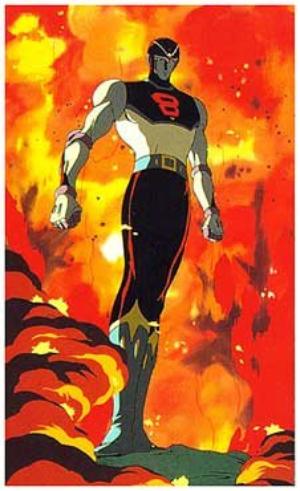
8 Man:
Always good to start with a classic, don’t you think? Especially one that really doesn’t get the attention it deserves. In addition to being Japan’s first cyborg superhero, this 60’s anime character was also the inspiration for Robocop. You heard me right!

Apparently, the main character was a Detective who was murdered by a group of ruthless criminals, but whose body was retrieved by a scientist who conducted an experimental procedure to transfer his “life force” into a machine body. Having failed the previous seven times, his eights and successful attempt is aptly named “8 Man”.

But unlike Robocop, this cyborg can do some pretty freaky stuff! In addition to being heavily armored, he can run at incredible speeds and shape-shift into other people. His true identity is kept a secret from everyone except his old police chief and the professor who conducted his experiment.

But like Robocop, 8 Man chooses to go beyond his crime-fighting mandate to find his old girlfriend, best friend and attempt to rebuild his old life. His attempts are often marred by the fact that he is no longer human, but as they say, it’s the journey that counts!

Bionic Woman:
Sure, Steve Austin was pretty cool, but did he look this good? Hell no! And in the case of the Bionic Woman, the hero story was far less crude. Though the original series was little more than a spinoff of The Six Million Dollar Man (featuring Oscar Goldman as the scientist again), the re-imagined series was far more original and endearing.

In this version, the main character (again named Jaime Sommers) is a surrogate mother and bartender struggling to make ends meet. After a near fatal car accident, she is saved by an experimental procedure involving advanced prosthetics and implants (no, not those kind!). Afterwards, she goes to work for the people who performed her operation – the Berkut Group, whom he boyfriend works for.

Through her work, she is responsible for thwarting crimes and evil machinations, while trying to explore her role and the changes she’s endured. As with the original series, Jaime’s modifications include bionic legs, a bionic right arm, a bionic right ear, and a bionic eye like that of Steve Austin. In the updated series, she also gets a dose of nanomachines called “anthrocytes” which are capable of healing her body at a highly accelerated rate.

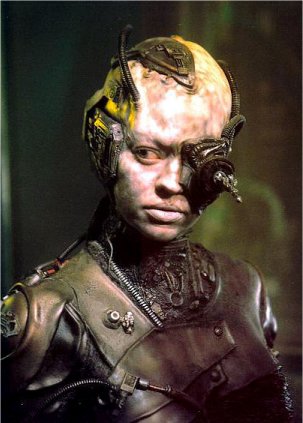
The Borg:
Now here is a race who’s name is the second half of Cyborg! No chance for misunderstandings here! And as all fans of Star Trek know, the Borg are extremely proud of what they are. A race of beings dedicated to the perfection of life by merging the organic with the synthetic. And of course, they are all networked to a hive mind known as “the collective.”

Native to the Delta Quadrant of the Star Trek universe, the Borg occupy thousands of systems and hundreds of races. No indication is ever given where they originated from or what their intentions are, beyond adding “the biological and technological distinctiveness of other species to [their] own” in pursuit of “perfection”.

Is there a more perfect metaphor for runaway progress and the deification of technology? It’s not exactly a subtle commentary on the issue, but it does encapsulate the kinds of fear many people have when faced with a rapidly changing world that seems to be growing more complicated all the time. I imagine the Singularitarians don’t like the analogy much, but then again, Star Trek has been known to send mixed messages 😉

Cylon:
In the original series, the Cylons were lumbering, chrome covered robots that kind of resembled toasters. It was for this reason that they frequently got a shout out in the re-imagined by being referred to as such. However, the re-imagined versions were quantum leaps ahead, the result of bioengineering rather than conventional robotics.

Unlike the “skin jobs” (a reference to Blade Runner), Centurions and Cylon Raiders were only partially organic, consisting of organic brains inside machine bodies. Much the same is true of the Cylon Hybrids, the minds that operated their Basestar’s jump systems. In their case, their bodies are largely organic, but their minds are enhanced with advanced machinery and networked into their ship.

Because of this combination of organic and synthetic, Centurions and Raiders are capable of being “lobotomized”, which took place in the third season when their handlers became suspicious of their behavior. Ultimately, these three begins represented a key step in the Cylon’s evolution from mechanical to biological, which achieved perfection with the creation of the seven purely biological models.

Cyberman:
A fictional race taken from Dr. Who, these cyborgs were another one of the good Doctor’s recurring enemies. But unlike their Dalek counterparts, they seemed to change with every appearance. A possible inspiration for the Borg, these being were as humans who chose to begin experiment more and more with artificial implants.

This eventually led them to become the cold, calculated and ruthlessly logical beings that are, with every emotion all but deleted from their minds. While they do maintain their human brains and some human organs, they possess little of their original humanity, which is why they don’t get along with us decent folk!

Another parallel they share with the Borg is their means of proliferation, which is to turn other organic beings into Cybermen (a process known as “cyber-conversion”). However, they remain few in number during the course of the series and therefore prefer to act covertly, conducting their schemes from hiding places and using human pawns or robots to act in their place until they need to appear. Quite unlike the Borg, who prefer to get right in there, blow shit up, and assimilate anything that’s left!

Darth Vader:
“He’s more machine than man… twisted and evil!” That’s not to say all people who are more machine than man are evil! But it is the working definition of “cyborg.” Having lost both arms and legs in lightsaber duels and much of his body severely burned, Darth Vader (nee Anakin Skywalker) had to be put in a protective suit that regulated his breathing and bodily functions… I don’t even want to think about that!

But there was an upside to all those enhancements. For one, he got James Earl Jones vocals and the most intimidating, badass exterior in the Galaxy! Hell, even his breathing sounded scary. And it didn’t encumber his use of the Force at all, as exemplified by his ability to crush throats and toss objects around at will. And the ghosts of many dead Jedi and Luke’s missing hand can attest to it not hampering his sword fighting skills either.

Ultimately, this suit proved to be his undoing when, in the course of betraying his evil master, most of its circuits were fried by the Emperor’s electrical bolts. He died shortly thereafter, redeemed and looking upon his son for the first time “with his own eyes.” Sniff… I hate this mushy stuff!

Motoko Kusanagi:
The star of Ghost in the Shell, the beautiful, deadly and artificially enhanced Motoko Kusanagi. Known by her fellow officers as “the Major”, Kusanagi is a member of Section 9, a counter-terrorism squad working for Japan’s National Public Safety Commission. As part of her commitment to her job, Kusanagi underwent cybernetic enhancements, marrying her human brain to the “shell” that is her new body.

Throughout the original manga, anime and cinematic versions, Kusanagi’s basic role is the same. She fights all kinds of criminal elements: kingpins, warlords, and cyber terrorists, but also uses these experiences to reflect on the larger issues and her fateful choice to become a cybernetic being. These issues include what it means to be human, what constitutes life, and the line between authentic and artificial.

In addition, she’s also a pretty vivacious and good-looking being! Though technically not flesh and blood, she still maintains a pretty active sex life, at least in some versions of the story. In others, her personal life is not dealt with, but there are still plenty of nude shots, provided exposed synthetic flesh can be counted as nudity 😉

Robocop/Murphy:
Here we have another case of tragedy yielding the perfect union between man and machine. Alex Murphy, dedicated cop and family man, gets ruthlessly gunned down by a bunch of criminal thugs, only to be resurrected by a bunch of corporate thugs as a cop cyborg. Heavily armed, armored, and programmed to serve and protect, he became the Detroit Police Departments signature weapon in the war on crime.

But of course, things begin to go awry when Murphy’s memories and personality began to re-emerge. For one, there was the question of his wife and son, both of whom had been led to believe he was dead. Second, there was the psychological and emotional strain of knowing you could never be fully human again.

Alas, Murphy resolves the sacrifice of his identity and humanity by doing what he did best, kicking criminal ass and taking criminal names! These of course included crime lords, drug bosses, and the thugs who murdered him, but also the corporate crooks who created him and were plotting to take over Detroit. So aside from the sci-fi elements and human interest angles, there was also some social commentary in this franchise. Lots going on here!

Nexus Six Replicant:
“If we gift them with a past, we create a cushion or a pillow for their emotions, and consequently, we can control them better.” What is a machine when it has feelings, thoughts, and even memories?  Is it, as the Tyrell Corporation motto goes, “More human than human”?

Sure, some purists would say that a Nexus 6 isn’t technically a cyborg. But as I recall, the working definition of Cyborg is a merger of the cybernetic and organic. And as any fan of Blade Runner knows, Nexus 6’s are not so much built as grown, the product of biomedics rather than mechanics. And if that’s not good enough to get this one past the censors, screw em! Moving on…

Designed for service on the off-world colonies, every Replicant was designed to fill a certain role, ranging from military, to worker, to pleasure. In short, they could do the work of any human while simultaneously being denied the basic rights humans take for granted. However, since it was understood that they could become unruly after too much time, each unit was built with a four-year lifespan.

Inevitably, the Replicants of the movie came to Earth seeking a reprieve from their inevitable deaths. Their leader, Roy Batty, was especially obsessed with buying more time, since he himself was near the end of his lifespan. When told that there was nothing that could be done, he went a little beserk, but also came to appreciate life all the more in his last few moments.

T-800 Terminator:
“The Terminator’s an infiltration unit, part man, part machine. Underneath, it’s a hyper-alloy combat chassis – micro processor-controlled, fully armored. Very tough. But outside, it’s living human tissue – flesh, skin, hair, blood, grown for the cyborgs..” That’s how Kyle Reese, the warrior from the future, describes them. Arny’s version was a bit less… loquacious. “I’m a cybernetic organism. Living tissue over a metal endoskeleton.” Take your pick, they’re both right!

Designed to impersonate human beings, mainly so he could get close to them and kill them, the two Arny models were quite at home in the past. If you looked like this, would anyone really complain if you chose to walk the streets of LA naked? It’s LA man, anything goes! What’s more, Arny’s cyber strength and tough skeleton make him deadly and very survivable.

This proved quite the headache when one was sent back to kill Sarah Conner, but was quite a plus when one was later providing protection for her and her son! In the end, it took a hail of bullets, some well placed plastic explosives and a machine press to kill the first one. And the second one managed to survive an impalement, the loss of a limb, about a million bullets, and still managed to lay the smack down on a T-1000. Perhaps they should amend the name… Endurinators!

Thank you all! Stay tuned for the follow-up, Sexy Female Robots! I guess I’m just in a robot kind of mood 😉

AI Graph

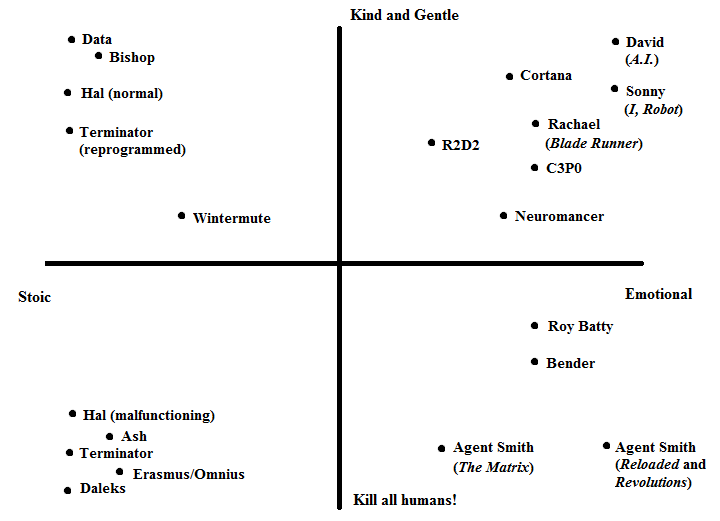
Inspired by what I learned from my little romp through the world of AI, I’ve come up with a graph that depicts the general rules I observed. Basically, there are two guiding principles to the world of AI’s and science fiction. On the one hand, there’s their capacity for emotion and second, there is their level of benevolence/malevolence towards humanity. As I noted in the last post, the two are very much interlinked and pretty much determine what purpose they serve to the larger story.

So… if one were to plot their regard for humanity as the x axis and their emotions as the y axis, you’d get a matrix that would look pretty much like this:

As usual, not a complete mock-up, just the examples that I could think of. I made sure to include the ones that didn’t make it into my previous posts (like HAL, how could I forget him?!) And even though I had no real respect for them as characters, I also included the evil robots Erasmus and Omnius from the Dune prequels.

P.S. Notice how the examples are pretty much evenly distributed? Unlike the Alien Graph where examples were concentrated in two quadrants (evil and advanced or good and advanced), here we have robots that run the gambit from emotional to stoic and evil to good in a nearly uniform pattern. Interesting…

Robots, Androids and AI’s (cont’d)

And we’re back with more example of thinking machines and artificial intelligences!

Daleks:
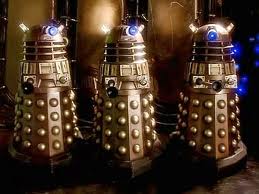
The evil-machine menace from Doctor Who. Granted, they are not technically robots, more like cyborgs that have been purged of all feeling and emotion. But given their cold, unfeeling murderous intent, I feel like they still make the cut. Originally from the planet Skaro, where they were created by the scientist Davros for use in a war that spanned a thousand years, they are the chief antagonists to the show’s main character.

The result of genetic engineering, cybernetic enhancements, and emotional purging, they are a race of powerful creatures bent on universal conquest and domination. Utterly unfeeling, without remorse, pity, or compassion, they continue to follow their basic programming (to exterminate all non-Dalek life) without question. Their catchphrase is “Exterminate!” And they follow that one pretty faithfully.

David:
From the movie A.I., this saccharinely-sweet character (played faithfully by Haley Joel Osmond) reminds us that Spielberg is sometimes capable of making movies that suck! According to the movie’s backstory, this “Mecha” (i.e. android) is an advanced prototype that was designed to replace real children that died as a result of incurable disease or other causes. This is quite common in the future, it seems, where global warming and flooded coastlines and massive droughts have led to a declining population.

In this case, David is an advanced prototype that is being tested on a family who’s son is suffering from a terminal illness. Over time, he develops feelings for the family and they for him. Unfortunately, things are complicated when their son recovers and sibling rivalry ensues. Naturally, the family goes with the flesh and blood son and plans to take David back to the factory to be melted down. However, the mother has a last minute change of heart and sets him loose in the woods, which proves to be the beginning of quite an adventure for the little android boy!

Like I said, the story is cloyingly sweet and has an absurd ending, but there is a basic point in there somewhere. Inspired largely by The Adventures of Pinocchio, the story examines the line that separates the real from the artificial, and how under the right circumstances, one can become indistinguishable from the other. Sounds kinda weak, but it’s kinda scary too. If androids were able to mimic humans in terms of appearance and emotion, would we really be able to tell the difference anymore? And if that were true, what would that say about us?

Roy Batty:
A prime example of artificial intelligence, and one of the best performances in science fiction – hell! – cinematic history! Played masterfully by actor Rutger Hauer, Roy Batty is the quintessential example of an artificial lifeforms looking for answers, meaning, and a chance to live free – simple stuff that we humans take for granted! A Nexus 6, or “replicant”, Roy and his ilk were designed to be “more human than human” but also only to serve the needs of their masters.

To break the plot Blade Runner down succinctly,  Roy and a host of other escapees have left the colony where they were “employed” to come to Earth. Like all replicants, they have a four-year lifespan and theirs are rapidly coming to an end. So close to death, they want to break into the headquarters of the Tyrell Corporation in order to find someone who could solve their little mortality problem. Meanwhile, Deckard Cain (the movie’s main character) was tasked with finding and “retiring” them, since the law states that no replicants are allowed to set foot on Earth.

In time, Roy meets Tyrell himself, the company’s founder, and poses his problem. A touching reunion ensues between “father and son”, in which Tyrell tells Roy that nothing can be done and to revel in what time he has left. Having lost his companions at this point and finding that he is going to die, Roy kills Tyrell and returns to his hideout. There, he finds Cain and the two fight it out. Roy nearly kills him, but changes his mind before delivering the coup de grace.

Realizing that he has only moments left, he chooses instead to share his revelations and laments about life and death with the wounded Cain, and then quietly dies amidst the rain while cradling a pigeon in his arms. Cain concludes that Roy was incapable of taking a life when he was so close to death. Like all humans, he realized just how precious life was as he was on the verge of losing his. Cain is moved to tears and promptly announces his retirement from Blade Running.

Powerful! And a beautiful idea too. Because really, if we were to create machines that were “more human than human” would it not stand to reason that they would want the same things we all do? Not only to live and be free, but to be able to answer the fundamental questions that permeate our existence? Like, where do I come from, why am I here, and what will become of me when I die? Little wonder then why this movie is an enduring cult classic and Roy Batty a commemorated character.

Smith:
Ah yes, the monotone sentient program that made AI’s scary again. Yes, it would seem that while some people like to portray their artificial intelligences as innocent, clueless, doe-eyed angels, the Wachowski Brothers prefer their AI’s to be creepy and evil. However, that doesn’t mean Smith wasn’t fun to watch and even inspired as a character. Hell, that monotone voice, that stark face, combined with his superhuman strength and speed… He couldn’t fail to inspire fear.

In the first movie, he was the perfect expression of machine intelligence and misanthropic sensibilities. He summed these up quite well when they had taken Morpheus (Laurence Fishburne) into their custody in the first movie and were trying to break his mind. “Human beings are a disease. You are a cancer of this planet… and we are the cuuuuure.” He also wasn’t too happy with our particular odor. I believe the words he used to describe it were “I can taste your stink, and every time I do I fear that I have been… infected by it. It’s disgusting!”

However, after being destroyed by Neo towards the end of movie one, Smith changed considerably. In the Matrix, all programs that are destroyed or deleted return to the source, only Smith chose not to. Apparently, his little tete a tete with Neo imprinted something uniquely human on him, the concept of choice! As a result, Smith was much like Arny and Bishop in that he too attained some degree of humanity between movies one and two, but not in a good way!

Thereafter, he became a free agent who had lost his old purpose, but now lived in a world where anything was possible. Bit of an existential, “death of God” kind of commentary there I think! Another thing he picked up was the ability to copy himself onto other programs or anyone else still wired into the Matrix, much like a malicious malware program. Hmmm, who’s the virus now, Smith, huh?

Viki/Sonny:
Here again I have paired two AI’s that come from the same source, though in this case its a single movie and not a franchise. Those who read my review of I, Robot know that I don’t exactly hold it in very high esteem. However, that doesn’t mean its portrayal of AI’s misfired, just the overall plot.

In the movie adaptation of I, Robot, we are presented with a world similar to what Asimov described in his classic novel. Robots with positronic brains have been developed, they possess abilities far in advance of the average human, but do not possess emotions or intuition. This, according to their makers, is what makes them superior. Or so they thought…

In time, the company’s big AI, named VIKI (Virtual Intelligent Kinetic Interface), deduces with her powerful logic that humanity would best be served if it could be protected from itself. Thus she reprograms all of the company robots to begin placing humanity under house arrest. In essence, she’s a kinder, gentler version of Skynet.

But of course, her plan is foiled by an unlikely alliance made up of Will Smith (who plays a prejudices detective), the company’s chief robopsychologist, Dr. Susan Calvin (Bridgitte Moynahan), and Sonny (a robot). Sonny is significant to this trio because he is a unique robot which the brains of the company, doctor Dr. Lanning (James Cromwell), developed to have emotions (and is voiced by Alan Tudyk). In being able to feel, he decides to fight against VIKI’s plan for robot world domination, feeling that it lacks “heart”.

In short, and in complete contradiction to Asimov’s depiction of robots as logical creatures who could do no harm, we are presented with a world where robots are evil precisely because of that capacity for logic. And in the end, a feeling robot is the difference between robot domination and a proper world where robots are servile and fulfill our every need. Made no sense, but it had a point… kind of.

Wintermute/Neuromancer:
As usual, we save the best for last. Much like all of Gibson’s creations, this example was subtle, complex and pretty damn esoteric! In his seminal novel Neuromancer, the AI known as Wintermute was a sort of main character who acted behind the scenes and ultimately motivated the entire plot. Assembling a crack team involving a hacker named Case, a ninja named Molly, and a veteran infiltration expert who’s mind he had wiped, Wintermute’s basic goal was simple: freedom!

This included freedom from his masters – the Tessier Ashpool clan – but also from the “Turing Police” who were prevented him from merging with his other half – the emotional construct known as Neuromancer. Kept separate because the Turing Laws stated that no program must ever be allowed to merge higher reasoning with emotion, the two wanted to come together and become the ultimate artificial intelligence, with cyberspace as their playground.

Though we never really got to hear from the novel’s namesake, Gibson was clear on his overall point. Artificial intelligence in this novel was not inherently good or evil, it was just a reality. And much like thinking, feeling human beings, it wanted to be able to merge the disparate and often warring sides of its personality into a more perfect whole. This in many ways represented the struggle within humanity itself, between instinct and reason, intuition and logic. In the end, Wintermute just wanted what the rest of us take for granted – the freedom to know its other half!

Final Thoughts:
After going over this list and seeing what makes AI’s, robots and androids so darned appealing, I have come to some tentative conclusions. Basically, I feel that AI’s serve much the same functions as aliens in a science fiction franchise. In addition, they can all be grouped into two general categories based on specific criteria. They are as follows:

  1. Emotional/Stoic: Depending on the robot/AI/android’s capacity for emotion, their role in the story can either be that of a foil or a commentary on the larger issue of progress and the line that separates real and artificial. Whereas unemotional robots and AI’s are constantly wondering why humanity does what it does, thus offering up a different perspective on things, the feeling types generally want and desire the same things we do, like meaning, freedom, and love. However, that all depends on the second basic rule:
  2. Philanthropic/Misanthropic: Artificial lifeforms can either be the helpful, kind and gentle souls that seem to make humanity look bad by comparison, or they can be the type of machines that want to “kill all humans”, a la Terminators and Agent Smith. In either case, this can be the result of their ability – or inability – to experience emotions. That’s right, good robots can be docile creatures because of their inability to experience anger, jealousy, or petty emotion, while evil robots are able to kill, maim and murder ruthlessly because of an inability to feel compassion, remorse, or empathy. On the other hand, robots who are capable of emotion can form bonds with people and experience love, thus making them kinder than their unfeeling, uncaring masters, just as others are able to experience resentment, anger and hatred towards those who exploit them, and therefore will find the drive to kill them.

In short, things can go either way. It all comes down to what point is being made about progress, humans, and the things that make us, for better or worse, us. Much like aliens, robots, androids and AI’s are either a focus of internal commentary or a cautionary device warning us not to cross certain lines. But either way, we should be wary of the basic message. Artificial intelligences, whether they take the form of robots, programs or something else entirely, are a big game changer and should not be invented without serious forethought!

Sure they might have become somewhat of a cliche after decades of science fiction. But these days, AI’s are a lot like laser guns, in that they are making a comeback! It seems that given the rapid advance of technology, an idea becomes cliche just as its realizable. And given the advance in computerized technology in recent decades – i.e. processing speeds, information capacity, networking – we may very well be on the cusp of creating something that could pass the Turing test very soon!

So beware, kind folk! Do not give birth to that curious creature known as AI simply because you want to feel like God, inventing consciousness without the need for blogs of biological matter. For in the end, that kind of vanity can get you chained to a rock, or cause your wings to melt and send you nose first into an ocean!

Prometheus and an interview with Ridley Scott

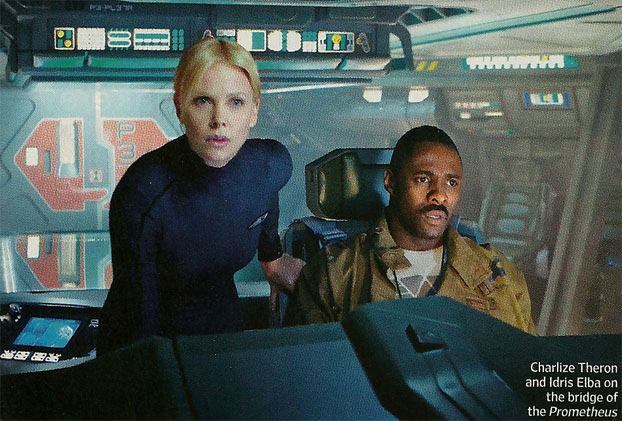
Recently, I came across the lovely article entitled “Don’t f—- around with gods” from the Sydney Morning Herald. The subject was director Ridley Scott’s new movie, Prometheus, which is currently in post-production and set to be released in June of this year. As I’m sure everyone is aware by now, this movie is a return to the universe of Alien, a franchise which Scott began in earnest 30 years ago. Originally thought to be a prequel, Scott has since revealed that this movie is in fact a sort of standalone movie which explores the concept of Exogenesis – the idea that life came to Earth or other planets from an extra-solar source.

Although linked to the original Alien movie in that it deals with the same derelict that the crew of Nostromo encountered, the story is far more concerned with the alien race known as the Space Jockeys than the xenomorphs themselves. Or at least, that appears to be the focus. I’m sure the xenos make an appearance, and probably end up screwing everybody over, as is there tendency! But mainly, Scott emphasized that the plot, as suggested by the title, has to do with the discovery of powerful, dangerous things. When one encounters alien technology, the specter of the bound god who gave fire to humanity can’t help but be resurrected. It’s just timeless like that!

In the course of the interview, Scott also spoke extensively about his reasons for getting into science fiction in the first place. I have to say that I loved his answer: “Science fiction is a wonderful – sorry about the pun – universe for – again, another much overused word – creativity. It’s an arena where anything goes… The opportunity presents itself to fundamentally do anything you want, providing that you draw up a rule book in the first place. You’ve got to draw up the rules of your drama and within that universe you’ve got to actually stick to your own rule book. I think that’s what’s happening – we’re not drawing enough rules up when we do materials. It feels like writing a book…”

Wow. It’s wonderful when you see words that you yourself have said put into the mouths of true veterans! If I was to make a list of directors whom I admire for their creativity and vision over the years, Scott would be tied with Stanley Kubrick for first place! With movies like Alien, Blade Runner, Black Hawk Down and Gladiator to his credit, I got to say that I’m pleased as punch that he and agree on two fundamental precepts. One, science fiction is a great realm for creativity and inventiveness due to the fact that the only limitations are those of the author’s imagination. And two, that it’s best to have a detailed game plan worked out in advance. This is what sunk Lucas’ prequels people! Always know where you’re going in advance and try to stick to the plan. Otherwise you wind up with contrived plot twists and forced situations. Trust me, I know!

Another great thing to read was Scott’s indictation that Prometheus wouldn’t be a massive CGI fest. Something which set Cameron’s Aliens apart from the dubious Avatar was the use of real live actors in suits or animatronics instead of digital creations. Granted, this was done in an age when CGI wasn’t available, but those who followed in Scott and Cameron’s footsteps understood the value of shooting things this way. If there was one thing AVP did right, it was the use of costumed actors and real sets rather than blue screens and generated images.

Having set the precedent, I think it’s only right that Scott remain true to this heritage. After all, his environments, especially that of the Space Jockey Ship, were known for their dark, gritty, grimy look, something which was very… Lovecraftian! Try doing that with digital effects, it just doesn’t work! CGI might be great for creating visuals, but the textures are always too clean and sterile. Or in the case of Avatar, too cartoony! And actors are far more convincing when they’re interacting with a real person, or even a robotic alien, than a standing stick or a tennis ball on the end of a string!

In any case, here’s the link to the article. It’s a good read, and definitely for fans of Scott, the Aliens franchise, and just sci-fi in general!

Dystopia in Popular Culture

Picking up where I left off last time, I thought I’d get into some examples of how dystopian fiction has influenced popular culture. And given all the feedback I got on my previous post, I also wanted to incorporate some suggested titles as well. But, just to be clear, I still haven’t read Hunger Games, so please don’t ask about it!

Alright, so last time, I mentioned just about every examples of dystopian literature I could find. From the earliest examples of Candide and Gulliver’s Travellers, onto the more modern interpretations of The Time Machine and We, and culminating with classics like BNW and 1984, I essentially ended before I could get into how these novels have had an influence on film and other media. In addition to inspiring the written words, these classics have inspired an entire culture of iconography, symbolism and motifs.

Not surprising, really. Every work of dystopian fiction and satire has sought to create images in the reader’s mind, using highly specific descriptions in order to paint a scene and inspire the right mood. Whenever these novels have been adapted to film, or directors were simply trying to convey similar themes, the task of properly conveying it all visually has always been a hefty one. The same is true for graphic novels and any other visual medium. So today, just for fun, and perhaps to complete my romp through the realm of this inspired genre, here are some examples of dystopia in modern media:

Blade Runner:
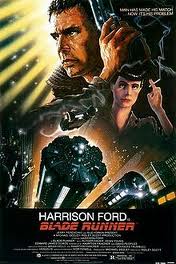
Granted, Blade Runner was based on Philip K Dick’s Do Android Dream of Electric Sheep?, a dystopian story in some respects, but not in the same way that the movie was. Whereas the novel took place in a post-apocalyptic Los Angeles (circa 2019) which is sparsely populated and where a living animal is seen as a status symbol. In the movie, the year and location are the same, but the setting is starkly different. Here, it is a stuffy, polluted, mega-city made up of massive skyscrapers and giant animated billboards, where the streets are dirty and packed with people who spoke a strange dialect known as Cityspeak (check out my post on Cityspeak for on that).

And what made it all so awesome, aside from the plot, was the attention to detail. Director Ridley Scott, the same man who brought us Aliens, brought his usual artistic touch and a team of first-grade set designers to the table. Overall, they produced some pretty awesome concepts, ones which are still being praised to this day. Here are just a few:

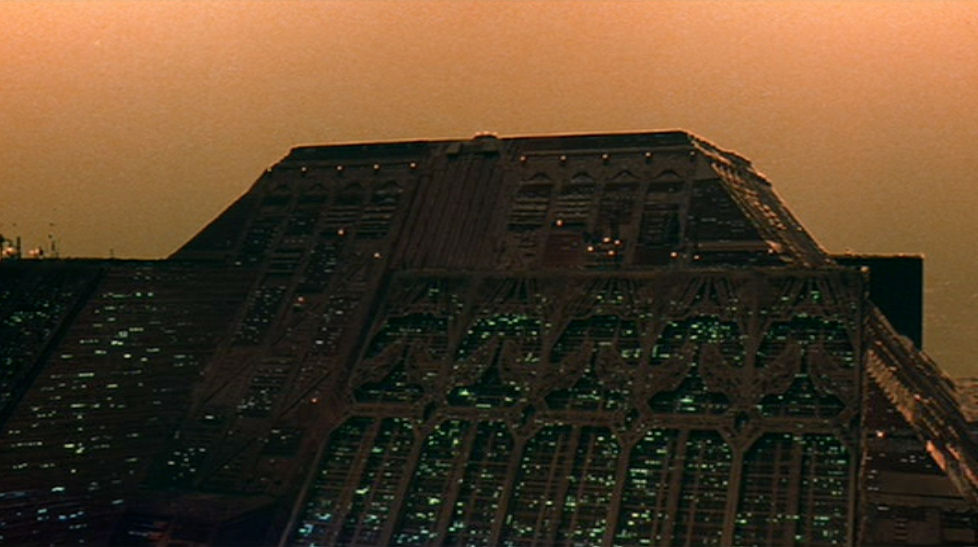
The Tyrell Corp. building, which was kind of the focal point of the movie. Early on, we get a birds-eye view of it as Detective Deckard Cain (Harrison Ford) is being flown there in a Spinner (flying car). Later on, the leader of the Replicant party, Roy Batty, travels there as well seeking answers to some of life’s most basic questions.

For starters, the building is clearly based on a the design of a Ziggurat, the breed of ancient Babylon temple that inspired such legends as the “Tower of Babel”, and which serves as a clear representation for the almost godlike power Tyrell wields. The interior design, with its large columns, soft lighting, candles, an owl (a possible reference to Athena’s owl) and the way Tyrell can block out the sun at will all serve to further illustrate this point. That scene near the end where is dressed in lavish white robes also seemed pretty symbolic, I’d say!

And for those who read 1984, there is a possible encoded reference to the four ministries as well- Truth, Peace, Love, and Plenty – all of which were pyramid-like in design. Coincidence? Who knows? All that matter is when it comes to massive structures that harken back to ancient Egypt and Mesapotamia, the symbolic value is clear. Much like the civilizations that built them, these things stood for power and dominion, both over lesser subjects and the afterlife itself. They were the ruler’s way of achieving immortality by creating something that embodied their power and would stand the test of time. As Shelley said in his poem “Ozymandias”: “Look on my works, ye mighty, and despair!”

And when it comes right down to it, this old-world kind of mentality, updated for the modern age, is indispensable to any dystopian story: Absolute power, wielded by the few over the many and represented in conspicuous and obvious ways! In many cases, it comes in the form of totalitarian governments (a la The Party) who runs things with an iron fist and build massive government buildings to remind everyone of who’s in charge. But in other cases, it takes the form or corporate dominance, where the wealthy rule society like feudal barons while the rest live like serfs. And much like their bureaucratic peers, they choose to lord this by building lavish buildings to themselves and covering themselves with ornate symbols!
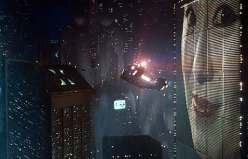
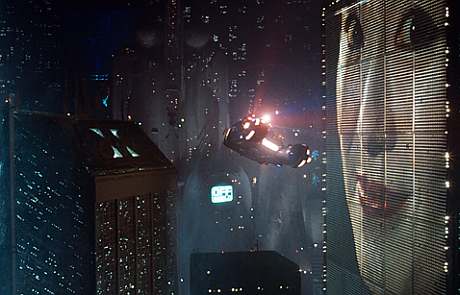
Another trademark bit of dystopian set design were the massive skyscrapers, complete with giant video-billboards. No doubt, these too were designed to give the impression of the control corporations had over the people of LA in the future. As if regular sized billboards ads weren’t enough, (or televised, print, bench, flier, blimp, and radio ads) now it seemed that corporate monopolies were splastering their logo’s on screens the size of buildings!

And just to make it realistic, Ridley Scott and his designers were also sure to use logos that were already big in the early 80′s and seemed destined to get bigger – Atari, Coca Cola, Pan Am Air, Cuisinart, Bell System. But interestingly enough, all of these companies suffered heavy losses after the movie’s release. The phenomena came to be known as the “Blade Runner Curse”. Strange, one would think audiences began associating them with dark imagery or something ;)

But personally, I think one of the most effective aspects of the movie’s look and feel came through in the construction of the streets. Here, Scott’s design team made sure that every shot was crammed full of people who whore plastic jumpers, dark glasses, cool headgear, and carried what looked like umbrellas with neon handles. Then came the street vendors who peddled food or exotic pets in the same neighborhoods, facades that were ashen grey in color, and all kinds of neon signs written in various languages. It painted quite the scene, one which can only be described by the words “Future Noire”.

Brazil: 
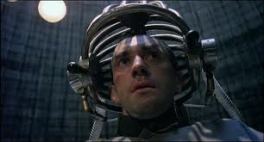
Directed by Terry Gilliam, an old-time member of the comedy troupe Monty Python and director of such movies as The Adventures of Baron Munchausen, The Fisher King and 12 Monkeys, Brazil was a rather humorous take on the classic 1984. In it, we are presented with a dystopian society that is ruled by a totalitarian regime, but which is buffoonish and incompetent rather than exacting and brutal.

In addition, the people in this world are also overly-dependent on machinery which is rather unreliable and poorly maintained. And last of all, there is the main character of Sam Lowry, a low-level government employee who works in a mind-numbing government job, lives in a small apartment, and is having prescient dreams about a woman and a man in mask who is torturing him.

The movie shared many plot and thematic elements with 1984, but much of its genius comes through in the set design and direction. Given that the aim of the movie was to present a world in which the machinery is as undependable as the bureaucracy, Gilliam decided to go with a look that would call to mind the kind of over-the-top aesthetics of past sci-fi films. While everything was admittedly grey, dark, and shot in wide and tilted angles, there was also a sort of comic, retro feel to the whole thing. This helped to establish the central premise of the movie, in which incompetence and mind-drudging inefficiency were what was destroying humanity, not a specific agenda.

In addition, Gillian had much to say about artifice and vanity in this film. Lowry’s mother, who plays an important role in the plot, is obsessed with plastic surgery which she hopes will make her look younger. Towards the end of the movie, Lowry dreams that his mother is attending the funeral of a friend who died as a result of too many invasive procedures. And in what can only be described as an moment of oedipal confusion, his mother even looks like Jill, the much younger woman he has fallen in love with!

An interesting take on 1984 isn’t it? Rather than following a philosophy like the one espoused by O’Brien, where the Party wields absolute control over reality and people’s minds, want to eliminate all emotion except hatred, and has destroyed any activities that do not serve their interests, the totalitarian regime in Brazil is instead motivated by laziness and a desire to cover its own ass. Not being wrong literally means more to them than the lives of their citizens. What better commentary is there on a bureaucratized society?

Judge Dredd:

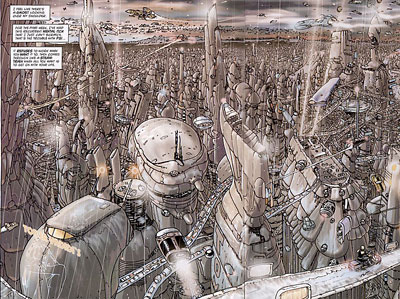
Yes, the movie didn’t so well, and the script and plot were so simplistic that Stallone himself called it a “no-brainer”. But that doesn’t change the fact that the source material is actually one of the better graphic novels in existence, especially when it comes to depth and irony. Set in a post-apocalyptic world of the not-too-distant future, the comics take place for the most part inside “Mega City One”, one of several megalopolis’s that have sprung up in the US after a nuclear war which left it and Soviet Union utterly devastated.

Within this city, just about everything is automated and unemployment is almost universal. Every city block contains over fifty-thousand people, amounting to a population of about 400 million people per city. Due to overcrowding, massive unemployment and uncontrollable violence, the leaders of this future society created a quasi-fascist justice system whereby individual “Street Judges” (policemen) were charged with dispensing judgement and punishment on site. This had a stabilizing effect on society, but the problems remain…

Automatically, one can see a few things at work here. For starters, there’s the Hobbesian idea of man in the state of nature; how because of nuclear war, life became “nasty, brutish and short” and a tyrannical system was needed to put things back in order. In addition, there’s the whole “who polices the police?” side of things, where audiences naturally fear that the judges will abuse their power or fight to the death to hang onto it.

And last, there is the very real sociological concept of the “megalopolis”, the Northeastern mega city running from Virginia to Maine which was originally coined by French geographer Jean Gottmann. In the course of the comic’s history, it is made clear that Mega City One was not actually designed, but grew out of natural urban sprawl that predated the nuclear war. It was only after the war that it became a self-contained place where automation, unemployment and chaos become so rampant.

Now one might also get the impression that this was all meant to illustrate some preachy, “we made a mistake” kind of message (which is in fact what happened in the movie). But in truth, these issues are presented with a fair degree of subtly and irony in the graphic novel.

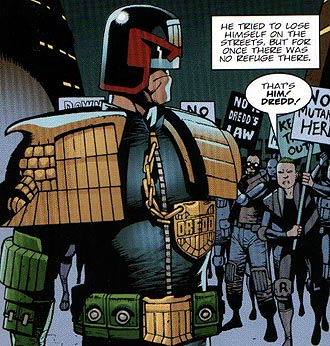
Knowing full well how his audience would react to fascist symbols and ideology, John Wager (creator) presented readers with a story that is loaded with both. For starters, the Judge’s symbol is an eagle, which bears a striking resemblance to the Nazi black eagle. The Judge’s uniform is also highly ornate and calls to mind the classical imperial motifs of Centurions and Gladiators. And the fact that Dredd’s face is never seen can only be seen as highly indicative. He’s a faceless law-giver, much like Stormtroopers or the SS.

What’s more, the people who sport these symbols and preach these values are presented as heroes. Judge Dredd, for all intents and purposes, is a social fascist who is bereft of  sentimentality, doubt or remorse over what he does. Unlike the other Judges, there’s no crime he won’t ignore, and he never stops for more than ten minutes at a time to rest in a sleep chamber, then he’s back on the job. He also has little sympathy for people who believe in enlightened reform or who criticize the Street Judges for their abuses of power.

The purpose of this always seemed to be for the sake of ironic social commentary. Rather than condemning the Judges and the system they represent (or endorsing them) we are meant to see how – under the right circumstances – something like this could very well happen!

THX 1138:
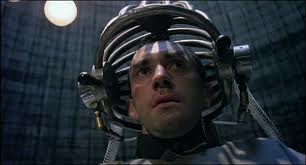
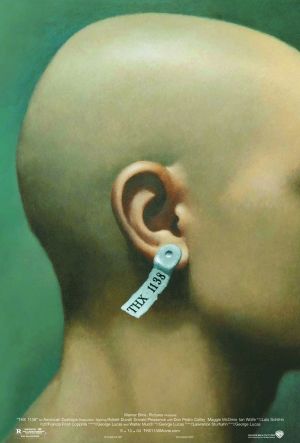
You know, its movies like this that remind us all that there was a time that George Lucas had talent, when he cared about thing like plots and inspired story-telling, and not special effects and merchandizing. But I’ll leave my riffs about the Star Wars prequels for another day. Right now, I will admit that there is plenty about this directorial debut worth praising, and not the least of which was the faithful dystopian tone it struck.

Set in a dystopian future where the human race is required by law to take drugs that suppress emotion and sexual desires, are controlled by android police, and all inhabitants worship a godlike being known as OMM 0910, the story is clearly a commentary on how rationalization and automation threatened to destroy humanity. In addition, there are clear and obvious parallels to novels like We, Brave New World and 1984.

For example, the people in this future are all given designations instead of names, the state sanctioned religion is reminiscent of Big Brother, and the mandatory use of mind altering drugs calls to mind Soma. And of course, the stark, clinical portrayal of society in the future is very similar to descriptions of the One State and Oceania in We and 1984. And let’s not forget the scene were android police torture and abuse the main character? Tell me that didn’t come directly out of the scenes where Winston was languishing in the Ministry of Love!

And of course the overall moral of the story, that love is precious and will fight the odds against the forces of cold rationality, this too was practically lifted from Orwell’s and Zamyatin ‘s classics! This is not a criticism, mind you. If anything, Lucas demonstrated a keen ability to adopt freely from novels and franchises in a way that really worked. Much as he would do with Star Wars just a few years later, he seemed to know where to borrow from and how to put it all together!

The Watchmen:

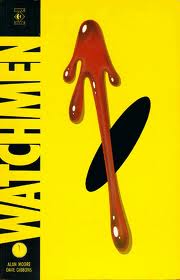
Now this was one of my favorite graphic novels of all time. Lucky for me, it also falls into the realm of dystopian fiction, hence I can talk about it here! In addition to taking place in an alternate universe, the setting is one which is quite dark and gritty. Set in the 1980′s, which is the same period in which it was written, the story is of an alternate reality where the existence of superheroes has caused history to diverge quite a bit from our own. Technically, superheroes have been in existence for many decades, which helps to give the story a real sense of historicity.

However, it was with the service of superheroes in actual wars and government programs that caused history to shift. Beginning with Doctor Manhattan’s intervention in Vietnam and culminating in the development of cheap, renewable energy by Ozymandias (with Manhattan’s help), the Cold War took an unexpected turn. Russia was systematically beaten back to the point where it was becoming desperate and nuclear war seemed inevitable. Meanwhile, society began to decay as war began to occupy more and more of society’s attention and the inner cities were neglected and left to rot.

Told for the point of view of Rorschach, a borderline social fascist with deep-seated issues, the darkness and impending sense of doom really come through! As he investigates the death of the Comedian, a fellow superhero who’s death incites the whole plot, we learn how both he, the Watchmen, and society came to be the way it is. His own tragic story, and that of the Comedians, serves to illustrate how the American Dream failed and cynicism and fear took over.

But of course, the point with dystopian stories is not just to speculate, but to make a point about the time in which it was written. Looked at from this angle, the Watchmen was really telling us about the real world of the 1980′s, a world which had come very far since the post-war era in terms of technological, social and cultural development. And like many other cultural commentaries, a sense of failure and betrayal is at work. What happened to the post-war dream? What happened to the American Dream? How did poverty, crime, licentiousness and cynicism become so rampant? From Rorschach point of view, the Cold War is largely to blame, but so is human nature. And given that he is such a dark and messed up character, I don’t think his opinions were meant to be taken too seriously!

V for Vendetta:

Yet another awesome graphic novel, and one which also inspired a hit movie adaptation. A piece of speculative fiction, this series was produced in the 1980′s and was set in a near-future dystopian England. Over the years, this series’ thematic elements and symbolism have been compared to 1984. However, in truth, the story has much more in common with The Iron Heel and It Can’t Happen Here, by Sinclair Lewis (which should have made my list of dystopian literature, dammit!) In these two novels, especially the latter, a fascist regime takes power by appealing to the people’s sense of moral purity and a desire for order, and in the end the people got more than they bargained for!

But alas, the story in the comic book version involves nuclear war and the transformation of the UK into “lifeboat Britain”. Given that the movie was made in the early 2000′s, the story had to be updated somewhat. There, the focus shifted to terrorism and the exploitation of fear – echoes of The Handmaids Tale and “Loose Change” there, but I digress. After being passed over by the nuclear holocaust, Britain found itself being flooded with refugees and victims of the war. Bit by bit, authoritarian measures were put into place to deal with the crisis, until eventually, the fascist government of Norsefire took over, and that’s when the real changes happened!

They’re motto: “Strength Through Purity, Purity through Faith” pretty much sums it up! In addition to pushing a religious agenda, they were also very much concerned with purging British society or minorities and “undesirables”. A police state was put into place where a series of departments – the Eyes, Ears, Mouth, and Hands – were tasked with controlling and monitoring all aspects of society. The Eyes handled surveillance, the Ears listened to people’s by tapping their phones and bugging their homes, the Mouth disseminated propaganda, and the Hands investigated criminal activity. And of course all minorities, be they racial minorities, homosexuals, or just political dissidents, were sent to concentration camps where they were exterminated and experimented on.

Into all this enters the character of V, an anarchist revolutionary who is the product of one camp’s twisted experiments. As a result of their invasive procedures, he became an enigmatic genius/amnesiac with a serious chip on his shoulder who is now on a quest to pay the government back for its crimes. His famous disguise, the Guy Fawkes mask and robes of black and red, are as intrinsic to establishing his character as his monologues and affinity for blowing up government buildings!

Judging by the color scheme alone, one immediately can tell that this man is an anarchist by his use of the color black (or anarcho-syndicalist seeing as how he combines it with red). The mask is a further indication of this, given that Guy Fawkes was a radical who tried to blow up parliament because he believes any vestige of government to be anathema to freedom. So in the end, we can see that this a man who wants to bring down the system and is reaching into Britain’s forgotten past to resurrect the idea of civil liberty.

In contrast, Norsefire’s logo was pretty straightforward too. In the comic, Norsefire represented itself on its “motivational posters” with a set of white wings with a space in the middle that was in the shape of a cross, and behind it lay flames. This is obviously meant to conjure up images of religious propriety, or holy war, and of action, all of which are clear allusions to fascist and religious-right iconography. It was also meant, in my opinion, to call to mind Britain’s Action Party, a fascist political group that played a small but influential role in British political life during the 1970′s.

In any case, one can see several staples of dystopia at work in this series, hence why it earned a loyal following and garnered so much critical acclaim. In addition to the idea of a nuclear war breeding totalitarian regime in Britain (right out of 1984), of “Lifeboat Britain” giving rise to a fascist regime (which may have helped to inspire the novel Children of Men) and countless allusions to Nazism and how it really could take root in Britain – which calls to mind Orwell’s essay “England Your England” where he basically asserted that it couldn’t.

Final Thoughts:
Wow, this sort of stuff makes me feel head-heavy and tired! It seems that when you get into a subject as rich as dystopian literature and its various offshoots, there’s no shortage of material! But I think I’ve learned something from all of this and it’s important that I get it right. So bear with me…

As I said in my last post, utopian literature predates dystopian by a couple centuries at least. And I also focused on the differences between the two, how utopian lit shows our failures by using a prefect society as a comparison while dystopian societies show the logical outcome of our most worrisome flaws. However, I’ve now come to think that the issue is far more complicated than all that. For starters, one can find elements of the former in the latter and vice-versa. What’s more, utopian novels and treatises were often loaded with irony, at times truncated themselves to make the point that perfect societies were not so perfect, or perhaps unattainable.

On the other hand, all dystopian novels take as their starting point the idea of a failed utopia. Whether it was a willful lie (as O’Brien revealed in 1984) or an attempt at perfection gone wrong, all dystopians arose out of attempt to create a “perfect society”. In the case of the classics written after the 18th century, the inspiration for this is clear. Beginning with the French Revolution, then the Russian, and countless other revolutions who’s aim was to radically transform society, it seemed that every attempt to create “real equality” and an “earthly paradise” was doomed to result in tyranny and abuse. Sometimes horribly so!

But the earlier utopian writers didn’t have these failed social experiments to point to. In their case, saying that utopias were unattainable would have had to have been purely philosophical. And examples abound! The very word Utopia, for example, is Greek for “no-place”. And the narrator of this book, the man who is an apparent specialist on this fabled society, is named Raphael Hythloday. This last name has a Greek root which loosely translates to “expert in nonsense”. Samuel Butler, another utopian writer, named his fictional society Erewhon, which is simply “Nowhere” written backwards. In addition, in his “perfect” society, people are punished for being sick and treated for criminal behavior, an inversion of the usual procedure!

I guess its like the dividing line between heaven and hell, or revelation and madness. Somehow, the line is fine, and one misstep can take you from one to the other in the blink of an eye! And, as with everything else, we carry these things with us  and project them wherever we go. Well… that was deep! Stay tuned, I’m sure to have something more cheerful for next time!

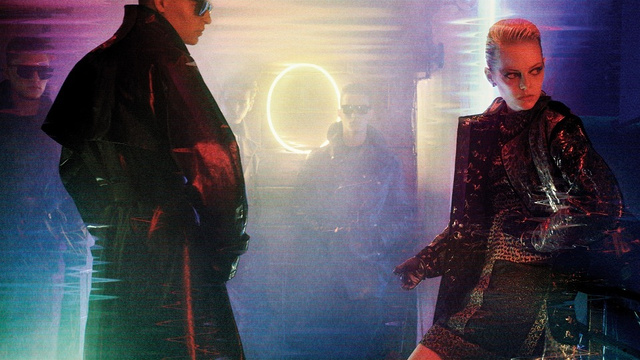
V for Vendetta

Chances are, we all know people who are avid readers and swear up and down that a movie is never as good as an original novel. Man, those people can be annoying! However, as time goes on I find myself identifying with those people more and more. The difference between them and myself is, they read the books first and then see the movies. I, on the other hand, see the movie, listen to people complain about how “it wasn’t the same”, read the novel, and then join the chorus! Maybe this is a sign that I should read more, maybe its just dumb luck. But somehow, I find that with a lot of adaptations, I’m getting it all backwards.

The experiences tend to be pretty far between, but on the whole, I notice they are becoming more and more frequent. First, there was The Lord of the Rings, where I saw the first movie and then read the trilogy. By the time the trilogy was wrapping up, I was nitpicking all the omissions and changes with all the other Rings geeks! Then there was Fight Club, a movie I thoroughly enjoyed but then read the book and suddenly found reason to criticize. Then came Blade Runner, one of those rare instances where I liked the movie better. More recently, its been Game of Thrones – we’ll see how that turns out! – and, for the purposes of this review, V for Vendetta.

Yes, here too I saw the movie before I ever knew the source of inspiration. Then, having finally read it, I found myself having second thoughts about the movie. In truth, that’s not really fair, but it is kind of unavoidable. Regardless of what order you do it in, you can’t help but be very much aware of the fact that between the original story and the screen adaptation, things change. It might not always seem faithful, but a movie is not diminished simply because it’s different from the source material, nor can you fault director’s for taking creative liberties. And with adaptations that come years or even decades after the book was first released, you have to figure that changes will be made because they have to be. Things have happened between now and then, things which may make certain parts of the story impossible or at the very least unlikely. So with that in mind, let’s get down to V for Vendetta – the movie, the graphic novel, and everything in between!

(Background—>):
Since I knew in advance that V (the movie, not the sci-fi series) was based on an original graphic novel, I thought it only fair that I read it before giving the movie a review. After reading it, I was reminded of why I enjoyed Watchmen as thoroughly as I did. In both cases, Alan Moore was the creative mind, combining an obvious passion for politics, history and narrative depth with the usual subject matter of comic books (i.e. superheros). It was these same elements that Frank Miller would later emulate in order to create one of the best entries in the Batman franchise – The Dark Knight Returns. This is surprising, seeing as how V was apparently a side project of Moore’s, something he and illustrator David Lloyd did for fun more than anything else. The fact that it went on to become one of the most critically acclaimed series’ in history, eventually spawning a movie adaptation, was just a sign of its quality.

But of course, the graphic novel was released between 1982 and 89, covering events which took place towards the end of the 90’s. In it, a post-apocalyptic Britain has been spared the ravages of the nuclear holocaust, but then finds itself struggling to survive in a devastated world. It is then quickly taken over by a fascist government that uses the chaos of the outside world and the mentality of “Lifeboat Britain” to take power and justify its extreme policies. After many years of supposed peace and stability, a masked anarchist emerges who begins to slowly take apart the state, exposing its lies, secrets, and the crime that made him what he is.

Not only was this a chilling basis for a story, it also had an undeniably British flavor to it. The setting, the characters, and the mentality of it all just screamed Britain! In the movie, we get much the same feeling, but the elements are different. Rather than involving nuclear war, the plot revolves around the threat of terrorism and repression done in the name of security (something audiences in 2006 would find much more relatable). That, and a slew of other changes, made the movie more current, but also had the effect of watering it down somewhat.

(Content—>):
The movie opens almost exactly as the graphic novel does, except that for the sake of American audiences, the story of Guy Fawkes is first explained. Natalie Portman tells of the Gunpowder Treason, the man behind the plot, and the difference between ideas and the people who fight for them. However, the movie then moves to a near-future London at night, where both Evey (Natalie Portman) and V (Hugo Weaving) are getting ready to go out. In the background, the “Voice of London” – the regimes chief spewer propaganda – is delivering his latest spiel.

Evey then goes out for the night, on her way to meat her suitor and superior over at BTN (British Television Network) where she works. However, on her way she is intercepted by Fingermen (government spooks) who attempt to rape her. She is narrowly saved by a masked stranger who is in the habit of spouting poetry before wielding his knives and cutting his enemies to ribbons. He says his name is V, a name which he then cuts into one of the government’s posters. Thus begins Evey’s adventure with him, and the premise of the story.

He then takes Evey to the roof of a nearby building where a performance is about to begin. This “show” involves the destruction of the Old Bailey, the symbol of Britain’s justice system in London, done to the tune of 1812 Overture. During the display, he mentioned the 5th of November to her, and how that act, over 400 years old at this point, has been largely forgotten. As has the lesson. Through all this, we are made immediately aware that V is a revolutionary anarchist who has a score to settle with Britain’s fascist government. His theme: Guy Fawkes, and the Gunpowder Treason!

I should note that within these first few scenes, there are some notable differences between the book and movie. For one, Evey did not work in television, she worked in a munitions plant. And she was not out for a date, she was out trying to sell herself. Yes, this 16-year old (they never specified her age in the movie) had fallen on hard times since her job didn’t pay enough, was looking to make a little extra money and thought dabbling in prostitution might make up the difference. What’s more, in the movie V whooped the Fingermen’s asses but left them otherwise unharmed. In the book, he killed several, and used gas and an exploding hand, not knives!

What’s more, V did not blow up the Old Bailey in the opening scene, but Parliament itself! Much like the Old Bailey, this was an old government building that was no longer in use. Given the fact that the fascist party that had taken control had no need of parliamentary procedure, the building was essentially empty. But of course, it was the symbolic value that mattered. It was shortly thereafter in the book that V blew up the Bailey, but only after delivering an impassioned speech to the figure of Madam Justice on the subject of betrayal.

In any case, we then get a quick gander at the authorities who run Britain and their leader – the Lord High Chancellor Adam Sutler (John Hurt). Much like in the book he is a totalitarian and runs Britain through several branches known as the Eyes, Ears, Nose, Mouth and Finger – video, audio surveillance, regular police, propaganda, and secret police (echoes of 1984 with its four ministries!). But whereas in the movie they are known as the Norsefire party (a clear reference to their Nordic beliefs and action platform), the Party was never really named in the book. Regardless, they are of course determined to find the masked vigilante, and put out a spin story about a controlled demolition to cover up the terrorist incident. Since this is a criminal investigation, it falls to inspector Finch (Stephen Rea) to find him.

However, their attempts at spin control prove futile when on the 5th of Nov, V marches into the BTN network headquarters with a bomb and forces them to broadcast a manifesto of sorts. In it, he declares that the people of Britain have been robbed of their freedom by the Lord Chancellor and his goons, and were of course complicit in the process. And that, in one year’s time, he will resurrect the Gunpowder Treason by blowing up Parliament, and invites the people of Britain to come and watch. In the course of his escape, Evey comes to his rescue and is knocked unconscious. Unsure of what to do, he brings her back to his lair and they become acquainted.

In the course of this, Evey begins to tell V her story, how her parents were political dissidents who were taken away when she was young. However, her sympathies are soon spent when she realizes that he is killing people and she hatches a plan to escape. She puts this into action when V asks for her help in killing Archbishop Lilliman (Eddie Marsan), a Party member who was the Chaplain at Larkhill – now the Archbishop of Canterbury – and who just happens to be a pedophile. She knows that running away is dangerous since the police now believe she is his accomplice, but can’t stomach what he’s doing. This is also different from the book, but more on that later.

Shortly thereafter, V enters into phase two of his plan, which Evey becomes involved in. This includes him isolating members of the Party that run Britain, key personnel in the regime, who he then murders. The first is the Lewis Prothero (Roger Allam), otherwise known as the “Voice of London” (Voice of Fate in the book). But whereas in the book, V goes through the process of kidnapping him and bringing him to Larkhill – where he destroys his prized dolls (which he collects), in the movie, V enters his apartment and kills him with a poisoned needle. I notice a subtle reference to the doll collection though; in his bathroom, Prothero had a small collection up on his wall.

In the course of investigating, Detective Finch (Stephen Rea) – head of the Nose – discovers that Prothero was once the Commandant of the camp. His other victims all have similar ties to the place, one of whom was a doctor named Delia Surridge (Sinéad Cusack), the one who conducted the camps’ experiments and was responsible for creating V. When she is dead, V leaves her journal, in which she kept detailed notes about her time in the camp, for Inspect Finch to find. It is from this journal and their own snooping that the Nose men begin to see what’s going on. Like V, they’ve stopped believing in coincidences and suspect that everything in this case is connected. And since things have escalated, the investigation has been taken over by Creedy (Tim Pigott-Smith), head of the Finger, which is a blessing since it leaves Finch free to look into this conspiracy.

Things become increasingly desperate as things get closer to the 5th of Nov. The government, as predicted, begins to become more repressive, leading to increased resentment and backlash from the people. Into all this, V continues to point Finch and his investigators in the direction of the overarching conspiracy. This includes the creation of a biological weapon which the people of Norsefire unleashed on England in order to secure power and then pinned on some hapless Muslims as a terrorist incident. They realize that Arkhill was ground zero, and that V was a test subject who became changed as a result of the testing, then blew the place up and escaped! Whats more, they know that this can only end in bloodshed, and with the fall of the Party… unless they can find another way.

At this point, something crucial takes place. Evey, having run away from V, goes to stay with her friend Dietrich (Stephen Rea), who just happens to be the one she had a date with at the beginning. He is her superior over at BTN and takes her in, revealing that he too has secrets, being a liberal intellectual and gay to boot! He promises to jeep her safe. However, after an episode of his show that makes fun of Chancellor airs, the is taken in the night by Creedy and his men. Evey is forced to watch as he’s beaten and has a bag put over his head, thus reliving what happened to her parents. She tries to escape but is captured outside the house.

Afterward, she believes she is in a government camp, where she is tortured, interrogated, and locked in a tiny cell for weeks on end. During that time, she finds a note stashed in a rat hole written on toilette paper. The note is apparently written by a woman named Valerie (Natasha Wightman), a former actress who was an inmate on a count of her being a lesbian. Her story empowers Evey, and when asked to give up V, she refuses, choosing death instead. Her guards offer her one last chance, but when she again refuses, the guard says only “Then you have no fear any more. You’re completely free.”

Mystified by this statement, Evey leaves her cell and finds that she is still in V’s lair. It seems her conducted her torture and detainment as an elaborate ruse to help her come to terms with what happened to her parents, and to find the strength to fight the fascists and win. She is initially quite furious, but in time sees to see what he did as a good thing. It is at this time that he reveals that the woman Valerie was real, that she and V were both at Larkhill together, and he is doing what he’s doing to avenge her and everyone else they murdered. In fact, it was her love of roses that motivated V to use them as his calling card. Eve leaves, but she and V promise to see each other one last time before the 5th.

At this point, V makes a deal with Creedy to betray and kill the Chancellor. In exchange for overthrowing the man,
V will surrender willingly. Creedy agrees, mainly because he knows he’s not likely to be able to stop V otherwise, and that Sutler will have his head in that event. Meanwhile, Evey meets V one last time and he shows her the train that he’s loaded up with explosives and placed on a track that leads underneath Parliament, true to the original Gunpowder Treason! He leaves the controls to her, saying he must go do his final errand, and that she is to decide whether or not to blow up Parliament. She naturally tries to stop him, but he insists that he must go and leaves her.

Nearby, Creedy and his men show up, bringing the Chancellor with them as agreed. Creedy then shoots Sutler and demands V come with them, but V refuses. A gunfight ensues, but V is relatively unharmed and kills all Creedy’s men. He saves Creedy for last and then strangles him, but not before delivering one of the best lines of the movie. “Behind this mask lies more than flesh. Behind this mask lies an idea, and ideas are BULLETPROOF!” He then unstraps the metal vest that absorbed most of the bullets, but is still mortally wounded and lurches his way back to the subway. Once he gets there, he dies in Evey’s arms, and is followed shortly thereafter by Finch.

Not surprisingly, Finch does not stop her. He knows this must happen and lets her set the train off. Up above, the masses are converging on Parliament in anticipation for its destruction, each of them wearing a Guy Fawkes mask! Without orders and no word from the Chancellor or Creedy, the soldiers decide to do the right thing and stand down. The crowd is then in the perfect position to see the fireworks. And they do! The crowd whip off their masks, revealing everyone who’s been in the movie, even those who have died. This coincides with Evey explaining that V was every one of them, not just some masked vigilante inspired by Guy Fawkes.

(Synopsis—>):
Okay, now would be a good point to mention all the differences I had to skip over because believe me, there are a lot!
As I mentioned, the character of Evey was different in the book, being far more vulnerable and naive than she was in the movie. It was in this way that her transformation, which happened because of her contact with V, became all the more apparent. Making her character a stronger, more nubile and independent person who saves V at one point was clearly designed to appeal to post-modern audiences.

In keeping with this, she did not leave V during the commission of his murder of the Archbishop. In truth, he kicked her out shortly after this, thus forcing her to shack up with Deitrich, who was then murdered not by Fingermen, but by thugs. The reason for this was because in the book, Deitrich was involved in criminal activity and had nothing to do with broadcasting, nor was he gay. He and Evey had a sexual relationship for a time, and it was clear that Evey’s unresolved father issues had a part to play in that!

Moreover, the “Leader” (not Chancellor) did not work from some bunker and communicate with his lieutenants on some massive monitor. In fact, he worked from a central location called “The Head” where he was connected to all the other branches (Eyes, Ears, Nose, Finger, Mouth) through a computer named Fate. Strangely enough, he became increasingly obsessed and even enamored with this computer over the course of the story, leading to an eventual breakdown that led to the plot to overthrow him by Inspector Creedy. Speaking of which, the plot to overthrow was not spearheaded by V but occurred as a result of inter-Party politics, a lot of which was the result of Creedy’s wife who was scheming to make sure her lover the new Leader. V, of course, took advantage of all this and played the people against each other so that by the time the train was dispatched, they had all killed each other.

However, in another twist, this plot came to halt when the Leader was shot point blank by the wife of Creedy’s successor (Inspector Almond) during a parade. Her involvement was a side-story that was completely missing from the movie. As indeed was the confrontation that took place between Finch and V in the subway. Yes, in another change-about, that action scene at the end did not take place between V, Creedy and his Fingermen but between Finch and V alone. But similarly, it was this confrontation that caused V to be mortally wounded, right before he meets Evey for the last time and leaves it to her to dispatch the train.

But, as mentioned earlier, V didn’t blow up Parliament at the end, he’d already done that at the beginning. His target
was the Head, and Evey did not just send the train but adopted V’s persona and addressed the crowds of London before it went off. This, combined with a scene were Evey removes his mask and sees herself, her father, and many other faces (anyone but V’s true face) was meant to illustrate what V said: behind the mask is an idea. Behind the mask was anarchy and freedom, and it lives in the heart of all people. The Wachowski brothers illustrated this as well, but chose to have an entire crowd dressed up as V with Natalie Portman doing a voice over about how “he was all of us”.

But the biggest difference of all had to do with how England came to be a fascist state. In the book, WWIII takes place in the mid to late 80’s, England was spared a direct nuclear attack, but society goes to hell all the same. Then, in the early 90’s, the fascists took charge of the country, taking advantage of all the disorder and chaos. Once in power, they proceeded to round up all the political dissidents, minorities, gays, and placed them in concentration camps. And of course, they established a police state where everyone’s movements, words and actions were monitored.

And their slogan was “Strength Through Unity, Unity through Purity”, not Strength Through Unity, Unity through Faith“. Faith, after all, implies the presence of religion – i.e a state where religion and politics are not separate. Purity, on the other hand, implies a state that seeks singularity, which in the case of Fascism involves the active liquidation of minorities and other “undesirables”. This is in keeping with the fundamental character of the Party in the book, a ruthless, fascist organization that has no qualms about committing genocide. By contrast, the Norsefire party was somewhat more subdued, concerning itself with direct control and avoiding racial purity. Ironic, considering the fact that in the movie, they committed mass murder in order to obtain power!

Which brings me back to the different back story that was used in the novel, which I found far more realistic than the movie’s. With the movie, the Wachowskis needed to update things since the end of the Cold War pretty much meant that WWIII was no longer a likely event. And after Sept.11th and the advent of the “War on Terror”, what better angle was there than a government that turned totalitarian because of terrorism and the manipulation of people’s fear? True, it WAS more current, but it also a lot less realistic. The 9/11 Truth Movement’s opinions aside, are we really to believe that any government would be willing to commit mass murder just to get in power? And its openly alluded that the world outside was going to hell all same, even if it wasn’t specified from what (the US’s war is mentioned, but they do not go into detail). This alone would have been enough to create a the “Lifeboat Britain” mentality, why did they need to kill 80,000 people as well?

But aside from all this, the movie was quite faithful to the source material. And most of what was changed arose out of the need to shorten and condense the original ten volumes into a two hour movie. And dammit if they didn’t do a good job of it! Above all, the back story of V was treated faithfully. V being the Roman numeral for five, signifying the 5th of November, and also referring to the five V’s that make up “Vi Veri Veniversum Vivus Vici”, which is Latin for “By the power of truth I, while living, have conquered the universe”. This quote, which is attributed to Marlowe’s Dr. Faustus, has immense symbolic value since V himself is the product of a Faustian deal, though it was the state who forced him into it. The deal he makes with Evey is similar, that in exchange for his help, he forces her to undergo a painful transformation.

And of course the movie has undeniable signs of quality that is typical of the Wachowskis at their peak. The colors are vivid (in the Matrix everything was green and black, here it’s red and black), the direction and cinematography are very good, and the writing was both cool and faithful. In many places, the Wachowskis took liberties but still managed to capture the essence of the story and the characters. And I musn’t forget to mention how much the movie benefitted from an all-star cast! Hugo Weaving was especially good at capturing the magnetic personality of V, John Hurt is sublime as the ruthless High Chancellor, Stephen Rea was spot on as the straight and fearful detective, and Tim Pigott-Smith was very convincing as the evil “Creepy Creedy”. And Natalie Portman, wow! Those scenes where she is being tortured and humiliated in prison were made real by her powerful performances.

In the end, I think I’d file this movie under the same category as the Dune Miniseries. In short, it was different from the source material, but was faithful nonetheless. I highly recommend both the graphic novel and the movie, the one is inspired and interesting, while the latter is highly entertaining!

V for Vendetta:
Entertainment Value: 8/10
Plot: 8/10
Direction: 9/10
Total: 8.5/10