The Informant: A Revenger Mission Update

revengers_sourceAnd we’re back from our meeting with my NSA source. And as usual, I have some good news and bad news. I suppose it all depends on how you look at it. And for our mutual friend and colleague, who happened to be on site when it happened, it was certainly shocking. Perhaps I should defer to my field report and let people decide for themselves…

Veiled Tsunami and Dark Angel were on hand to oversee the events and monitored our conversation. The transcript they while bearing witness appears below, with minor annotations provided. For security purposes, the names of the people involved have been removed.

Source: [censored], you look different. Lose weight since we spoke last?

Smackdown: [censored], good to see you too. Yeah, been getting a little more exercise than usual.

Source: So I’ve heard. Are the rumors true?

Smackdown: What, you mean about the new crime-fighting league? I suppose so. Depends on what you’ve heard.

Source: Well, I’ve heard that you got criminals running scared in the big city. Some say its only a matter of time before they start bringing in the heavy guns, try to knock you over.

Smackdown: That’s really not what I called you to talk about.

Source: I figured as much. You don’t hear from a guy for years, suddenly he calls out of the blue. You gotta assume he’s looking for a favor.

Smackdown: Yeah, well you remember Kandahar, don’t you? I’m calling it in.

Source: Easy there, Mr. Vigilante. I’m debating who owes who here. But you need to know, I’m taking a big risk just by coming out here. As per your… request, I did some digging and got a hit on the name you gave. Turns out you’re friend, Mr. T, presents a bit of weird case.

Smackdown: Weirder than grown men and women running around in costumes fighting crime?

Source: [laughs] Worse, though it’s definitely in the same ballpark. Tyrene, it turns out, wasn’t just some high-profile thief treasure hunter. He was a deep cover operative who did wet work for any number of security agencies. NSA had never heard of him, but I know guys who say folks at the CIA, MI6 and Mossad had him on speed dial. His criminal racket was just a cover he used for a few years.

Smackdown: Wait a minute, this artist used to be an assassin?

Source: We all got our hobbies. Right now, yours is to run around the big city making purse snatchers and mobsters nervous. Mine is spying on immigrants who don’t file for the right kind of permits. We make a living though…

Smackdown: I get it, fine! But where does the whole rumor about this code come into play?

Source: What, you mean that painting fable? No idea. But rumor has that after he retired, he turned to art, and some of his subject matter was spooking some of his old associates. Anything else I could tell you would be speculation at this point, but I did find one other thing that might be useful to you.

Smackdown: What?

Source: An old file from the CIA archive. Brought you a copy, thought you might like some light reading on the way home.

Smackdown: [takes the file. reads it] Wait a minute… this was his first job. He was contracted to recover a downed aircraft?

Source: In Nicaragua, yes. Back when the Contras were fighting for control of the country. The official-unofficial story said one of the CIA’s planes was shot down after conducting a covert meeting with the rebels, but that sounds like company talk to me. I think they found something down there in the middle of the conflict zone, so they sent in some company men to get their hands on it. He was one of the infiltration team that was supposed to go in and find out.

Smackdown: And?

Source: Keep reading.

Smackdown: I don’t get this… after that mission, he was put on indefinite medical leave?

Source: Right. After that mission, he became the super spy that no one wanted to have on the payroll anymore. After that, he was the guy they secretly contracted to do the big, black op missions.

Smackdown: There’s another page here. It looks like it was from before he retired. [reads] So he broke into a secret warehouse? And this was connected to the mission down south?

Source: Apparently. And it’s not a warehouse so much as of the storage facility the CIA put aside for hiding sensitive materials. My guess is whatever they recovered over there was brought back here. Tyrene broke back in to where it was being kept and tried to take it again.

Smackdown: And they just let him take it?

Source: No idea. The report doesn’t say he made off with anything, it just hints that he came back to the location where they kept it. Again, just guessing, but I think whatever he found was something he needed to get his hands on again.

Smackdown: Like a crack addict needing a new fix… I think I see a pattern here.

Source: Do you? Because I have to admit that it’s getting a little weird for me.

Smackdown: Yeah, sorry for the confusion. It’s still new to me too. This makes us square, you know. I promise never to ask for a favor again.

Source: You could just call to chat about old times.

Smackdown: [laughs] I’ll do that, just as soon as the collective scum of the world decides to take a break.

Confused, Revengers? Well I sure was at first. Allow me to elucidate further… Based on the clues provided the other two paintings, I think that Tyrene was part of a recovery team that was sent to Guatemala to pick up something alien. I think it gave him and the others special powers, and thereafter they were put to work doing deep cover stuff to keep their powers secret.

I think he broke back into the warehouse where it was being kept because whatever it was it gave him needed to be periodically recharged. Or maybe he just hoped that he could get a boost by going back to the source. Who knows? Point is, I think the third and final painting contains the location of the warehouse itself! I trust people are nervous now, because if it does, whoever stole it is on their way there!

The address of this storage facility was contained in the brief my source prepared for me. We need to go there immediately and prevent whoever is hoping to break in from doing just that. No doubt it will guarded, but for all we know, our adversary is packing some serious heat!

So who’s with me for a road trip/ass-whooping?

Drone Wars!

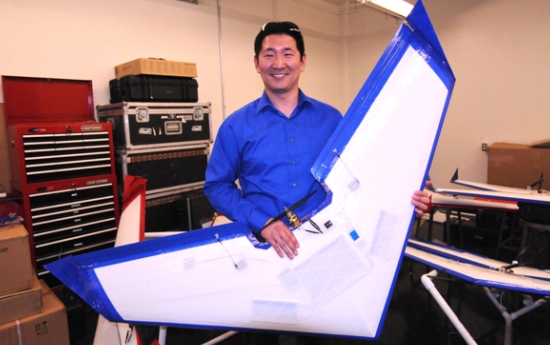
X-47BThat’s the crux of Timothy Chung’s research, an assistant professor in the Systems Engineering department at the Naval Postgraduate School in Monterey, California. For the most part, he and the Advanced Robotics Systems Engineering Lab (ARSENL) have been working on a way to construct a series of low-cost, lightweight autonomous flying vehicles known as Aerial Battle Bots that will give the US and the western allies an advantage should a full-scale conflict involving UAV’s happen.

The aspect of cost is especially important, seeing as how drones cost on the order of several million dollars apiece. By supplementing reconnaissance and hunter-killers with dogfighting drones, the army and navy of the future will have a lost cost-option for keeping their big-budget fliers safe. What’s more, it’s extremely important that the drones work in tandem, since it’s highly likely other nations will be developing similar swarms of drones in the future too.

Chung_droneWith the help of a DARPA research grant, Chung and his associates have completed a small fleet of about a dozen drones. Each is a essentially a commodity radio-controlled flying machine, called Unicorn, that has been retrofitted with an onboard computer and other gear in order to take their places in the larger group. He hopes that by this August, he and his team will be able to get the vehicles flying and be able to start experimenting with getting them working together, as well as facing off!

In other news, questions relating to drone dogfights and the issue of autonomous drones were raised once again at the White House. Back around Thanksgiving, the mounting concerns from the human rights community led Deputy Defense Secretary Ashton Carter to sign a series of instructions that were designed to ensure that human oversight would always be a factor where drone strikes and UAV’s were concerned.

john-brennanThese concerns have since mounted with the recent announcement that John Brennan, the White House’s counter-terrorism adviser and the man known as the “Drone Godfather”, was nominated to become the next head of the CIA. For years now, he has been the man in charge of the US antiterrorism efforts in Central Asia, many of which have involved the controversial use of Predator and Reaper strikes.

These concerns were voiced in a recent letter from Sen. Ron Wyden (D-Ore), a member of the Senate intelligence committee. In it, he asked Brennan pointedly when and under what conditions the president would be able to target American citizens using drones:

“How much evidence does the President need to determine that a particular American can be lawfully killed? Does the President have to provide individual Americans with the opportunity to surrender before killing them?”

Naturally, the questions were quite specific when it came to the authorization of lethal force and when such authorization would be given to target people within the US’s borders. But there were also many questions that highlighted concerns over how this same process of authorization has taken place in other countries, and how little oversight has taken place.

(U.S. Air Force photo/Staff Sgt. Brian Ferguson)(Released)In short, Wyden used the occasion to express “surprise and dismay” that the intelligence agencies haven’t provided the Senate intelligence committee with a complete list of countries in which they’ve killed people in the war on terrorism, a move which he says “reflects poorly on the Obama administration’s commitment to cooperation with congressional oversight.” And given the mounting criticism at home that using killer drones against unspecified targets in Afghanistan and Pakistan has earned, not to mention the blowback happening overseas, he is not alone in thinking this.

Like it or not, it’s a new age where “umanning” the front lines is having an effect, albeit not the desired one. At one time, the predominant thinking in military and intelligence communities was that using automated aerial, land and sea vehicles, war could be fought cleanly, effectively, and without the loss of life – at least on OUR side. However, this thinking is coming under increasing scrutiny as it comes closer and closer to realization. And at the center of it all, the philosophical and existential questions are numerous and impossible to ignore.

For starters, war is and always will be a human endeavor. Just because you are not risking the lives of your own people doesn’t mean the fight is any more sanitary or bloodless. Second, even though none of your own citizens will be mourning the death of their loved ones doesn’t mean there won’t be mounting civilian opposition as conflicts go on. In a global community, people are able to witness and empathize with the plight of others. And finally, the increased use of machinery, be it autonomous or remote controlled, will inevitably lead to fears of what will happen if that same technology would ever be turned against its own people. No weapon is so safe and no government so trustworthy that people won’t fear the possibility of it being turned on them as well.

Source: news.cnet.com, wired.com

Data Miners Published!

Dataminers_3It’s finally happened. After three years of writing, editing and constant picking, I finally got around to pushing Data Miners through publication! As you can see, I decided to go with the black and green cover, which I feel highlights the lines of code best. And I also made sure there’d be print on the side. I feel there should be demarcation between the front and back covers, hope you agree.

And here is the precis I decided to go with on the back of the dust jacket. Hope it encapsulates the story without giving too much away:

“Prad is a member of the DeMarchy, an elite society of data miners dedicated to finding the patterns in chaos and exposing the lies that permeate our society. Or so he thinks. In reality, he’s a second-rate programmer working for a faceless company and obsessed with a woman he can’t possibly have. Until one day when a mysterious package arrives that plunges him into a mystery ten years in the making.  If he can crack the code, he just might be able to save his friends and himself.  If not, they’ll lose everything: their jobs, their freedom, and even their lives. Like everything else in Prad’s wireless world, the answer is out there, just waiting to be mined!

But to give my loyal followers are more in-depth survey, the book was inspired largely by the works of William Gibson and his exploration of technology and its effects on society. But for my own purposes, I wanted some serious espionage and spy thriller stuff, the kind of things people would expect from a techno-thriller. After all, one of the cornerstones of the digital age has been fears about the loss of privacy, the dangers of government surveillance, and the threat posed by insidious people with the wrong kinds of talents!

Add to that the concept of Democratic Anarchy, a west-coast libertarian perspective, and some real history – which I shamelessly exploited for the sake of fiction – and you’ve got Data Miners. In time, I will be producing the sequel, Data Pirates, which focuses on the darker side of hacking and libertarianism, and a finale, entitled Data Moguls. But those will have to wait for my current workload to cool down a little…

In the meantime, look for Data Miners on Amazon-Kindle! It will be appearing on my author page for the ebook price of 4.99, or for free if you’ve got a Kindle Select membership. My first full length novel is out, Yaaaaaay! Follow the links below if you want a copy:

Amazon Author Page

What does Osama’s death mean (part II)?

What is to be done? Well for starters, the US and its coalition allies should withdraw from Afghanistan. If history has taught us anything, its that occupations are a losing battle, especially in places like Afghanistan. That country has made a name for itself grinding up invaders and spitting them back out. It’s mountainous terrain, hardened people and impenetrable network of tribal loyalties have always proven to be the undoing of invaders, no matter who they were or what kind of technological superiority they possessed. But above and beyond all that, it is startling how much Afghanistan is beginning to look like Iraq, which in turn showed the same signs of failure early on that haunt all occupations and foretell their failure. To break it down succinctly, there are five basic indicators that indicate that an occupation has failed.

1. Insurgency: If the population turns against you and begins mounting an armed resistance, you know you’ve lost. Little to nothing can be done at this point because tougher measures will only aid in their recruitment, they have the home field advantage, and can recruit endlessly from their own population. The occupier, no matter how benign their original intentions, can’t allow violence to go unchecked, and so they inevitably play into the hands of their enemy. Already Afghanistan has mounted its own insurgency in the form of a resurgent Taliban that is actively recruiting from the country’s Pashtun majority. Recruits spill over the border on a regular basis from Pakistan, where millions of Pashtuns also live, and there is little the US and Coalition can do about it because the Khyber Pass (the mountainous region that spans the border) is too vast and rugged to keep sealed.

Much like in Iraq, what we’re seeing is a major resistance that is actively recruiting from a major ethnic group that is fighting to regain the power it once enjoyed. In some ways, it worse than with the Sunnis of Iraq, because the Pashtuns constitute the largest ethnic group in Afghanistan with 40 percent of the population, the remaining 60 being made up of Tajiks, Uzbeks, Turkmen, Arabs, and many other groups. In short, they constitute a larger chunk of the population, and their counterparts are disparate and divided.

2. Weak/Crooked Allies: Hamid Karzai, an ethnic Pashtun who served in the post-Soviet Afghani government, has a long history of allying himself with US interests. During the Russian occupation, he was a secret contact for the CIA and helped run guns and money to the mujahedin from neighboring Pakistan. During the Taliban’s rise to power, he became a vocal opponent, and after 9/11 he became a major ally of the US . It is also rumored that he was a consultant for Unocal, a major oil firm with strong ties to the Bush family. It’s little wonder then why he was installed as president once Coalition forces had ousted the Taliban. Unfortunately, since the invasion, his government has been notorious for its corruption and impotence. In the former category, his election win in 2009 was tainted by scandal and blatant instances of fraud. His family have also thrived under his rule and committed numerous criminal acts, the most notorious of which were by his half-brother Ahmad Wali Karzai, a prominent drug trafficker and CIA contractor.

In the latter category, Karzai’s political impotence is legendary. In fact, he is often playfully referred to as the “mayor of Kabul” because his power does not extend beyond the capitol. Warlords who owe no allegiance to him or coalition authorities, who were bought off in order to fight the Taliban, are largely responsible for controlling the other regions of the country. Though corrupt and weak, Karzai’s remains an important political ally to the US because of his background and ethnic-ties. He is able to put a Pashtun face on a government dominated by non-Pashtun groups, and is a long-standing enemy of the Taliban which it is still doing battle with. Beyond that, however, he is powerless and fast becoming a liability.

3. Civil War: When the people turn on each other as a result of the occupation, you know you’re not doing a very good job. Iraq is a prime example of this, with the Sunni minority doing battle with the Shia majority and the US and its allies playing the role of arbiter. No one, especially the Iraqi people, can forget the carnage of that episode. But worrying still is how Afghanistan is going in the exact same direction. While the country is no stranger to civil war, it is clear that it has been inching in that direction for years now and another civil war seems inevitable. And when that happens, the general chaos tends to be blamed on the occupation force. Not only is their presence seen as the catalyzing force, which it usually is, but their inability to contain the situation also makes them accountable.

4. Unclear Enemy: While the US and its allies have always claimed that their fight is with the Taliban on behalf of the Afghani people, the reality is quite different. The line between Taliban and Pashtuni’s became blurred sometime ago, with US and Coalition forces now waging war on the dominant ethnic group. This is not a choice position for an occupier to be in. When you can’t tell the difference between your enemy and the general population, you know you’re in trouble. When the line that separates them becomes blurred, and not just to you, you know your mission is doomed to failure. In any failed occupation, this is precisely what happened. What began as a controlled, limited engagement, spilled over and became messy, brutal and confusing. This is what happened to the United States in Vietnam and to the Russians in Afghanistan, not to mention every colonial ruler everywhere. And, inevitably, it backfired… horribly!

5. Criticism at Home and Abroad: When your own people begin to criticize you, not to mention your allies, you know you’ve overstayed your welcome. In any democracy, one cannot prosecute a war without popular support. Dictatorship’s fare slightly better with domestic opposition, but sooner or later, any war effort can be broken because of popular resistance. For years now, public opposition to the presence of US and Coalition troops has been on the rise. Recent survey’s conducted by US news services even went as far as to claim that Afghanistan was becoming “Obama’s Vietnam”. A comparison to Iraq would be more apt, but the existing metaphor has more power.

In addition, Karzai himself has become increasingly vocal in his condemnation of Coalition forces “methods”. In this respect, he is not unlike Nouri al-Maliki, the current Prime Minister of Iraq, who also skirted the fine line between supporting and condemning his US-allies. In time, Maliki even began to go as far as to say that Iraq would demand a total withdrawal of US forces if things continued on their current track. Karzai may not be in that kind of position, he knows he cannot survive without US support for the time being, but he also cannot sit idly by while Afghani civilians are killed and not speak up. In time, as civilians casualties mount, he may very well be forced to choose sides, no longer able to skirt the line between his allies and his people.

6. Widening Conflict: When your conflict begins to spill into neighboring countries, you’ve got a full blown quagmire! Remember the US bombing of Cambodia during the 70’s, which took part because US forces believed the Viet Cong were running guns through that country? Well, the outcome – hundreds of thousands of people killed, no change in the course of the war, and the rise of Khmer Rouge in Cambodia – was hardly a success, regardless of what Nixon would say. Much the same is true of Iraq, where Iran began exercising a sizable influence over Shia politics in the south and had to be called in to mediate. Turkey’s border conflicts with the Northern Kurds is another example, lucky for everyone it did not end in an invasion! But in any case, the rule is clear. If you have to widen the scope of the conflict to strike at your enemy, you got a problem and need to examine your options.

For many years now, this has been the problem in Afghanistan. The conflict has been spilling over the border into Pakistan, due in part to the fact that Osama found refuge there, but also because the shared border region, which remains unsealed, is heavily populated by militants, most of whom share ethnic and cultural ties to Afghanistan Pashtuni population . The US began conducting Predator strikes in the area in 2008, and has since expanded its involvement to include special forces and CIA operatives. While the death of Bin Laden is certainly a symbolic victory for this expansion, it cannot be expected to make the war in Afghanistan itself any easier. In the long run, its more likely to destabilize Pakistan’s already shaky government and create a permanent haven for Islamic militants, much like Cambodia became a radical communist regime.

So, since the war in Afghanistan possesses all of these things in abundance, I would argue that the time has come to pack up and leave. In addition to it being a potential disaster, and that its really not making life any better for those affected, there is also the fact (as stated in my previous article) that it ceased being about Al-Qaeda and Bin Laden some time ago. Now that he is dead and his whereabouts confirmed, perhaps this is just the justification that’s needed to put an end to the last war in the “war on terror.” I doubt anyone would buy it, but what can you do?

What Does Osama’s Death Mean?

I did not start this blog with the intention of getting into politics. There are few things more subjective and divisive than where one stands on various issues, political parties, or where they fall in the big spectrum. However, once in awhile something comes along and you just have to take to whatever forum you have available and comment on it.

And so I come here, to my webpage where I usually do reviews, to comment on this groundbreaking story.

Yes, it finally happened. After ten years of obscurity and unconfirmed whereabouts, after years and years of being told “we think he is in the border region between Afghanistan and Pakistan”, Bin Laden was not just found, but killed. And the big question that seems to be on everyone’s lips is, what happens now? Obviously, 9/11 was a turning point in history.

https://www.ksat.com/resizer/yqlLuH0Z9k6DQyBhL7WYyuSGcAw=/1600x1042/smart/filters:format(jpeg):strip_exif(true):strip_icc(true):no_upscale(true):quality(65)/cloudfront-us-east-1.images.arcpublishing.com/gmg/A6FBIWFP6VAWTEZ4LPRRPV7WV4.jpg

Whether or not you agreed with the assessment that it “changed everything”, you had to admit that it was what Gibson described as a “nodal point” in our history. It changed many things, for better or for worse, including but not limited to how the world thinks of terrorism, how the US executed its foreign policy, what that policy entailed, and had a huge impact on international relations.

It also put a face on global terrorism, again for better or for worse. And with Bin Laden’s escape from the US-led invasion of Afghanistan and the subsequent invasion of Iraq and torture controversies, many people have been left wondering about the course of the whole “war on terror” and whether or not it was even worth pursuing anymore.

And now, ten years, and two inconclusive wars later – not to mention some “enhanced interrogation techniques”, hundreds of thousands dead, and a whole lot of unanswered questions – the man responsible for 9/11 and this detour in our history is finally dead. But the question remains…

What Now?

Does Bin Laden’s death mean anything for the “war on terror”? Even though the term has been dropped from the US’ foreign policy lexicon, will this affect the position of the US on the world stage or have any impact on the problems of extremism or terrorism?

https://api.time.com/wp-content/uploads/2019/09/september-11-memorial.jpg?quality=85&w=1200&h=628&crop=1

Second, and perhaps of equal importance, how will future generations look back on this period in our history? Will they see it as an aberratio, as our generation tends to do with Vietnam? Or will they see it as something that began with tragedy and ended with triumph, albeit with some bumps along the way?

Not Really, No

Personally, I think the answer to the first question is a resounding no. While Bin Laden’s death is certainly a symbolic victory, and definitely a victory for Obama (if he exploits it just right), his death really doesn’t change things vis a vis the bigger picture. Why? Because the war on terror ceased being about Osama many years ago, shortly after Afghanistan was invaded in fact.

Which I think helps to answer question two, but one thing at a time! As it stands, the US is still engaged on a number of fronts with its former “war on terror”, and its enemies go far beyond Bin Laden and his small band of people. Whether it’s the resurgent Taliban, Islamic militants in Pakistan, or the possibility of Al-Qaeda in Yemen, the US finds itself committed to a war on several fronts.

And they aren’t going so well! While the Obama administration’s focus on relying on drone strikes and tactical operations is certainly better than having boots on the ground, this strategy isn’t working too well either. Drone strikes are not as surgical as advertised and the civilian death toll is something the current administration is deliberately keeping from the public.

https://ctc.usma.edu/wp-content/uploads/2019/09/181031-Z-YV608-1012-1200x800.jpg

On the plus side, the US has pulled out of Iraq after seven disastrous years of occupation. The long-term effects that it will have on the region are also unclear. But one thing is for sure… after years of insurgency, civil war, and most areas of the country still living in fear and dire poverty, things couldn’t get much worse.

Any hopes the neo-cons have that something good will come out of the Iraqi war, hence saving Bush’s legacy, cannot be taken seriously anymore. There are those who predict it will get even worse, that the sectarian violence is nearing phase two, that the current government can’t possibly control the country, and that some kind of fundamentalist autocracy with strong ties to Iran is inevitable.

Some think there’s nowhere to go but up, but even many of them believe that it was the withdrawal of the US that now makes this possible – i.e. that nothing good could happen so long as the occupation continued, the Iraqis needing to “build democracy” on their own.

Addendum: these hopes were dashed as well, due to the rise of ISIS and the extreme sectarian violence that followed. While it’s clear that ISIS is a long-term consequence of the US invasion of Iraq and the civil war in Syria, there is also plausible speculation that the rather abrupt withdrawal of US troops from Iraq in 2009 was a factor.

https://media.npr.org/assets/img/2011/05/02/osama-death-celebrated-by-crowd-at-white-house_7137673_wide-81d420967a48ee88ca7c8ae54004993f7a213f5f.jpg?s=1400

So realistically, Osama’s departure from the international scene is really not the decisive factor it could have been roughly a decade ago. At least, not in my humble opinion. And this, as I said earlier, goes a long way towards answering how this whole episode will be viewed by future generations, – provided I’m correct, of course! 😉

Given the fact that the US can’t use this as a pretext to pull out of Afghanistan, stabilize Iraq, restore the US’s tarnished reputation in the Middle East or amongst it allies, mend fences with Russia, end North Korea and Iran’s defiance, or bring back the hundreds of thousands of dead Iraqis or Afghans, future generations are likely to see this whole campaign as a resounding failure.

So indeed… what now? What can be done to salvage the situation that 9/11, Osama Bin Laden, and the “war on terror” has left us with? What can we do, short of turning back the clock and killing him back in 2002 when the opportunity first presented itself, thus avoiding all the crap that happened between now and then?