
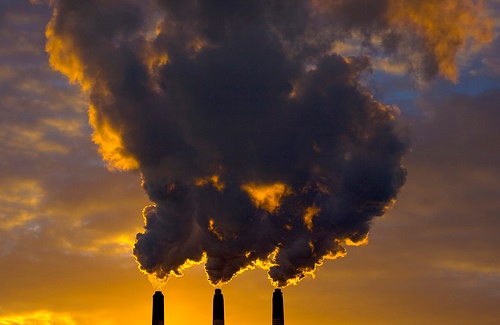
 It’s no secret that humanity, like all terrestrial organisms, has a symbiotic relationship with the Earth’s environment. And whereas the fortunes of entire civilizations and species once depended upon the natural warming and cooling cycle, for the past few centuries, human agency has an increasingly deterministic effect on this cycle. In fact, since the beginning of the Industrial Revolution, just 250 years ago, human industry increased the levels of carbon dioxide in the atmosphere by more than 40 percent.
And now, it seems that humanity has reached a rather ignominious and worrisome milestone. Working at the Mauna Loa Observatory, an atmospheric research facility, scientists announced Friday that for the first time in millions of years, the level of the carbon dioxide in the atmosphere had reached 400 parts per million on average over the course of a full 24-hour day. The last time there were these kinds of CO2 levels was approximately 3 million years ago, and that has many worried.
 For some time now, climatological scientists have warned of the dangers of reaching this limit, mainly because of the ecological effects it would have. The Kyoto Protocol, an attempt during the late-90s to curb fossil fuel emissions on behalf of the industrialized nations of world, specifically set this concentration as a target that was not to be surpassed. However, with nations such as Canada, the US and China expressing criticism or pulling out entirely, it was clear for some time that this target would not be met.
And as mentioned already, the planet has not seen these kind of CO2 levels since the Pliocene Era, a time of warmer temperatures, less polar ice, and sea levels as much as 60 to 80 feet higher than current levels. If conditions of this nature are permitted to return, the human race could be looking at some very serious problems in the near future.
 For starters, much of the world’s population and heavy industry is built along coastlines. With sea levels reaching an additional 60-80 feet, several million people will be displaced over the course of the next few decades. What’s worse, inland areas that have river systems connected to the sea are likely to experience severe flooding, leading to more displacement and property damage.
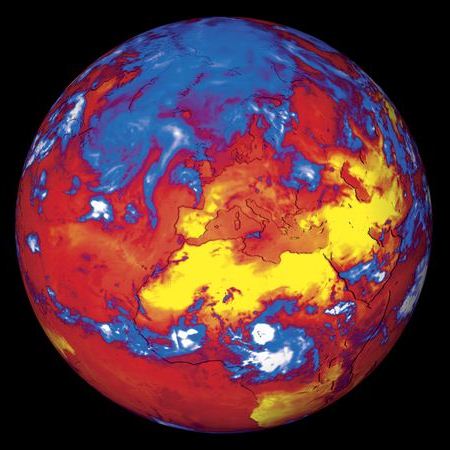
Those areas that find themselves far from the coast are likely to experience the opposite effects, increased heat and dryness due to increased temperatures and the loss of cloud cover and precipitation. This in turn will result in widespread drought, wildfires, and a downturn in food production. And let’s not forget that rising temperatures also mean the spread of disease and parasites, ones that are typically confined to the tropical areas of the world.
 If any of this is starting to sound familiar, it’s because that is precisely what has been happening for the past few decades, and with increasing frequency. Record hot summers, food shortages in several parts of the world, flooding, wildfires, hurricanes, the West Nile Virus, Avian Bird Flu, Swine Flu, SARS, rising sea levels – these are all symptoms of a world where increasing output of Greenhouse Gases mean increasing temperatures and ecological effects.
But of course, before anyone feels like the situation is hopeless, this news does come with a silver lining. For one, the confirmation that we have now reached 400 ppm is likely to spur governments into greater action. Clearly, our current means are not working for us, and cannot be counted on to see us into the future. What’s more, a number of clean energy concerns are well under way, providing us with viable and cost effective alternatives.

The growth in solar energy in just the last few years has been staggering, and carbon capture technology has been growing by leaps and bounds. What’s more, upstarts and clean energy labs no longer need government support, though public pressure has yeilded several positive returns in that area. Even so, crowd-funding is ensuring that growth and innovation that would not be possible a few years ago is now happening, so we can expect the current rate of progress to continue here as well.
And of course, geoengineering remains a viable possibility for buying our planet some time. In addition to clean energy (putting less CO2 in the air), and carbon capture (removing the CO2 there), there are also a number of possibilities for Global Dimming – the opposite of Global Warming – to slow down the process of transformation until we can get our act together. These include evaporating oceanic water to lower sea levels and ensure more cloud cover, triggering algae blooms to metabolize more CO2, and dumping sulfur dioxide (SO2) in the air to combat the warming effect.
But in the end, nothing short of serious and immediate changes will ensure that decades and centuries from now, the ecological balance – upon which all species depend – is maintained. Regardless of whether you think of humanity as the masters or the children of this planet, it’s clear we’ve done a pretty shitty job in both capacities! It’s time for a change, or the greatest natural resource in our corner of the universe, Earth itself, is likely to die out!
Source: fastcoexist.com





 Stories by Williams