The Revelation Space Universe

Lighthuggers, Inhibitors, Ultras, Hyperpigs, Conjoiners Drives, Demarchists, Chasm City… Few science fiction authors have come up with as many weird and intriguing concepts as Alastair Reynolds. The author of the Revelation Space series, Pushing Ice, Blue Remembered Earth, Century Rain, House of Suns, Terminal World, and a slew of short stories and articles, Reynolds is not only a hard science fiction author but an actual scientist.

Yes, from 1991 to 2004, Reynolds worked as an astronomer for the European Space Research and Technology Center, which is part of the European Space Agency, in Noordwijk, Holland. So when it comes to matters of science and space – be it exploration, travel, or the physics thereof – this guy really knows what he’s talking about.

To start my review of his work off right, I’d like to cover his first full-length novel. Known as Revelation Space, this story became the basis for the universe of the same name and the setting of most of his books. It also advanced a lot of ideas and concepts which would inspire yours truly 😉

Revelation Space (2000):
The story opens with three separate but interrelated strands, though their connection is initially unclear. The first takes place on a planet known as Resurgam in 2551, where an archaeologist named Dr. Dan Sylveste is leading an expedition to uncover the remains of the Amarantin. This alien species, which were a winged-humanoid race, existed for over 900,000 years on the planet before some cataclysmic event wiped them out.

The most recent discovery of the excavation team proves that the Amarantin were far more technologically developed than previously thought. Retiring to his den, Dan begins to commune with the beta-level simulation of his deceased father, Calvin Sylveste. Often, he consults his father, who died on Yellowstone, for advice in scientific and political matters. However, Dan soon learns that a coup has taken place due to his obsession with uncovering the Amarantin, and a party shows up at the site to arrest him.

Cut to 2540 aboard the Nostalgia for Infinity, a “Lighthugger” vessel that is the mainstay of the universe in this time (the name refers to the fact that it can fly to within an inch of the speed of light.) Here, Triumvir Ilia Volyova is awake while the other crew members are in reefersleep (cryogenic suspension). They are en route to the Epsilon Eridani system and the planet of Yellowstone to find Dan Sylveste, not knowing that he departed for Resurgam some 15 years previously.

Its crew of Ultras (modified spacers) is desperate to find Sylveste since their Captain is a victim of the Melding Plague – a nanovirus that has infected all of Yellowstone. Basically, they are seeking his services yet again since his last treatment did not seem to take. Ilia also plans to pick up a new gunner since their last one apparently went insane and had to be spaced, the only clue he left behind was the name “Sun Stealer”, which he wrote on a wall in his own blood.

Last, the scene switches to 2524 and the surface of Yellowstone, where professional assassin Ana Khouri is hired by a wealthy recluse known as The Mademoiselle. Apparently, she wants Dan Sylveste found and killed, and she knows the Nostalgia for Infinity will go to the ends of the universe to find him. As such, she orders Khouri to go into stasis and meet up with the crew 20 years later when they arrive in orbit.

Meanwhile, we learn a few things of importance. For one, the Nostalgia appears to have been infected by virus other than the one that’s got their Captain in cryo-sleep. This virus appears to be what drove the last gunner insane and is threatening to kill Ilia now. During a training exercise where they test their landing suits, another glitch results in the death of another crewman, leaving only the Triumvirs – Ilia, Hegazi, Sajake – and the Captain.

We also learn that the cargo hold of the ship is holding a large supply of Cache Weapons, what are apparently referred to as Hell-class, all of which appear to be a bunch of Doomsday devices. Ilia secured these weapons from sources unknown, but in time it is suggested that they are of Conjoiner manufacture – the same advanced faction that built the Nostalgia’s engines (aka. Conjoiner Drives).

Artist concept of Ana Khouri

And finally, we learn why Sylveste is on Resurgam and why the Mademoiselle wants him dead. As it turns out, the Sylveste family maintained a research institute on Yellowstone dedicated to the study of alien civilizations. Many extinct cultures were discovered by humanity as it spread into space, no living ones aside from two exceptions. The first is the Pattern Jugglers, a planet-wide sentient species that comprised massive kelp nets that seemed to preserve the neural patterns of anyone who walked into them. The second is known as the Shrouders, aliens that were presumed to exist within a bunch of anomalous space-time bubbles.

Sylveste became interested in these when a colleague of his became the first to survive contact with a “Shroud” but was left insane. After years of doing nothing but scrawl images on the floor, he spoke and told Sylveste that he actually made contact with an alien intelligence inside the Shroud. This area of space-time, he said, was known as “Revelation Space”. He told him further that they held information about a great mystery that would explain the deaths of all alien civilizations in the quadrant and that he had to go to the Jugglers to get it. As preservers of memories, they held the secrets of many dead alien worlds in their massive neural nets.

Having completed all this, Sylveste finally flew into the Shroud and survived. However, his partner in the expedition, a female researcher, was lost and presumed dead. In truth, she survived, but just barely, and returned to Yellowstone where she became a recluse known as… wait for it… the Mademoiselle! Hence why she wants Sylveste dead, because she blames him for her accident and the fact that she is now forced to live in a containment apparatus.

Ah, but there’s more! After he made contact with “Revelation Space”, Sylveste was told to go to Resurgam, where he would find his answers. He did not know why, but it seemed the Amarantin were the final piece of the puzzle. Before that happened, though, he was brought aboard the Nostalgia to help the Captain for the first time. And years later, his work would be interrupted when the colony rose up against him.

Hints are also given as to what is going on vis a vis the extinction and the virus aboard the Nostalgia. Essentially, eons and eons ago, the first intelligent races of the Galaxy met up and began a prolonged conflict known as the Dawn War. After millions of years of fighting, the remaining civilizations, exhausted and cynical about sentient life, combined their intelligences with machinery to create a series of specialized weapons. Collectively, they came to be known as the Inhibitors, a race of machine-like intelligences that sought out sentient life and exterminated it once it achieved a high level of technical development.

Sun Stealer by bartolomeusz

Meanwhile, on Resurgam, Sylveste is given a reprieve from house arrest to see the latest results of the excavation, which has proceeded in his absence. It seems that the crews turned up a massive underground city containing many ruins and hints as to what happened. Featured over and over is an Amarantin idol which is reaching toward the sun. Hints are also given that Resurgam’s moon, Cerberus, was also particularly significant to the Amarantin people. After learning of all this, Sylveste proposes marriage to his new sweetheart, and they prepare to have their marriage in the city ruins.

By 2566, Khouri is brought aboard as the ship’s new gunner, and they arrive at Resurgam. However, before they make orbit, a nearly catastrophic situation occurs when one of the ship’s doomsday weapons suddenly becomes active and has to be released. It detonates off their bow and creates an artificial singularity that very nearly consumes their ship. Having just made it away, Ilia concludes that the virus is stepping up its game!

Once they make orbit, the crew establishes contact and demands Sylveste be turned over. To make their point, they stage a ruse where they pretend to level an outlying settlement, and the colony responds by handing Sylveste over. This they do by attacking him during his wedding and taking him and his wife prisoner. The crew fly down in their special suits to retrieve him and announce that they plan to bring him and his wife aboard. However, Sylveste turns the tables by saying his artificial eyes contain a pinhead antimatter device that will destroy their ship. He lists new terms, which include letting his wife go and taking him to Resurgam’s moon of Cerberus. In exchange, he promises to help their Captain any way he can.

As Sylveste and the crew of the Nostalgia for Infinity approach Cerberus, Sylveste realizes the massive celestial body isn’t a planet at all—but rather, a massive space station. They fly inside and begin to be set upon by the device’s defenses, but eventually make it down inside. Once in there, Sylveste realizes what it really is. Basically, the moon was built eons ago by the Inhibitors, which served as a beacon to alert them of the emergence of a star-faring intelligence. Once activated, it would signal the Inhibitors to launch their machines to the system so they could exterminate whichever species found them. Sylveste concludes that this is what happened to the Amarantin.

Aboard the Nostalgia, Ilia also is confronted by the truth when the virus threatens to finally take over the ship. Appearing on the ship’s main display, an Amarantin who identifies himself as “Sun Stealer” explains their purpose to her. Apparently, the Amarantin are the Shrouders! These bubbles in space-time have been their protection against the Inhibitors for hundreds of thousands of years and their means of drawing out new sentient races to find them and do their bidding. When Sylveste’s colleague passed into them, they realized their time had come, and as such, tried to manipulate him into discovering if the Inhibitors were still alive out there.

Unfortunately, this case of first contact went poorly. Not being able to recognize his neural patterns, the Amarantin nearly drove Sylveste’s friend completely mad with their message. Luckily for them, he was able to make sense of it in time and delivered it to Sylveste, who then came back to the Shroud, where they were able to imprint a series of clues in his mind as well as a virus that would monitor him. These, they hoped, would eventually lead him back to their homeworld and the moon of Cerberus.  Their intent all along was to have someone else make contact with the Inhibitor machine. Thus they could see if it was safe to emerge from hiding. If so, they planned to retake their homeworld. If not, it would be a different race who was exterminated, and they would wait until the next came along.

However, that plan changed when Sylveste came aboard the Nostalgia for the first time and unknowingly planted the virus in the ship’s hardware. Hence why the gunner went mad and why its been threatening to take over the ship. Cut off from Sylveste, it was beginning to go mad. However, once he was aboard, it saw an opportunity to complete its mission. Having taken the helm, Sun Stealer now kept the ship in orbit around the moon and began reporting everything it saw back to the Amarantin Shroud.

Down on the station, Sylveste realizes that the beacon has become active and that he has been played. Rather than allow the Inhibitors to emerge, he detonates the bombs in his eyes to destroy the facility. Back on the ship, Ilia decides to unleash the Melding Plague that’s been consuming their Captain and let Sun Stealer do battle with it. Sun Stealer loses, and the ship begins transforming into a gothic nightmarish version of itself. But at least they’ve restored control of it to themselves. The story ends with the crew reuniting and setting course for Resurgam again.

Good Points and Bad:
Well, I don’t know if you could tell from my description, but the plot of this book was pretty damn complicated and mighty layered. And personally, I thought that was a good thing! It is not unusual for an author to have distinct points of view in a story that seem unrelated but inevitably come together, but Reynolds was really working overtime with this one. How and where the plots overlapped could produce headaches due to the sheer effort of keeping track of it all, but I, for one, felt it worked pretty well.

In addition, the inventions and futuristic concepts were a real mind-blower for me at the time. In fact, I specifically picked up this book in order to research modern sci-fi and get a dose of the latest hard science, and that’s exactly what I got. Beta-level simulations, Alpha constructs, nanotechnology, servitors, Lighthuggers, inertia, controlled singularities, and the like. It all called to mind numerous other classic sci-fi franchises, many of which Reynolds himself acknowledged a debt to.

For example, his Inhibitors sounded very much like the Firstborn of the Space Odyssey series. Here and there, you had aliens who were so advanced that they could download their consciousness into machinery that would preserve them for eternity, making for effective space travel in a universe that didn’t permit FTL. Reefersleep also called to mind cryogenic pods from Alien and other franchises. Cybernetic implants, augmentation, and nanobots are all concepts one can find elsewhere too. Still, the way Reynolds combined these things together was quite masterful and very much in keeping with the tradition of space opera.

And finally, I found the story downright intriguing. The concept of an ancient race that prevents the rise of space-faring sentient life because it knows from experience that such life will likely engage in a prolonged war with other sentients seemed quite believable. One need only look at the process of human history to know that conflict is a defining feature and that peace on a grand scale only seems to follow in the wake of terrible, exhausting wars. Consider Europe after two world wars, Japan after the Shogunate wars, or China after its Warring States period (and even after that!) Like it or not, peace and consensus are very often the result of war, war, and more war.

Okay, now for the weak stuff. As I said already, the plot can be convoluted. For the most part, this works in the story’s favor. However, something which comes up in other Reynold’s works as well is his tendency to throw in too many plot twists, especially toward the end. Already we have a very complicated and layered story that really didn’t need any more curve balls, but some are thrown even as the other plot threads are culminating. In this story, the unnecessary twists involve last-minute revelations.

In Sylveste’s case, this happens just before he is captured by his own people, and he takes the opportunity to unburden himself to his wife. He tells her that his father once had an alpha-level simulation of himself, as opposed to the beta that he frequently talks to. He gave this alpha to the Pattern Jugglers in exchange for the info they gave him. It is also revealed that Dan Sylveste is actually a clone of his father. Hence his vanity and obsessive nature, which were inherited from a father who wanted a duplicate of himself.

Last, there’s the revelation that the Captain of Nostalgia – John Brannigan – went into the Jugglers sea himself and used them to imprint his mind on Sajaki, one of the Triumvirs. His reasons had to do with the fact that he knew he needed to go into reefersleep until they found a cure for the Melding Plague. Unable to stand the idea of being out of it for so long, he decided to get the Jugglers to erase Sajaki’s mind and replace it with a copy of his own. That way, he could be aware of everything that was going on while he was under. This twist also seemed quite unnecessary, as it really didn’t advance the plot any, just added another complication.

But overall, I was very pleased with this book and was sure to pick up its sequel. In fact, Revelation Space was the second Reynold’s book I had read at this point (the first was Century Rain), and I consider his writing to be a highly educational experience. In fact, much of his ideas and hard scientific basis served to inspire my own writing, particularly when it came to Source. So when it comes to authors I owe a debt to, he’s right up there! Stay tuned for more reviews of Reynolds and the Revelation Space Universe!

The Coming Singularity… In Song!

Singularitarian. That’s a good name for someone who embraces the idea of the coming Technological Singularity, which I believe I mentioned somewhere… Yes, these days a lot of high-minded terms get thrown around to describe what may very well be possible somewhere in this century and the next. Extropian, Post-Human, Clinical Immortality, Artificial Intelligence, Cyber Ethics, Transhuman, Mind/Machine Interface, Law of Accelerated Returns, and so forth. It can be kind of confusing to stay up with it since all the lingo is kind of complex and esoteric. Lot of big and obscure words there…

Luckily, Mr. Charlie Kam has decided to explain. Setting the ideas to the tune of “I am the Very Model of a Modern Major General”, he tells how the idea works and what the eventual aim is. Basically, the idea is all about improving the condition of humanity through the ongoing application of technology. By preserving our cells, our memories, lengthening our lives, we will ensure that humanity will live on and achieve more than we previously thought possible.

Since we don’t yet know how to do this, we will achieve the first step by either merging our own minds with technology to enhance our thought processes and expand our awareness. Or, we could just create machinery that could do the job for us (aka. AI). Then, applying this superior intelligence, we will unlock the mysteries of the universe, create nanotech machines, medicines that can cure all diseases, and machinery that can store human memories, senses and impressions for all time.

Some big names got thrown in there too, not the least of which was Ray Kurzweil, noted Futurist. But don’t take my word for it, watch the video. If nothing else, its good for a laugh.

Dystopia – Final Word

Well, after many, many suggestions on how my list of dystopian franchises could be augmented – this mainly consisted of poeple asking me “what about (blank)?” – I decided there were a few that I really couldn’t proceed without mentioning. This will be my last tour of the dystopia factory, lord knows that place gets depressing after awhile! But one thing at a time. Here’s my final installment in dystopian science fiction series, a hybrid list of novels, graphic novels, and movies!

A Clockwork Orange:
This dystopian novella was originally written in 1962 and was adapted into film by the great Kubrick almost a decade later. In addition, it was adapted into play after the author realized he didn’t like how the adapted movie ended. Having experienced all three, I can tell you that the movie was probably the best. In addition to the rather ingenious ideas presented by Anthony Burgess, it also benefited from Kubrick’s directorial genius and the superb acting of Malcolm McDowell.

Set in the not-too-distant future, the story revolves around a British youth named Alex who is growing up in a world permeated by youth violence. He is the leader of a group of thugs known as “The Droogs”, young men who go about committing acts of “ultra-violence” which consists of them beating up homeless people, random strangers and other gangs, as well as committing theft and gang rape.

In time, Alex and his friends go to far (even for them!) and an innocent woman is murdered during a break-in. His friends, who are already angry over his bullying and strong arming of them, decide to betray him and leave him to the police. Once in prison, Alex decides to cut his sentence short by undergoing a radical government experiment – an artificially created conscience through Pavlovian conditioning!

The result of this conditioning is that Alex is no longer capable of committing any acts of violence. In fact, even the mere thought of violence produces a reaction so strong that he breaks down and is overwhelmed by nausea. This renders him benign, but also helpless. And in time, all his past crimes begin to catch up with him and he is nearly killed. Once he wakes up in the hospital, he discovers the conditioning has worn off, and he can either resume his old ways, or strike out on a new path…

Another interesting side effect of the conditioning is that he can no longer listen to Beethoven without getting sick either. This has to be one of the most curious and intriguing scenes in the movie, where a restrained and helpless Alex begs the doctors to turn off the symphony because he can’t stand the idea of not being able to listen to it. Much like everything else he does, it speaks volumes of his sociopathic nature.

Ultimately, the movie differed from the novel in that the final chapter was omitted. Immediately before this, we see how Alex is now freed from the conditioning. He also seems intent on blaming the current government, which will oust them from power. But beyond that it not quite clear what’s going to happen. However, the following chapter shows how Alex has realized, independently, that he doesn’t want to live a life of violence anymore. Human freedom, he’s determined, is the ability to make choices for oneself, free of persuasion and operate conditioning.

As I said, I truly think the movie was an improvement on the novel, which is a rare thing with adaptations. Still, it is was in the film that the point of the story really came through, thanks to Kubrick’s usual attention to detail and subtlety. Whether it was through those long, close-up shots of McDowell and his crazy eyes, the combination of wide angle action shots in slow motion, or the way that it played to the tune of Beethoven, you really got a sense of the odd combination of genius and madness that is the anti-hero Alex. The reliance on white, sterile settings also helped to punctuate the sociopathic nature of the story – how underneath the veneer of domesticity, brutality and violence can exist! And last, by leaving the ending a mystery, the moral was more ambiguous, which made for a far more effective dystopian feel!

A Scanner Darkly:
Next up, we have Philip K Dicks seminal novel about drug abuse, self-destruction and the various hypocrisies arising out of America’s war on drugs. In this near-future scenario, which takes place in California in 1994 (seventeen years after it was written), a new drug has hit the streets known as Substance D – or SD, which stands for Slow Death. This powerful hallucinogenic is a great high, is violently addictive, and can render users brain damaged after too much use and abuse. And as a result of its popularity and impact, society is gradually becoming a full-blown police state, where cameras – or “Scanners” – are on every street corner and in the home of every suspected dealer.

Written from the point of view of an undercover narcotics agent, the story follows his descent into addiction and his eventual inability to tell reality from fantasy. Through repeated use of Substance D, he gradually becomes brain damaged himself, is released from the police department, and must go to a privately run recovery-center known as “New-Path”. There, he discovers that these centers, which operate like franchises, are actually growing the plant that Substance D is synthesized from. An interesting twist in which we learn that the people profiting from the side effects are the one’s providing the drugs. A stab at strong-arm governments or the pharmaceuticals industry, perhaps?

For the sake of adapting the movie to film, director Richard Linklater shot the entire thing digitally and then had it animated through the use of interpolated rotoscope. The effect of this was to render every single image in a vivid, almost cartoon-like format, which could only be interpreted as an attempt to mimic the effects of hallucinogens. This animation also came in handy with the rendering of the “scramble suit”, a sort of cloak-like device that PKD invented to ensure that undercover agents in his story could completely disguise their appearance, voice, and any other identifying characteristics.

In addition to being science fiction genius, these cloaks were a clear allegory to the anonymity of undercover agents and a faceless system of justice. While responsible for infiltrating and busting up the narcotics subculture, PKD clearly understood that this sort of profession can lead to an identity crisis, especially if the agents in question find themselves using drugs and becoming over-sympathetic to the people they are spying on. This, of course, is precisely what happens to the main character in the story!

In short, the novel was a commentary on the dangers of recreational drug use, but also on the reasons for why such subcultures come into existence in the first place. In addition to ruining lives and causing crime, repression, domestic surveillance, and other extra-legal practices can become quite commonplace. All of this mirrored PKD’s own experiences with the drug subculture and the law, which is why he dedicated the book to all the friends he had who succumbed to drug abuse and died as a result. Very sad!

And let’s not forget the name, a play on the words from the Biblical passage, 1 Corinthians 13:12 : “Through a mirror darkly.” In this day and age, where “scanners” are the means for monitoring society and police officers spend hours looking at their feeds, the scanner has become a sort of means through which people attempt to gaze into other peoples’ souls. But, as with the Biblical passage, this title is meant to refer to how, when we look at the problems of drug use in our society, we are seeing it all through a haze, the result of our own prejudices and preconceptions.

Akira:
How the hell did I forget this one last time? I mean seriously, this is one of my favorite movies and one of the most inspired Mangas of all time! Not only that, it’s a pretty good example of a dystopian franchise. And yet, I forgot it! WHAT THE HELL WAS I THINKING?! But enough self-flagellation, I came here to talk about Akira! So, here goes…

In 1988, famed Japanese writer, director and comic book creator Katsuhiro Otomo undertook the rather monumental task of adapting his Manga series Akira to the big screen. Though some predicted that a two hour movie could never do justice to the six-volume series he had written, most fans were pretty pleased with the end product. And the critical response was quite favorable as well, with the film being credited for its intense visualizations, cyberpunk theme, its post-apocalyptic feel, and the exploration of some rather heavy existential questions.

To break it down succinctly, Akira takes place in Neo-Tokyo, a massive urban center that was literally build up from the ruins of the original. According to the story’s background, WWIII took place in 1989, and after twenty years of rebuilding, the world once again appears to be one the brink. However, as we come to learn, the destruction of Tokyo was not the result of the nuclear holocaust per se. It’s destruction merely heralded it in after the world witnessed the city’s obliteration, assumed it to have been the result of a nuclear attack, and starting shooting their missiles at each other. The real cause was a phenomena known as “Akira”, an evolutionary leap that scientists had been studying and lost control of…

Quite the story, but what I loved most about the adapted movie and the manga on which it was based was the level of detail. Set in 2019 (the same year as Blade Runner, coincidentally!) this series incorporated a lot of concepts which made for a far more intricate and interesting tale. First off, there’s the concept of a post-apocalyptic generation that is filled with unrest and angst, having grown up in a world permeated by the horrors of nuclear war. Second, there’s the ever-present element of gang warfare that has sprung up amidst the social decay. Third, there’s a government slouching towards dictatorship in response to all the protests, unrest and chaos that is consuming the city.

Into all this, you get a secret military project in which the Akira phenomena is once again being studied. Though motivated by a desire to control it and prevent what happened last time from happening again, it seems that history is destined to repeat itself. Once again, the survivors must crawl from the wreckage and rebuild, their only hope being that somehow, they will get it right next time… A genuine dystopian commentary if ever I heard one!

But what was also so awesome about the series, at least to me, was the underlying sense of realism and tension. You really got the sense that Otomo was tapping into the Zeitgeist with this one, relating how after decades of rebuilding through hard work and conformity, Japan was on the verge of some kind of social transformation. Much like in real life, the characters of the story have been through a nuclear holocaust and have had to crawl their way back from the brink, and a sense of “awakening” is one everybody’s lips and they are just waiting for it to manifest.

A clear allusion to post-war Japan where the country had been bombed to cinders and was left shattered and confused! Not to the mention the post-war sense of uniformity where politicians, corporations and Zaibatsu did their best to repress the youth movements and demands for social reform. Well, that was my impression at any rate, others have their own. But that’s another thing that worked so well about Akira. It is multi- layered and highly abstract, relying on background, visuals and settings to tell the story rather than mere dialogue. In many ways, it calls to mind such classics as 2001, Clockwork Orange, and other Kubrick masterpieces.

Children of Men:
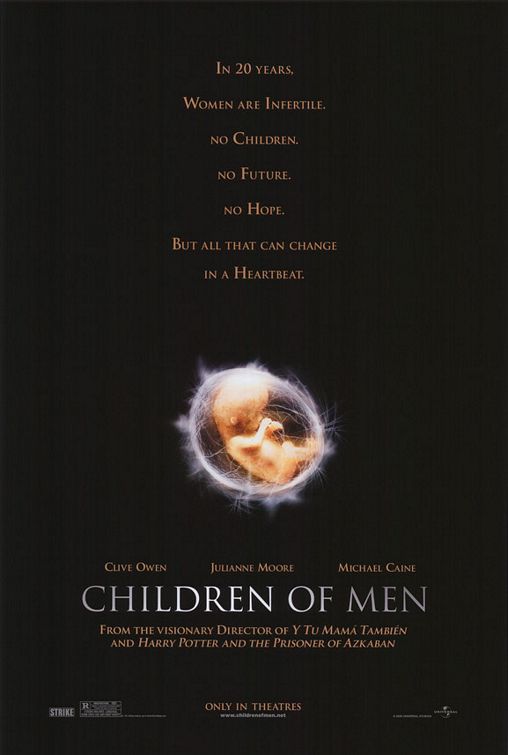
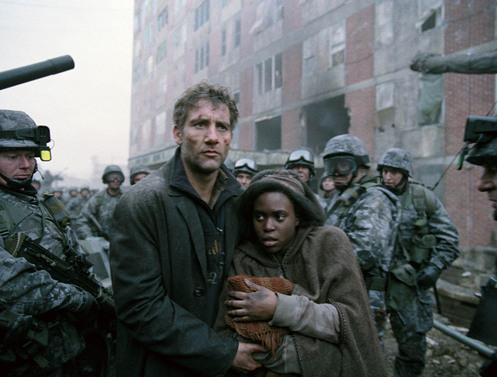
Made famous by the 2006 adaptation starring Clive Owen, this dystopian science fiction story was originally written by author P.D. James in 1992. The movie was only loosely based on the original text, but most of the particulars remained the same. Set in Britain during the early 21st century, the story takes place in a world where several subsequent generations have suffered from infertility and population growth has dropped down to zero. The current generation, the last to be born, are known as “Omegas” and are a lost people.

What’s more, the growing chaos of the outside world has also led to the creation of a dictatorial government at home. This is due largely to the fact that people have lost all interest in politics, but also because the outside world has become chaotic due to the infertility crisis. Much like in V for Vendetta, the concept of “Lifeboat Britain” makes an appearance in this story and acts as one of the main driving forces for the plot.

In any case, this also leads to the birth of a resistance which wants to end the governments tyrannical control over society, and which comes to involve the main character and his closest friends. In time, the plot comes to revolve around a single woman who is apparently pregnant. Whereas some of the rebels want to smuggle her out of Britain and hand her over to the international Human Project, others want to use her as a pawn in their war against the government. It thus falls to the main character to smuggle her out, protecting her from resistance fighters and the military alike.

Naturally, the movie drew on all the novels strongest points, showing how society had effectively decayed once childbirth effectively ended. It also portrayed the consequences of impending extinction very well – chaos, withdrawal, tyranny, etc. However, when it came time to adapt it to the screen, Mexican film director Alfonso Cuaron (who brought us such hits as A Little Princess, Y Tu Mama Tambien, and Harry Potter and the Prisoner of Azkaban), also used a variety of visual techniques and sets to convey the right mood.

For example, most of the sets were designed to look like near-future versions of today. In Cuaron’s estimation, all technological progress would have ceased once the implications of the crisis had fully hit, hence all cars, structures, weapons and gadgets were only slightly altered, or used sans modification. So while the billboards, newspapers and signs were all updated and carried messages appropriate for the period, cars, guns and other assorted background pieces looked entirely familiar.

In addition, much of the movie is shot in such a way so that the images are grey and the light effect seems piercing. This conveys a general mood of drab sadness, which is very accurate considering the setting! Last, Cuaron and his camera crews made many continuous action shots using wide angle lenses in order to capture a sense of crisis and how it effected so many people. Never was there a sequence in which you only saw the main actors and their immediate surroundings. The focus, like the scope of the story, was big and far-reaching.

Ghost in the Shell:
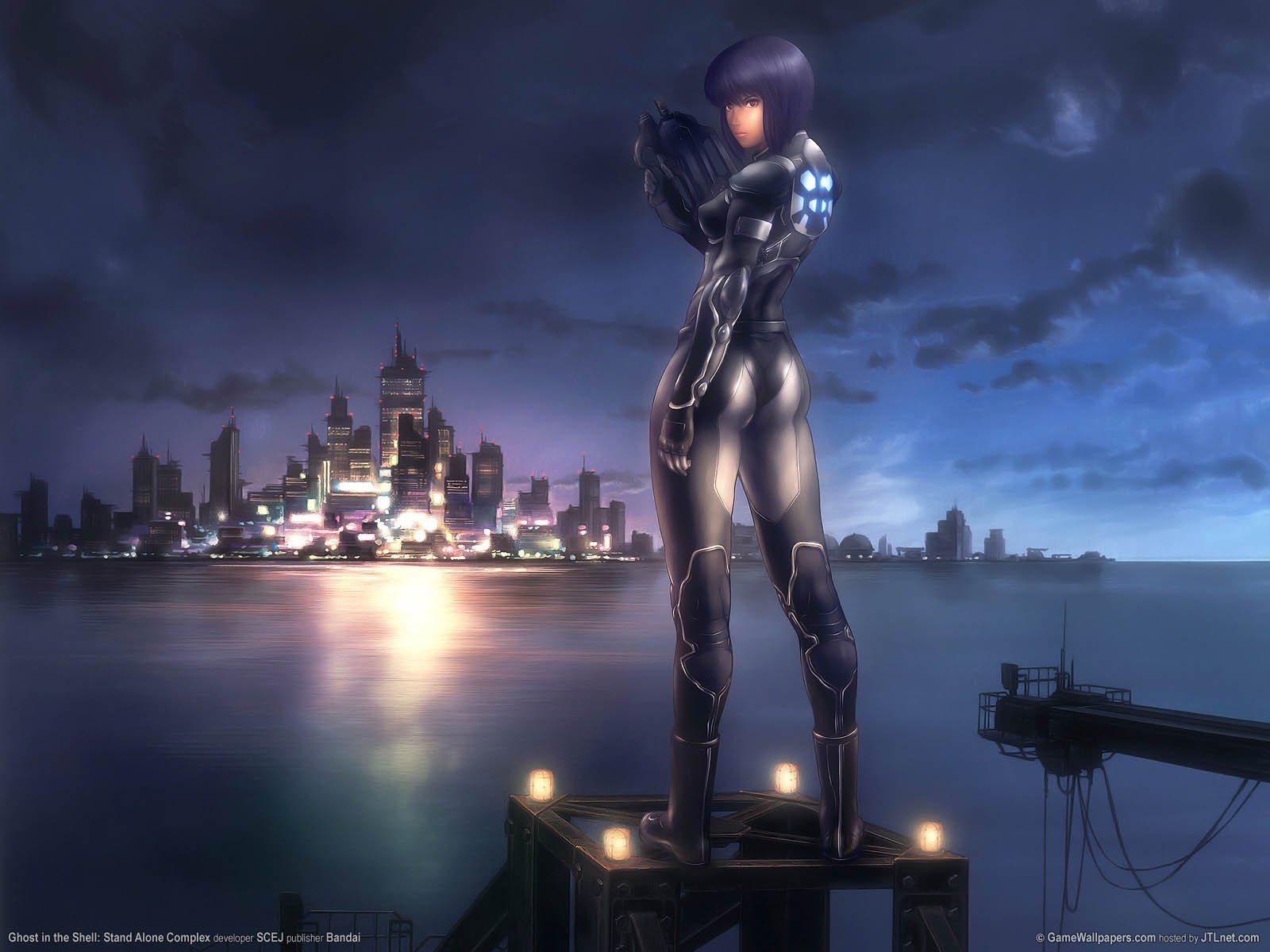
Much like Akira, this franchise comes to us by way of Japan and is cyberpunk-themed. In addition, it also came in the form of a manga, then onto a film, but with a television series to follow. And in many respects, it qualifies as dystopian, given that it took place in a dark future where technology has forever blurred the line between what is real and what is artificial. In addition, it also tapped into several cyberpunk trends which would prove to be quite apt (i.e. cyberspace).

Again, this story takes place in Japan in the early 21st century, a time when cybernetic enhancements and technological progress have seriously altered society. The main character is named Motoko Kusanagi, a member of a covert operations division of the Japanese National Public Safety Commission known as Section 9. She is affectionately known as “Major” given her previous position with the Japanese Self-Defense Forces. And did I mention she’s a cyborg? Yes, aside from her brain and parts of her spinal cord, she is almost entirely machine, and this plays into the story quite often.

In addition to facing external threats, Kusanagi and her companions also face conflicts that arise out of their own nature. These deal largely with issues relating to their own humanity, whether or not a person and their memories can even be considered real anymore if they have been replaced by digital or cybernetic enhancements. These questions were explored in depth in the movie, where events revolve around a sentient program that was developed by the government, but which has since gone rogue and is seeking an independent existence.

However, another thing that makes Ghost in the Shell a possible candidate for the category of dystopia is the setting. Whether it was the manga, the movie, or the television series, the look and feel of the world in which it takes place is quite telling. Always there is a dirty, gritty, and artificial quality to it all, calling to mind The Sprawl, Mega City One, and Neo-Tokyo.

As in these settings, things look futuristic, but also rustic, poor and improvised, hinting at extensive overcrowding and poverty amidst all the advanced technology. This is a central element to cyberpunk, or so I’m told. In addition to being futuristic, it also anticipates dystopia, being of the opinion that this “advancement” has come at quite a cost in human terms.

Logan’s Run:
Considered by many to be a classic dystopian story, Logan’s Run takes place in a 22st century society where age and consumption are strictly curtailed to ensure that a population explosion – like the one experience in the year 2000 – never happens again. In addition, society is controlled by a computer that runs the global infrastructure and makes sure that the all the dictates of population and age control are obeyed.

In any case, the story revolves around this concept of an age ceiling, where people are monitored by a “palm flower” that changes color every seven years. When they reach 21 – on a person’s Lastday – the crystal turns black and they are expected to report to a “Sleepshop” where they will be executed. Those who refuse to perform this final duty are known as “Runners”, and it falls to “Deep Sleep Operatives” (aka. Sandmen) to track down and terminate these people.

The main character – Logan 3 – is one such operative. On his own Lastday, he is charged with infiltrated the underground railroad of Runners and finding the place they call “Sanctuary”. This is a place where they are able to live out their lives without having to worry about society’s dictates and controls. However, in time, Logan comes to sympathize with these people, due largely to the influence of a woman named Jessica 6. In the end, the two make plans to escape together for Sanctuary, which turns out to be a colony on Mars.

Right off the bat, some additional elements can be seen here. In addition to the concepts of Malthusian controls and ageism, there is also the timeless commentary on how rationalization and regimentation can lead to inhumanity and repression. Much like in We or Anthem (by Ayn Rand), people do not have names as much as designations. All life is monitored and controlled by a central computer, and it is made clear towards the end that the computer is in fact breaking down. I can remember this last theme appearing in an episode of Star Trek TNG, where a planet of advanced people are beginning to die off because their “Custodian” is malfunctioning and no one knows how to fix it.

Metropolis:
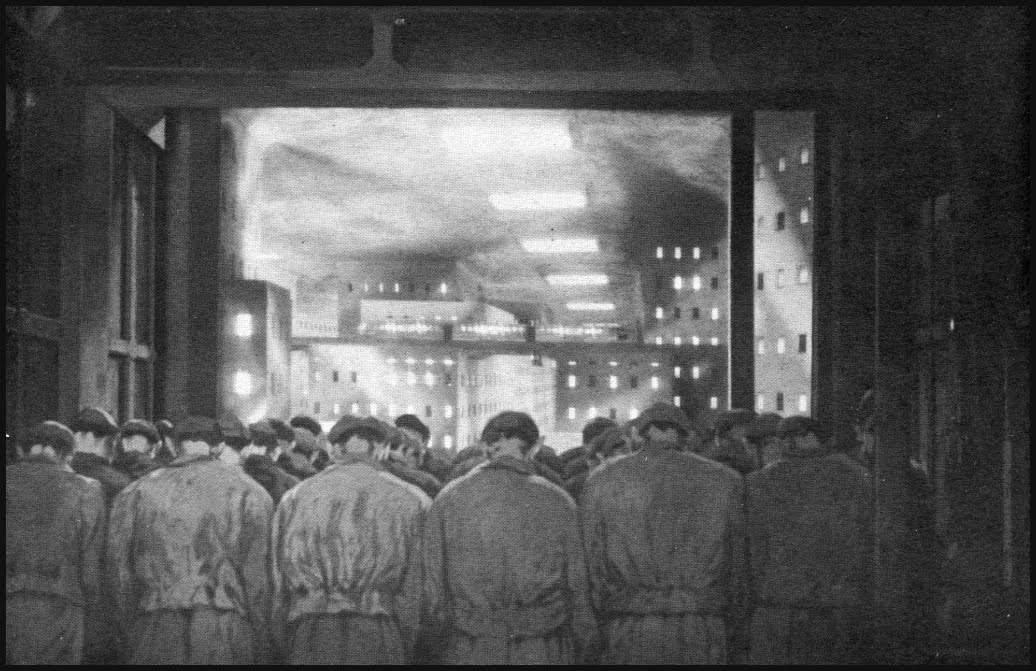
A true classic of both film and expressionist art, this movie also has the added (and perhaps dubious) honor of being a classic of dystopian science fiction! Created in Weimar Germany in 1927 by Fritz Lang, this movie tells the story of a dystopian future where society is ruled by elites who live in vast tower complexes and the workers lives in the recesses of the city far below them where they operate the machinery that powers it all.

This physical divide serves to mirror the main focus of the story, which is on class distinction and the gap between rich and poor. To illustrate this artistic vision, director Fritz Lang relied on a combination of Gothic, classical, modern and even Biblical architecture. In an interview, Fritz claimed that his choices for the set design were based largely on his first trip to New York where he witnessed skyscrapers for the first time. In addition, the central building of the futuristic city was based on Brueghel’s 1563 painting of the Tower of Babel (right>).

The theme of class conflict is further illustrated by the fact that the workers who live in the bowels of the city are also responsible for maintaining the machinery that makes the city run. One is immediately reminded of H.G. Wells’ The Time Machine and the divide between the Morlocks and the Eloi. This comes through even more when the workers decide to revolt and begin ransacking the neighborhoods of the elites. Ultimately, it is only through the love of the two main characters – Freder and Mariah – that the gulf between the two is sealed and order is restored, a fitting commentary on how society must come together in order to survive and achieve social justice.

In another act of blatant symbolism, we learn early on in the movie that the workers have taken to congregating in a series of tunnels that run under the city. It is here that they meet with Maria, their inspirational leader, and makes plans to change society. So in addition to tall, Babel-like buildings illustrated the gap between rich and poor, we have workers who are literally meeting underground! Wow…

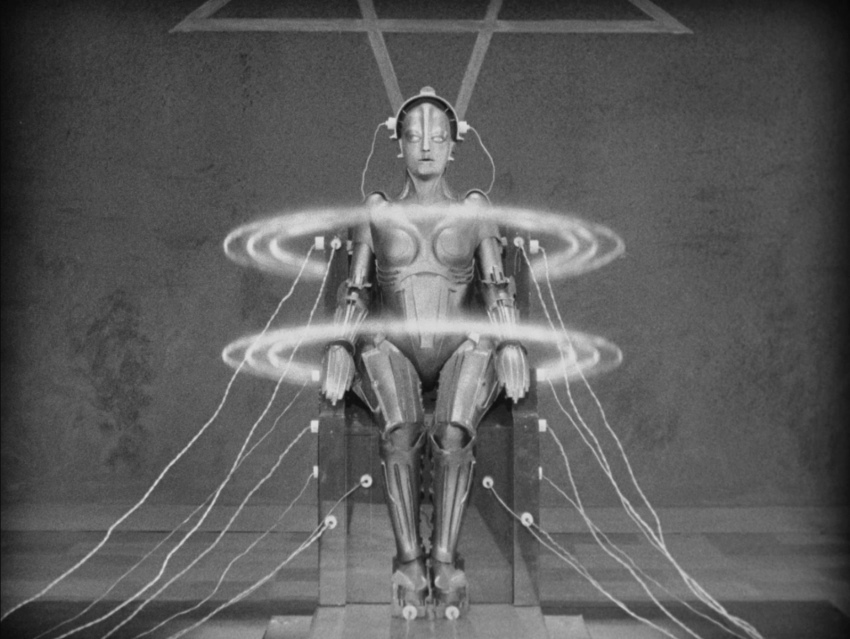
In addition, several other dystopian elements weave their way into the story. The line between artifice and reality also makes an appearance in the form of the robot which the movie is best known for. This robot was created by Rotwang, a scientist who is in the service of the main character’s father – Joh Fredersen, the master of the city. Apparently, this robot is able to take human form and was created to replace his late wife. Once this robot was released into the city, she began sowing chaos amongst men who begin to lust after her, and is the very reason the workers began revolting in the first place. She even causes the character of Rotwang to go insane when he can no longer distinguish between the robot and the woman she’s impersonating.

Neuromancer/Sprawl Trilogy:
Gibson is one of the undisputed master’s of cyberpunk and future noire lit and it was this novel – Neuromancer – that started it all for him. In it, he coined the terms cyberspace, the matrix, and practically invented an entire genre of Gothic, techno-noire terminology which would go on to inspire several generations of writers. His work is often compared to Blade Runner given the similar focus on urban sprawl, cybernetic enhancements, the disparity between rich and poor, and the dark imagery it calls to mind.

The first installment in the “Sprawl Trilogy”, this book takes place in the BAMA – the Boston-Atlanta Metropolitan Axis (aka. The Sprawl). In this world of the 21st century, cyberspace jockeys or cowboys use their “decks” – i.e. consoles – to hack into corporate databases and steal information. The purpose is, as always, to sell off the information to the highest bidder, usually another corporate power. In addition, guerrilla tactics and domestic terrorism are often used to get employees out of their contracts, seeing as how most companies have no intention of ever letting their talent go!

picture by Maxim-Lysak on deviantArt

Also, there is the massive gulf that exists between the rich and the poor in these novels. Whereas the main characters tend to live in overcrowded tenements and dirty neighborhoods, the rich enjoy opulent conditions and control entire parts of the world. In addition, the richest clans, such as the Tessier-Ashpools and Vireks, actively use cloning and clinical immortality to cheat death, and often live in orbital colonies that they have exclusive rights to. Much like in his “Bigend Trilogy”, much attention is dedicated to the transformative power of wealth and how it affords one better access to the latest in technology.

But always, the focus is on the street. Here, jockeys, freelancers and Yakuza agents are at work, pulling jobs so they can buy themselves the latest enhancements and the newest gear. In the case of Molly Millions, a freelance lady-ninja, this includes razor nails that extend from her fingertips. In the case of Yakuza enforcer from the short-story (and movie) Johnny Mnemonic, it consists of a filament of monomolecular razor wire hidden inside his thumb. For others, it might consist of artificial limbs, new organs, implants of some kind. Whatever ya need, they got it in the Sprawl. If not, you go to Chiba City or Singapore, chances are it was made there anyway!

*Interesting  Fact: according to Gibson, Blade Runner came out when he was still tinkering with the manuscript for this novel. After seeing it, he nearly threw the manuscript out because he was afraid Ridley Scott had pre-empted him! Funny how things work out, huh?

Final Thoughts:
Gee, there really isn’t much more to say is there? One thing I have noticed is that much of modern dystopia comes to us in the form of the cyberpunk genre. Though the definition of cyberpunk appears to constantly be evolving, it is generally acknowledged that it is a postmodern form of science fiction that combines “high tech and low life.” Having sorted through several modern examples of dystopian sci-fi, I can say that this is certainly an apt description.

In essence, it assumed that the presence of high tech would entail the emergence of a dystopian society, that the endless march of progress would lead to the destruction of the environment, the devaluing of human life, the elimination of privacy, and the line between real and fake. This last aspect was especially important, embracing cybernetics, virtual reality, and things like cloning and clinical mortality. Since the 1980’s, all of these notions have infiltrated science fiction movies, television, and have even become cliches to some extent.

This genre has given rise to new kinds of science fiction as well. For example, it is generally acknowledged that a sub genre known as post-cyberpunk emerged in the 1990’s which broke away from its predecessor in one key respect. Whereas it too focused on the rise of technology, it did not anticipate dystopia as part of the process. This is best exemplified by books such as Neal Stephenson’s The Diamond Age, a 21st century bildungsroman which predicted vast social and political changes as a result of nanotechnology.

Other sub genres that have emerged in recent years include “Steampunk”, a literary form that combines Victorian era technologies with the punk genres noire sensibilities. Other derivatives include Dieselpunk, Nanopunk, Biopunk, and even fantasy-punk crossovers like Elfpunk. Yes, like most things in the post modern era, it seems that literary genres are becoming fragmented and tribalistic!

But alas, I still feel the need to ask the question, what’s happened to dystopian literature of late? In my initial post, I got a lot of people asking me if I could include some more modern examples. You know, stuff that’s come out since 1984 and The Handmaids Tale. But unfortunately, what I’ve found tends to be more of the same. Just about every example of dystopian fiction appears to draw its inspiration from such handy classics as the one’s I’ve already mentioned, or is in some way traceable to them. Does this mean that we’ve hit bottom on the whole genre, or could it just be we’ve moved away from it for the time being?

Well, I recently learned from an article on IO9 that Neal Stephenson himself stated that science fiction needed to stop being so pessimistic and had to start getting inspirational again. Perhaps he’s onto something… Maybe we’ve gone too far with the whole cautionary tale and need to steer things back towards a brighter future, urging people on with common sense and technological solutions rather than laments. Maybe we need to let them know that such problems as world hunger, overpopulation, pollution, climate change, poverty, war, licentiousness and greed can all be overcome.

Then again, I’m working on a couple dystopian tales right now… Is it too much to ask that this craze last just a few years longer?

Thanks to all who’ve written in and “liked” my dystopian series! Hope to see y’all again soon as I get into ore cheerful things…