
 3-D printing continues to grow by leaps and bounds, being used to generate anything from components and models to complex machines and living tissues. And as the technology improves, the applications continue to grow and coalesce with developments made in other fields of scientific research. And in the last month alone, there have been a number of announcements that have both scared and impressed.
The first came from Duke University, where engineers have made yet another breakthrough. Seven years ago, they demonstrated their first “invisibility cloak” in a laboratory. Now, thanks to 3D printing, the fabrication process is a lot more accessible. And while invisibility might be a bit of a misnomer, that’s precisely what this object does as far as microwave radiation is concerned.
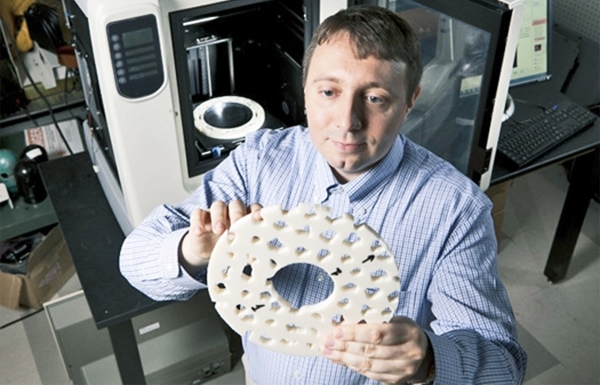 The object, which resembles a frisbee, has a large hole in the center, with seemingly random holes in the disc. The size, shape, and placement of these holes have actually been determined to disguise any object placed in the center hole from microwave beams, making it appear as though the object isn’t there. At present, the invention is limited in terms of practical use, but the design team believes this object has great potential.
According to Yaroslav Urzhumov, an assistant research professor in electrical and computer engineering at Duke, the technology could be used to create a polymer-based cloaking layer just 1 inch thick, wrapped around a much larger object. From this, they hope to eventually be able to create a material that will operate in higher wavelengths, including the visible light spectrum.
 Meanwhile, the team’s creation of the disc using a 3-D printer means the technology is now much more accessible. Urzhumov went as far to say the he believes that anyone with access to a 3D printer will have the ability to create something similar at home. In time, this could mean anyone would have the ability to create a full-spectrum invisibility cloak at home too. Good news for anyone looking to hide from surveillance drones or cameras!
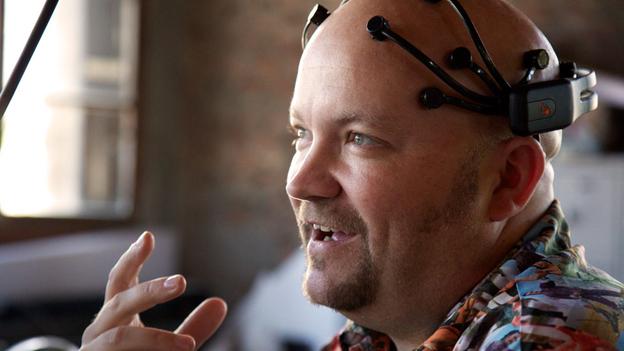
The second bit of news is even more impressive, and potentially frightening. It comes to us from Santiago Makerspace, a technology and design studio located in the heart of the Chilean capital where a designer created a 3D printed object using only their thoughts. The designer in question was George Laskowsky, Chief Technical Officer of Thinker Thing, a Chilean start-up that is developing a mind-controlled 3D printing system.
 The purpose behind Laskowsky’s work is simplification: while 3D printing has been growing and making design and fabrication easier and more accessible. However, mastering the design software is still a difficult challenge, especially for young children. That’s where Tinker Thing comes in, which seeks to develop the means to help children unleash their inner creativity.
Bryan Salt, CEO of Thinker Thing, expands on this, stating that there has not been enough work done on adapting the software for popular use. His company is looking to make it open and accessible so that it can be used to create items for one the largest markets for consumer products – children’s toys:
What is the point of these printers if my son cannot design his own toy? I realised that while there were a lot of people talking about the hardware of the printer no-one really seemed to be talking about how to actually use it.
 The software that makes this possible – Emotional Evolutionary Design (EED) – works by interpreting its users’ thoughts to make fantastical designs for toys and other objects. As part of the Monster Dreamer Project, Chilean children will get the first opportunity to try it out during tour of schools in the country at the end of this month.
Combined with Emotiv EPOCH (an EEG headset), a computer and a 3D printer, the children running Monster Dreamer will be presented with a series of different body shapes in bubbles. These will mutate randomly, with built-in rules preventing them from becoming too abstract. As different brain states such as excitement or boredom generate specific patterns of brain activity, the computer can identify the shapes associated with positive emotional responses.
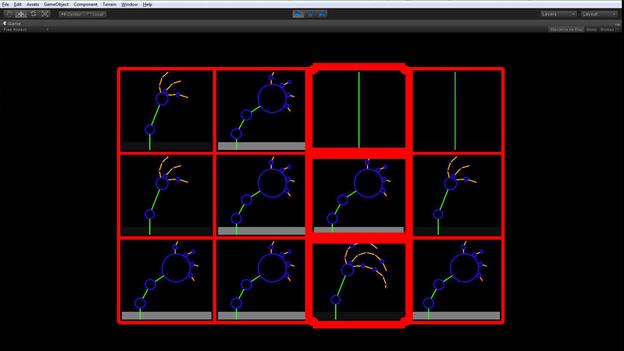 The favored shapes will grow bigger on the screen, while the others shrink. The biggest shapes are combined to generate a body part, and the process is repeated for different body parts until the monster is complete. The final result should be a unique 3D model that is ready for printing as a solid object. In essence, a child will create a tailor-made toy based solely on their emotional reactions to what they see.
Amazing the direction things are taking, isn’t it? One of the greatest appeals of 3D printing is the way which it is making technology and industry far more accessible and open to people.What began with items that would only interest engineers and design firms is now expanding to include just about any type of consumer product we can imagine, and comes with the ability to tailor make them at home, giving the average consumer immense control over the process.
 Though an individual printer may still cost more than the average person is willing to spend, in time, they will likely come down in price and become like any other computer accessory – i.e. printers, faxes, modems, wireless routers. What’s more, we are likely to see a situation where communal labs, such as those found in a university or internet cafe, come equipped with one in the next few years.
In a way, it would not be a fevered dream to imagine that this could very well be the curtain raiser for a new age, an age when the means of production is literally in the hands of every person. If we are capable of printing food and buildings as well as toys and components, we would also be looking at an age when scarcity is a thing of the past and society is truly democratic and open. And all without the need for violence and forcible redistribution…
I can’t tell you how preferable it is to think about this stuff and not the current pace and effects of Climate Change. Sometimes, the only way to have hope for the future is to keep things positive and contemplate the happier possibilities. Here’s hoping smarter heads and brighter prospects prevail!
Sources: cnet.news.com, bbc.com


 Stories by Williams