
 The world today is permeated by invisible waves that confer the ability to communicate, share, download, upload, invade, spy and monitor. In other words, so much depends upon it and so much happens within it. As a result, it would be nice if people could see it for once. That’s the idea behind “Digital Ethereal”, a project being led by artist and researcher Luis Hernan of the University of Newcastle in the UK, that seeks to give visual representation to this invisible world.
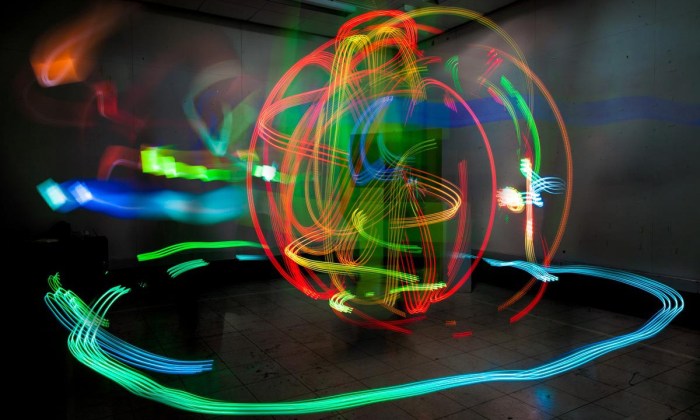
By using different colors of light – red, yellow, green and blue – he was able to reveal the different strength of Wi-Fi signals in the world around us, showing the “ghost in the machine” as it were. He has called his device the Kirlian Device – named for Russian inventor Semyon Davidovich Kirlian, who discovered Kirlian photography, a technique for photographing electrical discharges, usually invisible to the naked eye.
 As Hernan explained on his website:
This project came about as a design discourse on digital technologies, and the invisible infrastructure underpinning it. I believe our interaction with this landscape of electromagnetic signals, described by Antony Dunne as Hertzian Space, can be characterized in the same terms as that with ghosts and spectra. They both are paradoxical entities, whose untypical substance allows them to be an invisible presence…
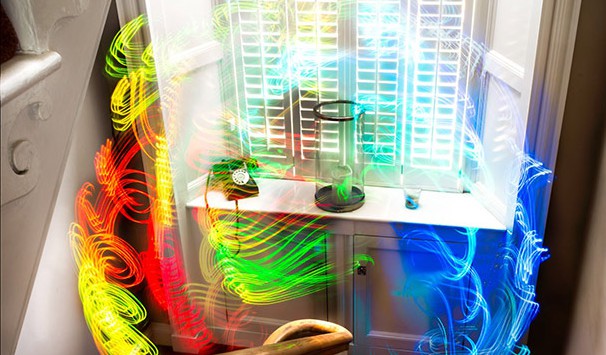
Quite simply, the Kirlian Device measures the properties of Wi-Fi signals in its immediate vicinity, and shows a corresponding color. Much like the color spectrum, red is at one end, indicating a strong signal, while blue is at the opposite end indicating a weak one. As Hernan moves around, he uses long exposure photography to reveal Wi-Fi “ghosts” – what he dubs “wireless spectres”. In this way, his project has a certain spiritual quality.
In the same way, they undergo a process of gradual substantiation to become temporarily available to perception. Finally, they both haunt us. Ghosts, as Derrida would have it, with the secrets of past generations. Hertzian space, with the frustration of interference and slowness.
 As he explained during an interview with Discovery:
The device is moved through the space, which is then registered in a long-exposure photograph. This process lasts for several minutes, and due to the brightness of the device, my figure is ghosted away in the process. In some pictures you can see my feet or even my blurred head underneath the light strikes…
For the purpose of his project, Hernan built his Kirlian Device out of an Arduino UNO board and Wi-Fi Shield which were connected to a strip of LED lights. But he’s also released a free Android app so that users can try it for themselves, and invited potential collaborators to drop him a line via his website. In the meantime, Hernan is currently pursuing his PhD with the Architecture and Interaction Design group at Newcastle University in the U.K.
And be sure to check out the video of the recent exhibition of Digital Ethereal:
Source: cnet.com, news.discovery.com

 Stories by Williams