10 Sci-Fi Novels People Pretend to Have Read

Came across this article in Io9 recently, then again over at Scoop.it. You can tell something is important not only when it speaks to you, but when like-minded individuals begin referencing it! And if you own a blog, you definitely want to get on that! In any case, I found the list especially interesting for two reasons. One, many of the books I have already read. And two, I haven’t even heard of the rest.

I’d say a list like this is long overdue, but it’s still highly subjective isn’t it? The books we pretend we’ve read all comes down to what we consider important and relevant, not to mention popular. And even within the genre of sci-fi, I’d say that list is too big to boil down to a simple top ten. Even so, it’s interesting to read and compare, and find out just how many you’ve read yourself. So please, check this out and tell me which of these you have read and which you think you’ll want to check out:

1. Cryptonomicon:
Read it! This book is Neal Stephenson’s groundbreaking piece of historical fiction, combining narratives involving World War II cryptographers with modern day IT geeks who are looking to establish a data haven in the South Pacific. The story tells the tale of a massive shipment of Nazi gold that got lost on its way to Japan, ran aground in the Philippines, and remained hidden until the late 90’s.

Personally, I loved this book because of the way it weaves history, both recent and distant, into a seamless narrative and draws all the characters into the same overarching plot. One would think that Stephenson was making a point about how we are all subjects of our shared history, but it could just be he’s that good a writer!

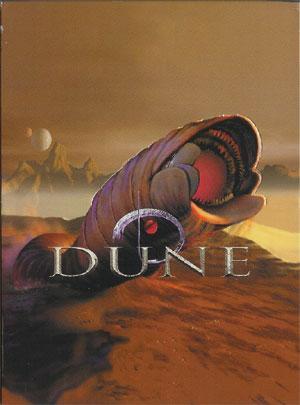
2. Dune:
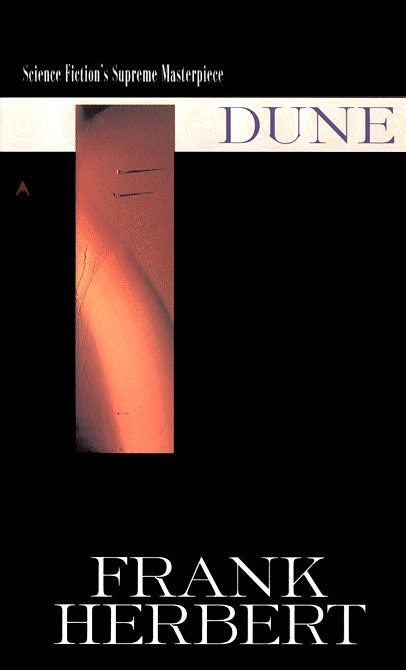
Read it thrice! In Dune, Frank Herbert draws upon an immense store of classical sci-fi themes, a grand awareness of human nature and history, and a keen grasp of ecology and the influence environment has on shaping its inhabitants to create the classic that forever established him as one of the greatest sci-fi minds of all time.

Sci-fi geeks everywhere know this one and it saddens to me to think that it’s even on this list. Anyone who’s willing to pretend that they read this book clearly considers it important, which is why they should have read it, dammit! Not only is it a classic, it’s from the guy who literally wrote the book on science fiction that was meant to be taken seriously.

3. Gravity Rainbow:
Never heard of it! Apparently, the story came out in 1974 and deals with the German V2 rocket program near the end of World War II. Pat Murphy, author of The City, Not Long After and The Wild Girls, went so far as to compare this book to James Joyce, a the great Irish modernist writer who was also renowned for being brilliant and inaccessible.

In addition to be classified as enriching, it is known for being odd and hard to get through, with many authors themselves claiming to have started it several times but never being able to finish it. The plot is also rather unique, combining transgressive sexuality with the idea of total war and technological races. But one look at the dust jacket will tell you all of that, right? Crazy Germans!

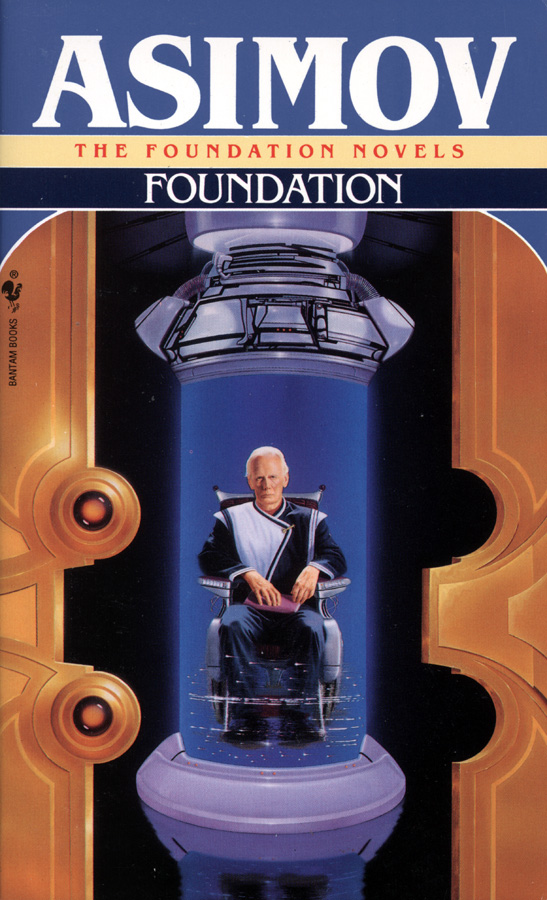
4. Foundation:
Read it myself, and also am somewhat sad that it made the list. Sure, the fact that it’s a classic means that just about everyone who’s eve shown the slightest interest in sci-fi would want to read it. But I can’t for the life of me understand why people would claim to have read it. Jesus, it’s not a hard read, people. And Amazon sells used copies for cheap and handles shipping. No excuses!

And having just reviewed it, I shall say nothing of the plot, except that it in many ways inspired fellow great Frank Herbert in his creation of Dune. Like Frank, Asimov combined the idea of a Galactic Empire with a keen awareness of human history, eternal recurrence, and prescient awareness.

5. Johnathon Strange & Mr. Norrell:

Now this one I have heard of, but never felt compelled to pick up and read. Apparently, its size and bulk are the reason many people react the same. This 2004 book is the first novel by British writer Susanna Clarke which deals with the nature of the English character and the boundary between reason and irrationality.

Set in 19th-century England during the time of the Napoleonic Wars, the story is an alternative history that is based on the idea that at one time, magic existed in England and has thanks to the help of two men – the namesakes of the story, Jonathan Strange and Gilbert Norrell. At once interesting and speculative, it also presents the rather romantic vision of romance returning to a world increasingly characterized by modernity and cold reason.

6. 1984:
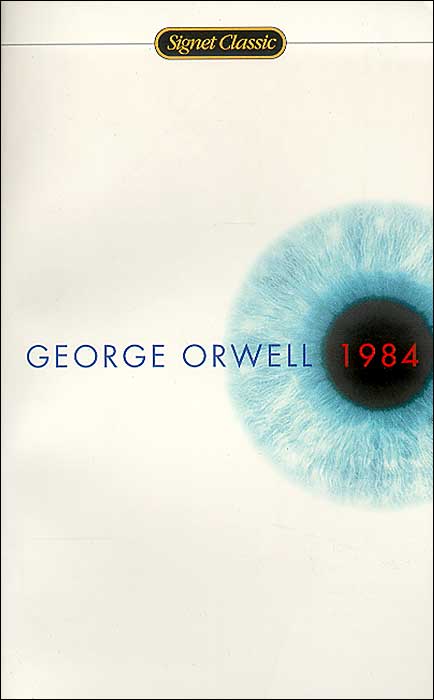
Yep, read this one thrice as well! And given it’s reputation and place in the annals of literary history, I can totally see why people pretend to have read it. Oh, and let’s not forget the way people love to reference and abuse it’s message for the sake of making a quick and easy political point! But none of that excuses not reading it.

Set in an alternate history where WWIII and revolution have led to totalitarian governments in every corner of the world, the story tells the tale of one man’s quest to find answers and facts in a world permeated by lies and absolute repression. Of course, this meager description doesn’t do it justice. In the end, so much comes into play that it would take pages and pages just to provide an adequate synopsis. Suffice it to say, it’s a book that will change your life. READ IT!

7. First and Last Men and Star Maker:
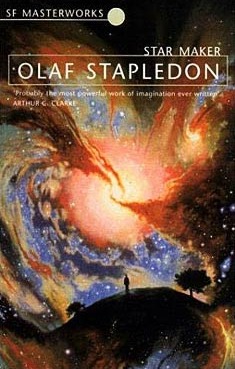
Another one which I’m not too sure about. Much of what is described within are concepts I have heard of in other places, and some of the content sounds familiar. Still, can’t say I’ve ever heard of Stapledon or these two works by name. But after reading about his work, I’m thinking I ought to check him out now. Tell me if you’d agree…

Published in 1930 and 1937, these two books tackled some rather broad ground. The first deals with the history of humanity, covering 18 species of humanity from the present to two billion years into the future. Based on Hegelian concept of history, humanity goes through several different types of civilizations and passes between stability and chaos over the course of it all. However, undeniable progress is made, as each civilization reaches further the last, culminating in leaps in evolution along the way.

In Star Maker, the plot revolves around a man who is able to leave his body and venture throughout the universe. He is able to merge with more minds along the way, a snowballing effect which allows him and his companions to explore more and worlds through time and space. This leads to a climax where a cosmological mind is created and makes contact with the “Star Maker” – the creator of the universe.

Sounds cool huh? And they appear to have no shortages of accolades. For example, Arthur C. Clarke called Star Maker one of the finest works of science fiction ever written, and the concept explored therein had a profound influence on many subsequent sci-fi minds, not the least of which were Gene Roddenberry and J.M. Straczynski.

8. The Long Tomorrow:
This one, I have heard of, mainly because it’s on my list as an example of post-apocalyptic fiction. I have yet to read it, but after reading about it, I think I would like to. Set in a post-apocalyptic world devastated by nuclear war, the story takes place within a society that is controlled by religious groups preaching a technophobic message.

Inevitably, the story comes to a head when young people, intrigued by stories of a neighboring community, go out in search of it, braving punishment and even exile. Sounds familiar? Well, it should. This book, which was published in 1955, has gone on to inspire countless variations and pop culture renditions. It also attempts to illustrate the connection between natural disasters and regression, traditionalism and repression.

9. Dhalgren:
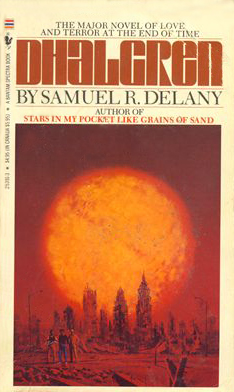
Yet another book that’s compared to James Joyce, largely by people that haven’t read it. I’m one of them! Apparently, this 1975 story by Samuel R. Delany takes place in a fictitious Midwestern town that has become cut off from the outside world by an event horizon. All communications are cut off, and the population become frightened by the night sky reveals two moons, and the morning sun is many times larger than our own.

More strange is the fact that street signs and landmarks shift constantly, while buildings that have been burning for days are either never consumed or show signs of damage. Gangs also begin to roam the nighttime streets, their members hidden within holographic projections of gigantic insects or mythological creatures. Against this backdrop, a group of people come together and try to make sense of what has happened as they struggle to survive.

Told from the point of view of a partial amnesiac, dysmetric, schizophrenic, as well as a bunch of other people who find themselves stranded in the city, the story is an exercise is confusion, dissociation, and a really just a big mystery. In the end, what is truly going on is never revealed, thus leaving the reader with their own interpretations. This is one of the selling points of the book, with William Gibson himself saying that it was “A riddle that was never meant to be solved.” Yeah, I definitely need to read this one!

10. Infinite Jest:
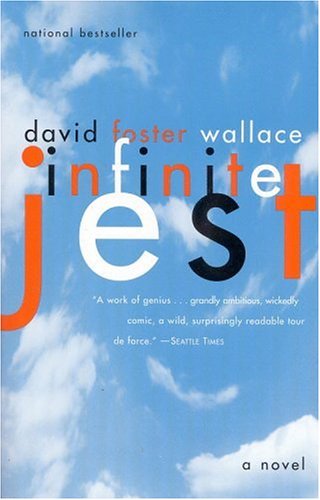
This last novel is more recent, having been released in 1996. Once again, haven’t heard of it, but given its content, praise, and the fact that the author’s low life was cut tragically short, it doesn’t surprise me that its one of those books that everyone feels they must read. But given the length, complexity and the fact that story contains 388 numbered end notes, I can see why they’ve also held back!

The story focuses on the lives of a celebrity family known as the Incandezas, a clear pun on their, shall  we say… luminous fame? The family is deeply involved in tennis, struggles with substance abuse, and in a state of disrepair since the father – a famous film director – committed suicide with a microwave. His last work was apparently a film (entitled “Infinite Jest”, but known throughout the story as “The Entertainment”) which is so entertaining, it causes viewer to lose all interest in everything besides watching the movie.

Clearly meant as a satire on North American culture, particularly celebrity families, entertainment, substance abuse and the sideshow that is celebrity rehab, the story is all about various people’s search for the missing tape of “The Entertainment” and what they plan to do with it. The novel received wide recognition and praise after its publication and became a testament to Wallace’s talent after he committed suicide in 2008.

Okay, that’s four out of ten for me. How did you do? And even if you could say that you’ve read most of the books on this list, or at least the one’s you’ve heard of, I’d say we’ve all come away with a more additions to our reading lists, hmmm? Yeah, I guess its back to Amazon for me!

Of Faster-Than-Light Travel

It’s a popular concept, the fictional technology that could help us break that tricky light barrier. And it’s not hard to see why. The universe is a really, really, REALLY big place! And if we ever want to begin exploring and colonizing our tiny corner of it – and not have to deal with all the relativistic effects of time dilation and long, long waits – we better find a way to move faster.

And this is where various franchises come up with their more creative take on physics and the natural universe. Others, they just present it as a given and avoid any difficult, farfetched, or clumsy explanations. And in the end, we the viewers go along because we know that without it, space travel is going to be one long, tedious, and mind-bendingly complex journey!

Alcubierre Drive:
Proposed by Miguel Alcubierre as a way of resolving Einstein’s field equations, the Alcubierre Drive is an untested by possible way to achieve FTL travel. As opposed to Warp, Foldspace, or most other proposed means of FTL that involve some kind of internal propulsion of jump drive, the Alcubierre Drive is based on the idea of generating a wave that a ship would then “surf” in order to travel.

The creation of this wave would cause the fabric of space ahead of the spacecraft to contract and the space behind it to expand. The ship would then ride this wave inside a region of flat space known as a warp bubble and be carried along as the region itself moves through space. As a result, conventional relativistic effects such as time dilation would not apply in the same way as if the ship itself were moving.

The Alcubierre drive is featured in a few different science fiction genres, mainly those of the “hard” variety. This includes Stephen Baxter’s Ark, M. John Harrison’s novel Light, Warren Ellis and Colleen Doran’s Orbiter, and Ian Douglas’s Star Carrier where it is the primary means of transport.

FTL Drive:
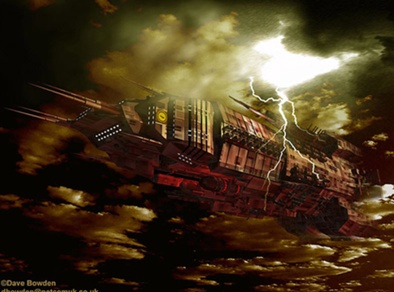
The primary means of interstellar travel in the Battlestar Galactica universe, where every ship larger than a in-system transport is equipped with an FTL drive. How it works is never really explained, but it is clear that the technology is complex and involves a great deal of calculation. This is not only to ensureolve n accurate relocation through space-time, but also to make sure they don’t up jumping too close to a planet, star, or worse, right in the middle of either.

Whereas Colonial ships use their own computers to calculate jumps, Cylon ships rely on the Hybrid. These “machines” are essentially semi-organic computers, and represent the first step in Cylon evolution from pure machines to organic beings. Apparently, the hybrids were more sophisticated than Colonial computers, especially the aging Galactica. Hence, they were able to calculate jumps more quickly and accurately.

Holtzman Drive:
This FTL drive system comes to us from the Dune universe, and is otherwise known as a “Foldspace Engine”. Relying on principles that are not entirely clear to those in the Dune universe, the system involves depositing a ship from one point in space-time to another instantaneously. Though the workings of the drive are never really explained, it is intimated in Chapterhouse: Dune that tachyons are involved.

Another key component in the system is a Guild Navigator, a mutant who has been given natural prescient abilities thanks to constant exposure to spice. Using this prescience, the Navigator “sees” a path through space-time in order to guide the ship safely through. But in time, the Ixians invented a machine that was capable of doing this job as well, thus making the entire process automated and breaking the Guild’s monopoly on spacing.

Hyperspace:
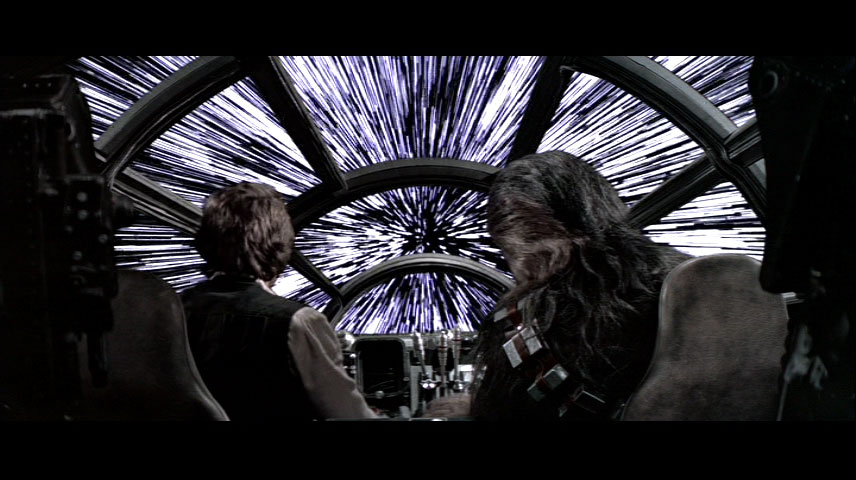
Like the Warp drive, the terms hyperspace and hyperdrive have become staples withing the science fiction community. It’s most popular usage comes from Star Wars where it is the principle means of interstellar travel. Though it is never explained how a hyperdrive works, it is made abundantly clear through a series of visuals in the first and subsequent movies that it involves speeds in excess of the speed of light.

In addition, Han Solo indicated in the original movie that the Falcon’s top speed was “point five past light-speed”, indicating that it can travel 1.5 c. All other references to hyperspace speed factors in the franchise are similar, with velocities given in terms of a decimal point value. As a fast ship, the Falcon can reach point five, whereas most of the larger Imperial and Rebel ships can make only point three or four at most.

Though Star Wars is the most popular example of hyperspace, it is by no means the earliest. The first recorded example was in John Campbell’s “Islands of Space,” which appeared in Amazing Stories in 1931. Arthur C. Clarke’s also mentioned hyperspace in his 1950 story Technical Error. However, the most enduring example comes from Asimov’s Foundation universe, where hyperspace is the principal means of travel in the Galactic Republic. In I, Robot, the invention of the “hyperspatial drive” is the basis of one of the short stories, and was meant to provide a sense of continuity with his earlier Foundation series.

Other franchises that feature the concept of hyperspace include Babylon 5, Homeworld, Macross/Robotech, and Stargate. Combined with Star Wars and the Foundation series, it is the most popular – albeit the most ill-defined -form of FTL in the realm of science fiction.

Infinite Probability Drive:
The perfect mixture of irreverence and science: the Infinite Probability Drive from The Hitchhikers Guide to the Galaxy. This FTL concept is based on a particular perception of quantum theory which states that a subatomic particle is most likely to be in a particular place, such as near the nucleus of an atom, but there is also a small probability of it being found very far from its point of origin.

Thus, a body could travel from place to place without passing through the intervening space if you had sufficient control of probability. According to the Guide, in this way the drive “passes through every conceivable point in every conceivable universe almost simultaneously,” meaning the traveller is “never sure where they’ll end up or even what species they’ll be when they get there” and therefore it’s important to dress accordingly!

Subspace Jump Drive:
Here we have an FTL concept which comes from one of my favorite games of all time, Descent Freespace. Subspace jumps, relying on the drive system of the same name, represent a very quick method of interstellar travel. By relying on subspace “corridors” that run from one point in space-time to another, a ship is able to move quickly from one star system to the next.

The only drawback to this concept is the fact that travel must occur along officially designated “nodes”. These nodes usually pass between large gravitational sources (i.e. between stars systems) but also can exist within a system itself. Virtually all nodes are unstable, existing for mere seconds or minutes at a time. However, nodes which will last for centuries or longer are designated as “stable” and used for transit.

Another favorite franchise which uses a similar concept is the Wing Commander universe. In all versions of the game, particularly Wing Commander: Privateer, interstellar travel comes down to plotting jumps from predesignated points in space. One cannot simply jump from one spot to another provided accurate calculations are made, they have to use the mapped out points or no jump is possible. This, as opposed to hyperspace travel, posits that subspace is a reality that exists only in certain areas of space-time and must be explored before it can be used.

TARDIS:
Officially, the Time and Relative Dimension in Space is a time machine and spacecraft that comes to us from British science fiction television program Doctor Who and its associated spin-offs. Produced by the advanced race known as the Time Lords, an extraterrestrial civilization to which the Doctor belongs, this device that makes his adventures possible.

Basically, a TARDIS gives its pilot the ability to travel to any point in time and any place in the universe. Based on a form of biotechnology which is grown, not assembled, they draw their power primarily from an artificial singularity (i.e. a black hole) known as the “Eye of Harmony”. Other sources of fuel include mercury, specialized crystals and a form of temporal energy.

Each TARDIS is primed with the biological imprint of a Time Lord so that only they can use it. Should anyone else try to commandeer one, it undergoes molecular disintegration and is lots. The interior of a TARDIS is much larger than its exterior, which can blend in with its surroundings using the ship’s “chameleon circuit”. Hence why it appears to outsiders as a phone booth in the series.

Warp Drive:
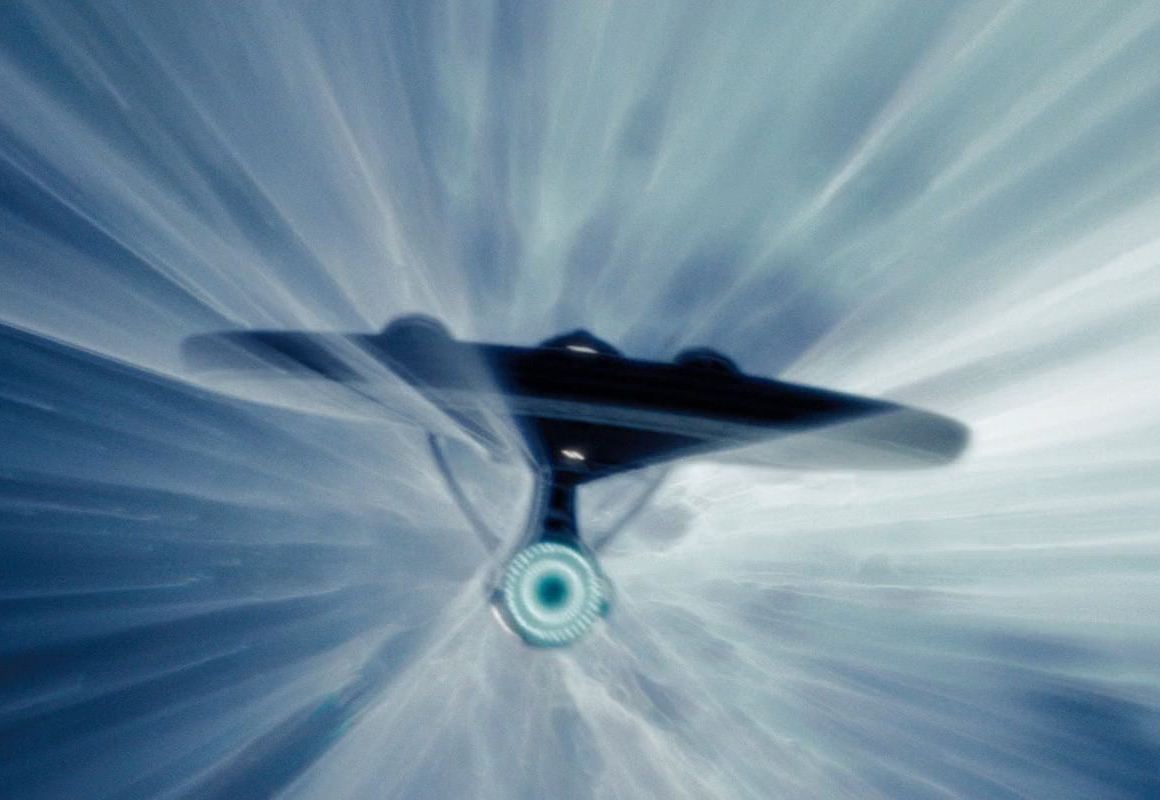
Possibly the best known form of FTL travel which comes to us from the original Star Trek and its many spinoffs. In addition to being a prime example of fictional FTL travel, it is also perhaps the best explained example.Though said explanation has evolved over time, with contributions being made in the original series, TNG, and the Star Trek technical manual, the basic concept remains the same.

By using a matter/antimatter reactor to create plasma, and by sending this plasma through warp coils, a ship is able to create a warp bubble that will move the craft into subspace and hence exceed the speed of light. Later explanations would go on to add that an anti-matter/matter reaction which powers the two separate nacelles of the ship are what create the displacement field (the aforementioned “bubble”) that allows for warp.

Apparently, Warp 10 is the threshold for warp speed, meaning that it is the point at which a ship reaches infinite speed. Though several mentions are made of ships exceeding this threshold, this was later explained as being the result of different scales. Officially, it is part of the Star Trek canon that no ship is capable of exceeding Warp 10 without outside help. When that occurs, extreme time dilation, such as anti-time, occurs, which can be disastrous for the crew!

In addition to Star Trek, several other franchises have made mention of the Warp Drive. This includes StarCraft, Mass Effect, Starship Troopers, and Doctor Who.

Final Thoughts:
Having looked through all these examples, several things become clear. In fact, it puts me in mind of a clip produced by the Space Network many years ago. Essentially, Space explored the differences between FTL in past and present franchises, connecting them to developments in real science. Whereas Warp and Hyperspace tended to be the earliest examples, based on the idea of simply exceeding the speed of light, thereby breaking the law of physics, later ideas focused on the idea of circumventing them. This required that writers come up with fictional ideas that either relied on astrophysics and quantum theory or exploited the holes within them.

One such way was to use the idea of “wormholes” in space-time, a hypothetical theory that suggests that space is permeated by topological holes that could act as “shortcuts” through space-time. A similar theory is that of subspace, a fictional universe where the normal rules of physics do not apply. Finally, and also in the same vein, is the concept of a controlled singularity, an artificial black hole that can open a rift through space-time and allow a ship to pass from one point in the universe to another.

Explanations as to how these systems would work remains entirely hypothetical and based on shaky science. As always, the purpose here is to allow for interstellar travel and communications that doesn’t take decades or even centuries. Whether or not the physics of it all works is besides the point. Which brings me to two tentative conclusions.

  1. Explanations Need Not Apply: Given the implausible (or at the very least, inexplicable) nature of most FTL concepts, the best sci-fi is likely to be the stuff that doesn’t seek to explain how its FTL system of choice works. I’st simply there and does the job. People hit a button, push a lever, do some calculations, or fly into a jump gate. Then boom! seconds later (or days and weeks) and they find themselves on the other side, light years away and ready to do their mission!
  2. That’s Hard: Given how any story that involves relativistic space travel, where both time dilation and confusing time jumps are necessarily incorporated into the story, only the hardest of hard sci-fi can ever expect to do without warp drives, hyperspace, jump or FTL drives. Any other kind of sci-fi that is looking to be accessible, and therefore commercially successful, will have to involve some kind of FTL or face extinction.

Well, that’s all I got for the time being. In the meantime, keep your eyes on the skies and don’t stop dreaming about how we’re one day going to get out there. For even if we start sending ships beyond our solar system in the near future, it’s going to be well into the distant future before they get anywhere and we start hearing back from them. At least until someone figures out how to get around Einstein’s Theory of Relativity, damn bloody genius! Until then, I’d like to sign off with a tagline:

This has been Matt Williams with another conceptual post. Good night, and happy spacing!

My Personal Writing Tips, or “How to Avoid Rookie Mistakes”

Proofreading and editing can be such a chore, I tell ya! Thought I’ve never been very good at proofreading and criticizing other peoples work, I find that it is when I am called upon to edit and evaluate their work that I most want to retreat into my shell. I feel selfish when this happens, mainly because of all the people I have asked to review my own work and give me their opinions. You’d think I’d be better at this aspect of it!

But of course, I know that part of the reason I hate editing the work of others is because I hate editing my own. I’ve noticed this about most people who enjoy writing, composing, and anything else that requires active revision and corrections. By the time the work is done, they want to put it down and forget about it, to let others handle the business of finding the flaws and pointing out the necessary corrections.

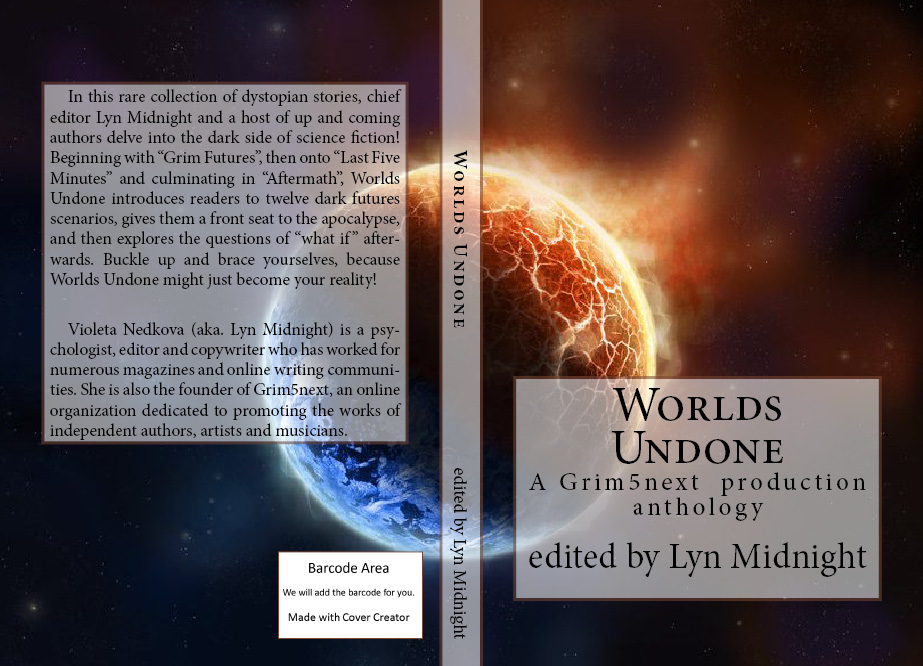
Alas, I’ve had to check most of that baggage ever since I started to become a member of several writing communities. In fact, I’ve even volunteered to act as a contributing editor for two major projects, one of which is the “Yuva Anthology” (begun by Khaalidah and myself), the other being the “Worlds Undone” Anthology. The latter one people might remember from a few months ago, when I was doing mock ups for a cover and happened to find some primo artwork to feature in it. Thanks again to cazzyae at deviantArt for her talent and generosity of spirit for that one! Thanks to her, Createspace’s easy interface, and the suggestions of many people at G5N, here’s how the cover came out:

Unfortunately, that has opened up a different can of worms for me. While I’ve definitely managed to overcome some of my reservations about reading other people’s work, I find that my pet peeves, or what I consider to be the marks of weak writing, keep rearing their ugly head. After reading many stories, I began to think that a tutorial might be in order to help some of the newbies avoid some rookie mistakes, ones which I have committed at least a half dozen times. Each!

I should also take this opportunity to thank Kristen Lamb, who’s impressive article “4 Writing Crutches that Insult the Reader’s Intelligence” reminded me of this idea. After seeing the title in my Inbox, I immediately zoomed over to her site to see if we shared the same pet peeves and sensibilities. Upon reading it, I could tell she was much more versed in this whole writing thing than I am! Still, I happen to share her appraisal of some bad writing habits, especially item number four in her list, “telling instead of showing”.

So, to take a page from her book (no pun!) and to make good on something I’ve been planning to do for some time now, I present you with the list of rookie writing mistakes it is best to avoid. All are the result of what I myself have done repeatedly, and have managed to weed out (for the most part) after many years of practice:

  1. Avoid Infodumping: Never start a story with a long, drawn out passage telling the reader what they need to know in order to set up the plot. For that matter, never let your story digress into such exposition either. A story is by definition a journey, with information, details, twist, and revelations provided bit by bit over time. Even if it’s a short story, never, ever simply announce what’s happening or what the significance of it is. Such actions turn what is supposed to be a tale into a description and is boring to read.
  2. Less is More: When it comes to explanations and descriptions, avoid excessive detailing. You don’t need to tell the reader everything about what’s going on, moment for moment, nor do you need to describe the scene in perfect detail. A simple, straightforward description of the scene and the interactions taking place is enough, let the reader’s imagination fill in the rest. Think of it like telling a crafty lie: if you want someone to believe it, don’t tell them a long story loaded with details, keep it simple, straightforward, and plausible. (Editor’s note: lying is wrong!)
  3. It’s called Background for a reason: One of the best tips I ever got as a writer was to “leave the background in the background.” This kind of overlaps with points one and two, but I keep it separate because of how often I see it and how it has factored into my own work. Much like explaining a scene or dumping info into a chapter, going to great lengths to establish the wider context in which the story takes place (i.e. “universe building”) is a bad idea. Stick to the story, only include that which is absolutely necessary, and let the universe build itself. In time, and if you’re lucky, you’ll get a chance to write follow-up pieces which will allow you to delve into different aspects of your fictitious world in more detail.
  4. “No one talks like this!”: If there’s one thing I learned from the Star Wars prequels and the Dune spinoffs, it’s that wooden dialogue can totally ruin a story. When drafting scenes that call for verbal interaction between characters, always keep in mind that this is supposed to sound like a conversation between actual people. Do not allow yourself to be swayed by duty to the story or the need to establish character elements. Those things that need to be conveyed are best when done with fine strokes and subtlety, and never, ever let your characters fall into expository passages where they simply say what’s goings on. Or to quote the Robot Devil from Futurama: “You’re characters lack subtlety. You can’t have people just announce their feelings! That makes me so angry!”
  5. Referencing: When writing a story that is meant to have allegorical similarities to today, or is meant to make a point about a specific issue, avoid referencing them too closely. Never say, “this was just like that thing that happened back then” or “it’s this all over again”. Let the reader infer what you are referring to with your carefully crafted, fictitious comparison. In Foundation, Asimov never directly compared the Galactic Empire to Rome, nor did Frank Herbert ever mention oil in relation to the spice in Dune. Once again, trust in the reader to make the appropriate conclusions and avoid telling them anything outright. Otherwise, you risk turning an “ah-ha” moment into an unimpressed “oh.”

That’s all I got. Suffice it to say, I am still learning and still looking for ways to perfect my craft. That’s never going to happen, of course, but it’s the goal which provides endless opportunity for improvement. Speaking of which, more samples will be forthcoming soon as I work my way deeper into “Winston Agonistes”, “Crashland”, “Frontera”, and “Fortress”. And most importantly of all, Data Miners will finally be ready for distribution by August long weekend! Yes, after roughly six months of delays, the editing of that story is finally coming to an end. But more on that in a bit.

In the meantime, keep hammering those keys, keep working on those manuscripts, and keep reaching for the brass ring of artistic perfection. And while you’re at it, feel free to share with me some lessons that you’ve learned along the way and feel obliged to share with the newbies in your field. There’s no shortage of lessons, as there are no shortages of mistakes 😉

The Foundation Series

When it comes to science fiction, few authors have achieved the kind of notoriety and prolific ouput of Isaac Asimov. Amongst the greats of classic sci-fi, he considered one of the “Big Three”, along with arry Niven and Arthur C. Clarke. And when it comes to his many novels, short stories, articles and thoughtful essays, two series stand out above all else. The Robot series and, more importantly, the Foundation novels.

Not only did they get the ball rolling on many major sci-fi themes that would come up again and again over the years (such as the concept of a Galactic Empire), they once again brought commercial science fiction into the limelight by showing how hard science could be merged with real history to produce genuinely thought-provoking literature. This is a trend which seems to be necessary once every generation years or so, with Frank Herbert doing it again roughly a decade later. And in his case, much of the inspiration came from Asimov himself.

So in honor of that accomplishment, and to mark the occasion that I finally finished reading the original trilogy, I thought it was high time that I start reviewing the Foundation series, beginning with the book that started it all. So without further ado, here’s Foundation!

Plot Synopsis:
The story opens many thousands of years in the future, where humanity has spread to occupy the entire Galaxy and is governed by the Galactic Empire. For over 12,000 the Empire has stood, and appears to still be stable and powerful. However, a trend of decay has set in and some suspect that it’s only a matter of time before the Empire falls

One such man is Hari Seldon, a scientist who has perfected a form of psychology and mathematics known as psychohistory. Having calculated the exact date and sequence of events which will lead to the collapse of the Empire, he has also created an organization that will be dedicated to ensuring that the dark ages that naturally follow will be as brief as possible – one thousands years instead of the alternate 30,000.

Divided into five parts – each of which was published throughout the 1940’s and together in a single volume in 1951 – the story jumps forward in time from the starting point, 0 F.E. (Foundation Era), to several hundred years in the future. Several protagonists are employed, people who find themselves at the center of events in any given period. Each period involves the emergence of a “Seldon Crisis”, a calamity that was predicted by Seldon’s psychohistory in advance, and the requisite response by the Foundation to resolve it. The first story, which sets up the subsequent stories and crises, is aptly named:

The Psychohistorians: Told from the point of view of Gaal Dornick, a young mathematician who has travelled to the capitol world of Trantor to meet Seldon, the story moves from their introduction to Seldon’s arrest by the Committee of Public Safety. Named after the Revolutionary body that send countless French citizens to their death after the 1789 Revolution, this committee is made up of Imperial aristocrats who are angered by Seldon’s philosophy and want to see him silenced. However, not wanting to martyr him, they instead tell him and his Foundation to pack up and move to Terminus, a world on the edge of the Empire.

The story then concludes with Seldon telling Dornick that he knew this was coming, and that it was actually all part of the plan. By being able to set up the Foundation at the edge of the Empire, it will be in a perfect position to begin enacting its policies once the Empire begins its inevitable slide into decline and loses control of first the periphery, and then the core systems. Thus, the most important lesson about psychohistory is presented for the first time: like a prescient science, it predicts all things and all things happen in accordance with its laws.

The Encyclopedists: Fifty years later on Terminus, the Foundation scholars have begun work on the Encyclopedia Galactica, the complete compendium of scientific knowledge for when the Empire falls. Unfortunately, the Empire is surrounded by four independent kingdoms that are in danger of threatening Terminus. The mayor of the planet, Salvor Hardin, is the protagonist of this story, and believes that the only way to keep their neighbors at bay is to pit them against each other. He perceives an opportunity when the Kingdom of Anacreon, which hopes to place military bases on Terminus, reveals that the four kingdoms no longer have nuclear technology.

Later, Hardin’s own rivalry with the Board of Trustees (the people responsible for the Encyclopedia) come to a head when Seldon’s Vault – a mysterious chamber which opens whenever a “Seldon Crisis” is imminent – opens to deliver a message. According to Seldon’s hologram, the creation of the Encyclopedia was a ruse to hide Terminus’ real importance. The true goal of the Foundation is to further science in a galaxy as it becomes consumed by interplanetary strife. Realizing that they are no longer in control, the Board hands its political power to the Terminus City mayor who graciously accepts.

The Mayors: Beginning in 80 F.E., this story revolves around the Foundation’s efforts to bring technology to the Four Kindgoms. This has the effect of creating a priesthood of sorts in these states, reminiscent of early medieval Europe where Roman priests were dispatched to western European kingdoms to establish centers of learning. Salvor Hardin has been re-elected many times over the course of the decades but faces an impending problem as an “Action Party” threatens to overthrow him. Fearing that Anacreon is slowly overtaking them, they want power so the Foundation will fight back.

On Anacreon, it is also becoming clear that the young King Lepold I faces an internal threat from his uncle, Prince Regent Wienis. Before he can come of age, Wienis plans on seizing power for himself. Central to this plan is using a battleship the Foundation restored for Anacreon to attack and conquer the planet. On the night that Lepold is to be ordained, Wienis invited Hardin into his quarters and shares his plan with him. Hardin reveals that he too has a plan, a counter stroke which will neutralize the battleship and Wienis’ power.

After decades of seeing Foundation scientists as “holy men”, the public is incensed when they learn that Wienis is planning an attack on them. What’s more, all their technology, including the attacking battleship, becomes useless as the only people who know how to run them (the Foundation scientists) begin shutting them down. Wienis loses it and tries to kill Hardin, but his weapons cease working, and he takes his own life.

Upon his return to Terminus, Hardin is vindicated when Seldon’s vault opens to reveal that his plan was right. With this crisis behind them, the Action Party defers to the mayors and their authority is once again validated. In addition, the Four Kingdoms are now free to continue the advance of “Scientism”, which will extend their influence throughout the region and ensure the fulfillment of Seldon’s plan.

The Traders: Events in this section take place 135 F.E., at a time when the Foundation has begun sending out Trade representatives to distant worlds to share their technology with all neighboring planets in the quadrant. Master Trader Eskel Gorov, also an agent of the Foundation government, has traveled to the worlds of Askone to trade in nucleics. Gorov, however, is met with resistance by Askone’s governing Elders who abide by the taboo that certain technologies are morally proscribed.

Enter the protagonist, Trader and Foundation agent Linmar Ponyets, who is sent to Askone’s central planet to negotiate the release of Gorov, who has been arrested. After learning that the Elder’s Grand Master plans to have Gorov executed, Ponyets agrees to offer them a payoff in the form of a transmuter than can turn lead into gold. At the same time, Ponyets finds a willing ally in a young protegee named Councilor Pherl. While initially wary of Ponyets, he is convinced that the transmuter could help him to attain power and eventually become Grand Master himself.

Because of this, Gorov is released and travels back to Foundation space with Ponyets. Gorov is critical of Ponyets dealings, saying that it was unethical, but Ponyets counters with a quote by Hardin, wherein he said “Never let your sense of morals prevent you from doing what is right!”

The Merchant Princes: This last story, which takes place in 155 F.E., occurs against the backdrop of a powerful Foundation, which has subjugated the neighboring Four Kingdoms and expanded its commercial and technological empire throughout numerous stellar systems. However, it still faces challenges, this time around from a planet named Korell where three Foundation ships have disappeared. Fearing that a “Seldon Crisis” in coming, the Foundation assigns Master Trader Hober Mallow to investigate and determine the Korellian’s level of technology.

At the same time, the people who assign Mallow, Foreign Secretary Publius Manlio and the Mayor’s secretary, Jorane Sutt, foresee an opportunity to weaken the traders by creating an embarrassing diplomatic incident. To oversee their plan, they plant an agent aboard Mallow’s ship to spy on him. When they arrive on Korell, he invites a Foundation missionary on board their ship, a move which causes a mob to surround the ship. Since Foundation agents and technology are not allowed on Korell, this arouses Mallow’s suspicions.

Mallow hands the missionary over to the mob, in spite of the agents intervention, and the missionary dies. Surprisingly, he doesn’t seem too disturbed by this and even earns the chance to meet with Korell’s authoritarian ruler, Commdor Asper Argo, because of it. He appears friendly and welcomes Foundation technological gifts, though he refuses to allow Scientism on Korell. In accordance, Mallow agrees to continue trading with them but agrees to abstain from encouraging missionary work within the Republic of Korell.

Later, Mallow is also given a tour of the planet’s facilities, during which time he notices the presence of atomic technology bearing the emblem of the Empire. He concludes that the Empire is expanding into the periphery again and journeys alone to the planet Siwenna, which he believes may be the capital of an Imperial province. There he finds nothing but a desolate world and an impoverished patrician named Onum Barr, a former provincial senator who tells him how an a local rebellion led the Empire to devastate the planet and kill all but one of his sons.

Convinced there is nothing there to see, Mallow returns to Terminus where he faces trial for murder because of how he turned the missionary over to the Korellian mob. However, he is able to convince the court that the “missionary” was in fact a Korellian secret policeman who played a part in the conspiracy against the Traders manufactured by Sutt and Manlio. Acquitted, Mallow is received with delight by the population of Terminus, which will almost undoubtedly select him as Mayor in the elections scheduled to take place in the following year.

To prepare for the election, Mallow engineers the arrest of Sutt and Manlio, and eventually takes office. However, he is soon faced with tensions between the Foundation and Korell, which declares war on the Foundation, using its powerful Imperial flotilla to attack Foundation ships. Instead of counterattacking, Mallow takes no action, knowing that Korell has become accustomed to trade with the Foundation and the lack of said trade will cause deprivation and anger towards the government. In time, this will cause Korell’s war efforts to grind to a halt and the end of hostilities.

Thus ends book I of the foundation series, with the Foundation ascendent in a Galaxy that is becoming increasingly permeated by chaos and Seldon’s plan in effect on well underway.

Good Points:
As I said, this novel (if you’ll excuse the pun) really wrote the book on Galactic Empires and historically/socially relevant sci-fi. Inspired largely by Gibbon’s The History of the Decline and Fall of the Roman Empire, it advances the notion that all civilizations are basically organism, subject to the same laws as all living things. And like all organisms, they enjoy a period of growth, maturation, and then decline, culminating in their death. When that happens, their absence leaves a natural power vacuum characterized by chaos, strife, and a marked decline in all things “civilized” – aka. the arts, the sciences, learning, etc.

By taking a page from history, namely the attempts to preserve classical knowledge throughout the Middle Ages (which culminated in a rebirth of learning in the Renaissance) Asimov creates a fictional repeat of history in the distant future whereby the efforts of the preservers were enhanced with the help of foresight and a coordinated plan. Had such factors existed in the wake of Rome’s fall, it is entirely possible that the Dark Ages would have lasted for a significantly shorter amount of time.

On top of that, this book was is also very accessible and readable, in spite of the fact that it throws some rather deep scientific and intellectual content at the reader. And the way the stories are succinct, concise, and tie together so effectively makes for a read which is easy on top of it all. For an accomplished reader, it can be read in one sitting. I am hardly a speed reader, but even I found it a quick study.

Bad Points:
Conversely, some of the books selling points are also potential weaknesses. For one, its accessibility can be seen as a mark of simplicity. For example, the book is all about a science that deals with the masses, of how historical events are determined by the actions of billions, trillions and even quadrillions of people. And yet, in every story, everything seems to hinge on the actions of one person, the protagonist, and a few others.This seems a little contradictory, and intentional since it provides quick resolution to the plot.

Herein lies another weakness, which is that of contrivance. Many times throughout the novel, the way the characters tend to figure things out seems awfully convenient. In every story, you see the mayors, merchants and Foundationists pulling resolutions seemingly out of nowhere, knowing everything they need to in advance or just providing a perfect solution on the spot. Granted, it seems to make sense, but how they know to do this and how it always seems to work out does not seem wholly realistic.

And of course, the explanation is always there in the background, Hari Seldon predicted it using psychohistory and these people know that science so they are therefore prepared where others are not. This sort of advances a notion that the science itself is infallible, that human minds really can be reduced to mathematical formulae which is water-tight. If anything, I would say that predicting the behavior of billions gets more unpredictable the farther afield one looks, and that no science can ever be capable of predicting it with certainty. And we all know what became of those philosophies that tried – aka. Marxism, Hegelianism, and many other isms besides!

But of course, the concept of psychohistory is entirely fictitious and was really just a tentative argument that Asimov advanced, and for the sake of a fictional story no less. In order to make the story work, he had to create a universe in which a form of prescient foresight, made possible through the application of rigorous mathematics and psychology, was possible and accurate. In short, its just food for thought, not something to be taken seriously. And of course, Asimov did show that he was willing to break from this notion with the second book in the series, Foundation and Empire, where the “Plan” began to falter due to external, unaccounted factors.

So in the end, I have to recommend Foundation as required reading, not just for science fiction fans but for all people curious as to how many trends we’ve come to associate with speculative and satirical literature (including dystopian lit) got started. Granted, there were those who came before Asimov who made use of such themes and classical inspirations, but he was the one who brought such things into the public eye like few before him. And as a result, he would go on to have an immeasurable influence on those who followed in his wake.

Up next, Foundation and Empire, part two of the original trilogy, before fans and publishers practically forced him to write many, many more books in the series. Stay tuned!

Dystopia and Deathmatches in Sci-Fi

Battle Royale:
This controversial story, also adapted into a film, takes place in an alternate universe where Japan is a member region of a totalitarian state named the Republic of Greater East Asia. Alluding to the Greater East Asia Co-Prosperity Sphere of WWII, it is clear that this a world in which Japan won the Second World War and continued on the path of fascist Imperialism.

In any case, the story revolves around what is called “The Program”. Under the guise of a “study trip”, a group of junior high school students from a fictional town are gassed on a bus. They awaken in the school of an isolated, evacuated island and learn that they have been placed in an event where they must battle each other to the death, or all will die.

Officially a military research project, it is a means of terrorizing the population, of creating such paranoia as to make organized insurgency impossible. Every year, fifty classes are selected to participate where students from a single class are isolated and are required to fight the other members. It ends when only one student remains, with that student being declared the winner.

Their movements are tracked by metal collars, which contain tracking and listening devices; if any student should attempt to escape the Program, or enter declared forbidden zones, a bomb will be detonated in the collar. If no one dies within any 24-hour period, all collars will be detonated simultaneously and there will be no winner.

Banned in many countries (the novel and the film) because of its controversial and graphic nature, Battle Royale has gone on to inspire such books as The Hunger Games.  Combining a Lord of the Flies-style appraisal of human psychology with a indictment of reality TV, this story remains one of the most effective pieces of modern dystopian literature featuring death matches.

Dune:
Fans of Dune will remember the lovely scene in the novel where Count Fenrig travels to Geidi Prime to speak with the Baron. Once he arrived, and in honor of Feyd Rathau’s birthday, he was treated to a gladiator match between Feyd and a slave gladiator. This is a common feature on Geidi Prime where death matches are considered public entertainment and every major city has its own arena.

And what better place for this kind of entertainment than Geidi Prime, a world run by ruthless overlords and characterized by harsh, perverse brutality? And that was the point after all. The Harkonnen’s were the bad guys in this tale and everything about them, their appearances, ethics, and homeworld was designed to match.

Robot Jox:
Taking place in a post-apocalyptic world where conventional warfare is forbidden between nations, Robot Jox tells the tale of a gladiator-style sport where giant mechs do battle in open arenas. This is how the two super-nations – the American-influenced Western Market and the Russian Confederation – work out their differences.

Of course, espionage and betrayal remain an integral part of the games, mirroring the Cold War. What’s more, the games often rigged to ensure that one bloc can get a leg up on the other. And in the end, the entertainment factor is also a driving force behind the games. In a post-apocalyptic world, the masses need some form of entertainment to distract them from the shock and horror of their daily lives.

The Hunger Games:
Following in the same vein as Battle Royale and Lord of the Flies, The Hunger Games tells the tale of a not-too-distant future where the United States has degenerated into a tyrannical government ruled from a political seat known only as “The Capitol”. Every year, the rulers of this city force all the outlying districts to send two young people – one boy and one girl – to compete in a free-for-all known as the Hunger Games.

The purpose of these games is simple, to keep all districts in a state of awe and fear so they won’t be able to contemplate another uprising. Years back, it is said that the 13 districts committed to one such uprising, the result being that District 13 was destroyed. The remaining twelve now send their competitors and try to exploit the incentives, which just happen to be rations.

Throughout the book, several things are made clear about the games which highlight its satirical nature. Satirizing reality TV shows, we learn that the games are televised, incentives are offered to keep the games going, and contestants draw sponsors based on their popularity. In addition, extra elements like romances and collaborations are encouraged to ensure that the games remain interesting and dramatic.

In the end, the games serve the purpose of keeping people down but also exploiting their destitute nature by offering them a shot at something better. When the games are over and only one person remains, they will receive enough rations to last them a lifetime. Many times over, it is also shown how life in the capitol is opulent and comfortable, whereas the outlying districts are malnourished and must do things like hunt illegally for food. And of course, the farther the district from the capitol, the more difficult life is, another aspect which the capitol exploits to ensure its continued survival.

The Running Man:
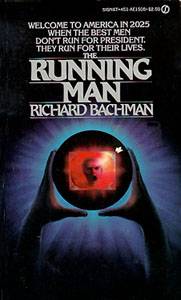
Written by Stephen King under the pen name Richard Bachman, The Running Man is also a near-future dystopian tale set in 2025 where the US has become a totalitarian state because of economic fallout and wide-scale starvation. For a population dogged by hunger and martial law, the only real source of enjoyment is a televised TV show where convicts are forced to engage in gladiator-style combat against seasoned “hunters”.

Aptly named “The Running Man”, the show begins when a series of “enemies of the state” – i.e. convicts – are released into a massive arena where they are pursued by a group of network-employed hitmen. For every hour they remain alive, they earns 100 dollars, plus a bonus for every Hunter they kill. If they survive 30 days, they earn a total of 1 billion “New Dollars” and a full pardon. Or so they say…

Though the novel and the movie differ in terms of plot and resolution, the basic elements are the same. In a future where the vast majority of the population is indigent and desperate, brutal spectator sports are seen as the only outlet. In both versions, much is made of how popular the games are and how important they are to both the network and the government, hence why every attempt is made to ensure that the Hitmen always win.

This serves to reinforce the notion that enemies of the state will always lose when faced with the governments brand of justice, which in this respect is similar to a show trial. It also ensures that the most profitable business in that day and age, since the show grosses billions of dollars in sponsorship and betting on convicts is also a big side-business, stays up and running. So in addition to serving as a source of social control, the games are also an example of corporatism, where the government has a lucrative arrangement with its biggest corporations.

Unreal Tournament:
Don’t laugh! Yes, this may have been a glorified (and gory) first-person shooter in it’s time, but that doesn’t mean it wasn’t also inspired. Though gamers cared little for the storyline, the fact remains that Unreal Tournament actually had a dystopian theme that drew from several classical sources. Set in a future where the Earth government creates a no-holds-barred arena deathmatch game to settle disputes between deep space miners.

However, when it became clear just how profitable and popular the games were, the games expanded to become an interstellar affair where anyone could fight and the prizes were astronomical. In turn, the corporate responsible for creating the games also became incredibly powerful and used every tool in its crooked arsenal to make sure that competitors were in good supply and things always worked in their favor.

Any player who survived long enough to make it to the end would square off against the companies own cyborg. If they were fortunate enough to kill him too, they received the grand prize and rank of Tournament Champion! All of this, though it took the form of a first-person shooter, calls to mind all the previously mentioned examples of dystopian science fiction and psychological realism. By pitting the desperate, the brutal and the avaricious against each other, a company was able to make an obscene amount of money and keep people blind to the true abuses of power in their universe.

Final Thoughts:
In the end, all of these examples have one thing in common. Whether the setting is a post-apocalyptic world or just a destitute nation dealing with economic downturn, the element of social control is always there. By throwing the powerless, hungry and greedy into an arena and ordering them to kill or be killed, a government ensures that it not eliminates potential threats but channels discontent into something truly atavistic and brutal. Though this is in many ways inspired by the Roman example, modern developments seem to be the true inspiration.

Like all dystopian literature, it seems that developments within the late 19th and early 20th century were the crucial factor. It was here that writers and social commentators truly came face to face with humanity’s abundant capacity for distraction, atavistic behavior, and indifference to suffering. That is another thing that all these pieces of literature have in common. Whether it is the brutal cynicism of those who profit from the games, or the uncaring nature of those who enjoy them, a disgusting lack of empathy runs through them all like a vein.

For what is worse than exploiting misery for the sake of entertainment? It’s one thing to persecute people directly, but making the oppressed and exploited fight each other for the scraps off your own table? That’s a real dick move!

Speaking of which, stay tuned for my review of The Hunger Games. I’ve finally gotten to the end of the book and will sharing my long-promised thoughts on them real soon! Thank you all, and remember: don’t let the bastards pit you against each other! FIGHT THE POWER!

My First Troll!

Wow, this is what it feels like to experience hate mail! I gotta say, I’m kind of flattered. It was in reference to my article “Dune and Its Descendents”, one of many in which I praised the late Frank Herbert for his amazing work over the years and bashed the work that has followed in his wake. Like many fans of the original books, my love for them is matched only by my disappointment with how the series ended.

Plenty of times I have encountered fans of the new books, and we’ve been able to have some spirited debate. Hell, I even conversed with Kevin J Anderson himself and managed to keep a civil tongue, partly out of sympathy because this guy gets TONS of hate mail! But this person, who goes by the name of Carlos, he really took the cake. Here’s what he said:

“Of course your the big idiot ever, since the creation of the universe. And you don’t understand the work of frank Herbert, or the deep: spiritual, scientific, artistic and philosophic work of this avatar, also the reality of science fiction (reality). Frank Herbert is a genius, like Tolkien, and if you don´t understand it, its because you don´t have brains or the intelligence needed to see it. Au dare you to say something so idiot from others work, in what brainless basis of yours? It makes no sense or logic, i only see envy, some ow, and a very small brain, even smaller than a desert rat.

Carlos”

How nice, he even signed his name. It’s like F*@@$% you, you unbelievable bastard! Sincerely, Troller. Well,  I would be inclined to reply to this… um … comment here, except for two things. One, the man’s name doesn’t provide a link that goes anywhere. And two, I don’t have the slightest freaking idea what the hell he’s on about.

Correct if I’m wrong but it sounds like he thinks I’m bashing Frank Herbert, not the work of Kevin J Anderson and Brian Herbert. And what the hell is this “avatar”, does he even know what that means? That would imply a stand in, which makes me think he IS defending these two authors. But their names never come up, and rarely do their works ever inspire such heartfelt defense of the words “genius” or “deep”. Mainly people just say that they’re alright and entertaining and not hurting anyone.

Ah well, I’m clearly over thinking this. Mainly, I’m just intrigued because this is the first hate mail I’ve ever received here, which makes me think I’m coming up in the world! And second, the vociferous and confused nature of it kind of amuses me. It’s good to believe that attacks against you are the result of misunderstandings and confused emotion, and not the result of disapproval you can actually understand and get behind.

Ah well, kudos Carlos. You will always be my first hater! I just wish I knew what the hell you were talking about.

Sci-Fi Drugs

The other night, I had one of those moments. It was a moment where I found myself thinking about a cool concept and realized that it would make a damn fine post. It’s also one that interests me quite a bit and has even influenced my own writing. So as quickly as I could, I hopped on my laptop (even though it was 2am) and began making a list of all the sci-fi drugs I knew!

To me, the reasons for including drugs as part of a sci-fi franchise are obvious. For one, drugs and drug cultures are very much a part of our society, so it’s only natural that a sci-fi author should have something to say about it. As Gibson said, all sci-fi is really about the time in which it is written, ergo fictionalized drugs in future settings are really a reflection on the attitudes of today.

On the other hand, creating fictitious drugs and inventing subcultures that use them are a good way to give a story some realistic background. Wherever and whenever a story takes place, you have to assume that they will have narcotic substances there, and what form they take and how they go about dealing with them tells you much about that culture.

Either way, it’s a subject that has fascinated me for quite some time. So here are some highlights from the wold of sci-fi drugs!

Can-D:
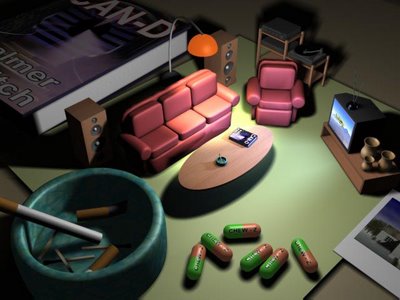
Here we have a designer drug that was created by none other than sci-fi great Philip K. Dick. As fans may know, this guy was somewhat of an expert on drugs, having taken part in the Californian drug counter-culture during the 60s and 70s. As a result, he had a lot to say about drug use, their impact, and drug policy.

In this particular case, the drug comes to us from the story of The Three Stigmata of Palmer Eldritch. Taking place in the 21st century, where global warming has sent millions of people off Earth to the hostile environments of the Solar System, people have turned to a combination of the drug Can-D and what are known as “layouts.”

Layouts are physical props intended to simulate a sort of alternate reality where life is easier than either the grim existence of the off-world colonies or life on Earth. By taking the drug in conjunction with the layouts, people are able to experience a sort of shared hallucinogenic state. This in turn has given rise to pseudo-religious cults that have grown up around the use of layouts and the drug, consisting of people who dream of better worlds than the one they are forced to endure.

Dancer:
To complete the semi-dystopian setting of his Bridge Trilogy, Gibson was sure to add a designer drug that was all the rage amongst Californians in the near future. The drug was named Dancer, a powerful and addictive hallucinogen that apparently came in the form of a red dust. People would take it orally, rub it on their gums, smoke it or snort it.

In short, Dancer was like a red cocaine, except that it caused hallucinations rather than manic behavior. People who consumed it would typically become euphoric and mellow, causing them to get all rhythmic and break into dance (hence the name). However, it was was also known to make people violent from time to time, which made it more akin to the the effects of PCP.

Inspired by California’s drug culture and the emergence of designer drugs in the early 90s, Dancer was clearly meant to serve as an allegory for multiple drugs, or as a prediction of what the next big craze could be.

Dust:
Fans of Babylon 5 ought to remember this one. Basically, the drug was a hot item on the black market because it had the ability to give users temporary telepathic powers. It was violently addictive, and known for giving a very powerful and unique high. However, in the course of trying to stop the Dust trade to B5, Psi Cop Bester acknowledged that the drug was originally created by the Psi Corps as a way of creating telepaths.

When they realized it didn’t work, the drug was abandoned, but made its way to the black market because of its obvious appeal. As a longtime fan of B5, I can honestly say it was elements like this that made me like the show. Not only was the concept and the name cool, the fact that it began as a government-sanctioned drug was also believable and clearly inspired by the history of many real-world drugs.

Neuroin:
Inspired by Philip K Dick’s short story, Minority Report was a quasi-dystopian future where the use of precognitives promised to eliminate all violent crime from society. But of course, there’s a dark side to all this, and it just happens to be linked to the underworld drug known as Neuroin, a powerful and addictive psychoactive substance.

Though it is never explained in any real detail, the name suggests that it is of the opiate family and possibly combined with a neural stimulant. In addition to being the drug of choice of the protagonist, it is also the very thing that created the precognitives in the first place. All three psychics were once children who suffered brain damage in utero as a result of their mothers’ neuroin use. Though damaged neurologically, a side effect was the development of precognitive powers, which the state began to use in order to engineer the process known as “PreCrime.”

Based on the film adaptation, the principal means of taking neuroin appears to be through a specialized inhaler. This would allude to the fact that neuroin was taken in vaporized form. In the end, this drug served as both a commentary on the dangers of escapism as well as a plot device. While neuroin was the reason for the precognitives existence, it was also how the main character chose to numb himself over the loss of his son.

Nuke:
The designer drug from Robocop 2, and one man’s attempt at achieving his dream of becoming a Jesus-like figure! Designed by Cain, Nuke was an extremely pleasurable and addictive substance that began making the rounds in Old Detroit by the second movie. Coupled with a Police strike and financial ruin, Nuke seemed to be the thing that would finally break Detroit and allow the greedy bastards at OCP to finally take over.

There are several kinds of Nuke, but by far the most popular variety comes in the form of the red sludge. This is known as Red Ramrod, and was followed shortly thereafter by White Noise, Blue Velvet, and Black Thunder. The color scheme alluded to Cain’s “patriotic” sentiments, as he was known to say that his drug was making “Made in America” mean something again.

Nuke comes only in liquid form and is taken by means of small needles that inject the drug directly into the bloodstream. Because of its highly pleasurable nature and chemical properties, only a few doses are needed before a person becomes hooked and will experience intense withdrawal if they don’t get a regular dose. A commentary on the emergence of designer drugs, it was also served as a means for making some tough observations on drug use and its effect on society.

Snow Crash:
This drug is, admittedly a little off the beaten path. Featured in the Neal Stephenson novel of the same name, Snow Crash was essentially an allegory for a system crash, but in neurological form. Taking the form of both an inhalant and a digital virus, the “drug” had the effect of rendering users docile, passive and babbling an idioglossia similar to speaking in tongues.

But of course, there was more to it than all that. Basically, Snow Crash was designed by an information tycoon named L. Bob Rife who wanted control over people’s minds and daily habits. Using a Sumerian tablet, he basically encoded the ancient “Enki virus” – a virus that altered humanity’s neurology and spawned modern languages. So really, he was looking to reverse the Babel myth, making humanity neurologically simpler and thus programmable.

In addition to being a commentary on the drug culture, Snow Crash was also an observation about the proliferation of computer viruses in the early 90s and an allegory on the similarities between ancient myth and modern technology. It was also pretty cool and weird!

Soma:
When it comes to designer drugs, Soma pretty much takes the cake. Derived from Aldous Huxley’s classic tale of dystopia and social engineering, Brave New World, Soma was the kind of drug that came with the label “good for what ails ya” and meant it literally. Designed to cure any and all emotional problems, the pill was mass produced and a key feature of the World State’s apparatus of social control.

Use of Soma is prescribed at a very young age to citizens of the World State, as soon as children are old enough to begin sleep conditioning. Slogans such as “a gram is better than a damn” are programmed into their minds so that they respond to emotional stress by simply popping a pill. This is often referred to as “taking a vacation”.

To illustrate the effects of the drug, Huxley relied on his own experience using mescalin and other drugs. Apparently, subjects using Soma would enter a dream-like state where everything became pleasant and agreeable, all their worries and unpleasant emotions melting away. This dream-like state could be discerned by observing a person’s eyes, which would become noticeably glazed.

In addition, though the state freely distributed the drug and there were no shortages, Soma was still designed to be non-addictive and with no harmful side effects. This, added to its effectiveness, made it the ultimate designer drug and a very effective means of social control. A commentary on the pharmaceutical industry of his day and on the drug culture of the 1920s and 30s, Soma remains the most popular example of a fictional sci-fi drug!

Spice:
Then again, the spice melange is pretty damn popular too. However, as the only drug on this list that is not designed or synthesized, and is by definition an “awareness narcotic,” Spice is really in a category of its own. Taken from the Dune series, Spice was the most precious resource in the universe in more ways than one.

For starters, Spice could only be found on one planet, the desert world known as Arrakis. Mining Spice was also a highly hazardous duty, due to the inhospitable climate of Arrakis and the presence of Sandworms. And given its many benefits, which included prolonged life and expanded awareness, it’s little wonder why it was so damned expensive!

A clear allegory for oil, all life and commerce in the Imperium of Dune revolved around Spice in one way or another. The Guild Navigators used it to achieve their limited prescience and guide ships through foldspace. The Bene Gesserit used it to enhance their mental and physical acuity and make contact with their “Other Memory”. And every house used it to improve their health and longevity. In short, without Spice, all trade and commerce in the universe would end and countless people would die.

And of course, there never would have been a Paul Mua’dib or a Leto II, and humanity would have died as a result! That’s quite a drug them people got there!

Substance D:
Once again, we have a fictitious drug that comes to us straight from the mind of Philip K Dick. Featured in his 1977 book A Scanner Darkly about the drug subculture of California, Substance D was a powerful psychoactive drug that also went by the name “Slow Death.” The name proved apt, as the drug was not only violently addictive, but resulted in brain damage due to overuse.

According to the story, Substance-D was synthesized from the fictitious blue flower Mors ontologica, which is Latin for “death of being”. In the course of the story, the protagonist – an undercover narcotics agent – becomes addicted to the drug, suffers brain damage and is sent to one of the new recovery centers (“New Path”) to get clean.

In time, he is given the task of working on one of their many farms and learns that these places serve as grow ops for the flower. Hence, we see that “New Path” is the source of Substance-D, and is therefore benefiting from both the drug and the harmful effect it has on society. A commentary on strong-arm governments and the pharmaceutical industry perhaps?

Final Thoughts:
When it comes to fictionalized narcotics, a few basic features become evident. For one, fictional drugs can take one of two forms, being either of the organic or synthetic (i.e. designer) variety. Second, their use as part of a story’s background is meant to call attention to our current drug wars, warts and all. But above all, they seem to serve as a form of social commentary by pointing to the ongoing nature of temptation, escapism and repression. On the one hand, human beings will always be looking for escapes and ways to ease the burden of existence. On the other, we are always likely to feel the need to control the flow of narcotic substances and legislate what people can and can’t put in their bodies.

Finally, I found that just about all the authors here were taking a descriptive, rather than prescriptive, approach. Essentially, they were content to sit back and make observations on the whole issue of drug use and moral legislation, rather than making pronouncements. This would seem the preferable option considering that you can’t really offer a clear resolution without sounding either enabling or preachy. Some say that drug use destroys society, other say that people have the right to put whatever they want in their bodes. And then there are those who say that human weakness is a constant, and that criminalizing such a thing turns a flaw into a war. Complicated!

On a brighter note, all this talk puts me in mind of my own fictional creations. Years back, when I was coming up with the concept for my Legacies story, I spent a fair bit of time pondering what kind of drugs people would be using in the relatively distant future. I think I might just dedicate a page or a post to just that topic. In truth, I’d like to know what people think about my inventions. Look for it, it shall be coming soon!

Technology in the Dune Universe

Hello again techies and social studies experts! I’m sorry, I assume those are the only two kinds of people who would enjoy these posts 😉 Regardless, I love doing them, mainly because it gives me a chance to exercise a little critical thinking when it comes to some of the most popular franchises of science fiction.

And today, I thought I’d tackle the bid baddy of classic sci-fi, Mr. Frank Herbert himself. Whereas most writers in this expansive genre tend to take a highly positive or negative view, Herbert distinguished himself by being highly subtle, ambiguous and multilayered in his approach.

Far from saying technology would save humanity, or condemn it, he seemed to be arguing that it really wouldn’t alter our basic makeup and behavior. That, presumably, would only come with thousands of years of natural evolution, selective breeding and funky narcotics!

But I digress, here are some examples of the technologies that characterized the Dune universe:

Atomics:
stoneburnerEvery house in the Dune universe keeps a nuclear arsenal in reserve. However, since the Great Convention forbids their use in war, and anyone found in dereliction would guarantee their own obliteration, they are not employed. Everybody’s got em, nobody uses em! At least not anymore…
Their last known use occurred on Selusa Secundus many years before the events of the first novel. It was here that a rogue house employed several in an attempt to destroy House Corrin. The attempt failed and the house was eradicated, their name erased from history. Unfortunately, Selusa Secundus was left a radioactive ruin, hence why it was converted to serve as the Emperor’s prison planet.

However, one type of nuclear device is still legal under the Great Convention. Known as a Stone Burner, these devices emit powerful J-radiation that destroys eye-tissue, rendering everyone in the blast vicinity blind. However, their primary function is to burn through a planet’s crust. If they are powerful enough, they are able to burn clean through to a planet’s core and destroy them planet from within.

Axlotl Tank:
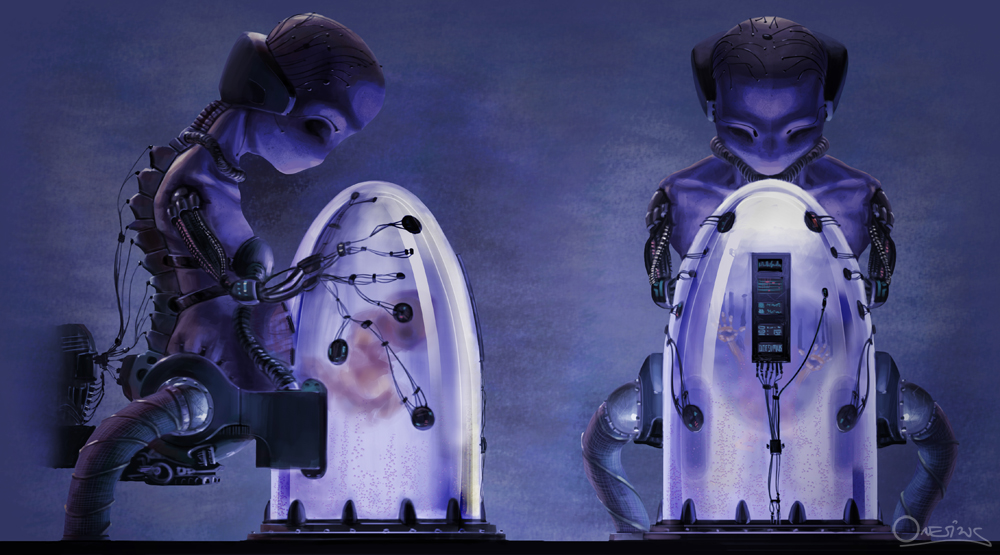
2007-8-18_DuneAxlotlTankThough widely used in the Dune universe, axlotl technology is also one of its most mysterious. A trade secret of the Tleilaxu, an axlotl tank is a “device for reproducing a living human being from the cells of a cadaver,” resulting in what is known as a ghola. In addition, the Tleilaxu Masters use these tanks in order to produce clones of themselves and keep their line going.

As the series progresses, axlotl tanks began being used to produce the spice melange, which had previously only been available on Arrakis. In time, it was also revealed that axlotl tanks were in fact Tleilaxu females, women whose bodies had been converted to grow gholas, clones and spice inside their wombs.

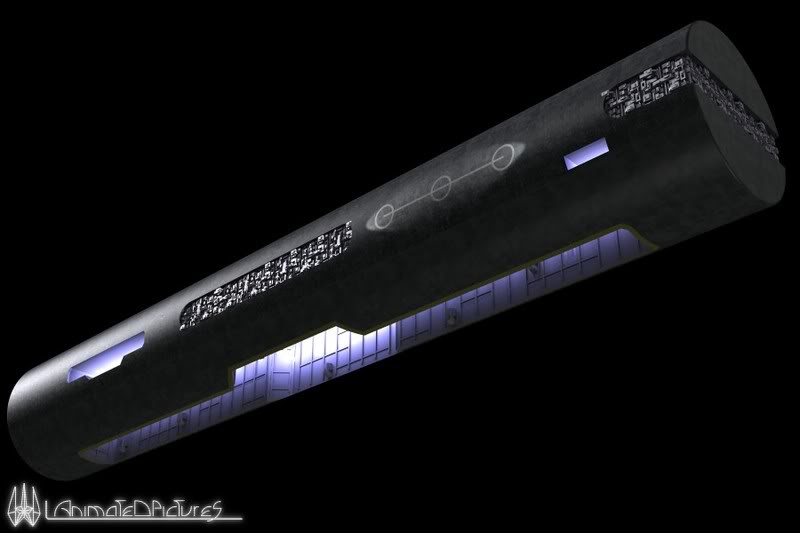
Guild Heighliner:
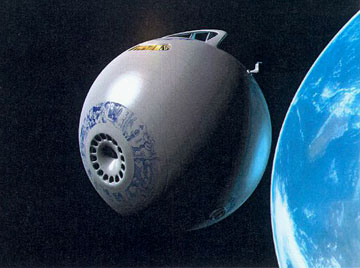
Dune_heighlinerThe principal means of interstellar transport in the Dune universe, a heighliner is a Guild ship that is capable of transporting massive amounts of people and cargo. Powered by the Holtzman Drive (see below) the ship is capable of “folding space” – jumping from one point in space-time to the next – instantaneously.

Each Guild Heighliner comes with its own navigator, a Guild mutant who uses their semi-prescient abilities to see through space and time to chart a safe rout for the ship to fly. The navigators do all this from inside their giant tanks where they remain immersed in spice gas.

Holtzman Drive:
foldspaceThis is the technology that allows Guild Heighliners to fold space, thus traveling instantaneously form one point in the universe to another. Using what is known as the “Holtzman Effect”, the same phenomena that powers personal shields as well as the catastrophic effect when one comes into contact with the beam of a lasgun.

Though it is never explained in detail, some hints are given throughout the series as to what principles of physics may be involved. For example, in Chapterhouse: Dune, an allusion was made to tachyon particles, the theoretical particle that can presumably travel faster than light.

Lasgun:
lasgunThe appendix of the first Dune novel, titled Terminology of the Imperium, defines Lasgun as follows:

continuous-wave laser projector. Its use as a weapon is limited in a field-generator-shield culture because of the explosive pyrotechnics (technically, subatomic fusion) created when its beam intersects a shield.

At one time, these directed energy weapons were the mainstay of Imperial armed forces. However, the development of shields meant that their use had to become more selective. Mounted on ships, ornithopters, and carried by infantry, lasguns remain a highly effective weapon, capable of cutting through any material.

No-Chamber/No-Ship:
ixian_noshipThis technology was first mentioned in God Emperor of Dune and took the form of a No-Chamber. This Ixian invention was basically a chamber that was cloaked in a stealth field which blocked it from prescient vision as well as more conventional means of detection.

After the death of Leto II, this technology was expanded to include No-Ships and even No-Globes. The former were basically heighliners which were equipped with no-fields and the Ixian machine which did the job of a Guild Navigator. In essence, these ships were not only sheilded from prescient vision, but were invisible to sensors and even the naked eye.

No-Globes were an even larger version of the technology, capable of covering an entire planet in a no-field and rendering it both invisible to prescience, invisible to the naked eye and undetectable. However, in Heretics of Dune and Chapterhouse: Dune, it is suggested that those of Atreides ancestry are capable of seeing through no-fields. This proved to be the case when Miles Teg was awakened to his abilities after being examined with an Ixian T-probe. His ghola also had this ability once he was awakened to his past memories.

Ornithopter:
dune_thopter1In the Dune universe, ornithopters (or ‘thopters) are the principle means of planetary transportation. Combining jet thrusters with articulated wings, the thopter is capable of vertical takeoff and landing, making it one of the most versatile flying machines ever invented.

Though most are used for commercial and personnel transport, thopters are also capable of being militarized, and often are. Armed missiles, bombs, lasguns, and even shields, they are most effective when used in an assault and/or supporting role.

Personal Shields:
Holtzmanshields-Dune1984The Terminology of the Imperium defines them as follows: the protective field produced by a Holtzman generator. This field derives from Phase One of the suspensor-nullification effect. A shield will permit entry only to objects moving at slow speeds (depending on setting, this speed ranges from six to nine centimeters per second) and can be shorted out only by a shire-sized electric field.

While these shields can be mounted on aircraft, vehicles and even large structures, the most common use is in the form of personal shielding units. These are worn by infantry for battle or for the sake of combat training in order to prevent serious injury. The introduction of this technology to the battlefield had a regressionary effect on warfare in that it forced troops to largely abandon energy and ballistic weapons in favor of hand to hand combat. Hence why swords and knives are commonly used in the Dune universe.

Stillsuit:
stillsuitThe trade secret of the Fremen! Stillsuits, as the name suggests, are a water reclamation and purification system that are worn by the desert-dwelling nomads whenever they are out on the sand dunes. Powered by the motion of it’s user, which includes foot-pumps mounted in the suit’s heels, the system turns all water loss – perspiration, urination, even feces – into usable water which they can draw from a tube near their mouth.

Given water’s scarcity on Arrakis, the purpose of these suits is clear. By preventing moisture loss and recycling it into useable water, they ensure that a person out in the open can sustain themselves indefinitely in the extremely dry and hot desert environment. As Doctor Kynes himself remarked: “With a Fremen suit in good working order, you won’t lose more than a thimbleful of moisture a day..”

Conclusions:
When it comes to science fiction franchises, one can tell a lot by the technology, big and small, that are all part of the background. And when looks over these examples of technology in the Dune universe, a few things become abundantly clear right away:

  1. The connection between environment and invention: Because the bulk of the story takes place on Arrakis, much of the technology we see was specifically adapted for desert use. Shields were useless in the desert environment, turbofans often broke down from dust and sand, and even massive crawlers were at risk of being consumed by Sandworms. In short, all the advanced technology of the Imperium was either useless or subject to hazards from the desert and its creatures. In the end, the most basic inventions, stillsuits and thumpers, were best suited to ensure survival. In short, those technologies who worked with the environment instead of against it were the most likely to work. More indications followed, such as how Paul’s father said to him that “On Caladan we ruled by sea and air power, but here on Arrakis, you need desert power.” On the one hand, this would seem to indicate that every planetary environment required its own balance of technology, Caladan being a sea planet meant ships and aircraft were the weapons of choice. On the other, he seemed to be alluding to the fact that rule on Arrakis required the allegiance of those who knew the desert best (i.e. the Fremen)
  2. Technology as regressive as well as progressive:This is something that I found particularly intriguing about the Dune universe, which was how it combined medievalism and futurism. On the one hand, humans have perfected interstellar travel and have colonized millions of planets throughout the galaxy. On the other, they fight with swords, knives, and live under a feudal system of government. As the story progresses, two reasons are given for why this is:
    1. After the Bulterian Jihad, the Great Convention established that no thinking machines or anything resembling them would ever be created again. As Leto II remarked in GEOD: “The target of the Jihad was a machine-attitude as much as the machines… Humans had set those machines to usurp our sense of beauty, our necessary selfdom out of which we make living judgments.” In short, the purpose of the Great Convention was not just to ban AI’s but the very mentality that had created them. Thenceforth, the very concept of industrial dependence was to be banned. And as Duncan Idaho later observed, such an economy was the basis for unlimited consumption and growing social equality. This ideal, borne of the Industrial Revolution, was also the cause of social chaos and the eventual rise of AI’s. By banning these and the system that ensured their creation, humanity was effectively going back to a time where feudal control by a small group of barons was basically necessary.
    2. The Great Convention also forbade the use of atomics. This meant that war had to be conventional from now on. The advent of shields also meant that energy weapons were no longer advisable, which meant that soldiers were further forced to adapt to conventional means of fighting – i.e. hand to hand combat. Swords, knives, and slow-pellet stunners were now mainstays of modern warfare, not by choice, but by necessity.

All of this leads to conclude that Frank Herbert was a freaking genius, or at least possessed a very complicated intellect. Whereas most science fiction and speculative writers tend to take a positive or negative view of technology, he preferred to take a very historic and ambiguous view of it. Setting his story in the distant future, one would immediately get the impression that humanity would be so highly evolved that it no longer resembled humanity of today.

However, Frank showed us a universe where humans were not only very much like they are today but also retained elements from our past. Much like the world of today, people are dependent on a single resource, are subject to petty rivalries, and a morally dubious system. But like the world of yesteryear, they are ruled by dukes, barons, emperors, and a system of entitlement and gross privilege and view democracy as a threatening sham.

One can only assume that Frank was making the point that human nature will not change as a result of technological innovation or space travel. Sure, AI’s and cybernetics might emerge down the road, giving humanity the ability to enhance their bodies and thought processes. But Frank’s take on this was that humans would naturally revolt against these once they came to the conclusion that they were needlessly complicated people’s lives.

So in the end, the only way out of being human was to create “mature humanity” as the Bene Gesserit said. This consisted of selective breeding and organic enhancement, relentlessly training people to strengthen their minds, bodies, and unlock the mysteries of the brain, eventually culminating in a person who could not only access their genetic memory, but merge space and time in their own mind. Interesting… and freaky!

Well, my mind is blown and I got nothing more to say. Stay tuned for something else, assuming I can overcome the effects of venturing into Frank’s head space. Man, it’s weird and awesome in there, kind of like a spice trance!

Technology in the Star Trek Universe (updated!)

I’ve wanted to do a post like this for awhile, ever since my conceptual post on Galactic Empires in fact. After doing my research on what distinguished one from the other, I noticed just how central technology, or the perception thereof, is to it all.

And let’s face it, Star Trek has had a lot to say about technology over the years, not all of it consistent! So with a series of examples, I thought I’d examine just what Gene Roddenberry and his successors have had to say.

Cloaking Device:
First developed by the Romulan Empire, the concept for an invisibility field that encompasses an entire ship has been picked up by just about every advanced race in the galaxy. Considered impractical by many because of the intense power drain, other races have found ways to adapt it to give their ships a decided edge in combat.

One such race are the Klingons whose vessels all come equipped with a cloak. The Romulans maintain use of this technology on their military vessels, particularly their warbirds, and even the Federation has been known to dabble in it from time to time. Another discernible weakness is the presence of tachyons and anti-protons that cloaked vessels are known to produce.

Holodecks:
The holodeck is an advanced holoprojector device that was designed by Starfleet for use aboard starships, stations, and institutions. It serves the purpose of entertaining, training and training purposes. Using focused photons to simulate matter, the holodeck is able to create physically real virtual environments out of pure energy.

Because of their potential for danger, all holodecks come equipped with built-in safeguards. Matter created aboard the holodeck ceases to exist as soon as it passes beyond its generators, and the technology has been adapted to creating AI’s such as the ship’s emergency doctor program.

Hypospray:
This non-invasive piece of medical technology is the mainstay of Starfleet medical. Using a compressed air transport mechanism, this device is able to transfer the injectant painlessly from the device into the subdermal layer below the skin of the body, or artery.

In the original series, hyposprays resembled hypodermic needles, but by the time of the 24th century (the TNG series) they had become much more sophisticated, resembling the unit pictured at top left.

Phasers:
Short for phased-energy laser, phasers are the most common energy weapon in Starfleet and the known universe. Beginning in the 23rd century, the technology was adapted for use as hand-held weapons, military rifles, and as the primary weapons banks on ships.

The 24th century saw further developments in the development of this weapon, which included mutli-segment phaser arrays,  and phaser cannons. The former made their first appearance in TNG on the USS Enterprise D and other updated ships while the latter appeared for the first time on USS Defiant.

Replicators:
Using the same technology as the holodeck, a replicator is a matter-energy device that is capable of dematerializing quantities of small matter and reconstituting it as something else. This can take the form of food, commercial products, or machine parts. In short, anything can come out of a replicator so long as it has the atomic matrix down, and isn’t illegal!

Prior to TNG, Starfleet ships used food synthesizers, but by the 24th century, the technology had been perfected and made standard on all starships, stations, outposts and settlements. Because of their sheer usefulness and versatility, every advanced race has adapted the technology for their own use.

Shields:
Also known as Deflector Shields or Screens, these devices are the mainstay of all advanced races in the Star Trek universe. Operating by creating a layer, or layers, of energetic distortion containing a high concentration of gravitons, they are able to provide protection against weapons fire and natural hazards.

Typically, shields are emitted from either a central emitter dish or a series that are dispersed over the hull. They usually come in six sections, covering the fore, aft, port, starboard, dorsal and ventral areas of the ship. In time, shields can be dissipated by either continuous or repeated energy discharges, leaving the ship vulnerable.

Transporters:
Utilizing subspace technology and the same matter-to-energy concept as a holodeck, the transport is the principle means of transportation to and from ships in the Star Trek universe. Often referred to as “beaming”, transporters are able to dematerialize, transmit and reassemble an object from one pad to another.

Making its debut in the original series, the technology has been updated in the TNG universe and its various spinoffs to allow for greater accuracy and safety through the addition of added redundancies. This increased accuracy allows for point-to-point transport, usually within smaller areas like the ship itself.

Tricorders:
A handheld sensing device, the tricorder was invented by Starfleet specifically for use by Starfleet personnel. However, since their inception in the 22nd century, they’ve gone through repeated upgrades, adaptations and have been adopted by just about every advanced race in the Alpha Quadrant.

As it stands, there are six varieties of tricorder in use within Starfleet alone. These include the psychotricorder which measures a patients brainwaves, a medical tricorder which diagnoses ailments and injury, and four models (VI,VII, X and XV) all of which are in service in one branch of Starfleet or another.

Warp Drive:
In the Star Trek universe, the warp drive is both the primary means of transport and the pinnacle of a race’s technology. In fact, Starfleet only makes contact with a new alien race once they’ve developed this technology, as it’s felt that it is only at this point in a species’ development that they will be advanced enough to experience first contact.

First developed by the human race in the late 21st century, warp technology was what precipitated First Contact with the Vulcans. Utilizing a matter/antimatter process and a dilithium chamber, a warp drive generates a “warp field” to envelope a starship. This has the effect of distorting the local spacetime continuum and moving the starship at velocities that exceeded the speed of light.

Every advanced race in the Alpha Quadrant has this technology, though some are able to achieve greater velocities (known as warp factors) than others. In the course of the old series and new, new and more advanced forms of FTL are being researched which may replace standard warp. These include transwarp, quantum slipstream, and a host of others.

Conclusions:
Technology as Utopian:
For the most, part Star Trek seems to be making the point that technology is a good thing. Whether it was the original series, TNG, or the many spinoffs to follow, it seemed that humanity owed much of its current condition to technological progress. Though they never explained how, at many points in the franchise it is said that Earth is now a paradise, bereft of crime, bigotry, hunger, and inequality. Just about all known diseases have been cured, and even money has become obsolete.

Yes, it seems that in the future, the focus of the economy has shifted to one of “self-improvement”… Might seem a bit hokey on the surface, but as I said in the Galactic Empires post, it’s really not that farfetched. Although its still pure fiction, the advent of something like warp drive, which would make space travel quick and affordable, commerce and transport between colony worlds would be open. This would mean abundant resources that went far beyond Earth and the Solar System, and we already know just how rich our system is in resources (see Asteroid Mining).

But more importantly is the development of replicator technology, which comes in the form of personal and industrial sized units. The former are used to produce everything from food and clothing to consumer products while the latter can create just about anything in bulk quantity. If this were possible, then all scarcity and deprivation would cease to exist. What’s more, the entire basis of an unequal distribution of wealth would disappear. Frankly, it puts me in mind of what Orwell said in 1984:

From the moment that the machine first made its appearance it was clear to all thinking people that the need for human drudgery, and therefore to a great extent for human inequality, had disappeared. If the machine were used deliberately for that end, hunger, overwork, dirt, illiteracy and disease could be eliminated within a few generations.

By the “machine”, Orwell was of course referring to industrial technology and the economy it spawned. However, his overall point was clear. Modern technology, dedicated to the write purpose, had the ability to significantly raise the fortunes of all people. And let’s not forget how in the Star Trek universe, hyposprays and various medical devices can solve just about all that ails you! Break a bone, you get the bone knitter! Tear your ACL, you get the… ligament bonder. I don’t know, all I do know is that pain is virtually obsolete in this universe and its because of progress.

So really, Roddenberry wasn’t far off when he envisioned a “perfect society” in the future. It was just in how he failed to explain how this could done that things seemed a little weak. But of course, there was a flip side to the whole thing.

Technology as Dystopian:
But of course, there were plenty of examples of technology gone wrong. The examples are a little too many to name, so I’ll keep it to just a few. The first comes from the first season when the Enterprise D comes to a planet of Aldea. There, a group of advanced humanoid aliens live in relative peace and prosperity, except that they are sterile and therefore dying off. Hence why they start kidnapping the Enterprise’s children!

Eventually, the Enterprise crew determines that the source of their problem is the great machine that runs their planet, otherwise known as “Custodian”. Because they’ve forgotten how to use the machine, the Aldeans have been unaware of the fact that it’s long since broken down and has been letting harmful radiation in. They assist them in fixing it, and the lesson about letting technology run your life has landed!

The second example comes from the regrettable movie Insurrection, where the Enterprise E comes to an idyllic planet inhabited by the Bak’u. Here, people live in virtually perfect harmony with the planet by denying themselves certain technology, opting instead for the simple life. Their philosophy is simple: “when you create a machine to do the job of  man, you take something away from the man”.

All of this seems inconsistent with the usual message of Star Trek, and even the movie itself. Far from being purely primitive, the Bak’u employ all kinds of labor saving technology, which includes irrigation and dams. So really, are they really so opposed to technology or just specific technologies? Nevertheless, the metaphor is clear. Combined with the fact that this place has youth-preserving powers, the metaphor of this place is pretty obvious. It is the fountain of youth, garden of Eden, and the evil Son’a who are advanced and creepy want to destroy it. Not their best movie!

But the last and best example comes in the form of The Borg. A race of cybernetic beings who have merged the organic and synthetic, run by a hive mind that quashes all individuality, and threatening to assimilate all in their path, the metaphor is so thick you need a knife to cut through it. They are the ruthless march of progress personified!

And just look at them and their ships, are they not the perfect representation of cold, unfeeling technology? Sure they are! And the way people change once they’ve been assimilated, becoming soulless automatons and losing all color and individuality. Tell me that’s not a perfect visual representation of the death of the human spirit under the weight of urbanization and anonymity.

Some might call this inconsistent, but it seemed more likely like Roddenberry and his writers were simply hedging their bets. On the one hand, he was showing how human potential could one day yield the perfect society, or at least one that was free of all the problems we know and lament today. On the other, they must have wanted to show the obvious downside and dangers at worshiping at the altar of progress. After all, if you put an ideal, any ideal, ahead of humanity and life, all you get is dystopia!

And as always, other races in the Star Trek universe serve as a mirror for the human condition, or rather different aspects of it. If the human race has got it right, then others must not have achieved that careful balance of humanity and progress just yet. Whereas some prefer to be Luddites and live in an agrarian Eden, others have become runaway cyborgs who assimilate all in their path. It’s all about balance people!

Well, that was kind of fun! And it combined two of my favorite things in the world. Sci-fi and literary criticism. Perhaps I should do more of these. As always, suggestion on which franchise should be covered would be great. I can think of a few off the top of my head – such as the Star Wars universe, Dune, Aliens, Terminator, and possibly Battletech – but I would like to hear from others too. There’s always those added few that would be perfect but I fail to think of. Thanks all!

Cool Ships (volume VIII)

Battleship Yamato:
A couple times now I’ve given praise to ship designs that went beyond the usual airplane/ seafaring paradigm. But what can you say about a spaceship which is a carbon copy of a old sea battleship? I don’t know, gutsy maybe? That its paying homage to the original? That’s all I can really say on this one, since it is identical to its namesake from the Imperial Japanese Navy.

Taken from the anime series of the same name, the Yamato was a prototype ship which was built in secret by Earth forces in the ruins of the original. Using alien technology, it was the first Earth ship to boast FTL and a “wave-motion-gun”. These devices were meant to give it an edge in the ongoing war with a race known as the “Gamilons”.

Early in this war, the Gamilons had bombarded Earth with radioactive meteorites. The result was that all human settlements had to be moved underground. However, the radiation was slowly working its way down to the inhabitants, and the only hope for survival came in the form of a message from a distant star. After completion, the Yamato was meant to fly to this world and retrieve the device which apparently could cleanse Earth of its poisonous radiation.

Thus, the Yamato was created to perform a mission that meant the very survival of the human race. It’s drive system was to make sure it could make the trip, while its weapons were meant to ensure it could defend itself.

Cylon Heavy Raider:
Another installment from the BSG universe, here we have the heavy hitter of the Cylon fleet, the dual purpose attack and transport craft, otherwise known as “the turkey”. Capable of atmospheric entry, space flight and FTL travel, the Heavy Raider is capable of attacking, transporting troops and conducting boarding operations.

Unlike the standard Raider, the heavy can either fly itself on autopilot or be piloted by actual an Centurion. However, its automated functions do not appear to be the result of a sentient nervous system. In terms of armaments and capacity, the heavy has six cannons mounted under its cockpit and its bay is capable of holding up to ten Centurions.

The Heavy Raider made its first appearance in season one (“Scattered”) when one crashed into the starboard flight pod. On Caprica, Sharon Valerii (Boomer) commandeers one to provide fire support to the resistance and save Starbuck as she escaped from a Cylon medical facility (“The Farm”). The Heavy Raider would go on to make several more appearances in the series, particularly whenever assault missions or heavy raids were concerned.

Quasar Fire-class Cruiser:
Once more onto the Star Wars universe, my friends! But this time, its into the expanded universe with a ship that is somewhat obscure by most standards. Known as the Quasar Fire-class cruiser, or Alliance Escort Carrier, this ship made its first appearance in the Thrawn Trilogy during the Battle of Bilbringi then again in the novel The Truce At Bakura.

Designed by the Sullustans as a cargo transport, many of these vessels were given to the Alliance and converted for combat. This consisted of stripping down the cargo bays and turning into hangars, and mounting defensive turrets at the front and rear.

Thought lightly armored, armed, and shielded, the Quasar’s small size and versatility make it a ship of choice for small fleets and minor attack forces. It’s six squadrons of fighters also give it an effective defensive screen, making it all the more suitable as a small fleet command ship.

The Leviathan:
Did I say once more, I meant twice… maybe more! And this one goes way back, to roughly 4000 years before events in the original movies. Officially known as an Interdictor-class cruiser, this vessel was the mainstay of the Republican navy during the time of the Mandalarion Wars and was featured heavily in Star Wars: Knights of the Old Republic.

During the outbreak of the Sith War which immediately followed, the Leviathan served as Darth Revan’s flagship. After he was captured by the Jedi Order, ownership of this vessel changed to Darth Malak. The ship was responsible for obliterating the surface of Taris and was later the site where Darth Revan, now working for the Jedi Order, confronted Darth Malak for the first time since his defection.

Measuring 600 meters in length, the ship carries an arsenal of 20 quad laser cannons, 4 turbolasers, 2 ion cannons, and four squadrons of fighters. Although somewhat mild by modern Star Wars standards, she was designed to be a forerunner to the modern Star Destroyer design.

Negh’var-class Cruiser:
Despite their brawling, yelling and terrible table manners, you gotta admit; the Klingons make a fine looking ship! And this is especially true of the Negh’var-class warship, the heaviest of the heavies in the Klingon armada, serving as the command ship on many different occasions (and in multiple universes).

Ships of this kind made their first appearance in the series finale of Star Trek: TNG when two attacked the USS Pasteur. Another appeared in DS9 when a changling posing as General Martok led the Klingon fleet against the Cardassian Union, and again against Deep Space 9 when the Federation chose to oppose the invasion. They also went on to play an important role in the Dominion War alongside Federation and Romulan warships.

In addition to the standard cloaking device, the Negh’var carries an impressive array of armaments, including two massive disruptor pods mounted underneath the ship’s wings. It also carries multiple photon torpedo launchers, and several smaller emitters mounted across the ship. She is also capable of standing toe to toe with most other ships in the Alpha Quadrant in terms of velocity, making it up to speeds of Warp 9.

Ornithopter:
Not long ago, I was lamented the fact that I kept forgetting to mention anything from the Dune universe. Now I can’t seem to do a single post without including a Dune ship! This time, its the ornithopter, the curious cool ship that’s perplexed readers and conceptual artists for some time.

The most common vessel in the Imperium, the ornithopter (or ‘thopter for short) was an extremely versatile vessel that served primarily as a cargo vessel and transport. In addition, they often served in a military capacity, being fitted with lasguns, bombs and missiles. This was particulalry the case during Paul Muad’ib’s uprising, when House Atreides ‘thopters were fitted for the assault on Arrakeen and the Imperial Palace.

According to numerous descriptions taken from the expanded Dune universe, the thopter was primarily powered by jet propulsion, but relied on a set of beating wings to maintain altitude and maneuver. The concept has gone through several renditions over the years, due to the many attempts to adapt Dune to the screen. In David Lynch’s 1984 movie adaptation, ‘thopters appeared as small, box-like crat with swept wings that retracted and deployed from the fuselage.

In the 2000 miniseries, they were pictured as vertical take off and landing craft with fans mounted in pivoting wings. The featured picture (shown above left) is taken from The Road to Dune and is an artists concept of what a ‘thopter would look like. Here, we see beating wings which deploy for takeoff and retract upon landing.

USNC In Amber Clad:
Feels like its been awhile since I included anything from the Halo universe. And so here’s the Reunion, a Vladivostok-class guided missile frigate. Though somewhat old and outclassed by modern Covenant standards, several frigates played a crucial role in the Great War against Covenant forces. One such vessel was the In Amber Clad.

Armed with 12 Point Defense Guns, 40 missile pods, 5 twin rail gun turrets, a magnetic accelerator cannon, a compliment of Shiva nuclear missiles and a full compliment of Marines, dropships and escort fighters, the In Amber Clad was considered the mainstay of the old Earth fleet. Capable of atmospheric entry and landing, this ship did not need to rely on drop pods or shuttles, and could land an entire Marine force by itself.

During the Covenant War, these frigates were replaced by the larger and more heavily armed Halcyon-class cruisers. However, the In Amber Clad managed to score a significant victory over the Covenant during the Battle of Installation 05. During the course of the battle, it served as the flagship and won the day when it crashed into the Covenant ship High Charity.

VF-1 Veritech:
As requested, I’ve finally found an example from the Robotech universe! And to be honest, I wondered how long it would take. Though I’m not too familiar with this franchise, the RPG is something I remember fondly from my childhood, and some of the designs still percolate in my consciousness.

One of which is this, the VF-1 Vertiech, also known as the “Valkyrie”. This battleoid, which was adapted from alien technology (known as Protoculture),was originally designed for hand-to-hand combat with aliens which were up to 15 meters in height, the Veritech and subsequent breeds of mechas became the new face of warfare.

Mechas can function in both the fighter and mech role. Capable of flying through space, atmospheres and fighting on land, the Veritech was one of the most versatile and maneuverable mechas in the known universe. With a flight speed of Mach 3 (in atmosphere), and a top speed of 100 km/h running, she is as fast as any land vehicle or aerospace vessel. In addition, the standard Veritech carries two high-powered lasers, head mounted laser cannons, guided missiles, a rotary cannon, and is even capable of engaging in hand to hand combat.

YT-2400 Corellian Freighter:
To finish, I’m in the mood for something Corellian! And so it’s back to the Star Wars universe for this one. Much like its predecessor, the YT-1300 (a.k.a. the Millennium Falcon), the 2400 was a class of light freighter that was fast, tough and endlessly modifiable. So like the Falcon, it was a favorite amongst smugglers, merchants and privateers.

Smaller and lighter than the 1300 series, the 2400 boasted only one servo-turret for defense in addition to its shield array and armor plating. However, this could easily be remedied with the addition of extra guns and missile launchers. And its ample hull space and engine power, the 2400’s could easily accommodate additional mounts and the added weight.

One such ship which acheived notoriety during the Galactic Civil War was the Outrider, the ship of famed smuggler Dash Rendar. This ship, like most other 2400’s, was heavily modified to accommodate additional systems and weapons. Clearly, when the Corellian shipyard designated this vessel as freight transport, it was a nod and a wink!

Thank you all and good hunting! See you in next time in volume 9!