For the past three and a half years, the Kepler space telescope has been hurtling through space and searching the Milky Way for signs of of other planets orbiting distant stars. In that time, Kepler has identified many Earth-like exoplanets, many of which reside within our own stellar neighborhood. However, it has found only one planet in recent months that is Earth-sized.
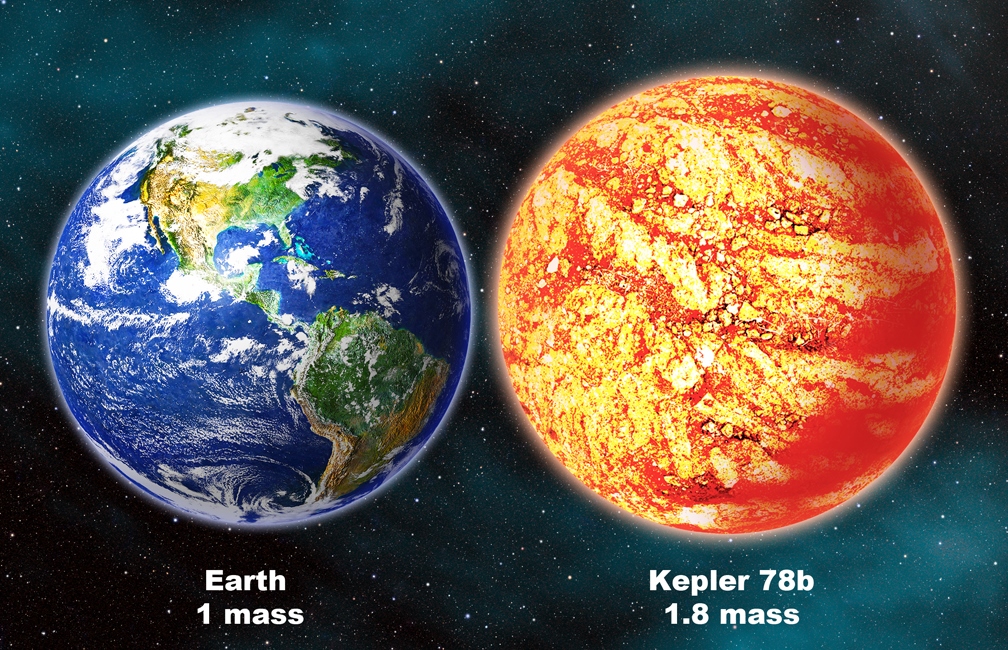
That planet is known as Kepler-78b, the existence of of which was recently verified by NASA scientists at Cape Canaveral. Of all the planets discovered beyond our Solar System, this one is both rocky in composition and weighs in at roughly 1.2 times Earth’s mass. Beyond that, however, the similarities between this planet and our own end.
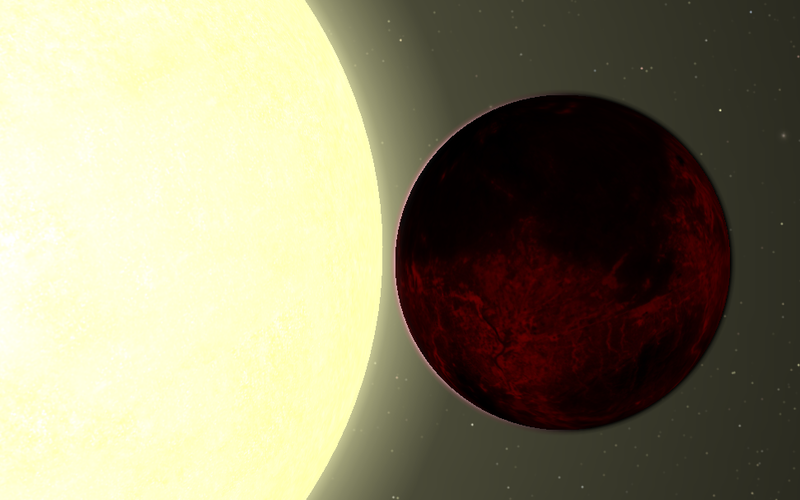
In addition to having an orbital period of 8.5 hours, the planet also rotates around its parent star at a distance of about 1.5 million kilometers (approx. 93205 miles). Basically, this means that Kepler-78b is thirty to forty-five times closer to its Sun than Mercury is to ours, and experiences a full year in under nine days. This makes Kepler 78b an extremely hostile environment, unsuitable for life as we know it.
Andrew Howard, of the University of Hawaii at Manoa’s Institute for Astronomy and the lead author on one of two papers published in Nature magazine about the discovery of the new planet, said in recent webcast:
We’ve been hearing about the sungrazing Comet ISON that will go very close to the Sun next month. Comet ISON will approach the Sun about the same distance that Kepler-78b orbits its star, so this planet spends its entire life as a sungrazer.
A handful of planets the size or mass of Earth have been discovered, but Kepler-78b is the first to have both a measured mass and size. At 1.2 times the size of Earth with a diameter of 14,800 km (9,200 miles), astronomers say it has a density similar to Earth’s, which suggests an Earth-like composition of iron and rock. Its star is slightly smaller and less massive than the sun and is located about 400 light-years from Earth in the constellation Cygnus.
Verification of the planet’s existence and characteristics was made by two independent research teams that used ground-based telescopes for follow-up observations. The team led by Howard used the W. M. Keck Observatory atop Mauna Kea in Hawaii. The other team led by Francesco Pepe from the University of Geneva, Switzerland, did their ground-based work at the Roque de los Muchachos Observatory on La Palma in the Canary Islands.
And while the discovery is exciting, the close proximity of Kepler-78b to its star poses a challenge to theorists. According to current theories of planet formation, it couldn’t have formed so close to its star, nor could it have moved there. Given that its star would have surely been larger when the system was in formation, Kepler-78b’s orbit would have put in inside the swollen star. Hence, the planet’s existence is an enigma.
To make matters worse, Kepler-78b is a doomed world. Gravitational tides will continue to pull Kepler-78b even closer to its star, and eventually it will move so close that the star’s gravity will rip the world apart. Theorists predict that the planet will vanish within three billion years. And while this may sounds like an eternity to us, in astronomical terms it represents a life cut short.
As the government shutdown goes into its second week, there is growing concern over how it is affecting crucial programs and services. And its certainly no secret that a number of federally-funded organizations are worried about how it will affect their long term goals. One such organization is NASA, who has seen much of its operations frozen while the US government attempts to work out its differences.
In addition to 97% of NASA’s 18,000 employees being off the job, its social media accounts and website going dark, and its television channel being shut down, activities ranging from commercial crew payouts, conferences, and awards and scholarship approvals are all being delayed as well. Luckily, certain exemptions are being made when it comes to crucial work on Mars.
These include the Mars Atmosphere and Volatile EvolutioN (MAVEN) orbiter. Following two days of complete work stoppage, technicians working on the orbiter were granted an exemption and permitted to continue prepping it for launch. And not a moment too soon, seeing as how a continued shutdown would have caused the orbiter to miss its crucial launch window.
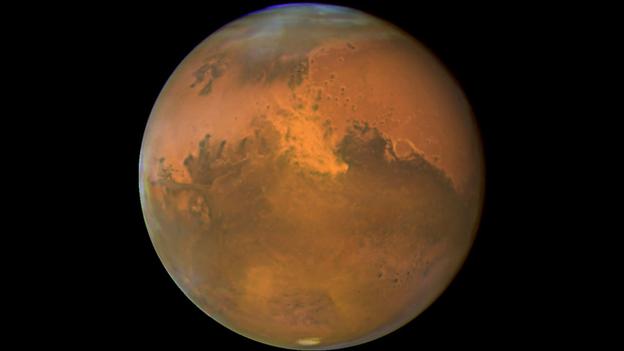
Designed to survey the Martian atmosphere while orbiting the planet, NASA hopes that MAVEN will provide some clues as to what became of the planet’s onetime atmosphere. MAVEN was been scheduled to blast off for the Red Planet on Nov.18 atop an Atlas V rocket from the Florida Space Coast until those plans were derailed by the start of the government shutdown that began at midnight, Oct. 1.
But as Prof. Bruce Jakosky, MAVEN’s chief scientist, stated in an interview just two days later:
We have already restarted spacecraft processing at the Kennedy Space Center (KSC) today. [Today, we] determined that MAVEN meets the requirements allowing an emergency exception relative to the Anti-Deficiency Act.
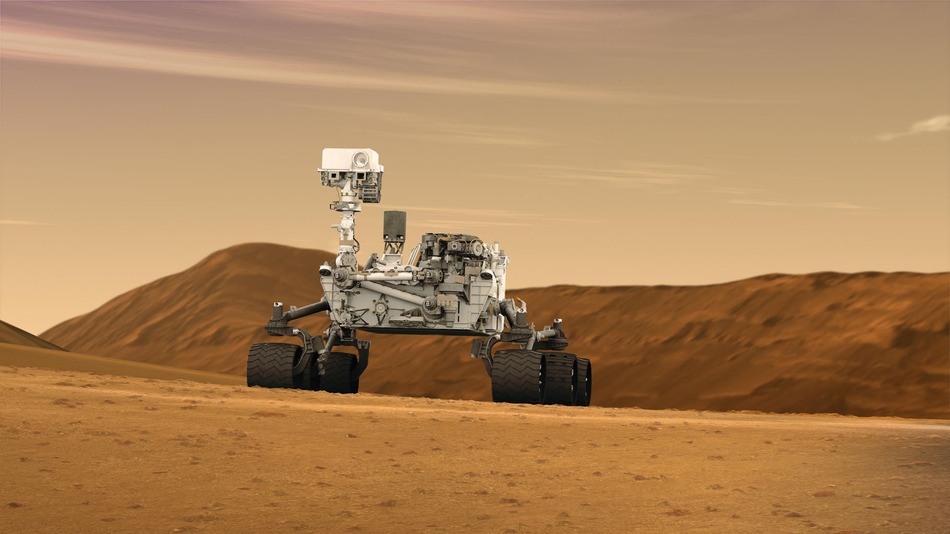
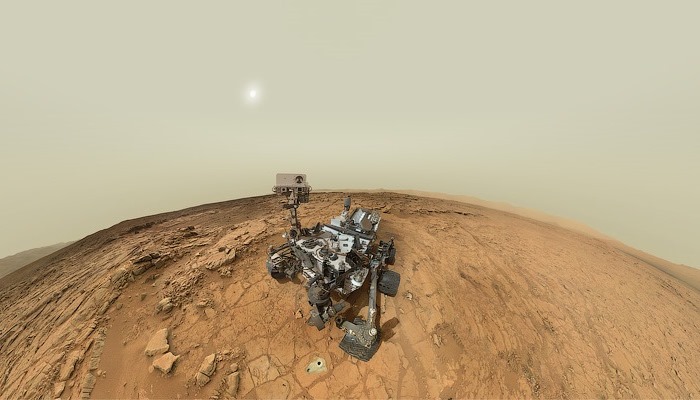
Another merciful exception to the shutdown has been the Curiosity Rover. Since contract workers at NASA’s Jet Propulsion Laboratory (JPL) oversee the rover’s mission, the Curiosity team is not subject to the same furloughs as other NASA employees. At JPL, the technicians and workers at the lab are employed by the California Institute of Technology, and are therefore able to keep the mission going.
However, the management at JPL and Cal Tech will continue to assess the situation on a weekly basis, and it’s possible the team may not remain completely intact in the event of a prolonged shutdown. This would be particularly detrimental for Curiosity since the Mars rover requires daily maintenance by scientists, engineers and programmers and cannot run on autopilot.
As Veronica McGregor, a media relations manager at JPL, said in a recent interview:
Right now, things continue on as normal. Curiosity is one where they literally look at the data each day, sit down, create a plan, decide what science instrument is going to be used tomorrow, they write software for it and upload it. [It’s] is kind of a unique mission in that way.
Other programs running out JPL will also continue. These include the Opportunity and Odyssey rovers, the Mars Reconnaissance Orbiter, the HiRISE camera, Dawn, Juno, and Spitzer space probes, and the Voyager satellites, APL, MESSENGER, and New Horizons. In addition, operations aboard the International Space Station will continue, but with the bare minimum of ground crew support.
Robotic missions that are already in operation – such as the Cassini spacecraft circling Saturn, or the Lunar Atmosphere and Dust Environment Explorer (LADEE) winging its way to the moon – will have small crews making sure that they are functioning properly. However, no scientific analysis will be conducted during the shutdown period.
As the shutdown continues, updates on which programs are still in operation, which ones will need to be discontinued, and how they will be affected will continue to be made available. One can only hope the politically-inspired deadlock will not become a prolonged affair. It’s not just current programs that are being affected after all.
Consider the proposed 2030 manned mission to Mars, or the plans to tow an asteroid closer to Earth. I can’t imagine how awful it would be if they were delayed or mothballed due to budget constraints. Politics… bah!
Last year, the private space exploration company Planetary Resources announced that they intended to being prospecting and mining asteroids in the near future. And while they are certainly not alone in their intention to make this happen (Deep Space Industries has the same intention), many have asked if humanity is ready to begin extracting resources from the Asteroid Belt, at least as far as our level of technology is concerned.
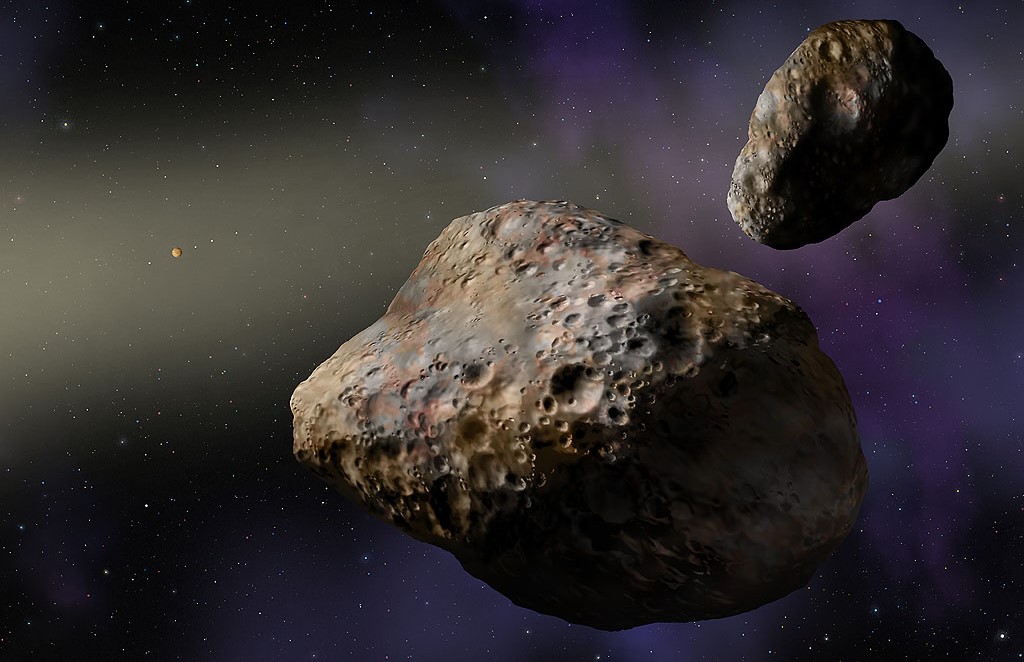
In response, a group of astronomers at the University of Strathclyde in the UK did their own study and concluded that it is indeed possible with current rocket technology. What’s more, they conducted a survey of the Asteroid Belt and identified 12 near-Earth asteroids that could be easily retrieved and mined, and which are believed to contain high concentrations of precious and industrial metals.
Already, it has been estimated that an asteroid as small as one-kilometer in diameter could contain upwards of two billion tons of iron-nickel ore, which is three times the global yield on Earth. Then there is the likely presence of gold, platinum, and other rare substances. Planetary Resources claims a 30-meter object of the right composition could contain $25 to $50 billion in platinum.
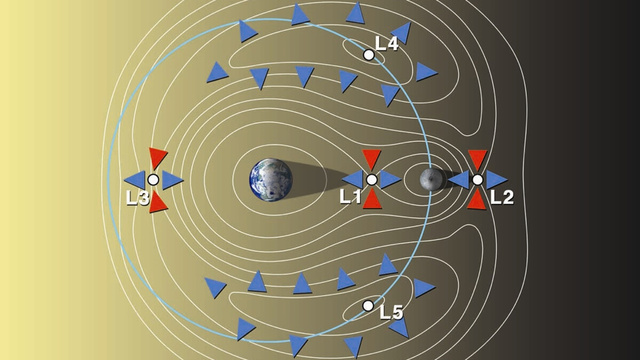
These numbers spurred the University of Strathclyde team, led by Garcia Yarnoz, to pour over the astronomical data on near-Earth objects to see if any of them could actually be snared. To their surprise, they found 12 small asteroids that pass close enough to Earth that they could be corralled into the L1 or L2 Lagrangian points for mining operations. The researchers dubbed these asteroids Easily Retrievable Objects (EROs).
Lagrange points refer to points where the gravity of Earth an another celestial object balance out. If anything enters one of these areas, it stays put, which is precisely what you want to do if you are looking to study it, mine it, or just keep it where its accessible. The L1 and L2 Lagrangian points are where the gravity of Earth and the sun are at a draw, roughly 1.6 million km (1 million miles) from Earth and about four times the distance to the moon.
The 12 candidate asteroids all have orbits that take them near the L1 or L2 Lagrangian points, so they would need only a small push to get them to the right spot. Yarnoz and his team estimate that changing the velocity of these objects by less than 500 meters per second would be sufficient, and this could be completed as early as 2026.
One of the important criteria in selected 12 mineable asteroids from the database of 9,000 near-Earth objects was size. Nudging a larger asteroid safely to a Lagrange point is simply not feasible with the current state of technology. In fact, most of the EROs that were identified in the study range between two to 20 meters, but that’s still large enough to contain substantial resources.
These 12 objects are probably a small fraction of EROs floating around near Earth. We know where many more of the big space rocks are because they’re much easier to see, but there might be a wealth of resource-rich small asteroids near the Lagrangian points ripe for the picking. And with time, and more orbital telescopes to spot them with, we can expect the list of mineable asteroids to grow.
Io, the innermost of Jupiter’s four largest moons, has always been a source of wonder for astronomers and scientists. In addition to its pockmarked and ashen surface, it is the most volcanically active object in the Solar System, with about 240 active regions. This is due to the immense tidal forces that Jupiter provides, which create oceans of lava beneath the surface and huge volcanoes blasting it hundreds of kilometers into space.
Naturally, these eruptions are not visible directly from Earth unless one is using infrared cameras. But recently, a new series of eruptions were observed by Dr. Imke de Pater, Professor of Astronomy and of Earth and Planetary Science at the University of California in Berkeley. She was using the Keck II telescope on Mauna Kea in Hawaii on August 15, 2013 when it immediately became apparent something big was happening at Io.
In a telephone interview with Universe Today, de Pater claims this eruption is one of the top 10 most powerful eruptions that have been seen on Io, and she just happened to have the best seat in the house to observe it.
When you are right at the telescope and see the data, this is something you can see immediately, especially with a big eruption like that. It is a very energetic eruption that covers over a 30 square kilometer area. For Earth, that is big, and for Io it is very big too. It really is one of the biggest eruptions we have seen.
However, the fact that it occurred in the Rarog Patera region of Io, aptly named for a Czech fire deity, is somewhat unusual. While many regions of Io are volcanically active, de Pater said she’s not been able to find any other previous activity that has been reported in the Rarog Patera area, which the team finds very interesting.
According to Ashley Davies of NASA’s Jet Propulsion Laboratory in Pasedena, California, Rarog Patera was identified as a small, relatively innocuous hot spot by the Galileo spacecraft during its encounter with the Jovian moon during the late 90’s. However, the observations made indicated that the volcanic activity was at a level way, way below what was seen on Aug 15.
Though we cannot see the eruptions directly, observation using the Keck telescope in the past have ascertained there are likely fountains of lava gushing from volcanically active fissures. But unlike volcanic eruptions here on Earth, which are already awesome and frightening to behold, eruptions on Io would be roughly 1000 times as powerful.
And since Io has no atmosphere to speak of, and the planet’s mass is significantly less than that of Earth’s (0.015 that of Earth’s to exact), the lava shoots off into space. Thus, for anyone standing on the moon’s surface, the result would look very much like a space launch at night, with plumes of flames reaching from the ground and extending indefinitely into the sky.
As de Pater further indicated in the course of her interview, volcanic activity remains quite unpredictable on the Jovian moon:
We never know about eruptions – they can last hours, days months or years, so we have no idea how long it will stay active. but we are very excited about it.
No data or imagery has been released on the new eruption yet since the team is still making their observations and will be writing a paper on this topic. One thing is clear at this point, though. Despite its mysterious nature, Io still has a few surprises left for Earth scientists.
And for more information on the mysterious planet of Io, check out this Astronomycast podcast, featuring an interview with Dr. Pamela Gay of Southern Illinois University:
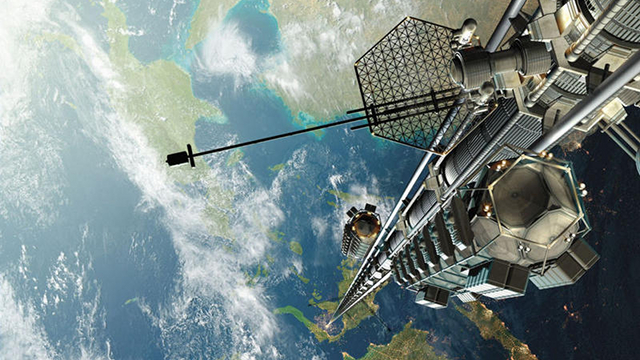
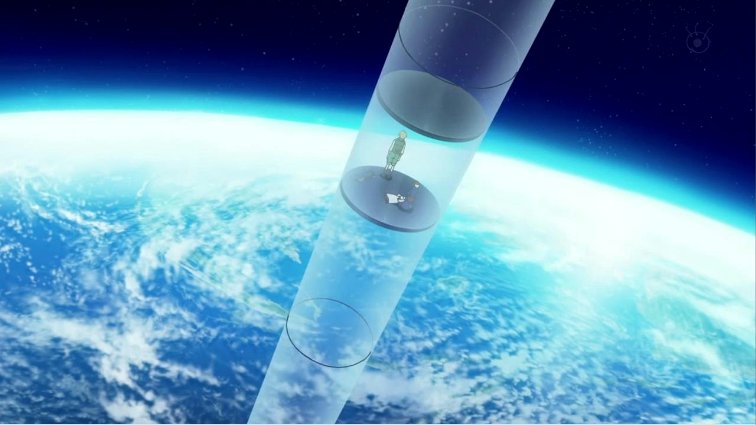
When it comes to classic and hard science fiction, there are few concepts more inspired, more audacious, and more cool than the Space Elevator. Consisting of a cable (or tether) attached the Earth near the equator and a station in geosynchronous orbit, a structure of this kind would allow us to put objects, supplies and even people into orbit without the need for rockets and space ships.
And perhaps I am a bit biased, seeing as how one of the writer’s featured in the Yuva anthology happens to have written a story that features one – Goran Zidar, whose story “Terraformers” includes an orbital colony that is tethered to the planet by a “Needle”. But I’ve found the concept fascinating for as long as I have known about it, and feel like its time for a conceptual post that deals with this most awesome of concepts!
Here goes…
History:
The first recorded example of the space elevator concept appeared in 1895 when Russian scientist Konstantin Tsiolkovsky was inspired by the Eiffel Tower in Paris. He considered a similar tower that extended from the ground into geostationary orbit (GSO) in space. Objects traveling into orbit would attain orbital velocity as they rode up the tower, and an object released at the tower’s top would also have the velocity necessary to remain in orbit.
However, his concept called for a compression structure, which was unfeasible given that no material existed that had enough compressive strength to support its own weight under such conditions. In 1959, another Russian scientist named Yuri N. Artsutanov suggested a more feasible proposal, a tensile structure which used a geostationary satellite as the base from which to deploy the structure downward.
By using a counterweight, a cable would be lowered from geostationary orbit to the surface of Earth, while the counterweight was extended from the satellite away from Earth, keeping the cable constantly over the same spot on the surface of the Earth. He also proposed tapering the cable thickness so that the stress in the cable was constant. This gives a thinner cable at ground level that becomes thicker up towards the GSO.
In 1966, Isaacs, Vine, Bradner and Bachus, four American engineers, reinvented the concept under the name “Sky-Hook”. In 1975, the concept was reinvented again by Jerome Pearson, whose model extended the distance of the counterweight to 144,000 km (90,000 miles) out, roughly half the distance to the Moon. However, these studies were also marred by the fact that no known material possessed the tensile strength required.
By the turn of the century, however, the concept was revitalized thanks to the development of carbon nanotubes. Believing that the high strength of these materials might make an orbital skyhook feasible, engineer David Smitherman of NASA put together a workshop at the Marshall Space Flight Center and invited many scientists and engineers to participate. Their findings were published in an article titled “Space Elevators: An Advanced Earth-Space Infrastructure for the New Millennium”.
Another American scientist, Bradley C. Edwards, also suggested using nanotubes to create a 100,000 km (62,000 mile) paper-thin cable that would be shaped like a ribbon instead of circular. This, he claimed, would make the tether more resistant to impacts from meteoroids. The NASA Institute for Advanced Concepts began supporting Edwards’ work, allowing him to expand on it and plan how it would work in detail.
In Fiction: In 1979, the concept of the Space Elevator was introduced to the reading public thanks to the simultaneous publications of Arthur C. Clarke’s The Fountains of Paradise (1979) and Charles Sheffield’s The Web Between the Worlds. In the former, engineers construct a space elevator on top of a mountain peak in the fictional island country of Taprobane, which was loosely based on Clarke’s new home in Sri Lanka, albeit moved south to the Equator.
In an interesting and fact-based twist, the purpose for building the elevator on Earth is to demonstrate that it can be done on Mars. Ultimately, the protagonist of the story (Dr Vannevar Morgan) is motivated by his desire to help a Mars-based consortium to develop the elevator on Mars as part of a massive terraforming project, something which has been proposed in real life.
Similiarly, in Sheffield’s Web, which was his first novel, we see a world famous engineer who has created extensive bridge networks all over the world using graphite cable. In hoping to achieve the unachievable dream, he begins work on a space elevator code named the “Beanstalk”. This brings him into an alliance with a corrupt tycoon who wants to make rockets obsolete, and intrigue ensues…
Three years later, Robert A. Heinlein’s novel Friday features a space elevator known as the “Nairobi Beanstalk”. In Heinlein’s vision, the world of the future is heavily Balkanized, and people exist in thousands of tiny nation states and orbital colonies which are connected to Earth via the Beanstalk, which as the name suggests, is located in equatorial Africa.
In 1993, Kim Stanley Robinson released Red Mars, a sci-fi classic that remains a quintessential novel on the subject of Mars colonization. In the novel, the Martian colonists build a space elevator that allows them to bring additional colonists to the surface, as well as transport natural resources that were mined planetside into orbit where they can be ferried back to Earth.
In 1999, Sid Meier’s, creator of the famed Civilization gaming series, released the sci-fi based Sid Meier’s Alpha Centauri that deals with the colonization of the planet “Chiron” in the Alpha Centauri system. In the course of the turn-based strategy game, players are encouraged to construct special projects as a way of gaining bonuses and building up their faction’s power.
One such project is the Space Elevator, which requires that the faction building first research the technology “super tensile solids” so they have the means of building a super-tensile tether. Once built, it confers bonuses for space-based unit production, allows orbital drop units to be deployed over the entire planet, increases production rates for satellites, and removes the need for aerospace facilities. In David Gerrold’s 2000 novel, Jumping Off The Planet, we are again confronted with an equatorial space elevator, this time in Ecuador where the device is once again known as the “beanstalk”. The story focuses on a family excursion which is eventually revealed to be a child-custody kidnapping. In addition to this futuristic take on domestic issues, Gerrold also examined some of the industrial applications of a mature elevator technology.
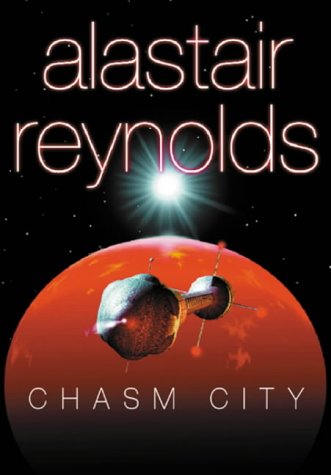
In 2001, Alastair Reynolds, a hard sci-fi author and creator of the Revelation Space series, released Chasm City, which acted as a sort of interquel between the first and second books in the main trilogy. At the opening of the novel, the story takes place on Sky’s Edge, a distant world where settlers travel to and from ships in orbit using a space elevator that connects to the planetary capitol on the surface.
And in 2011, author Joan Slonczewski presented a biological twist on the concept with her novel The Highest Frontier. Here, she depicts a college student who ascends a space elevator that uses a tether constructed from self-healing cables of anthrax bacilli. The engineered bacteria can regrow the cables when severed by space debris, thus turning the whole concept of tensile solids on its head.
Attempts to Build a Space Elevator: Since the onset of the 21st century, several attempts have been made to design, fund, and create a space elevator before the end of this century. To speed the development process, proponents of the concept have created several competitions to develop the relevant technologies. These include the Elevator: 2010 and Robogames Space Elevator Ribbon Climbing, annual competitions seeking to design climbers, tethers and power-beaming systems.
In March of 2005, NASA announced its own incentive program, known as the Centennial Challenges program, which has since merged the Spaceward Foundation and upped the total value of their cash prizes to US$400,000. In that same year, the LiftPort Group began producing carbon nanotubes for industrial use, with the goal of using their profits as capital for the construction of a 100,000 km (62,000 mi) space elevator.
In 2008, the Japanese firm known as the Space Elevator Association, chaired by Shuichi Ono, announced plans to build a Space Elevator for the projected price tag of a trillion yen ($8 billion). Though the cost is substantially low, Ono and his peers claimed that Japan’s role as a leader in the field engineering could resolve the technical issues at the price they quoted.
In 2011, Google was reported to be working on plans for a space elevator at its secretive Google X Lab location. Since then, Google has stated that it is not working on a space elevator. But in that same year, the first European Space Elevator Challenge (EuSEC) to establish a climber structure took place in August.
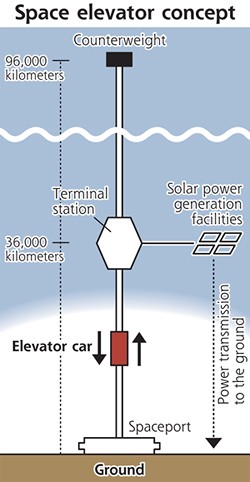
And in 2012, the Obayashi Corporation of Japan announced that in 38 years it could build a space elevator using carbon nanotube technology. Their detailed plan called for a 96,000 long tether, supported by a counterweight, that could hold a 30-passenger climber that would travel 200 km/h, reaching the GSO after a 7.5 day trip. However, no cost estimates, finance plans, or other specifics were made at this point.
Despite these efforts, the problems of building are still marred by several technical issues that have yet to be resolved. These include the problems of tensile strength, dangerous vibrations along the tether line, climbers creating wobble, dangers posed by satellites and meteoroids, and the fact that such a structure would be vulnerable to a terrorist or military attack.
Other Possibilities: Though we may never be able to resolve the problems of building a space elevator on Earth, scientists are agreed that one could be made on other planets, particularly the Moon. This idea was first devised by Jerome Pearson, one of the concepts many original proponents, who proposed a smaller elevator that would be anchored by Earth’s gravity field.
This is a necessity since the Moon does not rotate and could therefore not maintain tension along a tether. But in this scenario, the cable would be run from the moon and out through the L1 Lagrangian point. Once there, it would be dangled down into Earth’s gravity field where it would be held taught by Earth gravity and a large counterweight attached to its end.
Since the Moon is a far different environment than planet Earth, it presents numerous advantages when building a space elevator. For starters, there’s the strength of the materials needed, which would be significantly less, thus resolving a major technical issue. In addition, the Moon’s lower gravity would mean a diminished weight of the materials being shipped and of the structure itself.
As Pearson explained:
[T]o lift a thousand tons per day off the lunar surface, it would take less than 100,000 tons of elevator to do it — which means it pays back its own mass in just 100 days, or somewhere between three and four times its own mass per year — which is not a bad rate of return… You don’t need nanotubes and very, very high strength materials. But the higher the strength, the more of the ratio you can get for hauling stuff on the moon.
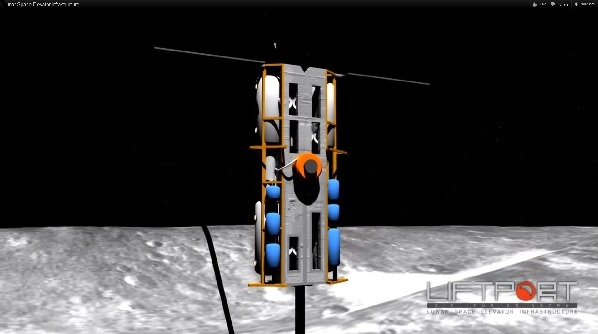
In fact, LiftPort is already deep into developing a “Lunar Elevator”. Plans to build one by 2020 were announced back in 2010, and since that time, the company launched a Kickstarter campaign to get the funding necessary to conduct tests that will get them closer to this goal. These consisting of sending a tethered robot 2km from the surface to conduct stress and telemetry tests.
Ultimately, the company estimates that a Lunar Elevator could be made at the cost of $800 million, which is substantially less than a “Terran Elevator” would cost. Similarly, it is likely that any manned missions to Mars, which will include eventual settlement and plans to terraform, will involve a Martian elevator, possibly named the “Ares Elevator”.
Much like SpaceX’s attempts to resolve the costs of sending rockets into space, the concept of a space elevator is another means of reducing the cost of sending things into orbit. As time goes on and technology improves, and humanity finds itself in other terrestrial environments where resources need to be exported into space, we can expect that elevators that pierce the sky will become possible.
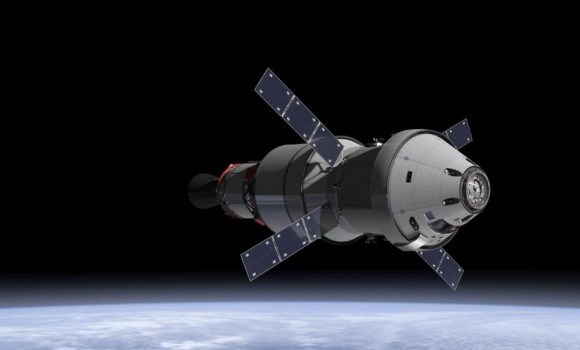
It’s known as the Orion Multi-Purpose Crew Vehicle (MPCV), and it represents NASA’s plans for a next-generation exploration craft. This plan calls for the Orion to be launched aboard the next-generation Space Launch System, a larger, souped-up version of the Saturn V’s that took the Apollo teams into space and men like Neil Armstrong to the Moon.
The first flight, called Exploration Mission 1 (EM-1), will be targeted to send an unpiloted Orion spacecraft to a point more than 70,000 km (40,000 miles) beyond the Moon. This mission will serve as a forerunner to NASA’s new Asteroid Redirect Initiative – a mission to capture an asteroid and tow it closer to Earth – which was recently approved by the Obama Administration.
But in a recent decision to upgrade the future prospects of the Orion, the EM-1 flight will now serve as an elaborate harbinger to NASA’s likewise enhanced EM-2 mission. This flight would involve sending a crew of astronauts for up close investigation of the small Near Earth Asteroid that would be relocated to the Moon’s vicinity. Until recently, NASA’s plan had been to launch the first crewed Orion atop the 2nd SLS rocket to a high orbit around the moon on the EM-2 mission.
However, the enhanced EM-1 flight would involve launching an unmanned Orion, fully integrated with the SLS, to an orbit near the moon where an asteroid could be moved to as early as 2021. This upgrade would also allow for an exceptionally more vigorous test of all the flight systems for both the Orion and SLS before risking a flight with humans aboard.
It would also be much more technically challenging, as a slew of additional thruster firings would be conducted to test the engines ability to change orbital parameters, and the Orion would also be outfitted with sensors to collect a wide variety of measurements to evaluate its operation in the harsh space environment. And lastly, the mission’s duration would also be extended from the original 10 to a full 25 days.
Brandi Dean, NASA Johnson Space Center spokeswoman, explained the mission package in a recent interview with Universe Today:
The EM-1 mission with include approximately nine days outbound, three to six days in deep retrograde orbit and nine days back. EM-1 will have a compliment of both operational flight instrumentation and development flight instrumentation. This instrumentation suite gives us the ability to measure many attributes of system functionality and performance, including thermal, stress, displacement, acceleration, pressure and radiation.
The EM-1 flight has many years of planning and development ahead and further revisions prior to the 2017 liftoff are likely. “Final flight test objectives and the exact set of instrumentation required to meet those objectives is currently under development,” explained Dean.
The SLS launcher will be the most powerful and capable rocket ever built by humans – exceeding the liftoff thrust of even the Saturn V, the very rocket that sent the Apollo astronauts into space and put Neil Armstrong, Buzz Aldrin and Michael Collins on the Moon. Since NASA is in a hurry to reprise its role as a leader in space, both the Orion and the SLS are under active and accelerating development by NASA and its industrial partners.
As already stated by NASA spokespeople, the 1st Orion capsule is slated to blast off on the unpiloted EFT-1 test flight in September 2014 atop a Delta IV Heavy rocket. This mission will be what is known as a “two orbit” test flight that will take the unmanned Multi-Purpose Crew Vehicle to an altitude of 5800 km (3,600 miles) above the Earth’s surface.
After the 2021 missions to the Moon, NASA will be looking farther abroad, seeking to mount manned missions to Mars, and maybe beyond…
And in the meantime, enjoy this video of NASA testing out the parachutes on the Orion space vehicle. The event was captured live on Google+ on July 24th from the U.S. Army’s Yuma Proving Ground in Arizona, and the following is the highlight of the event – the Orion being dropped from a plane!:
Ever since our astronomers have gained the ability to see into deep space and discern what lies in distant solar systems, a total of 910 extra-solar planets have been discovered. Of those, only a handful have been confirmed as potentially habitable by Earth scientists. Despite these discovered, it was not until recently that a “blue planet” outside of the Solar System, thanks to NASAs Hubble telescope.
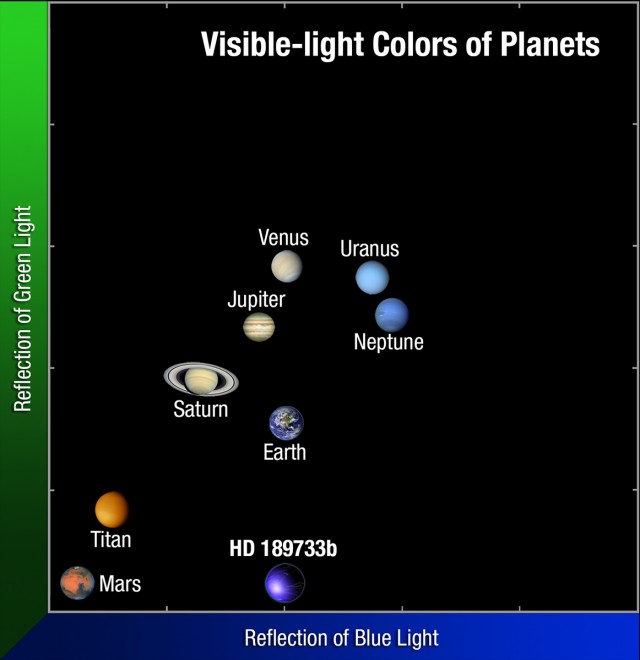
But here’s the kicker: as it turns out, the planet is not blue due to the presence of liquid water. The blue color likely comes from clouds in the atmosphere made of molten glass. The planet is known as HD 189733 b, located roughly 63 light years away from Earth in the constellation of Vulpecula (aka. the Fox). Initially discovered in 2005 by French astronomers who observed it passing in front of its star, HD 189733 b is one of the best-studied exoplanets.
Prior to this new finding, it was already known that the planet was a hot Jupiter — a massive gas giant that orbits very close to its parent star — and that, using polarimetry, it was most likely blue. Since that time, the blue color has been confirmed by a spectrograph aboard Hubble which scanned the planet during an eclipse. As it passed behind its parent star and out of our vision, Hubble recorded less blue light coming from the star, while the other colors remained the same.
This strongly indicates that the light reflected by HD 189733 b’s atmosphere is blue and thus, if we were close enough to directly observe the planet, it would appear blue. This is an apparent first for astrophysicists and astronomers, who wouldn’t normally be able to observe such a fluctuation from 63 light years away. But the size of the planet, plus the amount of light reflecting off it from its very-close-by star, mean that Hubble can do its thing.
As for the cause of the color itself, the current theory is that the planets atmosphere is full of clouds that contain tiny silicate particles, which absorb some light frequencies but reflect and scatter blue light. In the words of NASA, because the surface of the planet is around 815 Celsius (1,500 Fahrenheit), these particles are likely in a molten, liquid state that periodically turn into rain. Yes, you read that right, the planet experiences periods of molten glass rain!
In addition to that, it is also known that its orbital period (length of a year) is only 2.2 days. The planet is also tidally locked, meaning that one side is always facing towards the sun while the other experiences perpetual night. So basically, outside of its blue color, HD 189733 b is about as uninhabitable as it gets.
Ah well, the search for a truly Earth-like exoplanet continues I guess! And in the meantime, enjoy this short video from Hubble ESA – a computer graphic representation of the universe’s other “blue planet”:
It’s no secret that humanity, like all terrestrial organisms, has a symbiotic relationship with the Earth’s environment. And whereas the fortunes of entire civilizations and species once depended upon the natural warming and cooling cycle, for the past few centuries, human agency has an increasingly deterministic effect on this cycle. In fact, since the beginning of the Industrial Revolution, just 250 years ago, human industry increased the levels of carbon dioxide in the atmosphere by more than 40 percent.
And now, it seems that humanity has reached a rather ignominious and worrisome milestone. Working at the Mauna Loa Observatory, an atmospheric research facility, scientists announced Friday that for the first time in millions of years, the level of the carbon dioxide in the atmosphere had reached 400 parts per million on average over the course of a full 24-hour day. The last time there were these kinds of CO2 levels was approximately 3 million years ago, and that has many worried.
For some time now, climatological scientists have warned of the dangers of reaching this limit, mainly because of the ecological effects it would have. The Kyoto Protocol, an attempt during the late-90s to curb fossil fuel emissions on behalf of the industrialized nations of world, specifically set this concentration as a target that was not to be surpassed. However, with nations such as Canada, the US and China expressing criticism or pulling out entirely, it was clear for some time that this target would not be met.
And as mentioned already, the planet has not seen these kind of CO2 levels since the Pliocene Era, a time of warmer temperatures, less polar ice, and sea levels as much as 60 to 80 feet higher than current levels. If conditions of this nature are permitted to return, the human race could be looking at some very serious problems in the near future.
For starters, much of the world’s population and heavy industry is built along coastlines. With sea levels reaching an additional 60-80 feet, several million people will be displaced over the course of the next few decades. What’s worse, inland areas that have river systems connected to the sea are likely to experience severe flooding, leading to more displacement and property damage.
Those areas that find themselves far from the coast are likely to experience the opposite effects, increased heat and dryness due to increased temperatures and the loss of cloud cover and precipitation. This in turn will result in widespread drought, wildfires, and a downturn in food production. And let’s not forget that rising temperatures also mean the spread of disease and parasites, ones that are typically confined to the tropical areas of the world.
If any of this is starting to sound familiar, it’s because that is precisely what has been happening for the past few decades, and with increasing frequency. Record hot summers, food shortages in several parts of the world, flooding, wildfires, hurricanes, the West Nile Virus, Avian Bird Flu, Swine Flu, SARS, rising sea levels – these are all symptoms of a world where increasing output of Greenhouse Gases mean increasing temperatures and ecological effects.
But of course, before anyone feels like the situation is hopeless, this news does come with a silver lining. For one, the confirmation that we have now reached 400 ppm is likely to spur governments into greater action. Clearly, our current means are not working for us, and cannot be counted on to see us into the future. What’s more, a number of clean energy concerns are well under way, providing us with viable and cost effective alternatives.
The growth in solar energy in just the last few years has been staggering, and carbon capture technology has been growing by leaps and bounds. What’s more, upstarts and clean energy labs no longer need government support, though public pressure has yeilded several positive returns in that area. Even so, crowd-funding is ensuring that growth and innovation that would not be possible a few years ago is now happening, so we can expect the current rate of progress to continue here as well.
And of course, geoengineering remains a viable possibility for buying our planet some time. In addition to clean energy (putting less CO2 in the air), and carbon capture (removing the CO2 there), there are also a number of possibilities for Global Dimming – the opposite of Global Warming – to slow down the process of transformation until we can get our act together. These include evaporating oceanic water to lower sea levels and ensure more cloud cover, triggering algae blooms to metabolize more CO2, and dumping sulfur dioxide (SO2) in the air to combat the warming effect.
But in the end, nothing short of serious and immediate changes will ensure that decades and centuries from now, the ecological balance – upon which all species depend – is maintained. Regardless of whether you think of humanity as the masters or the children of this planet, it’s clear we’ve done a pretty shitty job in both capacities! It’s time for a change, or the greatest natural resource in our corner of the universe, Earth itself, is likely to die out!
Back in January, National Geographic Magazine celebrated its 125th anniversary. In honor of this occasion, they released a special issue which commemorated the past 125 years of human exploration and looked ahead at what the future might hold. As I sat in the doctor’s office, waiting on a prescription for antibiotics to combat my awful cold, I found myself terribly inspired by the article.
So naturally, once I got home, I looked up the article and its source material and got to work. The issue of exploration, especially the future thereof, is not something I can ever pass up! So for the next few minutes (or hours, depending on how much you like to nurse a read), I present you with some possible scenarios about the coming age of deep space exploration.
Suffice it to say, National Geographic’s appraisal of the future of space travel was informative and hit on all the right subjects for me. When one considers the sheer distances involved, not to mention the amount of time, energy, and resources it would take to allow people to get there, the question of reaching into the next great frontier poses a great deal of questions and challenges.
Already, NASA, Earth’s various space agencies and even private companies have several ideas in the works or returning to the Moon, going to Mars, and to the Asteroid Belt. These include the SLS (Space Launch System), the re-purposed and upgraded version of the Saturn V rocket which took the Apollo astronauts to the Moon. Years from now, it may even be taking crews to Mars, which is slated for 2030.
And when it comes to settling the Moon, Mars, and turning the Asteroid Belt into our primary source of mineral extraction and manufacturing, these same agencies, and a number of private corporations are all invested in getting it done. SpaceX is busy testing its reusable-launch rocket, known as the Grasshopper, in the hopes of making space flight more affordable. And NASA and the ESA are perfecting a process known as “sintering” to turn Moon regolith into bases and asteroids into manufactured goods.
Meanwhile, Virgin Galactic, Reaction Engines and Golden Spike are planning to make commercial trips into space and to the Moon possible within a few years time. And with companies like Deep Space Industries and Google-backed Planetary Resources prospeting asteroids and planning expeditions, it’s only a matter of time before everything from Earth to the Jovian is being explored and claimed for our human use.
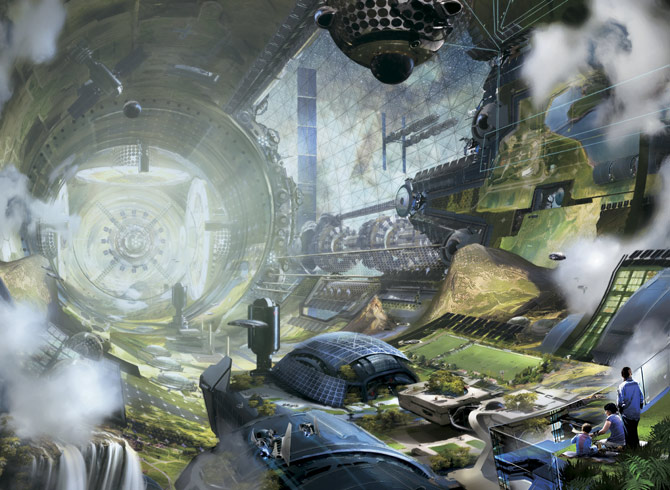
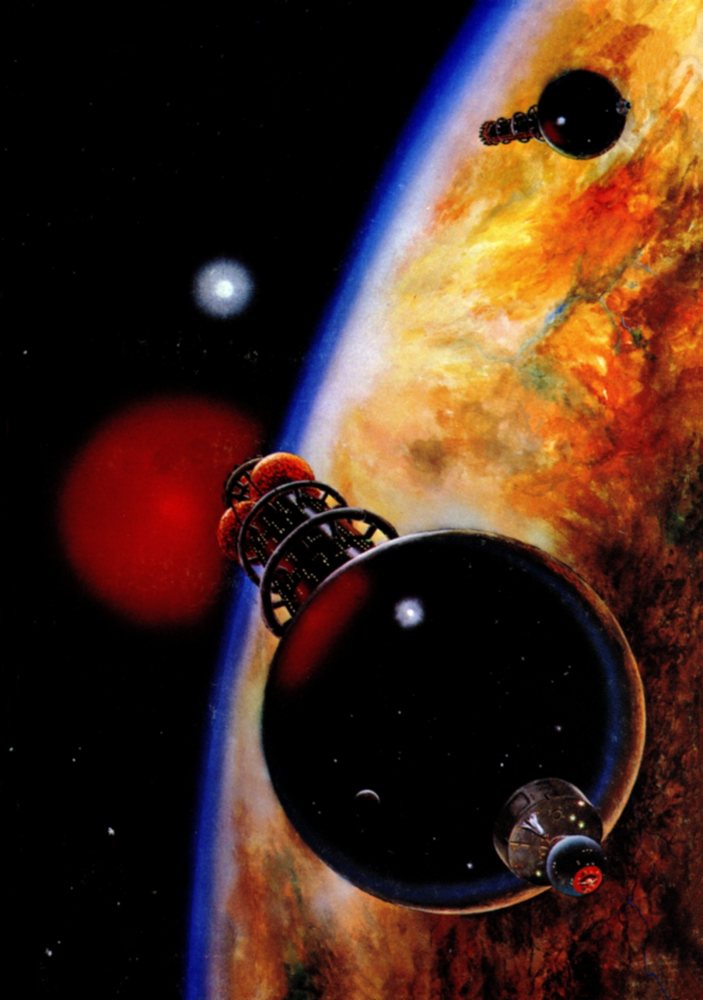
Space Colony by Stephan Martiniere
But when it comes to deep-space exploration, the stuff that would take us to the outer reaches of the Solar System and beyond, that’s where things get tricky and pretty speculative. Ideas have been on the table for some time, since the last great Space Race forced scientists to consider the long-term and come up with proposed ways of closing the gap between Earth and the stars. But to this day, they remain a scholarly footnote, conceptual and not yet realizable.
But as we embark of a renewed era of space exploration, where the stuff of science fiction is quickly becoming the stuff of science fact, these old ideas are being dusted off, paired up with newer concepts, and seriously considered. While they might not be feasible at the moment, who know what tomorrow holds? From the issues of propulsion, to housing, to cost and time expenditures, the human race is once again taking a serious look at extra-Solar exploration.
And here are some of the top contenders for the “Final Frontier”:
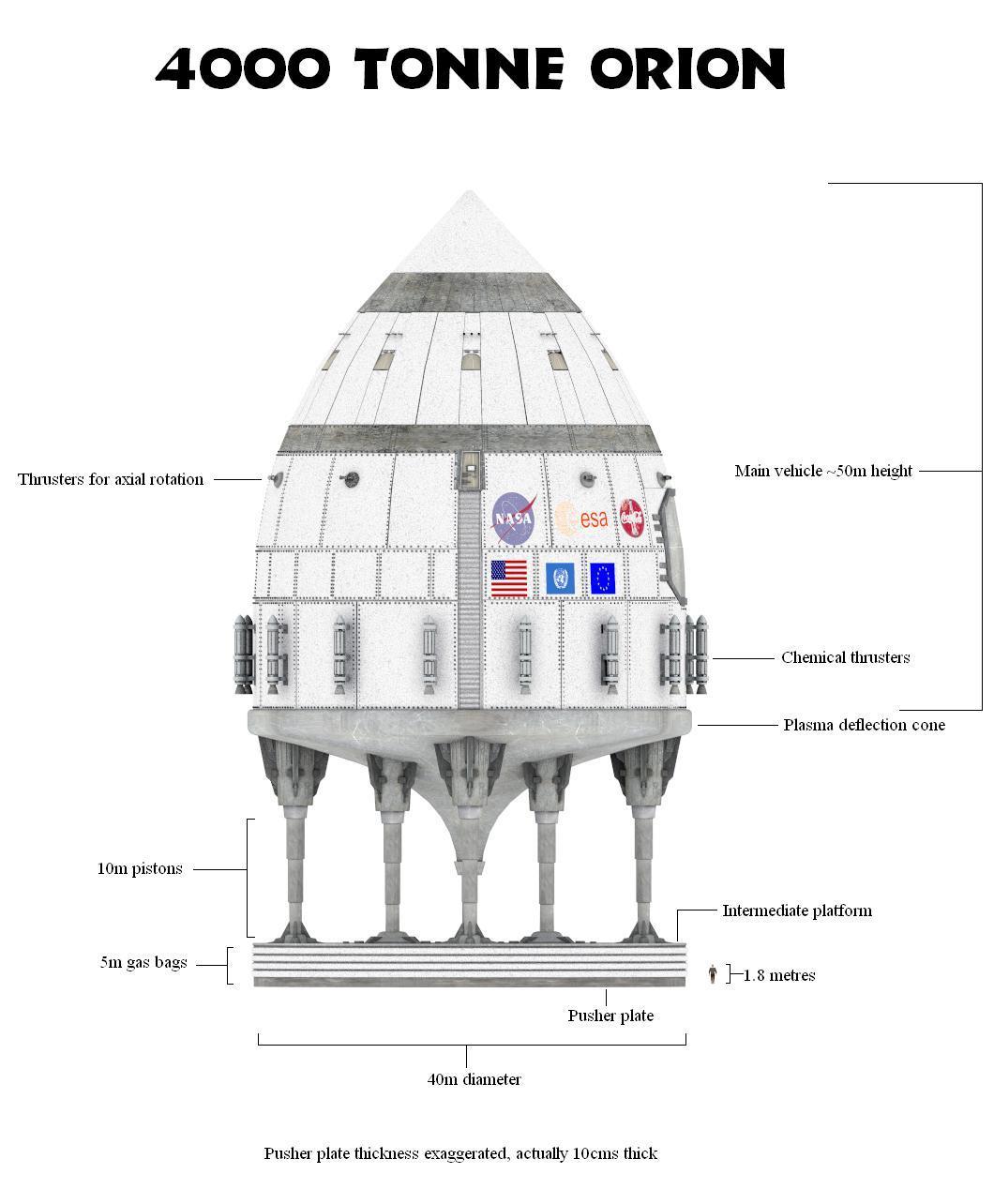
Nuclear Propulsion: The concept of using nuclear bombs (no joke) to propel a spacecraft was first proposed in 1946 by Stanislaw Ulam, a Polish-American mathematician who participated in the Manhattan Project. Preliminary calculations were then made by F. Reines and Ulam in 1947, and the actual project – known as Project Orion was initiated in 1958 and led by Ted Taylor at General Atomics and physicist Freeman Dyson from the Institute for Advanced Study in Princeton.
In short, the Orion design involves a large spacecraft with a high supply of thermonuclear warheads achieving propulsion by releasing a bomb behind it and then riding the detonation wave with the help of a rear-mounted pad called a “pusher”. After each blast, the explosive force is absorbed by this pusher pad, which then translates the thrust into forward momentum.
Though hardly elegant by modern standards, the proposed design offered a way of delivering the explosive (literally!) force necessary to propel a rocket over extreme distances, and solved the issue of how to utilize that force without containing it within the rocket itself. However, the drawbacks of this design are numerous and noticeable.
F0r starters, the ship itself is rather staggering in size, weighing in anywhere from 2000 to 8,000,000 tonnes, and the propulsion design releases a dangerous amount of radiation, and not just for the crew! If we are to rely on ships that utilize nuclear bombs to achieve thrust, we better find a course that will take them away from any inhabited or habitable areas. What’s more, the cost of producing a behemoth of this size (even the modest 2000 tonne version) is also staggering.
Antimatter Engine: Most science fiction authors who write about deep space exploration (at least those who want to be taken seriously) rely on anti-matter to power ships in their stories. This is no accident, since antimatter is the most potent fuel known to humanity right now. While tons of chemical fuel would be needed to propel a human mission to Mars, just tens of milligrams of antimatter, if properly harnessed, would be able to supply the requisite energy.
Fission and fusion reactions convert just a fraction of 1 percent of their mass into energy. But by combine matter with antimatter, its mirror twin, a reaction of 100 percent efficiency is achieved. For years, physicists at the CERN Laboratory in Geneva have been creating tiny quantities of antimatter by smashing subatomic particles together at near-light speeds. Given time and considerable investment, it is entirely possible this could be turned into a form of advanced propulsion.
In an antimatter rocket, a dose of antihydrogen would be mixed with an equal amount of hydrogen in a combustion chamber. The mutual annihilation of a half pound of each, for instance, would unleash more energy than a 10-megaton hydrogen bomb, along with a shower of subatomic particles called pions and muons. These particles, confined within a magnetic nozzle similar to the type necessary for a fission rocket, would fly out the back at one-third the speed of light.
However, there are natural drawback to this design as well. While a top speed of 33% the speed of light per rocket is very impressive, there’s the question of how much fuel will be needed. For example, while it would be nice to be able to reach Alpha Centauri – a mere 4.5 light years away – in 13.5 years instead of the 130 it would take using a nuclear rocket, the amount of antimatter needed would be immense.
No means exist to produce antimatter in such quantities right now, and the cost of building the kind of rocket required would be equally immense. Considerable refinements would therefore be needed and a sharp drop in the cost associated with building such a vessel before any of its kind could be deployed.
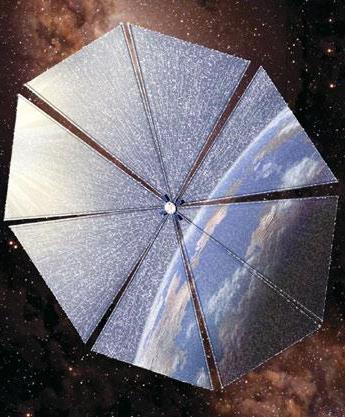
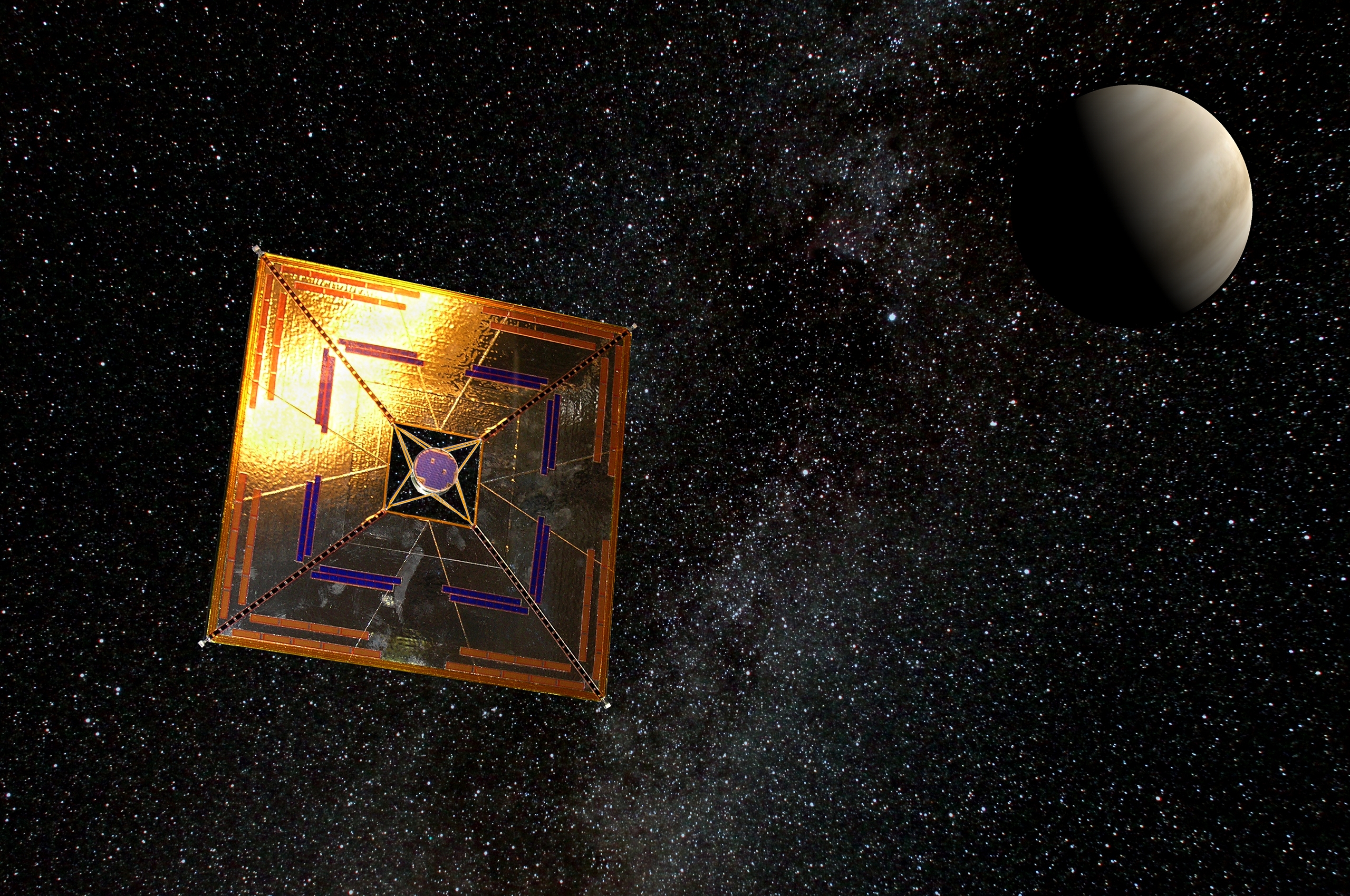
Laser Sail: Thinking beyond rockets and engines, there are some concepts which would allow a spaceship to go into deep space without the need for fuel at all. In 1948, Robert Forward put forward a twist on the ancient technique of sailing, capturing wind in a fabric sail, to propose a new form of space travel. Much like how our world is permeated by wind currents, space is filled with cosmic radiation – largely in the form of photons and energy associated with stars – that push a cosmic sail in the same way.
This was followed up again in the 1970’s, when Forward again proposed his beam-powered propulsion schemes using either lasers or masers (micro-wave lasers) to push giant sails to a significant fraction of the speed of light. When photons in the laser beam strike the sail, they would transfer their momentum and push the sail onward. The spaceship would then steadily builds up speed while the laser that propels it stays put in our solar system.
Much the same process would be used to slow the sail down as it neared its destination. This would be done by having the outer portion of the sail detach, which would then refocus and reflect the lasers back onto a smaller, inner sail. This would provide braking thrust to slow the ship down as it reached the target star system, eventually bringing it to a slow enough speed that it could achieve orbit around one of its planets.
Once more, there are challenges, foremost of which is cost. While the solar sail itself, which could be built around a central, crew-carrying vessel, would be fuel free, there’s the little matter of the lasers needed to propel it. Not only would these need to operate for years continuously at gigawatt strength, the cost of building such a monster would be astronomical, no pun intended!
A solution proposed by Forward was to use a series of enormous solar panel arrays on or near the planet Mercury. However, this just replaced one financial burden with another, as the mirror or fresnel lens would have to be planet-sized in scope in order for the Sun to keep the lasers focused on the sail. What’s more, this would require that a giant braking sail would have to be mounted on the ship as well, and it would have to very precisely focus the deceleration beam.
So while solar sails do present a highly feasible means of sending people to Mars or the Inner Solar System, it is not the best concept for interstellar space travel. While it accomplishes certain cost-saving measures with its ability to reach high speeds without fuel, these are more than recouped thanks to the power demands and apparatus needed to be it moving.
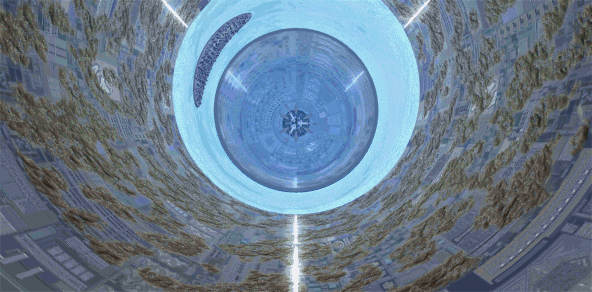
Generation/Cryo-Ship: Here we have a concept which has been explored extensively in fiction. Known as an Interstellar Ark, an O’Neill Cylinder, a Bernal Sphere, or a Stanford Torus, the basic philosophy is to create a ship that would be self-contained world, which would travel the cosmos at a slow pace and keep the crew housed, fed, or sustained until they finally reached their destination. And one of the main reasons that this concept appears so much in science fiction literature is that many of the writers who made use of it were themselves scientists.
The first known written examples include Robert H. Goddard “The Last Migration” in 1918, where he describes an “interstellar ark” containing cryogenic ally frozen people that set out for another star system after the sun died. Konstantin E. Tsiolkovsky later wrote of “Noah’s Ark” in his essay “The Future of Earth and Mankind” in 1928. Here, the crews were kept in wakeful conditions until they reached their destination thousands of years later.
By the latter half of the 20th century, with authors like Robert A. Heinlein’s Orphans of the Sky, Arthur C. Clarke’s Rendezvous with Rama and Ursula K. Le Guin’s Paradises Lost, the concept began to be explored as a distant possibility for interstellar space travel. And in 1964, Dr. Robert Enzmann proposed a concept for an interstellar spacecraft known as the Enzmann Starship that included detailed notes on how it would be constructed.
Enzmann’s concept would be powered by deuterium engines similar to what was called for with the Orion Spacecraft, the ship would measure some 600 meters (2000 feet) long and would support an initial crew of 200 people with room for expansion. An entirely serious proposal, with a detailed assessment of how it would be constructed, the Enzmann concept began appearing in a number of science fiction and fact magazines by the 1970’s.
Despite the fact that this sort of ship frees its makers from the burden of coming up with a sufficiently fast or fuel-efficient engine design, it comes with its own share of problems. First and foremost, there’s the cost of building such a behemoth. Slow-boat or no, the financial and resource burden of building a mobile space ship is beyond most countries annual GDP. Only through sheer desperation and global cooperation could anyone conceive of building such a thing.
Second, there’s the issue of the crew’s needs, which would require self-sustaining systems to ensure food, water, energy, and sanitation over a very long haul. This would almost certainly require that the crew remain aware of all its technical needs and continue to maintain it, generation after generation. And given that the people aboard the ship would be stuck in a comparatively confined space for so long, there’s the extreme likelihood of breakdown and degenerating conditions aboard.
Third, there’s the fact that the radiation environment of deep space is very different from that on the Earth’s surface or in low earth orbit. The presence of high-energy cosmic rays would pose all kinds of health risks to a crew traveling through deep space, so the effects and preventative measures would be difficult to anticipate. And last, there’s the possibility that while the slow boat is taking centuries to get through space, another, better means of space travel will be invented.
Faster-Than-Light (FTL) Travel: Last, we have the most popular concept to come out of science fiction, but which has received very little support from scientific community. Whether it was the warp drive, the hyperdrive, the jump drive, or the subspace drive, science fiction has sought to exploit the holes in our knowledge of the universe and its physical laws in order to speculate that one day, it might be possible to bridge the vast distances between star systems.
However, there are numerous science based challenges to this notion that make an FTL enthusiast want to give up before they even get started. For one, there’s Einstein’s Theory of General Relativity, which establishes the speed of light (c) as the uppermost speed at which anything can travel. For subatomic particles like photons, which have no mass and do not experience time, the speed of light is a given. But for stable matter, which has mass and is effected by time, the speed of light is a physical impossibility.
For one, the amount of energy needed to accelerate an object to such speeds is unfathomable, and the effects of time dilation – time slowing down as the speed of light approaches – would be unforeseeable. What’s more, achieving the speed of light would most likely result in our stable matter (i.e. our ships and bodies) to fly apart and become pure energy. In essence, we’d die!
Naturally, there have been those who have tried to use the basis of Special Relativity, which allows for the existence of wormholes, to postulate that it would be possible to instantaneously move from one point in the universe to another. These theories for “folding space”, or “jumping” through space time, suffer from the same problem. Not only are they purely speculative, but they raise all kinds of questions about temporal mechanics and causality. If these wormholes are portals, why just portals in space and not time?
And then there’s the concept of a quantum singularity, which is often featured in talk of FTL. The belief here is that an artificial singularity could be generated, thus opening a corridor in space-time which could then be traversed. The main problem here is that such an idea is likely suicide. A quantum singularity, aka. a black hole, is a point in space where the laws of nature break down and become indistinguishable from each other – hence the term singularity.
Also, they are created by a gravitational force so strong that it tears a hole in space time, and that resulting hole absorbs all things, including light itself, into its maw. It is therefore impossible to know what resides on the other side of one, and astronomers routinely observe black holes (most notably Sagittarius A at the center of our galaxy) swallow entire planets and belch out X-rays, evidence of their destruction. How anyone could think these were a means of safe space travel is beyond me! But then again, they are a plot device, not a serious idea…
But before you go thinking that I’m dismissing FTL in it’s entirety, there is one possibility which has the scientific community buzzing and even looking into it. It’s known as the Alcubierre Drive, a concept which was proposed by physicist Miguel Alcubierre in his 1994 paper: “The Warp Drive: Hyper-Fast Travel Within General Relativity.”
The equations and theory behind his concept postulate that since space-time can be contracted and expanded, empty space behind a starship could be made to expand rapidly, pushing the craft in a forward direction. Passengers would perceive it as movement despite the complete lack of acceleration, and vast distances (i.e. light years) could be passed in a matter of days and weeks instead of decades. What’s more, this “warp drive” would allow for FTL while at the same time remaining consistent with Einstein’s theory of Relativity.
In October 2011, physicist Harold White attempted to rework the equations while in Florida where he was helping to kick off NASA and DARPA’s joint 100 Year Starship project. While putting together his presentation on warp, he began toying with Alcubierre’s field equations and came to the conclusion that something truly workable was there. In October of 2012, he announced that he and his NASA team would be working towards its realization.
But while White himself claims its feasible, and has the support of NASA behind him, the mechanics behind it all are still theoretical, and White himself admits that the energy required to pull off this kind of “warping” of space time is beyond our means at the current time. Clearly, more time and development are needed before anything of this nature can be realized. Fingers crossed, the field equations hold, because that will mean it is at least theoretically possible!
Summary: In case it hasn’t been made manifestly obvious by now, there’s no simple solution. In fact, just about all possibilities currently under scrutiny suffer from the exact same problem: the means just don’t exist yet to make them happen. But even if we can’t reach for the stars, that shouldn’t deter us from reaching for objects that are significantly closer to our reach. In the many decades it will take us to reach the Moon, Mars, the Asteroid Belt, and Jupiter’s Moons, we are likely to revisit this problem many times over.
And I’m sure that in course of creating off-world colonies, reducing the burden on planet Earth, developing solar power and other alternative fuels, and basically working towards this thing known as the Technological Singularity, we’re likely to find that we are capable of far more than we ever thought before. After all, what is money, resources, or energy requirements when you can harness quantum energy, mine asteroids, and turn AIs and augmented minds onto the problems of solving field equations?
Yeah, take it from me, the odds are pretty much even that we will be making it to the stars in the not-too-distant future, one way or another. As far as probabilities go, there’s virtually no chance that we will be confined to this rock forever. Either we will branch out to colonize new planets and new star systems, or go extinct before we ever get the chance. I for one find that encouraging… and deeply disturbing!
As I learned not long ago, today is the 540th birthday of the late great man who definitely proved that the Earth revolved around the sun. And so I thought I’d take some time out of my busy (not so much today!) schedule to honor this great man and the massive contribution he made to astronomy, science and our understanding of the universe.
Given the importance of these contributions, I shall do my best to be pay homage to him while at the same time being as brief and succinct as I possibly can. Ready? Here goes…
Background: Born in Toruń (Thorn), Poland on 19 February 1473, Mikolaj Kopernik was the youngest of four children to be born into his wealthy merchant family. Given his background, Copernicus’ family was able to provide an extensive education for their son, which took him from Thorn to Włocławek to Krakow, where he attended university. In this time, he learned to speak many languages – including Polish, Greek, Italian, German and Latin (the language of academia in his day) – and also showed himself to be adept at mathematics and science.
During this time, he also received a great deal of exposure to astronomy, since it was during his years in Krakow (1491-1495) that the Krakow astronomical-mathematical school was experiencing its heyday. He was also exposed to the writings of Aristotle and Averroes, and became very self-guided in his learning, collecting numerous books on the subject of astronomy for his personal library.
Leaving Krakow without taking a degree, Copernicus moved to Warmia (northern Poland) where he turned to the study of canon law, perhaps in part because of his family’s strong Roman Catholic background. However, his love for the humanities and astronomy never left him, and he seemed to devote himself to these subjects even as he worked to obtain his doctorate in law. It was also during his time in Warmia that he met the famous astronomer Domenico Maria Novara da Ferrara and became his disciple and assistant.
Under Ferrara, Copernicus traveled to Bologna, Italy and began critiquing the logical contradictions in the two most popular systems of astronomy – Aristotle’s theory of homocentric spheres, and Ptolemy’s mechanism of eccentrics and epicycles – that would eventually lead him to doubt both models. In the early 1500’s, while studying medicine at the University of Padua in Italy, he used the opportunity to pour over the libraries many ancient Greek and Latin texts to find historic information about ancient astronomical, cosmological and calendar systems.
In 1503, having finally earned his doctorate in canon law, Copernicus returned to Warmia where he would spend the remaining 40 years of his life. It was here that all of his observations about the movement of the planets, and the contradictions in the current astronomic models, would crystallize into his model for the heliocentric universe. However, due to fears that the publication of his theories would lead to official sanction from the church, he withheld his research until a year before he died.
It was only in 1542, after he had been seized with apoplexy and paralysis, that he sent his treaties, De revolutionibus orbium coelestium (On the Revolutions of the Heavenly Spheres) to Nuremberg to be published. It is said that on the day of his death, May 24th 1543 at the age of 70, he was presented with an advance copy of his book.
Impact and Legacy: The immediate reaction of the church to the publication of Copernicus’ theories was quite limited. In time, Dominican scholars would seek to refute based on logical arguments and Aquinism, ranging from the positions of planets in the sky to very idea that Earth could be in motion. However, in attempting to disprove Copernicus’ theory, his detractors merely fostered a debate which would provide the impetus for reevaluating the field of physics and proving the heliocentric model correct.
And in time, with the help of such astronomers and mathematicians as Galileo, the debate would come to a head. Using the telescope, a technology he helped pioneer, he was able to demonstrate that the size of the planets during various times in the year did indeed conform to the heliocentric model, and that it was only through distortions caused by observing with the naked eye that made them seem larger (hence, closer to Earth) than they really were.
And although Galileo would eventually be forced to recant and placed under house arrest for his last few years on this Earth, the Copernican system became the defacto model of astronomy henceforth, and would help to launch the Scientific Revolution whereby several long-established theories would come to be challenged. These included the age of the Earth, the existence of other moons in our Solar System, Universal Gravitation, and the belief in the universe as a giant, rationalized clockwork mechanism.
Final Thoughts:
Naturally, there are those purists who would point out that he was not the first to propose a heliocentric planet system. In fact, the concept of a universe with the sun at the epicenter dates back Ancient Greece. However, Copernicus would be the first astronomer to propose a comprehensive model, which would later be refined by Galileo Galilee.
Other purists would point out that his system, when he developed it, had numerous observation and/or mathematical flaws, and that it was only after Galileo’s observations of the heavens with his telescope that his theories were made to work. But it is precisely because he was able to realize the truth of our corner of the universe, sans a reliable telescope, that makes this accomplishment so meaningful.
In Copernicus’ time, the rigors of the Aristotelian and Ptolemaic models were still seem by the majority of astronomers to be the correct one, regardless of church doctrine or religious bias. In purely mathematical terms, there was little reason to make an intuitive leap and suppose that the great minds on which Scholastic science was based had got it all wrong.
So when it comes right down to it, Copernicus was an intuitive genius the likes of which is seen only once in a lifetime. What’s more, his discoveries and the publication thereof helped bring humanity out of the Dark Ages – a time where learning and the hearts and minds of men were still under the iron grip of the Church – and helped usher in the modern age of science.
And if I could get a bit polemic for a second, I would like to say that it is unfortunate then that much of what Copernicus helped to overcome is once prevalent in society today. In recent years, long-established scientific truths like Evolution, Global Warming, and Homosexuality have being challenged by individuals who claim they are lies or merely “theories” that have yet to be proven. In all cases, it is clear what the agenda is, and once again faith and God are being used as a justification.
In fact, despite the monumental growth in learning and the explosion in information sharing that has come with the digital age, it seems that misinformation is being spread like never before. Whereas previous generations could always blame ignorance or lack of education, we few who are privileged enough to live in a modern, secular, democratic and industrialized nation have no such excuses.
And yet, it seems that some decidedly medieval trends are determined to persist. Despite living in a time when the vast and infinite nature of the universe is plain to see, there are still those who would insist on making it smaller just so they can sleep soundly in their beds. As if that’s not enough, they feel the need to villify that which they don’t understand, or openly threaten to kill those who preach it.
Sorry, like I said, polemic! And on this day of days, we can’t help but remember the lessons of history and how so often they are ignored. So if I might offer a suggestion to all people on this day, it would be to choose a subject they feel uninformed about and learn what they can about it. And do not trust just any source, consider the built-in biases and political slants of whatever it is you are reading. And if possible, go out and hug a scientist! Tell them you accept them, do not fear what they have to say, and will not be sending them death threats for doing what they do.

 For the past three and a half years, the Kepler space telescope has been hurtling through space and searching the Milky Way for signs of of other planets orbiting distant stars. In that time, Kepler has identified many Earth-like exoplanets, many of which reside within our own stellar neighborhood. However, it has found only one planet in recent months that is Earth-sized.
 In addition to having an orbital period of 8.5 hours, the planet also rotates around its parent star at a distance of about 1.5 million kilometers (approx. 93205 miles). Basically, this means that Kepler-78b is thirty to forty-five times closer to its Sun than Mercury is to ours, and experiences a full year in under nine days. This makes Kepler 78b an extremely hostile environment, unsuitable for life as we know it.
 A handful of planets the size or mass of Earth have been discovered, but Kepler-78b is the first to have both a measured mass and size. At 1.2 times the size of Earth with a diameter of 14,800 km (9,200 miles), astronomers say it has a density similar to Earth’s, which suggests an Earth-like composition of iron and rock. Its star is slightly smaller and less massive than the sun and is located about 400 light-years from Earth in the constellation Cygnus.

























 Stories by Williams