6 – Assemble

6 – Assemble

I hate it when I’m right.

It didn’t take them long to find the right vat. The intruder had entered the Foundries with the same grace and untraceable nature that got them this far. When Dube and Alpha team entered, they were unable to determine the path the intruder had taken. Looking left and right along the sloping corridor, Beta proceeded eastward while Alpha headed west.

When Beta found the vat, they contacted Alpha, who rendezvoused at their position shortly thereafter. It was as bad as Dube suspected. On the console, the intruder had deposited an infiltration node. This allowed them to bypass the biometric locks. The blueprints of what they had assembled were still on the screen.

Broadband Array (port.)

Signal Booster

The vat was still warm, meaning that Alpha and Beta teams had just missed the intruder. Luckily, they now knew exactly what said intruder hoped to accomplish, and it wasn’t sabotage.

[Jonas, are you getting all of this?]

[Confirmed] said Jonas, who proceeded to give a final assessment. [The intruder intends to divert power to a portable array and send a boosted broadband signal. We estimate a 100% probability that the intended recipient is a vessel in deep space. I have multiple probabilistic assessments as to their intentions.]

[No need! Just tell us where they’re headed.]

Jonas uploaded the likeliest route, gossamer threads overlain on top of a map of the ship’s midsection. The probability was indicated by the intensity of the thread. One stood out among the others, but there were two more that were considered a close second and third. Necessity required that they investigate all of them.

[A word of warning] Jonas added. [The fact that the intruder did not attempt to manufacture an explosive device, despite having access to do so, implies that they are equipped with defensive measures. Approach them with extreme caution.]

[Thank you, Jonas]

Dube paused for a second. Everyone in Alpha, Beta, and Charlie team had heard everything he had. He could feel their trepidation, and they his. Some wanted to discuss the possibilities further, he could tell. Unfortunately, there was no time for additional speculation. Not anymore. Their intruder was equipped with the means to broadcast their location. And they would be doing that very soon.

[We have something] said Vorhees. He and team Beta were tracing the intruder’s second most-likely path, as determined by Jonas. The fact that they had something to report so soon suggested Jonas might have gotten things wrong.

[There’s EM traces on the floor that conform to footprints. They’re rapidly fading, but we’re tracking them ahead.]

Dube reached out to Jonas. [Hypothesize]

[Engineer Vorhees is correct. This is consistent with an advanced stealth system. The powerful EM fields involved, upon contact with the interior surface materials, would create a residual electromagnetic field.]

Dube sensed what Jonas might suggest because it was exactly what he was thinking. He quickly leapt at the opportunity to suggest it first.

[Can we track them? Amplify the impressions left to establish a trail?]

[Of course] Jonas replied.

A second later, and the path established by the intruder appeared in Dube’s sensorium. For everyone but Beta team, it was a mark on their maps. For Vorhees and his team, it was a series of footprints that began to recede in front of them.

[Permission to take team Beta ahead. We’re hot on his trail, and I don’t think we want to lose time regrouping.]

Dube could feel the urgency in his thoughts.

[Granted], he replied. There was simply no time to waste. The other teams would simply have to catch up to Beta once they had the intruder cornered, wherever that proved to be.

[Alright, let’s move with a purpose!] said Vorhees, prioritizing communication with Baghadur and Kyeong. They obliged and, like him, engaged their exoskins’ overdrive function to enhance their speeds. Rather quickly, their gate overtook the rate at which the intruder’s tracks were fading. A few seconds later, the imprints appeared brighter and more pronounced.

All indications said they were getting closer.

Up ahead, the imprints veered away from the corridor and disappeared behind a bulkhead. As expected, they were taking the shortest route through the Gyro section, which would give them access to the singularity drive, propulsion section in the rear. It was a small mercy that their intruder was not intent on sabotaging either. But that was no reason to slow down or relax!

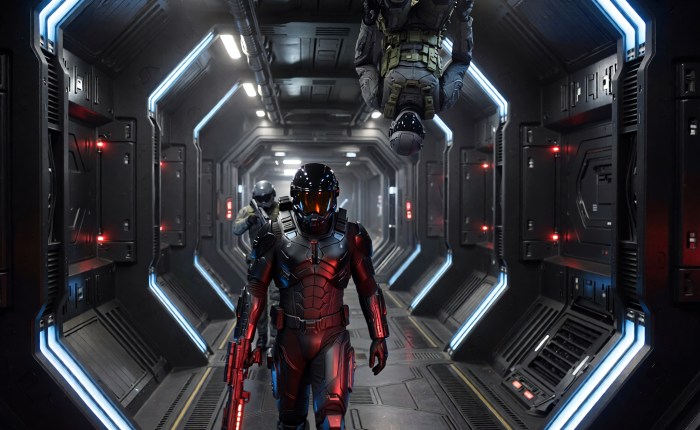
Vorhees bounded around the bulkhead, followed closely by Baghadur and Kyeong. This led them through an aperture and down another corridor. This one consisted of a series of twisting maintenance passages that interconnected the Foundries and ultimately led to the rear of the ship. A twisted network that would be easy to get lost in. Luckily, between the intruder’s foot imprints and Jonas’ predicted path, they were clearly hot on his trail. Particularly hot, if the brightness of the EM signatures he’d left behind was any indication.

Vorhees stopped. Baghadur and Kyeong came to a stop behind him, just short of bowling him over. They both voked to him.

[What’s wrong? Why have we stopped?]

They saw why a nanosecond later. The path of their intruder ended rather suddenly.

[Fan out] Vorhees ordered. [He’s visible, or at least he temporarily disengaged his stealth field to throw us off. Look for his footprints, quickly.]

Two affirmatives. The three of them each grabbed a passageway and began moving forward to sweep them meticulously. Vorhees was unsurprised when Dube voked to him and asked for a report on their progress. Vorhees kindly updated him with the data he and his team had obtained.

[I see] replied Dube. [Proceed with caution, we are barely a minute behind you.]

[Understood.]

Vorhees looked down the length of the hatchway in front of him and began moving. His exoskin’s overdrive was no longer engaged, and his steps were even and measured. His biomonitors also noted an increase in his adrenal activity and heart rate. He didn’t need to be told that he was feeling more nervous. He had been the second when the footprints he’d been chasing disappeared.

Where are you?

[I have something], Kyeong announced. Vorhees stopped and tapped into his visual field. Looking at the floor, his counterpart spotted a single pair of footprints that were separated by about two meters and rapidly fading.

[He definitely came this way. And you were right, he’s cycling his stealth mode to throw us off.]

[He could be headed anywhere from here], Baghadur offered.

Vorhees looked at the map in his visual field. Baghadur was right. The criss-crossing nature of the maintenance hallways meant that their intruder could be trying to lose them in this network and was headed for an entirely different part of the ship. Then again, it was possible he was just trying to divide them up to even the odds if any ran into him.

The thought made Vorhees’ biomonitors raise their warning about his adrenals. He quickly voked to his companions.

[Kyeong, hold your position. We’ll converge on you.]

Vorhees turned. There was a bright flash, followed by the gradual appearance of a solid form in front of him. He managed to get a look at their intruder, standing not more than a few meters away. His skin was a bronze sheen that reflected Vorhees’ own image back at him. Extending from his right arm was a projectile launcher that was still glowing from the discharge.

Vorhees eyes then fell to his chest, where his exoskin was rapidly disintegrating. The suit’s controls were assaulting his senses to let him know that its structural integrity was failing. Counter-measures were failing, and its attempts to repel the assaulting nanoware were proving futile. Small pieces of the armored skin flaked away like hot embers, rapidly exposing his chest,

A second flash, and the small fire was opening his chest cavity. Vorhees’ biomonitors were blaring now, issuing every kind of warning they could that his body was being invaded by nanobots rapidly boring a hole into his heart and spine.

Vorhees fell. Before the world turned dark on him, he saw their intruder again. His bronze outer shell glistened with the light of the hallway’s status lights. On the wall behind him, there were more shining patches – footprints and handprints that showed where he had anchored himself against the ceiling.

As the light slowly drained from the room, Vorhees realized the full measure of the intruder’s strategy. He had thrown them off in several directions, causing them to split up, thus allowing him to lure the team leader into a trap. With their squad now down a person, he would no doubt do the same to the others – attempt to keep chasing down different paths and picking them off one by one.

Then again, he might opt to use the moment of chaos he’d created to resume his headlong journey towards his objective. Surely, he had bought himself more time now.

What mattered was that he had options and the ball was in his court, something only a professional could pull off.

Clever fellow, thought Vorhees before things went dark.

2 – Worldship

2 – Worldship

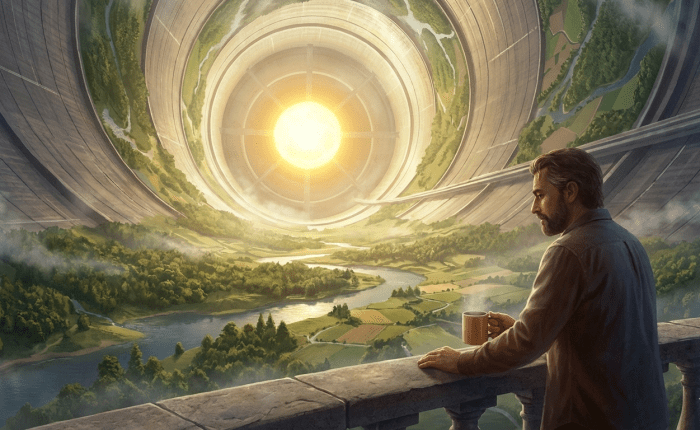
Light poured in through apertures in the hull. The many photons they admitted were focused by the ship’s interior lenses and directed towards the center. Where they met, a bright apparition hovered in midair, visible to everyone on the curved ground below. This “Sun,” which they had brought with them through the miracle of engineering, painted the landscape below in a warm light, drawing attention to every tree, structure, and ripple in the water.

It was appropriate and soothing for someone who had just arisen from cryosleep. Placing his cup down on the parapet, Dube took a deep breath and drew in the morning air. The landscape was quite accommodating, generating dew that formed on the grass and leaves. When the morning light came and turned it into water vapor, the result was fragrant ozone. Were it not for the vertically-sloping skyline, it would have looked, smelled, and felt like home.

Dube got a strange flash of recollection. He remembered standing somewhere, feeling the sights, sounds and smells of home. But he also recalled that there was a voice telling him that it wasn’t home, not anymore. The rest was darkness…

It was like something out of a bad dream that he could only remember in the vaguest sense. Dube knew that such recollections were natural after waking from cryosleep. The dreams one had, especially as they were coming out of dormancy, were known for being vivid. But as time went on, they became foggier and harder to retrieve.

If that were true, the indeterminate recollection was meaningless.

Then again, there was the extraction process that he and the other Engineers had undergone. So many memories from their training sessions had been removed afterward and put in storage, only to be reloaded when a specific Contingency occurred. A common side effect of the process, they had been forewarned, was vague recollections and moments of déjà vu.

If that were true, then Dube was sensing something from a training session, something that he elected to forget. He didn’t see how scenes from home and discussing where home was could possibly be related to contingency-specific training. But until he could retrieve something more of the memory, he had no way of knowing.

Dube huffed. Apparently, another symptom of cryosleep was endlessly poring over trivial matters. Vivid dreams were certainly to be expected during cryosleep, but not any particular obsession with them. Meanwhile, the ship’s artificial dawn was spreading in front of him and he had barely noticed.

There was much to notice too. The last time he had stared out onto the landscape of the ship, it was in the process of being spun up. The grass, trees, and foliage had just taken root, the deserts and transitional zones stood silent, and the waters reflecting the artificial dawn were not yet flowing. But in the years since their departure, the landscape must have blossomed and died many times over.

To look out onto the inner world that was the Transverse today was to look upon an environment that was at once familiar, yet alien. It was exacting in its biomimicry, every patch of the landscape adopted from the original example. But the biosphere had still evolved to become its own unique lifeform, with one generation of life dying and making way for the next. Even though the layout and distribution were as he remembered them, every organism that currently existed inside the ship was different than the ones that came before.

Like the human body, which swapped all its cells every seven to ten years, the landscape Dube beheld was the latest skin covering the same giant organism. That organism would continue to procreate and see its spawn mature and die. It would happen many more times as the ship made its way towards their destination. If necessary, it would continue to do so long after they reached it. The symmetry of that made Dube smile.

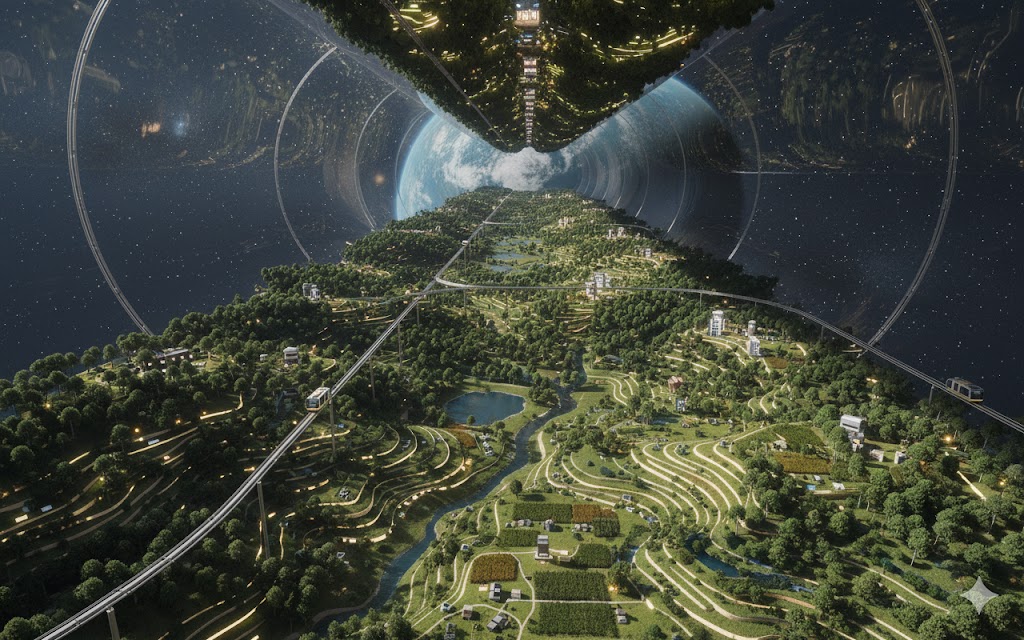
It also filled him with feelings of insignificance at the same time. From one end to the other, they had created a closed-loop system that mimicked (as closely as possible) the entire environment of Earth. Within a single structure, the entire biosphere of Earth was recreated.

In the center, there was the massive rainforest belt made up of the Amazon, Congo, and Borneo sections. Capping this section on either side was the patches of savannah and desert, gradually giving way to grasslands and temperature forests.  Stretching perpendicular to these were the three saltwater seas that ran the length of the interior – Atlantic, Pacific, and Indian – eventually emptying into the Arctic and Antarctic oceans.

Further down the ship’s spine, Dube could make out where the verdant hills and lakes of the Precambrian landscape gave way to the next geographical region of the interior. This was the Prairie-Steppe of the northern hemisphere, which distinguished them from the Pampas of the southern. While the view was somewhat hazy, thanks to all the moisture-laden air between Dube and that section, they were distinguishable based on their comparatively flat profile and large tracts of grasslands and shrubbery.

Light from the sunband painted the many structures distributed across this landscape, casting shadows beneath them. Down there, crewmembers were tilling the fields, planting the seeds of the previous harvest to grow the next.

A glance in the opposite direction revealed a different transition. The fields of the Borealis seemed to go on forever, until they thinned to make way for the Tundra. Beyond that, in the barely-perceptible distance, was the northern ice cap – a frozen field that wrapped the front section of the North Habitation module. Dube felt a chill just looking at it.

Picking up his cup, Dube took another sip of his coffee. The dose of restoratives Jonas had added was swarming through his insides now, meeting up with his dormant medimachines and giving them a blast of chemical energy. Once that was complete, they would come together to administer repairs to all of his bodily systems.

He could already feel the cobwebs in his brain being combed away.

Looking to his left, just above his eye level, Dube saw Lake Ontario, the central freshwater lake in the northern section of the vessel. The sunlight reflected from the surface a fine patchwork, indicating where wind and Coriolis forces caused ripples on the water. From his vantage point, the lake looked like something Dube would expect to see from Low Earth Orbit, and perhaps flying over Mars and Venus someday. The experience was known to trigger vertigo to the uninitiated, but Dube had seen it enough times to become comfortable with it.

His eyes came to rest on the small chain of islands that were grouped along Ontario’s narrowest point, the Engineers attempt to reproduce the Thousand Islands and the complex Frontenac Arch biosphere. Already, there were people in small boats out to the open water with their fishing implements. Perhaps they would even catch something. The pike, trout, steelhead, and bass had been awake longer than any of them, after all.

[Engineer Dube. Have you had adequate time to recuperate?]

Dube sighed. [Yes, Jonas. And just to save us both some time, I will be heading for the Bridge right now.]

[Thank you, Engineer Dube. I shall see you there.]

“Of course, you shall,” he sneered.

My Interview with AADYA Geo Talks!

My Interview with AADYA Geo Talks!

A few months back, I had the honor of appearing on AADYA Geo Talks, the podcast series launched by Bharti Sharma and the organization she founded – AADYA, whose name means “origin” in Hindi. As a geologist and world-traveller, Sharma launched this organization to promote knowledge about planetary and geoscience and create opportunities for collaborative research to address critical global challenges. 

During the interview, we talked about how I got into science journalism, my podcast series, and my science fiction writing. The interview lasted for more than an hour because she asked great questions about a range of wonderful topics (and she let me talk for as long as I wanted!) Here’s how she described our conversation:

“In this episode of AADYA Geo Talks, we explore the mind of a space journalist who has spent years unraveling the wonders of the universe. From the allure of dark matter to the search for extraterrestrial life, Matthew takes us on a journey through the most fascinating corners of space science. But here’s where it gets even more intriguing—science fiction has always fueled real-world space missions. “

Check it out, and watch it in segments if you need to! Also, visit the AADYA website to learn more about their education, outreach, and collaborative efforts.

Boltzmann’s Brainchild

Boltzmann’s Brainchild

His head was hurting. His mouth was dry. His entire body felt uninspired and feeble. He felt much the same a short while ago when he left the dinner table. How long ago was that? What time was it?

He’d left his watch upstairs and hadn’t the capacity to find a clock right now. But a quick pass by the hall window confirmed that the Sun was coming up. They were firmly in the AM, and he was forced to accept that it was no longer the previous evening.

No appreciation for time! Why was that?

Continue reading “Boltzmann’s Brainchild”

A Sneak Peak at Exogenisis!

A Sneak Peak at Exogenisis!

Hello again! I am going to do something I haven’t done in a long time here and share some creative writing I’ve been working on. In truth, I have done a lot of creative writing these past few years that I have failed to share here. I decided it was time to rectify this, and what better way to start than to share the first chapter of one of my current WIPs? It is titled Exogenesis, and it is a story that has taken a long time for me to realize!

I described this idea a short while ago in another post (“A Visit to the Ideas Folder“). In fact, I described two ideas, one titled Pilgrimage and the other titled Exogenesis. As I wrote at the time, Pilgrimage is a short story about distant origins and how future humans may come to trace their ancestry back to Earth. It is also the first chapter in the full-length version set in the same universe, titled Exogenesis. I am told that this is how many of the greats realized their first novels, so I decided to give it a try.

In any case, here’s the first chapter in full! A word of warning: there’s a lot of linguistics and semantic evolution in here, so some words won’t make a lot of sense at first sight. But I’m hoping the context will help resolve all that. Enjoy!

Continue reading “A Sneak Peak at Exogenisis!”

Writing About Trauma

depression1-650x487Delving back into the world of Whiskey Delta, I’ve found myself coming back to a familiar theme for me that informs much of my writing. It’s the theme of trauma, how one experiences the feelings of being overwhelmed, depressed, anxious, and at a loss for control in their life. For those who follow the Whiskey Delta series, all of these are things that keep coming up for one main character – Sergeant Aaron Dezba.

In the story, Dezba is haunted by the loss of his wife and daughter – two people who became infected by the zombie virus and turned into living horrors. Unable to deal with it at first, he locked them in his basement and kept them alive, hoping that some kind of cure might be found someday. But upon learning that such a thing would never be possible, he killed them both and fell into a deep depression.

zombie-girlAs the story continued, he found a measure of redemption by confessing his crimes and rededicating himself to completing a mission that could possibly result in the creation of a vaccine. Though the virus could not be cured, the researchers in the story were able to fashion something that would immunize the uninfected against it. However, Dezba never forgot the loss of his wife and daughter, and remains haunted by this and similar traumas throughout the story.

In attempting to write about this, I actually drew a lot on my own experiences. Mercifully, I have not lost my wife or a child, but trauma is something I’ve experienced in my own life. It’s something I’ve never talked about in this forum, but thought that I might share it at this time. You see, a few years back, I was diagnosed with an anxiety disorder, and it was pretty obvious to the people I sought help from that it was caused by an extended period of high stress that I found myself in just previous to that.

https://i0.wp.com/blogs.psychcentral.com/nlp/files/2013/11/naturalremediesfordepression.jpgI’ve always been an OCD-type person; but apparently, enduring extreme stress can make the symptoms ten times worse, which pretty much describes my reality ever since! The short version is that during the fall/winter of 2007, I was working for three months in an isolated community, teaching grade 5/6 to a bunch of kids who hated my guts because I replaced their previous teacher.

He, I say at the risk of editorializing, was a selfish prick who ran out on them because he was pissed about trivial disciplinary matters. And he took all the resources with him, leaving me with nothing. The first week, I got virtually no sleep and felt like I was on the verge of a nervous breakdown. I tried to quit, but couldn’t stomach the long-term consequences it would cause to my teaching career. No one else on the island was hiring, which meant I would have to find another career.

https://i0.wp.com/www.smarttop10.com/wp-content/uploads/2013/10/Top-10-Home-Remedies-for-Depression.jpgWhat’s more, my father was absolutely livid when he found out I was hoping to quit, and I didn’t like the idea of being estranged from him. But mostly, I didn’t think I could live with the consequences of such a failure. And so, for the next three months, I stuck it out, committing to stay until someone permanent was found. And finally, at Christmas, they found my replacement, plus several more (more than a few people quit by this point in the year).

I then returned home happy and relieved as all hell, but found that I still couldn’t sleep right and was feeling quite anxious all the time. Eventually, my mother suggested I might be depressed and recommended I go talk to someone. I did, and they diagnosed me with acute depression and anxiety. Things got better, without the need for drugs, but I found over the course of the next year that I could not return to what I considered to be normal.

https://i0.wp.com/www.findingoptimism.com/blog/wp-content/uploads/depressed_7_w.jpgIt was quite hard for me to hold down a regular job, and I absolutely needed regular sleep or I was just not the same. Eventually, I began to take meds and sought counseling until I thought I had a handle on things. Still, I was not too comfortable around my parents, my father and I had several strained conversations over how I felt he had made things worse, and when my wife and I moved in together, I was quite happy.

That too improved, but as soon as we left Comox to move to Victoria, I felt myself having problems again. I had stopped taking meds around this time, and being outside of my comfort zone made a big difference, I found. I once again sought out counseling, took a new kind of medication, and once again came through. I’ve been through many changes these past few years and things have gotten better, but the problem remains.

When serious stressors strike or something comes along that sets off my OCD, I suffer from acute anxiety, panic attacks and depression, and it usually takes a few days before it all finally goes away. I’ve come to learn so much from these episodes, like how one’s own mind can become their greatest enemy, just how much a person can endure, and how wonderful it feels coming out the other side.

https://i0.wp.com/www.personal.psu.edu/afr3/blogs/siowfa12/vetptsd.jpgEvery time, I manage to come through okay. But I always wonder, is this the way it’s going to be for the rest of my life? Will I be subject to severe bouts of OCD forever, or can I expect to be normal again? Well, normal for me, at any rate. These are the kinds of feelings and questions that I tap into whenever I need to write a character who has endured trauma and feels like he or she will never be the same again.

I explore these questions because it is something I now know. It is my private shame, and something I only share if I need to, or I choose to get really up close and personal. But writing is perhaps the most personal thing of all. And when I write, I choose to express my own experience with trauma as accurately and vividly as I can. It’s like a form of therapy, and I do believe it has made me a better writer.

As for the rest… Well, as the sayings go, life goes on. That which does not kill us, makes us stronger. And when life gives you lemons, make lemonade. And if you’re a writer, keep hammering those keys and turning your personal pain into art. Otherwise, what the hell good is it?

My First Attempt At Writing Romance

Hey all. Today I thought I’d share something from my editing pile that got me thinking. In my line of writing, I don’t get many chances to write romance. It’s not that I don’t want to; in fact, I’d kill for the opportunity to write some more smutty scenes! It’s just that science fiction and stories that focus more on the social and existential questions don’t call for a lot of love and/or sex scenes, not generally at any rate. Somehow, things like sex are expected to be just part of the background, unless the material truly calls for it.

Luckily, since I began writing modern-day fiction, I’ve found that opportunities for a little love play and eroticism have increased. Unfortunately, I found myself kind of fumbling with them since they just weren’t something I was used to. But I managed to soldier on, write them as best I could with an eye towards speaking from the female perspective (the plot called for it), and tried my damnedest to make it as hot as possible.

So today, I thought I’d share a sample chapter form the upcoming Data Miners that I dealt with all that. Occurring later in the novel, it is a scene where two FBI agents, while on assignment, have an opportunity to explore their growing mutual infatuation. As always, the timing is not quite ideal, but as we all know, things like love and attraction do not wait for ideal circumstances. The following scene is the first time they experience something more than the usual kinship. But first, some background…

Agent Nina Righetti (told from her POV) and Angent Winston Heinlein have just finished burning the midnight oil in the Boston hotel where they are staying for the night. Before coming to town, they had already been on their first “date”, which consisted of a quick meal before being forced to look into the possibility that one of their own was spying on them. At this point, they are of the opinion that their investigation might be the result of a total set-up, and that they are co-conspirators in bringing this to light. After finishing their little tete-a-tete, Winston is all set to head back to his room so they get some sleep before their early morning.

Enjoy!

*               *               *

 “Well… thanks for the late night dose of outrage. We must do this again sometime.”

Winston turns around in the doorway and laughs. The file folder hangs in his right hand, his jacket in the other and draped over his shoulder.

“Yeah, should have brought some food, I guess.”

“Hmm, yes, we seem to be good at that.”

“Good at what?”

“Mixing work with dinner.”

Winston blushes. “Oh yeah. We still could get dinner, if you’re not opposed to getting some overpriced room service.”

“Well, the bureau is footing the bill…”

Nina checks her watch. The sun is disappearing outside, and according to the concierge, the kitchen doesn’t close until eleven. But one look at Winston scraps that idea. His hair is disheveled and sticking up at the back, like an alfalfa sprout. Her own blouse is tousled and untucked, her hair no longer behaving. Through their little soirée, they managed to work up a bit of a sweat. Not the best circumstances for a second date, and in a cheap hotel room no less!

“Think it’s a bit too late for that,” she says. “I think I’ll just catch a shower and tuck in.”

Winston nods. He looks just the slightest bit disappointed.

“Right, I think I might too.” He gives his underarm a sniff, recoils comically. They share a brief chuckle. Then comes the pause, the nice, long, awkward pause as he stands there, neither one of them knowing what to say or how to break off this moment.

“Then I guess this is goodnight,” he says. Nina nods, and given a few seconds to ponder what to do next, puts out her hand. Winston gives her a funny look but takes it, shakes it heartily.

“Well, good night then, agent Righetti. See you in the morning.”

“Bright and early,” she says. Another pause. She notices his hair again and can’t stop fixating on the spike at the back. She can endure its presence no longer.

“I’m sorry, this is bothering me,” she says, and reaches out to flatten it. Her hands land on around his head, the warmth and slight tinge of dampness registering on her plans. She can smell him too now, the faint scent of aftershave and detergent punctuated by a little of his musk.

And now she’s completely still. His hair is fixed, but her hands are still there. She looks up at his face and is caught there, caught in the limits of his smell, of his embrace. She could pull away, but something is keeping her there. The feel of him, the scent of him, pulling her forward. She notices for the first time that they’re not green like she previously thought. There’s the small ring of hazel in there too, and they’re boring into her. She recognizes that look, imagines her brown eyes are staring back at him with that same expression.

She feels the touch of his lips then, warm and gentle against hers. They are locked there for what feels like hours, a tingling sensation spreading throughout her body. She can feel little else except for her panties melting away. That and her legs going wobbly.

And then… they pull apart, slowly. She’s embarrassed, at least until she sees the look on his face. It’s the kind of face Garrett makes whenever they’ve fucked. That happy, stupid vacant look a man gets after he’s come, but Winston also looks surprised. Happily surprised, like he wanted to kiss and is amazed she’d want to do it back. She suddenly has the impression that it was her who fired first, though it’s hard to tell.

Winston clears his throat. “Um… well… goodnight.”

She nods and puts her hand to her lips. With the return of normal sensation, she can feel the hot tinge of blood rushing to her face. Most of it appears to be returning from other areas of her body.

“Yes…” she says, clearing her throat. “Good night.”

Winston steps back, turns sideways, and begins to walk away. He stops, turns around, pardons his mistake, and walks the other way. She has to resist the urge to laugh. Watching him pace off, one would think he’s forgotten how. Either that or he’s been unable to maintain enough blood flow for both his heads. She watches him go a second longer and then seals herself back in her room.

Leaning up against the door, she can feel her face flushing again and again, waves of hot blood rolling over her. Her legs still feel a bit weak, prompting her to slide further down the door. The slight tang of sweat she was feeling before has become a lot more potent now. And it smells different on her too. No longer just stress and anger, there’s a new scent there overpowering them all.

I need… a shower… she thinks. A nice… long… hot shower.

Naturally, this is not the last time the two will have a romantic run in, but it was the first scene that I wrote of its kind. Ladies especially, I would like to know what you think of it. Does it capture the essence of a romantic encounter, as told from a woman’s point of view? If not, what needs to change to capture the hotness factor?

More on that front as the book nears completion. And stay tuned for my review of the new Batman movie as well. Processing, but expect it to hit the page by tomorrow morning at the latest!

Of William Gibson (The Bigend Trilogy)

Not only is he a famous author, he’s also a fellow BCite and the man who literally wrote the book on cyberpunk. Beyond that, his books have been renowned for capturing the zeitgeist of our times, an age characterized by revolutions in information technology and mass media. And I can honestly say that I’ve tried to emulate him in recent years. His Neuromancer was required reading seeing as how I wanted to get into hard sci-fi and he’s a major name. And his latest works also gave me a push in the direction of modern day fiction, dealing with the cutting edge rather than the future.

But… gotta be honest here, these books have been a bit of a disappointment for me. Pattern Recognition, Spook Country, and Zero History are all mainstream bestsellers that did an awful lot to capture the spirit of our age once more, but they all shared elements which I thought were kind of… well, weak. For example, consider the plot set-ups to all three books. All things in this trilogy by Gibson revolve around the enigmatic (and absurdly named) Hubertus Bigend. He’s an advertising magnate who’s always looking for the angles, the hidden agendas, the thing that’s beyond cutting edge, just five minutes away from becoming real. And to investigate these things, he hires freelance contractors, strange people with strange gifts. And that’s what sets the plots in motion every time.

In Pattern Recognition, he recruits Cayce Pollard (pronounced Cay-See), a freelance “coolhunter” who uses her odd intuition to evaluate logos and brand names for companies. Her father was lost in 9/11 (something that Gibson had to include because it occurred while writing it) and this haunts her. In addition to her weird skills (hypersensitivity to iconography) she follows footage on the internet produced by some cinematic genius. Bigend wants the creator found because… he’s curious, he wants their talent, or something like that. So Cayce sets out to find them relying on Bigend’s network, his dime, and her own personal contacts. Her journey takes her from New York, to London, to Tokyo, and finally to Moscow, all the while she’s pursued by a rival and some shadowy agents who’s agenda is not quite clear. In the end, she finds the geniuses in Moscow, the genius is a brain-damaged girl who’s sister takes care of her and puts out the footage as a way of expressing herself. The dark agents pursuing her turn out to be their protectors who just stalked her because they weren’t sure of her, and Bigend’s slightly richer for having uncovered the truth… I guess. Cool idea, weak climax, weird overall point.

Then there was Spook Country. The name alone was telling, alluding to its focus on the paranoia and intrigue of post-9/11 America. In this one, Bigend is back, employing yet another freelance contractor named Hollis Henry (why they couldn’t just bring Cayce back is beyond me, but whatever). This one has no weird intuition, she’s just a former teen singer who’s gone on to become a writer about the industry. He hires her ostensibly to research locative art for some new magazine, a cutting edge technology that is now referred to as “augmented reality”. In the course of this, she discovers that her real mission is to find out who the artist is working for. You see, he’s been using the GPS technology that powers locative art to track a crate that’s been moving around the world for years, passing that info onto some shadowy figure.

So once again, Bigend is curious… When Hollis looks into it, she finds out that the crate is filled with millions that were embezzled from Iraq’s reconstruction fund and the old man tracking it is a former intelligence operative who has a score to settle. He and his crack team are also being tracked by a current intelligence man who uses an addict named Milgrim to track the old man’s operatives by translating their Russian texts (rendered in a language called Volapuk). By the end, the old man and his crew follow the crate to Vancouver and fill it full of hollow point bullets containing radioactive dust. The money is now useless, Hollis is given an exclusive first hand look at it, and returns to Bigend to report on it. Once again, he’s richer for knowing, but has gained nothing else… And all that spy stuff and paranoia? Didn’t really amount to much. Sure there was spy work going on but it was pretty damn subtle, the marginal stuff that goes on at the fringes of the war on terror, not anything central to it. Not what I would expect at all from a book that was trying to make a point about post-9/11 America, in all its paranoid, angry, confused glory.

In the finale, Zero History, which apparently takes it name from the character Milgrim, a man who has no record of his existence for the last ten years (hence, zero history), things are a bit more clear in terms of Bigend’s motivation. However, the overall story was a bit weak, with a name like Zero History and the fact that its the third installment in the series, I was expecting a big send-off, something that went over and above what the first two did. It didn’t seem too much to expect; after all, the first book was a fitting commentary on cyberspace and the sort of tribalism its engendered. The second book upped the ante with a look at espionage and paranoia in post-9/11 America. So who wouldn’t expect that this one would deal with something incrementally bigger and more important? Alas… not so much. But I digress!

In the final installment of the trilogy, Bigend hires Hollis again, paired up with Milgrim, to investigate the origin of some elusive fashion line known as Gabriel Hounds. The reason he wants to do this is because he wants to break into the military-fashion crossover market. Not as silly as it sounds; according to the book, this has been a huge market trend since the Vietnam War and has received new life thanks to the war in Iraq. The culture of war provides life to the fashion industry, swaths of men who buy outfits to look like soldiers, and fashion designers get accustomed to making army gear and end up contracting to the military itself. In the course of their investigation, they learn that one sample they are looking at is the illusive brand named Hounds. These denim products are sold using direct marketing: the dealers show up at prearranged drop points, sell off their merchandise, and then disappear. However, the other sample they come across is being produced by an arms dealer who has a big racket involving former contacts in the military and consulting worlds, and he now sees Bigend as competition. Since he’s a former military man and is into some shady stuff, things begin to get dangerous!

However, the climax is once again the same, with a build-up and then a letdown. Sure the bad guys get beat, but no one dies and no one even gets hurt beyond a simple tasering. Some arrests are made, people hook up, and the world keeps on spinning! There’s also the point of how Bigend’s company appears to be coming apart towards the climax, but in another abortive twist, nothing happens. Bigend is simply declared as being “too big to fail” by the end, and his machinations about being able to see a few minutes into the future appear to have come true thanks to the work of his people. Cool, as a concept, the idea of limited prescience, but like with the other books, it feels like something taped over the plot itself to give it some credibility. Bigend’s main motivation was his curiosity, a contrivance to get the story moving; everything else just feels like justification. Somehow, Bigend has to benefit from all his maneuvering, and developing some kind of system whereby he can predict trends sounds like a good answer. No explanation is forthcoming as to how this works, its just thrown in at the end. Too bad too, as a premise, it’s pretty cool and even kind of worked with the title. Zero History: there is no future, just a constantly evolving present. He who can see just a few minutes ahead and glimpse it in formation will have unimaginable power!

As a third act twist, Gibson does throw one curve ball. Turns out the elusive Hounds designer, whom Hollis finds, is Cayce Pollard herself! Cool, but again, not much comes of it. Hollis says she won’t reveal her, Pollard says she’s not worried, she knows how to deal with Bigend so she’ll be okay when he finds her, and the thread dies! The story then shifts over to the military man and the threat he poses and no word is given to the Hounds for the rest of the story. Odd seeing as how that was central to the plot, but this kind of truncation is common by this installment in the story so I wasn’t surprised. In the plus column, the story does provide some interesting thoughts on resistance to commodification and how the culture of the armed forces trickles down to the street. But seriously, all the fashion stuff gets really suffocating! After a certain point in my reading of it, I couldn’t help but notice the constant mention of clothing, apparel, jackets, etc. Intrinsic to the themes of the novel yes, but I mean, c’mon! Felt like I was reading Sex and the City fan fiction after awhile! Then there was the rather odd attempts to give Bigend character traits beyond his wealth and eccentricities. Aside from an odd fashion sense he has a lust for the Full English breakfast that is mentioned too often in the story, and serves no real purpose that I can see.

Second, there’s the usual Bigend motivation factor. His interest in the marketability of military apparel is one thing, but why would be pay through the nose to get Milgrim clean in this book? Apparently, Bigend likes him because he “notices things” while at the same time is good at going completely unnoticed. For these reasons, he’s decided to pay for rehab in a Swiss clinic and put him on his payroll. Really? All that money just to hire someone who’s only marketable skill is being inconspicuous and observant? Seems more like he just wanted to bring the character back and came up with a small contrivance to fill the point. And of course, there’s Bigend himself. Unlike the previous books, where he just a shadowy figure in the background, by this book he’s grown to the point where he’s kind of like a Bond villain. Gibson even goes as far to say it by the ending, how his purchase of a Russian low-flying craft, the way he had it decked out, and has all the staff dressed like odd caricatures, is Bondian. Doesn’t make it any less weird. Oh, and the fact that he has acquired half of Iceland through a series of business deals and is flying all his staff there on that Russian craft at the end? Bondian!

Overall, what stands out about these books is their similarity to his earlier works, particularly Neuromancer. In this and other works, the story revolves around contractors who are picked up by mysterious men who work behind the scenes or have hidden agendas. But whereas in Neuromancer and other titles belonging to the “Sprawl” and “Bridge” trilogies where you have corporate magnates or mass media forces with clear (and often morally ambiguous) intentions, this time around the agenda of the shadowy person (i.e. Bigend) seems pretty benign and… well, pointless. I mean, why for example is Bigend so obsessed with uncovering all of these mysteries, what’s his motivation? Where’s the profit incentive, the threat to his bottom line? Surely a filthy-rich advertising magnate would have better things to do than spend all kinds of time and money on pet projects that have no purpose other than satisfying his curiosity. In some cases, marginal attention is given to how these things could be of use to him, but curiosity is always the main driving force. Again and again, Bigend’s actions are justified by saying that this is just the kind of guy he is, an eccentric, controlling man who wants to know whats going on around every corner and just happens to be rich enough to make that happen.

To be fair, I get it. I mean how else are you going to set up plots like this, which delve into the mysteries of the everyday world, not sci-fi worlds where anything’s possible because its total fiction and the limits of your imagination are the only constraints you have to deal with? But I would expect that a story would build to a climax, not truncate itself or end up being a letdown for the heroes, not to mention the audience. But then again, Gibson’s work is in details, the story come through more in the subtext than in the goings on of the text itself. And I still love Gibson’s work and owe a rather large debt to him for the inspiration and example he’s provided over the years. So I won’t be avoiding his books in the future; in fact, I’m anxious to see what he’ll do next. Whatever else can be said about this man, he’s good at what he does and manages to always have a keen eye for the things that are just beyond the fringes of the now, the things that are likely to be the cutting edge stuff of tomorrow. One has to wonder how much influence he himself exercises in this regard… Oh well, something for his next book maybe!