Oh, I was dreading doing this review. Although I do LOVE trashing bad movies, there a couple reasons why I wasn’t looking forward to doing THIS one. For one, I didn’t want to have to see it again. Second, it’s kind of a controversial subject, this being such a big movie and all. Those that liked it seemed to really like it, those who didn’t REALLY DIDN’T! That’s the funny thing about James Cameron movies, I guess. At least when it comes to everything since Titanic. But I’ve got little to say on the subject that isn’t directly to related the movie’s content, hype, and how it was TOTALLY OVERRATED! Yeah, this is Avatar… whatever.
Avatar (the Cameron flick, not the Japanese anime!)
Yes, that’s another well-known fact about this movie. In addition to sharing so many plot elements with other films (most of which James Cameron did himself), it also shares a name with a Japanese anime of the same name. To keep things differentiated, the anime and the live-action adaptation, directed by M. Night Shyamalan (huh! another terrible director!) went by its alternate name The Last Airbender. Personally, I think Cameron should have changed the name of HIS movie. Avatar, the anime, came first, and Cameron’s movie had far more to be ashamed of!
In any case, this movie was treated favorably by critics for a number of reasons. Foremost were the visual effects, which everybody agreed were pretty damn impressive! Then there was the powerful story-telling. Uh… okay. Then there was the multi-layered thematic nature of the film. Right! However, those of us who aren’t superficial morons who aren’t ignorant of cinematic history (or real history for that matter) noticed a few things that didn’t quite measure up to all the hype. Here they are…
1. Insipid Plot:
So many critics liked the story, huh? Odd, because what I saw was cheesy, cliched, and actually kinda racist film. And here was what made it all that… and by that I mean, really really bad! For one, the idea of an idealized native culture that is being ruthlessly exploited by evil corporations and their military stooges. Sure, sounds familiar enough, and its pleasing that in this context, the native species would be given its due considering how the opposite attitude – that of Europeans “civilizing” the “savages” of the world – has been so widely accepted for so long.
But it’s still pretty insulting. Simply flipping old racist constructs on their head and idealizing the victims doesn’t set the record the straight or undo the harm. If anything, its more for the sake of the victimizers that this is done. In short, its easier to vilify one’s ancestors in fiction that to actually address how that kind of shit went down in the real world. In fact, one thing I loved about the popular response to this movie was the people who came forward and demand that audience who claimed to love the movie do something about actual exploitation and genocide in the real world. Love the Na’vi, you gullible fops? Then fucking stop the ongoing oppression of First Nations!
Second, if you think about it, this movie was kinda racist itself. The Na’vi were helpless before the onslaught of the human corporation and their armed forces, until a defector came along and led them to victory. Can you say “Great White Hope”? Bingo, these people had to be rescued! What is that if not a heaping dose of the more recent, but not less racist notion that the indigenous people of the world who’ve been traditionally wronged by westerners can only be saved by them? God forbid you’d ever think that these individuals can help themselves, or need a break from being saved! Hell, it was the idea of “saving them” that created this whole problem in the first place! But I’m getting preachy here, moving on! Sure, there were lots of fitting elements that are taken from real history, such as the residential school which they had set up for the Na’vi, and the whole “negotiations for their land” angle, but it was all so painfully obvious! Which brings me to point two…
2. Obviousness:
Where to start? How about “Unobtainium”? Seriously… how lame was that?! We already have the many, many instances in the movie where people go on about how rare and valuable this mineral is. You don’t have to give it such an blatant name! Second, the name of the planet… Pandora. Also a patently obvious reference to the heavy handed moral of the story, which is that humanity shouldn’t be messing with people and places it doesn’t understand! There was that horrid speech the CEO (played by Giovanni Ribisi) gave where he talks about how precious and valuable “Unobtainium” is, and how the “flea-bitten savages” are getting in the way. And did anyone else notice that their was a Dream Catcher and other Native artifacts being prominently displayed on the wall behind him? Was that not just the most blatant case of symbolism ever? We get the allegory, and we also get that the guy’s a greedy little bastard. You don’t have to show AND tell us is such an insistent way.
And of course, there’s the divide between the scientists and the corporation and its military enforcers. Whereas the former appreciate the planet and its people and want to understand it, they wanna rape it. Add to that the clear and obvious indications that Jake Sully (Sam Worthington) was going to defect and that he and Neytiri (Zoe Saldana) were going to get together. All of this stuff has been so done to death that it was obvious how it was all going to play out as soon as the introductions were finished! Sure, its nice to have a script that writes itself, but man, a few surprises would be nice!
3. Weak Characters:
To put it simply, the characters in this movie are cardboard cut-outs. On the one hand, you’ve got the conflicted hero with the sympathetic injury, the hardened military man who doesn’t give a shit, and the corporate sleazebag who only cares about the bottom line. On the other, you’ve got the down-to-death native characters: the wizened old chief, the stern second in command, and the beautiful chiefs daughter who loves the foreigner. Holy shit were these last elements stolen out of Pocahontas, and it wasn’t even original when they did it! The former characters were largely stolen from Dances with Wolves, though just about any movie about the closing of the frontier would do here! As I’ve said already, there’s absolutely nothing original here, just a rehashing of old ideas and things that have been done to death.
4. Recycling:
According to Rotten Tomatoes, critics praised Avatar for its “imaginative, absorbing storytelling.” That’s also funny because when I watched this movie, all I saw was a whole heap of things Cameron’s already done, of course with some Pocahantas/Dances with Wolves stuff thrown in for good measure. For starters, you’ve got the theme that was present in Aliens, of the evil mega-corporation that is motivated by unbridled greed and using the military to further its aims. And let’s not forget those armored mechs, which very much resemble the cargo loaders from Aliens as well! Hell, even Sigourney Weaver was in this! I know Cameron likes to reuse actors, but given all the parallels he made to Aliens already, her presence was just a little tongue-in-cheek. Oh yeah, then you’ve got the unlikely love story between star-crossed lovers who managed to succeed against all odds. That’s Titanic right there! And the whole human-machine hybrid (some alien DNA sliced in there for good measure)? That’s right out of Terminator!
So really, the only thematic element in this movie that Cameron hasn’t already done was the whole raping the virgin planet and exploiting the natives thing, but that he simply ripped off from half a dozen other movies! So really, nothing this movie did was original! Sure, some would say that the concept of a massive, planet-wide organism who’s neural pathways connect everything is cool, but that’s been done too, by Stanislaw Lem no less. And when he did it, it was original, hence better (see Solaris)!
5. The F/X ARE The Movie!
The best criticism I’ve heard yet about this movie has to do with Cameron’s motivation for making it. I mean, if you think about it, what was the purpose of creating this… thing? It certainly wasn’t to tell a story that needed to be told. And it sure as hell wasn’t to add to the already impressive array of original franchises Cameron has under his belt (see Aliens and Terminator). Overall, it really seemed like the only motivation Cameron had in making this movie was to test out the latest in F/X technology. That and making an obscene amount of money! But really, one of the biggest selling points of Avatar, which the studio and distributors advertised ruthlessly, was the fact that it boasted the latest in CGI effects, 3D, and fully mapped-out virtual environments. Kinda reminds you of Lucas, huh? Another guy who makes movies simply so he can create something that has the latest in F/X… and no story. In fact, you might say that Cameron was even hoping to replace Lucas as Hollywood’s pioneer in the field of F/X. There’s something cool about being on the cutting-edge, but as many people have told Lucas, F/X do not a movie make!
And while we’re on the topic, what was the hell was all that stuff about people feeling depressed and experiencing withdrawal symptoms after they left the theater? I kid you not, apparently some people felt so depressed after returning to the real world that they reported suicidal thoughts! WHAT? Did they really think the movie was that beautiful? Sure, it was impressive, but personally, I also the whole set-up looked artificial and overdone! In addition to the Na’vi looking like a bunch of cartoon characters, the “rich” 3D environments were so obviously rendered. Some people obviously found that impressive, but really, all I could think was how CGI it all looked. Far from being immersive, it was actually kind of repellant. If the Matrix sequels and Star Wars prequels taught us anything, it was that saturating every scene with digital effects doesn’t make a movie look or feel any more real. It those case, it had the opposite effect; people were very much aware of the fact that they were watching something that WASN’T REAL. And when it comes to movies, suspension of disbelief is everything!
Okay, now for the good stuff. It WAS entertaining. And I liked the fact that this time around, the natives kicked ass! I was totally set for a sad ending when the final fight scene was happening, which would have been far more realistic considering that’s how it happened in the real world. But I think we can all agree, this way was much better! Screw you ya corporate-military asswipes, Eywa don’t take shit from nobody! But alas, I couldn’t get over the way this movie was pitched at sort of a fifth-grade level. It was cheesy, cliche, full of obvious references, recycled elements and themes, and really didn’t give us anything new aside from the special effects. And even those felt cheesy, and definitely weren’t enough to overcome the weaknesses of the plot (and I saw it in Imax!)
Clearly, the movie was a confluence of motivations that came down to money and testing out the latest digital effects. It pioneered the use of the new 3D technology – yet another thing that’s being recycled here – and as expected, other studios and movies are following Cameron’s lead (which was clearly the point!) And of course, Cameron made his obscene amount of money, once again earning the prize for top grossing-film of all time, as well as half a dozen Academy Awards for best visuals, effects and art direction. Mercifully, Cameron did NOT quote the movie when he got up to accept this time. Remember that dreadful “I’m king of the world!” speech after Titanic? Douche…
All in all, I think this movie is best filed in the guilty pleasure column, somewhere between Independence Day and Army of Darkness. Maybe you got other titles in mind, point is, don’t expect a lot from this one!
Avatar:
Entertainment Value: 7/10
Plot: 3/10
Direction: 8/10
Overall: 6/10

 For years, I have been pondering how the information age has affected society, particularly with regards to politics and social change. Many would argue that it has simply amplified the tendencies Neil Postman spoke of in Amusing Ourselves to Death, where the truth would drowned in a sea of irrelevance and mindless entertainment would keep us pacified and inert. However, others, including myself, have been the type to notice how access to information and the ability to connect the world over has helped activists and reform movements mobilize and overcome, in ways that might have been impossible in previous ages.
 The movement officially began in November of 2012 as a series of teach-ins by activists Nina Wilson, Sheelah Mclean, Sylvia McAdam and Jessica Gordon in Saskatoon. This led to a series of teach-ins, rallies and protests that were planned by the founders in a National Day Of Action on Dec. 10th, which coincided with Amnesty Internationals Human Rights Day and similar protests already underway in British Columbia over the Northern Gateway and Pacific Trails pipelines – two other issues effecting First Nations, but which are being pushed ahead by the Conservative Government.
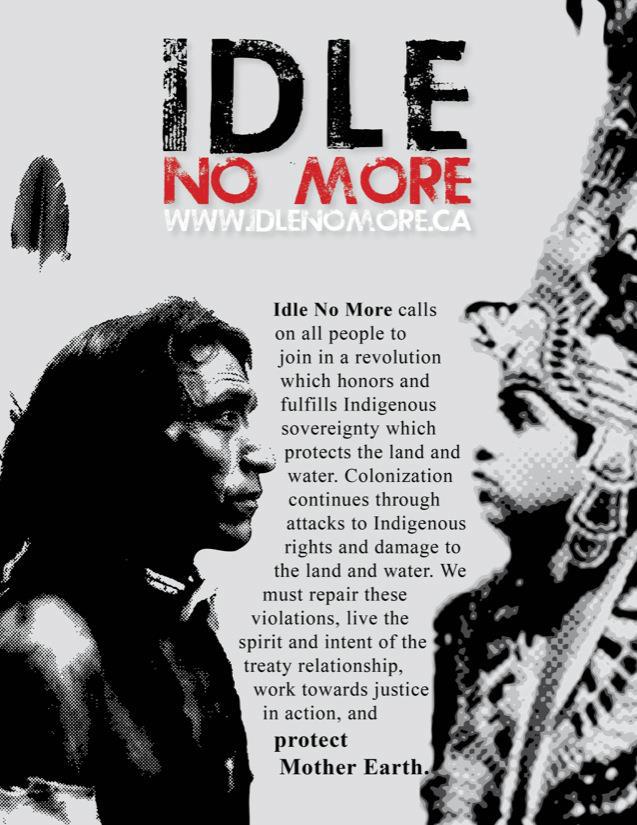 Taken together, they are seen as part of a larger agenda on behalf of the Harper government to run rough-shod over environmental and First Nation interests, to ignore the harm caused by the implementation of one or many economic projects, and to streamline the legal process to make it easier for them to push their projects through. On top of that, they seek to redress hundreds of years of abuse, neglect and genocide that remain a stumbling block to a healthy relationship between the Canadian government and its First Nation people, and an embarrassment to the world.
 To many, this is a hard-won victory, even though the greatest battles may be yet to come. And as far as I am concerned, it is demonstration of what social media and the internet can do when used for positive political change. Much like the Arab Spring, the Wisconsin Protests, and the 2008 and 2012 elections, having the means to connect with people far and wide and share in a common goal, all the while circumventing traditional media and official procedures, may mean the difference between victory and defeat.
 Source: CBC.ca, Huffington Post.ca, Facebook, idlenomore.ca



 Stories by Williams