The Future is Here: The Airport Virtual Assistant

You ever walk into a Walmart, look at the greeter and think to yourself, “I bet a hologram could do that guy’s job.” Yeah, I’m guessing probably not, huh? But in all seriousness, these individuals and other members of the service industry may find themselves being declared redundant pretty soon. Thanks to the introduction of the AVA (Airport Virtual Assistant) by airportONE, the job of being the happy, smiling face that people see when they arrive and leave and get their helpful info from may soon be filled by a virtual lady. That’s right, holograms are taking our jobs!

Already, the technology has been installed in three major New York City Airports, including La Guardia, Newark, and JFK. Washington Dulles and Boston Logan are following suit, and expect to have theirs up and running soon. At present, the capabilities of the AVA are limited to reciting a 90 second loop of general airport information to anyone looking for guidance. However, airportONE is looking to expand on that by adding voice-recognition software and a fully interactive program which can answer people’s questions. They also plan to make future versions multilingual so that they can assist international travelers.

According to the company’s own promotional material, which isn’t creepy at all, the benefits of this technology are obvious:

“She works 24 hours a day, seven days a week and doesn’t charge for overtime. She never gets sick and doesn’t require a background check.”

Isn’t that exactly what Mr. Dyson, the guy who built Skynet, said in Terminator 2? Anyone remember how that out? And according to airportONE, plans are underway to create new and different models that can be used in hospitals, business offices, stores and museums. Very soon, the entire service industry could be outsourced once more… to a land of microchips and directed photons.

So far, reaction to the AVA has been a bit mixed. But I can imagine what the folks at South Park have to say about this act of technological outsourcing!

The Future is Here: Hoverbike for Sale!

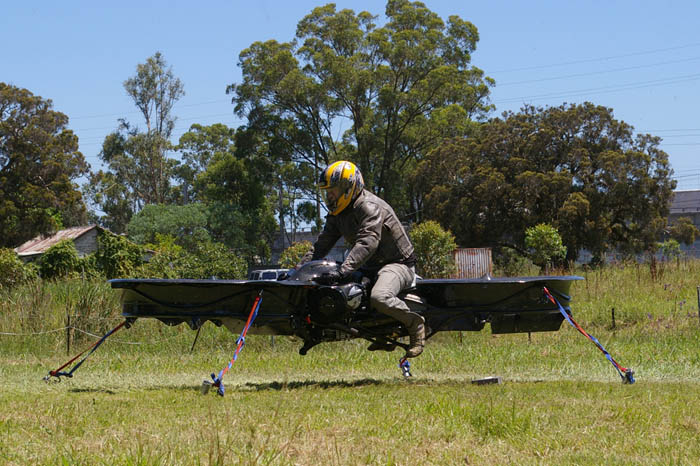
Boy, I’m behind the times here! But that’s what you get when you go away for two weeks and don’t keep up with the latest in trade and tech news. According to Next Big Future, a prototype hoverbike is now available for purchase. Apparently, inventor Chris Malloy, who built the prototype last June, is now offering to custom build one for anyone willing to cough up $84,500 US (or $80,000 Australian).

Powered by ducted fans, mounted at the front and rear, the bike is like something out of Star Wars, except that the science is perfectly sound ;). So far, Malloy has conducted tests with the bike tethered to the ground, which demonstrates that it is capable of hovering just fine. However, he is still working out the kinks when it comes to riding freely.

This is especially true when it comes to turning and rolling, which any biker will tell you is when stability counts for everything. Initially, Malloy was hoping to let the driver turn the vehicle simply by leaning this way and that. However, he soon abandoned that idea in favor of a computerized control system that would ensure stability. This, he has yet to finish, but he’s hopeful that with the right investment capital, he can make it work.

According to his own website, he is eliciting donations to fund the development of his project through to completion. His requested total is 1.1 million dollars to bring the project to fruition and begin commercial production. When he reaches that goal, he will be giving the prototype away for free. Pretty cool of him huh? I recommend people get their names in now and pledge a few dollars. That prototype is not going to be around for long!

In the meantime, check out this video posted by Malloy himself, where he tests the scale model of the bike to show how the fans work.

The Future is Here: Portable Coilguns

It seems that not only the US Navy is experimenting with electromagentic guns. Personal inventors are doing said same. I present you with the CG-33 Portable Coil Gun, the best EM gun to be presented to the world as of yet. And the funny thing is, it was made by an independent inventor named Jason using simple OTS (off-the-shelf) electronic components. These include a 12V Nickel-metal battery, a series of capacitors and a bolt action loading system.

You might want to study up on mechanical and electrical engineering before attempting to build one of these, but the results are impressive. I wouldn’t be surprised if Jason got a call from Heckler and Koch or some other gun manufacturer in the near future!

The Future is Here: Invisible Tanks!

Swedish-made CV90 with ADAPTIV panels

So far, we’ve heard of stealth fighters, stealth ships, and stealth suits. But what about stealth tanks? Why shouldn’t the mobile armored fighting vehicle be included in this race to make all weapons stealthy? Well its seems BAE (British Aerospace Marconi Electronic) Systems has decided to do just that. Working with the concept of Infra-Red imaging and its use on the modern battlefield, BAE has created the ADAPTIV camoflage system.

Basically, modern military vehicles use IR imaging for a number of purposes, namely target acquisition, night vision, homing and tracking. Ever since the late 80s and early 90s, any vehicle that did not have these capabilities found themselves at a marked disadvantage on the battlefield. After all, if you can see your enemy but they can’t see you, then you can destroy them with impunity!

A prime example of this happened during the Gulf War, where Iraqi armored formations were eviscerated simply they did not have the ability to see in the dark. While they moved about blind, US Abrams tanks simply targeted the enemy using their night vision and began picking them off one by one.

However, with every advanced army in the world employing IR technology, the pendulum has once again swung to defense. With all armies able to see an enemy vehicle’s thermal signature, any vehicle that has a way to hide it will now have the edge. That is the principle of ADAPTIV, which combines the idea of Infra-red concealment with the larger concept of adaptive camouflage.

Essentially, this consists of sheets of hexagonal panels that act as pixels when attached to the exterior of the vehicle. These pixels can individually change temperature very rapidly and combine to display an infrared image of the background scenery captured from cameras on board the vehicle, allowing even a moving tank to match its surroundings. BAE has also put together a library of images to display the heat signature of other vehicles, such as cars, trucks, and natural objects, such as large rocks.

Pretty cool huh? Already the technology has been proposed as being adaptable to more than just land vehicles. It can also be added to helicopters, surface ships, for commercial use, and can even send friendly identification signals. Check out the BAE promotional video below for a demonstration.

The Future is Here: Rail Guns!

Naval Surface Warfare Center test, January 2008

Officially, it’s known as an electrically-powered artillery gun, a system that uses high-powered magnets and electrical charges to accelerate a conductive projectile to hypersonic speeds. The projectile runs along a set of magnetic rails and is then hurled at targets at a velocity of 2.4 kilometres per second (or 5,400 mph).

For years, the US Navy and other national militaries have been experimenting with the concept. The benefits are obvious, and range from the lack of propellants, to range, to sheer destructive power. Unlike an explosive shell, a railgun projectile can punch through walls of concrete and steel with ease while also ensuring less in the way of collateral damage.

As a concept, the railgun has a solid presence in the field of science fiction. It’s first mention was in the 1897 science fiction novel A Trip to Venus by John Munro. In this story, Munro describes a device known as an “electric gun” which is used to launch spaceships from Earth into orbit. In the 1955 novel Earthlight, Arthur C. Clarke described how an electromagnetically gun was used to defend a fortress from an attacking warship.

Railgun from Halo 4

More modern examples include Robert A. Heinlein’s The Moon is a Harsh Mistress, Snow Crash by Neal Stephenson, Redemption Ark by Alastair Reynolds, the TV series Babylon 5, and the Wing Commander and Halo gaming universes. Here, as in elsewhere, EM guns make an appearance as either railguns, “mass drivers”, or “asteroid guns”.

And let’s not forget movies like Eraser, Demolition Man, and Transformers II (ick!). In these films, the concept was also used, either in the context of a futuristic infantry weapon or as a ship-mounted weapon. However, outside of science fiction and pop culture, the concept was considered purely experimental. As far as developers and civilian administrators were concerned, the technology was too theoretical, too expensive, and too… well, science fiction-y.

But as of the new millennium, the US Navy began conducting actual tests under the name of Project “Velocitas Eradico,” which roughly translated is Latin for Killing Speed. As of January 2008, the Navy began conducting their first true field tests, which involved the firing of conductive projectiles to test their overall velocity.

And then, in February of 2012, the US Navy unleashed the first true railgun, meaning an electromagnetic artillery weapon that actually resembles a deck gun. Video evidence showed the weapon being test fired within a lab and eviscerating a target located on an outside test range. I’ll think you agree, the footage is impressive, but that was the point! With these most recent tests, the Navy hopes that Congress will approve funding for further development.