Just came across this in Scoop.it and Futurist Foresight. Apparently, it’s a 3D printer that an engineering grad student and her peers came up with over at Virginia Tech. The name itself inspires a lot of mental imagery, doesn’t it? Well, its quite simple. You use a computer to generate an image of a 3D image or model. You store the image on a flash drive or data storage device, then you plug it into the printer. Press print, et voila! The printing device constructs the object by placing layer after layer of plastic together until the object is finished.
I had heard of this technology before the video surfaced, in that case it involved a gun maker who would create weapon’s cases using the same technology. And a simple internet seach will show that there are already commercial models available for sale, starting at about 20 grand! However, the concept is quite new and is making waves all over. Just think of the applications, especially if 3D printers can utilize materials other than plastic!
Singularitarian. That’s a good name for someone who embraces the idea of the coming Technological Singularity, which I believe I mentioned somewhere… Yes, these days a lot of high-minded terms get thrown around to describe what may very well be possible somewhere in this century and the next. Extropian, Post-Human, Clinical Immortality, Artificial Intelligence, Cyber Ethics, Transhuman, Mind/Machine Interface, Law of Accelerated Returns, and so forth. It can be kind of confusing to stay up with it since all the lingo is kind of complex and esoteric. Lot of big and obscure words there…
Luckily, Mr. Charlie Kam has decided to explain. Setting the ideas to the tune of “I am the Very Model of a Modern Major General”, he tells how the idea works and what the eventual aim is. Basically, the idea is all about improving the condition of humanity through the ongoing application of technology. By preserving our cells, our memories, lengthening our lives, we will ensure that humanity will live on and achieve more than we previously thought possible.
Since we don’t yet know how to do this, we will achieve the first step by either merging our own minds with technology to enhance our thought processes and expand our awareness. Or, we could just create machinery that could do the job for us (aka. AI). Then, applying this superior intelligence, we will unlock the mysteries of the universe, create nanotech machines, medicines that can cure all diseases, and machinery that can store human memories, senses and impressions for all time.
Some big names got thrown in there too, not the least of which was Ray Kurzweil, noted Futurist. But don’t take my word for it, watch the video. If nothing else, its good for a laugh.
This is a little off the beaten path right now, but lately, I’ve been spending a lot of time contemplating this big concept. In fact, it’s been informing the majority of my writing for the past year, and during my recent trip back to Ottawa, it was just about all my friend and I could talk about (dammit, we used to club!) And since I find myself explaining this concept to people quite often, and enjoying it, I thought I’d dedicate a post to it as well.
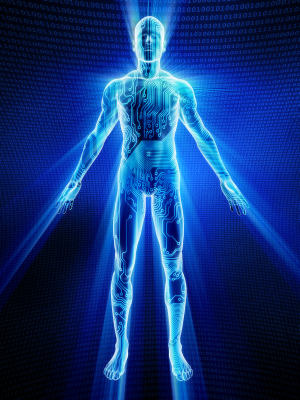
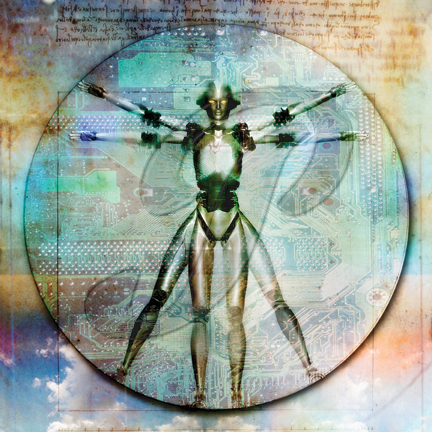
It’s called the Technological Singularity, and was coined in 1993 by sci-fi author Vernor Vinge. To put it concisely, Vinge predicted that at some point in the 21st century, human beings would be able to augment their intelligence using artificial means. This, he argued, would make the future completely unpredictable beyond that point, seeing as how the minds that contemplating the next leaps would be beyond anything we possess now.
The name itself is derived from the concept of the Quantum Singularity or Event Horizon, the region that resides at the center of a black hole beyond which, nothing is visible. In the case of a black hole, the reason you can’t see beyond this point is because the very laws of physics break down and become indistinguishable. The same is being postulated here, that beyond a certain point in our technological evolution, things will get so advanced and radical that we couldn’t possibly imagine what the future will look like.
Bad news for sci-fi writers huh? But strangely, it is this very concept which appears to fascinate them the most! Just because we not be able to accurately predict the future doesn’t stop people from trying, especially writers like Neal Stephenson, Greg Bear, and Charles Stross. Frankly, the concept was coined by a sci-fi writer so we’re gonna damn well continue to talk about it. And besides, when was the last time science fiction writers were bang on about anything? It’s called fiction for a reason.
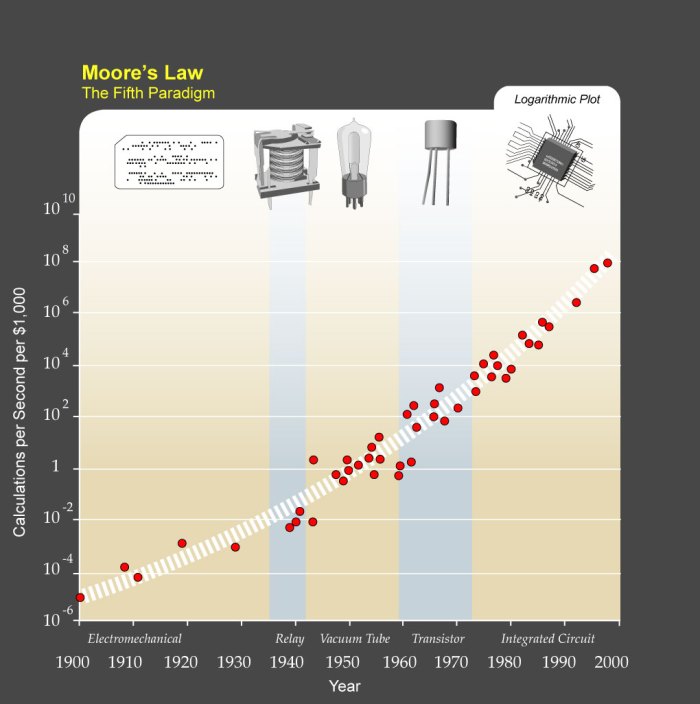
Men like Ray Kurzweil, a futurist who is all about achieving immortality, have popularized this idea greatly. Thanks to people like him, this idea has ventured beyond the realm of pure sci-fi and become a legitimate area of academic study. Relying on ongoing research into the many, many paradigm shifts that have taken place over time, he and others have concluded that technological progress is not a linear phenomena, but an exponential one.
Consider the past few decades. Has it not been a constant complaint that the pace of life and work have been increasing greatly from year to year? Of course, and the driving force has been constant technological change. Whereas people in our parents generation grew up learning to use slide rules and hand-cranked ammonia copiers, by the time they hit the workforce, everything was being done with calculators and Xerox printers.
In terms of documents, they used to learn typewriters and the filing system. Then, with the microprocessor revolution, everything was done on computer and electronically. Phones and secretaries gave way to voicemail and faxes, and then changed again with the advent of the internet, pager, cell phone and PDA. Now, all things were digital, people could be reached anywhere, and messages were all handled by central computers.
And that’s just within the last half-century. Expanding the time-frame further, let’s take a much longer view. As a historian, I am often fascinated with the full history of humanity, going back roughly 200,000 years. Back then, higher order primates such as ourselves had emerged in one small pocket of the world (North-Eastern Africa) and began to circulate outwards.
By 50,000 years ago, we had reached full maturity as far as being homo sapiens is concerned, relying on complex tools, social interaction, sewing and hunting and gathering technigues to occupy every corner of the Old World and make it suitable for our purposes. From the far reaches of the North to the Tropics in the South, humanity showed that it could live anywhere in the world thanks to its ingenuity and ability to adapt. By 15,000 years ago, we had expanded to occupy the New World as well, had hunted countless species to extinction, and began the process of switching over to agriculture.
By 5000 years ago, civilization as we know it was emerging independently in three corners of the world. By this, I mean permanent settlements that were based in part or in full on the cultivation of crops and domestication of animals. Then, 500 years ago, the world’s collided when the Spanish landed in the New World and opened up the “Age of Imperialism”. Because of the discovery of the New World, Europe shot ahead of its peer civilizations in Africa, Asia and the Middle East, went on to colonize every corner of the world, and began to experience some major political shifts at home and abroad. The “Age of Imperialism” gradually gave way to the “Age of Revolutions”.
100 years ago, the total population of the Earth reached 1 billion, industrialization had taken full effect in every developed nation and urban populations were now exceeding that of rural. 50 years ago, we had reached 3 billion human beings, were splitting the atom, sending rockets into space, and watching the world decolonize itself. And only 10 years ago, we had reached a whopping 6 billion human beings, were in the throws of yet another technological revolution (the digital) and were contemplating nanotechnology, biomedicine and even AI.
In short, since our inception, the trend has been moving ever upwards, faster and faster. With every change, the pace seems to increase exponentially. The amount of time between paradigm shifts – that is, between revolutionary changes that alter the way we look at the world – has been getting smaller and smaller. Given this pattern, it seems like only a matter of time before the line on the graph rises infinitely and we have to rethink the whole concept of progress.
Is your nooble baked yet? Mine sure is! It’s get like that any time I start contemplating the distant past and the not too distant future. These are exciting times, and even if you think that the coming Singularity might spell doom, you gotta admit, this is an exciting time to be alive. If nothing else, its always a source of intrigue to know that you are on the cutting edge of history, that some day, people will be talking about what was and you will be able to say “I was there”.
Whoo… deep stuff man. And like I said, fun to write about. Ever since I was a senior in high school, I dreamed of being able to write a book that could capture the Zeitgeist. As soon as I learned about the Technological Singularity, I felt I had found my subject matter. If I could write just one book that captures the essence of history at this point in our technological (and possibly biological) evolution, I think I’ll die a happy man. Because for me, it’s not enough to just have been there. I want to have been there and said something worthwhile about it.
Alright, thanks for listening! Stay tuned for more lighter subject matter and some updates on the latest from Story Time and Data Miners. Plus more on Star Wars, coming soon!




 Stories by Williams