
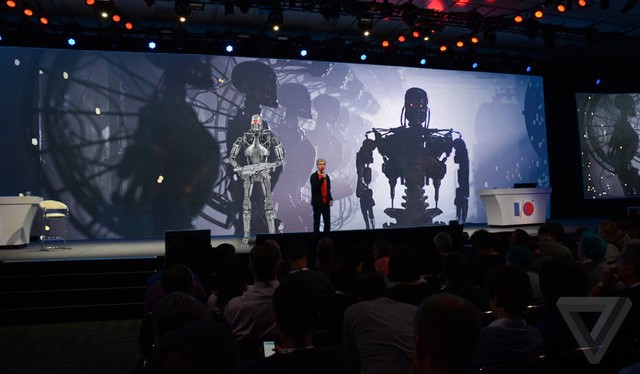
 We’ve all thought about it… the day when super-intelligent computer becomes self-aware and unleashes a nuclear holocaust, followed shortly thereafter by the rise of the machines (cue theme from Terminator). But as it turns out, when the robot army does come to exterminate humanity, at two humans might be safe – Google co-founders Larry Page and Sergey Brin to be precise.
Basically, they’ve uploaded a killer-robots.txt file to their servers that instructs T-800 and T-1000 Terminators to spare the company’s co-founders (or “disallow” their deaths). Such was the subject of a totally tongue-in-cheek presentation at this year’s Google I/O at the Moscone Center in San Fransisco, which coincided with the 20th anniversary of the Robots.txt file.
 This tool, which was created in 1994, instructs search engines and other automated bots to avoid crawling certain pages or directories of a website. The industry has done a remarkable job staying true to the simple text file in the two decades since; Google, Bing, and Yahoo still obey its directives. The changes they uploaded read like this, just in case you’re planning on adding your name to the “disallow” list:

While that tool didn’t exactly take the rise of the machines into account, it’s appearance on the Google’s website as an Easter egg did add some levity to a company that is already being accused of facilitating in the creation of killer robots. Calling Google’s proposed line or robots “killer” does seem both premature and extreme, that did not stop a protester from interrupting the I/O 2014 keynote address.
 Basically, as Google’s senior VP of technical infrastructure Urs Hölze spoke about their cloud platform, the unidentified man stood up and began screaming “You all work for a totalitarian company that builds machines that kill people!” As you can see from the video below, Hölze did his best to take the interruptions in stride and continued with the presentation. The protestor was later escorted out by security.
This wasn’t the first time that Google has been the source of controversy over the prospect of building “killer robots”. Ever since Google acquired Boston Dynamics and seven other robots companies in the space of six months (between and June and Dec of 2013), there has been some fear that the company has a killer machine in the works that it will attempt to sell to the armed forces.
 Naturally, this is all part of a general sense of anxiety that surrounds developments being made across multiple fields. Whereas some concerns have crystallized into dedicated and intelligent calls for banning autonomous killer machines in advance – aka. the Campaign To Stop Killer Robots – others have resulted in the kinds of irrational outbreaks observed at this year’s I/O.
Needless to say, if Google does begin developing killer robots, or just starts militarizing its line of Boston Dynamics acquisitions, we can expect that just about everyone who can access (or hack their way into) the Robots.txt file to be adding their names. And it might not be too soon to update the list to include the T-X, Replicants, and any other killer robots we can think of!
And be sure to check out the video of the “killer robot” protester speaking out at 2014 I/O:
Sources: theverge.com, (2)

 You can use household materials to build one, and a rubber band to hold your smartphone in place on the front of the device. Assembly instructions, plans and links for where to source the needed parts (like lenses) — as well as an SDK — are available on the project’s website. Google hopes that by making the tech inexpensive (unlike offerings from, say, Oculus), developers will be able to make VR apps that hit a wider audience.
 Meanwhile, Google has created some great demos within the Cardboard app, showcasing the kind of experiences people can expect moving forward. Right now, the Cardboard app features simple demonstrations: Google Earth, Street View, Windy Day, and more. But it’s just a small taste of what’s possible. And anyone willing to put some time into putting together their own cardboard headset can get involved. Never before has virtual reality been so accessible, or cheap.
 As Google said a related press release: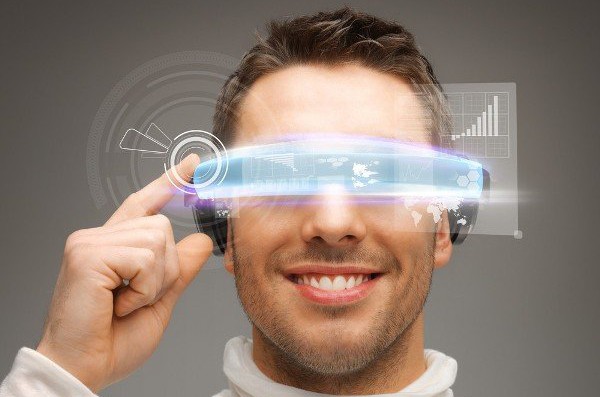

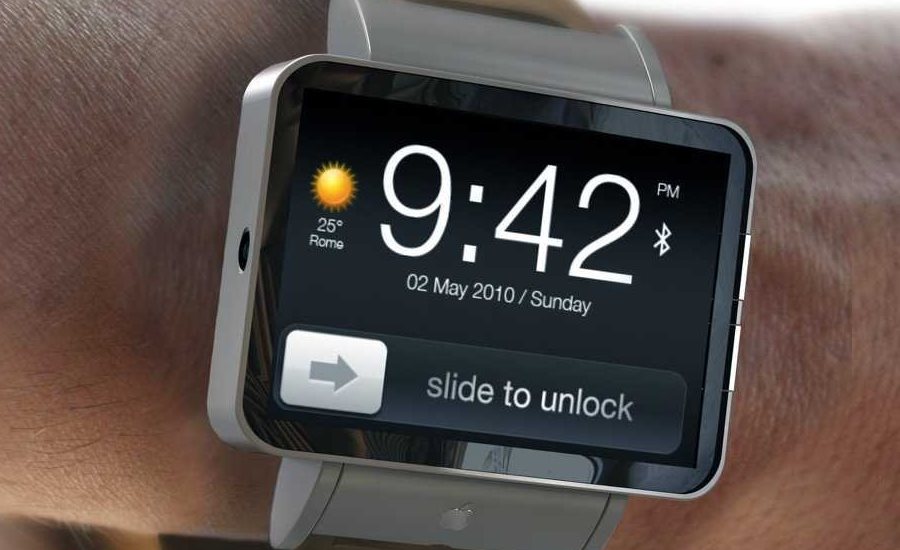

 Android Wear takes much of the functionality of Google Now – an intelligent personal assistant – and uses the smartwatch as a home for receiving notifications and context-based information. For the sake of travel, Android Wear will push relevant flight, weather and other information directly to the watch, where the user can tap and swipe their way through it and use embedded prompts and voice control to take further actions, like dictating a note with reminders to pack rain gear.
 Google officials also claimed at I/O that the same interface being Android Wear will be behind their new Android Auto and TV, two other integrated services that allow users to interface with their car and television via a mobile device. So don’t be surprised if you see someone unlocking or starting their car by talking into their watch in the near future. The first Android Wear watches – the Samsung Gear Live and the LG G Watch – are available to pre-order and the round-face Motorola Moto 360 is expected to come out later this summer.


 And in addition to building computer brains, Google itself is also in the business of extending human life. This project, called Calico, hopes to slow the process of natural aging, a related though different goal than extending life expectancy with treatment for disease. Though of course, the term “immortality” is perhaps a bit of misnomer, hence why it is amended with the word “clinical”. While the natural effects of aging are something that can be addressed, there will still be countless ways to die.
 Stories by Williams