Visualizing the Internet

Submarine fiber optic cables around the worldOrdinarily, when one talks about visualizing cyberspace, they think of massive neon-structures or cityscapes made up of cascading symbols of data. While these images – the creation of writers like William Gibson and film makers like the Waschowski Brothers – are certainly visually appealing, they are not exactly realistic, and hardly do the real thing justice.

Thankfully, a recent article over at policymic has presented us with a new and interesting way of visualizing this thing we call the World Wide Web. By compiling images of the various deep-sea cables that allow us to transmit information at the speed of light, author Laura Dimon reminds us that while the internet may be made up of trillions of bits of data moving about at any given moment, it is dependent upon real-world physical connections.

Submarine Cable Map 2012And these connections are extensive, with more than 550,000 fiber optic cables running along the ocean floor that are responsible for transmitting trillions upon trillions of interactions per day. According to the Washington Postthese cables “wrap around the globe to deliver emails, web pages, other electronic communications and phone calls from one continent to another.”

But surprisingly, few people seem to truly appreciate this. In an age of WiFi where more and more networks are being added to our public airwaves every day, the perception that all this information is something ethereal seems to have become rooted. Luckily, real-world events – such as the severing of several Seacom cables off the coast of Alexandria back in March – have managed to remind people just how grounded and potentially vulnerable the internet is.

Global Internet Map 2012Given our immense and increasing reliance on the internet for business, personal communications, entertainment and shopping, one would that we as a people would possess at least a passing knowledge of how it works. But as Eric Schmidt, Google’s executive chair, claimed in his book The New Digital Age: “The internet is among the few things humans have built that they don’t truly understand.”

Luckily, Laura provides a breakdown in her article which is a good start:

It consists of tens of thousands of interconnected networks run by service providers, individual companies, universities, and governments. There are three major parts to its construction: the networks that physically connect to each other (with about 12 that are particularly significant); the data-storing centers; and the architecture that lies in between. That is where it gets really interesting.

Global Internet Map 2011And just in case this doesn’t provide a clear picture, there are numerous images that have been created by organizations like Telecom Maps and The Fiber Optic Association. These show just how immense, extensive, and crisscrossed the cables that bring us all our emails, videos, blog feeds, and ability to surf are.

In addition, they also remind us that the historic gap between the developed and underdeveloped world persists into the information age. For every network of cables, there are cable landing stations that connect the deep sea lines to the continent they are servicing. As the maps show, Europe has more international network capacity than any other world region.

Global Voice Traffic Map 2010

They also remind us that the once undisputed technological supremacy of the United States has been slowly eroding as humanity enters the 21st Century. This has been especially apparent within the last decade, where localized service providers have eschewed the US as a central hub and begun to connect their networks to other countries and regions.

Fascinating, and educational. I hope someday to be able to use these sorts of visualizations in the classroom, as a means of letting students know what enables all their surfing habits. I imagine most of them will be surfing on their smartphones as I speak!

Sources: policymic.com, telegeography.com, thefoa.org

Winning Ideas: The Bodyheat Powered Flashlight!
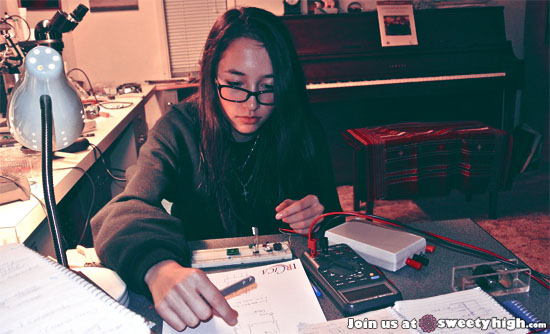
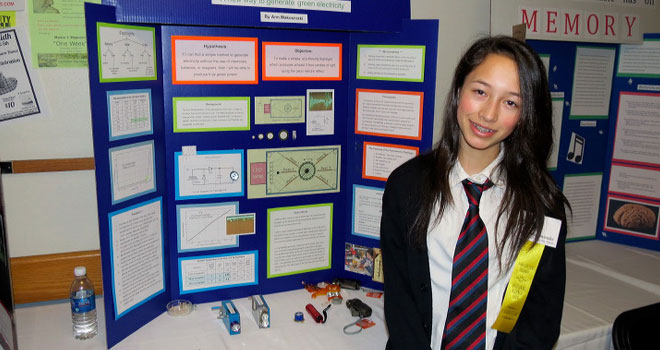
body_heat_flashlightEvery year, IT giant Google holds an online competition open to students aged 13-18 from around the globe to come up with new and challenging scientific ideas. And this year, one the winners just happens to hail from my hometown of Victoria, British Columbia. Her name is Ann Makosinki, a 15 year old high school student who invented a way to power a flashlight using only the warmth of your hand.

She claimed a trophy made of Lego for the 15-16 age category at an awards gala that was held on Monday, Sept. 23rd. Her prizes were a $25,000 scholarship and a “once-in-a-lifetime experience” from either CERN (the European Organization for Nuclear Research), LEGO or Google. Quite the impressive accomplishment for a 11th grader, but then again, Makosinki has been a scientist at heart ever since she was a little kid.

google-science-fair-winners-2013For starters, when other children were playing with toy cars and dolls, she busied herself with transistors and microcircuits. What’s more, by Grade 6, she began submitting projects to science fairs and began showing an interest in alternative energy. Still, Makosinki was surprised to be getting an award, given her competition. As she said:

I’m in shock, I’m in shock. It’s actually kind of embarrassing because I didn’t even change [before the awards ceremony]. I didn’t even comb my hair or anything. I must have looked like an absolute mess on stage because I didn’t expect to go up at all.

As for the invention itself, it is easy to see why she won. Basically, it is an LED flashlight that relies on the thermoelectric effect to generate electricity when held. This is done through a series of devices that are known as Peltier tiles, which produce electricity when heated on one side and cooled on the other. The tiles are fixed to the outside of the flashlight while the tube itself is hollow.

peltier-figure-9When held one side of the Peltier tiles are heated by the warmth of the person’s hand, air flowing through the hollow tube helps keep the other side cool. This combination of body heat and air cooling allows enough power to be generated to maintain a steady beam of light for 20 minutes. And all without the need for batteries and the resulting ewaste when they go dead.

Makosinki came up with the idea while researching different forms of alternative energy a few years ago. Already, she had experimented with Peltier tiles for her Grade 7 science fair project. While researching her project, she thought of them again as a way to potentially capture the thermal energy produced by the human body. After doing some calculations, she found that the amount of energy produced by a person’s hand was theoretically sufficient to power an LED light.

ann_makosinksiHowever, putting it into practice proved somewhat more difficult. After buying some Peltier tiles on eBay, she tested them and found that while they generated more than enough power, the voltage produced was only a fraction of what she needed. She rectified this problem after doing some further research, where she discovered that the addition of transformers could be used to boost the voltage.

She spent months doing research on the internet, experimenting with different circuits and even building her own transformers, which still didn’t provide enough voltage. In the end, she came across an article on the web about energy harvesting that suggested an affordable circuit that would provide the voltage she needed when used with a recommended transformer. Finally, the circuit worked.

ann_makosinksi1Makosinski admitted there were points in the experiment when she thought it would never work. But as she said:

You just kind of have to keep going. This took quite awhile ’cause I had to do it during the school year as well and I had homework, plays, whatever that I was also doing.

After making it to the Google Science Fair, she and her colleagues spent the day presenting at Google’s headquarters in Mountain View, California. Here, the 15 judges – which included scientists from a variety of fields, science journalists, an astronaut, and a former Google Science Fair winner – witnessed their creations and tried to determine which held the most promise.

The other winners included Viney Kumar, an Australia student who captured the 13-14 age category for an Android app that warns drivers of an approaching emergency vehicle more than a minute in advance, in order to help clear a path for it. And then there was Elif Bilgin of Turkey, a 16-year old who took home the Scientific American Science in Action Prize and the Voter’s Choice Award for inventing a way to make plastic from banana peels.

Ann-Makosinski-Google-Science-Fair-2The Grand Prize for the 17-18 age category went to Eric Chen, a 17 year old student from San Diego who is researching a new kind of anti-flu medicine using a combination of computer modelling and biological studies. He received the top prize of a $50,000 scholarship and a 10-day trip to the Galapagos Islands.

Alas, Makosinki felt the best part of the competition was getting to meet the other finalists in person at last.

It’s just so inspiring to see other people who are kind of like me and kind of want to make a difference in the community not just by talking about it but by actually doing stuff.

What’s next for the young inventor? Personally, I hope Makosinki and her fellow prize winners will be forming their own research group and looking for new and exciting ways to come up with renewable energy, recycling, vaccinations, and electronics. What do you think Makonsinky, Kumar, Bilgin, Chen? That’s what Andraka and his fellow finalists did after winning ISEF 2012, and they seem to be doing pretty good. So… hintedy, hint hint!

And be sure to enjoy this video of Ann Makosinki showing off her invention, courtesy of Technexo:


Sources:
cbc.ca, (2), gizmag.com, technexo.com, huffingtonpost.ca

A Kinder, Gentler Internet: Youtube Algorithm Screens Comments

youtube_commentsThere’s scarcely a soul among us who hasn’t watched a video on YouTube. But have you ever stuck around long enough to read the comments section? It’s like a leper colony for the mind, a vindication for misanthropes everywhere. And after many years of being at the forefront of rudeness, racism, and generalized dumbassery, the YouTube comment section is getting a clean up.

Whereas the old system worked by placing the latest comments at the top nearest the video, regardless of their relevance or lack of redeeming content. The new system will employ a series of algorithms to determine what each viewer will find most relevant. This includes comments from your friends, from the video creator, and from “popular personalities” (i.e. celebs of one type or another).

youtube_convoBut it doesn’t stop there. Currently, since comments are displayed as they come in, making the act of following a conversation difficult at best. But from now on, the site will feature threaded conversations, which is consistent with Google policy, the site’s now owners. As for private conversations, the new platform will be powered by Google+, allowing users the option of deciding who they want their posts and videos to be visible to.

Additionally, there will be a sort of cross-posting between YouTube and Google+. If you post a YouTube video on Google+ and some one comments on it there, the comment will show up on the video over at YouTube, too. Alternatively, they could choose to have their comment only show up on YouTube, or only show up on Google+. There’s a lot more control.

googleplus-conversation

But perhaps most importantly of all, there are new filters that will be in place. As it stands, YouTube commenters enjoy total anonymity, which allows them to post racist, sexist, homophobic and vitriolic comments without fear. And while content creators can choose to allow all or no comments, or manually approve each comment, this is completely impractical for videos that garner millions of views a week.

But now, YouTube is introducing filters that will make it easier. The new filters basically allow content creators to not only be able to assign people to an Approved list or a Blocked list (which will auto-approve or auto-reject comments, respectively), they will be able to add keywords to a Blacklist. This will flag comments that contain those words and send them into a special list which can be reviewed and approved/rejected later.

ConversationPrism_2880x1800The threaded comments feature and began to be put into effect a little over a week ago. Filters were made available at the same time for channel pages only, but in the months to come they’ll become available for every individual video, giving content creators and commenters more control over the conversations they participate in. Basically, it will still be YouTube, but with some Facebook-like privacy and content filters.

And while many might deplore these new rules as an example of heavy handed “internet censorship”, there are many more who believe this change is overdue in coming. And given that the control rests with the users, who have the ability to share or be private, and to filter specific kinds of content, the basic spirit of a democratic, open forum remains.

Source: gizmodo.com

The Future is Here: Lab-Grown Burger Gets a Taste Test

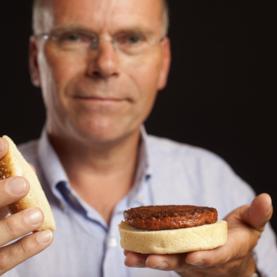
labmeat0Yesterday, the world’s first lab-grown hamburger was cooked, served, and eaten. And according to an article from The Week, it passed the taste test. The taste test took place in London, where Mark Post, the man who had grown the patty in his lab at Maastricht University in the Netherlands, allowed two independent tasters to sample one of his hamburger patties.

The samplers were food writer and journalist Josh Schonwald and Austrian food trends researcher Hanni Rützler. After biting into a piece of the cooked meat in front of reporters, Schonwald claimed that “It had a familiar mouthfeel. [The difference] is the absence of fat.” Naturally, both tasters were careful not to comment on whether the burger was “good” or not, as any such judgements might seem premature and could hurt its chances for sales at this point.

lab-grown-burgerThis lab-grown patty took two years and $325,000 to produce. And as sources revealed, the money came from Google co-founder and TED speaker Sergey Brin. Worth an estimated $20 billion, Brin has a history of investing in cooky projects – everything from driverless cars to trips to the moon. And as he told The Guardian, he was moved to invest in the technology for animal welfare reasons and believes it has “the capability to transform how we view the world”.

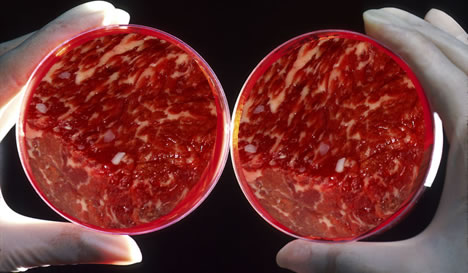
lab-grown-burger_postThe hamburger was grown in Post’s lab using bovine skeletal muscle stem cells that were collected from a piece of fresh beef. The cells were grown by “feeding” them calf serum and commercially available growth medium to initiate multiplication and prompt them to develop into muscle cells over time. Once they differentiated into muscle cells, they were given simple nutrient sources and exercised in a bioreactor, helping the muscle to “bulk up.”

The resulting five-ounce burger, cooked by chef Richard McGeown for Schonwald and Rützler, was made using 20,000 strips of cultured meat – about 40 billion cow cells – and took about three months to produce. As Post joked, this is significantly less time than it takes to raise a cow. And while the arrival of in-vitro meat has been predicted and heralded for decades, but now that it’s finally here, people are not sure how to respond.

labmeat1On the one hand, it offers a range of possibilities for producing sustainable, cheap meat that could help meet global needs using only a laboratory. On the other, there’s no telling how long it will be before consumers will be comfortable eating something grown in a petri dish from stem cells. Between the absence of fat and the stigma that is sure to remain in place for some time, getting people to buy “lab-grown” might be difficult.

But then again, the same issues apply to 3D printed food and other forms of synthesized food. Designed and developed as a means of meeting world hunger and future population growth, and with sustainability and nutritional balance in mind, some degree of hesitation and resistance is to be expected. However, attitudes are likely to shift as time goes on and increased demand forces people to rethink the concept of “what’s for dinner”.

And while you’re thinking the issue over, be sure to check out this video of Mark Post speaking about his lab-grown burger at TEDx Haarlem:


Sources:
scientificamerican.com, theweek.co.uk, theguardian.com
, blog.ted.com,

Google CEO Wants Land Set Aside for Experimentation

future-city-1Back in May, Google co-founder and CEO Larry Page hosted a rare Q&A session with the attendees of the Google I/O keynote speech. During this time, he gave some rather unfiltered and unabashed answers to some serious questions, one of which was how he and others should focus on reducing negativity and focusing on changing the world.

Page responded by saying that “the pace of change is increasing” and that “we haven’t adapted systems to deal with that.” He was also sure to point out that “not all change is good” and said that we need to build “mechanisms to allow experimentation.” Towards that end, he claimed that an area of the world should be set aside for unregulated scientific experimentation. His exact words were:

There are many exciting things you could do that are illegal or not allowed by regulation. And that’s good, we don’t want to change the world. But maybe we can set aside a part of the world… some safe places where we can try things and not have to deploy to the entire world.

So basically he’s looking for a large chunk of real-estate to conduct beta tests in it. What could possibly go wrong?

detroit_experimentOne rather creative suggestion comes from Roy Klabin of PolicyMic, who suggest that an aging and dilapidated Detroit might be just the locale Page and his associates are looking for. This past week, the city declared bankruptcy, and began offering to sell city assets and eradicate retirement funds to meet its $18 billion debt obligations.

What’s more, he suggests that SpaceX founder Elon Musk, who’s always after innovation, should team up with Google. Between the two giants, there’s more than enough investment capital to pull Detroit out of debt and work to rehabilitate the city’s economy. Hell, with a little work, the city could be transformed back into the industrial hub it once was.

And due to a mass exodus of industry and working people from the city, there is no shortage of space. Already the city is considering converting segments of former urban sprawl into farming and agricultural land. But looking farther afield, Klabin sees no reason why these space couldn’t be made available for advanced construction projects involving arcologies and other sustainable-living structures.

dragonfly-vertical-farm-for-a-future-new-york-1Not a bad idea, really. With cities like Boston, New York, Las Vegas, New Orleans, Moscow, Chendu, Tokyo and Masdar City all proposing or even working towards the creation of arcologies, there’s no reason why the former Industrial Heartland – now known as the “Rust Belt” – shouldn’t be getting in on the action.

Naturally, there are some who would express fear over the idea, not to mention Page’s blunt choice of words. But Page did stress the need for positive change, not aimless experimentation. And future generations will need housing and food, and to be able to provide these things in a way that doesn’t burden their environment the way urban sprawl does. Might as well get a jump on things!

And thanks to what some are calling the “New Industrial Revolution” – a trend that embraces nanofabrication, self-assembling DNA structures, cybernetics, and 3D printing – opportunities exist to rebuild our global economy in a way that is cleaner, more efficient and more sustainable. Anyone with space to offer and an open mind can get in on the ground floor. The only question is, what are they willing to give up?

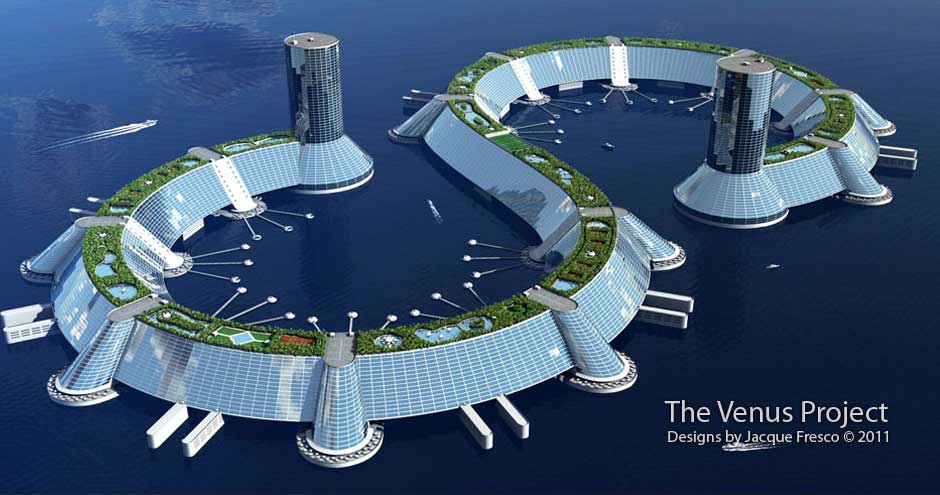
venus_projectThere’s also a precedent here for what is being proposed. The famous American architect and designer Jacque Fresco has been advocating something similar for decades. Believing that society needs to reshape the way it lives, works, and produces, he created the Venus Project – a series of designs for a future living space that would incorporate new technologies, smarter materials and building methods, and alternative forms of energy.

And then there’s the kind of work being proposed by designer Mitchell Joachim and Terreform ONE (Open Network Ecology). And amongst their many proposed design concepts is one where cities use vertical towers filled with energy-creating algae (pictured below) to generate power. But even more ambitious is their plan to “urbaneer” Brooklyn’s Navy Yard by turning natural ecological tissues into viable buildings.

future-city2This concept also calls to mind Arconsanti, the brainchild of architect Paolo Solari, who invented the concept of arcology. His proposed future city began construction back in the 1970 in central Arizona, but remains incomplete. Designed to incorporate such things as 3D architecture, vertical farming, and clean, renewable energy, this unfinished city still stands as the blueprint for Solari’s vision of a future where architecture and ecology could be combined.

What’s more, this kind of innovation and development will come in mighty handy when it comes to time to build colonies on the Moon and Mars. Already, numerous Earth cities and settlements are being considered as possible blueprints for extra-Terran settlement – places like Las Vegas, Dubai, Arviat, Black Rock City and the Pueblos and pre-Columbian New Mexico.

Black Rock City - home to "Burning Man" - shown in a Martian crater
Black Rock City – home to “Burning Man” – shown in a Martian crater

These are all prime examples of cities built to withstand dry, inhospitable environments. As such, sustainability and resource management play a major role in each of their designs. But given the pace at which technology is advancing and the opportunities it presents for high-tech living that is also environmentally friendly, some test models will need to be made.

And building them would also provide an opportunity to test out some of the latest proposed construction methods, one that do away with the brutally inefficient building process and replace it with things like drones, constructive bacteria, additive manufacturing, and advanced computer modelling. At some point, a large-scale project to see how these methods work together will be in order.

Let’s just hope Page’s ideas for a beta-testing settlement doesn’t turn into a modern day Laputa!

And be sure to check out this video from the Venus Project, where Jacque Fresco explains his inspirations and ideas for a future settlement:


Sources:
1.
Elon Musk and Google Should Purchase and Transform a Bankrupt Detroit (http://www.policymic.com/)
2. Larry Page wants to ‘set aside a part of the world’ for unregulated experimentation (theverge.com)

3. Six Earth Cities That Will Provide Blueprints for Martian Settlements (io9.com)
4. The Venus Project (thevenusproject.org)
5. Arcosanti Website (arcosanti.org)
6. Terreform ONE website (terreform.org)

Incredible Astrophoto: Yuga Kurita’s “Galactic Volcano”

mt-fuji

I came across this stunning photo lately and just had to share it. The man who took it is none other than inspired photographer Yuga Kurita, who snapped a shot of Mt. Fuji at night to create a truly stunning image that makes the iconic Mt. Fuji appear like a galactic volcano. This effect is due largely to the heavens obliging him on a clear night, but also thanks to thousands of people climbing the mountain’s slopes.

Apparently, this is something of a pilgrimage in Japan, where people take their flashlights and climb the mountain at night in order to get a clear look from the peak of the volcano at the sun rising on the following day. Over at his account on Google+, he explains his inspiration to get a snapshot of the mountain at night:

When I arrived at Fujiyoshida in Yamanashi Prefecture, I saw people climbing up Mt. Fuji with flash lights and I thought they looked like lava streams. Then I came up with this composition, since nowadays, the Milky Way appears vertically in the sky so probably I could liken Mt. Fuji to an imaginary galactic volcano, that is, people climbing up with torches are lava streams and the Milky Way is the volcano smoke.

After deciding to get a picture of the “stellar” site, Kurita checked out several maps and then spent an entire day driving and hiking around the base of the mountain in order to get the most pristine shot. And as you can see, it worked out quite well! Between the vertical arm of the Milky Way and the lights leading up the mountainside, it looks like stars are escaping out of the mountain’s mouth and stellar flames are trickling over the edge. Truly cosmic!

To see more of Kurita’s work, click on this link here, or head on over to Google+ and simply type in his name.

Sources: plus.google.com, universetoday.com

Cyberwars: Massive Government Surveillance Uncovered!

wire_tappingOn Friday, Washington DC found itself embroiled in controversy as revelations were made about the extent to which US authorities have been spying on Americans in the last six years. This news came on the heels of the announcement that the federal government had been secretly cataloging all of Verizon’s phone records. No sooner had the dust settled on that revelation that it became known that the scope of the Obama administration’s surveillance programs was far greater than anyone had imagined.

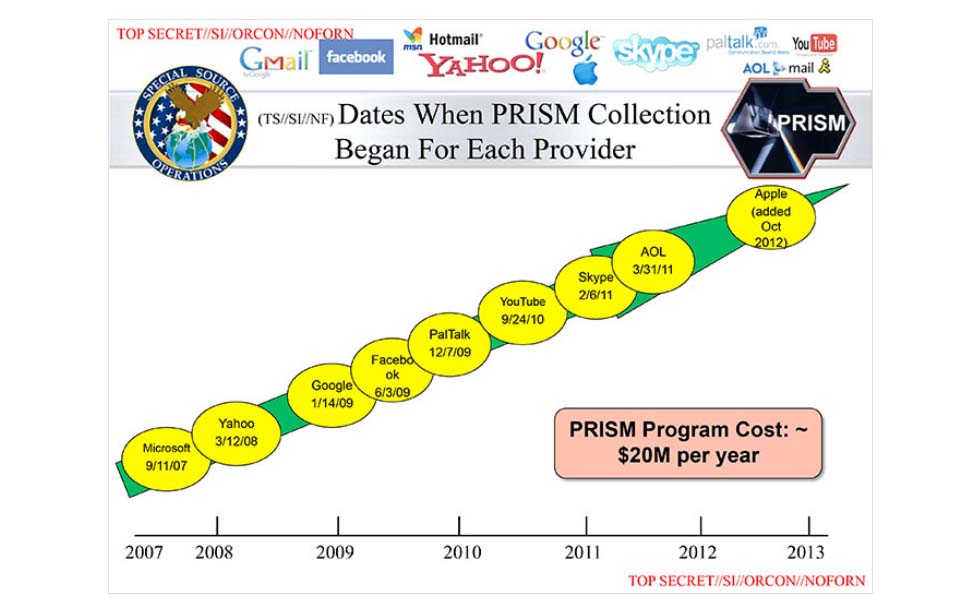
According to updated information on the matter, it is now known that The National Security Agency (NSA) and the FBI have been tapping directly into the central servers of nine leading U.S. Internet companies, extracting everything from audio and video chats, photographs, e-mails, documents, and connection logs that would enable their analysts to track foreign targets.

prism3This information was revealed thanks to a secret document that was leaked to the Washington Post, which shows for the first time that under the Obama administration, the communication records of millions of US citizens are being collected indiscriminately and in bulk – regardless of whether they are suspected of any wrongdoing. Equally distressing is the names being named: U.S. Service Providers such as Microsoft, Yahoo, Google, Facebook, PalTalk, AOL, Skype, YouTube, Apple.

The document further indicates that all of this has been taking place since 2007, when news disclosures, lawsuits and the Foreign Intelligence Surveillance Court forced then-president George W. Bush to look for new authority to justify his program warrantless domestic surveillance. It’s continuance and expansion under Obama has created a great deal of understandable intrigue, and not only because of promises made that “illegal wiretapping” would not take place under his watch.

prism1The joint FBI-NSA program responsible for mining all the data is known as PRISM, and it may very well be the first of its kind. While the NSA and FBI have a long history of monitoring suspects via phone records and computer activity, and are both accustomed to corporate partnerships that help it divert data traffic or sidestep barriers, such a vast program has never before been possible. In the current information age, there is an immense wealth of information out there, and where better to access all of this than in Silicon Valley?

Not long after the news broke in Washington, London’s Guardian reported that GCHQ, Britain’s equivalent of the NSA, also has been secretly gathering intelligence from the same internet companies through an operation set up by the NSA. According to the same leaked information, PRISM appears to allow the GCHQ to circumvent the formal legal process required in Britain to seek personal material such as emails, photos and videos from an internet company based outside of the country.

prism2But perhaps worst of all is the fact that this process is entirely above board, at least for the companies involved. Back in 2007, Congress passed the Protect America Act, and then in 2008 followed it up with the FISA Amendments Act, both of which immunized private companies that cooperated voluntarily with U.S. intelligence collection against prosecution. And late last year, when critics in Congress sought changes in the FISA Amendments Act, the only lawmakers who knew about PRISM were bound by oaths of office to hold their tongues.

An anticipated, a bi-partisan amalgam of Senators came out to defend the initial reports of phone record monitoring shortly after it was announced. In a rare display of solidarity that cut across party lines, Democrats and Republicans from both the Senate and House came forward to say that the program was justified, only spied on terrorists, and that law-abiding citizens need not worry.

National Security Agency - aerial view
National Security Agency – aerial view

Once again, the argument “if you’ve done nothing wrong, you’ve got nothing to fear” finds itself employed by people who do not want to voice criticisms about a government spying program. Echoes of the Bush administration and McCarthy era all over again. Needless to say, all of this has many people worried, not the least of which are people opposed to government intrusion and the protection of privacy for the past decade.

Ever since it became possible to “mine data”  from numerous online digital sources, there has been fear that corporations or governments might try to ascertain the habits and comings and goings of regular people in order to effectively monitor them. For some time now, this sort of monitoring has been somewhat benign, in the form of anticipating their spending habits and using targeted advertising. But always, the fear that something more sinister and totalitarian might emerge.

government-surveillanceAnd with the “War on Terror”, the Patriot Act, domestic warrantless wiretapping, the legitimization of torture, and a slew of other crimes the Bush administration was indicted in, people all over the world have become convinced that “Big Brother” government is just around the corner, if indeed it is not already here.

The fact that such processes have continued and even expanded under Obama, a man who originally pledged not to engage in such behavior, has made a bad situation worse. In many ways, it demonstrates that fears that he too would succumb to internal pressure were justified. Much as he was won over by the Pentagon and CIA to continue the war in Afghanistan and UAV programs, it seems that the constellation of FBI and NSA specialists advising him on domestic surveillance has managed to sway him here as well.

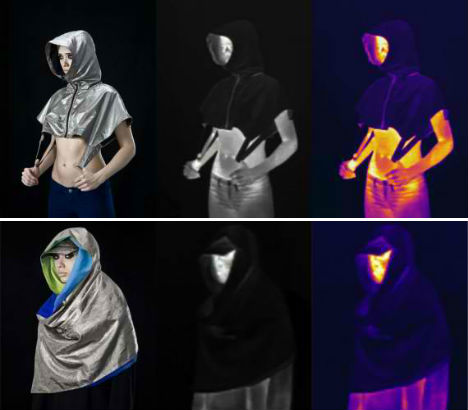
Stealth-Wear1One can only hope that this revelation causes the federal government and the Obama administration to reconsider their stances. After all, these are the same people who were convinced to stand down on the use of UAVs in oversees operations and to take measures that would ensure transparency in the future. We can also hope that the NSA and FBI will be required to once again have to rely on the court system and demonstrate “just cause” before initiating any domestic surveillance in the future.

Otherwise, we might all need to consider getting our hands on some stealth wear and personal cameras, to shield ourselves and create an environment of “sousveillance” so we can spy on everything the government does. Might not hurt to start monitoring the comings and goings of every telecommunications and Silicon Valley CEO while were at it! For as the saying goes, “who watches the watchers?” I’ll give you a hint: we do!

Also, be sure to check out the gallery of artist Adam Harvey, the man who pioneered “stealth wear” as a protest against the use of drones and domestic surveillance. To learn more about sousveillance, the concept of a society monitored by common people, check out Steve Mann’s (inventor of the EyeTap) blog.

Sources: washingtonpost.com, guardian.co.uk, policymic.com, ahprojects.com, eyetap.blogspot.ca


The Future of the Classroom

virtual_learning2As an educator, technological innovation is a subject that comes up quite often. Not only are teachers expected to keep up with trends so they can adapt them into their teaching strategies, classrooms,and prepare children in how to use them, they are also forced to contend with how these trends are changing the very nature of education itself. If there was one thing we were told repeatedly in Teacher’s College, it was that times are changing, and we must change along with them.

And as history has repeatedly taught us, technological integration not only changes the way we do things, but the way we perceive things. As we come to be more and more dependent on digital devices, electronics and wireless communications to give us instant access to a staggering amount of technology, we have to be concerned with how this will effect and even erode traditional means of information transmission. After all, how can reading and lecture series’ be expected to keep kid’s attention when they are accustomed to lighting fast videos, flash media, and games?

envisioning-the-future-of-education

And let’s not forget this seminal infographic, “Envisioning the future of educational technology” by Envisioning Technology. As one of many think tanks dedicated to predicting tech-trends, they are just one of many voices that is predicting that in time, education will no longer require the classroom and perhaps even teachers, because modern communications have made the locale and the leader virtually obsolete.

Pointing to such trends as Massive Open Online Courses, several forecasters foresee a grand transformation in the not too distant future where all learning happens online and in virtual environments. These would be based around “microlearning”, moments where people access the desired information through any number of means (i.e. a google search) and educate themselves without the need for instruction or direction.

virtual_learning3The technical term for this future trend is Socialstructured Learning = an aggregation of microlearning experiences drawn from a rich ecology of content and driven not by grades but by social and intrinsic rewards. This trend may very well be the future, but the foundations of this kind of education lie far in the past. Leading philosophers of education–from Socrates to Plutarch, Rousseau to Dewey–talked about many of these ideals centuries ago. The only difference is that today, we have a host of tools to make their vision reality.

One such tool comes in the form of augmented reality displays, which are becoming more and more common thanks to devices like Google Glass, the EyeTap or the Yelp Monocle. Simply point at a location, and you are able to obtain information you want about various “points of interest”. Imagine then if you could do the same thing, but instead receive historic, artistic, demographic, environmental, architectural, and other kinds of information embedded in the real world?

virtual_learningThis is the reasoning behind projects like HyperCities, a project from USC and UCLA that layers historical information on actual city terrain. As you walk around with your cell phone, you can point to a site and see what it looked like a century ago, who lived there, what the environment was like. The Smithsonian also has a free app called Leafsnap, which allows people to identify specific strains of trees and botany by simply snapping photos of its leaves.

In many respects, it reminds me of the impact these sorts of developments are having on politics and industry as well. Consider how quickly blogging and open source information has been supplanting traditional media – like print news, tv and news radio. Not only are these traditional sources unable to supply up-to-the-minute information compared to Twitter, Facebook, and live video streams, they are subject to censorship and regulations the others are not.

Attractive blonde navigating futuristic interfaceIn terms of industry, programs like Kickstarter and Indiegogo – crowdsources, crowdfunding, and internet-based marketing – are making it possible to sponsor and fund research and development initiatives that would not have been possible a few years ago. Because of this, the traditional gatekeepers, aka. corporate sponsors, are no longer required to dictate the pace and advancement of commercial development.

In short, we are entering into a world that is becoming far more open, democratic, and chaotic. Many people fear that into this environment, someone new will step in to act as “Big Brother”, or the pace of change and the nature of the developments will somehow give certain monolithic entities complete control over our lives. Personally, I think this is an outmoded fear, and that the real threat comes from the chaos that such open control and sourcing could lead to.

Is humanity ready for democratic anarchy – aka. Demarchy (a subject I am semi-obsessed with)? Do we even have the means to behave ourselves in such a free social arrangement? Opinion varies, and history is not the best indication. Not only is it loaded with examples of bad behavior, previous generations didn’t exactly have the same means we currently do. So basically, we’re flying blind… Spooky!

Sources: fastcoexist.com, envisioningtech.com

Big News in Quantum Computing!

^For many years, scientists have looked at the field of quantum machinery as the next big wave in computing. Whereas conventional computing involves sending information via a series of particles (electrons), quantum computing relies on the process of beaming the states of these particles from one location to the next. This process, which occurs faster than the speed of light since no movement takes place, would make computers exponentially faster and more efficient, and lead to an explosion in machine intelligence. And while the technology has yet to be realized, every day brings us one step closer…

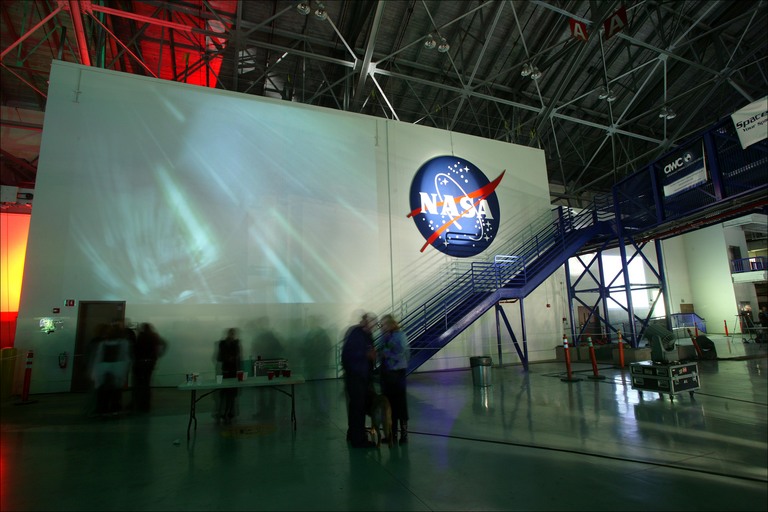
One important step happened earlier this month with the installment of the D-Wave Two over at the Quantum Artificial Intelligence Lab (QAIL) at the Ames Research Center in Silicon Valley, NASA has announced that this is precisely what they intend to pursue. Not surprisingly, the ARC is only the second lab in the world to have a quantum computer.  The only other lab to possess the 512-qubit, cryogenically cooled machine is the defense contractor Lockheed Martin, which upgraded to a D-Wave Two in 2011.

D-Wave’s new 512-qubit Vesuvius chip

And while there are still some who question the categorization of the a D-Wave Two as a true quantum computer, most critics have acquiesced since many of its components function in accordance with the basic principle. And NASA, Google, and the people at the Universities Space Research Association (USRA) even ran some tests to confirm that the quantum computer offered a speed boost over conventional supercomputers — and it passed.

The new lab, which will be situated at NASA’s Advanced Supercomputing Facility at the Ames Research Center, will be operated by NASA, Google, and the USRA. NASA and Google will each get 40% of the system’s computing time, with the remaining 20% being divvied up by the USRA to researchers at various American universities. NASA and Google will primarily use the quantum computer to advance a branch of artificial intelligence called machine learning, which is tasked with developing algorithms that optimize themselves with experience.

nasa-ames-research-center-partyAs for what specific machine learning tasks NASA and Google actually have in mind, we can only guess. But it’s a fair bet that NASA will be interested in optimizing flight paths to other planets, or devising a safer/better/faster landing procedure for the next Mars rover. As for Google, the smart money says they will be using their time to develop complex AI algorithms for their self-driving cars, as well optimizing their search engines, and Google+.

But in the end, its the long-range possibilities that offer the most excitement here. With NASA and Google now firmly in command of a quantum processor, some of best and brightest minds in the world will now be working to forward the field of artificial intelligence, space flight, and high-tech. It will be quite exciting to see what they produce…

photon_laserAnother important step took place back in March, when researchers at Yale University announced that they had developed a new way to change the quantum state of photons, the elementary particles researchers hope to use for quantum memory. This is good news, because it effectively demonstrated that true quantum computing – the kind that utilizes qubits for all of its processes – has continually eluded scientists and researchers in recent years.

To break it down, today’s computers are restricted in that they store information as bits – where each bit holds either a “1″ or a “0.” But a quantum computer is built around qubits (quantum bits) that can store a 1, a 0 or any combination of both at the same time. And while the qubits would make up the equivalent of a processor in a quantum computer, some sort of quantum Random Access Memory (RAM) is also needed.

Photon_follow8Gerhard Kirchmair, one of Yale researchers, explained in a recent interview with Nature magazine that photons are a good choice for this because they can retain a quantum state for a long time over a long distance. But you’ll want to change the quantum information stored in the photons from time to time. What the Yale team has developed is essentially a way to temporarily make the photons used for memory “writeable,” and then switch them back into a more stable state.

To do this, Kirchmair and his associates took advantage of what’s known as a “Kerr medium”, a law that states how certain mediums will refract light in a different ways depending on the amount shined on it. This is different from normal material materials that refract light and any other form of electromagnetic field the same regardless of how much they are exposed to.

Higgs-bosonThus, by exposing photons to a microwave field in a Kerr medium, they were able to manipulate the quantum states of photons, making them the perfect means for quantum memory storage. At the same time, they knew that storing these memory photons in a Kerr medium would prove unstable, so they added a vacuum filled aluminum resonator to act as a coupler. When the resonator is decoupled, the photons are stable. When resonator is coupled, the photons are “writeable”, allowing a user to input information and store it effectively.

This is not the first or only instance of researchers finding ways to toy with the state of photons, but it is currently the most stable and effective. And coupled with other efforts, such as the development of photonic transistors and other such components, or new ways to create photons seemingly out of thin air, we could be just a few years away from the first full and bona fide quantum processor!

Sources: Extremetech.com, Wired.com, Nature.com

Cyberwars: The Credit Card Info Stealing App

theft_creditcard1Want to steal someone’s credit card information? There’s an App for that! Yes, it seems that smartphones are the latest tool in the identity and info thief’s arsenal, just a few years after it was reported that laptops were being used for to read people’s passports. And the worst part of it is, it can be done using a technology that is perfectly legal, and worse, was designed to make the life of consumers that much easier.

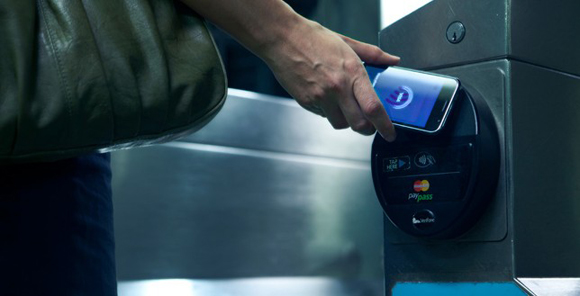
MasterCard calls the App PayPass, while Visa calls it payWave. Simply wave your credit card over a sensor and you’ve made a transaction, without the hassle of having to remember or enter a PIN number. But one of the unintended downsides is that it also makes it that much easier for a third party to steal your credit card information, and just as quickly and conveniently.

theft_creditcard3An investigative report was recently performed by CBC News and Mandy Woodland, a St. John’s lawyer who specializes in technology and privacy law. Using a Samsung Galaxy SIII, one of the most popular on the market today, the team downloaded a free app from the Google Play store to read information such as a card number, expiry date and cardholder name simply holding the smartphone over a debit or credit card.

According to their report, a thief can simply walk by, pause and read the information through an unwitting person’s coat and wallet, and then the information can be sent to another phone. The entire process only takes five minutes to download the App, and just seconds to obtain the credit card info. After conducting the process with a team members credit card, they used the stolen information to buy a coke.

??????????????Naturally, the process could be used to pay for gas, a new computer, or plane tickets to a vacation paradise! And as Woodlands said in an interview with CBC:

It’s always a concern when a stranger could obtain my personal information and my banking and financial information just from a simple walk by, particularly the fact that that worked so quickly.

Furthermore, Michael Legary, who runs a security company called Seccuris Inc., claims they have investigated cases where phones paired with these apps were used to commit credit card fraud. Legary also claims that the app has become a tool for organized crime in Europe:

They don’t even need to talk to you or touch you, they can get information about who you are. That may make you more of a target for certain types of crime.

theft_creditcardBut of course, credit card companies would like their clients not to worry. In a written statement, Visa claimed that there have been no reports of fraud perpetrated by reading its payWave cards, in the manner shown by the CBC. Citing the many layers of protection and identity security, Visa points to its record, which it claims shows historic lows of fraud. Mastercard similarly claimed that its customers are protected, specifically their MasterCard’s Zero Liability Policy. My only answer to that is, wait a while…

At the same time, Google has announced, in response to this investigation, that it would remove any app that violated Google’s developer distribution agreement or content policies. However, the app in question is still available on Google’s download site.

In conjunction with other forms of identity theft and RFID skimming, this latest revelation only adds to the growing concern that technologies which are designed for convenience are being abused to make our lives more harassed and insecure. It also raises an important issue about corporate security in the digital age.

Much like with internet security and hackers, there appears to be a constant back and forth between thieves and credit card companies, the one erecting more and more barriers of security and the other coming up with more elaborate ways to beat them. As for the rest of us, it seems we can only be vigilant. But if possible, it might be smart to purchase an Faraday pouch for your personal effects!

In the meantime, here is a demonstration of the credit card “skimming” at work.


Sources: CBC.ca, huffingtonpost.ca