More News From the Red Planet!

Big news from and about Mars this week! Yes, the Red Planet is showing no signs of slowing down when it comes to making the headlines. But in the past week, the biggest stories have been roughly 100 million kilometers apart. That’s the current distance between the Earth and Mars, give or take a few meters.

The first bit of news came three days ago, when NASA scientists went batty over the discovery of a shiny object sitting in Curiosity’s path, which it quickly began to examine. The second came from Morocco, where a meteorite that landed in the desert 14 months ago was revealed to have come from the Red Planet itself, prompting a team of scientists from the University of Alberta to bring it back for research.

Though seemingly unrelated, both stories had one thing in common. By examining objects on the martian surface, and those which break off from time to time and fall to Earth, scientists may be able to reconstruct what conditions on the surface of the planet were once like.

Unfortunately, the first bit of news turned out to be a bit of a hoax. After examining the shiny object, the Curiosity team determined that it had come from Curiosity itself. At least, that was there initial conclusion when they realized that the object was most likely plastic, which is not something you find sitting on the surface of a dead planet. An image of the object taken by the rover’s micro-imager ChemCam shows it looking very different from the Martian surface around it (click to get a better view).

As for the meteorite, research there may prove to be more lucrative. According to Chris Herd, a geologist with the University of Alberta, the meteorite holds traces of Mars’ atmosphere from when it split off, roughly 600 million years ago. Apparently, the meteorite started out as a typical volcanic rock on the surface of Mars until it was launched off the planet by the impact of an asteroid.

As Herd puts it, when the meteorite struck the martian surface, “a shock wave shot through the rock. Cracks and fissures within the rock were sealed instantly by the heat, trapping components of Mars’ atmosphere inside, and forming black, glassy spots.” These glassy spots are the real point of interest because they reveal “evidence of weathering at the Martian surface.”

This is further evidence that Mars boasted water on its surface, and as recently as within the last few hundred million years. It does not definitively prove whether or not it also boasted life, but at least it helps to confirm what Curiosity has been observing in recent weeks. It’s also exciting news because it means that Mars could one day be made to accommodate water again. This will come in mighty handy should humans ever decide to settle there!

Stay tuned for more Red Planet news!

Sources: cbc.ca, news.cnet.com

Three Scenarios for Life on Mars

As usual, the Red Planet is capturing the imagination of scientists and people all over the world, thanks in no small part to ongoing discoveries made by Curiosity and her predecessors. At the center of all the speculation is the big question: was there ever life on Mars? Recently, Curiosity Scientist Ashwin Vasavada sat down with the good folks from thinkrtv to discuss that questions and present some viable scenarios as to what that life might have looked like.

According to thinkrtv, this video is the first installment in an ongoing series called EPIPHANY which “invites impassioned thought leaders across all disciplines to reveal the innovative, the improbable, and the unexpected of their worlds.” Based on that description, I’m thinking they will be moving onto places like Europa, Titan, Dione and Enceladus next, all moons in our Solar System which may boast or be capable of supporting life.

Cool stuff, and some rather intriguing ideas presented here. Click on the video below or follow the link to see Vasavada’s interview:

Source: thinkrtv

Total Recall: The Original

Wow, it seems that I have Mars on the brain today! How else am I to explain the constant deluge of Mars-related news and my insistence on publishing Mars-related posts? Not to mention the fact that a few nights back, my wife and I finally sat down and watched Total Recall together. the original, not the remake. And interestingly enough, the whole reason we watched it, aside from my insistence that it was a classic, was the fact that she expressed some desire to see the new one.

As for myself, I had little interest paying theater prices to  see the remake. But I figure I’ll have to catch on DVD (or download) sooner or later, if only so that I can provide a comparative review. My compromise with on this with el wifey was that she watch the original first, just so she’d know what she was missing when we finally did get around to seeing it 😉

Word around the camp fire is that the remake has made its share of money (it’s purpose from the get-go) but that the critical response has been pretty iffy. In fact, it received a 29% “rotten” rating on Rotten Tomatoes.com and was generally panned for lacking all the elements that made the original a hit. Of my friends and fellow armchair critics, the consensus seemed to be that it boasted cool action sequences, but lacked originality and depth.

So to be fair, and in preparation for my eventual exposure to the remake, I thought I’d give the original movie an official review. I mean, you have to know what makes an original movie awesome before you say that a remake fails to deliver right? Of course you do! And I apologize in advance for all the terrible puns, but this is an Anry movie dammit! They are to be expected. Okay, here goes. Cue the Arny noises:

“HLALALALALAL!”

Total Recall (1990):
Loosely based on Philip K. Dick’s short story “We Can Remember It For You Wholesale”, the story deals with the subject of false memories, identity, and free will. Although Dick’s original story did not take place on Mars, much of the plot had to do with Mars, Martians, and the fact that the main character was a hero who was in possession of secrets even he didn’t… (ahem) recall. In the end, the movie adaptation was faithful to the spirit of the story, if not the letter, and managed to expand on it greatly.

The film was a box office success, grossing over 250 million dollars and receiving largely positive reviews. In addition to its classic sci-fi themes and motifs, it boasted some very cool and cunning set designs, special effects, and action sequences. Plus, it possessed that rare and awesome Anry quality, where everything had a certain comical, cheesy element to it, even the somewhat gratuitous violence.  but of course, much of this was due to the directorial style of Paul Verhoeven, director of such gory over-the-top cinematic splatter fests as Robocop, Starship Troopers, and Showgirls!

Plot Synopsis:
The story opens on the apartment of a blue collar worker named Douglas Quaid (Arny) who is unhappy with his workaday life. At night, he dreams of being on Mars with a strange woman he doesn’t recognize, and interprets this as a latent desire to move there and become something more than he is.He asks his wife about moving to Mars, which she promptly shoots down given the violence between a mutant resistance faction and the Mars government, which is led by a man named Cohaagen (Ronny Cox).

Eventually, his desire to experience a trip to Mars leads him to seek out a company called Rekal, an organization that specializes in false memories. After hearing the sales pitch, he decides he wants to live out a fantasy where he is a secret agent who is sent to Mars, a scenario which resonates with him for some reason. Unfortunately, things go awry when Quaid begins his “implant procedure”, as it seems that he begins acting out his fantasy even before its been implanted in his mind. Naturally, the company is frightened and decides to dump Quaid in a cab and erase all traces of his visit from their computers.

When he returns home, a work friend finds him and asks about his visit, which he does not (ugh!) recall. The conversation then turns ugly as thugs grab him and his friend pulls a gun, telling him he must die because he “blabbed about Mars”. Quaid has no idea what he’s talking about, but quickly kills him and all the thugs with ease. Running back to his apartment, he tells his wife Lori (Sharon Stone) about what happened, insisting that it’s not a delusion. After washing the blood from his hands, he is shocked to find that another gunman is trying to kill him. This time it’s his wife!

After disarming Lori, he learns the truth. His name is not Douglas Quaid, and he and Lori were never married. His true identity was erased for reasons she does not know and she was to keep an eye on him, posing as his wife. When he realizes she is stalling and men are on the way to get him, he knocks her out and runs. He is pursued by an agent named Richter (Michael Ironside) who is apparently Lori’s boyfriend and works for Cohaagan. He is determined to kill Quaid, something which Cohaagan doesn’t want. He reveals that he is the one who erased Quaid’s memory and dumped him on Earth, and asks that he be returned to him alive.

After escaping, Quaid ends up in a dingy hotel and is contact by a man claiming to be his contact from Mars. He warns him that he has a trace bug in his skull, and tells him how he can muffle the signal. He then leaves Quaid a case with various items, such as money, ID cards, a device for removing the bug in his nose, and holographic device which projects a mirror image of himself. On top of all that, there is a laptop-like device that contains a recording which he made for himself, which begins to explain the situation…

Turns out his real name is Hauser, and that he was working for Cohaagen up until a few months ago. Then, he defected and joined the resistance, a move which prompted Cohaagen to erase his mind and dump him on Earth. The recording tells him to go to Mars and find the resistance, and that his mind contains enough info to ruin Cohaagen forever. Quaid escapes mere seconds before Richter and his men show up, and does as the recording tells him and gets his ass to Mars!

Once there, he has a bit trouble getting through security, as the disguise he brought begins to malfunction. Richter is in the vicinity and realizes it is Quaid, and a firefight begins. Quaid narrowly escapes thanks to a stray shot which shatters the dome, causing decompression. When the emergency doors begins to close, he manages to slide underneath one and make it away.

He then travels to the Hilton Hauser told him to seek out, where he finds a message in a safety deposit box written in his own hand. It tells him to go to a club called “The Last Resort” in the red light district (“Venusville”) and ask for a woman named Melina. A newfound friend named Benny, a cab driver with “five kids to feed”, picks him up in the midst of a resistance attack and explains that this is commonplace. Once in the “Last Resort”, which appears to be a front for the resistance, Quaid meets Melina; who as it turns out, is the woman from his dreams. They have a brief reunion, in which she slaps him and tells him they thought Cohaagen killed him. He replies that he doesn’t remember who he is, to which she replies that he was only ever using her to “get inside” and kicks him out.

Back at his hotel, Quaid receives some strange visitors: Rekall’s President, Dr. Edgemar, and his wife, Lori. He explains to Quaid that he is dreaming his experiences and never left Rekal, which makes some sense since everything that has happened to him is what he specified in his travel package. He offers him a way out by presenting a pill, which he claims is a symbol that will allow him to wake up from his self-sustaining dream. Quaid is about to comply, but notices that Edgemar is sweating and shoots him. Lori then attacks him with the help of some more thugs, and Quaid is beaten to near-unconsciousness.

However, Melina shows up to rescue him, and the two kill the thugs, shoot Lori, and then make a getaway. Once again, Richter shows up and is unable to capture them before they slip away. They run to the Last Resort and escape through a series of underground tunnels which lead to the resistance headquarters. Meanwhile, Richter and his men attack the club, but are told to pull back by Cohaagen. He then shuts down the ventilation shafts, slowly depriving Venusville and the mutant population of air.

In the resistance HQ, Quaid is taken before Kuato, leader of the resistance, who apparently lives within the stomach of one of his lieutenants. He helps Quaid to remember what he saw that made Cohaagen erase him memory, which turns out to be an underground reactor built by aliens millions of years before. He wakes up to discover that Cohaagen’s forces have found them and are coming through the walls. They escape into a airlock, but Benny betrays them and shoots Kuato’s host dead. With his final words, Kuato tells Quaid to start the reactor.

Captured, Quaid and Melina are brought to Cohaagen’s facility where he tells them the last of the story. It turns out Hauser was not a double agent at all, but a loyal member of Cohaagen’s inner circle who volunteered for the memory implant procedure so he could get close to Kuato and lead their forces to his lair. They knew that Hauser would not be able to fool Kuato unless he sincerely believed himself to be a double-agent, hence the implanted memories and feigned cover up. Quaid does not believe it, until Cohaagen shows him another recording where Hauser tells him himself that he’s been played.

Cohaagen orders them both placed in memory-implant chairs where Hauser will be restored and Melina will be turned into a willing supplicant of his. He then leaves with Richter, and Quaid manages to break his bonds and kill the scientists before the procedure can take effect. He pulls Melina out, who also appears unaffected, and they begin to fight their way to the reactor. Benny tries to take them out using a drilling machine, but Quaid manages to disable the machine and kill him with a drill!

Once they reach the reactor assembly, Richter attempts to stop them with a small army. But relying on the holographic device and some kick-ass shooting, Quaid and Melina manage to take them out. Richter tries to escape using the underground lift, but Quaid jumps aboard the and the two fight it out. Quaid manages to overpower Richter and tosses him over the edge. Richter grabs hold of Quaids arms and threatens to take him with him, but he loses his arms when they are crushed against the shaft, and he falls to his death.

Quaid reaches the reactor room where Cohaagen tries to stop him, telling him that the reactor will detonate the planet’s precious minerals. However, Quaid doesn’t believe him, and Melina arrives shortly thereafter to shoot Cohaagen. However, Cohaagen indicates that he has planeted a bomb on the device, which Quaid narrowly manages to toss down a shaft before it goes off. Once it explodes, it breaches the room’s seals, causing decompression and sucking Cohaagen out onto the surface where he dies of asphyxiation. Quaid manages to activate it mere seconds before he and Melina are sucked out as well and begin to suffocate.

The reactor fires up and begins to plunge a series of red hot rods into Mars’ core. This causes the ice core at the heart of the planet to melt and explode in plumes of air to the surface. This air leads to the creation of an atmosphere and a blue sky within seconds, saving Melina and Quaid from asphyxiation and destroying all pressure domes on the surface. The Red Planet has now become a habitable world, which is apparently what the Martian aliens had intended all along.

Quaid and Melina walk up to the nearest hilltop and look out at the sky. Quaid wonders aloud if he is in fact dreaming, to which Melina replies that he had better kiss her before he wakes up. The movie ends with the sunshine becoming a blinding flash of light, leaving viewers to wonder if it was all a dream, or actually happened.

Summary:
To cut straight to the chase, I really liked this movie. I saw it back when I was a surly teen, and appreciated it for what it offered – action, guns, and plenty of creative nudity! Remember that scene in the Last Resort with the three-breasted hooker? Scarcely a boy who grew up in the 80’s doesn’t know about her! But as I got older, I came to see the plot as something rather creative and complicated, which inevitably drew me back to the story again and again over the years.

Of course, the number of twists and explanations might seem a bit contrived, and even I thought so for awhile. But that was before I saw it again recently and actually thought them through. Basically, Hauser was himself when he found the resistance and posed as a defector. But Melina didn’t let him in, thinking his intentions weren’t pure. It was Cohaagen’s attempt to remedy this by staging his capture, circulating rumors of his torture and death, and then planting false memories and dumping him on Earth and setting him up to find his way to Mars and the resistance. It was only in this way that his sincerity could be seen as genuine, and the psychic Kuato wouldn’t be able to detect his true intentions. For all intents and purposes, he was Quaid when he met him, and his desire to learn the truth and help the resistance was genuine.

Sure, the overall twists, turns, and explanations for them all still present some degree of confusion, but that’s part of what’s good about this movie. Even after multiple viewings, audiences still debate whether or not everything was just a dream or real. They cite various tidbits of evidence, like the fact that Dr. Edgemar was sweating, that the story was exactly what Quaid asked for, that this coincidence was due to the fact that Quaid was looking to reclaim the life he lost, or that he had dreams of Melina before he went to Rekal. It all makes for a cool debate.

The plot also managed to make some rather cool commentary on the nature of identity, memory, false consciousness and free will. If it were possible to implant memories in a human being, then would they really cease to be who they were and become someone else? Would this be a possible remedy to the problems of criminal behavior and psychosis? Kuato offers a resolution to all this when he says to Quaid, “a man is defined by his actions, not his memories.” This is then thrown for a loop when Quaid discovers that his true and original self was an agent of Cohaagen’s, but he responds to this by embracing his new identity and fighting to free Mars.

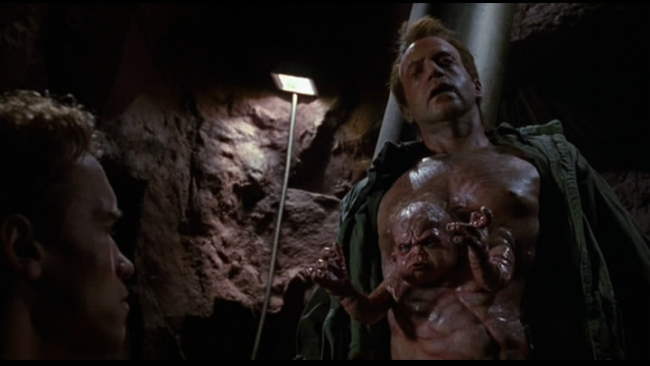
And of course, the special effects and sets were all very well done. Sure, there are plenty of people who would say that they looked cheesy, especially the animatronic heads that were used for the asphyxiation, robotic head, and bug-removing scenes, but they were pretty state of the art for the time. The mutants were also very well done, molded plastic imitating the effects of radiation quite well. And the animatronic limb that Benny showed and Kuato’s body-within-a-body was also pretty convincing! And this was done without the benefit of any CGI.

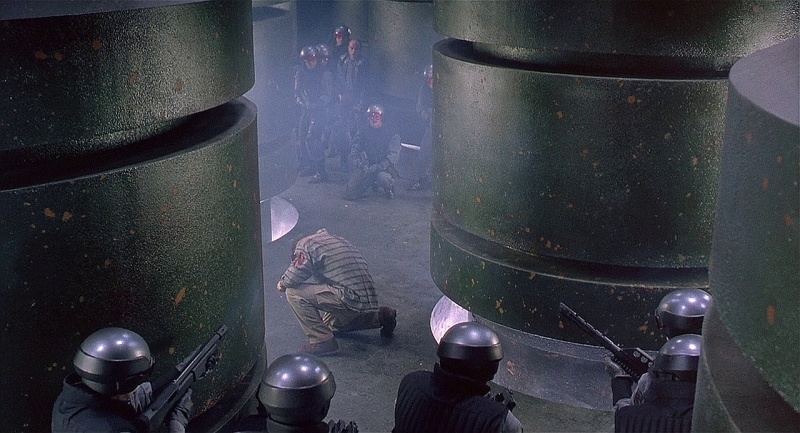
What’s more, it was original, which is a claim the remake can’t possibly make. though I have yet to see the movie, one thing that I hear from just about everyone is how the sets and effects seemed very much borrowed. The robot forces look like Storm Troopers and droids, the flying cars look like something out of Minority Report, and the cityscape seemed ripped from Blade Runner. In the case of the original, there was a latent cyberpunk 80’s feel to much of it, but nothing had been copied or borrowed, much as I can tell.

It was also well cast and ably acted. Cox and Ironside brought their usual awesomeness to their villain characters, Stone was convincing as the assassin/seductress, and the supporting cast was pretty solid. And let’s not forget, it was an Arny movie, which meant that it was automatically fun, cheesy, and full of hilarious one liners and his signatures “Hlalalalalalal!” And seriously, some of the lines he said: “Consider that a divorce”, “You blew my covah!”, and “See ya at the party, Richter!”. They rank right up there with “Get to tha choppa!”

The only real weaknesses were the many cheesy scientific implausibilities. For one, the scene where he removes the bug from his nose was impossible, as it would have broken his nose. Second, there’s no way anyone could create an atmosphere on Mars by simply evaporating water. Sure, it might be a good step in the right direction, but there’s no guarantee it would work, and it would take centuries, not mere seconds. Last, if you were already asphyxiating due to exposure to near-vacuum, you wouldn’t be instantly saved once breathable oxygen started pouring out. But of course, all of this could be dismissed by saying that it was all a dream. Or it can be simply written off as part of the cheese factor.

Overall, I’d say this movie deserves to be placed in the sci-fi classics section, between guilty pleasure movies and the films that actually have something to say and will make you think a little. If you haven’t seen it, then do so! And if you’re planning on seeing the remake, or already have, then get your ass to the video store and ask for Total Recall! And until next time, here’s a three-breasted hooker to keep you company! See ya at the party! Halalalalalalal!

Mars Lander Mission, 2016

With all the news coming back from Curiosity rover since its deployment, one would get the impression that Mars is a pretty happening place. Blue sunsets, wide open vistas, tall mountains and extensive plains. All the while, our collective fascination with the planet has been growing apace. And it seems that this trend is destined to continue…

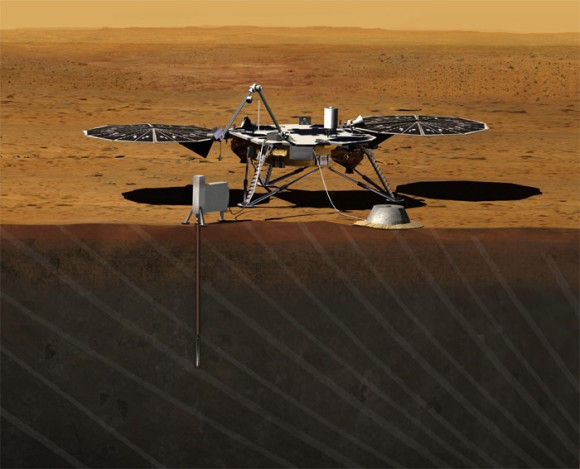
After looking at several low-cost options for their next major mission, NASA scientists decided to once again return to the Red Planet, this time to do some interior planet studies to determine whether Mars has a solid or liquid core, and determine the planet’s basic structure.

Known as the InSight lander, this mission won out over two equally enticing proposals. The first called the for the deployment of the Titan Mare Explorer (TiME), a floating high-tech buoy which would be sent to Saturn’s moon Titan. Once there, it would study the methane lakes of Titan, examining their composition and interaction with the atmosphere. Thanks to the Cassini probe, these lakes have attracted a great deal of interest of late, particularly since they may be able to support life. Understandably, many can’t wait to study them up close and see if this holds true.

The second potential mission called for the deployment of “Chopper”, a proposed Comet Hopper mission that would put a lander on comet 46P/Wirtanen where it would study the comet’s composition. This comet, which was originally discovered in 1948, belongs to the Jupiter family of comets and orbits the Solar System once every 5.4 years. Studying its make-up would go a long way to helping scientists understanding how Solar comets behave and provide clues as to the early formation of our Solar System.

But scratch those! With 2016 on the way, budget limited and Mars the happening place, InSight will be the one to go. What’s more, it’s research is likely to prove very useful in settling some ongoing arguments, not the least of which is whether Mars possesses liquid water beneath its surface. If this should prove true, it might mean terraforming could be a go sometime down the road…

People can dream! And speaking of which, check out the NASA simulation of what InSight will look like once deployed.


Source: Universe Today

Time-Lapse Footage of Curiosity Rover Landing

Amongst the awesome footage which is coming back from Mars, courtesy of the Curiosity Rover, is this lovely compilation. Using the many photos snapped by the rover as it made it’s decent, the enterprising folks over at Spaceflight 101 have created a time-lapse video of what the landing looked like.

Taken by the the Mars Descent Imager (MARDI), the images capture the separation of the heat shield from the rover and then its powered descent. Well worth watching, and stay tuned for more updates from Curiosity as it continues its journey across the Martian Landscape.

The Blue Martian Sunset

Ever since the Curiosity rover landed, NASA had been awash with new photos of the Martian landscape. Naturally, most have been black and white picks of the oxidized soil immediately around the rover’s landing area. But more have been arriving lately that show a feature unique to Mars. That feature is the Blue Sunset.

Scientists working for NASA claim that this phenomena is due to the particulate matter that is present in the Martian atmosphere. This red dust – which is composed of oxidized minerals, mainly iron – is what gives Mars its distinct color, but also provides for a fractal effect which shifts light towards the blue end of the spectrum. The same basic principle is true for sunsets seen from Earth, where our oxygen and nitrogen and ozone atmosphere causes the light to shift to the red end of the spectrum.

These patterns of Red Shift and Blue Shift are actually a very common element when it comes to astronomy. When observing galaxies in the night sky, scientists are able to tell that they are moving away because the light that they emit, and which is intercepted by our telescopes is shifted to the red end of the spectrum. Based on how much shift is occurring, scientists are bale to measure just how fast they are moving, relative to us.

When it comes time to hurl some objects into space ourselves, such as interstellar space craft, we can expect to see some of this close up. Out there, relativistic effects caused by high speeds will make the stars ahead of the ship look reddish, while stars seen to the rear will appear blue. Cool how that works huh?

To illustrate this Blue Sunset, NASA has released a compilation, time-elapse video which was taken two years ago by the Exploration Rover. It shows the sun setting in full, all the while emitting that cool, blue glow. Enjoy and stay tuned for more news on the Martian front!

Curiosity Has Landed!

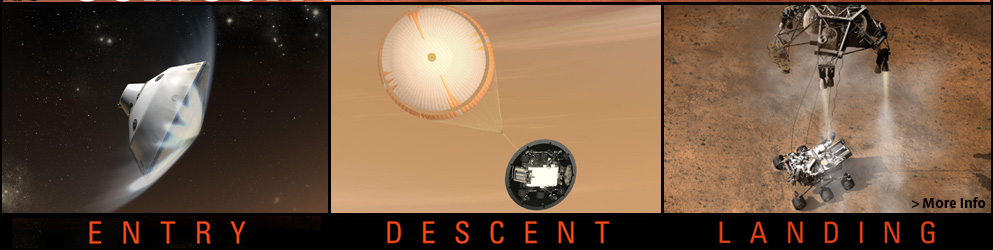
Yesterday, at precisely 10:23 pm Greenwich Mean Time, NASA announced the successful landing of the Mars Curiosity Rover! After blazing through Mars’ atmosphere at over 21,000 km/h, Curiosity’s unique landing system deployed and brought the rover in for a nice, controlled landing.

Needless to say, pandemonium ensued at NASA’s Jet Propulsion Lab, where the landing was being monitored. All those on hand began jumping, hooting, hollering and hugging each other, much as they used to do whenever a successful launch was made or men touched down on the moon. Times may have changed, but the basic goal remains the same: to conquer the unknown and take the next big leap. And when that happens, you can expect the people who work so hard to make that happen to get a little giddy 😉

In addition, the HiRISE team (High Resolution Imaging Science Experiment), caught this beautiful and perfectly-timed photo from the Mars Reconnaissance Orbiter (MRO). The photo shows Curiosity at left deploying its chute and descending to the surface.

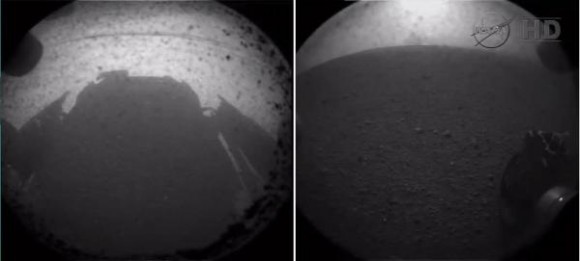
Immediately after touching down, Curiosity began sending photos back to NASA of Mars surface. The first two were of its landing zone in Mars’ Gale Crater, shown here:

To mark this momentous occasion, President Obama had this statement to make:

“Tonight, on the planet Mars, the United States of America made history.

The successful landing of Curiosity – the most sophisticated roving laboratory ever to land on another planet – marks an unprecedented feat of technology that will stand as a point of national pride far into the future. It proves that even the longest of odds are no match for our unique blend of ingenuity and determination.

Tonight’s success, delivered by NASA, parallels our major steps forward towards a vision for a new partnership with American companies to send American astronauts into space on American spacecraft. That partnership will save taxpayer dollars while allowing NASA to do what it has always done best – push the very boundaries of human knowledge. And tonight’s success reminds us that our preeminence – not just in space, but here on Earth – depends on continuing to invest wisely in the innovation, technology, and basic research that has always made our economy the envy of the world.

I congratulate and thank all the men and women of NASA who made this remarkable accomplishment a reality – and I eagerly await what Curiosity has yet to discover.”

Yes, this is certainly is history in the making. Needless to say, Curiosity is expected send back some interesting finds as it wanders the Martian surface, takes soil samples, and scans them to determine what secrets and mysteries the surface holds. In time, all this information could become intrinsic to settlement and terraforming, the creation of human civilization on a planet other than Earth! Exciting times we live in!

In the meantime, check out this compilation video of the landing paired with footage take from NASA’s Jet Propulsion Lab:

Via: Universe Today

Terraforming in Pop Culture

Welcome back to the wonderful world (pun!) of Terraforming. In my last post on the subject, I came to see that it emerged in fiction in the early 20th century as part of our growing awareness of the universe and humanity’s place within it. As western civilization grew and came to encompass the entire world through exploration, conquest and colonization, human scientists simultaneously discovered that our universe was much larger than previously thought, and began to postulate that life could exist on other planets.

In short, while our world grew smaller, the universe grew much, much larger. With no more nooks  or corners left to explore and conquer, we began to set our sights to the heavens for the next frontier. It’s such a fertile topic, but I shan’t get into it here. If I start waxing philosophical on all the thought that goes into exploring new worlds, we’ll be here forever.

Onto to the subject for today, which is terraforming in popular culture! As you can guess, there are quite a few instances of this taking place, and for good reason. Wherever science fiction and exoplanets have shown up in pop-culture, the concept terraforming was sure to follow. In some cases, this constituted a mere mention, but in others, detailed descriptions were given. Here is a list of just a few examples that I could find:

Aliens:
Central to the plot of Aliens was the fact that LV-426, the planet where the Nostromo and its crew encountered the Xenomorph in the first movie, had become a settler colony. As the executive at Weyland Yutani told Ripley, it was what they referred to as a “Shake and Bake Colony”, where terraformers were sent on ahead to run the atmospheric processors and make the planet suitable for human use. This was all in keeping with WY’s motto of “Building Better Worlds”. Pshaw!

Shortly after they arrive on LV-426, Ripley and the compliment of Colonial Marines determined that the colonists had been moved into the atmospheric processor, specifically to its lower levels where the air was hot and humid. Apparently, these conditions were favorable to the Xenomorph hatchlings, which began to use the colonists as hosts to breed”Chestbusters”.

After their disastrous confrontation in the hive, the atmospheric processor suffered a rupture to its coolant systems, which meant that the entire thing would go thermonuclear in just a few hours. After being all but eradicated in their first encounter with the Xenomorph and losing their only transport back to the ship, this served to add further urgency to the plot. And in the end, it was the destruction of the atmospheric processor which ensured that the Xenomorph colony was destroyed and all traces of them (with the exception of the Queen) wiped out.

Cowboy Bebop:
Set in the not-too-distant future, this anime from from the late nineties was set in a universe where humanity lived throughout the Solar System. This was made possible due to the discovery of hyperspace gates; however, due to the explosion of one near the Moon, Earth found itself being bombarded by meteorites which devastated large sections of the planet. As a result, much of the human race had to relocate to the Inner Planets, the Asteroid Belt, and the moons of Jupiter.

Many episodes of the show take place on the planets of Venus, Mars, Ganymede, Io, Callisto, and Titan, where terraforming has rendered them partially of fully habitable. Though the concept is treated as a sort of given, some degree of explanation is given as to how it took place and the varying degrees of success that resulted. In the case of Mars and Venus, the terraforming was so successful that Mars became the new hub of human civilization and Venus a major population center.

With this background firmly in place, the series plot arc – which involves a motley group of bounty hunters patrolling the system Space Western style – is then able to unfold. Though the show last only 26 episodes, it did achieve a cult following and a level of influence, similar to Joss Wedon’s Firefly (another Space Western that died prematurely).

Firefly:
Speak of the devil, or in this case, a show that made good use of the concept of terraforming. Intrinsic to the plot of this show, so much so that they opened every episode by referring to it, is the fact that in this future, the human race was forced to relocate to a new star system after Earth had been “used up”. Arriving at the “White Star”, they found dozens of planets and hundreds of moons around the system’s central sun and its many dwarf suns. These planets were then terraformed, a process which took generations, and began populated them soon after.

Another fact which is central to the story is the fact that while the central worlds were terraformed successfully and boasted large, advanced populations, the outer planets were poorly terraformed, leading to dry, desolate worlds that became havens for crime and backwards populations. Though life was show to be difficult in these colonies, they were also the only places where people can still enjoy a life free of the repressive Alliance regime.

But more importantly, this back story gave Joss Whedon an excuse for the look and feel of his acclaimed Space Western! It also played perfectly into the show’s historical narrative, where the expanding Alliance represented the closing of the American frontier and the death of a way of life. For not only were the First Nations and their culture being sacrificed in the name of “Manifest Destiny”, a great deal of the American Dream of an open frontier was as well.

Red Planet:
Set in 2056 AD, the plot of this film centers around ongoing terraforming efforts on Mars. Faced with the dual problems of overpopulation and pollution, NASA and other space agencies begin sending automated probes to Mars that contain atmosphere-producing algae. These probes have been seeding Mars for twenty years as the first stage in a terraforming effort that will make the planet suitable for human settlement. When the oxygen production is inexplicably reduced, a crew is sent to investigate so that the  terraforming efforts can be put back on track.

When the mission arrives, and endures numerous disasters,they eventually discover that the introduction of Earth algae has stirred up the native Martian life. This consists of nematodes that have come to the surface to feed on the algae, emitting oxygen in return. This, they realize, has changed the parameters of the original project, but leaving it otherwise intact.

Star Trek II and III:
What is generally hailed by fans as the best movie of the franchise (Wrath of Khan) opens up with a rather unusual take on terraforming. In fact, the plot of both the second and third movie revolve around a project known as Genesis, a means of instantaneously transforming a planet from a lifeless husk into a habitable M-class planet.

In Wrath of Khan, things begin when the starship Reliant, while searching for a lifeless planet in the Ceti Alpha system, is taken over by Khan Noonien Soong and his band of genetically-modified people. Having learned of their mission, Khan becomes obsessed with finding the Genesis device so that he can restore the desolate landscape of Ceti Alpha V, presumably with the intention of resurrecting his dead wife.

In the end, Kirk and the Enterprise disable his ship inside a nebula, prompting Khan to set the Genesis device to self-destruct in the hopes of taking Kirk with him. With their warp drive non-functional, the Enterprise could not escape, prompting Spock to sacrifice himself in order to bring the engines back online. Though he dies from radiation poisoning, the ENterprise escapes as the Genesis device detonates, which has the effect of turning the nebula itself into an M-Class planet.

At the very end of the movie, Spock’s body is placed inside a torpedo casing and fired into orbit around Genesis. After landing on the surface, the “Genesis wave” heals Spock’s body and he is reborn. This, as all fans of the franchise know, was the basis for the third movie where Kirk and the Enterprise come back to Genesis to retrieve him. In the course of doing so, the Genesis plant is examined in more detail and the effects of the project. Ultimately, though the device was capable of creating life out of lifeless, it proved unstable and resulted in the total collapse of the planet created.

Total Recall:
The film adaptation of Philip K Dick’s “We can Remember it for You Wholesale” differed from the source material in many key ways. For example, in addition to the central theme of memory and the dividing line between real and artificial, there was also an extensive backstory involving Mars. Ultimately, the character of Quad (played by Arnold Schwarzenegger) learns that he is drawn to Mars because that is where he is from, and his false identity implanted because of something he witnessed there.

In the end, it is revealed that this secret has to do with an ancient alien device that lies at the heart of the planet, a device which has the power to terraform Mars into a habitable world. Apparently, this involved some super-heated coils that, when activated, would plunge into the planet’s watery core, evaporating them and filling Mars’ atmosphere with water vapor. When Quad activated the device, it had the effect of creating breathable atmosphere within a matter of minutes.

Not the most realistic depiction of terraforming, but it did have it’s upsides. For one, it took advantage of contemporary scientific theories that stated that Mars might have underground sources of water and ice. Second, it incorporated speculation of how these could be used to eventually create oxygen-creating plants on the surface and hence, an atmosphere. Last, it worked into the plot in that the villain, Coohagen, knew that if Mars had a natural atmosphere, it would destroy the basis of his power (controlling the air supply).

Of Terraforming

Several scientific subjects have piqued my interest as of late, particularly the ones that relate to the colonization of other planets. And there are plenty of good reasons for this. First off, NASA has been talking at length about a possible Mars mission which will be begin in 2030. Second, the topic is central to the novel my group and I are writing. And third, because it’s what I do. I’m a geek, dammit! Do I really need any other reason?

So in honor of this fertile and increasingly relevant topic, I thought I’d dedicate a post to the science of terraforming and its depiction in popular culture. Like the majority of your more radical ideas, the concept first appeared around the turn of the 20th century. As part of the larger trend of exploring planetary colonization, several historical developments contributed to this phenomena.

Foremost amongst them was the closure of the American frontier by 1900 and the partitioning of Africa in 1905. With the “Age of Discovery” officially over, scientists and dreamers began to look farther abroad for the next place to move to. Refinements in the fields of metallurgy, chemistry, and astronomy also contributed to the idea that planets like the Moon, Mars, Venus, Europa, Ganymede, and even other star systems, could be colonized.

And thanks to the advent of the Space Race, the Apollo missions, and Eco-engineering in the latter half of the 20th century, scientists have begun to take a serious look at terraforming, particularly in regards to Mars. While the practicality, feasibility and affordability are all still being debated, the very fact that there is a serious scientific debate would seem to indicate that it may very well be done someday.

And so, here is a list of science fiction novels from the last century that have explored the idea of terraforming. Once again, I hope you enjoy reading about them as much as I enjoyed researching them, and incorporating some of what they taught me!

Last and First Men:
This future history by Olaf Stapledon, released in 1930, is the first time that the terraforming of Venus is made in fiction. This was only a fragment of the larger story, which focuses on human evolution over the course of two billions years. Nevertheless, the move to Venus is an intrinsic part of the story involving the “Fifth Men”, who are forced to relocate after Earth becoming uninhabitable.

This occurs only after humanity pushes the local inhabitants to extinction after a protracted war. Afterward, they begin the process of transforming Venus to meet their needs. Like all early accounts, the description was hampered by the fact that knowledge of Venus was highly inaccurate. For example, Stapledon’s account has Venus covered in oceans, rather than the pits of sulfuric acid which are now known to be there.

Farmer in the Sky:
Here we have Robert A. Heinlein’s 1950 story which focuses on a family which has moved to Ganymede, which is in the process of being terraformed. Earth is overcrowded in this day and age, and farming colonies are being established in Jupiter’s moon to help provide much needed food supplies.

The process of creating the new farms is explained in some detail. For example, the topsoil is created from scratch by pulverizing boulders and lava flows, and seeding the resulting dust with carefully formulated organic material. Pressurized housing is erected to ensure that new arrivals are able to adjust, since the atmosphere is not fully breathable. And Ganymede is shielded from Jupiter’s intense radiation by a massive heat shield.

Hints are even given that establish that Ganymede once boasted an indigenous civilization, or was at least visited by one in the past. This includes a working land vehicle that has many legs, essentially a large metal centipede.

The Sands of Mars:
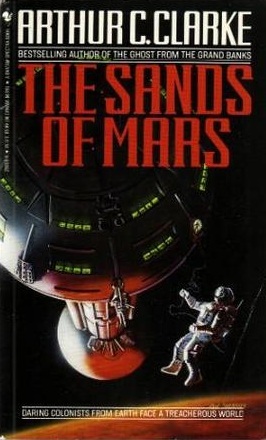
Next we have Arthur C. Clarke’s 1951 novel, which happened to be his first published work. And curiously enough, it is written from the point of view of a famous science fiction author. A case of art imitating life, or art as wish fulfillment? In any case, the setting is a research facility on Mars, which is in the process of terraforming so it will be able to become a self-sufficient colony.

Based on Clarke’s descriptions, this terraforming process (known as “Project Dawn”) involves some rather curious steps. The first is the ignition of the moon Phobos so that it will become a second “sun” for Mars. It will burn for at least one thousand years and the extra heat, combined with the mass production of the oxygen-generating plants, will eventually make the Martian atmosphere breathable for humans.

In many respects, this served as a preview for the plot of 2001: A Space Odyssey and it’s sequel 2010: Odyssey Two (see below).

The Martian Way:
In keeping with the tradition of sci-fi greats, this next novel was written by Isaac Asimov and first published in 1952. The story is told from the point of view of Scavengers, Mars-born humans who spend their time scouring space for the spent lower stages of spacecraft. This sort of lifestyle, making do with less and toughing things out, is known as the “Martian Way”.

At this point, Mars is still very much dependent on Earth for water shipments, which are used for fuel as well as consumption. Life takes a turn for a worse when an ambitious Earth politician decides to cut of the “Wasters”. In response, the protagonists come up with an ambitious plan, to fly to Saturn’s Rings and tow back an asteroid made of pure ice.

The trip is difficult and takes many months, but the Martian Scavengers manage to snag an asteroid that will supply two hundred years worth of water. This, they begin to use to transform the ecology of Mars, and turn the tables on the Earth government.

The Psychotechnic League:
Written by Poul Anderson over the course of two decades, the Psychotechnic League refers to a series of novels and short stories that are set in the same universe. Of all these stories, two in particular deal with the terraforming of Solar Planets. In “The Big Rain”, Venus is being terraformed, a process of planetary engineering that takes several centuries to complete.

In “The Snows of Ganymede”, the focus shifts to the Jovian moon where scientists are able convert the planet to the point where it experiences seasons similar to Earth. This, in addition to Mars, Venus and several other Solar Planets, all come together in time to form the Solar Union. Because of Anderson’s realistic description, the term “big rain” became associated with scientific terraforming models.

The Space Odyssey Series:
Arthur C. Clarke’s series, which began with the novelization of the classic film 2001: A Space Odyssey, revolves around the terraforming of Europa by a super advanced race. Known as the Firstborn, these aliens use the Monoliths to travel throughout the universe to foster the development of sentient life. Millions of years after fostering the development of high-order primates on Earth, they shifted their focus to Europa, Jupiter’s ice moon.

Much as in “Sands of Mars”, the process involved the creation of a “second sun”, this time involving Jupiter. In the first novel, the story ends with David Bowman, the only astronaut to survive an exploratory mission to Jupiter after their ships AI (the HAL 9000) malfunction and kills the crew.
When he arrives, he discovers a Monolith in orbit around Europa and disappears without a trace shortly thereafter.

In 2010: Odyssey Two, a second mission is mounted to determine the whereabouts of the first. When the joint US-Soviet mission arrives at Europa, they come to realize that the planet is showing signs of life. They also learn that the Monoliths are in the process of turning Jupiter into a sun so that Europa’s icy surface will evaporate and form an atmosphere, allowing all the life contained underneath to emerge and grow.

In the subsequent novels, Europa is revisited after its transformation is complete. Although sentient life does not appear to be possible, the planet does boast an atmosphere and vast oceans, which teem with sluggish sulfur-based lifeforms. In the end, after the Monoliths are convinced that humanity deserves a reprieve, and they land on Europe to commence building peaceful relations with the Europan life forms.

Mars Trilogy:
We finish with the most recent and profound example of all, the Mars Trilogy by Kim Stanley Robertason. The trilogy’s three works – Red Mars, Green Mars, Blue Mars – all focus on the ongoing efforts to transform Mars from an arid, hostile world with barely any atmosphere to a lush, hospitable planet capable of supporting human life.

The first novel deals with the initial colonization effort, which begins with the crew of the Ares, a ship carrying 100 scientists drawn predominantly from the US and the Soviet Union. Upon arriving, the crew builds the first settlement, known as Underhill, as well as colonies on the hollowed out asteroid-moon of Phobos.

After debating what is to be done with Mars, whether to turn it “Green” or leave it “Red”, the United Nations Organization Mars Authority (UNOMA) eventually opts for the “Green” option and terraforming begins. This process involves the drilling of “moholes” in the surface to release subsurface heat to thicken the atmosphere and the detonation of nuclear devices deep in the sub-surface permafrost to release water.

Green Mars, which begins 50 years after events in the first novel, during the dawn of the 22nd century. At this point in time, the Martian landscape is evolving thanks to the expansion of plant life, hence the name. The process is stimulated though the use of continent-sized orbital mirrors which focus sunlight to and away from various sectors of the planet, to melting the northern polar ice cap, and digging moholes deep enough to form volcanoes.

In the third and final installment, Blue Mars, long-term terraforming has created atmospheric pressure and temperature conditions that allow for the presence of liquid water on the planet’s surface, forming rivers and seas. This all takes place over the course of the following century, long after Earth has flooded and revolutions have displaced corporate control of the planet. Because of this, Mars has become the principle planet of the Solar System.

Summary:
Terraforming efforts have come a long way in fiction, and hopefully some day soon they will be realizable. Even though the concept remains highly speculative at this point, all proposed efforts are currently focused on Mars. In all ways that count, Mars has everything we would need to make it suitable for human habitation. This includes water, in the presence of the frozen ice caps and possibly underground rivers, and high concentrations of carbon and oxygen in the form of CO2, nitrogen, and gravity to keep the atmosphere anchored.

And most importantly of all, Mars’ atmosphere closely resembles that of Earth several billions of years ago. In time, due to the development of photosynthetic bacteria, enough oxygen was produced to allow for the development of animals. Though the careful introduction of similar bacteria and plants to Mars surface, humans could speed that process along and eventually create a breathable atmosphere. This, in turn, will allow for the creation of an ozone layer and weather patterns. Combined with the melting of the polar ice and underground aquifers, this will lead to surface water in the form of rivers, streams and oceans.

B5, Season 3 Best Episodes

Season Three was named “Point of No Return” for good reason. It was the season where everything hit the fan and there was no going back.  The Shadow War began, B5 broke away from the Earth Alliance, the temporal plot and purpose of the Great Machine was fulfilled, and Sheridan finally went to Z’ha’dum. So of course, there were plenty of big, great and significant episodes. Here are the one’s I liked best and why.

1. Matter of Honor:
A representative from Earth Force Special Intelligence (David Endawi) comes to B5 to investigate the matter of the Shadow vessel. After talking with all the ambassadors, he learns a few disturbing facts. G’Kar relates what he has learned from the book of G’Quan and his own investigations out on the rim. Londo relates a nightmare he has where he can see countless Shadow vessels passing overhead while he is standing on Centauri Prime. And Delenn claims she knows nothing about it. Naturally, she is lying…

Londo meets with Morden and tells him he wants to end their relationship. Morden reluctantly agrees, but first, they must divvy up the assets. He agrees to let the Centauri hold a quarter of the Galaxy, in return, they will get the rest and the two sides will go their separate ways. As an addendum, he asks that Londo let them take one world in between, a world which he has already asked Lord Refa to blockade for them. Londo is startled to know that Morden is in contact with someone else in the royal court.

At about the same time, another visitor comes to B5, a Ranger named Marcus Cole. After escaping from a world on the border of Centauri space, he comes to B5 to ask for their help in liberating the colony. For years, the Rangers have been using it as a training base and now it seems that the Centauri are moving in and blockading it. Sheridan is shown the White Star, a prototype Mimbari-Vorlon creation that will be the mainstay of the alliance in the coming war. They fly to the planet, just as a Shadow vessel appears and engages them. They narrowly defeat it by luring it into a jump gate and opening a seperate jump point inside it, which creates a massive explosion that kills the pursuing ship.

Endawi returns home and tells Earth Force Intelligence that he was unable to learn anything of value. We then see the head of Intelligence meeting with Morden and a representative of the Psi Corps. Morden is pleased that nothing was turned up, but is told by the Psi Corps representative that fears of nebulous alien threat that this sighting has caused could prove useful to their agenda…

Significance:
This episode introduces Marcus Cole and the Rangers, who’s existence has been mentioned before but will now be of extreme importance. Started by Sinclair on Mimbar and made up of largely human volunteers, these are to be the foot soldiers in the coming Shadow War. The White Star, which is also introduced in this episode, is to be the mainstay of their fleet.

After growing uneasy about his alliance with Morden and his “associates”, Londo has finally broken it off, only to learn that Lord Refa is attempting to forge one of his own. In time, this will pit Londo and Refa against each other, and give Londo a chance to redeem his mistakes. Finally, we learn that Morden and the Shadows have made friends back at Earth, and may have had a hand in assassinating Santiago and installing Clark. Already we have learned that the point of their alliances is to sow chaos and discord before they attack. Clearly, backing Clark’s conspiracy is part of that plan.

Memorable Lines:
Sheridan: You’ve been back and forth to your homeworld so many times since you got here, how do I know you’re the same Vorlon? Inside that Encounter Suit you could be anyone.
Kosh: I have always been here.
Sheridan: Oh yeah? You said that about me too.
Kosh: Yes.
Sheridan: I really hate it when you do that.
Kosh: Good.

Londo: My people have a manifest destiny. They can achieve it just as well without the help of your associates, perhaps better.
Morden: So we’re no longer necessary?
Londo: That’s right.
Morden: And now that we’ve done everything you’ve asked, you’d like us to just.. disappear.
Londo: I do believe you have got it surrounded, Mr. Morden!
Morden: Aren’t you being premature? After all, you’re people are moving on several other worlds. You might still need us.
Londo: No, I don’t think so. We have danced our last little dance Mr. Morden. Now it is time for you… to go away.

Sheridan: (looking at the footage of a Shadow vessel) A few months ago, you told me about an ancient race, the Shadows. This is one of theirs, isn’t it?
Delenn: These ships, once they target you they never stop, never slow down, never give up until they’ve destroyed you… and nearly invincible.
Sheridan: I don’t believe that. Every ship has a weakness.
Delenn: Believe what you will, til experience changes your mind. Take a good look, John, and remember it well. That is the face of our enemy.

Garibaldi: I’m not authorized for that kind of information.
Endawi: But… you’re the head of Security.
Garibaldi: And what kind of head of Security would I be if I let people like me know things that I’m not supposed to know? I mean, I know what I know because I have to know it, and if I don’t have to know it, I don’t tell me, and I don’t let anyone else tell me, either. Now look, we’ve tried most of the other ambassadors. Why don’t you speak to G’Kar? Maybe he knows something about this ship.
Endawi: Under the terms of our recent treaty, I am not authorized to have any official conversation with the Narn without Centauri approval.
Garibaldi: So you’ll ask unofficially. And I can give you reasonable assurances that the head of Security will not report you for doing so.
Endawi: Because you won’t tell yourself about it.
Garibaldi: I try never to get involved in my own life. Too much trouble.

Delenn: We must find help. We cannot hope to destroy a ship like that alone.
Sheridan: With all due respect, Ambassador, I’ve heard that before.

Ivanova: Captain, the day something happens around here and I don’t know about it, worry
Sheridan: Tell me, Commander…have you ever wondered what would happen if you opened a jump point while inside a jump gate?
Ivanova: No! And neither should you! EarthForce experimented with the idea during the Minbari War. They called it the Bonehead Maneuver. (to Lennier) No offense.
Lennier: None taken.

Morden: Your government can dismiss this as an isolated incident.
Psi Cop: I don’t know. There’s something about this idea of a threat to planetary security I find very appealing. As long as we keep the real truth to ourselves, there’s no reason we can’t use this situation to speed up the program here at home.

2. Voices of Authority:
B5 is assigned a political officer from the Ministry of Peace, a woman named Musante who’s purpose is to expand the power of the Nightwatch. In addition to following Sheridan around (and trying to seduce him), she openly tells Zack and the other members of Nightwatch that their mandate has expanded to stamp out all indications of treason and ideological impurity. Sheridan has to stay on his toes in order to keep the “conspiracy of light” a secret in her presence.

Otherwise occupied with her, he sends Ivanova to meet with Draal on Epsilon 3 so they can begin using the Great Machine to locate the First Ones. She finds the home of The Walkers, the ancient race that’s been spotted around Sigma 957, but also alerts the Shadows to her presence. She narrowly escapes before they are able to take her over. Then, she is given a vision of Earth Force One as it exploded, and sees a private communique between Morden and Clark where they discuss Santiago’s assassination. After months of quietly waiting, they have the proof they need to expose him!

Ivanova and Marcus travel to Sigma 957 and meet with a Walker ship. After some deliberation, Ivanova is able to get them to agree to join their war effort against the Shadows. When they return, the information she uncovered with Draal’s help has been released, Mustante is recalled to Earth so that MiniPax can investigate the allegations and “punish” whoever’s responsible.

Significance:
This episode picks up where season two left off where Draal tells Sheridan that he wants to join their alliance and will place the Great Machine at their disposal. In using it, Ivanova is able to find one of the elusive First Ones, first shown in season one, and uncover evidence of the conspiracy back home. In so doing, she also demonstrated that she has latent telepathic abilities, for as Draal says, no ordinary human could do what she did. Marcus and Ivanova also secure the cooperation of The Walkers, and learn that they are not on good terms with the Vorlons.

This episode also establishes that the Ministry of Peace, after slowly expanding its mandate on B5, is now mounting an all out offensive against dissenters and those who oppose Clark’s government. Now that evidence has been released that implicates them in Santiago’s death, things are likely to escalate.

Memorable Lines:
Draal: Good afternoon, everyone! Captain, Delenn tells me that you’re going to try contacting the First Ones. It is a magnificent idea—a daring and splendid idea! In doing so, you will see things no human has ever seen before! It will be…fun! Assuming you’re not vaporized, dissected, or otherwise killed in an assortment of supremely horrible and painful ways! Exciting, isn’t it?

Draal: I asked for Captain Sheridan!
Ivanova: Um… He’s busy.
Draal: I don’t like surprises!
Ivanova: Really? Love ’em, myself. To me, everything’s a surprise! You’re a surprise. This place is a surprise. You see this? [She holds up a finger.] Paper cut. Hurts like hell! Anybody else would be upset, but to me, it’s just one more wonderful surprise! I mean, I even surprise myself sometimes! So I guess there’s nothing wrong with me surprising you. Right?
Draal: (laughs) I like you! You’re trouble!
Ivanova: Well, thank you! That’s the nicest thing anybody’s said about me in days!

Sheridan: And, uh when exactly did all this happen?
Musante: When we rewrote the dictionary.

Ivanova: Good luck, Captain. I think you’re about to go where…everyone has gone before

Marcus: I think you just hit a nerve. The Vorlons must owe them money or something.
Ivanova: At least it tells us that they understand our language. They’re just not willing to speakto us in it.
Marcus: Who knew they were French? Sorry.

Walkers: ZOG!
Ivanova: “Zog”? What do you mean, zog? Zog what? Zog yes, zog no?
Marcus: It’s leaving. My guess is “zog” means “no”.
Ivanova: Like hell. I am not letting them leave here without saying yes.
Marcus: Really? And how do you propose stopping them? Perhaps a big red and white sign with the word “stop” on it? I’ll put a bucket on my head and pretend to be the ancient Vorlon god Boogee.
Ivanova: That’s it!
Marcus: Fine. I’ll get a bucket.

3. Messages from Earth:
Marcus escorts a former member of IPX, a woman named Dr. Mary Kirkish, to meet with the command staff of B5. She has some terrible news for them: it seems that Earth has known about the Shadows for quite some time, and has even been experimenting on their ships. The last time was on Mars after they uncovered one that was buried there, which  witnessed personally. Now they are planning on doing it again, this time on Ganymede with another buried ship. This time, they plan to merge a human pilot with it and control it. Garibaldi claims he surveyed the site years back and found a Psi Corps badge that was left there. Sheridan agrees to take the White Star and head to Ganymede to destroy it.

In his absence, the Nightwatch grows wary of his whereabouts. They have been ordered by their new head to be on the lookout for suspicious activity.Meanwhile, Garibaldi visits G’Kar in his cell, where he’s serving his sentence for assaulting Londo, and finds he’s writing a book about his experiences. On their way to Earth, Delenn and Sheridan spend an evening together and share precious memories. When they arrive at Earth, they find that the Shadow vessel has already been activated and begins destroying the facility.

Unable to match the vessels firepower, they manage to destroy it by luring it into Jupiter’s atmosphere then pulling a hasty escape maneuver. The Shadow vessel is unable to follow them out and is crushed by Jupiter’s intense gravity well. However, before they can exit the atmosphere, Sheridan’s old ship, the Agamemnon, shows up and attempts to board them. Sheridan and crew manage to narrowly escape by opening a jump point in the upper atmosphere, which ignites the hydrogen and covers their escape. Back at home, ISN says that Earth gov claims the facility was attacked by an unknown ship and uses this as a pretext to declare martial law.

Significance:
The link between the Psi Corps and the Shadows is revealed, as are Earth’s experiments with Shadow technology. The Nightwatch, having grown suspicious of Sheridan’s activities, are now planning to move on him. G’Kar’s book, which he has begun writing in this episode, will prove of great significance in later episodes. Clark’s government, which has been planning on using the “alien threat” to justify its repression, has decided to use Sheridan’s intervention as a pretext to declare martial law. Delenn and Sheridan’s relationship is also developing and becoming romantic.

Memorable Lines:
Garibaldi: But where in my contract does it say that I have to eat the same food for breakfast every day for three years?
Sheridan: Paragraph 47, Subsection 19, Clause 9A. You can find it in the index under S.U.A.E.I.
Garibaldi: S.U.A.E.I.?
Sheridan/Ivanova: Shut Up And Eat It.

Marcus Cole: And they have much to be concerned about. There’s always the threat of an attack by, say, a giant space dragon – the kind that eats the sun every 30 days? It’s a nuisance, but what can you expect from reptiles? Did I mention that my nose is on fire, and that I have 15 wild badgers living in my trousers?… I’m sorry. Would you prefer ferrets?

Sheridan: Full power! Give me everything you’ve got!
Lennier: If I were holding anything back, I would tell you.

4. Point of No Return:
The declaration of martial law has caused a great stir aboard B5. At home, Clark has apparently dissolved the Senate and ordered that all commanders who do not comply with the order are to be arrested. Sheridan contacts General Hague, but is told by one of his officers that he has gone to ground and that the Army is attacking the Senate building. Londo recieves a guest aboard the station, lady Lady Morella, a psychic who was also the wife of the late Emperor Turhan. He has asked her to visit so that she might give him a vision, in the hopes that he can avert the future he has foreseen for himself. Naturally, the declaration of martial law is a major inconvenience!

Shortly thereafter, Hague’s ship gets into a firefight with ships loyal to Clark and narrowly escapes. Sheridan is forced to issue the declaration of martial law and a riot ensues. He is told by Franklin to hang on, that things will get better, but Clark’s loyalists begin bombing Mars and Proxima shortly thereafter. G’Kar is released from prison early due to a shortage of staff, and he tells Garibaldi he might be in a position to help him and the command staff. Nightwatch is ordered to take over security and Garibaldi openly declares his resistance to it. Sheridan contacts General Smits to get advice on how to deal with the situation, and Smits tells him in a covert and roundabout way how to beat it.

Shortly thereafter, Zacks helps them by telling the Nightwatch that Sheridan is conspiring against them and lures them into an airlock where they are sealed in. Sheridan tells them their orders are not legal and places them under arrest. They are shipped out shortly thereafter and replaced by Narns loyal to G’Kar. They have managed to avert this crisis and buy some time, but also know that very soon, Clark’s forces will be coming for them.

Significance:
Sheridan and his staff have taken a stand against Clark and the Nightwatch, which at this point puts them directly in the path of fire. They know now that they might openly rebel if their “conspiracy of light” against the Shadows is to survive. Londo is told definitively that he will be Emperor someday, which he fears because he’s foreseen how it will lead to his death.  He is also told that he has one final chance to break from the path that he is on, and gives several clues as to what will be coming in later episodes. “The eye that does not see” is G’Kar, who he is told he must not kill. “The one that is already dead” is Sheridan, whom he must save along with Delen. And how he must “surrender to (his) greatest fear” alludes to letting G’Kar kill him, as he has foreseen numerous times and allow Vir to take his place.

Memorable Lines:
Vir: I thought the purpose of filing these reports was to provide accurate intelligence!
Londo: Vir, intelligence has nothing to do with politics!

General Smits: Captain. I’m sure you’ve been following the news.
Sheridan: Yes, sir. If I may ask, what’s your opinion?
General Smits: My opinion has nothing to do with this, Captain, and neither does yours! Our job is to follow orders from the Commander in Chief and respect the chain of command! If you have different opinions, I suggest you file them in a deep dark place where nobody’ll ever find them! Am I clear?

G’Kar: You must understand, Ta’Lon. I have had a revelation!
Ta’Lon: What kind of revelation?
G’Kar: A most profound and substantial one, Ta’Lon. The kind of revelation that transforms your mind, your soul, your heart—even your flesh—so that you are a new creature, reborn in the instant of understanding
Ta’Lon: That was a stirring reply, Citizen G’Kar. Unfortunately, while all answers are replies, not all replies are answers. You did not answer the question that I asked. What do you understand now that you did not understand before?

Sheridan:If I were you, I wouldn’t use my weapons on the airlocks. They’re a solid beryllium alloy. The ricochet is a killer.

Morella: You have a chance few others will ever have, Mollari. You still have three opportunities to avoid the fire that waits for you at the end of your journey. You have already wasted two others. You must save the eye that does not see. You must not kill the one who is already dead. And at the last, you must surrender yourself to your greatest fear, knowing that it will destroy you. Now if you have failed all the others, that is your final chance for redemption.
Londo: I…don’t understand!
Morella: The future reveals itself only reluctantly, Ambassador. Take the sign for what it is. Look for it when it appears!
Londo: I will. Thank you!
Morella: One more thing. You will be Emperor. That part of your destiny cannot be avoided.
Londo: I see.
Morella: (to Vir) You will also be Emperor.
(Vir laughs)
Morella: Why are you laughing?
Vir: I… I thought you were joking!
Morella: We do not joke in the face of prophecy, Vir.
Londo: Lady Morella, please! We cannot both be Emperor!
Morella: Correct. One of you will become Emperor after the other is dead. That is all we see and all we wish to see.

5. Severed Dreams:
Hague’s ship, the Alexander, makes to B5 after escaping from Earth and fighting against many of its own fleet. Major Ryan is in charge ever since Hague died in their last firefight. Sheridan orders that communications be cut off so no one will learn that they are harboring rebels, and Ryan tells Sheridan that Clark has begun bombing Mars after it declared its opposition to martial law. Another ship arrives soon after, the Churchill under Captain Hiroshi, that is also on the run. Together, they decide to make a stand against Clark and his forces once they arrive. Sheridan declares to the station that B5 is breaking away from the Earth Alliance and will not submit to President Clark’s forces.

A Ranger comes to the station to see Delenn. After being wounded, he is recovering in medbay and tells her that many other League worlds have begun fighting amongst themselves at the behest of the Shadows, and that the Grey Council intends to do nothing about it. Incensed, Delenn travels to Mimbar to confront the Council, and despite their attempts to block her, is able to come before them. She breaks the Council, as was foretold by one of Valen’s prophecies, and ask the Religious and Worker Castes to join her. They agree and mobilize to follow her.

Back at the station, Clark’s forces arrive and demand Sheridan’s surrender. He refuses, and the firefight begins. B5 and the Alexander are damaged, Hiroshi scuttles her own ship and rams one of the enemy’s Destroyers, and raiding party is beaten by Garibaldi’s security forces and G’Kars Narns. They believe they’ve won by a razor’s edge, only to be confronted by another force of Earth ships. All seems lost, but Delenn and several Mimbari warships jump in and she tells the Earth ships to back off. They do, and Sheridan and his staff are hailed by the station’s people as heroes. The episode ends with a close-up of a Nightwatch wall poster that has been ripped in half.

Significance:
In addition to containing one of the best battle scenes of the series, this episode was pivotal in terms of the overall plot. Sheridan and B5 have officially broken away from Earth and now are free to pursue their war against the Shadows freely. Their conspiracy of light has finally come full circle and become a full-fledged war effort. Delenn has broken the Grey Council in order to mobilize what Mimbari she can to join the war effort and cut out the obstructive Warrior Caste who never believed in the prophecy of the coming Shadows. This is beneficial in the short run, but will have consequences down the road.

Memorable Lines:
Acolyte: I told you, Delenn, they will not speak to you.
Delenn: Then they will listen to me! I served the Council for sixteen cycles. I was the chosen of Dukhat to replace him! I held him when he died! His blood is on my hands, his spirit in my eyes, his word on my lips! You will step aside in his name and mine, or–in Valen’s name—I will tear this ship apart with my bare hands until I find them! Move aside!

Delenn: Three years. For three years, I warned you this day was coming. But you would not listen. “Pride,” you said! “Presumption!” And now the Shadows are on the move. The Centauri and the younger worlds are at war, the Narns have fallen… even the humans are fighting one another. The pride was yours! The presumption was yours! For a thousand years, we have been awaiting the fulfillment of prophecy. And when it finally happens, you scorn it – you reject it – because you no longer believe it yourselves!… “The problems of others are not our concern.” I do not blame you for standing silent in your shame. You, who knew what was coming, but refused to take up the burden of this war! If the Warrior Caste will not fight, then the rest of us will! If the Council has lost its way, if it will not lead… if we have abandoned our covenant with Valen… (Grabs the leader’s staff and breaks it) Then the Council should be broken… as was prophesied! We must stand with the others – now, before it’s too late!

David Sheridan: Son… I follow the news. Well, I did until ISN went black! I see what’s going on. Your mother doesn’t like to think about it. You know how she is. John, I can’t imagine the kind of decisions that are going through your mind right now. I’m sure they’re not easy. The important ones never are. But when push comes to shove, you’ve always done the right thing. What was the first lesson I ever taught you?
John Sheridan: Never start a fight, but always finish it.

Sheridan: May I have your attention, please? In the last few hours, we have learned that warships are coming this way from Earth, their orders are to seize command of Babylon 5 by force. As commanding officer and military governor of Babylon 5, I cannot allow this to happen. President Clark has violated the Earth Alliance Constitution by dissolving the Senate, declaring martial law, and personally ordering the bombing of civilian targets on the Mars colony. He is personally responsible for the deaths of hundreds of innocent people. Following these attacks Orion 7 and Proxima 3 have broken away from the Earth Alliance, and declared independence. Babylon 5 now joins with them. As of this moment, Babylon 5 is seceding from the Earth Alliance. We will remain an independent state until President Clark is removed from office. At the end of this current crisis, anyone who wishes to leave for Earth is free to do so. Meanwhile, for your own safety, I urge everyone to stay in their quarters until this is over. That is all.

Delenn: This is Ambassador Delenn of the Mimbari. Babylon 5 is under our protection. Withdraw… or be destroyed!
Captain Drake: Negative. We have authority here. Do not force us to engage your ship.
Delenn: Why not? Only one human captain has ever survived battle with a Mimbari fleet. He is behind me. You are in front of me. If you value your lives, BE SOMEWHERE ELSE!

6. Interludes and Examinations:
The Shadows have begun openly attacking known space, beginning with the Brakiri. Sheridan tries to mobilize help, but find no other races are willing to get involved. He is told that if he can demonstrate that he has equal power, they will consider joining, otherwise they will keep their heads down and hope the Shadows will pass them over. He meets with Delenn to share his misgivings, and says that if he could give the other races a victory, they might join. She tells him that is what he will need to do, and he will find a way. He reflects that she is beginning to sound like Kosh, and that’s when it hits him!

Londo is expecting Lady Adira, the woman he loves to arrive on the station soon. However, Morden shows up beforehand and confronts him about his intervention in his relationship with Lord Refa. He tells Londo that his race must continue making war on its neighbors. He accuses Morden’s associates of using his people as a distraction so they might carry out their own agenda unnoticed. Morden threatens him, but Londo refuses to back down, telling him there’s nothing he can do to him “that hasn’t already been done.” Rather than kill him, Morden poisons Adira, knowing that Londo will think Refa was responsible. Intent on revenge, he decides to work with Morden again in exchange for his help.

Meanwhile, Franklin’s problems with stims are reaching a tipping point and beginning to effect his work. Garibaldi confronts him about it but is told to mind his own business. He then goes around him to his second and asks for access to Franklin’s medical records to prove he’s addicted. He is about to access the records but then stops, and sees Franklin watching him. He is asked why he didn’t go through with it, and tells Franklin that it doesn’t seem worth it if he can’t convince him as a friend. Franklin tells him he already checked, and that his tests prove he’s addicted. He resigns his post immediately and begins going on walkabout to deal with his issues.

Meanwhile, Sheridan asks Kosh for help but is rebuffed. Kosh tells him its not time for his people to get involved. Desperate and out of patience, Sheridan berates him for the way his race has been on the sidelines and how he’s been manipulating them. Kosh becomes angry and attacks Sheridan using a strange energy wave, but Sheridan refuses to back off. He says he will comply, but that he will not be there when Sheridan goes to Z’ha’dum. Vorlon ships attack and destroy the Shadows, a move which rallies the younger races, but Morden and some of his “associates” come to Kosh’s quarters and kill him. Too late, Sheridan understands what Kosh meant. His ship, with his remains, flies into the sun to die.

Significance:
In this episode, the Shadow war finally begins. After having insurmountable difficulties getting the other races to work together, Sheridan is able to establish a fragile alliance by getting the Vorlons to intervene. Kosh is killed in retaliation, but before he dies, he reaches out to Sheridan in a dream again and tells him he’s sorry he waited so long to get involved. A part of his consciousness breaks off and attaches itself to Sheridan, which will prove significant in later episodes. After waiting for years to see her again, Londo loses Adira and turns to Morden for help. His revenge will lead him into cooperation with G’Kar, who will in turn assist him in saving his world from the Shadows.

Memorable Lines:
Sheridan: Will you (get involved)?
Gaim Ambassador: No… We are not attacked yet… may not be attacked. If we join Brakiri, we are noticed. We invite attack.
Sheridan: They are going to come for you, sooner or later.
Ambassador: You do not know that. What do they do not see, they may not attack. The enemy is powerful. Show us you have equal power, and we will consider. If not, then we will stay quiet. Do you have equal power?

Morden: I thought we had a deal… we carved up the galaxy you and I.
Londo: Yes, we did. And what you do in your half is your business. And what I do in mine is mine.
Morden: We need your government to continue its campaign.
Londo: Yes? And why is that, hmm? I don’t think you have any interest in restoring the glory of the Centauri Republic. No, I think you are using us as… shall we say, agents as chaos? Convenient distraction, making it easier for your associates to do whatever they wish to do, yes?
Morden: My associates need a voice and an ear in the Centauri royal court. If you violate the terms of our agreement, my associates may turn their eye towards your homeworld.
Londo: Then we will pluck it out.
Morden: If you put yourself between us and our objectives, you may come to regret it.
Londo: There is nothing you can do to me, Mr. Morden, that hasn’t already been done… Good day.
Morden: (to Shadow) No… we need him alive for now. There are other ways.

Sheridan: The only way we’re going to survive this war is to organize the League, the Narns and as many other races as possible into a cohesive, offensive force… It’s never been done before, and I can see why. I mean, it’s like stacking marbles in a corner. They are hip deep in their own agendas and their own rivalries. I mean, half of them won’t even talk to the other half! But what’s worse…
Delenn: What?
I feel like I’m lying to them. You’ve seen the reports from the front lines. Yes, I have ideas, some possibilities. But at this moment, the stone cold fact is that none of us can stand up to those ships! If we could just score one victory against the Shadows, it’d be enough to make some of the others come around.
Delenn: Then perhaps we should give them a victory.
Sheridan: Oh, just like that?
Delenn: Just like that.
Sheridan: And how do you suggest we do that?
Delenn: I’m sure you’ll think of something.
Sheridan: Everyday, people around here start talking more and more like Kosh…

Morden: Anything I can do to help?
Vir: Um… Short of dying? No, can’t think of a thing.

Sheridan: For three years now you’ve been pulling everyone’s strings, getting us to do all the work, and you haven’t done a damn thing but stand there and look cryptic! Well, it’s about time you start pulling your own weight around here. […] I hear you’ve got a saying: “Understanding is a three-edged sword”? Well, we’ve got a saying, too: “Put your money where your mouth is”!
Kosh: Impudent.
Sheridan: Yeah? Well, maybe that’s the only way to get through to you. You said you wanted to teach me to fight legends. Well, you’re a legend too, and I am not going away until you agree!
Kosh: Incorrect. Leave. Now.
Sheridan: No.
Kosh: Disobedient!
Sheridan: Up yours! (Kosh hits him with some kind of energy) So, the real Kosh shows his colors at last, huh? You angry now? Angry enough to kill me? Because that’s the only way I’m leaving. Unless your people get off their encounter-suited butts and do something, I’ve got nothing to lose! God, my own government wants to kill me, and if we lose this war, I’m just as dead! Our only chance is to get the other races on board for this fight and right now you’re the key to doing that.
Kosh: It is not yet time.
Sheridan: And who decides that time? You? You put me in this position. You asked me to fight this damn war! Well, it’s about time you let me fight it my way! How many people have already died fighting this war of yours, huh? How many more will die before you come down off that mountain and get involved? Ships, colonies, whole worlds are being destroyed out there, and you do nothing! How many more? How many more, Kosh? How many more dead before you’re satisfied? Huh?
Kosh: I will do as you ask. But there is a price to pay. I will not be there to help you when you go to Z’ha’dum.
Sheridan: All right. If that’s the trade-off. If you want to withhold your help when the time comes, that’s fine. I’ll go it alone.
Kosh: You do not understand. But you will.